Micro-LED Display Market Outlook:
Micro-LED Display Market size was valued at USD 1.1 billion in 2025 and is expected to cross USD 8.6 billion by the end of 2035, expanding at more than 23.3% CAGR during the forecast period i.e., between 2026-2035. In 2026, the industry size of micro-LED display is estimated at USD 1.3 billion.
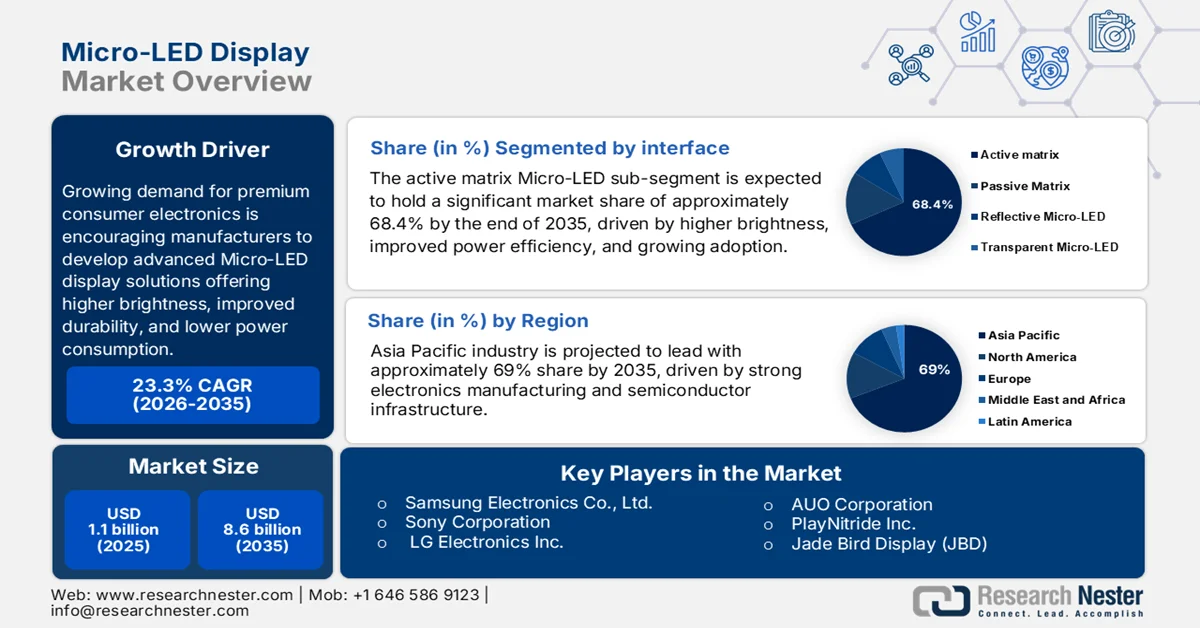
The global micro-LED display market is primarily driven by the growing need for well-organized and high-performance display technologies among consumer electronics, automotive, and industrial applications. If compared with conventional display technologies, micro-LED displays offer higher brightness, lower power consumption, longer operational life, and improved durability, enabling their use for next-generation electronic devices. Besides this, it is stated by the U.S. Department of Energy (DOE) that solid-state lighting technologies have the potential to reduce U.S. lighting energy consumption by approximately 75% by 2035, which highlights the rising attention on power-optimized electronic technologies. This is encouraging large adoption of Micro-LED technology across next-generation display applications.
The improvements in semiconductor manufacturing are helping the large development of micro-LED display technology. As production processes become more efficient, manufacturers are working to increase production capacity and reduce manufacturing costs, which is expected to support the use of micro-LED displays across different applications. Moreover, according to the CHIPS Program Office, the CHIPS and Science Act provides approximately USD 52.7 billion to strengthen semiconductor research and manufacturing in the United States, which help future advancements in display technologies.
Key Micro-LED Display Market Insights Summary:
Regional Highlights:
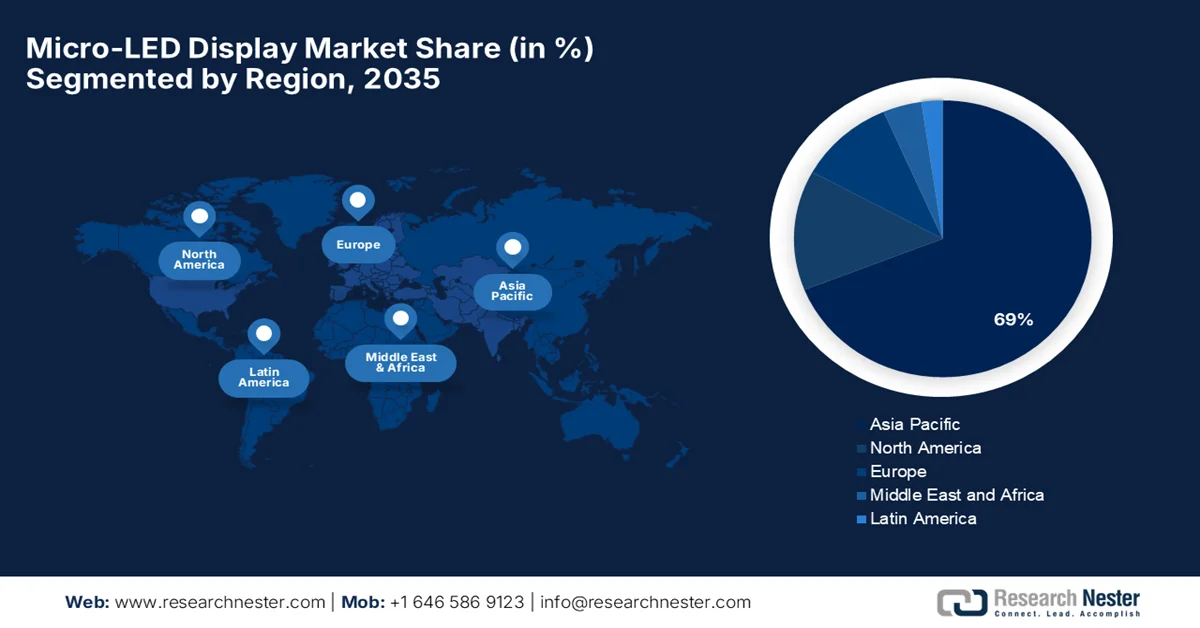
- The micro-LED display market in Asia Pacific is anticipated to capture approximately 69% of the global market share by 2035, bolstered by the region's strong electronics manufacturing ecosystem and expanding semiconductor production capabilities
- North America is expected to secure a significant share of the market throughout 2026-2035, fueled by increasing investments in advanced semiconductor technologies and display innovation
Segment Insights:
- The active matrix micro-LED sub-segment is projected to account for approximately 68.4% of the micro-LED display market by 2035, propelled by its ability to deliver high-resolution images, superior brightness, and enhanced power efficiency across premium display applications
- The consumer electronics sub-segment is expected to witness notable growth during 2026-2035, supported by the rising demand for premium smartphones, televisions, smartwatches, laptops, and other advanced electronic devices
Key Growth Trends:
- Rising adoption of smart wearable devices
- Expansion of medical imaging infrastructure
Major Challenges:
- Competition from well-established display technologies
- Limited availability of commercial products
Key Players: Samsung Electronics Co., Ltd. (South Korea), Sony Corporation (Japan), LG Electronics Inc. (South Korea), AUO Corporation (Taiwan), PlayNitride Inc. (Taiwan), Jade Bird Display (JBD) (China).
Global Micro-LED Display Market Forecast and Regional Outlook:
Market Size & Growth Projections:
- 2025 Market Size: USD 1.1 billion
- 2026 Market Size: USD 1.3 billion
- Projected Market Size: USD 8.6 billion by 2035
- Growth Forecasts: 23.3% CAGR (2026-2035)
Key Regional Dynamics:
- Largest Region: Asia Pacific (69% share by 2035)
- Fastest Growing Region: Europe
- Dominating Countries: China, United States, South Korea, Japan, Taiwan
- Emerging Countries: India, Germany, Vietnam, Singapore, Saudi Arabia
Last updated on : 30 July, 2026
Micro-LED Display Market - Growth Drivers and Challenges
Growth Drivers
- Rising adoption of smart wearable devices: The need for connected consumer devices showcases constant progress as consumers are looking for compact products with improved visual experiences and longer battery life. This is encouraging manufacturers to implement advanced display solutions for smartwatches, fitness trackers, and other portable electronic devices. Moreover, according to the International Data Corporation (IDC), global wearable device shipments have reached approximately 534.6 million units in 2024, reflecting the continued expansion of the wearable electronics market and supporting future demand for micro-LED displays.
- Expansion of medical imaging infrastructure: In the healthcare infrastructure, the use of advanced diagnostic and medical imaging equipment globally is increasing. Healthcare providers are investing in high-quality visualization systems to improve diagnosis and clinical workflows, which are creating opportunities for next-generation display technologies. Besides this, it is recorded by the World Health Organization (WHO) that medical imaging equipment, which includes MRI, CT, PET, and gamma camera systems, is tracked globally as a key indicator of healthcare capacity, reflecting the constant expansion of advanced medical equipment across countries. This trend is helping meet future need for high-performance display technologies, including Micro-LED.
- Increasing investment in defense modernization: The modern defense systems are heavily using advanced display technologies in cockpit displays, helmet-mounted systems, command centers, and surveillance equipment to improve operational performance and situational awareness. This is encouraging the implementation of next-generation display solutions across defense applications. Therefore, as per the Stockholm International Peace Research Institute (SIPRI), global military expenditure has reached approximately USD 2,718 billion in 2024, which showcases an increase of 9.4% compared with 2023. The constant investment in advanced defense equipment is creating favorable opportunities for micro-LED display technologies
Challenges
- Competition from well-established display technologies: These technologies benefit from well- established manufacturing facilities, which can reduce production costs and create strong market acceptance; despite its performance, it is difficult for Micro-LED to achieve rapid commercial implementation. Micro-LED technology remains to face strong competition from OLED and LCD displays, which are already being used largely across smartphones, televisions, laptops, and automotive displays.
- Limited availability of commercial products: micro-LED displays are currently available in only a limited number of commercial products, as the technology is still in the early stages of market adoption. Many manufacturers are slowly announcing Micro-LED across different applications while assessing its performance and production capabilities. Moreover, the availability of Micro-LED-based smartphones, televisions, laptops, wearables, and other consumer electronic devices remains limited, which slows the larger commercial implementation of the technology across the global market.
Mico-LED Display Market Size and Forecast:
| Report Attribute | Details |
|---|---|
|
Base Year |
2025 |
|
Forecast Period |
2026-2035 |
|
CAGR |
23.3% |
|
Base Year Market Size (2025) |
USD 1.1 billion |
|
Forecast Year Market Size (2035) |
USD 8.6 billion |
|
Regional Scope |
|
Micro-LED Display Market Segmentation:
Technology Segment Analysis
By the end of the forecast period, the active matrix micro-LED sub-segment, under the technology segment, is expected to account for the largest market share of approximately 68.4%. The growth of the sub-segment is mainly driven by its capability to deliver high-resolution images, improved brightness, and better power efficiency among premium display applications. Its growing use in consumer electronics, automotive displays, and wearable devices is further helping market growth. Therefore, it is recorded by the U.S. Department of Energy (DOE) that solid-state lighting technologies have the potential to reduce U.S. lighting energy consumption by approximately 75% by 2035, which highlights the growing attention on energy-efficient electronic technologies that support the development of micro-LED displays.
Application Segment Analysis
In the application segment, the consumer electronics sub-segment is projected to register significant progress till the end of forecast period. Its growth is driven by the growing demand for premium smartphones, televisions, smartwatches, laptops, and other electronic devices with advanced display features. Manufacturers are also enhancing the use of Micro-LED technology to improve display quality and support next-generation consumer products. Moreover, according to the IEA, electricity demand from data centres is expected to be more than double by approximately 2030, reflecting the continued expansion of the digital ecosystem that supports innovation in advanced electronic technologies, including micro-LED displays.
Product Type Segment Analysis
The wearable displays sub-segment is anticipated to witness significant growth during the forecast period. The growth of the sub-segment is mainly attributed to the growing implementation of smartwatches, fitness bands, and other wearable electronic devices. As manufacturers continue introducing connected products with advanced display features, the need for Micro-LED technology is expected to grow. Therefore, it is stated by GSMA, that mobile internet users are projected to reach 5.5 billion by 2030, reflecting the continued expansion of the connected device ecosystem and creating favorable opportunities for wearable display technologies.
Our in-depth analysis of the micro-LED display market includes the following segments:
|
Segment |
Subsegments |
|
Technology |
|
|
End user |
|
|
Application |
|
|
Product Type |
|

Vishnu Nair
Head - Global Business DevelopmentCustomize this report to your requirements — connect with our consultant for personalized insights and options.
Micro-LED Display Market - Regional Analysis
APAC Market Insights
The Asia Pacific micro-LED display market is expected to lead the market during the forecast period due to the region's strong electronics manufacturing base and increasing production of consumer electronic devices. The region is projected to reach approximately 69% of the global market share in 2035, supported by its deep electronics manufacturing ecosystem and well-established semiconductor supply chain. Rising investments in semiconductor manufacturing and display technologies are also helping the commercialization of Micro-LED across smartphones, wearables, automotive displays, and industrial applications. Additionally, it is said by the World Semiconductor Trade Statistics (WSTS), that the Asia Pacific region accounted for approximately 70% of global semiconductor sales in 2024, highlighting the region's leading position in the semiconductor industry that supports next-generation display technologies.
The region is witnessing constant leadership in display materials, precision manufacturing, and electronic component production, which is one of the reasons for the steady progress of Japan market. Companies are paying attention to developing advanced display technologies for consumer electronics, automotive systems, and industrial equipment. Additionally, as per the International Federation of Robotics (IFR), Japan supplied approximately 38% of global industrial robot production in 2023, that showcase its strong manufacturing capabilities that support the development of advanced display technologies, including Micro-LED.
As the country continues to strengthen its position in display panel manufacturing and in consumer electronics production, this is one of the reasons for the China market is expected to register strong growth as the country continues to strengthen its position in display panel manufacturing and consumer electronics production. Advances in electronics manufacturing are supporting the future implementation of Micro-LED technology across a wide range of display applications. Further, according to the Ministry of Industry and Information Technology (MIIT), the value added of China's electronic information manufacturing industry increased by approximately 11.8% in 2024.
North America Market Insights
North America is expected to account for a significant share of the global micro-LED display market during the forecast period, which is supported by increasing investments in advanced semiconductor technologies and display innovation. The region also benefits from strong research activities, established electronics manufacturers, and a growing need for high-performance displays across consumer electronics, automotive, and defense applications. Therefore, according to the Semiconductor Industry Association (SIA), the U.S. semiconductor industry directly employed approximately 345,000 workers in 2024, reflecting the country's strong semiconductor ecosystem that supports continued advancements in next-generation display technologies.
The U.S. market is expected to register steady growth as technology companies continue developing advanced display solutions for consumer electronics, automotive systems, and defense applications. The country is also enhancing domestic semiconductor production, which supports the manufacturing of next-generation display components. Furthermore, it is stated by the Semiconductor Industry Association (SIA) that global semiconductor sales reached approximately USD 630.5 billion in 2024, that showcase continued growth in the semiconductor industry that helps in advanced display technologies.
The region continues to strengthen its photonics and semiconductor research capabilities, and the Canada market is projected to register stable growth. Government-backed research infrastructure is promoting innovation in advanced optical and electronic technologies that can be applied to next-generation display manufacturing. At the same time, the Government of Canada announced an approximately USD 120 million investment in CMC Microsystems in 2024 to strengthen Canada's semiconductor manufacturing and commercialization capabilities. This initiative is expected to support advanced semiconductor technologies while creating favorable opportunities for next-generation display manufacturing.
Europe Market Insights
The Europe micro-LED display market is expected to witness firm growth during the forecast period due to rising demand for high-performance display technologies across consumer electronics, automotive, industrial equipment, and defense applications. The region is also strengthening its semiconductor ecosystem to support the development of next-generation electronic technologies. Additionally, according to the European Commission, the European Chips Act is expected to mobilize more than EUR 43 billion in public investments to reinforce semiconductor research, manufacturing, and innovation across Europe, creating favorable opportunities for advanced display technologies, that include Micro-LED.
Due to its strong semiconductor manufacturing base and increasing use of advanced displays in automotive and industrial applications, Germany is projected to remain a key market for micro-LED displays. The country's well-established electronics industry continues to help the development of next-generation display technologies. Moreover, it is recorded by Germany Trade & Invest (GTAI), that its semiconductor industry generated more than EUR 17 billion in revenue in 2025, highlighting the country's growing role in advanced electronics and semiconductor manufacturing that supports micro-LED display development.
France market is expected to register steady progress due to the country's strong focus on research and innovation in electronics, photonics, and advanced materials. As collaboration between research institutes and technology companies is helping the development of next-generation display technologies across multiple applications. Besides this, it stated by the French National Centre for Scientific Research (CNRS), that the organization operates more than 1,100 laboratories across France, strengthening research in electronics, photonics, and materials science that can support future micro-LED display development.
Key Micro-LED Display Market Players:
- Samsung Electronics Co., Ltd. (South Korea)
- Sony Corporation (Japan)
- LG Electronics Inc. (South Korea)
- AUO Corporation (Taiwan)
- PlayNitride Inc. (Taiwan)
- Jade Bird Display (JBD)(China)
- Company Overview
- Business Strategy
- Key Product Offerings
- Financial Performance
- Key Performance Indicators
- Risk Analysis
- Recent Development
- Regional Presence
- SWOT Analysis
- Samsung Electronics Co., Ltd. has launched The Wall micro-LED display, which is available in a standard format for all different screen sizes. The product is usually used for corporate buildings, retail spaces, and luxury residential environments.
- This company pays attention to display systems that require detailed image quality for professional content creation. For this, Sony Corporation develops Crystal LED displays that are used in broadcast, virtual production, and simulation projects.
- LG Electronics Inc. markets its LG MAGNIT series for indoor display applications. These are commonly installed in meeting rooms, retail stores, entertainment venues, and control centers.
- AUO Corporation develops ALED micro-LED displays for commercial and industrial applications. They also offer transparent and customized micro-LED displays to help meet different display requirements across industries.
- PlayNitride Inc. is a Micro-LED technology company that develops Micro-LED chips and display solutions. Its PixeLED products are used in wearable devices, automotive displays, transparent displays, and augmented reality applications.
- Jade Bird Display (JBD) specializes in Micro-LED micro displays for compact optical devices. Their products are mainly designed for AR smart glasses, head-mounted displays, and projection systems where small display size and high brightness are important.
Here is a list of key players operating in the global micro-LED display market:
The market is gradually shifting from technology demonstration to larger commercial deployment, which encourages manufacturers to launch products for a wider range of applications. There are well- established electronics manufacturers which include Samsung Electronics, Sony Corporation, LG Electronics, and AUO Corporation operating alongside Micro-LED specialists including PlayNitride Inc. and Jade Bird Display (JBD), each bringing different technical capabilities and product expertise. The global micro-LED display market remains slightly competitive as companies are exploring new commercial opportunities for the technology. As production skills continue to progress, while companies are placing greater emphasis on delivering reliable display solutions that can match the changing need of consumer and industrial customers.
Corporate Landscape of the Market:
Recent Developments
- In March 2026, LG Electronics launched the 2026 LG MAGNIT Micro LED display, which showcases effortless setup, increased reliability, and premium visual performance for commercial and premium residential applications.
- In May 2026, AUO introduced its latest micro-LED display technologies at SID Display Week 2026, which highlighted transparent micro-LED solutions, AI-integrated display applications, and advanced interactive displays for smart mobility and commercial applications.
- In November 2025, Samsung introduced The Wall MPF Series, which increases its LED display lineup with AI-powered image improvement and higher brightness for business applications.
- Report ID: 8713
- Published Date: Jul 30, 2026
- Report Format: PDF, PPT
- Explore a preview of key market trends and insights
- Review sample data tables and segment breakdowns
- Experience the quality of our visual data representations
- Evaluate our report structure and research methodology
- Get a glimpse of competitive landscape analysis
- Understand how regional forecasts are presented
- Assess the depth of company profiling and benchmarking
- Preview how actionable insights can support your strategy
Explore real data and analysis
Frequently Asked Questions (FAQ)
About this Report
Connect with our Expert


Report, 2026-2035



Copyright @ 2026 Research Nester. All Rights Reserved.
