Global Printed Circuit Heat Exchangers Market
- An Outline of the Global Printed Circuit Heat Exchangers Market
- Market Definition and Segmentation
- Study Assumptions and Abbreviations
- Research Methodology & Approach
- Primary Research
- Secondary Research
- Data Triangulation
- SPSS Methodology
- Executive Summary
- Growth Drivers
- Major Roadblocks
- Opportunities
- Prevalent Trends
- Government Regulation
- Growth Outlook
- Competitive White Space Analysis – Identifying Untapped Market Gaps
- Risk Overview
- DROT
- Technological Advancement
- Technology Maturity Matrix for Printed Circuit Heat Exchangers Market Recent News
- Regional Demand
- Global Printed Circuit Heat Exchangers by Geography – Strategic Comparative Analysis
- Strategic Segment Analysis: Printed Circuit Heat Exchangers Demand Landscape
- Printed Circuit Heat Exchangers Demand Trends Driven by Sustainability, Strategic Collaborations, and Regulatory Compliance (2026-2036)
- Root Cause Analysis (RCA) for discovering problems of the Printed Circuit Heat Exchangers Market
- Porter Five Forces
- PESTLE
- Comparative Positioning
- Global Printed Circuit Heat Exchangers – Key Player Analysis (2036)
- Competitive Landscape: Key Suppliers/Players
- Competitive Model: A Detailed Inside View for Investors
- Company Market Share, 2036 (%)
- ALFA LAVAL
- DongHwa Entec
- Energyn Co., Ltd.
- Hangzhou Shenshi Energy Conservation Technology Co., Ltd
- Kelvion Holding GmbH
- KOBE STEEL, LTD.
- Microchannel Devices S.r.l.
- Nexson Group
- PARKER-HANNIFIN CORPORATION
- Shanghai Heat Transfer Equipment Co., Ltd.
- Sunwen Industry Wuxi Co.,Ltd & Sunwen Piping Solutions Co., Ltd
- Tempco srl
- Vacuum Process Engineering
- Global Printed Circuit Heat Exchangers Market Outlook
- Market Overview
- Market Revenue by Value (USD Thousand), Volume (Units), and Compound Annual Growth Rate (CAGR)
- Printed Circuit Heat Exchangers Market Segmentation Analysis (2026-2036)
- By Type
- Liquid-to-Liquid PCHE, Market Value (USD Thousand), and CAGR, 2026-2036F
- Gas-to-Gas PCHE, Market Value (USD Thousand), and CAGR, 2026-2036F
- Gas-to-Liquid PCHE, Market Value (USD Thousand), and CAGR, 2026-2036F
- By Material
- Stainless Steel, Market Value (USD Thousand), and CAGR, 2026-2036F
- Nickel Alloys, Market Value (USD Thousand), and CAGR, 2026-2036F
- Titanium, Market Value (USD Thousand), and CAGR, 2026-2036F
- Copper, Market Value (USD Thousand), and CAGR, 2026-2036F
- Others, Market Value (USD Thousand), and CAGR, 2026-2036F
- By Application
- Oil & Gas, Market Value (USD Thousand), and CAGR, 2026-2036F
- Chemical & Petrochemical Processing, Market Value (USD Thousand), and CAGR, 2026-2036F
- Power Generation, Market Value (USD Thousand), and CAGR, 2026-2036F
- Hydrogen & Renewable Energy Systems, Market Value (USD Thousand), and CAGR, 2026-2036F
- HVAC / Thermal Management, Market Value (USD Thousand), and CAGR, 2026-2036F
- Pharmaceuticals, Market Value (USD Thousand), and CAGR, 2026-2036F
- Others, Market Value (USD Thousand), and CAGR, 2026-2036F
- By End User
- Industrial, Market Value (USD Thousand), and CAGR, 2026-2036F
- Commercial, Market Value (USD Thousand), and CAGR, 2026-2036F
- Regional Synopsis, Value (USD Thousand), 2026-2036
- North America Market Value (USD Thousand) and CAGR & Y-o-Y Growth Trend, 2026-2036F
- Europe Market Value (USD Thousand) and CAGR & Y-o-Y Growth Trend, 2026-2036F
- Asia Pacific Market Value (USD Thousand) and CAGR & Y-o-Y Growth Trend, 2026-2036F
- Latin America Market Value (USD Thousand) and CAGR & Y-o-Y Growth Trend, 2026-2036F
- Middle East and Africa Market Value (USD Thousand) and CAGR & Y-o-Y Growth Trend, 2026-2036F
- By Type
- Market Overview
- North America Market
- Overview
- Market Value (USD Thousand), Current and Future Projections, 2026-2036
- Increment $ Opportunity Assessment, 2026-2036
- Segmentation (USD Thousand), 2026-2036, By
- By Type
- Liquid-to-Liquid PCHE, Market Value (USD Thousand), and CAGR, 2026-2036F
- Gas-to-Gas PCHE, Market Value (USD Thousand), and CAGR, 2026-2036F
- Gas-to-Liquid PCHE, Market Value (USD Thousand), and CAGR, 2026-2036F
- By Material
- Stainless Steel, Market Value (USD Thousand), and CAGR, 2026-2036F
- Nickel Alloys, Market Value (USD Thousand), and CAGR, 2026-2036F
- Titanium, Market Value (USD Thousand), and CAGR, 2026-2036F
- Copper, Market Value (USD Thousand), and CAGR, 2026-2036F
- Others, Market Value (USD Thousand), and CAGR, 2026-2036F
- By Application
- Oil & Gas, Market Value (USD Thousand), and CAGR, 2026-2036F
- Chemical & Petrochemical Processing, Market Value (USD Thousand), and CAGR, 2026-2036F
- Power Generation, Market Value (USD Thousand), and CAGR, 2026-2036F
- Hydrogen & Renewable Energy Systems, Market Value (USD Thousand), and CAGR, 2026-2036F
- HVAC / Thermal Management, Market Value (USD Thousand), and CAGR, 2026-2036F
- Pharmaceuticals, Market Value (USD Thousand), and CAGR, 2026-2036F
- Others, Market Value (USD Thousand), and CAGR, 2026-2036F
- By End User
- Industrial, Market Value (USD Thousand), and CAGR, 2026-2036F
- Commercial, Market Value (USD Thousand), and CAGR, 2026-2036F
- Country Level Analysis, Value (USD Thousand)
- U.S. Market Value (USD Thousand) and CAGR & Y-o-Y Growth Trend, 2026-2036F
- Canada Market Value (USD Thousand) and CAGR & Y-o-Y Growth Trend, 2026-2036F
- By Type
- Overview
- Europe Market
- Overview
- Market Value (USD Thousand), Current and Future Projections, 2026-2036
- Increment $ Opportunity Assessment, 2026-2036
- Segmentation (USD Thousand), 2026-2036, By
- By Type
- Liquid-to-Liquid PCHE, Market Value (USD Thousand), and CAGR, 2026-2036F
- Gas-to-Gas PCHE, Market Value (USD Thousand), and CAGR, 2026-2036F
- Gas-to-Liquid PCHE, Market Value (USD Thousand), and CAGR, 2026-2036F
- By Material
- Stainless Steel, Market Value (USD Thousand), and CAGR, 2026-2036F
- Nickel Alloys, Market Value (USD Thousand), and CAGR, 2026-2036F
- Titanium, Market Value (USD Thousand), and CAGR, 2026-2036F
- Copper, Market Value (USD Thousand), and CAGR, 2026-2036F
- Others, Market Value (USD Thousand), and CAGR, 2026-2036F
- By Application
- Oil & Gas, Market Value (USD Thousand), and CAGR, 2026-2036F
- Chemical & Petrochemical Processing, Market Value (USD Thousand), and CAGR, 2026-2036F
- Power Generation, Market Value (USD Thousand), and CAGR, 2026-2036F
- Hydrogen & Renewable Energy Systems, Market Value (USD Thousand), and CAGR, 2026-2036F
- HVAC / Thermal Management, Market Value (USD Thousand), and CAGR, 2026-2036F
- Pharmaceuticals, Market Value (USD Thousand), and CAGR, 2026-2036F
- Others, Market Value (USD Thousand), and CAGR, 2026-2036F
- By End User
- Industrial, Market Value (USD Thousand), and CAGR, 2026-2036F
- Commercial, Market Value (USD Thousand), and CAGR, 2026-2036F
- Country Level Analysis, Value (USD Thousand)
- UK Market Value (USD Thousand) and CAGR & Y-o-Y Growth Trend, 2026-2036F
- Germany Market Value (USD Thousand) and CAGR & Y-o-Y Growth Trend, 2026-2036F
- France Market Value (USD Thousand) and CAGR & Y-o-Y Growth Trend, 2026-2036F
- Italy Market Value (USD Thousand) and CAGR & Y-o-Y Growth Trend, 2026-2036F
- Spain Market Value (USD Thousand) and CAGR & Y-o-Y Growth Trend, 2026-2036F
- Netherlands Market Value (USD Thousand) and CAGR & Y-o-Y Growth Trend, 2026-2036F
- Russia Market Value (USD Thousand) and CAGR & Y-o-Y Growth Trend, 2026-2036F
- Switzerland Market Value (USD Thousand) and CAGR & Y-o-Y Growth Trend, 2026-2036F
- Poland Market Value (USD Thousand) and CAGR & Y-o-Y Growth Trend, 2026-2036F
- Belgium Market Value (USD Thousand) and CAGR & Y-o-Y Growth Trend, 2026-2036F
- Rest of Europe Market Value (USD Thousand) and CAGR & Y-o-Y Growth Trend, 2026-2036F
- By Type
- Overview
- Asia Pacific Market
- Overview
- Market Value (USD Thousand), Current and Future Projections, 2026-2036
- Increment $ Opportunity Assessment, 2026-2036
- Segmentation (USD Thousand), 2026-2036, By
- By Type
- Liquid-to-Liquid PCHE, Market Value (USD Thousand), and CAGR, 2026-2036F
- Gas-to-Gas PCHE, Market Value (USD Thousand), and CAGR, 2026-2036F
- Gas-to-Liquid PCHE, Market Value (USD Thousand), and CAGR, 2026-2036F
- By Material
- Stainless Steel, Market Value (USD Thousand), and CAGR, 2026-2036F
- Nickel Alloys, Market Value (USD Thousand), and CAGR, 2026-2036F
- Titanium, Market Value (USD Thousand), and CAGR, 2026-2036F
- Copper, Market Value (USD Thousand), and CAGR, 2026-2036F
- Others, Market Value (USD Thousand), and CAGR, 2026-2036F
- By Application
- Oil & Gas, Market Value (USD Thousand), and CAGR, 2026-2036F
- Chemical & Petrochemical Processing, Market Value (USD Thousand), and CAGR, 2026-2036F
- Power Generation, Market Value (USD Thousand), and CAGR, 2026-2036F
- Hydrogen & Renewable Energy Systems, Market Value (USD Thousand), and CAGR, 2026-2036F
- HVAC / Thermal Management, Market Value (USD Thousand), and CAGR, 2026-2036F
- Pharmaceuticals, Market Value (USD Thousand), and CAGR, 2026-2036F
- Others, Market Value (USD Thousand), and CAGR, 2026-2036F
- By End User
- Industrial, Market Value (USD Thousand), and CAGR, 2026-2036F
- Commercial, Market Value (USD Thousand), and CAGR, 2026-2036F
- Country Level Analysis, Value (USD Thousand)
- China Market Value (USD Thousand) and CAGR & Y-o-Y Growth Trend, 2026-2036F
- India Market Value (USD Thousand) and CAGR & Y-o-Y Growth Trend, 2026-2036F
- South Korea Market Value (USD Thousand) and CAGR & Y-o-Y Growth Trend, 2026-2036F
- Japan Market Value (USD Thousand) and CAGR & Y-o-Y Growth Trend, 2026-2036F
- Australia Market Value (USD Thousand) and CAGR & Y-o-Y Growth Trend, 2026-2036F
- Indonesia Market Value (USD Thousand) and CAGR & Y-o-Y Growth Trend, 2026-2036F
- Malaysia Market Value (USD Thousand) and CAGR & Y-o-Y Growth Trend, 2026-2036F
- Vietnam Market Value (USD Thousand) and CAGR & Y-o-Y Growth Trend, 2026-2036F
- Thailand Market Value (USD Thousand) and CAGR & Y-o-Y Growth Trend, 2026-2036F
- Singapore Market Value (USD Thousand) and CAGR & Y-o-Y Growth Trend, 2026-2036F
- New Zealand Market Value (USD Thousand) and CAGR & Y-o-Y Growth Trend, 2026-2036F
- Rest of Asia Pacific Excluding Japan Market Value (USD Thousand) and CAGR & Y-o-Y Growth Trend, 2026-2036F
- By Type
- Overview
- Latin America Market
- Overview
- Market Value (USD Thousand), Current and Future Projections, 2026-2036
- Increment $ Opportunity Assessment, 2026-2036
- Year-on-Year Growth Forecast (%)
- Segmentation (USD Thousand), 2026-2036, By
- By Type
- Liquid-to-Liquid PCHE, Market Value (USD Thousand), and CAGR, 2026-2036F
- Gas-to-Gas PCHE, Market Value (USD Thousand), and CAGR, 2026-2036F
- Gas-to-Liquid PCHE, Market Value (USD Thousand), and CAGR, 2026-2036F
- By Material
- Stainless Steel, Market Value (USD Thousand), and CAGR, 2026-2036F
- Nickel Alloys, Market Value (USD Thousand), and CAGR, 2026-2036F
- Titanium, Market Value (USD Thousand), and CAGR, 2026-2036F
- Copper, Market Value (USD Thousand), and CAGR, 2026-2036F
- Others, Market Value (USD Thousand), and CAGR, 2026-2036F
- By Application
- Oil & Gas, Market Value (USD Thousand), and CAGR, 2026-2036F
- Chemical & Petrochemical Processing, Market Value (USD Thousand), and CAGR, 2026-2036F
- Power Generation, Market Value (USD Thousand), and CAGR, 2026-2036F
- Hydrogen & Renewable Energy Systems, Market Value (USD Thousand), and CAGR, 2026-2036F
- HVAC / Thermal Management, Market Value (USD Thousand), and CAGR, 2026-2036F
- Pharmaceuticals, Market Value (USD Thousand), and CAGR, 2026-2036F
- Others, Market Value (USD Thousand), and CAGR, 2026-2036F
- By End User
- Industrial, Market Value (USD Thousand), and CAGR, 2026-2036F
- Commercial, Market Value (USD Thousand), and CAGR, 2026-2036F
- Country Level Analysis, Value (USD Thousand)
- Brazil Market Value (USD Thousand) and CAGR & Y-o-Y Growth Trend, 2026-2036F
- Argentina Market Value (USD Thousand) and CAGR & Y-o-Y Growth Trend, 2026-2036F
- Mexico Market Value (USD Thousand) and CAGR & Y-o-Y Growth Trend, 2026-2036F
- Rest of Latin America Market Value (USD Thousand) and CAGR & Y-o-Y Growth Trend, 2026-2036F
- By Type
- Overview
- Middle East & Africa Market
- Overview
- Market Value (USD Thousand), Current and Future Projections, 2026-2036
- Increment $ Opportunity Assessment, 2026-2036
- Year-on-Year Growth Forecast (%)
- Segmentation (USD Thousand), 2026-2036, By
- By Type
- Liquid-to-Liquid PCHE, Market Value (USD Thousand), and CAGR, 2026-2036F
- Gas-to-Gas PCHE, Market Value (USD Thousand), and CAGR, 2026-2036F
- Gas-to-Liquid PCHE, Market Value (USD Thousand), and CAGR, 2026-2036F
- By Material
- Stainless Steel, Market Value (USD Thousand), and CAGR, 2026-2036F
- Nickel Alloys, Market Value (USD Thousand), and CAGR, 2026-2036F
- Titanium, Market Value (USD Thousand), and CAGR, 2026-2036F
- Copper, Market Value (USD Thousand), and CAGR, 2026-2036F
- Others, Market Value (USD Thousand), and CAGR, 2026-2036F
- By Application
- Oil & Gas, Market Value (USD Thousand), and CAGR, 2026-2036F
- Chemical & Petrochemical Processing, Market Value (USD Thousand), and CAGR, 2026-2036F
- Power Generation, Market Value (USD Thousand), and CAGR, 2026-2036F
- Hydrogen & Renewable Energy Systems, Market Value (USD Thousand), and CAGR, 2026-2036F
- HVAC / Thermal Management, Market Value (USD Thousand), and CAGR, 2026-2036F
- Pharmaceuticals, Market Value (USD Thousand), and CAGR, 2026-2036F
- Others, Market Value (USD Thousand), and CAGR, 2026-2036F
- By End User
- Industrial, Market Value (USD Thousand), and CAGR, 2026-2036F
- Commercial, Market Value (USD Thousand), and CAGR, 2026-2036F
- Country Level Analysis, Value (USD Thousand)
- Saudi Arabia Market Value (USD Thousand) and CAGR & Y-o-Y Growth Trend, 2026-2036F
- UAE Market Value (USD Thousand) and CAGR & Y-o-Y Growth Trend, 2026-2036F
- Israel Market Value (USD Thousand) and CAGR & Y-o-Y Growth Trend, 2026-2036F
- Qatar Market Value (USD Thousand) and CAGR & Y-o-Y Growth Trend, 2026-2036F
- Kuwait Market Value (USD Thousand) and CAGR & Y-o-Y Growth Trend, 2026-2036F
- Oman Market Value (USD Thousand) and CAGR & Y-o-Y Growth Trend, 2026-2036F
- South Africa Market Value (USD Thousand) and CAGR & Y-o-Y Growth Trend, 2026-2036F
- Rest of Middle East & Africa Market Value (USD Thousand) and CAGR & Y-o-Y Growth Trend, 2026-2036F
- By Type
- Overview
- Global Economic Scenario
- World Economic Outlook
- About Research Nester
- Our Global Clientele
- We Serve Clients Across World
Printed Circuit Heat Exchangers Market Outlook:
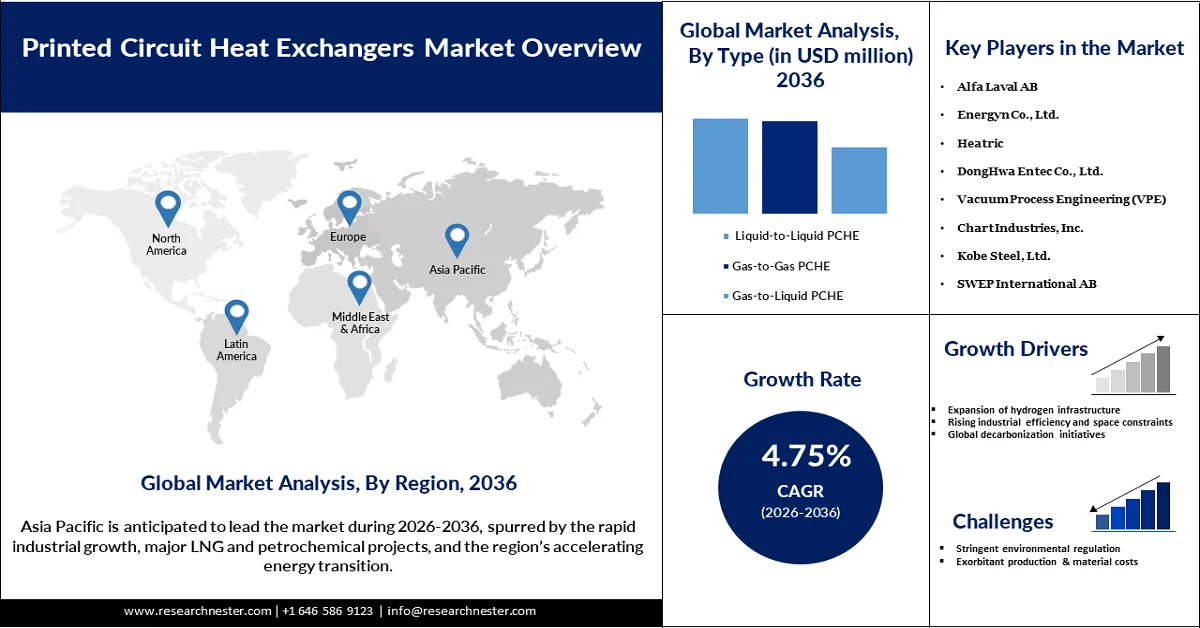
Printed Circuit Heat Exchangers Market is valued at USD 706.82 million in 2025 and is anticipated to surpass USD 1.18 billion by 2036, expanding at a CAGR of 4.75% during the forecast period, i.e., 2026 to 2036. In 2026, the industry size of printed circuit heat exchangers is estimated at USD 743.91 million.
A key factor driving the growth of the printed circuit heat exchangers (PCHE) market is their expanding use in cryogenic and LNG applications, where reliable performance and precise temperature control are vital for critical processes such as liquefaction, regasification, and gas processing. Systems operating at extremely low temperatures must effectively handle wide temperature swings while maintaining consistent thermal performance and operational efficiency. Their solid, diffusion-bonded construction enables them to tolerate pressure fluctuations and thermal cycling, supporting stable performance in LNG facilities, offshore production platforms, and gas distribution networks. With the continued development of LNG infrastructure and cryogenic storage projects worldwide, demand for reliable and space-saving heat exchange systems is expected to remain strong, supporting the broader advancement of energy and industrial operations. In line with this, in October 2025, Shenshi introduced a PCHE-LNG specifically for Fuel Gas Supply Systems (FGSS) on LNG carriers. The unit features a microchannel design with diffusion-bonded construction, enabling highly efficient heat transfer at cryogenic temperatures around –162 °C. By optimizing space and energy, it cuts floor area requirements by half and reduces energy consumption by 20%, while also preventing ice formation. This launch underscores the significance of PCHE technology in creating compact, leak-resistant, and reliable cryogenic LNG systems.
At the same time, the rising need for efficient, space-saving heat transfer systems is driving their adoption across multiple advanced industrial sectors, including power generation, oil and gas, hydrogen production, and chemical processing. These industries rely on equipment that can perform reliably under high pressures and extreme temperatures while maintaining steady thermal output. PCHE offers excellent heat transfer performance within a compact, space-saving design, making it ideal for environments where both efficiency and footprint are important.
Key Printed Circuit Heat Exchangers Market Insights Summary:
Regional Highlights:
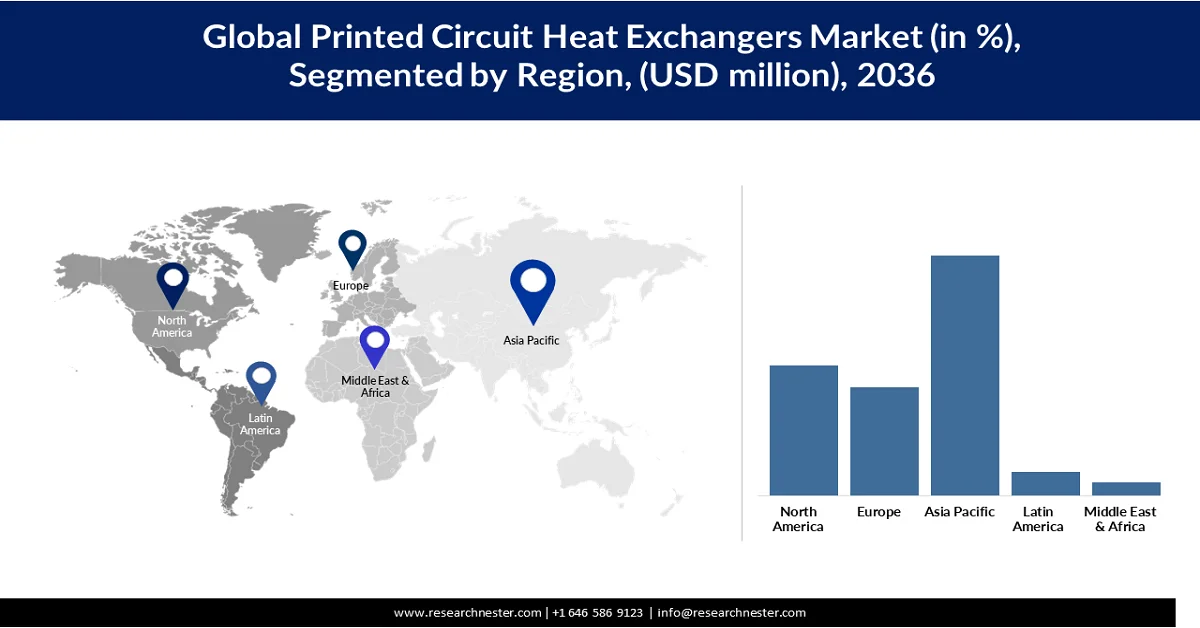
- Asia Pacific printed circuit heat exchangers market is projected to command a 44.84% share by 2036, attributed to rapid industrial expansion, large-scale LNG and petrochemical developments, and accelerating energy transition initiatives.
- North America is anticipated to secure a 28.42% share of the market by 2036, supported by rising deployment of compact high-pressure heat exchangers in hydrogen systems, LNG infrastructure, and energy transition projects.
Segment Insights:
- The liquid-to-liquid PCHE segment in the printed circuit heat exchangers market is projected to capture 37.50% share by 2035, propelled by strong deployment across oil and gas, petrochemical, and power generation facilities requiring reliable heat management in extreme operating environments.
- The stainless steel segment is expected to account for a 38.02% share by 2036, stimulated by its superior corrosion resistance, high-temperature durability, and suitability for demanding industrial operations.
Key Growth Trends:
- Global decarbonization initiatives
- Rising industrial efficiency and space constraints
Major Challenges:
- Exorbitant production & material costs
- Stringent environmental regulation
Key Players: Alfa Laval AB (Sweden), Energyn Co., Ltd. (South Korea), Heatric (United Kingdom), DongHwa Entec Co., Ltd. (South Korea), Vacuum Process Engineering (VPE) (USA), Chart Industries, Inc. (USA), Kobe Steel, Ltd. (Japan), SWEP International AB (Sweden), API Heat Transfer (USA), Thermofin (Italy), Linde Engineering (Germany).
Global Printed Circuit Heat Exchangers Market Forecast and Regional Outlook:
Market Size & Growth Projections:
- 2025 Market Size: USD 706.82 million
- 2026 Market Size: USD 743.91 million
- Projected Market Size: USD 1.18 billion by 2036
- Growth Forecasts: 4.75% CAGR (2026-2036)
Key Regional Dynamics:
- Largest Region: Asia Pacific (44.84% Share by 2036)
- Fastest Growing Region: North America
- Dominating Countries: United States, China, Japan, Germany, South Korea
- Emerging Countries: India, Canada, Singapore, United Arab Emirates, Australia
Last updated on : 5 March, 2026
Printed Circuit Heat Exchangers Market - Growth Drivers and Challenges
Growth Drivers
- Global decarbonization initiatives: Decarbonization requirements are boosting the adoption of PCHEs, elevating them from specialized tools to essential, compliance-driven equipment. As industries shift toward cleaner fuels, hydrogen production, carbon capture, and low-emission power generation, the need for efficient, compact, and dependable heat exchangers is growing rapidly. PCHEs, engineered for extreme thermal and pressure conditions while delivering accurate temperature control, are now considered indispensable for adhering to tight environmental regulations. In April 2024, Alfa Laval inaugurated a dedicated production line for PCHEs at its Alfa Laval Vicarb facility in Fontanil‑Cornillon, France, incorporating advanced diffusion‑welding technology to produce ultra‑compact heat exchangers that support energy transition applications, especially in hydrogen and related sectors. This initiative establishes the Fontanil site as a centre of PCHE excellence in France and aligns with broader deployment plans for hydrogen infrastructure and decarbonization solutions across multiple industries. Through enhanced energy efficiency, efficient heat recovery, and reduced emissions, PCHEs are fostering investment in cutting-edge energy projects, including cryogenic LNG installations and hydrogen processing units.
- Rising industrial efficiency and space constraints: The printed circuit heat exchangers market is expanding due to industries’ increasing demand for efficient, compact heat transfer systems and ongoing limitations on space and weight. Industries such as power generation, chemical processing, LNG, and hydrogen manufacturing are beginning to require heat exchangers that operate reliably under extreme pressure and temperature ranges, as well as provide consistent thermal performance. The bulkiness and greater weight of traditional heat exchangers generally do not meet these criteria. PCHEs are capable of providing the benefits of efficient heat transfer in a compact, lightweight manner through the use of their diffusion-bonded design, which leads to streamlined piping layout and less energy each time fuel is burned.
- Expansion of hydrogen infrastructure: The rapid expansion of hydrogen infrastructure is driving strong growth in the printed circuit heat exchangers market. By the end of 2024, approximately 1,160 hydrogen refueling stations were in operation worldwide. Each station relies on PCHEs to handle high-pressure hydrogen precooling and compression, with Asia and Europe emerging as the leading regions driving demand for these heat exchangers. Hydrogen processing, storage, and liquefaction require heat exchangers capable of precise thermal management under high-pressure, low-temperature conditions, a requirement that conventional systems often fail to meet. PCHEs, with their compact diffusion-bonded design, deliver high thermal efficiency, precise temperature control, and strong structural durability. Rising investments in hydrogen production and storage to meet energy transition and decarbonization targets are driving the adoption of PCHEs. With their space-saving design, energy-efficient operation, and robust safety, they have become vital for contemporary hydrogen infrastructure.
Challenges
- Exorbitant production & material costs: Elevated production and material expenses pose a significant challenge for the printed circuit heat exchangers market. The fabrication of these heat exchangers includes advanced processes like precision diffusion bonding and the incorporation of high-quality, corrosion-resistant materials, making production both costly and technically challenging. These production challenges push up the final equipment price, limiting adoption among smaller operators or projects with restricted budgets. Beyond this, the cost of specialized alloys and the implementation of strict quality measures add to production expenses. Moreover, PCHEs depend on diffusion bonding, a heat-and-pressure joining method that demands stringent process control, skilled operators, and extended cycle times, especially for high-pressure cores. This labor-intensive, inspection-heavy workflow embeds structural complexity into PCHE fabrication, limiting rapid scalability and extending manufacturing lead times.
- Stringent environmental regulation: The printed circuit heat exchangers market is constrained by limited alloy availability and stringent certification requirements. The reliance on corrosion-resistant materials from a limited number of global suppliers makes procurement difficult and costly. In addition, applications involving high pressures, cryogenic conditions, and hydrogen must adhere to rigorous certification standards, which require extensive testing and detailed documentation. Along with limited alloy supply, these requirements drive up costs, extend production lead times, and constrain scalability. As a result, while industrial demand rises, regulatory and supply challenges continue to restrain the printed circuit heat exchangers market. Therefore, even as demand for PCHEs grows, supply chain and regulatory constraints continue to pose significant barriers to market growth.
Printed Circuit Heat Exchangers Market Size and Forecast:
| Report Attribute | Details |
|---|---|
|
Base Year |
2025 |
|
Forecast Period |
2026-2036 |
|
CAGR |
4.75% |
|
Base Year Market Size 2025 |
USD 706.82 million |
|
Forecast Year Market Size 2036 |
USD 1.18 billion |
|
Regional Scope |
|
Printed Circuit Heat Exchangers Market Segmentation:
Type Segment Analysis
The liquid-to-liquid PCHE segment is expected to hold 37.50% of the printed circuit heat exchangers market share. The strong presence of liquid-to-liquid PCHE systems across oil and gas, petrochemical, and power generation facilities is a key reason for their significant market share. These industries function in harsh operating environments where equipment must withstand extreme pressure levels and elevated temperatures regularly. As a result, there is a strong need for heat exchangers that offer consistent performance and structural reliability. In liquid-processing operations, PCHE systems provide effective heat management in a space-saving design, enabling plants to utilize available area more efficiently.
Material Segment Analysis
The stainless steel segment is expected to hold a 38.02% printed circuit heat exchangers market share by 2036. Stainless steel is favored for PCHEs due to its strength, superior corrosion resistance, and dependable high-temperature performance qualities vital for rigorous industrial environments. Industries like oil and gas, petrochemicals, and power generation frequently operate under extreme conditions, including high pressures and corrosive fluids, which require robust and dependable equipment. PCHEs constructed from stainless steel provide efficient heat transfer, extended service life, and reduced maintenance requirements, making them a practical and widely favored choice over alternative materials. At the same time, the push for energy-efficient systems and the expansion of new applications such as hydrogen production and clean energy projects are further boosting the adoption of stainless steel exchangers in the printed circuit heat exchangers market.
Application Segment Analysis
The oil & gas segment is expected to grow at a market share of 23.15% by 2036. The segment drives the printed circuit heat exchangers market as the industry increasingly requires compact and efficient heat transfer solutions for demanding operating conditions. PCHEs are also great for gas processing, LNG plant operations, and refining services where the equipment encounters high pressures, extreme temperature variations, and the elements of corrosion. They have diffusion-bonded, compact designs that provide very efficient heat transfer solutions in locations that cannot accommodate large or heavy equipment.
Our in-depth analysis of the printed circuit heat exchangers market includes the following segments:
|
Segments |
Subsegments |
|
Type |
|
|
Material |
|
|
Application |
|
|
End user |
|

Vishnu Nair
Head - Global Business DevelopmentCustomize this report to your requirements — connect with our consultant for personalized insights and options.
Printed Circuit Heat Exchangers Market - Regional Analysis
Asia Pacific Market Insights
Asia Pacific is expected to dominate the printed circuit heat exchangers market, accounting for 44.84% of the total share by 2036. The growth is fueled by rapid industrial growth, major LNG and petrochemical projects, and the region’s accelerating energy transition. More heat exchangers are being utilized than ever before in applications that require high temperature/pressure operation, very efficient (and low weight), compact designs, such as in the production of hydrogen, the storage and transportation of LNG at cryogenic temperatures, and the generation of power using gas-fired turbines. In May 2025, PacificLight Power revealed plans for a hydrogen-ready CCGT project in Singapore, initially capable of co-firing up to 30% hydrogen, which is expected to boost demand for high-pressure PCHEs in both heat-recovery and compression applications. In addition, the Asia Pacific region currently accounts for more than half of all installed PCHEs globally due to ongoing investment in upgrading energy/industrial infrastructure and developing new energy technologies.
The demand for PCHE in China is increasing as industries such as petrochemicals, power generation, and refining require compact and efficient heat-transfer solutions. The semiconductor and high-tech manufacturing industries are also pushing this demand by requiring accurate thermal management of their products. As a result of government programs promoting clean energy, hydrogen use, and energy efficiency, as well as strong local manufacturing capabilities and ongoing improvements in design, the printed circuit heat exchangers market will continue to grow.
The market for PCHE in India is expanding as sectors such as power generation, oil and gas, and petrochemicals require compact and highly efficient systems for transferring heat. The expansion of advanced manufacturing and semiconductor sectors has significantly boosted the need for accurate temperature management. Additionally, government programs promoting clean energy, hydrogen adoption, and energy efficiency, together with improvements in PCHE design and strong domestic production, have all contributed to the robust growth of the printed circuit heat exchangers market.
North America Market Insights
The printed circuit heat exchangers market in North America is expected to hold a share of 28.42% by 2036. The market is expanding due to rising demand for compact, high-performance heat exchangers that can operate under extreme pressures and temperatures, particularly in hydrogen systems, LNG operations, and energy transition projects. Active industrial development in regions such as the U.S, along with a growing emphasis on energy efficiency and emissions reduction, is driving quicker adoption of PCHEs over conventional shell-and-tube heat exchangers. The U.S. National Clean Hydrogen Strategy projects that by 2050, clean hydrogen could cut U.S. greenhouse gas emissions by around 10% while enhancing energy independence.
The U.S. printed circuit heat exchangers market is growing alongside the expansion of hydrogen and LNG infrastructure, fueling demand for compact, high-performance heat exchangers that can operate reliably under extreme pressures and temperatures. According to the World Nuclear Association, the U.S., the world’s largest nuclear power producer, contributing roughly 30% of global nuclear electricity and generating 816 TWh in 2024, is rapidly expanding its capacity with the commissioning of Vogtle 4 in March 2024. This growth is supported by the Inflation Reduction Act of 2022, which provides investment and tax incentives for both new and existing reactors, as well as hydrogen production. A well-established industrial base, together with rising focus on energy savings and carbon reduction, is accelerating the adoption of PCHEs over conventional shell-and-tube systems. Federal programs, such as the DOE Hydrogen Program, are providing additional support for the deployment of PCHEs in critical energy transition projects.
The expansion in LNG and cryogenic infrastructure is pushing the Canadian printed circuit heat exchangers market forward, creating strong demand for compact, high-performance units that can withstand high pressures and extreme temperatures. The growth of hydrogen production and other clean energy initiatives is encouraging wider adoption, as these exchangers ensure accurate thermal management and safety in space-limited environments.
Europe Market Insights
The printed circuit heat exchangers market in Europe is expected to hold a share of 19.62% by 2036. The market is driven by the expansion of hydrogen projects, energy transition policies, and industrial modernization initiatives. In May 2025, Alfa Laval became part of the RHeaDHy Horizon Europe project, working on high-capacity hydrogen refueling systems that use PCHEs for precooling hydrogen to −30 °C. These exchangers are increasingly employed in hydrogen precooling, compression, and refueling applications, where their compact form and diffusion-bonded strength meet rigorous safety and operational standards. Strong regulatory support and clean energy objectives are encouraging broader use of PCHEs in hydrogen mobility infrastructure and advanced thermal applications, highlighting Europe’s move toward compact, high-efficiency heat exchangers that surpass conventional alternatives.
The UK printed circuit heat exchangers market is projected to grow at a CAGR of 4.55%, driven by the expansion of hydrogen and LNG projects as well as clean energy initiatives. This is creating a strong need for compact, high-performing heat exchangers that can function at extreme levels of pressure and temperature. The oil and gas, chemical processing, and power generation industries are using PCHEs more frequently for their thermal efficiencies, space efficiencies in their plants, and safety. Government programs designed to reduce the carbon footprint of every sector through the use of lower-carbon technologies will continue to push this market forward.
The Germany printed circuit heat exchangers market for PCHEs is growing as investments in hydrogen production, LNG infrastructure, and clean energy projects continue to accelerate. PCHE provides reliable, compact, and efficient heat transfer at a variety of operating conditions. Moreover, it is used to cool high-pressure hydrogen and in chemical processes where the ability to transfer high levels of heat under demanding operational climates is essential. Development of favorable policies and funding from governmental and other sources related to low-carbon initiatives further enhances the pace of growth for PCHE.
Key Printed Circuit Heat Exchangers Market Players:
- Alfa Laval AB (Sweden)
- Energyn Co., Ltd. (South Korea)
- Heatric (United Kingdom)
- DongHwa Entec Co., Ltd. (South Korea)
- Vacuum Process Engineering (VPE) (USA)
- Chart Industries, Inc. (USA)
- Kobe Steel, Ltd. (Japan)
- SWEP International AB (Sweden)
- API Heat Transfer (USA)
- Thermofin (Italy)
- Linde Engineering (Germany)
- Company Overview
- Business Strategy
- Key Product Offerings
- Financial Performance
- Key Performance Indicators
- Risk Analysis
- Recent Development
- Regional Presence
- SWOT Analysis
- Alfa Laval AB is a global leader in PCHEs due to its extensive expertise in heat transfer technologies and decades of engineering experience. The company offers a wide range of PCHE solutions designed for high-pressure, high-temperature, and compact applications across industries such as petrochemicals, LNG, power generation, and hydrogen. Its strong focus on research and development drives innovation in materials, thermal efficiency, and compact design. With a worldwide presence and support network, Alfa Laval provides reliable, customized solutions and fast service to customers across regions.
- Energyn Co., Ltd. is recognized as a leading global producer of Printed Circuit Heat Exchangers (PCHEs) due to its advanced diffusion-bonded micro-channel designs, capable of handling extreme pressures and high temperatures while delivering exceptional thermal efficiency and durability. Its PCHEs are certified to ASME and KGS standards, making them suitable for demanding applications such as hydrogen infrastructure, LNG systems, fuel cells, and industrial processes. Strong research and development capabilities, combined with numerous patents and innovations for next-generation energy solutions, further enhance its printed circuit heat exchangers market position.
- Kobe Steel, Ltd. has established itself as a major player in the printed circuit heat exchangers market by leveraging decades of experience in heat exchanger design and manufacturing to develop diffusion‑bonded compact heat exchangers with excellent pressure and temperature resistance. Its PCHEs offer a high heat transfer area in a small footprint and can withstand ultra‑high pressures, making them suitable for demanding applications such as LNG plants, offshore platforms, and hydrogen infrastructure. Kobe Steel continues to win significant global contracts, expanding its reach beyond traditional markets and reinforcing its reputation for quality and performance in high‑pressure thermal systems.
- SWEP International AB is recognized for its expertise in compact plate heat exchanger technologies, including highly efficient microchannel and brazed plate solutions that deliver excellent thermal performance and reliability. With a strong global presence and focus on sustainability, energy efficiency, and customer‑centric innovation, SWEP serves a wide range of industrial, commercial, and institutional applications. Continuous investment in research, development, and lifecycle support strengthens its position as a trusted partner for high‑performance heat transfer systems worldwide.
- API Heat Transfer is a well‑established provider of high‑performance heat transfer solutions with a long heritage of engineering excellence and global manufacturing capabilities. The company offers a broad portfolio of custom heat exchangers and thermal systems, designed to meet the specific needs of diverse industries, including power generation, oil & gas, and industrial processes. Its strong engineering expertise, extensive product range, and worldwide sales and service network help deliver tailored solutions that improve efficiency, reliability, and performance across applications, reinforcing its role as a key player in advanced heat transfer technologies.
Below is the list of the key players operating in the global printed circuit heat exchangers market:
Leading companies in the printed circuit heat exchangers market are fueling growth by continually improving design, materials, and manufacturing processes, which increases efficiency and durability for high-pressure, high-temperature applications. They are broadening their presence in emerging markets such as hydrogen production, LNG, and modern power generation, while using partnerships and acquisitions to access new technologies and expand market share. The creation of local facilities and effective supply chains enables them to cater to rising demand in Asia and other industrial regions.
Corporate Landscape of the Global Printed Circuit Heat Exchangers Market:
Recent Developments
- In August, 2025, Kobe Steel, Ltd. announced that it had secured a contract from Saipem to supply PCHEs for TotalEnergies’ Kaminho Floating Production Storage and Offloading (FPSO) project offshore Angola. The Kaminho FPSO emphasizes decarbonization, featuring an all-electric power system and full reinjection of associated gas to substantially lower greenhouse gas emissions. Kobe Steel’s PCHEs, set to be installed on the FPSO topside in 2025, will support high-pressure operations thanks to their compact size, durability, and exceptional thermal efficiency.
- In March, 2024, Nexson Group expanded its technological expertise and presence in Europe by acquiring Thermowave GmbH, a German manufacturer of high-quality plate heat exchangers and a former member of the Güntner Group, a globally recognized leader in refrigeration components. This strategic move strengthens Nexson Group’s product offerings, engineering capabilities, and access to advanced plate heat exchanger technologies, while solidifying its position in industrial refrigeration, energy-efficient solutions, and thermal process applications.
- Report ID: 7463
- Published Date: Mar 05, 2026
- Report Format: PDF, PPT
- Explore a preview of key market trends and insights
- Review sample data tables and segment breakdowns
- Experience the quality of our visual data representations
- Evaluate our report structure and research methodology
- Get a glimpse of competitive landscape analysis
- Understand how regional forecasts are presented
- Assess the depth of company profiling and benchmarking
- Preview how actionable insights can support your strategy
Explore real data and analysis
Frequently Asked Questions (FAQ)
About this Report
Connect with our Expert


Report, 2026-2036



Copyright @ 2026 Research Nester. All Rights Reserved.
