Pneumatic Equipment Market Outlook:
Pneumatic Equipment Market size was valued at USD 35.4 billion in 2025 and is projected to cross USD 72.2 billion by the end of 2035, growing at a CAGR of 7.4% during the forecast period, i.e., 2026-2035. In 2026, the industry size of pneumatic equipment is estimated at USD 38 billion.
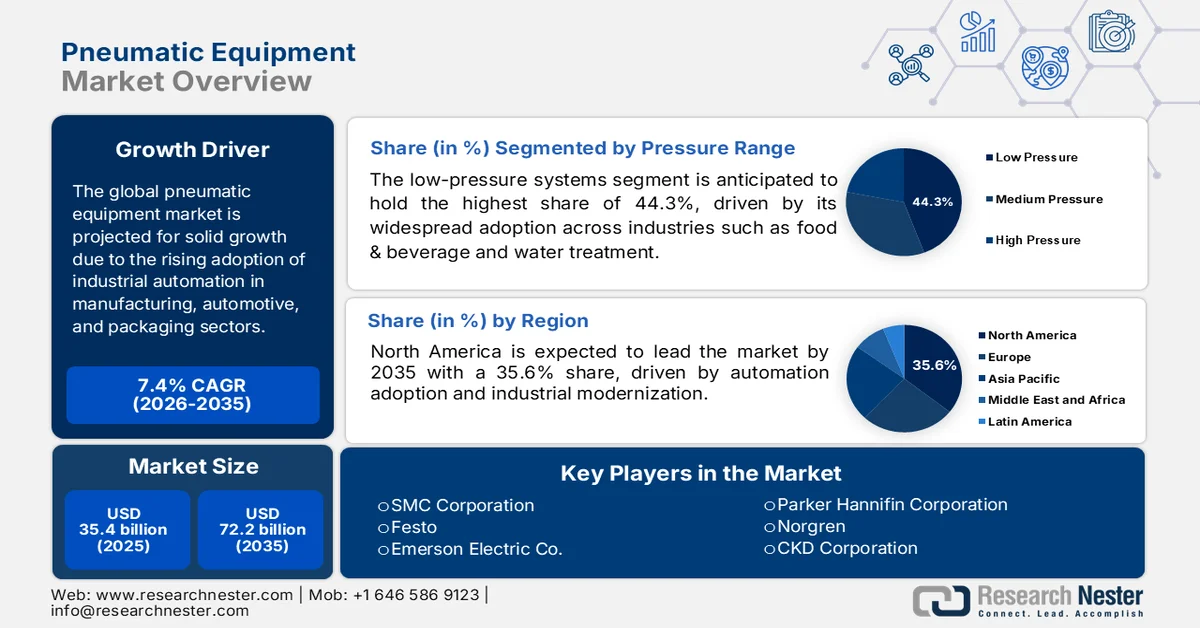
The global pneumatic equipment market is gradually expanding, which is positively impacted by the rising adoption of industrial automation in manufacturing, automotive, and packaging sectors. In addition, the demand for energy-efficient and low-maintenance machinery fuels the continuous integration of pneumatic systems, which are highly preferred for their high durability and precise motion control. According to the article published by the International Federation of Robotics in September 2024, 4.28 million industrial robots were operating in factories worldwide in 2023, which is up 10%, with 541,302 new installations, and is considered to be the second-highest annual total on record. Asia dominated robot adoption with 70% of global installations, which was led by China, while Europe and the Americas accounted for 17% and 10%, thus elevating the growth potential of pneumatic equipment globally.
Furthermore, the rapid industrialization in emerging economies and the digital transformation of factories, which is enabled by IoT-enabled pneumatic components, are creating significant expansion opportunities for the market. This ongoing modernization of assembly lines is propelling a steady long-term demand for pneumatic cylinders, valves, and actuators worldwide. For instance, Emerson in July 2024 announced the launch of the AVENTICS™ Series XV pneumatic valves, which offer higher flow rates, compact design, and interoperable valve sizes for greater flexibility in factory automation. These valves are designed for global machine builders, and they support universal threads, multiple connectivity options, and major industrial fieldbus protocols for seamless integration, thus positively benefiting the market’s expansion.
Key Pneumatic Equipment Market Insights Summary:
Regional Highlights:
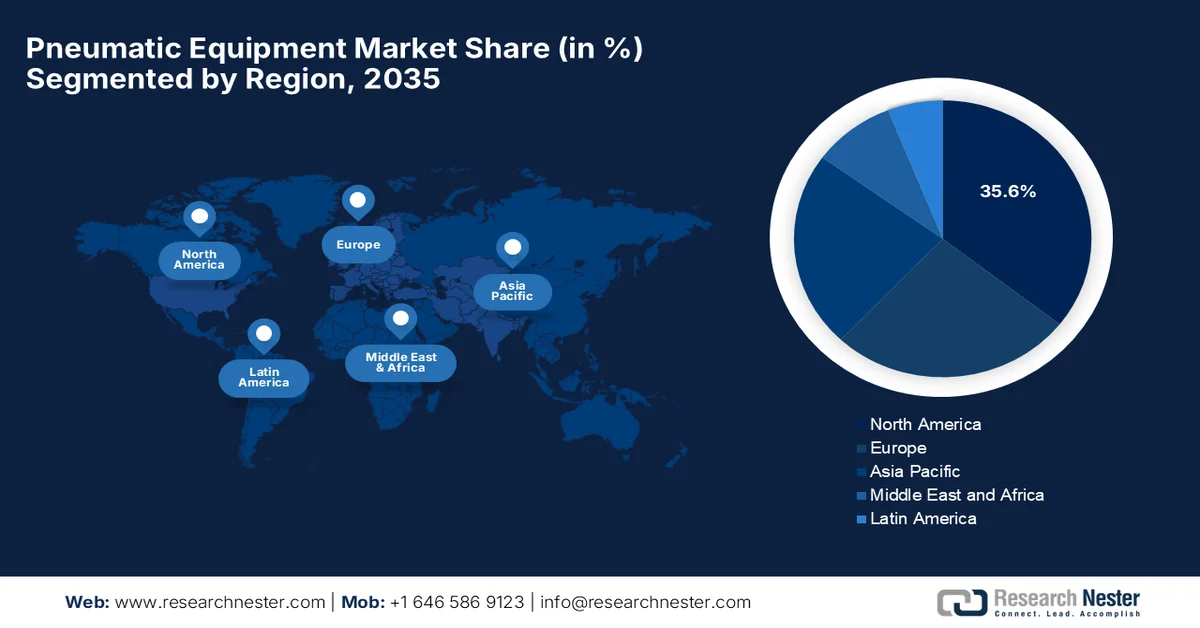
- North America is projected to command 35.6% share by 2035 in the pneumatic equipment market, underpinned by the rapid expansion of automated manufacturing and the extensive modernization of industrial facilities
- Asia Pacific is expected to witness notable growth throughout 2026-2035, fueled by rising investments in manufacturing automation across China, Japan, India, and South Korea
Segment Insights:
- Low-pressure systems are anticipated to account for 44.3% share by 2035 in the pneumatic equipment market, supported by their widespread adoption across food & beverage, water treatment, packaging, cement, and wastewater treatment industries
- Motion control is forecast to secure a significant market share by 2035, propelled by the increasing adoption of robotics, smart factories, and high-speed production lines
Key Growth Trends:
- Expanding automotive sector
- Stringent hygiene in food & pharma
Major Challenges:
- High energy consumption and efficiency concerns
- Competition from electric and alternative automation technologies
Key Players: SMC Corporation (Japan) ,Festo (Germany) ,Emerson Electric Co. (U.S.) ,Parker Hannifin Corporation (U.S.) ,Norgren (UK) ,CKD Corporation (Japan) ,Aventics (Germany),Chicago Pneumatic (U. S.) ,AirTAC International Group (Taiwan) ,Camozzi Automation (Italy) ,Aignep (Italy).
Global Pneumatic Equipment Market Forecast and Regional Outlook:
Market Size & Growth Projections:
- 2025 Market Size: USD 35.4 billion
- 2026 Market Size: USD 38 billion
- Projected Market Size: USD 72.2 billion by 2035
- Growth Forecasts: 7.4% CAGR (2026-2035)
Key Regional Dynamics:
- Largest Region: North America (35.6% share by 2035)
- Fastest Growing Region: Asia Pacific
- Dominating Countries: United States, China, Germany, Japan, South Korea
- Emerging Countries: India, Vietnam, Mexico, Brazil, Saudi Arabia
Last updated on : 24 July, 2026
Pneumatic Equipment Market - Growth Drivers and Challenges
Growth Drivers
- Expanding automotive sector: The worldwide surge in electric vehicle manufacturing needs some precise and reliable assembly lines. In this context, pneumatic equipment is highly utilized in terms of automotive welding, stamping, and painting robots due to its durability and fast cycle times. As automakers build new battery production facilities, the demand for specialized pneumatic control systems also skyrockets. In this context, Ashok Leyland in March 2026 announced a greenfield battery pack manufacturing facility at Pillaipakkam near Chennai, with a generous investment of USD 47 to USD 58 million, with the main goal of strengthening India's electric mobility ecosystem. This facility will localize EV battery pack production, enhance the domestic supply chain, and thus create immense demand in the market.
- Stringent hygiene in food & pharma: Food, beverage, and pharmaceutical industries require sterile production environments to prevent product contamination. In this context, pneumatic systems are highly preferred since they run on compressed air rather than leakage-prone hydraulic fluids. The mandatory use of stainless steel, corrosion-resistant pneumatic cylinders propels safe, clean, and compliant packaging processes. Atlas Copco Group in January 2025 announced the acquisition of Trident Pneumatics Pvt. Ltd., which is a manufacturer specializing in compressed air treatment and on-site gas generation solutions. Trident offers products including air dryers, filters, condensate drains, and gas generators, serving industries such as railway, textile, and food & beverage, thus strengthening the market’s footprint.
Challenges
- High energy consumption and efficiency concerns: One of the major challenges witnessed in the market is the high energy consumption which is associated with compressed air systems. This pneumatic equipment necessitates compressors that consume huge amounts of electricity, which makes operational costs a major concern for end users, especially in energy-intensive sectors. Industries are prioritizing sustainability and carbon reduction targets, due to which manufacturers face pressure to develop energy-efficient pneumatic solutions with improved air management, smart monitoring capabilities, and reduced operating costs. Apart from this, competition from electric automation technologies that provide higher energy efficiency and precision also creates huge challenges for pneumatic equipment adoption in certain applications.
- Competition from electric and alternative automation technologies: The booming adoption of electric actuators, servo systems, and other advanced automation technologies is also a major challenge for the market. Electric systems offer certain advantages, such as higher precision and improved energy efficiency, which make them attractive for applications that require accurate motion control. Industries are making a transition toward Industry 4.0 and smart manufacturing, due to which some manufacturers are shifting from traditional pneumatic systems toward digitally integrated electric solutions. In this context, pneumatic equipment producers need to continuously innovate by introducing intelligent pneumatic components, sensor-based monitoring, and hybrid automation solutions in order to maintain competitiveness.
Pneumatic Equipment Market Size and Forecast:
| Report Attribute | Details |
|---|---|
|
Base Year |
2025 |
|
Forecast Year |
2026-2035 |
|
CAGR |
7.4% |
|
Base Year Market Size (2025) |
USD 35.4 billion |
|
Forecast Year Market Size (2035) |
USD 72.2 billion |
|
Regional Scope |
|
Pneumatic Equipment Market Segmentation:
Pressure Range Segment Analysis
The low-pressure systems segment is anticipated to hold the highest share of 44.3% in the pressure range category of the pneumatic equipment market during the discussed timeframe. The segment’s dominance is mostly driven by its widespread adoption across industries such as food & beverage, water treatment, packaging, cement, and wastewater treatment. In these industries, low-pressure compressed air is extensively used for pneumatic conveying, material handling, aeration, fluidization, and automation applications. In July 2025, FS-Elliott announced the launch of the Polaris® P650 DF, which is a double-flow centrifugal air compressor with dual-inlet, intended for high-capacity oil-free compressed air delivery in a compact footprint. It is manufactured for flow rates up to 20,000 CFM (280–560 m³/min), and it helps industries such as petrochemical, water treatment, bio fermentation, and gas applications reduce costs and simplify installation.
Function Segment Analysis
Under the function segment, motion control is forecasted to capture a significant share in the market by the end of 2035. The rising integration of automated positioning, gripping, and handling systems across manufacturing industries is the main factor driving the segment’s leadership. In addition, the increasing adoption of robotics, smart factories, and high-speed production lines is driving demand for pneumatic motion control solutions. In May 2025, RS and IMI expanded their pneumatic actuator portfolio with solutions that are especially designed for industrial and process automation applications, offering reliable, efficient, and cost-effective motion control. This range includes IMI Bimba Original Line® and IMI Norgren pneumatic actuators, which are available in multiple configurations to meet different industry requirements.
Component Segment Analysis
Valves that are under the component segment are expected to grow at a considerable rate in the market over the forecasted years. The segment’s growth is largely attributable to increasing need for precise control and regulation of compressed air systems, rising focus on improving equipment reliability, and the growing integration of advanced valve solutions in compact and high-performance pneumatic applications. In addition, the demand for durable and low-maintenance components in industrial operations is expected to create encouraging growth opportunities for the valves segment. Apart from this, the continuous development of application-specific valve designs is also supporting their wider adoption across industries such as automotive, electronics, and process manufacturing.
Our in-depth analysis of the pneumatic equipment includes the following segments:
|
Segment |
Subsegments |
|
Pressure Range |
|
|
Function |
|
|
Component |
|
|
End user Industry |
|

Vishnu Nair
Head - Global Business DevelopmentCustomize this report to your requirements — connect with our consultant for personalized insights and options.
Pneumatic Equipment Market - Regional Analysis
North America Market Insights
North America pneumatic equipment market is expected to grow with the highest share of 35.6% during the forecast period. The region’s leadership is largely attributable to the rapid expansion of automated manufacturing and the extensive modernization of industrial facilities. Also, the region’s automotive, aerospace, and packaging industries depend on advanced pneumatic components to enhance factory floor efficiency, safety, and production speed. In this context, Guardair Corporation in June 2024 announced the launch of PowerQUAD™, which is an advanced pneumatic vacuum system featuring patent-pending dual-stage, multi-venturi technology for enhanced performance and efficiency. The company also notes that this vacuum delivers up to 35% higher vacuum head, 67% more vacuum flow, and up to 71% compressed air savings, reducing operating costs.
The booming aerospace, automotive, and semiconductor manufacturing bases are responsible for uplifting the U.S. pneumatic equipment market. Meanwhile, the country’s push to reshore industrial production is driving remarkable investments in new, highly automated factories that utilize advanced pneumatic networks. In addition, the country benefits from strict environmental mandates, and high labor costs accelerate the adoption of smart pneumatic systems to maximize operational efficiency. In May 2025, Eaton announced a USD 18.5 million expansion of its Orchard Park, New York aerospace manufacturing facility to increase production capacity for defense, commercial aerospace, and space customers. Furthermore, this project will add 50,000 square feet of manufacturing space and create 77 skilled jobs, thus elevating the growth potential of the pneumatic equipment industry.
In Canada, the pneumatic equipment market is projected for noteworthy growth, which is driven by rising investments in automated assembly plants across Ontario's robust automotive and machinery sectors. The country's market is also benefiting from the adoption of Industry 4.0 standards, with electronics and food processing facilities integrating smart pneumatic positioners and valves for higher process efficiency. In January 2025, Linamar Corporation invested more than USD 700 million with the main goal of expanding its automotive manufacturing operations across Ontario, thereby strengthening the EV supply chain. This expansion will support advanced components including eAxle systems, powertrain solutions, semiconductor packaging, hydrogen fuel cells, and battery storage technologies, thus heightening demand for pneumatic equipment.
APAC Market Insights
Asia Pacific market is poised to grow at a significant rate during the forecast period. The region’s growth in this field is largely attributable to rising investments in manufacturing automation across powerhouse economies such as China, Japan, India, and South Korea. The region's dominant electronics, semiconductor, and automotive assembly lines rely on precise pneumatic actuators and valves to maintain high-speed production. In December 2024, Rapidus began installing Japan’s first-ever ASML NXE:3800E EUV lithography system at its IIM-1 semiconductor fab in Hokkaido to enable mass production of advanced 2nm logic semiconductors. This facility will integrate advanced manufacturing equipment and automated material handling systems to support next-generation chip production, thus suitable for bolstering the market’s expansion.
The massive electronics, semiconductor, and electric vehicle manufacturing bases are certain factors responsible for boosting China pneumatic equipment market. Also, the nation’s intense focus on upgrading to high-end smart manufacturing under national industrial initiatives drives widespread adoption of advanced pneumatic networks. In June 2026, Apoch Pneumatic Technology announced the launch of the APV elbow union pneumatic quick connector, which is a compact push-to-connect fitting designed for space-constrained industrial automation and smart factory applications. It consists of a 90-degree elbow design, PPS resin construction, and chemical-resistant sealing options, and it enables reliable, tool-free tubing connections for industries including semiconductor, pharmaceutical, automotive, and food processing.
In India, the pneumatic equipment market is expanding exponentially, which is catalyzed by the government's aggressive Make in India initiative and substantial foreign direct investments in local manufacturing. The country’s market also benefits from rapidly growing sectors such as automotive assembly, pharmaceuticals, food processing, and textile manufacturing, which are heavily automating their facilities to meet rising domestic and international demand. In April 2024, Pneumax inaugurated its new Pneumax Pneumatic India Pvt. Ltd. facility in Noida, which marks a major step in expanding its global operations and customer support capabilities. In addition, this particular expansion strengthens Pneumax’s ability to deliver innovative pneumatic solutions, thereby improving operational efficiency and supporting growing industrial demand in India.
India Pneumatic Equipment Parts Export Statistics 2024: Shipment Value and Top Destination Countries
|
Export Destination |
Export Value (USD ‘000) |
Export Value (USD Million) |
Quantity (Kg) |
|
U.S. |
169,924.98 |
169.92 |
18,156,000 |
|
Germany |
20,744.56 |
20.74 |
4,230,620 |
|
UK |
13,249.18 |
13.25 |
2,760,030 |
|
Spain |
12,544.44 |
12.54 |
1,573,910 |
|
Denmark |
10,199.95 |
10.20 |
2,006,050 |
|
Italy |
7,655.81 |
7.66 |
1,998,390 |
|
Brazil |
5,785.62 |
5.79 |
1,915,030 |
|
China |
5,109.43 |
5.11 |
674,163 |
|
Czech Republic |
4,654.69 |
4.65 |
983,377 |
|
Romania |
3,543.70 |
3.54 |
872,897 |
Source: WITS
Europe Market Insights
Europe market has acquired a prominent position in the global landscape, which is propelled by the region’s focus on high-tech industrial automation and the transition toward green manufacturing. In addition, the region’s exceptionally strict carbon-neutrality targets and soaring electricity costs are compelling manufacturers to adopt smart, ultra-efficient pneumatic systems equipped with real-time leak detection and digital pressure controls. In February 2026, Škoda inaugurated a new USD 220 million battery systems assembly hall at its Mladá Boleslav plant, which makes it the Volkswagen Group’s largest BEV battery system manufacturer. This 55,000 m² facility can produce more than 1,100 battery systems per day and up to 335,000 annually, supporting electric vehicle production across multiple Group brands.
The nation's leading machinery, machine tool, and automotive sectors are positioning Germany pneumatic equipment market for exceptional growth. The country's skyrocketing energy costs and stringent domestic decarbonization laws force domestic factories to deploy advanced pneumatic technologies that are optimized for minimal compressed air waste and maximum power efficiency. In January 2023, ALMiG completed 100 years of innovation which is specializing in energy-efficient and reliable compressor solutions for global industries. The company is highly focused on advanced technologies, including speed-controlled compressors, heat recovery systems, and oil-free water-injected compressors for applications requiring high efficiency and clean compressed air. The presence of leading players and their tactical activities strengthens the country’s adoption of energy-efficient pneumatic technologies across key industrial sectors.
The strong emphasis on upgrading manufacturing infrastructure and boosting factory productivity is boosting the UK pneumatic equipment market. Apart from this, key sectors such as food and beverage, aerospace, and advanced packaging depend on sophisticated pneumatic systems to streamline automated production and assembly lines. Based on the government data published in December 2023, the UK’s advanced manufacturing plan aims to make the country the best place to start and grow manufacturing businesses by investing in innovation, clean technologies, digitalization, and skilled workers. It provides USD 5.7 billion in funding for key sectors such as automotive, aerospace, life sciences, hydrogen, and green industries while expanding programmes such as Made Smarter to support businesses, thus indicating a positive market outlook.
Key Pneumatic Equipment Market Players:
- SMC Corporation (Japan)
- Festo (Germany)
- Emerson Electric Co. (U.S.)
- Parker Hannifin Corporation (U.S.)
- Norgren (UK)
- CKD Corporation (Japan)
- Aventics (Germany)
- Chicago Pneumatic (U. S.)
- AirTAC International Group (Taiwan)
- Camozzi Automation (Italy)
- Aignep (Italy)
- Company Overview
- Business Strategy
- Key Product Offerings
- Financial Performance
- Key Performance Indicators
- Risk Analysis
- Recent Development
- Regional Presence
- SWOT Analysis
- SMC Corporation is one of the leading global manufacturers of pneumatic equipment. The company is maintaining a strong presence across industrial automation markets through its extensive product range, technological expertise, and global manufacturing and sales network.
- Festo is yet another prominent manufacturer of pneumatic and automation technology solutions and is well recognized for its advanced engineering capabilities and integrated industrial automation offerings. The firm is highly focused on innovation, smart manufacturing, and Industry 4.0-enabled technologies.
- Emerson Electric Co., through its Aventics brand, is a major player in the global market which is delivering pneumatic automation products for industrial applications. In addition, the company leverages its global industrial technology expertise, digital automation capabilities, and broad application support.
- Parker Hannifin Corporation is a leading motion and control technology manufacturer that has a strong presence in pneumatic equipment through its automation and pneumatic product divisions. Besides, the firm’s competitive advantage lies in its diversified industrial product portfolio, global reach, and engineering knowledge.
- Norgren is an IMI-owned brand and is a recognized manufacturer of pneumatic motion control and automation solutions. The company is highly focused on application-specific engineering, reliability, and customized pneumatic solutions for industries including transportation, life sciences, food processing, and industrial automation.
Here is a list of key players operating in the global market:
The global pneumatic equipment market is moderately consolidated, which hosts leading manufacturers that are maintaining strong positions through extensive product portfolios, global distribution networks, and advanced automation solutions. Key players in this field compete through innovations in energy efficiency, smart pneumatic systems, digital integration, and application-specific designs across various industries. Apart from this, major multinational manufacturers dominate developed markets, and regional and specialized manufacturers compete by offering customized solutions and cost-effective pneumatic components for niche applications. For instance, Atlas Copco Group in July 2026 announced the acquisition of LusoAr, which is a compressor distributor based in Porto, expanding its presence in Portugal’s pneumatic and compressed air solutions market. LusoAr provides air compressors, pneumatic systems, air treatment solutions, compressed air installations, and services for large and mid-size industries.
Corporate Landscape of the Market:
Recent Developments
- In June 2026, Chicago Pneumatic expanded its CP66 pneumatic torque wrench series with the launch of the CP6681, which is a high-durability tool designed for demanding bolting applications. It consists of an ergonomic D-Handle design, and the wrench improves operator comfort and control.
- In May 2026, Festo introduced the HPPH two-finger pneumatic parallel gripper, which is designed for collaborative robot (cobot) applications, consisting of an integrated design that combines control, sensing, and safety functions within a compact, lightweight body.
- Report ID: 8694
- Published Date: Jul 24, 2026
- Report Format: PDF, PPT
- Explore a preview of key market trends and insights
- Review sample data tables and segment breakdowns
- Experience the quality of our visual data representations
- Evaluate our report structure and research methodology
- Get a glimpse of competitive landscape analysis
- Understand how regional forecasts are presented
- Assess the depth of company profiling and benchmarking
- Preview how actionable insights can support your strategy
Explore real data and analysis
Frequently Asked Questions (FAQ)
About this Report
Connect with our Expert


Report, 2026-2035



Copyright @ 2026 Research Nester. All Rights Reserved.
