Pharmacy Benefit Management Market Outlook:
Pharmacy Benefit Management Market size was valued at USD 657.8 billion in 2025 and is expected to reach USD 1,134.2 billion by the end of 2035, registering around 5.6% CAGR during the forecast period, i.e., 2026-2035. In 2026, the industry size of pharmacy benefit management is estimated at USD 694.6 billion.
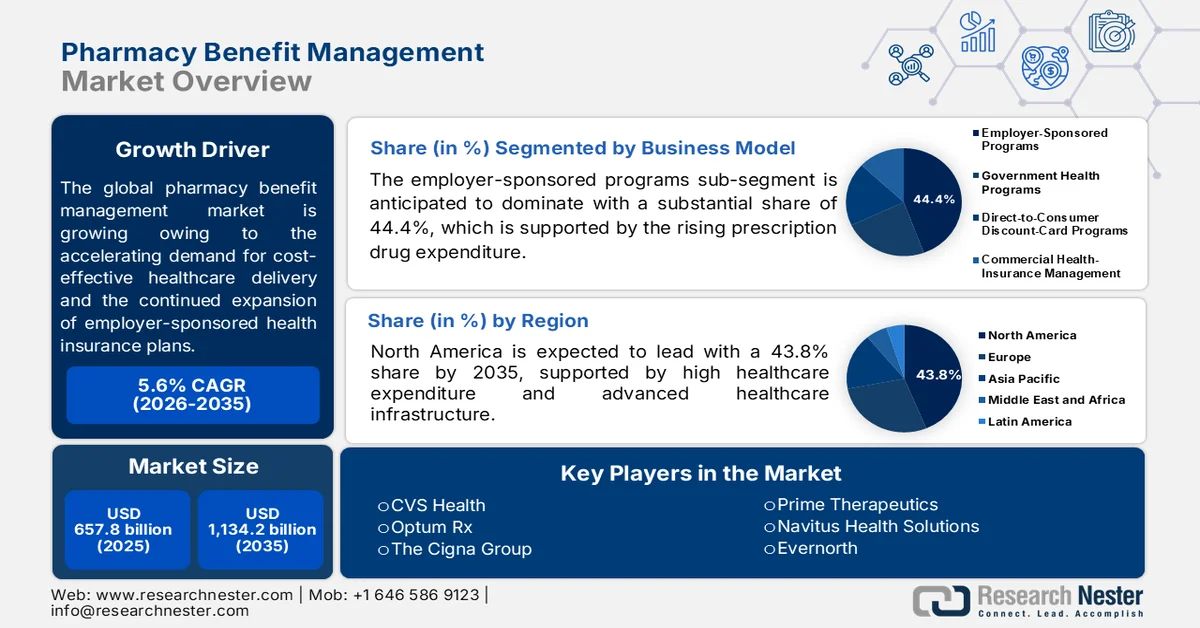
The global pharmacy benefit management market is set to witness steady expansion in the next decade owing to the accelerating demand for cost-effective healthcare delivery as well as the continued expansion of employer-sponsored health insurance plans. In addition, the rise of chronic diseases is encouraging the market to shift towards value-based care models that focus on patient outcomes over volume. This aspect is in turn prompting providers to integrate advanced digital health tools and predictive analytics into their operational frameworks. In April 2026, KFF revealed that employer-sponsored health insurance is the main source of coverage for U.S. residents under 65, covering about 60% of this population in 2025. It is widely used because workplace plans offer risk-sharing, administrative efficiencies, and significant tax advantages for employers and employees.
Employer-Sponsored Health Insurance Coverage by Age, Race/Ethnicity, and Citizenship in 2025
|
Category |
Group |
Share with Employer-Sponsored Health Insurance (ESI) |
|
Age Group |
Ages 0–17 |
54.2% |
|
Ages 18–25 |
56.5% |
|
|
Ages 26–39 |
63.1% |
|
|
Ages 40–64 |
63.3% |
|
|
Race/Ethnicity |
White, non-Hispanic |
68.6% |
|
Black, non-Hispanic |
50.3% |
|
|
Hispanic |
43.3% |
|
|
American Indian/Alaska Native, Non-Hispanic |
41.0% |
|
|
Asian, non-Hispanic |
68.8% |
|
|
Native Hawaiian/Other Pacific Islander, Non-Hispanic |
58.9% |
|
|
Multiple Races, Non-Hispanic |
58.2% |
|
|
Citizenship |
Citizen |
62.2% |
|
Non-Citizen |
38.0% |
Source: KFF
Furthermore, strategic clinical management and the optimization of formulary designs are becoming central to business models, especially as plan sponsors are looking for greater clarity in drug purchasing. Apart from this, ongoing corporate consolidations and strategic alliances between payers, pharmacies, and management firms are reshaping the competitive landscape in the market. In July 2026, CVS Caremark reported that it reached a global settlement with the FTC aimed at improving prescription drug affordability, pricing transparency, and pharmacy benefit practices. This agreement includes clearer rebate reporting, point-of-sale savings, cost-based pharmacy reimbursement, and a USD 25 monthly insulin cost cap for members, thus positively benefiting the market’s expansion.
Key Pharmacy Benefit Management Market Insights Summary:
Regional Highlights:
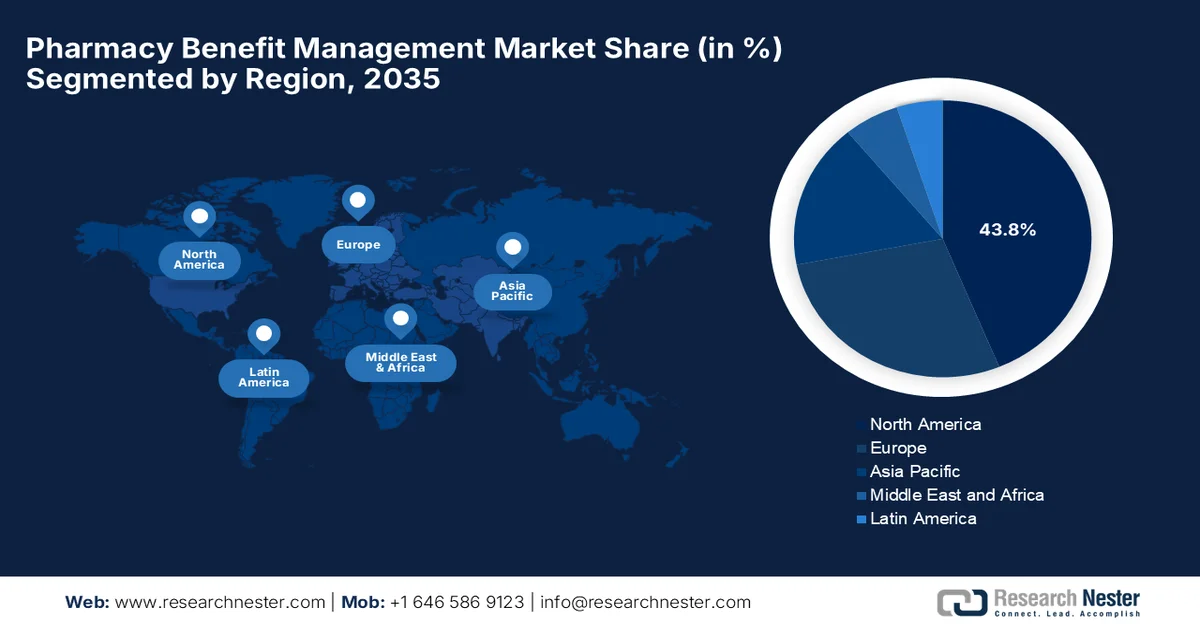
- North America is projected to command a 43.8% share of the pharmacy benefit management market by 2035, reinforced by sophisticated healthcare infrastructure, high healthcare spending, and extensive employer-sponsored insurance coverage
- Asia Pacific is poised for the fastest growth of during 2026-2035, fueled by expanding healthcare access, accelerating privatization of health insurance, and government initiatives toward universal health coverage
Segment Insights:
- The employer-sponsored programs sub-segment is anticipated to capture a dominant 44.4% share of the pharmacy benefit management market by 2035, supported by rising prescription drug expenditure, widespread employer-sponsored health insurance adoption, and increasing emphasis on pharmacy benefit cost control
- The specialty pharmacy services sub-segment is expected to register a lucrative share by 2035, propelled by increasing utilization of high-cost specialty medications, the rising prevalence of complex and chronic diseases, and the expanding pipeline of advanced therapies
Key Growth Trends:
- Rising prescription drug expenditure
- Digital transformation and automation
Major Challenges:
- Independent pharmacy attrition and network friction
- Competition from disruptive transparent models
Key Players: CVS Health (U.S.) ,Optum Rx (U.S.) ,The Cigna Group (U.S.) ,Prime Therapeutics (U.S.) ,Navitus Health Solutions (U.S.) ,Judi Health (U.S.) ,CVS Caremark (U.S.) ,Evernorth (U.S.).
Global Pharmacy Benefit Management Market Forecast and Regional Outlook:
Market Size & Growth Projections:
- 2025 Market Size: USD 657.8 billion
- 2026 Market Size: USD 694.6 billion
- Projected Market Size: USD 1,134.2 billion by 2035
- Growth Forecasts: 5.6% CAGR (2026-2035)
Key Regional Dynamics:
- Largest Region: North America (43.8% share by 2035)
- Fastest Growing Region: Asia Pacific
- Dominating Countries: United States, Canada, Germany, United Kingdom, Japan
- Emerging Countries: India, China, Australia, South Korea, Singapore
Last updated on : 25 August, 2026
Pharmacy Benefit Management Market - Growth Drivers and Challenges
Growth Drivers
- Rising prescription drug expenditure: This factor is encouraging insurers, employers, and government payers to adopt PBM solutions for cost control. The PBMs negotiate manufacturer discounts, manage formularies, process claims, and optimize pharmacy networks to reduce spending. Increasing healthcare costs and prescription utilization are therefore creating sustained demand in the market globally. In November 2025, the Organization for Economic Co-operation and Development (OECD) stated that prescription medicines accounted for more than 75% of retail pharmaceutical spending in most OECD countries in 2023. It also mentioned that government programs and compulsory insurance were the main sources of funding, which covered nearly 60% of retail medicine costs on average.
OECD Retail Pharmaceutical Spending Per Capita by Country 2023
|
Country |
Expenditure (USD PPP) |
|
U.S. |
1,713 |
|
Germany |
1,158 |
|
Switzerland |
1,061 |
|
Canada |
990 |
|
Japan |
983 |
|
Greece |
921 |
|
Bulgaria |
883 |
|
Australia |
872 |
|
Korea |
851 |
|
Italy |
846 |
|
Austria |
845 |
|
France |
813 |
|
Slovenia |
770 |
|
OECD Average |
766 |
|
Ireland |
744 |
|
Belgium |
742 |
|
Slovak Republic |
718 |
|
Hungary |
699 |
|
Luxembourg |
696 |
|
Lithuania |
688 |
|
Spain |
673 |
|
Finland |
655 |
|
Sweden |
651 |
|
Portugal |
622 |
|
Czechia |
598 |
|
Poland |
582 |
|
Romania |
581 |
|
UK |
557 |
|
Latvia |
551 |
|
Poland |
523 |
|
Norway |
519 |
|
Netherlands |
486 |
|
Israel |
476 |
|
Croatia |
462 |
|
Estonia |
458 |
|
Chile |
455 |
|
Denmark |
404 |
|
Brazil |
377 |
Source: OECD
- Digital transformation and automation: Digital transformation is yet another important factor that is accelerating market growth with the assistance of automated claims processing, electronic prescribing, benefit tools, and digital formulary management. These technologies improve operational efficiency, enhance pricing visibility, and increase uptake in this sector. As per an article published by the National Institutes of Health (NIH) in February 2023, digital transformation is reshaping healthcare with the evolution of technologies such as AI, telemedicine, mobile health, cloud computing, and connected devices. In addition, the article also states that these innovations can improve patient engagement, healthcare delivery, operational efficiency, and access to personalized services, thereby reducing overall costs.
Challenges
- Independent pharmacy attrition and network friction: Escalating friction between PBMs and independent pharmacies has triggered severe network stability challenges. The independent pharmacy owners report dominant PBMs charging unfair reimbursement rates and retroactive pharmacy dispensing fees that compress retail margins below acquisition costs. The existence of this financial squeeze has caused widespread closures of community pharmacies, especially in case of rural and underserved areas, creating critical pharmacy deserts. Furthermore, the market faces criticism for steering patients toward their own corporate-owned mail-order or specialty pharmacies. This ongoing consolidation friction damages provider relations and invites localized lawsuits, which threatens the overall geographic coverage and health of pharmacy networks.
- Competition from disruptive transparent models: The emergence of alternative competitors is eroding the share of pioneers in the market. New entities, along with transparent cash-pay models, are bypassing standard insurance frameworks to offer drugs directly to consumers at fixed, or else low-margin costs. Simultaneously, modern tech-driven PBMs are winning over plan sponsors by offering strict pass-through models, where rebates are returned directly to the client. This presence of shift toward total clarity forces legacy PBMs to defend their value proposition. In this context, they need to shift away from hidden administrative fees and instead prove their worth through clinical care management and noticeable patient health outcomes.
Pharmacy Benefit Management Market Size and Forecast:
| Report Attribute | Details |
|---|---|
|
Base Year |
2025 |
|
Forecast Period |
2026-2035 |
|
CAGR |
5.6% |
|
Base Year Market Size (2025) |
USD 657.8 billion |
|
Forecast Year Market Size (2035) |
USD 1,134.2 billion |
|
Regional Scope |
|
Pharmacy Benefit Management Market Segmentation:
Business Model Segment Analysis
The employer-sponsored programs sub-segment, which is a part of the business model segment, is anticipated to dominate with a substantial share of 44.4% by the conclusion of the forecast period. This dominance in the pharmacy benefit management market is supported by the adoption of employer-sponsored health insurance, rising prescription drug expenditure, and growing employer emphasis on controlling pharmacy benefit costs. On the other hand, employers are increasingly leveraging PBMs for formulary management, utilization control, specialty-drug management, and cost optimization. In this context, CalPERS in July 2025 signed a five-year pharmacy benefits contract with CVS Caremark to improve prescription drug affordability, quality, and transparency for about 587,000 members. Also, the contract replaces OptumRx and aims to deliver greater accountability, financial predictability, and value for CalPERS members and employers.
Service Segment Analysis
By the end of 2035, the specialty pharmacy services sub-segment is expected to grow with a lucrative share in the market. This growth is largely attributable to increasing utilization and expenditure associated with high-cost specialty medications and the rising prevalence of complex and chronic diseases. On the other hand, the continued expansion of biologics, biosimilars, gene therapies, and other advanced therapies is positioning the segment for surging growth. In addition, the growing specialty-drug pipeline is increasing demand for specialized dispensing, patient support, adherence management, utilization management, and cost-containment services offered through PBMs, thus denoting a wider segment scope.
End user Segment Analysis
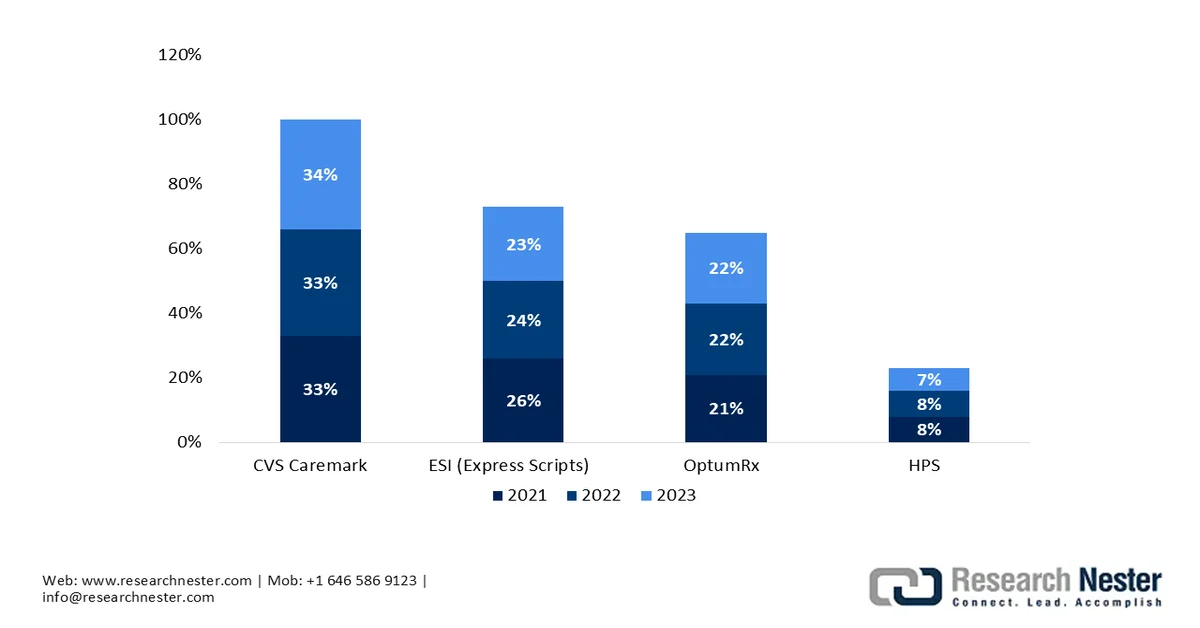
On the basis of end user, PBM organizations are predicted to attain a substantial revenue share in the market throughout the discussed timeframe. The segment’s growth is majorly propelled by the increasing outsourcing of prescription benefit administration by employers, health plans, and government-sponsored programs. In addition, PBM organizations are increasingly integrating pharmacy-network management, claims processing, rebate negotiation, specialty pharmacy, and mail-order services. NAIC in February 2025 disclosed that the three largest PBMs, i.e., Express Scripts, CVS Caremark, and OptumRx, processed about 79% of U.S. prescription drugs in 2022, which reflects their significant influence over drug coverage, pricing, and pharmacy access. It also mentioned that PBMs can negotiate discounts and rebates.
Our in-depth analysis of the market includes the following segments:
|
Segment |
Subsegments |
|
Business Model |
|
|
Service |
|
|
End user |
|
|
Delivery Channel |
|

Vishnu Nair
Head - Global Business DevelopmentCustomize this report to your requirements — connect with our consultant for personalized insights and options.
Pharmacy Benefit Management Market - Regional Analysis
North America Market Insights
North America pharmacy benefit management market is anticipated to dominate with a total share of 43.8% during the stipulated timeframe. The region’s dominance in this sector is attributable to highly sophisticated healthcare infrastructure, high healthcare spending, and extensive employer-sponsored insurance coverage. North America also benefits from the accelerating introduction of high-cost specialty biologics and gene therapies, which compels regional service providers to deploy advanced clinical utilization strategies and digital health integration. In May 2024, Optum Rx introduced Clear Trend Guarantee™, which is a pricing model especially designed to provide pharmacy benefit plan sponsors with greater transparency and predictability by combining retail, home delivery, specialty pharmacy, and rebate costs into one per-member guarantee.
A highly privatized commercial insurance sector and government-sponsored programs such as Medicare Part D and Medicaid are driving growth of the U.S. pharmacy benefit management market. In addition, the country’s market landscape is undergoing unprecedented structural shifts due to aggressive bipartisan congressional scrutiny and Federal Trade Commission investigations into rebate practices and spread pricing. In December 2023, AMCP reported that as of January 2023, around 275 million residents in America received pharmacy benefits administered by PBMs, reflecting their prominence in the U.S. prescription drug system. AMCP’s position statement, which was approved in December 2023, supports greater PBM transparency while cautioning that restrictions on rebates, spread pricing, and utilization management could increase costs.
U.S. Pharmacy Benefit Manager (PBM) Market Share by Prescription Claims Managed: 2021 - 2023
Source: FTC
The Canada pharmacy benefit management market is gaining enhanced traction and is characterized by a balance of provincial public drug plans with a private employer-sponsored insurance sector. The country’s market landscape is being reshaped by distinct provincial regulations and national pricing bodies that coordinate drug listings, which influences how private PBMs design and manage corporate formularies. Based on the government data published in May 2024, the country’s proposed Pharmacare Act (C-64) aims to provide universal, single-payer coverage for contraception and diabetes medications in order to improve affordability and access nationwide. The plan can benefit 9 million people of reproductive age. The government also announced almost USD 89.5 million investment in the Canada Drug Agency from 2024-25 until the next five years, thus supporting broader pharmaceutical affordability.
APAC Market Insights
Asia Pacific market is forecasted to grow at the fastest rate from 2026 to 2035. The region’s upliftment in this sector is majorly propelled by expanding healthcare access, accelerating privatization of health insurance, and government initiatives aimed at achieving universal health coverage. In Asia Pacific, digital health innovation is considered a major cornerstone wherein service providers are aggressively deploying mobile health applications, AI-based claims processing, and integrated telehealth platforms to reach a vast audience group. Press Information Bureau in April 2026 disclosed that India’s insurance sector is expanding and ranked 10th globally, with insurance and pension funds rising to 29.6% of household financial assets in FY2024-25. It also outlined that during the same time, insurers issued 41.84 crore policies, collected approximately USD 12.5 billion in premiums, paid around USD 8.8 billion in claims, and managed about USD 77.8 billion in assets.
The urgent need for cost-effective management of prescription medications for an aging population with chronic diseases drives growth in Japan pharmacy benefit management market. The market acts as a crucial intermediary sector which is integrated into the nation's highly structured, universal healthcare system and managed under the national health insurance framework. In November 2025, NIH revealed that Japan introduced the Rapid Introduction Premium in April 2024 to encourage earlier launches of innovative medicines by reducing the price gap with higher-priced markets such as the US. By March 2025, 4 drugs had received the premium, with rates of 5% or 10%, whereas U.S. drug prices averaged 3.2 times Japan prices.
The China pharmacy benefit management market is growing exponentially, and it operates as a rapidly evolving segment within the multi-tiered medical security system. This market is serving as a critical bridge between public medical insurance bureaus, commercial health insurers, retail pharmacies, and patients. China’s market also benefits from the government's dual-channel portal policy, which allows patients to access specialized prescription drugs at community pharmacies. Based on the government data published in January 2026, China introduced its first dedicated policy for pharmaceutical retail with a collective goal to transform pharmacies into health stations with stronger professional services, health promotion, and emergency preparedness, thus positively benefiting the market’s expansion.
Europe Market Insights
The Europe market is expected to expand by capturing a noteworthy share during the assessed time period. The market operates within a highly regulated, fragmented landscape which is dictated by different national healthcare systems, social health insurance frameworks, and strict governmental pricing controls. Apart from this, nations depend on health technology assessments and state-mandated pricing matrices, which encourage the market to focus primarily on specialized third-party administrative services, optimized medicine utilization, along with complex public-private partnership workflows. In addition, the market is experiencing a profound digital shift which is propelled by regional health data space initiatives, cross-border electronic prescription networks, and the integration of AI into claims auditing and clinical decision support systems.
The UK pharmacy benefit management market is growing exponentially, facilitated by the NHS digital transformation agenda, which includes the optimization of the electronic prescription service and cloud-based medicine optimization software to reduce prescribing errors. The country’s market also benefits from strict alignment with National Institute for Health and Care Excellence guidelines, and national generic and biosimilar substitution targets keep the market intensely focused. Based on the government data published in January 2024, the NHS App reached 33.6 million registered users in five years, and digital repeat prescriptions increased by almost 45% over a year to an average of 3.1 million per month. It mentioned that each electronic repeat prescription saves GP practices about 3 minutes, with app-based orders expected to save 1.85 million hours in 2024, thus indicating a positive market outlook.
The France pharmacy benefit management market is supported by the country’s increasingly digitized prescription and reimbursement ecosystem, which is improving coordination between prescribers, pharmacies, and patients. The market is reshaped by the expansion of generic and biosimilar substitution, wherein pharmacists are gaining broader substitution capabilities and reimbursement policies are encouraging the use of lower-cost alternatives. At the same time, the country is witnessing increased use of electronic health records, digital prescription services, and data-driven medication monitoring, which is strengthening prescription traceability and facilitating more efficient medicines management.
Key Pharmacy Benefit Management Market Players:
- CVS Health (U.S.)
- Optum Rx (U.S.)
- The Cigna Group (U.S.)
- Prime Therapeutics (U.S.)
- Navitus Health Solutions (U.S.)
- Judi Health (U.S.)
- CVS Caremark (U.S.)
- Evernorth (U.S.)
- Company Overview
- Business Strategy
- Key Product Offerings
- Financial Performance
- Key Performance Indicators
- Risk Analysis
- Recent Development
- Regional Presence
- SWOT Analysis
- CVS Health, through CVS Caremark, is considered to be a leading U.S. PBM serving employers, unions, and health plans. The company's offerings include formulary management, clinical programs, negotiated discounts, utilization management, and prescription-cost solutions.
- Optum Rx is yet another major player in this sector and is a major U.S. PBM serving employers, payers, health systems, and government clients. The firm provides affordability, specialty-drug management, formulary design, claims processing, and transparency solutions.
- The Cigna Group, through Express Scripts and related businesses, provides integrated pharmacy benefit solutions for employers and health plans. The company’s services include formulary and utilization management, specialty-drug management, clinical support, and medication affordability programs.
- Prime Therapeutics is a prominent player in this sector that focuses on transparent pharmacy benefits, specialty-drug management, affordability, and clinical expertise. The firm also leads in terms of modern technology, emphasizing member-focused and conflict-free decision-making.
- Navitus Health Solutions is an independent PBM that provides transparent pharmacy benefit solutions to employers, health plans, and government programs. In addition, the company’s primary offerings include pass-through pricing, lowest-net-cost formulary management, specialty pharmacy, and member support services.
Here is a list of key players operating in the global market:
The global pharmacy benefit management market hosts a small number of large PBMs that are commanding substantial scale in commercial, government, and employer-sponsored plans. Major players in this sector differentiate themselves with the help of formulary management, specialty-drug capabilities, pricing models, clinical programs, technology, pharmacy networks, and transparency initiatives. In this context, Optum Rx in March 2025 announced that updating pharmacy payment models to better reflect rising drug costs and support independent pharmacies. These changes aim to improve medication access, affordability, and pharmacy stability, thus denoting a positive market outlook.
Corporate Landscape of the Market:
Recent Developments
- In July 2026, Judi Health renamed Capital Rx as Judi Rx™, thereby introducing Judi Care™ for medical, dental, and vision benefits and Judi Cloud™ for platform licensing. These changes follow the company’s USD 400 million financing and aim to unify its healthcare technology and benefits administration services.
- In July 2026, Evernorth announced an investment of USD 100 million through 2028 in Pharmacy Forward, which is an AI-based specialty pharmacy program designed to improve access, adherence, and personalized care for more than 1 million Accredo patients yearly.
- Report ID: 4547
- Published Date: Aug 25, 2026
- Report Format: PDF, PPT
- Explore a preview of key market trends and insights
- Review sample data tables and segment breakdowns
- Experience the quality of our visual data representations
- Evaluate our report structure and research methodology
- Get a glimpse of competitive landscape analysis
- Understand how regional forecasts are presented
- Assess the depth of company profiling and benchmarking
- Preview how actionable insights can support your strategy
Explore real data and analysis
Frequently Asked Questions (FAQ)
About this Report
Connect with our Expert


Report, 2026-2035



Copyright @ 2026 Research Nester. All Rights Reserved.
