Pharmaceutical Electronic Manufacturing Services Market Outlook:
Pharmaceutical Electronic Manufacturing Services Market size was valued at USD 33.1 billion in 2025 and is expected to cross USD 74.8 billion by the end of 2035, expanding at more than 8.5% CAGR during the forecast period, i.e., 2026-2035. In 2026, the industry size of pharmaceutical electronic manufacturing services is assessed at USD 35.9 billion.
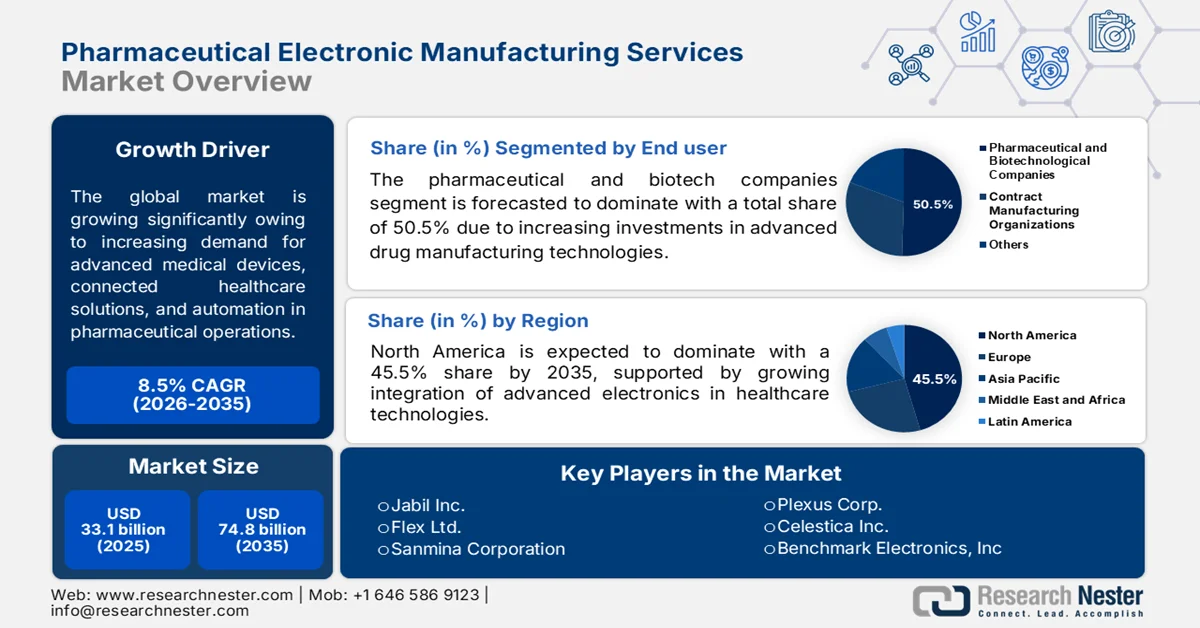
The pharmaceutical electronic manufacturing services market is poised to witness immense growth, which is driven by increasing demand for advanced medical devices, connected healthcare solutions, and automation in pharmaceutical operations. In addition, the rising adoption of electronic systems for drug development, monitoring, and patient care is also boosting uptake of this industry. In November 2023, the Organization for Economic Co-operation and Development stated that digital health transformation is improving healthcare through tools such as telemedicine, artificial intelligence, and electronic medical records. The adoption of EMRs and online health services has increased across OECD countries, allowing better information sharing between patients and providers, thus boosting the market’s growth potential.
Furthermore, manufacturers across both developed and developing nations are highly focused on outsourcing electronic design, assembly, and production services with the main goal of improving efficiency, accelerating product development, and leveraging specialized technological expertise. Besides, the integration of technologies such as Internet of Things (IoT), artificial intelligence, miniaturized electronics, and smart healthcare devices is supporting pharmaceutical electronic manufacturing services (EMS) market expansion. In November 2025, for instance, Flex and Merck KGaA, Darmstadt received the 2025 PDA drug delivery innovation award for their connected autoinjector, which combines digital technology with drug delivery to improve patient care. This smart device uses a mobile app, cloud-based data system, and healthcare monitoring tools in order to support treatment adherence, personalized care, and better health outcomes. Such collaboration highlights the role of electronic solutions in the healthcare ecosystem.
Key Pharmaceutical Electronic Manufacturing Services (EMS) Market Insights Summary:
Regional Highlights:
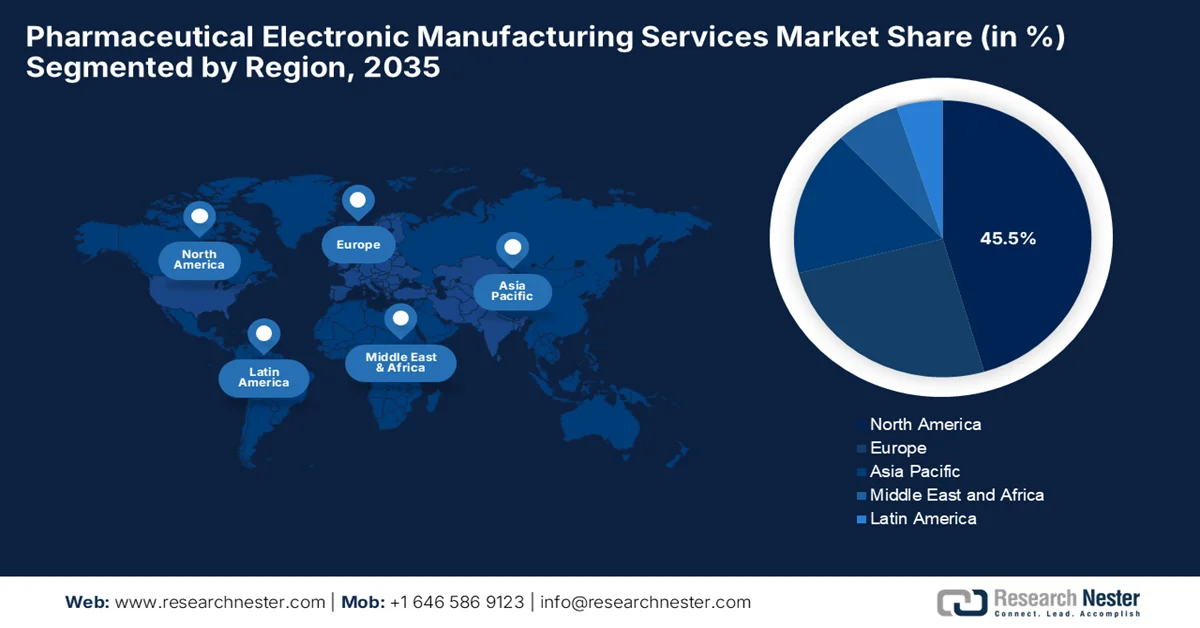
- The pharmaceutical electronic manufacturing services (EMS) market in North America is projected to account for 45.5% market share by 2035, reinforced by increasing integration of advanced electronics in healthcare devices and drug delivery systems
- Asia Pacific is poised to witness the fastest growth in the market throughout 2026-2035, fueled by rapid expansion of healthcare infrastructure, substantial investments in biopharmaceutical manufacturing, and the presence of dominant electronics manufacturing hubs
Segment Insights:
- The pharmaceutical electronic manufacturing services (EMS) market pharmaceutical and biotech companies segment is anticipated to capture 50.5% of the market share by 2035, supported by increasing investments in advanced drug manufacturing technologies and rising demand for precision electronic components in pharmaceutical production
- The drug manufacturing and processing segment is expected to retain a significant position in the market during 2026-2035, attributed to the increasing complexity of manufacturing operations requiring highly reliable electronic systems for process monitoring, equipment control, and quality assurance
Key Growth Trends:
- Outsourcing for cost efficiency
- Stringent regulatory compliance
Major Challenges:
- High capital expenditure and infrastructure intensity
- Supply chain volatility and component allocation risk
Key Players: Jabil Inc. (U.S.), Flex Ltd. (U.S.), Sanmina Corporation (U.S.), Plexus Corp. (U.S.), Celestica Inc. (Canada), Benchmark Electronics, Inc. (U.S.), Variosystems AG (Switzerland), Zollner Elektronik AG (Germany), TELEO Capital Management (U.S.).
Global Pharmaceutical Electronic Manufacturing Services (EMS) Market Forecast and Regional Outlook:
Market Size & Growth Projections:
- 2025 Market Size: USD 33.1 billion
- 2026 Market Size: USD 35.9 billion
- Projected Market Size: USD 74.8 billion by 2035
- Growth Forecasts: 8.5% CAGR (2026-2035)
Key Regional Dynamics:
- Largest Region: North America (45.5% share by 2035)
- Fastest Growing Region: Asia Pacific
- Dominating Countries: United States, China, Germany, Japan, Switzerland
- Emerging Countries: India, South Korea, Singapore, Ireland, Brazil
Last updated on : 6 August, 2026
Pharmaceutical Electronic Manufacturing Services Market - Growth Drivers and Challenges
Growth Drivers
- Outsourcing for cost efficiency: Developing internal electronic manufacturing needs substantial capital expenditure for equipment and specialized talent. In this context, pharmaceutical companies outsource to EMS partners to reduce overhead costs and operational risks; this strategic shift allows drug manufacturers to reallocate their financial resources toward core research and development activities. In February 2025, Jabil acquired Pharmaceutics International, Inc. (Pii), with a main goal to strengthen its pharmaceutical manufacturing and drug development services. This particular acquisition adds expertise in aseptic filling, lyophilization, and oral solid dose production, thus suitable for supporting pharmaceutical electronic manufacturing services (EMS) market expansion.
- Stringent regulatory compliance: The pharmaceutical sector requires proper compliance with global standards as well as regulations. Providers in the pharmaceutical electronic manufacturing services market offer specialized expertise, cleanrooms, and validated processes. This ensures medical devices and drug-delivery electronics meet strict quality needs, which in turn minimizes compliance risks for pharmaceutical companies. For instance, in March 2025, Flex inaugurated a new product introduction center near Boston to support healthcare customers in North America. The center provides end-to-end product development services, from prototyping and testing to production transfer, helping products reach the market faster while ensuring regulatory compliance, hence contributing to the market’s upliftment.
Challenges
- High capital expenditure and infrastructure intensity: Establishing a production line that is capable of generating medical-grade electronics demands high upfront financial investments, creating hesitation among small-scale players to make investments in this sector. Pharmaceutical electronics need to be manufactured in highly controlled, certified cleanrooms, whereas these cleanroom lines, testing systems, environmental controls, and validation support require more upfront spending when compared to ordinary industrial assembly operations. The presence of this capital intensity creates a lopsided industry, which directs big contracts toward larger enterprises that absorb infrastructure expenses, making it challenging for small and mid-scale players in the pharmaceutical electronic manufacturing services market.
- Supply chain volatility and component allocation risk: The pharmaceutical electronic manufacturing services market operates under persistent stress, which is caused by highly volatile global electronics supply chains. Sourcing specialized components such as semiconductors, microcontrollers, and sensors involves navigating fractured networks that are prone to severe geopolitical shocks. Therefore, any type of delay or cost increase can affect margins, contract pricing, inventory planning, and order fulfillment. When critical medical chips go on strict allocation lists, smaller EMS companies lack the procurement power to secure raw components. This structural vulnerability leads to lengthy component delays and thereby spikes material costs, in turn leading to production halts.
Pharmaceutical Electronic Manufacturing Services Market Size and Forecast:
| Report Attribute | Details |
|---|---|
|
Base Year |
2025 |
|
Forecast Period |
2026-2035 |
|
CAGR |
8.5% |
|
Base Year Market Size (2025) |
USD 33.1 billion |
|
Forecast Year Market Size (2035) |
USD 74.8 billion |
|
Regional Scope |
|
Pharmaceutical Electronic Manufacturing Services Market Segmentation:
End user Segment Analysis
By the conclusion of the assessed timeframe, the pharmaceutical and biotech companies segment is forecasted to dominate with a total share of 50.5%. The segment’s commendable position in the pharmaceutical electronic manufacturing services (EMS) market is largely driven by increasing investments in advanced drug manufacturing technologies and rising demand for precision electronic components in pharmaceutical production. Apart from this, expanding biologics and personalized medicine production is also contributing to the sub-segment's market leadership. The growing trend of outsourcing electronic manufacturing to specialized service providers enables pharmaceutical and biotech companies to reduce operational costs while accelerating product development. Furthermore, the heightening demand for connected medical devices, smart manufacturing systems, and reliable supply chain solutions is expected to drive the segment's dominance throughout the forecast period.
Application Segment Analysis
Drug manufacturing and processing is anticipated to maintain a prominent position in the pharmaceutical electronic manufacturing services market from 2026 to 2035. The sub-segment is growing continuously on account of the increasing complexity of manufacturing operations, which requires highly reliable electronic systems for process monitoring, equipment control, and quality assurance. In addition, the expansion of continuous manufacturing facilities and the integration of real-time data analytics are encouraging pharmaceutical manufacturers to depend on electronic manufacturing service providers. In December 2025, Lilly announced a total USD 3 billion expansion of its recently acquired manufacturing facility in Kenosha County, Wisconsin, to increase production of injectable medicines for diabetes, obesity, and future treatments. This project is expected to strengthen the company's advanced manufacturing capabilities through automation and digital technologies, thus supporting growing global demand for its medicines.
Product Type Segment Analysis
The pharmaceutical manufacturing equipment electronics segment, which is under product type, is projected to maintain its leadership over the forecasted years. The rising deployment of high-performance electronic components in critical production equipment, including filling systems, lyophilizers, sterilization units, and inspection machines, is driving the sub-segment’s leadership. The increasing need for equipment reliability and predictive maintenance capabilities is driving demand for advanced electronic assemblies. In June 2024, Syntegon introduced its patented settle plate changer in order to automate viable environmental monitoring in aseptic pharmaceutical filling processes. This system supports EU GMP Annex 1 compliance by reducing manual intervention, contamination risks, and production interruptions, thus benefiting the pharmaceutical electronic manufacturing services market.
India Export Statistics: Medical, Surgical, Dental and Electro-Medical Instruments in 2024
|
Exporter |
Trade Value (USD '000) |
|
European Union |
772,391.53 |
|
U.S. |
620,727.15 |
|
China |
447,180.06 |
|
Germany |
242,940.70 |
|
Singapore |
242,654.03 |
|
Netherlands |
169,403.97 |
|
Japan |
142,536.14 |
|
Korea, Rep. |
124,106.95 |
Source: WITS
Our in-depth analysis of the pharmaceutical electronic manufacturing services (EMS) market includes the following segments:
|
Segment |
Subsegments |
|
|
|
Application |
|
|
Product Type |
|
|
Service Type |
|

Vishnu Nair
Head - Global Business DevelopmentCustomize this report to your requirements — connect with our consultant for personalized insights and options.
Pharmaceutical Electronic Manufacturing Services Market - Regional Analysis
North America Market Insights
North America pharmaceutical electronic manufacturing services (EMS) market is forecasted to maintain a dominating position during the stipulated timeframe. The region is expected to hold 45.5% of the share due to the increasing integration of advanced electronics in healthcare devices and drug delivery systems. North America’s leading position is also propelled by its technological infrastructure, substantial investments in pharmaceutical research and development, and a strong presence of major medical device and electronics manufacturers. In September 2025, the Center for Strategic & International Studies stated that U.S. pharmaceutical manufacturing resilience requires more than tariffs, and targeted strategies are needed to address supply chain risks, workforce gaps, and regulatory challenges. It also mentioned that generic drugs account for about 90% of U.S. prescriptions but only 13.1% of drug spending. In addition, a stronger approach involving technology investment and ecosystem support is highly essential for long-term medicine supply security.
The healthcare sector relies on complex electronic systems for drug manufacturing, delivery, and diagnostics, driving upliftment of the U.S. pharmaceutical electronic manufacturing services market. The country’s market also benefits from the presence of a massive domestic medical tech ecosystem and steady investments in digital health solutions, such as remote patient monitoring and smart therapeutic devices. In December 2023, the U.S. Food & Drug Administration (FDA) stated that advanced manufacturing technologies such as continuous manufacturing and 3D printing can strengthen public health preparedness by improving drug quality, reducing shortages, and enabling faster production of vaccines and medical products. These approaches support flexible and resilient supply chains through distributed manufacturing, digital stockpiles, and proper production methods, thus driving market growth.
The Canada pharmaceutical electronic manufacturing services market has gained enhanced traction, which is driven by the country's exponentially growing biomanufacturing sector and a strong national focus on digital health innovation. In addition, the country’s market benefits from a network of specialized tech hubs and academic research partnerships, which foster the development of advanced medical technologies. Based on government data, which was published in March 2023, Health Canada’s GUI-0024 guidance provides procedures for obtaining electronic certificates of pharmaceutical product and GMP certificates to confirm pharmaceutical quality and manufacturing compliance. Its processes complete the applications within 25 business days, and issued electronic certificates are valid for 1 year to support international pharmaceutical trade and regulatory assurance.
APAC Market Insights
Asia Pacific pharmaceutical electronic manufacturing services (EMS) market is anticipated to grow at the quickest rate during the assessed timeframe. The region benefits from rapid expansion of healthcare infrastructure, substantial investments in biopharmaceutical manufacturing, and the presence of dominant electronics manufacturing hubs. Countries such as China, Japan, India, and South Korea are driving extensive growth owing to their production capabilities, cost-effective manufacturing operations, and heightened domestic healthcare demands. In this context, AbbVie in January 2024 announced a total of USD 223 million expansion of its Singapore manufacturing facility with a main goal to increase biologics production capacity and strengthen its worldwide supply network. This particular project will add a total of 24,000 liters of biologics drug-substance capacity, support immunology and oncology medicines, and thus create more opportunities for the pharmaceutical EMS industry.
India Electromedical Equipment Export Value Trends: Financial Year 2020-21 to FY 2024-25
|
Financial Year |
Export Value (USD Million) |
|
FY 2020–21 |
985 |
|
FY 2021–22 |
1,163 |
|
FY 2022–23 |
1,335 |
|
FY 2023–24 |
1,472 |
|
FY 2024–25 |
1,483 |
Source: PIB
The country’s industrial manufacturing infrastructure, extensive supply chains, and large-scale government initiatives to modernize healthcare technology are positioning China pharmaceutical and electronic manufacturing services market for solid growth in the upcoming years. The country’s market benefits from unparalleled production speed, integrated component networks, and certain specialized manufacturing clusters that support the assembly of advanced medical hardware. Based on government data published in April 2025, China is advancing the digital transformation of its pharmaceutical sector by integrating AI and next-generation information technologies into manufacturing and supply chains. This government initiative targets substantial advancements by the conclusion of 2027 and anticipates that major pharmaceutical companies will complete their digital and intelligent transformation by 2030.
Japan pharmaceutical electronic manufacturing services market is growing exponentially which is driven by an intense focus on quality assurance. The country’s market is primarily driven by the rapidly aging population, which fuels substantial demand for innovative home-healthcare electronics, wearable patient monitors, and sophisticated drug delivery systems. In April 2024, OMRON Healthcare acquired Luscii Healthtech with the main goal of expanding digital healthcare solutions and accelerating large-scale adoption of remote patient monitoring. This collaboration strengthens OMRON’s digital health capabilities by connecting hospitals, physicians, community care providers, and patients across multiple regions. This initiative reflects the increasing demand for connected medical electronics and digitally integrated healthcare devices in Japan, thus making it suitable for standard market growth.
Europe Market Insights
The Europe pharmaceutical electronic manufacturing services (EMS) market is expected to expand at a steady pace, effectively driven by strong emphasis on patient safety and pioneering advancements in digital health solutions. Growth in the regional market is heavily fueled by the rising adoption of intelligent drug delivery systems, personalized medical devices, and connected health electronics designed to meet the strict sustainability and data security standards. In January 2026, the region’s parliament advanced the Critical Medicines Act to strengthen Europe’s medicine supply security by reducing dependence on limited suppliers and increasing local pharmaceutical manufacturing. The initiative focuses on strategic manufacturing projects, joint procurement, stockpile coordination, and supply-chain diversification to address shortages of essential medicines, thus elevating the growth potential of the market.
The prominent life sciences industry, well-established academic research institutions, and constant national efforts to advance digital healthcare and remote patient monitoring solutions are driving the overall UK pharmaceutical electronic manufacturing services market. The country’s industry is highly driven by the development of drug delivery platforms, smart inhalers, and wearable medical devices, which are aimed at improving efficiency and patient compliance. In March 2025, the UK Research & Innovation stated that the country is investing more than USD 18 million across 29 projects through the Sustainable Medicines Manufacturing Innovation Programme in order to improve sustainability in pharmaceutical production. This initiative focuses on waste reduction, emissions control, green chemistry, circular manufacturing, and resource efficiency.
The France pharmaceutical electronic manufacturing services (EMS) market is growing exponentially on account of state-backed digital health initiatives and a strong focus on medical technology innovation. The national market is significantly driven by regional biopharmaceutical ecosystems and innovation centers that support the advancement of connected healthcare devices, smart drug delivery technologies, and diagnostic equipment. In May 2024, Sanofi announced an investment of over USD 1.1 billion to expand biomanufacturing capacity at three sites in France, thereby strengthening domestic production of essential medicines. The investment includes USD 1.1 billion for monoclonal antibody production in Vitry-sur-Seine, USD 108 million for biologics manufacturing in Le Trait, and USD 11 million for Tzield® production in Lyon, thus making it suitable for standard pharmaceutical electronic manufacturing services (EMS) market growth.
Key Pharmaceutical Electronic Manufacturing Services Market Players:
- Jabil Inc. (U.S.)
- Flex Ltd. (U.S.)
- Sanmina Corporation (U.S.)
- Plexus Corp. (U.S.)
- Celestica Inc. (Canada)
- Benchmark Electronics, Inc. (U.S.)
- Variosystems AG (Switzerland)
- Zollner Elektronik AG (Germany)
- TELEO Capital Management (U.S.)
- Company Overview
- Business Strategy
- Key Product Offerings
- Financial Performance
- Key Performance Indicators
- Risk Analysis
- Recent Development
- Regional Presence
- SWOT Analysis
- Jabil Inc. provides end-to-end pharmaceutical EMS solutions, which include design, engineering, electronics manufacturing, drug delivery device production, and CDMO services through Pii. In addition, the company supports autoinjectors, inhalers, insulin pens, and connected healthcare devices with global manufacturing capabilities and regulatory expertise.
- Flex Ltd. delivers healthcare-focused EMS solutions which is through advanced manufacturing, engineering, supply chain management, and quality validation services. The firm’s global manufacturing network helps pharmaceutical and medical device companies scale production efficiently, thereby meeting quality requirements.
- Sanmina Corporation is yet another foundational player in this sector, which offers integrated electronics manufacturing solutions for healthcare applications, i.e., design, PCB assembly, systems integration, testing, and precision manufacturing. It provides pharmaceutical and medical device organizations with dependable, regulatory-compliant electronic solutions.
- Plexus Corp. provides end-to-end manufacturing services for healthcare and life sciences, covering design, PCB assembly, automation, testing, and supply chain solutions. The firm’s strong focus on quality, reliability, and cost optimization supports pharmaceutical companies developing advanced electronic healthcare products.
- Celestica Inc. delivers healthcare EMS solutions through certain engineering, advanced manufacturing, automation, systems integration, and lifecycle services. Further, the company’s Lean Six Sigma approach and global capabilities help pharmaceutical and medical technology companies improve efficiency, as well as regulatory compliance.
Here is a list of key players operating in the global pharmaceutical electronic manufacturing services market:
In the global pharmaceutical electronic manufacturing services (EMS) market, competition is concentrated among specialized healthcare electronics manufacturers and medical technology manufacturing providers that possess extensive pharmaceutical device capabilities. Leading companies in this field differentiate themselves through regulated manufacturing expertise, ISO-compliant quality systems, global production networks, and capabilities in connected drug delivery devices, wearable systems, as well as electronic pharmaceutical equipment. In addition, players from established nations dominate the sector due to advanced healthcare manufacturing ecosystems, whereas emerging countries are gaining importance through expanded electronics manufacturing capacity and cost-efficient production capabilities.
Corporate Landscape of the Pharmaceutical Electronic Manufacturing Services (EMS) Market:
Recent Developments
- In June 2026, Jabil expanded its manufacturing footprint in India with the inauguration of a new facility in Pune to strengthen its production and engineering capabilities in the region. The expansion increases its operational capacity and workforce in India, supporting its long-term strategy to enhance advanced manufacturing capabilities.
- In June 2026, TELEO Capital Management announced the acquisition of SmartFactory Rx™, which is a pharmaceutical manufacturing intelligence platform from Applied Materials, and rebranded it as Modersys. This platform supports biopharmaceutical and life sciences manufacturers through AI-based analytics and advanced manufacturing optimization solutions.
- Report ID: 8727
- Published Date: Aug 06, 2026
- Report Format: PDF, PPT
- Explore a preview of key market trends and insights
- Review sample data tables and segment breakdowns
- Experience the quality of our visual data representations
- Evaluate our report structure and research methodology
- Get a glimpse of competitive landscape analysis
- Understand how regional forecasts are presented
- Assess the depth of company profiling and benchmarking
- Preview how actionable insights can support your strategy
Explore real data and analysis
Frequently Asked Questions (FAQ)
About this Report
Connect with our Expert


Report, 2026-2035



Copyright @ 2026 Research Nester. All Rights Reserved.
