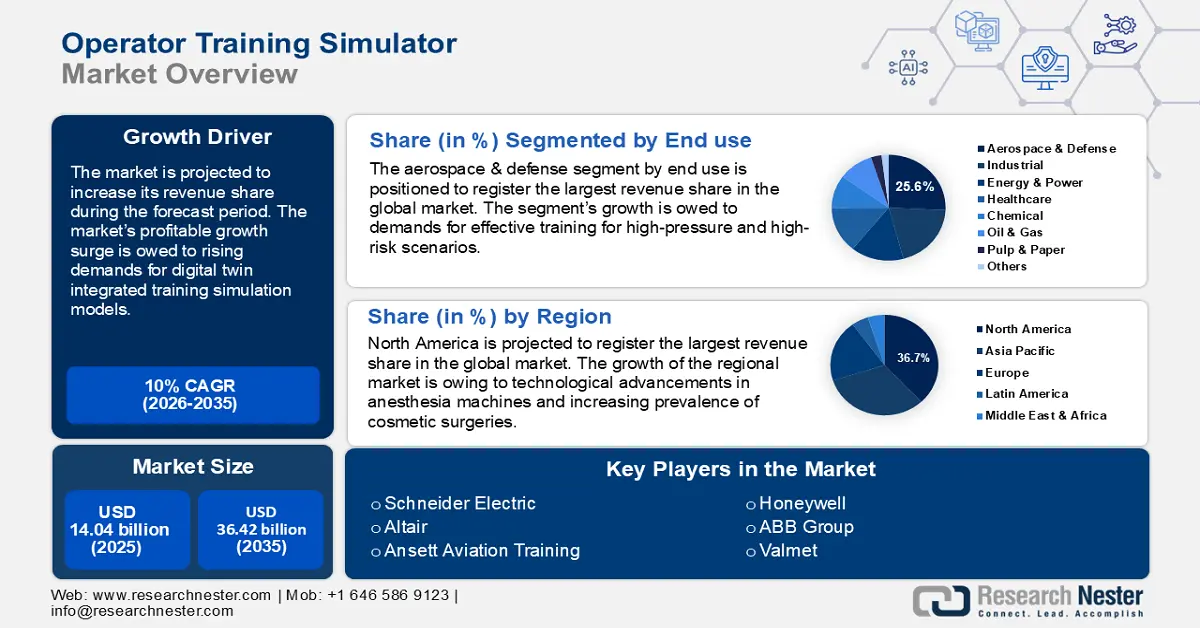
Operator Training Simulator Market Outlook:
Operator Training Simulator Market size was valued at USD 14.04 billion in 2025 and is likely to cross USD 36.42 billion by 2035, expanding at more than 10% CAGR during the forecast period i.e., between 2026-2035. In the year 2026, the industry size of operator training simulator is assessed at USD 15.3 billion.
The growth of the OTS sector is attributed to industries prioritizing safety and skill development of workers. Industries are seeking to prioritize worker skill development over hiring new talents, owing to the cost-effectiveness of investing in internal skill development. Operator training simulators provide an effective solution to upskilling workers by providing risk-free environments for operators to gain hands-on experience.
Sectors such as manufacturing, oil & gas, healthcare, etc., are experiencing rapid adoption of automation that drives the need for worker training. This is fueling the adoption of OTS solutions as effective simulators replicating real-world scenarios. Businesses can cut down on operational risks by implementing OTS solutions by mimicking high-pressure situations for workers. Additionally, the advent of virtual reality (VR) and augmented reality (AR) boosts the realism of the simulators, benefiting the growth of the operator training simulator sector. For instance, in November 2022, Airbus announced the Virtual Procedure Trainer (VPT) that will allow trainees to practice procedures in a fully interactive cockpit to build procedural knowledge and muscle memory. The company announced Lufthansa group as its first customer for VPT.
The operator training simulator market is poised to provide profitable revenue opportunities for global and local businesses. With the increased traction for cloud-based deployment models, small and medium-sized enterprises (SMEs) are set to benefit from cost-effective training solutions and avoid incurring significant costs from investments in physical infrastructure. The integration of machine learning (ML) into OTS platforms allows accurate analysis of operator performance and customize individual training sessions if necessary. Additionally, new revenue streams in emerging economies in Africa and APAC are poised to benefit the sector’s growth. For instance, in September 2024, Ansett Aviation Training (AAT) announced that its training centers have the capability to support African operators with Airbus A320, ATR600, or Boeing B737NG training infrastructure.