Oil and Gas Turbomachinery Market Outlook:
Oil and Gas Turbomachinery Market size was over USD 14.2 billion in 2026 and is anticipated to exceed USD 23.3 billion by the end of 2036, growing at over 5.1% CAGR during the forecast period i.e., between 2027-2036. In 2027, the industry size of oil and gas turbomachinery is evaluated at USD 14.9 billion.
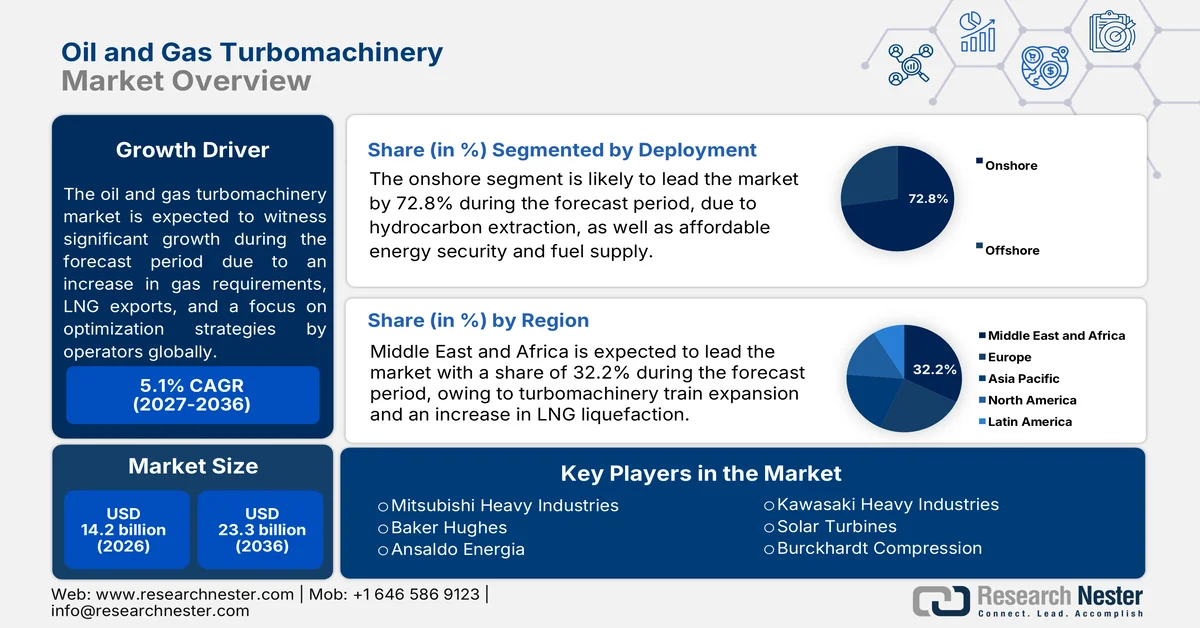
The worldwide oil and gas turbomachinery market is continuously expanding, owing to the need for rotating equipment driven by gas-powered demand and LNG exports, and a strong push for operators to improve. According to a data report published by the IEA Organization in 2026, global gas demand increased by 2.8% in 2024, then slightly decreased in 2025 due to high LNG prices. Despite this, demand further increased by 1% by the end of 2025, which translated to a surge of almost 40 BCM or 1.4 EJ in absolute terms across different nations. Besides, the building industry significantly contributed to growth in natural gas, with an increase in demand of 70% as of 2025. Additionally, the power and industrial sectors also accounted for nearly 65% of incremental gas demand in 2024, thus positively impacting the market’s growth and exposure globally.
Region-Wise Average Yearly Change in Natural Gas Shipment, 2004-2025
|
Region |
2004-2014 (bcm) |
2014-2024 (bcm) |
2024 (bcm) |
2025 (bcm) |
|
U.S. |
14 |
18 |
18 |
13 |
|
European Union |
-8 |
-1 |
6 |
10 |
|
Japan |
4 |
-3 |
5 |
-1 |
|
Other Advanced Regions |
7 |
9 |
20 |
5 |
|
China |
15 |
24 |
30 |
9 |
|
India |
2 |
2 |
10 |
-3 |
|
Middle East |
20 |
16 |
20 |
15 |
|
Russia |
5 |
6 |
5 |
-15 |
|
Other EMIDE |
14 |
7 |
-7 |
8 |
|
Global |
72 |
78 |
105 |
40 |
Source: IEA Organization
Furthermore, the structural shift towards supply-chain localization and installed-base modernization through staged retrofits are certain trends that are responsible for bolstering the oil and gas turbomachinery market globally. As stated in an article published by the World Bank Organization in June 2025, nearly 40% of worldwide energy expenditure by the end of 2050 is poised to originate from energy efficiency. Meanwhile, generous investment in energy efficiency is not urgent, particularly across developing nations, wherein the energy requirement is expected to increase by more than 30% within the same forecast year. In addition to this, energy efficiency can yield the payers’ pricing, ranging from USD 3 to USD 5 in returns, and also cater to delivering other socio-economic advantages, including government spending and lowered energy poverty, as well as reduced pollution and enhanced resilience.
Key Oil and Gas Turbomachinery Market Insights Summary:
Regional Highlights:
- Middle and East Africa is projected to command a 32.2% share of the oil and gas turbomachinery market by 2036, supported by expanding turbomachinery trains, rising liquefaction capacity, traditional gas development, and gas processing megaprojects
- Asia Pacific is anticipated to emerge as the fastest-growing region during the forecast period, propelled by the transition from coal to gas, combined-cycle procurement, regional supply expansion, and domestic energy equipment manufacturing
Segment Insights:
- The onshore deployment segment is anticipated to capture a 72.8% share of the oil and gas turbomachinery market by 2036, underpinned by the essential role of land-based hydrocarbon processing and extraction in supporting cost-effective fuel supply and energy security
- The midstream industry segment is projected to account for a 40.2% share during the forecast period, bolstered by the critical role of turbomachinery in hydrocarbon transportation, processing, storage, and pipeline operations
Key Growth Trends:
- Expansion in LNG liquefaction capacity
- Compressor demand from pipeline debottlenecking and gas processing
Major Challenges:
- Supply chain bottlenecks and extended lead times
- Ageing installed base and changing operating profiles
Key Players: GE Vernova (U.S.),Siemens Energy (Germany),Mitsubishi Heavy Industries (Japan),Baker Hughes (U.S.),Ansaldo Energia (Italy),Atlas Copco (Sweden),Ingersoll Rand (U.S.),Elliott Group / Ebara Elliott Energy (U.S. / Japan),MAN Energy Solutions (Germany),Kawasaki Heavy Industries (Japan),Solar Turbines (U.S.),Burckhardt Compression (Switzerland),Triveni Turbine (India) ,Kirloskar Pneumatic (India).
Global Oil and Gas Turbomachinery Market Forecast and Regional Outlook:
Market Size & Growth Projections:
- 2026 Market Size: USD 14.2 billion
- 2027 Market Size: USD 14.9 billion
- Projected Market Size: USD 23.3 billion by 2036
- Growth Forecasts: 5.1% CAGR (2027-2036)
Key Regional Dynamics:
- Largest Region: Middle and East Africa (32.2% Share by 2036)
- Fastest Growing Region: Asia Pacific
- Dominating Countries: United States, Saudi Arabia, China, Russia, Canada
- Emerging Countries: India, Australia, Indonesia, Malaysia, Brazil
Last updated on : 28 September, 2026
Oil and Gas Turbomachinery Market - Growth Drivers and Challenges
Growth Drivers
- Expansion in LNG liquefaction capacity: This is considered the most direct demand driver for the oil and gas turbomachinery market. According to a data report published by the IEA Organization in June 2025, the world, at present, comprises almost 670 bcm per year of LNG liquefaction capacity. Additionally, the overall amount of about 290 bcm per year of the newest LNG export capacity is projected to be online from projects that have reached investment decision and are under construction by the end of 2030. This particular capacity is further set to increase strongly through the end of the decade, with standard implications for the worldwide gas sector. Therefore, with such expectations, there is a huge growing opportunity for LNG liquefaction, which is positively fueling the market exposure.
- Compressor demand from pipeline debottlenecking and gas processing: This particular demand has generated a sustained demand for the compression equipment in the oil and gas turbomachinery market globally. As stated in an article published by NLM in June 2026, the optimized strategy in a compressor station tends to lower power consumption from an estimated 32 MW to 24.5 MW, which further corresponds to an energy saving of nearly 23%. This eventually demonstrates the potential of intelligent and standard optimization for supporting low-carbon and energy-efficient operation of the natural gas transportation infrastructure. Therefore, natural gas compressor stations significantly contribute to a substantial share of energy consumption, particularly in long-distance pipeline systems, thus proliferating the market expansion.
Challenges
- Supply chain bottlenecks and extended lead times: The oil and gas turbomachinery market faces severe constraints in sourcing critical components. In this regard, spare-parts shortages and long-lead times for specialized materials, particularly turbine-grade alloys and castings, create persistent delivery delays. Besides, manufacturing facilities designed for modest production volumes must now scale rapidly to meet surging demand, straining testing, commissioning, and spare-parts planning capabilities. Moreover, backlogs have stretched significantly, with lead times extending from traditional cycles to multi-year waits for new equipment. This bottleneck limits how quickly suppliers can respond to orders, constraining market growth even where demand exists.
- Ageing installed base and changing operating profiles: A significant portion of operating turbomachinery has exceeded its original design life, requiring increasingly intensive maintenance and life-extension strategies. Simultaneously, equipment designed for baseload operation is being pushed into cyclic and partial-load duty as power systems integrate more renewables. This transition accelerates wear and demands advanced condition monitoring and physics-based lifetime assessment. Therefore, replacement capacity remains constrained, pressuring operators to extend asset life rather than retire equipment, which shifts spending away from greenfield purchases toward upgrades and service, thus limiting the oil and gas turbomachinery market’s growth.
Oil and Gas Turbomachinery Market Size and Forecast:
| Report Attribute | Details |
|---|---|
|
Base Year |
2026 |
|
Forecast Year |
2027-2036 |
|
CAGR |
5.1% |
|
Base Year Market Size (2026) |
USD 14.2 billion |
|
Forecast Year Market Size (2036) |
USD 23.3 billion |
|
Regional Scope |
|
Oil and Gas Turbomachinery Market Segmentation:
Deployment Segment Analysis
The onshore deployment segment is anticipated to garner the highest share of 72.8% in the oil and gas turbomachinery market by the end of 2036. The segment’s upliftment is primarily attributed to processing and extracting hydrocarbons on land, based on which it remains essential for global cost-effective fuel supply, economic stability, and energy security. According to a data report published by the Department of Energy (DOE) in December 2021, the share of reduced global oil supply is projected to increase from almost 37% to 52% by the end of 2050. Despite this, the per capita income from oil and natural gas is expected to reduce by 75%, which is from USD 1,800 to USD 450 by the end of 2030. Therefore, to combat this, new sources of revenue and structural policies are increasingly required. In addition, technologies, including CCUS, offshore wind, and hydrogen, are required to manage emissions, thus making it suitable for boosting the segment’s growth.
Industry Segment Analysis
During the forecast period, the midstream industry segment is predicted to account for the second-highest share of 40.2% in the oil and gas turbomachinery market. The segment’s growth is effectively driven by the essential role that turbomachinery plays in moving, processing, and storing hydrocarbons between extraction sites and end markets. Besides, compressors and turbines are central to natural gas transmission, gathering systems, and processing plants, where they maintain pipeline pressure and enable efficient transport across long distances. As global gas trade expands and export corridors develop, demand for reliable midstream equipment grows accordingly. The segment benefits from recurring aftermarket needs, since pipeline operators must continually maintain, upgrade, and replace aging compression assets. Moreover, retrofit activity and debottlenecking projects further reinforce midstream's steady contribution to overall oil and gas turbomachinery market demand.
Type Segment Analysis
The gas compressors sub-segment under the type segment is expected to grab the third-highest share of 34.8% in the oil and gas turbomachinery market by the end of the stipulated timeline. The sub-segment’s development is highly propelled by its importance as a mechanical device that enables the ability to increase the pressure of a gas by diminishing its volume. In addition, it can also enable the processing of gases, storage, and efficient transport across different sectors. Besides, compressors are also crucial for enabling pipeline transportation, enhanced extraction and production, along with industrial processing and manufacturing, as well as storage and liquefaction. Moreover, the continuous shipment of gas compressors through standard exports across different countries is also positively fueling the segment’s growth and exposure globally.
Country-Wise Gas Compressors Shipment-Based Export, 2024
|
Country |
Trade Value (USD 1,000) |
Quantity (Item) |
|
European Union |
5,423,428.5 |
11,478,900 |
|
China |
4,996,212.6 |
149,689,000 |
|
Germany |
3,702,986.9 |
8,007,090 |
|
U.S. |
2,378,149.5 |
3,835,020 |
|
Italy |
1,298,426.0 |
1,432,300 |
|
Mexico |
1,215,671.5 |
4,680,140 |
|
Belgium |
1,093,133.0 |
1,208,340 |
|
Poland |
974,784.2 |
9,219,260 |
|
UK |
927,268.0 |
1,512,520 |
|
Romania |
868,070.7 |
3,482,470 |
Source: WITS
Our in-depth analysis of the oil and gas turbomachinery market includes the following segments:
|
Segment |
Subsegments |
|
Deployment |
|
|
Industry |
|
|
Type |
|

Vishnu Nair
Head - Global Business DevelopmentCustomize this report to your requirements — connect with our consultant for personalized insights and options.
Oil and Gas Turbomachinery Market - Regional Analysis
Middle East and Africa Market Insights
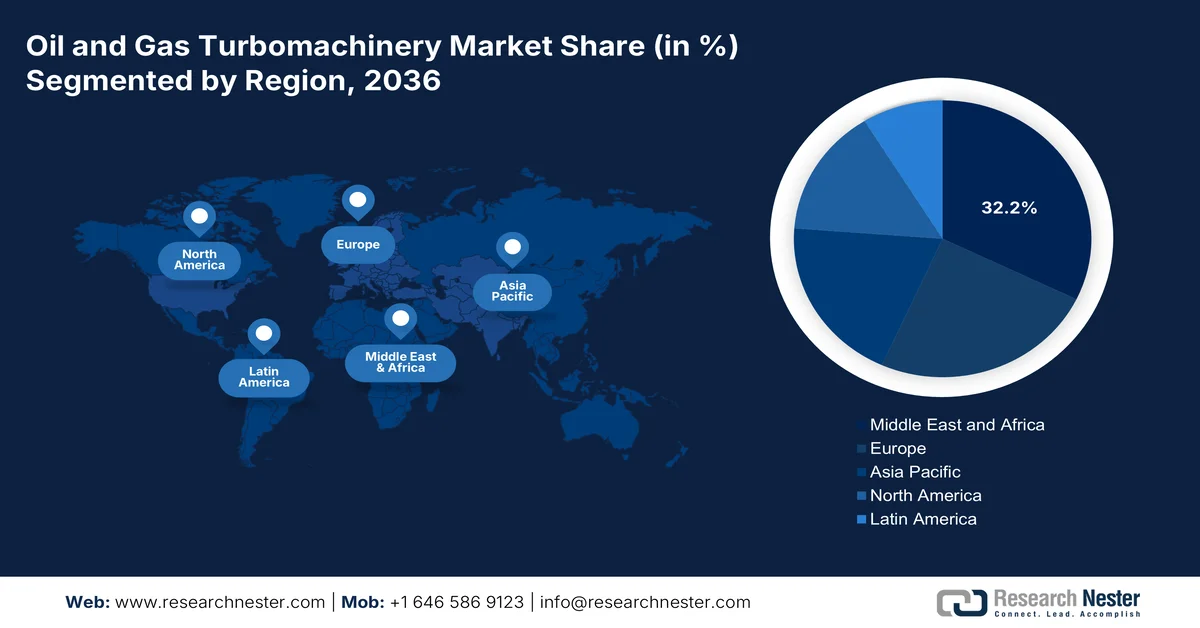
Middle and East Africa oil and gas turbomachinery market is anticipated to garner the largest share of 32.2% by the end of 2036. The market’s upliftment in the region is primarily attributed to an expansion in turbomachinery trains, a surge in liquefaction capacity, traditional gas development, and the presence of gas processing megaprojects. According to the 2025 World Energy Investment data report published by the IEA Organization, the region accounts for low-cost oil and gas resources globally and additionally offers nearly 30% and 17% of the worldwide oil and natural gas production, respectively. Based on this, the upstream oil and gas investment is highest, especially in Saudi Arabia and reached almost USD 40 billion as of 2025, which is about 15% more than in the past 10 years. Besides, the region overall invested nearly USD 130 billion in oil and gas supply as of the same year, thereby positively impacting the market’s growth.
Energy Investment Trends in Middle East and Africa, 2024
|
Components/Year |
2015 (USD Billion) |
2024 (USD Billion) |
2025e (USD Billion) |
2035 STEPS (USD Billion) |
2035 APS (USD Billion) |
|
Low-Emissions Electricity |
4.4 |
6.9 |
10.0 |
14.6 |
38.2 |
|
Grids and Storage |
20.5 |
13.2 |
14.1 |
22.9 |
43.9 |
|
Fossil Fuel Power |
11.7 |
12.4 |
10.9 |
6.2 |
6.8 |
|
Clean Supply |
0.2 |
0.7 |
1.6 |
6.0 |
29.4 |
|
Fossil Fuel Supply |
134.7 |
131.2 |
133.3 |
118.5 |
72.9 |
|
End use |
5.6 |
12.0 |
14.8 |
26.4 |
35.3 |
Source: IEA Organization
The oil and gas turbomachinery market in Saudi Arabia is growing significantly, owing to the development of the unconventional gas field and an expansion in power generation capacity. As stated in a data report published by the ITA in May 2026, the power generation sector is predicted to grow from 87.8 gigawatts as of 2024 to 116.4 gigawatts by the end of 2029, along with a 5.8% growth rate. In addition, the spending on renewable and power energy projects by the Ministry of Energy is predicted to reach a valuation of USD 293 billion by 2030. Likewise, the government in the country has also pledged to significantly generate 50% of the national electricity from renewable sources by the same year. Besides, global diversification from gas and oil, along with suitable government reforms for ensuring clean energy sources, thus demonstrating an optimistic outlook for the oil and gas turbomachinery market’s growth in the country.
Supply chain resilience, industrial localization, and an expansion in LNG export capacity are certain factors that are responsible for fueling the oil and gas turbomachinery market in the UAE. As per a data report published by the ITA in July 2026, the country has increased LNG production capacity, particularly in Abu Dhabi, with Phase 1 poised to aim for an estimated 9.6 million tons per annum and further expected to commence exports by the end of 2028. Besides, in terms of organizational contributions, Nimex Terminals and Abu Dhabi Ports Group signed an agreement for establishing the nation’s first-ever private-sector LNG and Liquefied Petroleum Gas (LPG) terminal centers at Khalifa Port. This is considered a more than USD 8 billion project aimed at turning the country into the ultimate regional LNG logistics and trading facility, thus positively contributing to the market’s upliftment.
APAC Market Insights
The Asia Pacific oil and gas turbomachinery market is expected to emerge as the fastest-growing region during the forecast period. The market’s development in the region is highly propelled by an expansion in transition from coal to gas, a focus on combined-cycle procurement, an improvement in regional supply depth, and the development of domestic energy equipment manufacturing capacity. According to an article published by Energy Economics in October 2024, the implementation of energy reforms readily correlates with an average surge by 0.1% increase in energy efficiency. Besides, the region is poised to account for nearly 50% of the worldwide economic growth, ensuring an increase in energy demand by 45% by the end of 2050. Besides, countries in the region effectively rely on traditional energy, resulting in energy and climate security issues, thus increasingly contributing to optimizing energy efficiency.
The oil and gas turbomachinery market in China is gaining increased traction, owing to dual-carbon compliance efforts, coal-to-gas transitions, the presence of governmental policy framework, and the demand for gas compressors and turbines. As stated in the 2025 World Energy Investment data report published by the IEA Organization, the country significantly achieved its 2030 solar and wind capacity target as of 2024, which demonstrated 6 years ahead of the usual schedule. Besides, based on the September 2026 OEC data report, the country exported USD 4.1 billion of gas turbines as of 2025. Additionally, major destinations of the exports include USD 921 million in the U.S., which is followed by USD 596 million in France, USD 375 million in Hong Kong, USD 371 million in Russia, and USD 233 million in Germany, thereby making it suitable for enhancing oil and gas turbomachinery market development.
The aspects of an expansion in rotating equipment industry, an escalation in strengthening national demand for turbomachinery equipment, an upsurge in manufacturing activities, increased industrialization, and suitable investments in transportation and energy are certain trends that are responsible for fueling the oil and gas turbomachinery market in India. As per an article published by Invest India Government in August 2026, the country’s non-traditional energy industry generously attracted a cumulative FDI equity inflow of USD 24,918.1 million as of March 2026. Additionally, the industry has positioned the country in 9th position, further accounting for 3% of the country’s overall FDI equity inflow. Besides, the industry accounted for a record USD 3,019 million between 2025 and 2026, which is further followed by USD 3.5 million between 2024 and 2025, and USD 3.2 million between 2023 and 2024, thus positively driving the market’s development.
Europe Market Insights
Europe oil and gas turbomachinery market is predicted to account for a considerable share by the end of the stipulated timeline. The market’s growth in the region is effectively driven by the existence of massive service bases, an increase in turbomachinery orders, modifications in compressor stations, and generous fund provision for decarbonizing energy supplies. According to a May 2026 UK Government article, employment opportunities across the British sector are focused on gaining security, owing to the provision of USD 471.5 million (£350 million) by the government, along with USD 161.6 million (£120 million) for crucial chemical sites and producers, along with the ceramics industry, respectively. Therefore, these two funds targeted the infrastructure in the UK to support employment opportunities and protect overall economic security, thus proliferating the oil and gas turbomachinery market’s growth.
The oil and gas turbomachinery market is gaining increased exposure in Germany, owing to the petrochemical and refining industries, a reduction in electricity prices, and an expansion in electricity price compensation for energy-based sectors. As stated in an article published by the Clean Energy Wire Organization in April 2026, the overall region readily approved an electricity price subsidy, especially for energy-intensive sectors in the country, by significantly freeing up to USD 4.3 billion (€3.8 billion) for state support by the end of 2028. The purpose of this was to launch a temporary industry electricity price subsidy, which is poised to provide suitable relief to its very own energy-based sector. Meanwhile, the European Commission greenlighted suitable state aid schemes for electricity price relief for energy organizations in Slovenia, Bulgaria, and Germany, thus boosting the oil and gas turbomachinery market exposure.
The increase in industrial decarbonization, energy security, an expansion in supply chains for critical energy inputs, suitable funds for supporting efficiency improvements, and a reduction in energy expenses are a few factors that are uplifting the oil and gas turbomachinery market in the UK. As per an article published by the UK Government in April 2026, the government has proclaimed a reduction in electricity bills by almost 25% for more than 10,000 domestic businesses through the British Industrial Competitiveness Scheme. In addition, the scheme is also expected to be expanded by 40%, with a one-off additional payment by the end of 2027. Based on this, this is focused on rolling out an additional 3,000 businesses and covering supportive firms. Therefore, based on all aspects, the market is continuously growing ad well as expanding in the country.
Key Oil and Gas Turbomachinery Market Players:
- GE Vernova (U.S.)
- Siemens Energy (Germany)
- Mitsubishi Heavy Industries (Japan)
- Baker Hughes (U.S.)
- Ansaldo Energia (Italy)
- Atlas Copco (Sweden)
- Ingersoll Rand (U.S.)
- Elliott Group / Ebara Elliott Energy (U.S. / Japan)
- MAN Energy Solutions (Germany)
- Kawasaki Heavy Industries (Japan)
- Solar Turbines (U.S.)
- Burckhardt Compression (Switzerland)
- Triveni Turbine (India)
- Kirloskar Pneumatic (India)
- Company Overview
- Business Strategy
- Key Product Offerings
- Financial Performance
- Key Performance Indicators
- Risk Analysis
- Recent Development
- Regional Presence
- GE Vernova manufactures heavy-duty and aeroderivative gas turbines used for mechanical drive and power generation across oil and gas operations. Its installed base spans LNG liquefaction, pipeline compression, and refinery applications, supported by a global service network.
- Siemens Energy produces industrial and heavy-duty gas turbines, steam turbines, and compressors for upstream, midstream, and downstream oil and gas applications. The company is particularly strong in LNG refrigeration trains and large-scale pipeline compression projects.
- Mitsubishi Heavy Industries manufactures large-frame gas turbines for LNG liquefaction, petrochemical, and refinery service through its Mitsubishi Power division. Its turbomachinery portfolio emphasizes high efficiency and long maintenance intervals for continuous-duty oil and gas operations.
- Baker Hughes supplies gas turbines, centrifugal compressors, and reciprocating compressors for oil and gas applications including LNG, pipeline transmission, and gas processing. The company integrates turbomachinery with digital monitoring and aftermarket services across the value chain.
- Ansaldo Energia manufactures gas turbines and steam turbines for power generation and industrial applications, including oil and gas facilities. Its portfolio serves refinery cogeneration, petrochemical plants, and remote oilfield power requirements.
Here is a list of key players operating in the global oil and gas turbomachinery market:
The global oil and gas turbomachinery market is highly consolidated at the top, with a small group of multinational corporations, such as GE Vernova, Siemens Energy, Mitsubishi Heavy Industries, and Baker Hughes, controlling a significant share of the gas turbine market through broad global presence and integrated service networks. Additionally, a diverse set of major and niche manufacturers compete on regional strength, application specialization, and product portfolio depth. Besides, in April 2026, Siemens Energy expanded its activities in Angola, which effectively underlined its growing commitment in the country, which comprises the objective of 25% gas in its energy mix. Based on this expansion, prices continue to remain volatile and international pressures are reshaping trade flows, thus proliferating the oil and gas turbomachinery industry’s growth.
Corporate Landscape of the Market:
Recent Developments
- In September 2026, Africa Energy Technology Centre (AETC) effectively expanded its strategic technology and energy cooperation with Angola, based on the launch of a multi-year licensing program and awarding 35 of 50 offshore and onshore blocks and drawing over USD 60 billion in investment commitments.
- In October 2025, Burckhardt Compression strengthened the North America-based service footprint with its newest facilities in the U.S. and Canada by opening a 1,200 m² facility that offers maintenance, testing, and sales support.
- In July 2025, Baker Hughes and Petroliam Nasional Berhad (PETRONAS) effectively entered a memorandum of understanding on a tactical partnership to explore business strategies that constitute the potential for supporting energy transition and expansion in Asia.
- Report ID: 8769
- Published Date: Sep 28, 2026
- Report Format: PDF, PPT
- Explore a preview of key market trends and insights
- Review sample data tables and segment breakdowns
- Experience the quality of our visual data representations
- Evaluate our report structure and research methodology
- Get a glimpse of competitive landscape analysis
- Understand how regional forecasts are presented
- Assess the depth of company profiling and benchmarking
- Preview how actionable insights can support your strategy
Explore real data and analysis
Frequently Asked Questions (FAQ)
About this Report
Connect with our Expert


Report, 2027-2036



Copyright @ 2026 Research Nester. All Rights Reserved.
