O Nitrochlorobenzene Market Outlook:
O Nitrochlorobenzene Market size was over USD 2 billion in 2025 and is expected to reach USD 3.6 billion by the end of 2035, growing at around 6.4% CAGR during the forecast period i.e., between 2026-2035. In 2026, the industry size of o nitrochlorobenzene is assessed at USD 2.1 billion.
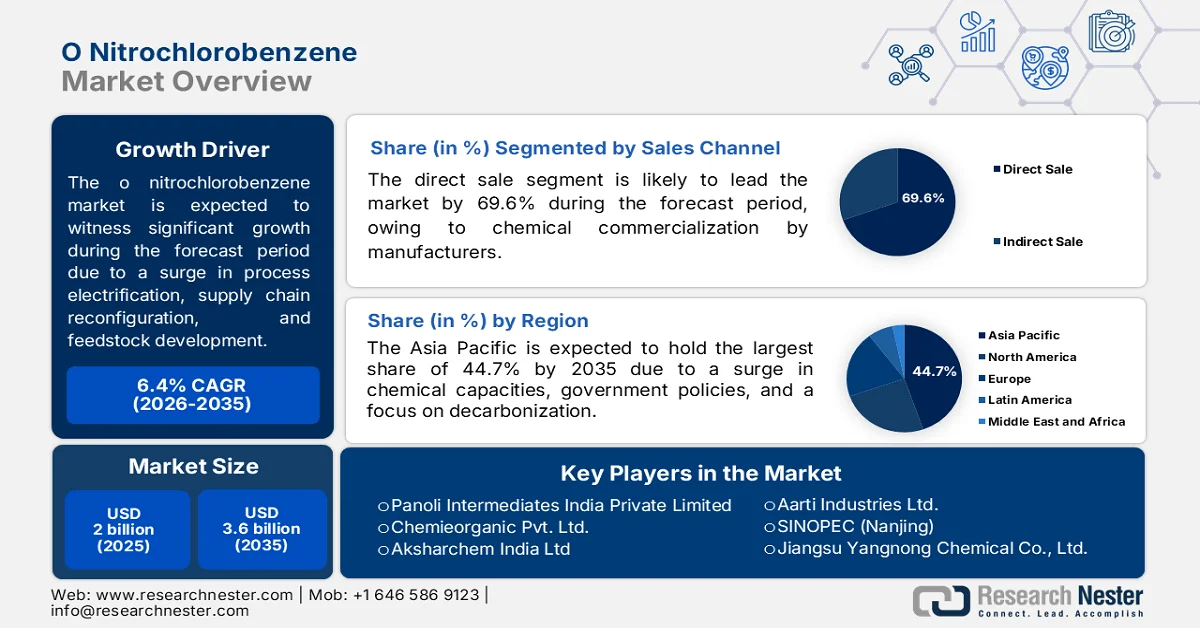
The global o nitrochlorobenzene market is currently undergoing a structural transformation, owing to environmental imperatives, trade flow reconfiguration, process electrification, and alternative feedstock development. According to a data report published by the IEA Organization in February 2026, the requirement for power is expected to increase by more than 3.5% per year on average globally, with a surge in the generation of electricity from nuclear, natural gas, and renewables. Besides, the electricity demand is expected to continue to grow at a rate 2.5 times as rapid as the total energy demand through 2030. Therefore, electrification is suitable for decarbonizing the production process of o nitrochlorobenzene. Meanwhile, the downstream diversification into value-based sectors, such as advanced composites, battery electrolytes, and liquid crystal polymers are also responsible for bolstering the market growth.
Global Electricity Supply and Shipment Exports, 2023
|
Country |
Trade Value (USD 1,000) |
Quantity (Item) |
|
China |
1,461,790.0 |
73,811,900 |
|
Mexico |
697,787.4 |
11,854,700 |
|
Europe |
296,537.5 |
5,349,980 |
|
U.S. |
248,328.7 |
2,467,890 |
|
France |
243,226.2 |
5,268,140 |
|
Poland |
237,257.8 |
5,721,160 |
|
Greece |
155,657.1 |
2,572,750 |
|
Slovenia |
152,910.1 |
3,222,010 |
|
Tunisia |
146,238.3 |
2,193,720 |
|
Romania |
112,409.6 |
2,374,020 |
Source: WITS
Furthermore, the bifurcation of worldwide supply chains, the green nitration revolution, and downstream diversification beyond conventional applications are a few trends that are positively contributing to the market’s growth and expansion globally. As stated in an article published by NLM in May 2024, 108 tons of nitro-aromatics are produced every year. In this regard, nitrobenzene is regarded as the largest sector of such products, with its worldwide industrial size amounting to USD 9.7 billion as of 2022, which is further predicted to expand to USD 13 billion by the end of 2027. Besides, nitro-aromatics are utilized in massive quantities, especially in the perfume, dye, agrochemical, high-energy explosives and materials, and pharmaceutical sectors, thereby demonstrating an optimistic outlook for the market’s development.
Key O Nitrochlorobenzene Market Insights Summary:
Regional Highlights:
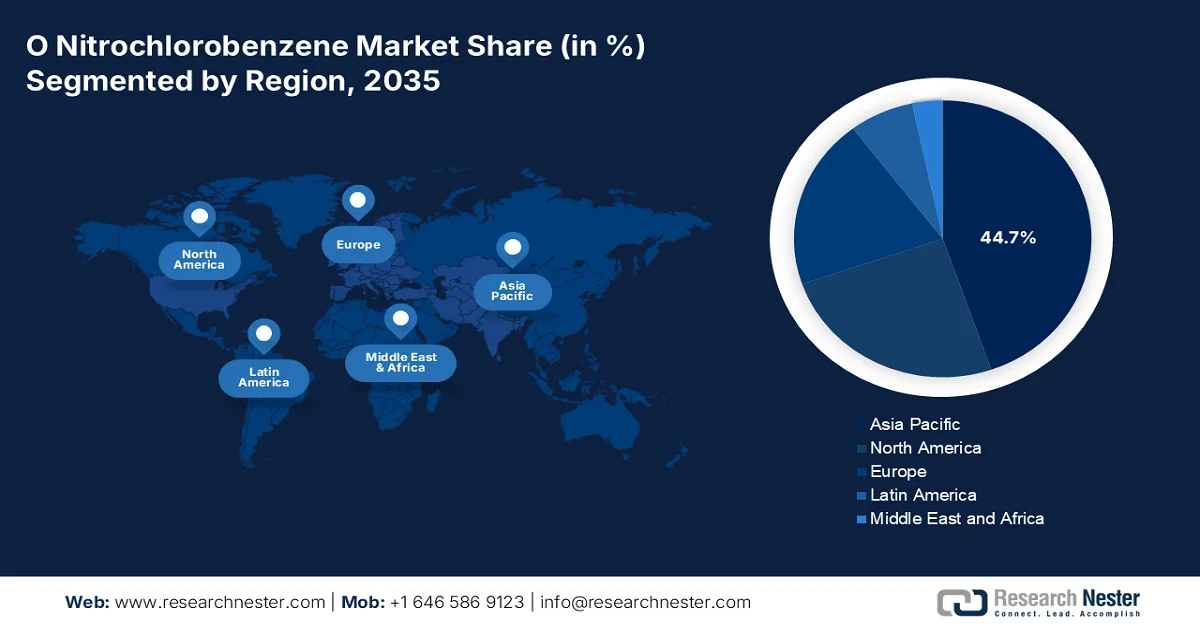
- The Asia Pacific o nitrochlorobenzene market is projected to command 44.7% share by 2035, reinforced by expanding textile dye sectors, low-cost chlor-alkali capacity, and the presence of agrochemical formulation centers
- Europe is poised to be the fastest-growing region in the market throughout 2026-2035, stimulated by stringent regulatory frameworks, circular economy mandates, and increasing adoption of bio-based chemical solutions
Segment Insights:
- The direct sale sub-segment is anticipated to capture 69.6% of the o nitrochlorobenzene market by 2035, underpinned by manufacturers supplying end-users directly to ensure technical collaboration, batch traceability, and supply security
- The more than 95% purity sub-segment is expected to hold 67.7% share of the market by 2035, bolstered by rising demand for high-purity materials that ensure consistent product performance and regulatory compliance
Key Growth Trends:
- Feedstock convergence for natural gas
- Modernization in aging infrastructure
Major Challenges:
- Hazardous waste disposal and acid recovery expenses
- Stringent regulatory pressures and compliance divergence
Key Players: Seya Industries Ltd. (India), Aarti Industries Ltd. (India), SINOPEC (Nanjing) (China), Jiangsu Yangnong Chemical Co., Ltd. (China), Liaoning Shixing Pharmaceutical & Chemical Co., Ltd. (China), Zhenjiang Huayu I/E Co., Ltd. (China), Panoli Intermediates India Private Limited (India), Chemieorganic Pvt. Ltd. (India), Aksharchem India Ltd (India), SABIC (Saudi Arabia).
Global O Nitrochlorobenzene Market Forecast and Regional Outlook:
Market Size & Growth Projections:
- 2025 Market Size: USD 2 billion
- 2026 Market Size: USD 2.1 billion
- Projected Market Size: USD 3.6 billion by 2035
- Growth Forecasts: 6.4% CAGR (2026-2035)
Key Regional Dynamics:
- Largest Region: Asia Pacific (44.7% Share by 2035)
- Fastest Growing Region: Europe
- Dominating Countries: China, India, Germany, United States, Japan
- Emerging Countries: Vietnam, Indonesia, Thailand, Malaysia, Poland
Last updated on : 23 July, 2026
O Nitrochlorobenzene Market - Growth Drivers and Challenges
Growth Drivers
- Feedstock convergence for natural gas: The natural gas industry is presently undergoing a structural transition that positively favors the o nitrochlorobenzene market globally. According to a data report published by iScience in February 2024, the newest worldwide investments in liquid natural gas and pipeline export facilities effectively ranged from 230 to 840 and 70 to 620 million tons per annum by the end of 2050 across different countries. Moreover, natural gas is regarded as a suitable contributor to gross domestic product (GDP) in various exporting nations, significantly contributing to 6% of GDP in Russia and 12% in Qatar. This has been crucial for meeting requirements across importing economies, especially in Europe and Asia, thus contributing to the market exposure.
- Modernization in aging infrastructure: The market production is beyond its economic life, which is characterized by high maintenance expenses, low yields, and the inability to cater to modernized environmental standards. As per the April 2026 U.S. Environmental Protection Agency article, the global chemical manufacturing accounts for a production volume of 1.0 trillion lb every year, along with 7,280 chemicals and 2,258 facilities. In addition, facilities for the top 10 industries constitute 7.1 trillion pounds, which is more than 98% of the overall production volume. Based on this, the number of chemicals and sites in chemical manufacturing accounts for 84% of total chemicals, thus positively contributing to the market’s exposure.
Challenges
- Hazardous waste disposal and acid recovery expenses: The traditional nitration process generates significant tons of spent sulfuric acid per ton of o nitrochlorobenzene, requiring costly neutralization, recovery, or disposal. Besides, acid recovery units add a considerable rate to capital expenditure and consume significant energy. In regions lacking adequate waste treatment infrastructure, producers face mounting liability risks and community opposition. Even with recovery systems, the process yields gypsum or ammonium sulfate byproducts with limited market value, creating secondary waste streams. This disposal burden is intensifying as landfills tighten acceptance criteria for chemical waste, forcing producers to either invest in expensive thermal oxidation or curtail production during peak waste accumulation periods, thus negatively impacting the o nitrocholobenzene market growth.
- Stringent regulatory pressures and compliance divergence: The o nitrochlorobenzene market is classified as a hazardous substance under multiple global frameworks, including REACH, TSCA, and China's Catalog of Hazardous Chemicals. Producers must navigate an increasingly complex and diverging regulatory landscape, where what is permissible in one jurisdiction may be restricted in another. In this regard, REACH's authorization process imposes substance evaluations that last for effective years, delaying market entry for new producers. Meanwhile, China's tightening emission standards require continuous monitoring of nitroaromatic compounds, with penalties for non-compliance reaching 5% of annual revenue. This regulatory patchwork forces multinational producers to maintain separate production protocols for different export markets.
O Nitrochlorobenzene Market Size and Forecast:
| Report Attribute | Details |
|---|---|
|
Base Year |
2025 |
|
Forecast Period |
2026-2035 |
|
CAGR |
6.4% |
|
Base Year Market Size (2025) |
USD 2 billion |
|
Forecast Year Market Size (2035) |
USD 3.6 billion |
|
Regional Scope |
|
O Nitrochlorobenzene Market Segmentation:
Sales Channel Segment Analysis
During the forecast period, the direct sale sub-segment, part of the sales channel segment, is predicted to account for the highest share, at 69.6%, in the o nitrochlorobenzene market. The sub-segment’s growth is highly driven by involving manufacturers selling chemicals straight to end-users without intermediaries. This model dominates high-purity and application-critical products where technical collaboration, batch traceability, and supply security are paramount. Besides, direct engagement enables joint R&D, customized impurity profiles, regulatory documentation support, and just-in-time logistics for large-volume buyers, including tire manufacturers, dye houses, and agrochemical formulators. Additionally, there is the requirement of a dedicated technical sales force, robust quality assurance, and long-term contractual relationships, thus driving the sub-segment’s growth.
Purity Segment Analysis
The more than 95% sub-segment under the purity segment is anticipated to grab the second-highest share of 67.7% in the o nitrocholorobenzene market by the end of 2035. The sub-segment’s upliftment is primarily fueled by ensuring minimal side reactions, consistent color strength in dyes, optimal biological efficacy in agrochemicals, and predictable curing behavior in rubber chemicals. Therefore, achieving and maintaining this specification demands advanced distillation, crystallization, or chromatography processes, along with rigorous quality control using HPLC or GC analysis. Besides, products in this tier command significant price premiums and are typically sold through direct channels with full certification. Moreover, consumers in this sub-segment prioritize consistency over cost, as even minor impurities can degrade final product quality, leading to rejects, regulatory non-compliance, or formulation failures in downstream manufacturing.
Application Segment Analysis
Based on the application segment, the dyes and dyestuff intermediates sub-segment is expected to grab the third-highest share of 48.6% in the o nitrochlorobenzene market by the end of the stipulated timeline. The sub-segment’s development is effectively fueled by its crucial role as the fundamental building blocks of color chemistry for different materials and undergoing chemical reactions to synthesize dyes. As per an article published by NLM in August 2023, every year almost 800,000 tons of synthetic dyes are produced, and 75% of this is readily consumed by the textile industry globally. In this regard, nearly 98 million tons of non-renewable resources are increasingly consumed, such as fertilizers for growing natural fibers, chemical utilization in various textile production stages, and oil for producing synthetic fibers, thus boosting the sub-segment’s growth and demand.
Our in-depth analysis of the o nitrochlorobenzene market includes the following segments:
|
Segment |
Subsegments |
|
Sales Channel |
|
|
Purity |
|
|
Application |
|

Vishnu Nair
Head - Global Business DevelopmentCustomize this report to your requirements — connect with our consultant for personalized insights and options.
O Nitrochlorobenzene Market - Regional Analysis
APAC Market Insights
The Asia Pacific o nitrochlorobenzene market is anticipated to account for the largest share of 44.7% by the end of 2035, owing to the consumption and production epicenter, which is fueled by an expansion in textile dye sectors, low-cost chlor-alkali capacity, and the existence of agrochemical formulation centers. According to an article published by the RMI Organization in February 2026, Southeast Asia caters to 4.5% of global chemicals output and is eventually emerging as the standard growth engine. In addition, this particular region is projected to capture almost 13% of the worldwide chemicals sector growth, and further expand by almost 3 times. This surge indicates a suitable opportunity for decarbonization, with the rising need for lower-emission and cleaner chemical production, thus positively impacting the market’s upliftment in the region.
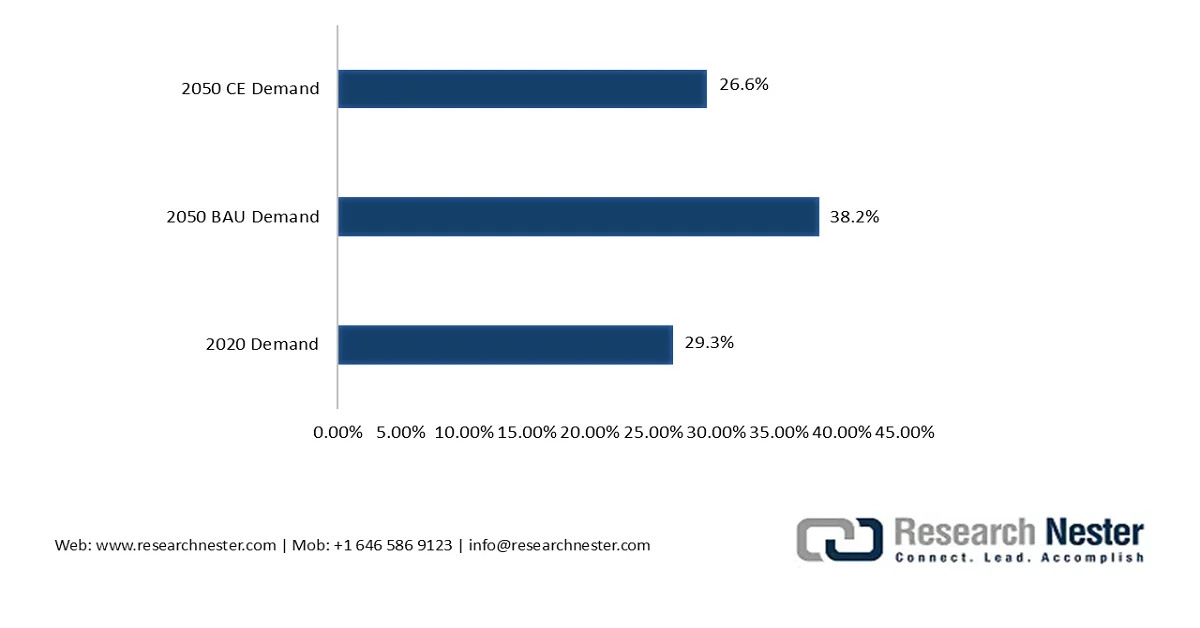
The Japan market is growing significantly, owing to the high-purity demand for electronic chemicals, green nitration innovation center, pharmaceutical intermediate exports, and standard supply security. As stated in a data report published by the IFI Recommendation for Society in January 2026, the cost of basic chemicals is intended to increase by 2 to 3-fold based on long downstream supply chains; hence, the cost impact on finalized products only accounts for nearly 1%. Meanwhile, the population in the region is predicted to reduce by 20% by the end of 2050, based on which the chemical sector possesses the opportunity for suitable growth. Moreover, there is an increase in the requirement for aromatics and olefins by the same year, with a focus on business as usual (BAU) and circular economy (CE), thus proliferating the market exposure.
Olefins, Aromatics, and Methanol Demand in Japan Based on Overall, BAU, and CE, 2020-2050
Source: IFI Recommendation for Society
The aspects of the textile and dye ecosystem, a surge in export-based agrochemicals, dual-carbon consolidation, road export corridors, and an expansion in capacity and mergers and acquisitions are a few trends that are responsible for fueling the market in China. As per an article published by the State Council Information Office in July 2025, the overall value-added output of textile organizations in the country accounts for a yearly business revenue of almost USD 2.8 million (20 million yuan). In addition, this increased by 4.2% year-on-year (YoY) between January and April. Besides, domestic textile firms readily generated 1.4 trillion yuan in terms of revenue, which indicated a 0.5% YoY decrease, thus demonstrating a huge growth opportunity for the market in the nation.
Europe Market Insights
Europe o nitrochlorobenzene market is expected to emerge as the fastest-growing region during the forecast period. The market’s development in the region is highly propelled by strict regulatory policies, including the European Green Deal and REACH, as well as circular economy mandates for adapting closed-loop acid recovery systems and ensuring supply chain diversification from Russia. Based on the European Commission article, bio-based products tend to replace fossil-based chemicals and resources, with the intention of saving almost 2.5 billion tons of carbon dioxide equivalent per year by the end of 2030. Besides, circular bio-based advanced solutions have the ability to fuel the region towards climate neutrality and zero pollution by the end of 2050, thus making it suitable for ensuring market development.
The Germany market is gaining increased traction, owing to the presence of nitration facilities, the establishment of designated chlorinated intermediates by the Federal Ministry for Economic Affairs and Climate Action, and a surge in chemical production, which is driven by agrochemical, pharmaceutical, and automotive demand. As per an article published by the Clean Energy Wire Organization in March 2024, the nation comprises 12 of the largest chemical production facilities. These include a combination of power and heat installations, responsible for 40% of emissions, which is followed by steamcracker facilities for chemical production with 24%, as well as ammonia production facilities with 14%. Therefore, with the presence of all these facilities, there is a huge growth opportunity for the market in the overall country.
The existence of multinational chemical organizations, competitive energy expenses, and accessibility to regional cohesion funds are certain factors that are significantly responsible for boosting the market in Poland. Based on the 2026 ITA data report, the planned expense for green transformation in the country amounts to nearly USD 184.5 billion to USD 210.8 billion (700 to 800 billion PLN) by the end of 2030, which demonstrates USD 31.6 billion to USD 39.5 billion (120 to 150 billion PLN). Moreover, the European Green Deal constituted the intention for a 55% reduction in greenhouse gas emissions within the same year, and also achieving climate neutrality by 2050. Meanwhile, the regional budget plan offers USD 161 billion (€137 billion) for subsidies and USD 40.2 billion (€34.2 billion) for repayable aid in the nation, thus positively impacting market expansion.
North America Market Insights
North America o nitrochlorobenzene market is projected to garner a considerable share by the end of the stipulated duration. The market’s growth in the region is highly driven by an increase in demand from rubber chemicals, agrochemical synthesis, and dye intermediates, along with the reshoring of agrochemical and pharmaceutical supply chains and a resurgence in regional chlor-alkali production capacity. According to the 2023 CISA Government data report, the chemical industry, particularly in the U.S., produces over 70,000 diversified products that are crucial to modern life. In addition, the industry also distributes these products to more than 750,000 end users throughout the country. Besides, the industry is valued at USD 486 billion, which accounts for 25% of the total GDP in the country, thus positively impacting the market’s upliftment.
Chemical Industry Contribution to Employment and Exports in the U.S. (2023)
|
Employment |
Exports |
||
|
Direct Employment |
529,000 |
Total Exports Value |
USD 125.3 billion |
|
Job Opportunity by Businesses |
6.8 jobs |
Chemicals and Related Products |
10 cents of every USD 1 of national exports |
|
Total Job Creation |
4.1 million |
|
|
|
Overall Chemical Manufacturing Facilities |
11,128 |
||
|
Deliveries by Chemical Distributors |
A shipment of more than 31 million tons of chemical products every 6 seconds |
||
|
Chemical Manufacturing Facilities Owned by SMEs |
68% and employing more than 500 people |
||
Source: CISA Government
The U.S. o nitrochlorobenzene market is gaining increased exposure, owing to supply chain and defense reshoring, the existence of the Inflation Reduction Act (IRA), the presence of robust pharmaceutical and agrochemical export bases, risk management standards, and low-cost chlorine feedstock. As stated in an article published by the Scottish Government in June 2026, the country is considered the largest industry worldwide, and is significantly valued at an estimated USD 639 billion as of 2024, which is further predicted to increase to USD 979 billion by the end of 2033. In addition, the nation also constitutes the top 5 pharma groups, including AbbVie located in Illinois, Merck & Co and Johnson & Johnson in New Jersey, along with Bristol Myers Squibb and Pfizer in New York. Therefore, with such growth and the presence of pharma organizations, there is a huge demand for the market in the country.
The integrated supply chain, chemical management plan, the federal sustainable chemistry fund, and agrochemical formulation center for cold-climate crops are a few factors that are responsible for driving the market in Canada. As stated in an article published by the David Suzuki Foundation Organization in March 2026, the chemical management plan has been assisting in protecting the environment and people from harmful substances. Besides, estimates demonstrated that Environment and Climate Change Canada expenditures on pollution reduction are predicted to decrease by USD 61 million in the upcoming fiscal year. Therefore, based on this, this regulatory organization and Health Canada are regulating and assessing different kinds of potentially harmful chemicals, as has been mandated by the Canadian Environmental Protection Act, thus enhancing the market’s expansion in the country.
Key O Nitrochlorobenzene Market Players:
- Seya Industries Ltd. (India)
- Aarti Industries Ltd. (India)
- SINOPEC (Nanjing) (China)
- Jiangsu Yangnong Chemical Co., Ltd. (China)
- Liaoning Shixing Pharmaceutical & Chemical Co., Ltd. (China)
- Zhenjiang Huayu I/E Co., Ltd. (China)
- Panoli Intermediates India Private Limited (India)
- Chemieorganic Pvt. Ltd. (India)
- Aksharchem India Ltd (India)
- SABIC (Saudi Arabia)
- Company Overview
- Business Strategy
- Key Product Offerings
- Financial Performance
- Key Performance Indicators
- Risk Analysis
- Recent Development
- Regional Presence
- SWOT Analysis
- Seya Industries is an established manufacturer of ONCB with a specialized focus on benzene-based chlorination and nitration products for pharmaceuticals, agrochemicals, and dye applications. The company has developed a distinct position in the market by marketing its production to international markets, such as the U.S. and Europe.
- Aarti Industries Ltd. is recognized as a dominant player in the global ONCB market, maintaining a strong market position in the nitro-chlorobenzene-based specialty chemicals segment. The company offers a diverse product portfolio of chemicals, making it a key supplier for end-use industries such as dyes, pigments, and pharmaceuticals.
- SINOPEC (Nanjing) is a major participant in the ONCB market, with its activities covered in comprehensive global market intelligence reports alongside other leading producers. The company’s position is underpinned by the resources of its state-owned parent, enabling large-scale chemical production.
- Jiangsu Yangnong Chemical Co., Ltd. is a significant Chinese producer of agrochemicals, where ONCB serves as a critical intermediate in its pesticide formulation chain. The company leverages its integrated R&D and manufacturing capabilities to serve both domestic and international agricultural markets.
- Liaoning Shixing Pharmaceutical & Chemical Co., Ltd. is a chemical manufacturer that includes ONCB (marketed as 2-Chloronitrobenzene) within its diversified product lineup for the chemical and pharmaceutical sectors. The company provides various chloronitrobenzene isomers for applications spanning dyes, pharmaceuticals, and agrochemicals.
Here is a list of key players operating in the global market:
The global o nitrochlorobenzene market accounts for a finished product manufacturing landscape that is fragmented, with production concentrated in Asia. Besides, China-based manufacturers dominate global capacity, leveraging integrated chlorobenzene supply and cost advantages, while India-specific producers hold a significant position in export markets, particularly for pharmaceutical and dye intermediates. European production is limited, with a structurally narrower producer base supporting premium regional pricing. Key differentiators include product purity, access to captive chlorobenzene feedstock, and regulatory compliance capabilities for export to Western markets. Besides, in March 2026, Aarti Industries Limited entered into a material amendment and ensured a long-lasting supply agreement by signing with a leading global chemical company for developing a high-value specialty chemical intermediate, thus driving the o nitrochlorobenzene industry globally.
Corporate Landscape of the Market:
Recent Developments
- In July 2026, Saudi Basic Industries Corporation (SABIC) signed a project-based development agreement with Rongsheng Petrochemical Co. Ltd. and Rongsheng New Materials Co. Ltd., a subsidiary, for the development of the Jintang New Materials Project in Zhoushan in China.
- In June 2025, Aksharchem India Ltd successfully expanded the precipitated silica facility based on the addition of 6,000 TPA, which is located in Gujarat, leading to the cumulative silica capacity reaching to 18,000 TPA.
- Report ID: 8690
- Published Date: Jul 23, 2026
- Report Format: PDF, PPT
- Explore a preview of key market trends and insights
- Review sample data tables and segment breakdowns
- Experience the quality of our visual data representations
- Evaluate our report structure and research methodology
- Get a glimpse of competitive landscape analysis
- Understand how regional forecasts are presented
- Assess the depth of company profiling and benchmarking
- Preview how actionable insights can support your strategy
Explore real data and analysis
Frequently Asked Questions (FAQ)
About this Report
Connect with our Expert


Report, 2026-2035



Copyright @ 2026 Research Nester. All Rights Reserved.
