Non Grain Oriented Electrical Steel Market Outlook:
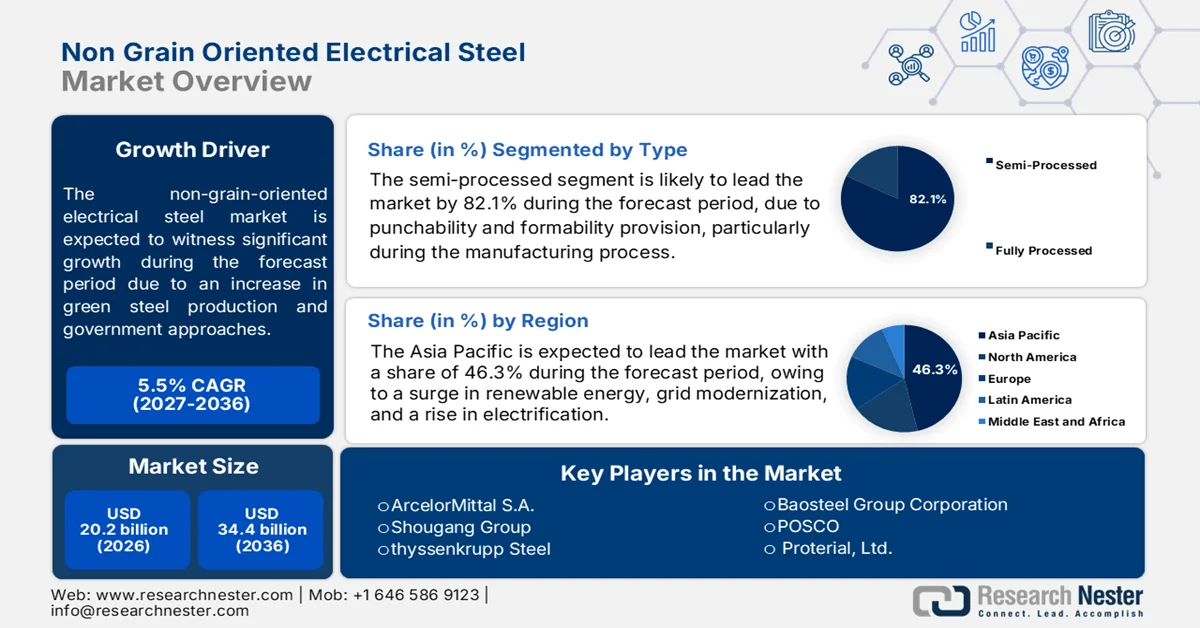
Non Grain Oriented Electrical Steel Market size was valued at USD 20.2 billion in 2026 and is projected to reach USD 34.4 billion by the end of 2036, registering around 5.5% CAGR during the forecast period, i.e., 2027-2036. In 2027, the industry size of non grain oriented electrical steel is evaluated at USD 21.3 billion.
The global non grain oriented electrical steel market is being positively influenced by regional supply chain dynamics, a shift in trade policies, the demand for green steel alternatives, and localized production strategies. According to an article published by the OECD in June 2026, there was an increase in steel excess capacity to 640 million tons as of 2025. This is further surging the overall OECD-based steel production by over 200 million tons, and is also projected to steadily rise and reach 745 million tons by the end of 2028. In addition, the worldwide steelmaking capacity has also increased over the past 4 years and reached 2,445 million tons as of 2025. Besides, in terms of the economy, the steel capacity is gradually expanding across different countries, which is effectively responsible for positively impacting the market’s growth and exposure globally.
Global Steelmaking Capacity by Region, 2021-2025
|
Region |
2021 (million tons) |
2022 (million tons) |
2023 (million tons) |
2024 (million tons) |
2025 (million tons) |
2021 vs 2025 volume |
2021 vs 2025 (%) |
|
Africa |
43.5 |
47.1 |
48.1 |
48.5 |
49.4 |
6 |
13.7 |
|
Asia |
1,632.7 |
1,646.2 |
1,643.0 |
1,660.6 |
1,658.6 |
25.9 |
1.6 |
|
China |
1,146.5 |
1,149.9 |
1,141.5 |
1,141.5 |
1,135.5 |
-11 |
-1.0 |
|
India |
143.9 |
154 |
161.2 |
179.5 |
185.3 |
41.4 |
28.8 |
|
Japan |
122.4 |
122.4 |
117.8 |
117 |
113.6 |
-8.8 |
-7.2 |
|
Vietnam |
26 |
26 |
26 |
26 |
29 |
3 |
11.6 |
|
Europe |
280.3 |
281.5 |
283.7 |
280.5 |
280.5 |
0.2 |
0.1 |
|
ASEAN |
80.4 |
80.4 |
82.9 |
82.9 |
86.0 |
5.5 |
6.9 |
|
CIS + Ukraine |
130.6 |
114.3 |
114.3 |
114.3 |
114.5 |
-16.1 |
-12.3 |
|
European Union |
205.6 |
205.6 |
205.7 |
205.7 |
204.7 |
-0.9 |
-.04 |
|
Other Europe |
74.7 |
75.9 |
78.1 |
74.9 |
75.8 |
1.1 |
1.5 |
|
Latin America |
73.9 |
73.9 |
74.2 |
74.2 |
74.4 |
0.5 |
0.6 |
|
Middle East |
89.0 |
92.3 |
93.9 |
94.9 |
96.2 |
7.2 |
8.1 |
|
Iran |
54.8 |
57.4 |
58.2 |
59.2 |
60.0 |
5.2 |
9.4 |
|
North America |
157.7 |
162.8 |
163.3 |
163.3 |
165.2 |
7.4 |
4.7 |
|
Oceania |
6.4 |
6.4 |
6.4 |
6.4 |
6.4 |
- |
- |
|
OECD Member Nations |
640.0 |
646.3 |
644.4 |
640.4 |
637.2 |
-2.8 |
-0.4 |
|
OECD Partner Economies |
1,774.0 |
1,778.1 |
1,782.4 |
1,802.2 |
1,807.9 |
33.9 |
1.9 |
|
World Total |
2,414.0 |
2,424.3 |
2,426.8 |
2,442.6 |
2,445.1 |
31.1 |
1.3 |
Source: OECD
Furthermore, the adoption of domain-refined and high-permeability grades, along with competition from nano-crystalline and amorphous alloys, and ultra-thin gauge development, particularly for high-speed applications, are a few trends that are responsible for boosting the market. As per a data report published by the World Steel Organization in 2024, 97.6% of steel industry raw materials were readily converted into steel products. Meanwhile, 96.1% of contractors and employees operated in EMS-specific infrastructure. Besides, in terms of economic performance, the steel sector generously invested 6.2% of its revenue in the newest processes and products, while the sector also distributed 96.5% of its revenue to society. Moreover, steel-producing manufacturing organizations are continuously focused on steel production, which is also positively impacting the market’s upliftment.
Top 20 Global Steel-Producing Manufacturing Companies, 2023
|
Manufacturing Company Name |
Production (Million Tons) |
|
China Baowu Group |
130.7 |
|
ArcelorMittal |
68.5 |
|
Ansteel Group |
55.8 |
|
Nippon Steel Corporation |
43.6 |
|
HBIS Group |
41.3 |
|
Shagang Group |
40.5 |
|
POSCO Holdings |
38.4 |
|
Jianlong Group |
36.9 |
|
Shougang Group |
33.5 |
Source: World Steel Organization
Key Non Grain Oriented Electrical Steel Market Insights Summary:
Regional Highlights:
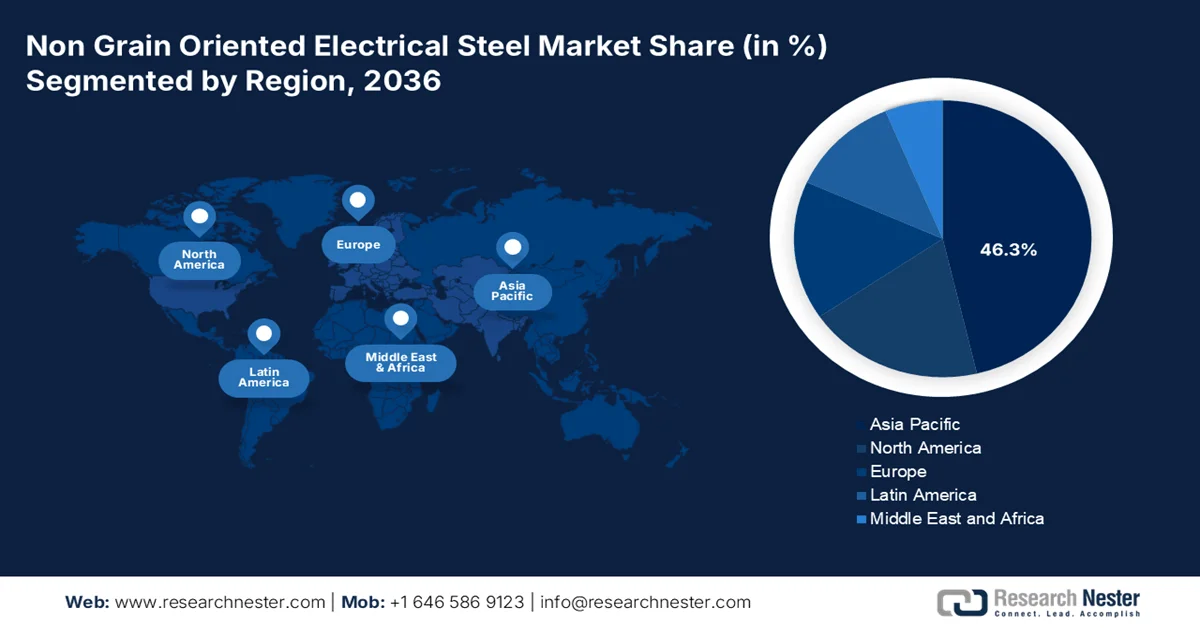
- The Asia Pacific non grain oriented electrical steel market is projected to account for a 46.3% share by 2036, with its expansion underpinned by automotive programs, grid modernization and renewable energy targets, and increasing electrification
- Europe is expected to hold a 16.2% share during the forecast period, with its growth accelerated by surging electric vehicle adoption, expanding renewable energy capacity, and the decarbonization agenda
Segment Insights:
- The semi-processed sub-segment of the non grain oriented electrical steel market is projected to capture an 82.1% share by 2036, reflecting its strong suitability for high-volume manufacturing and greater flexibility in tailoring final magnetic properties to specific applications
- The power generation sub-segment is forecast to secure a 44.7% share by 2036, owing to its fundamental role in converting primary energy sources into electricity for sustaining economic growth and modernized society
Key Growth Trends:
- Expansion in electric vehicle production
- Demand for energy-efficient electrical equipment
Major Challenges:
- Global overcapacity and trade imbalances
- Unfair competition from subsidized imports
Key Players: ArcelorMittal S.A., Shougang Group, thyssenkrupp Steel, Baosteel Group Corporation, POSCO.
Global Non Grain Oriented Electrical Steel Market Forecast and Regional Outlook:
Market Size & Growth Projections:
- 2026 Market Size: USD 20.2 billion
- 2027 Market Size: USD 21.3 billion
- Projected Market Size: USD 34.4 billion by 2036
- Growth Forecasts: 5.5% CAGR (2027-2036)
Key Regional Dynamics:
- Largest Region: Asia Pacific (46.3% Share by 2036)
- Fastest Growing Region: Europe
- Dominating Countries: China, Japan, United States, Germany, South Korea
- Emerging Countries: India, Brazil, Mexico, Canada, Italy
Last updated on : 9 September, 2026
Non Grain Oriented Electrical Steel Market - Growth Drivers and Challenges
Growth Drivers
- Expansion in electric vehicle production: The escalating worldwide shift to electric mobility readily stands as the primary growth driver for the non grain oriented electrical steel market globally. According to the 2026 IEA Organization report, the electric car industry reached new heights as of 2025, exceeding by 20% from 2024 to 20 million sales. In addition, the sales share of electric cars in the total car sector surged to 25%, which marked the fifth consecutive year wherein the yearly electric car sales increased by almost 3.5 million. This eventually resulted in nearly 5% of the worldwide car stock being electrified. Additionally, this also led to continuous growth and expansion in electric vehicles production across different nations, which demonstrates an optimistic outlook for the market’s growth.
Country-Wise Electric Car Sales, 2020-2026
|
Year |
China (Million) |
Europe (Million) |
U.S. (Million) |
Rest of the World (Million) |
|
2020 |
1.1 |
1.4 |
0.3 |
0.2 |
|
2021 |
3.3 |
2.3 |
0.6 |
0.3 |
|
2022 |
6.0 |
2.7 |
1.0 |
0.6 |
|
2023 |
8.1 |
3.2 |
1.4 |
1.0 |
|
2024 |
11.2 |
3.2 |
1.5 |
1.4 |
|
2025 |
13.2 |
4.2 |
1.5 |
2.0 |
|
2026e |
14.3 |
5.0 |
1.2 |
2.9 |
Source: IEA Organization
- Demand for energy-efficient electrical equipment: The worldwide emphasis on diminishing energy consumption is also driving the widespread incorporation of the non grain oriented electrical steel market. Based on an article published by the IEA Organization in 2025, the energy intensity in electric arc furnace steel production usually varies by 67% from country to country. Meanwhile, 10,000 industrial facilities in the U.S. displayed suitable adjustment for facility size, based on which energy is required to produce the same sales volume for manufacturing equivalent products. Besides, organizations that tend to implement standard energy management can uncover average savings, ranging between 5% and 11% for heavy industry, thus proliferating the market’s upliftment.
Challenges
- Global overcapacity and trade imbalances: The non grain oriented electrical steel market is severely hindered by persistent global overcapacity, particularly in commodity-grade products, which depresses prices and erodes profitability across the industry. This surplus production capacity, concentrated heavily in certain regions, forces manufacturers into cutthroat competition for market share, making it difficult to sustain healthy margins. The imbalance stifles investment in innovation and capacity upgrades, as companies struggle to justify capital expenditures when supply consistently outstrips demand. Consequently, producers find themselves trapped in a race to the bottom, where cost-cutting measures take precedence over quality enhancement or product differentiation, ultimately threatening the long-term sustainability of many manufacturing operations worldwide.
- Unfair competition from subsidized imports: Domestic producers, particularly in Europe, face a sustained flood of artificially cheap imports that unfairly undercut local manufacturers. This situation is driven by massive subsidies for new production capacity concentrated in Asia and the Middle East. The threat is so acute that nearly two-thirds of the non-grain-oriented electrical steel needed for Europe's new electric motors and generators now comes from outside the EU, often unhindered by fair trade and carbon reduction policies. This not only threatens the region's industrial capability and competitiveness but also undermines the foundations of its green and digital transitions, potentially limiting the market growth.
Non Grain Oriented Electrical Steel Market Size and Forecast:
| Report Attribute | Details |
|---|---|
|
Base Year |
2026 |
|
Forecast Period |
2027-2036 |
|
CAGR |
5.5% |
|
Base Year Market Size (2026) |
USD 20.2 billion |
|
Forecast Year Market Size (2036) |
USD 34.4 billion |
|
Regional Scope |
|
Non Grain Oriented Electrical Steel Market Segmentation:
Type Segment Analysis
Based on type segment, the semi-processed sub-segment is anticipated to capture the largest share of 82.1% in the non grain oriented electrical steel market by the end of 2036. The sub-segment’s upliftment is primarily attributed to its importance for providing superior punchability and formability, especially during high-volume manufacturing prior to undergoing finalized heat treatment for gaining optimal magnetic properties. This offers manufacturers greater flexibility in tailoring final magnetic properties to their specific application requirements, as the annealing cycle can be optimized for particular motor or transformer designs. Moreover, the continuous shipment of semi-finished stainless steel products, in terms of imports, across different countries also indicates a huge growth opportunity for the sub-segment globally.
Country-Wise Semi-Finished Stainless Steel Products Shipment Import, 2023
|
Country |
Trade Value (USD 1,000) |
Quantity (Kg) |
|
India |
1,420,094.7 |
607,694,000 |
|
China |
1,229,340.7 |
651,146,000 |
|
European Union |
763,813.3 |
247,337,000 |
|
Other Asia |
416,203.8 |
198,421,000 |
|
Sweden |
352,873.6 |
99,007,900 |
|
U.S. |
242,529.2 |
52,157,700 |
|
France |
195,580.4 |
33,197,500 |
|
Germany |
113,437.0 |
17,921,800 |
|
Belgium |
108,331.3 |
36,000,000 |
|
Austria |
93,226.3 |
21,379,900 |
Source: WITS
Application Segment Analysis
During the forecast period, the power generation sub-segment under the application segment is predicted to account for the second-largest share of 44.7% in the non grain oriented electrical steel market. The subsegment’s growth is effectively driven by its role as the foundational process of readily converting primary energy sources into electrical energy for sustaining regular human life, economic growth, and sustaining modernized society. According to an article published by the World Bank Group in August 2025, the primary energy supply for the steel industry effectively accounts for 6% of total national energy consumption, while steel facilities readily consume 6.4% of overall industrial electricity, along with 3.75 of fuel oil and 9.3% of natural gas. Besides, steel is considered an energy-intensive sector, which requires almost 2.9 gigajoules of energy for producing 1 ton of steel, thus positively impacting the sub-segment’s expansion.
Thickness Segment Analysis
The 0.5 mm sub-segment, which is part of the thickness segment, is expected to garner the third-largest share of 39.8% in the non grain oriented electrical steel market by the end of the stipulated timeline. The sub-segment’s development is highly propelled by a well-established and widely adopted standard within the market, serving as a versatile workhorse for numerous electromagnetic applications. This particular gauge strikes a favorable equilibrium between magnetic performance and mechanical handling characteristics, making it a preferred choice for manufacturers of medium-to-large rotating equipment and power transformers. Besides, its balanced properties allow for efficient core construction without the fragility or cost penalties associated with thinner gauges, thus positively enhancing the sub-segment’s growth.
Our in-depth analysis of the non grain oriented electrical steel includes the following segments:
|
Segment |
Subsegments |
|
Type |
|
|
Application |
|
|
Thickness |
|

Vishnu Nair
Head - Global Business DevelopmentCustomize this report to your requirements — connect with our consultant for personalized insights and options.
Non Grain Oriented Electrical Steel Market - Regional Analysis
APAC Market Insights
The Asia Pacific non grain oriented electrical steel market is anticipated to register the highest share of 46.3% by the end of 2036. The market’s upliftment is primarily driven by the existence of automotive programs by organizations, a focus on grid modernization and renewable energy targets, along with an increase in electrification. According to a data report published by the IEA Organization in June 2026, there has been a rise in the energy requirement by nearly 40%, while the electricity demand is also rapidly growing, nearly twice as fast as the total energy utilization. Likewise, there has also been a surge in renewables, with fossil fuels continuing to dominate and meeting more than 70% of energy demands. Therefore, based on these factors, the market is gaining increased exposure and continuous development in the overall region.
The non grain oriented electrical steel market in China is growing significantly, owing to the unparalleled scale for electric vehicle manufacturing, renewable energy facilities, and a focus on grid modernization. As per the 2025 IEA data report, the nation’s clean energy investment accounted for more than USD 625 billion, which almost doubled since the past years. In addition, the country also met its 2030 solar and wind capacity target as of 2024, and meanwhile, renewable installations are poised to continue. Apart from this, the country successfully met its 5% gross domestic product (GDP) growth target in 2024, leading to an evolution in macroeconomic-based priorities, thereby creating a huge growth and expansion opportunity for the market.
The aspects of infrastructure modernization, adoption of the government’s PLI scheme, particularly for steel production, and growth in the electric vehicle ecosystem are readily uplifting the non grain oriented electrical steel market in India. As stated in the May 2026 PIB Government data report, there was an increase in steel consumption from 77 million tons to 163.7 million tons in 2026. This eventually reflected a rapid pace of infrastructure development and an expansion in urbanization. Besides, the nation is continuously operating to gain 500 million tons of steel production by the end of 2047, while also pursuing decarbonization of the steel industry to meet net-zero emission intensity by 2040. Based on these aspects, steel production is continuously demonstrating sustained and robust momentum, this positively fueling the market exposure.
Europe Market Insights
Europe market is expected to emerge as the fastest-growing region with a share of 16.2% during the forecast period. The market’s development in the region is highly propelled by a surge in electric vehicles, massive expansion in renewable energy capacity, and the decarbonization agenda. According to an article published by Eurelectric in May 2023, the region initially was committed to reducing carbon dioxide emissions by almost 40% below 1990 levels by the end of 2030, and has further set an ambition of 80% to 95% reduction by 2050. In addition, the decarbonization strategy was raised with the Fit for 55 package, with targets aimed at diminishing net greenhouse gas emissions by almost 55% and also achieving climate neutrality. Therefore, with such targets, the market is continuously expanding in the overall region.
The non grain oriented electrical steel market in Germany is gaining increased traction, owing to the powerhouse of engineering and automotive industries, as well as the presence of a technologically innovative and massive manufacturing base, and an increase in the demand for high-performance electric vehicle traction motors. As stated in an article published by ITA in June 2026, the automotive sector is the country’s largest sector, which effectively accounts for nearly a quarter of overall industrial revenues and also supports nearly 780,000 employment opportunities. The sector generated more than USD 611 billion in total sales as of 2023, indicating an increase of 11% from 2022, including USD 496.3 million for motor vehicles, USD 15.7 million for trailers, and USD 99.8 million for accessories and parts, thus demonstrating an optimistic outlook for the market’s development.
The presence of machinery and metalworking industries, manufacturing facilities for household appliances, automotive components, and industrial equipment, along with a robust steel demand, are responsible for bolstering the market in Italy. As per an article published by the GMK Center in July 2026, steel production in the country accounted for 1.9 million tons as of June 2026. Additionally, the nation also increased its steel output by 3.5% year-on-year (YoY) in the first half of this year. Besides, national steelmakers increased their production, based on which the output surged by 11.5 million tons. Meanwhile, the steel production in the country has been expanding as well as fluctuating monthly, which is focused on enhancing the market’s growth and development.
Steel Production in Italy, 2025-2026
|
Month |
Production (Thousand Tons) |
|
May |
1,960 |
|
June |
1,783 |
|
July |
1,726 |
|
August |
821 |
|
September |
1,876 |
|
October |
1,989 |
|
November |
1,754 |
|
December |
1,447 |
|
January |
1,725 |
|
February |
1,865 |
|
March |
2,056 |
|
April |
1,929 |
|
May |
2,023 |
|
June |
1,900 |
Source: GMK Center
North America Market Insights
North America non grain oriented electrical steel market is predicted to garner a considerable share of 19.2% by the end of the stipulated timeline. The market’s growth in the region is effectively fueled by supportive government reforms, suitable contributions by organizations, and an increase in electrification. According to an article published by the Congress Government in April 2026, the Department of Energy (DOE) indicated that 1.5 million distribution transformers were readily shipped by regional manufacturers. Additionally, the industrial size for distribution transformers in the region was valued at USD 12.4 billion yearly. Besides, the producer price index of massive power transformers and distribution transformers increased by an estimated 40% in 2024, based on which there is a huge demand for NGO-based electrical steel in the overall region.
The non grain oriented electrical steel market in the U.S. is gaining increased exposure, owing to tactical government interventions, a surge in the end use demand, an increase in the requirement from the automotive sector, and escalation in grid component manufacturing. As stated in an article published by the U.S. EIA Government in November 2024, the yearly spending by different utilities producing and delivering electricity increased by 12% from USD 287 billion to USD 320 billion as of 2023. Based on this, delivery infrastructure and aging generation were replaced, new lines were readily connected to renewable resources, along with the integration of technologies, such as automated controls, sensors, and smart meters. Besides, the expenditure on electricity transmission systems almost tripled to USD 27.7 billion as of 2023, thus positively fueling the market in the country.
The upsurge in electricity demand, the provision of massive government-based infrastructure investment, provincial support, and strong requirement for electrical steel utilization are enhancing the market in Canada. As per an article published by ITA in April 2026, the overall installed electricity generation capacity was roughly 158 GW as of 2025 and is further predicted to reach 189 GW by the end of 2030. Besides, the nation’s electricity generation composition did not change, accounting for 58.9% of hydro, 13.5% of nuclear, 20.5% of fossil fuels, 6.3% of wind, and 0.7% of solar. Simultaneously, Yukon, Prince Edward Island, Newfoundland and Labrador, Manitoba, and British Columbia systems depend on hydro for 89% to 95% of power generation, thereby demonstrating a huge growth opportunity for the market.
Canada Energy Industry Analysis, 2022-2025
|
Components |
2022 (USD Million) |
2023 (USD Million) |
2024 (USD Million) |
2025 estimated (USD Million) |
|
Overall local production |
17,586 |
19,795 |
26,472 |
25,149 |
|
Total exports |
10,843 |
12,202 |
14,574 |
13,596 |
|
Total imports |
25,088 |
26,728 |
27,986 |
27,404 |
|
U.S. Imports |
10,856 |
11,904 |
13,204 |
11,886 |
|
Industrial size |
31,831 |
34,321 |
39,884 |
38,957 |
|
Exchange rates |
1.30 |
1.34 |
1.36 |
1.44 |
Source: ITA
Key Non Grain Oriented Electrical Steel Market Players:
- Proterial, Ltd. (Japan)
- AT&M (Advanced Technology & Materials Co., Ltd.) (China)
- Hengdian Group DMEGC Magnetics Co., Ltd. (China)
- Nucor Corporation (U.S.)
- Foshan Mingfuxing Metal Materials Co., Ltd. (China)
- ArcelorMittal S.A. (Luxembourg)
- Shougang Group (China)
- thyssenkrupp Steel (Germany)
- Baosteel Group Corporation (China)
- POSCO (South Korea)
- Company Overview
- Business Strategy
- Key Product Offerings
- Financial Performance
- Key Performance Indicators
- Risk Analysis
- Recent Development
- Regional Presence
- Proterial, Ltd., formerly known as Hitachi Metals, is recognized as a leading company in the amorphous and nanocrystalline alloy space, handling everything from R&D to mass production. The company produces advanced amorphous metal materials like Metglas™ and nanocrystalline FINEMET® for transformer and soft magnetic component applications.
- AT&M (Advanced Technology & Materials Co., Ltd.) is a major Chinese manufacturer whose Amorphous Products Branch produces amorphous and nanocrystalline materials, cores, and magnetic components for diverse applications. Their product portfolio serves the power distribution, renewable energy, consumer electronics, and transportation sectors.
- Hengdian Group DMEGC Magnetics Co., Ltd. is a prominent Chinese player in the soft magnetic alloy market, manufacturing amorphous and nanocrystalline magnetic materials and components. The company's offerings include amorphous ribbon materials, nanocrystalline ribbons, and magnetic sheets used across various electromagnetic applications.
- Nucor Corporation is a significant U.S.-based player in the electrical steel market, with its products being utilized in power generation and motor applications. The company produces non-grain-oriented electrical steel as part of its broader steel manufacturing operations, serving the North American market.
- Foshan Mingfuxing Metal Materials Co., Ltd. specializes in the research, development, and production of amorphous and nanocrystalline alloy strips, cores, and soft magnetic components. The company's nanocrystalline alloy products exhibit superior soft magnetic properties achieved through heat treatment of amorphous alloys.
Here is a list of key players operating in the global market:
The competitive landscape for amorphous and nanocrystalline alloy end-market products is moderately consolidated, featuring a mix of established global leaders and specialized regional players. Proterial, Ltd. (formerly Hitachi Metals) and TDK Corporation hold significant global influence, with Proterial being recognized as a leader in amorphous metal technology. The market also features strong regional competitors, particularly from China, where companies such as Yunlu Co., Ltd., AT&M, and Hengdian Group DMEGC Magnetics Co., Ltd. are prominent. Besides, in February 2023, JFE Steel Corporation commenced an additional expansion that targeted a suitable startup in April 2026. This eventually amounted to Yen 50.0 billion, which readily tripled the capacity for top-grade non-oriented electrical steel sheets for utilization in engine motors of electric vehicles, thus proliferating the market globally.
Corporate Landscape of the Market:
Recent Developments
- In May 2026, Arvedi S.p.A. declared a USD 95.7 million (€ 82.5 million) investment for its steel facility in Cremona, which is focused on expansion the production of non-grain-oriented electrical steel for automotive and electrification applications.
- In September 2025, ArcelorMittal unveiled its next-generation of electrical steels, particularly development in non-oriented electrical steels, with focus on high polarization grades, self -bonding varnish coating solutions, and high-specification low-loss iCARe® 420Save grades for e-traction.
- Report ID: 8761
- Published Date: Sep 09, 2026
- Report Format: PDF, PPT
- Explore a preview of key market trends and insights
- Review sample data tables and segment breakdowns
- Experience the quality of our visual data representations
- Evaluate our report structure and research methodology
- Get a glimpse of competitive landscape analysis
- Understand how regional forecasts are presented
- Assess the depth of company profiling and benchmarking
- Preview how actionable insights can support your strategy
Explore real data and analysis
Frequently Asked Questions (FAQ)
About this Report
Connect with our Expert


Report, 2027-2036



Copyright @ 2026 Research Nester. All Rights Reserved.
