Highly Reactive Polyisobutylene (HR-PIB) Market Outlook:
Highly Reactive Polyisobutylene (HR-PIB) Market size was valued at USD 2.4 billion in 2025 and is expected to cross USD 4.5 billion by the end of 2035, registering more than 6.9% CAGR during the forecast period, i.e., 2026-2035. In 2026, the industry size of highly reactive polyisobutylene is assessed at USD 2.5 billion.
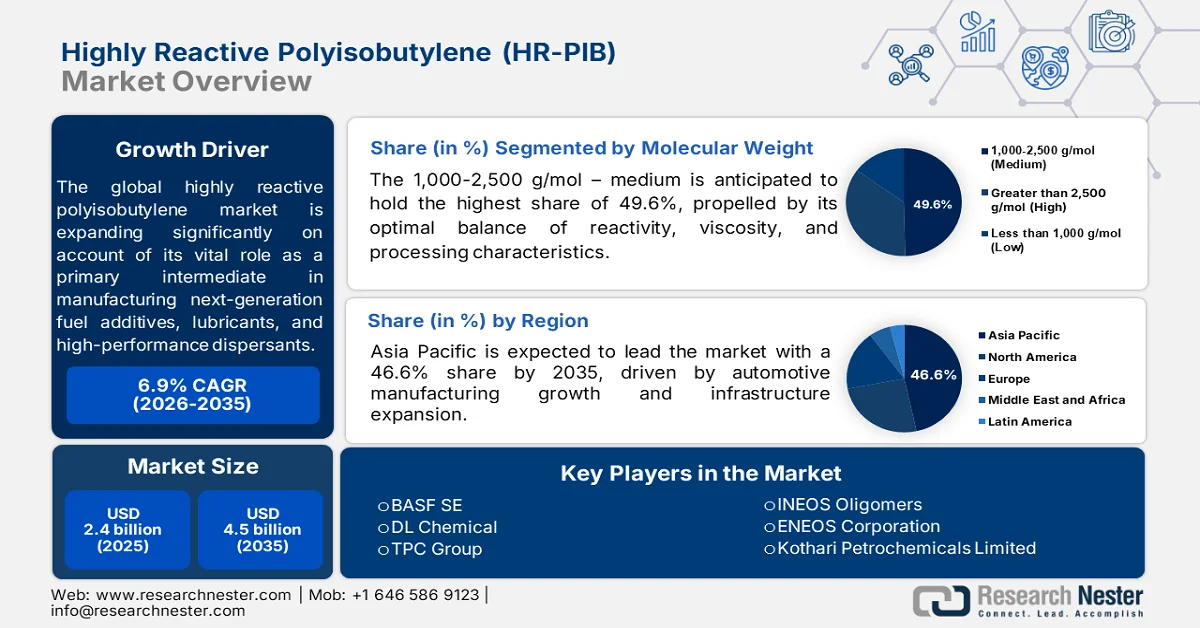
The global highly reactive polyisobutylene market is expected to witness consistent growth, which is due to its importance as a key raw material for producing advanced fuel additives, lubricant formulations, and high-performance dispersant solutions. The industrial sectors prioritize engine efficiency and reduced emissions, due to which the demand for highly pure, chlorine-free polymers that enhance fuel combustion is intensifying in the global landscape. According to an article published by the National Institutes of Health (NIH) in April 2025, polyisobutylene-bis-succinimide dispersants improve lubricant performance by controlling sludge and deposit formation in engines. By using advanced molecular modeling, researchers showed that PIBSI dispersants prevent nanoparticle aggregation through interactions between polar succinimide or amine groups and hydrophobic PIB chains, thus elevating the growth potential of the market.
Furthermore, adoption in the highly reactive polyisobutylene (HR-PIB) market is due to the formulation of industrial adhesives, sealants, and electrical insulation materials with superior thermal stability, moisture resistance, and flexibility. In addition, research and development in the industry encourage more players to capitalize on this sector. In September 2025, as stated by Semantic Scholar, researchers developed a cost-effective method to produce highly reactive polyisobutylene from mixed C4 gas streams using an AlCl₃·Bu₂O catalyst system. This process achieves high vinylidene content and controlled molecular weights under milder conditions, offering advantages over traditional low-temperature production methods, thus improving industrial HR-PIB manufacturing.
Key Highly Reactive Polyisobutylene Market Insights Summary:
Regional Highlights:
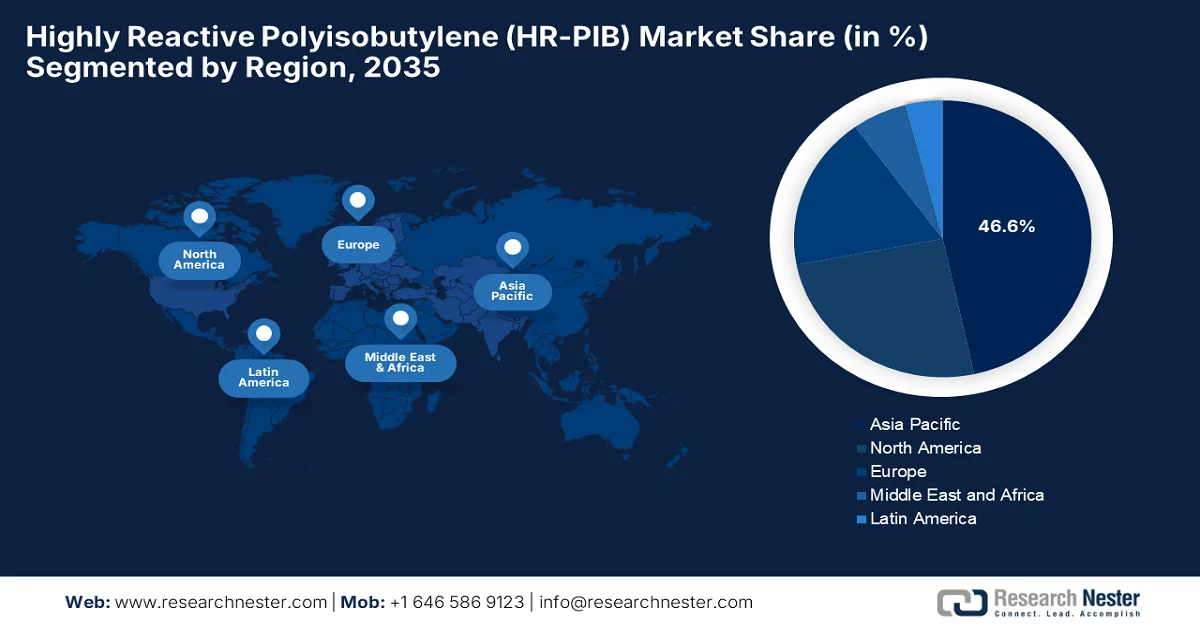
- Asia Pacific is projected to command the highest 46.6% share during 2026-2035, positioning the region as the leading highly reactive polyisobutylene (HR-PIB) market owing to massive automotive manufacturing hubs and escalating infrastructure development.
- Europe is expected to advance at a considerable rate through 2035, with its HR-PIB market supported by stringent environmental regulations and sustainability initiatives.
Segment Insights:
- The 1,000-2,500 g/mol segment is anticipated to account for a 49.6% share during 2026-2035, reinforcing its leading position due to its optimal balance of reactivity, viscosity, and processing characteristics.
- The adhesives segment is poised to capture a lucrative share by 2035 in the highly reactive polyisobutylene (HR-PIB) market, fueled by rising demand for high-performance pressure-sensitive and hot-melt adhesives.
Key Growth Trends:
- Rising demand from fuel and lubricant additives
- Growth in chemical manufacturing and specialty applications
Major Challenges:
- Volatility in feedstock and raw material prices
- Competition from evolving substitutes
Key Players: BASF SE (Germany), DL Chemical (South Korea), TPC Group (U.S.), INEOS Oligomers (UK), ENEOS Corporation (Japan), Kothari Petrochemicals Limited (India), Lubrizol (India).
Global Highly Reactive Polyisobutylene Market Forecast and Regional Outlook:
Market Size & Growth Projections:H3
- 2025 Market Size: USD 2.4 billion
- 2026 Market Size: USD 2.5 billion
- Projected Market Size: USD 4.5 billion by 2035
- Growth Forecasts: 6.9% CAGR (2026-2035)
Key Regional Dynamics:H3
- Largest Region: Asia Pacific (46.6% Share by 2035)
- Fastest Growing Region: Europe
- Dominating Countries: China, United States, Germany, Japan, India
- Emerging Countries: India, Canada, United Kingdom, Japan, Germany
Last updated on : 25 August, 2026
Highly Reactive Polyisobutylene (HR-PIB) Market - Growth Drivers and Challenges
Growth Drivers
- Rising demand from fuel and lubricant additives: The booming industrial sectors across the globe are powering the demand for highly reactive polyisobutylene as an important raw material in fuel and lubricant additives. Its superior reactivity enables the production of high-performance dispersants, improving engine cleanliness, fuel efficiency, and equipment durability, prompting a favorable business environment for pioneers in the HR-PIB market. In June 2024, NIH stated that patent analysis of 77,701 lubricant additive inventions shows a shift toward multifunctional and environmentally friendly additives. It also stated that China leads in patent filings, whereas the U.S. is the main source of globally influential lubricant additive technologies, positively increasing demand for HR-PIB solutions.
- Growth in chemical manufacturing and specialty applications: Expanding chemical manufacturing and specialty product development are creating encouraging growth opportunities for players involved in the highly reactive polyisobutylene market. This is an important intermediate in adhesives, sealants, elastomers, and specialty chemicals due to its high reactivity and processing efficiency. Continuous innovation across different end use industries also supports sustained market growth and broader commercial adoption. For instance, in June 2025, Evonik Industries announced expansion of its production of its POLYVEST® ST-E 60 by localizing the final manufacturing step in Shanghai. This investment will increase the supply of silane-functionalized polybutadienes. In addition, exporter concentration influences global supply availability, pricing trends, and trade dynamics across different applications.
Top Polyisobutylene Exporting Countries in 2024: Global Shipment Value, Volume & Market Leaders
|
Reporter |
Trade Value (USD ‘000) |
Quantity (Kg) |
|
Korea, Rep. |
376,242.15 |
209,117,000 |
|
European Union |
191,784.01 |
81,270,900 |
|
U.S. |
179,734.67 |
72,543,500 |
|
Belgium |
158,676.55 |
106,327,000 |
|
Germany |
155,054.44 |
65,686,100 |
|
France |
125,698.71 |
- |
|
China |
46,463.94 |
17,251,700 |
|
Japan |
35,999.71 |
12,510,000 |
|
Brazil |
23,956.50 |
17,755,900 |
|
Netherlands |
22,042.10 |
8,392,200 |
|
India |
21,051.01 |
12,813,000 |
|
Canada |
12,593.57 |
1,969,790 |
|
Singapore |
9,823.29 |
1,634,700 |
Source: WITS
Challenges
- Volatility in feedstock and raw material prices: Producing highly reactive polyisobutylene needs mostly-pure isobutylene feedstock, which is primarily derived from C4 hydrocarbon streams during crude oil refining and naphtha cracking. Also, the supply chain is directly associated with upstream petroleum operations, due to which manufacturers in the HR-PIB market witness extreme price volatility. Geopolitical conflicts, fluctuating worldwide oil demands, and refinery operational variations cause sudden spikes in raw material costs. The existence of these shifts makes it difficult for chemical producers to forecast expenses or maintain consistent profit margins. On the other hand, passing these costs along to downstream buyers is equally challenging, leading to severe margin compression.
- Competition from evolving substitutes: The growth of the highly reactive polyisobutylene (HR-PIB) market is being challenged by the continuous development of alternative high-performance polymers. Materials such as thermoplastic elastomers and silicone rubbers are competing for market share within the lucrative adhesives, sealants, and coatings industries. These substitutes offer comparable or sometimes superior structural flexibility, chemical resistance, and lower thermal sensitivities at a more competitive cost structure. In addition, a growing consumer and corporate preference for sustainable types of chemicals incentivizes formulators to look past traditional petrochemical-based products. If alternative chemical options achieve better sustainability profiles and lower production costs, there is a chance that they could significantly erode HR-PIB’s market share.
Highly Reactive Polyisobutylene (HR-PIB) Market Size and Forecast:
| Report Attribute | Details |
|---|---|
|
Base Year |
2025 |
|
Forecast Period |
2026-2035 |
|
CAGR |
6.9% |
|
Base Year Market Size (2025) |
USD 2.4 billion |
|
Forecast Year Market Size (2035) |
USD 4.5 billion |
|
Regional Scope |
|
Highly Reactive Polyisobutylene (HR-PIB) Market Segmentation:
Molecular Weight Segment Analysis
The 1,000-2,500 g/mol – medium sub-segment, which is a part of the molecular weight segment, is anticipated to hold the highest share of 49.6% during the stipulated timeframe. Its dominating position in the highly reactive polyisobutylene market is largely propelled by its optimal balance of reactivity, viscosity, and processing characteristics, making it suitable for manufacturing polyisobutylene succinic anhydride and premium lubricant dispersants. In August 2023, BASF announced that it is increasing the production capacity of its medium molecular weight OPPANOL® B polyisobutenes at its Germany site by 25%. The expansion improves supply reliability for customers across automotive, construction, electronics, food packaging, and lubricant industries, thus denoting a wider segment scope.
Application Segment Analysis
By the end of 2035, the adhesives segment is anticipated to grow with a lucrative share in the highly reactive polyisobutylene (HR-PIB) market. The segment’s growth is largely propelled by rising demand for high-performance pressure-sensitive and hot-melt adhesives in the packaging, construction, automotive, and electronics industries. Highly reactive polyisobutylene enhances adhesion, flexibility, moisture resistance, and long-term durability. In addition, increasing adoption of lightweight and durable bonding solutions is encouraging manufacturers to develop advanced adhesive formulations with improved performance characteristics. Moreover, ongoing advancements in terms of specialty adhesive technologies are creating new opportunities for polyisobutylene-based solutions across different industrial applications.
End user Industry Segment Analysis
The automotive and transportation segment is projected to grow with a considerable revenue share in the HR-PIB market throughout the assessed timeframe. This is due to increasing utilization of advanced lubricant additives, fuel system components, and sealing materials that improve vehicle efficiency and performance. In addition, the rising production of conventional and electric vehicles, along with growing requirements for enhanced engine protection, is accelerating the adoption of HR-PIB solutions in the automotive sector. In this context, Infineum and Tata Motors in April 2024 developed India’s first-ever heavy-duty engine lubricant designed to reduce emissions and improve fuel efficiency. The ultra-low viscosity (3.0 HTHS) lubricant has been commercialized for factory and service applications, thus achieving significant carbon reductions.
Our in-depth analysis of the highly reactive polyisobutylene market includes the following segments:
|
Segment |
Subsegments |
|
Molecular Weight |
|
|
Application |
|
|
End user Industry |
|

Vishnu Nair
Head - Global Business DevelopmentCustomize this report to your requirements — connect with our consultant for personalized insights and options.
Highly Reactive Polyisobutylene (HR-PIB) Market - Regional Analysis
APAC Market Insights
Asia Pacific highly reactive polyisobutylene market is anticipated to garner the highest share of 46.6% during the discussed timeframe. The region’s upliftment in this field is mainly attributable to massive automotive manufacturing hubs and escalating infrastructure development. In addition, accelerating demand for lubricant additives and fuel detergents, which is fueled by strict regional emission standards, has made countries in the region major consumers of the chemical for engine cleanliness and efficiency. In March 2024, Tata Motors Group signed an MoU with the government of Tamil Nadu to explore establishing a vehicle manufacturing facility with an estimated investment of USD 1.08 billion over more than five years. Also, India’s strong import reliance indicates growth opportunities for domestic PIB manufacturing and foreign suppliers to serve its expanding lubricant, fuel additive, and industrial markets.
India Polyisobutylene Imports by Country in 2024: Top Suppliers, Import Value and Volume Analysis
|
Supplier Country |
Trade Value (USD ‘000) |
Quantity (Kg) |
|
Korea, Rep. |
33,653.92 |
17,828,100 |
|
France |
1,402.30 |
501,124 |
|
Canada |
1,346.14 |
232,320 |
|
U.S. |
898.27 |
349,683 |
|
Malaysia |
871.98 |
528,870 |
|
Japan |
818.27 |
266,800 |
|
China |
772.84 |
207,747 |
|
Brazil |
759.28 |
553,880 |
|
Germany |
693.66 |
113,459 |
|
Belgium |
31.83 |
14,105 |
Source: WITS
The country's position as the world's largest automotive producer and its implementation of strict national emission standards are responsible for powering China highly reactive polyisobutylene market. Therefore, to meet these environmental regulations, domestic manufacturers are increasing their consumption of HR-PIB to produce high-performance fuel detergents and ashless dispersants that improve fuel economy and lower vehicle emissions. Based on the government data published in May 2023, the country implemented the national VI Stage 6b emission standards for light-duty and heavy-duty diesel vehicles, and it restricts the production, import, and sale of vehicles that are non-compliant. This particular regulation mainly aims to reduce vehicle emissions, improve air quality, and deliberately support sustainable automotive development through stricter pollution control requirements.
The highly reactive polyisobutylene market in Japan is growing at a stable pace, which is propelled by an emphasis on premium quality, technological innovation, and sustainability. The country’s market also profits from sophisticated electronics and industrial manufacturing sectors, which rely on the polymer’s exceptional moisture resistance and electrical insulation properties for precision adhesives and sealants. In April 2024, Shin-Etsu Chemical acquired dry adhesive technology from Setex Technologies and launched ShineGrip™, which is a biomimetic adhesive solution inspired by gecko structures. The technology supports applications in semiconductor and advanced manufacturing processes, thus showcasing Japan’s focus on advanced material technologies, especially for electronics and industrial applications.
North America Market Insights
The North America HR-PIB market is being efficiently reshaped by a mature and highly influential automotive aftermarket. The regional market also benefits from a growing construction industry and continuously expanding industrial manufacturing sectors, which depend on the chemical's superior moisture-barrier properties for advanced architectural sealants, adhesives, and commercial roofing systems. In August 2026, the U.S. Census Bureau disclosed that U.S. construction spending in June 2026 reached an annualized rate of USD 2.17 trillion and is considered to be a major contributor to economic activity. The article outlines that private construction accounted for almost 1.62 trillion, whereas public construction was stable at USD 544 billion, thus positively benefiting the market’s expansion.
The presence of leading chemical manufacturers and continuous innovation in polymer technologies propels demand in the U.S. highly reactive polyisobutylene market. In addition, a well-established domestic petrochemical infrastructure and major chemical suppliers allow the nation to focus on specialized polymer grades suitable for high-tier industrial applications. In this context, BASF and Lubrizol in January 2024 signed a licensing agreement for the production and distribution of selected EMGARD® and Plurasafe® industrial lubricant products. These products are marketed under Lubrizol’s CPI Fluid Engineering brand, thereby expanding its industrial lubricant portfolio, thus denoting the presence of strong demand in the country.
In Canada, the HR-PIB market is gaining momentum, which is intensely fueled by severe winter weather conditions and strict federal environmental regulations focused on reducing greenhouse gas emissions. In addition, the market is mostly dependent on specialized imports and local chemical blenders to meet the stringent technical demands of its industrial manufacturing base. Based on government data, the country’s polyisobutylene imports reached almost USD 12.1 million in 2024, wherein the top three importers accounted for more than 52% of total imports. The market is concentrated among major chemical distributors and industrial users, mainly located in Ontario.
Canada Polyisobutylene Import Market: Major Importers, Companies, and Locations 2024
|
Major Importer |
City |
Province |
|
Brenntag Canada Inc. |
Toronto |
Ontario |
|
Estée Lauder Cosmetics Ltd / Les Produits de Beauté Estée Lauder |
Toronto |
Ontario |
|
Storchem Inc. |
Burlington |
Ontario |
|
Synthetic Oils and Lubricants of Texas, Inc. |
Spring |
Texas, U.S. |
|
Thames River Chemical Corp. |
Burlington |
Ontario |
|
Univar Solutions Canada Ltd. |
Toronto |
Ontario |
Source: Government of Canada
Europe Market Insights
The Europe HR-PIB market is anticipated to progress at a considerable rate, which is due to stringent environmental regulations and sustainability initiatives. In addition, the country’s chemical manufacturers are at the forefront of adopting eco-friendly, chlorine-free polymerization processes with an intense emphasis on circular economy principles and technical innovation to maintain a secure chain. As of official data in August 2024, BASF Performance Materials is advancing its sustainability strategy by focusing on carbon reduction, circular solutions, and collaboration with customers, with a prime goal to support a low-carbon future. This particular division aims to achieve carbon neutrality by the end of 2050 through increased use of renewable energy, sustainable sourcing, and certified materials.
The country’s strong specialty chemicals sector and growing demand for high-performance materials in automotive, industrial, and advanced manufacturing applications are reshaping the growth dynamics of the Germany highly reactive polyisobutylene market. The presence of established polymer producers, continuous research in material engineering, and increasing adoption of lightweight and durable components are creating new growth opportunities for HR-PIB utilization. Furthermore, Germany’s high focus on precision manufacturing and technological advancements in mobility, machinery, and energy systems is contributing to the application of PIB-based solutions in specialized formulations, thus denoting a positive market outlook.
The UK highly reactive polyisobutylene market is projected to develop at a consistent pace, which is due to the rising demand for specialized polymers in sectors such as pharmaceuticals, packaging, and advanced manufacturing. In addition, the increasing investments in research and development activities and the adoption of improved material technologies are also supporting the integration of polyisobutylene into different industrial formulations. In this context, Synthomer and Henkel in April 2025 partnered to reduce the carbon footprint of Henkel’s TECHNOMELT® hot melt adhesive portfolio across major global markets. The collaboration enables measurable cradle-to-gate emission reductions while maintaining product performance, thus supporting the UK specialty polymer ecosystem.
Key Highly Reactive Polyisobutylene (HR-PIB) Market Players:
- BASF SE (Germany)
- DL Chemical (South Korea)
- TPC Group (U.S.)
- INEOS Oligomers (UK)
- ENEOS Corporation (Japan)
- Kothari Petrochemicals Limited (India)
- Lubrizol (India)
- Company Overview
- Business Strategy
- Key Product Offerings
- Financial Performance
- Key Performance Indicators
- Risk Analysis
- Recent Development
- Regional Presence
- SWOT Analysis
- BASF SE is considered to be a leading global PIB manufacturer, which is offering highly reactive PIB grades under the GLISSOPAL® brand. The company’s products serve lubricant additives, fuel additives, and specialty applications and are supported by advanced polymer technology and global supply capabilities.
- DL Chemical is a major HR-PIB producer with its D.POLYBUTENE HRPB portfolio, which is used in lubricants, adhesives, sealants, polymer modifiers, and industrial applications. In addition, the firm differentiates through proprietary technology, large-scale production capacity, and consistent product quality.
- TPC Group is a leading PIB manufacturer based in North America, and it supplies HRPIB and enhanced PIB products for lubricants, fuel additives, sealants, adhesives, and packaging applications. The company’s competitive strengths include broad product grades, proprietary technology, and reliable supply capabilities.
- INEOS Oligomers is yet another central player in this field, which manufactures Indopol® polybutenes used in lubricants, adhesives, sealants, rubber modification, and specialty applications. The company benefits from integrated production and extensive technical expertise.
- ENEOS Corporation produces specialty PIB products, which include HIMOL® polyisobutylene, for applications such as gum bases, adhesives, and packaging materials. The company is mainly focused on high-quality, stable polymer solutions for niche specialty markets.
Here is a list of key players operating in the global highly reactive polyisobutylene market:
The global highly reactive polyisobutylene market is moderately consolidated, and it hosts a limited number of specialty polymer manufacturers accounting for a significant share of production capacity. Competition in this sector is primarily driven by product reactivity levels, molecular weight grades, manufacturing technology, supply reliability, and geographic reach. On the other hand, leading manufacturers maintain integrated specialty chemical operations and serve various applications. Asia Pacific has emerged as a key production region which is supported by expanding capacity from domestic producers, whereas Europe- and North America-based players focus on advanced formulations and specialty grades.
Corporate Landscape of the Market:
Recent Developments
- In June 2026, BASF launched Oppanol® N PLUS, which is a new polyisobutene-based binder designed to improve performance and reliability in next-generation EV batteries, including solid-state battery applications. The advanced material offers consistent quality, better process efficiency, and flexible packaging options to support battery manufacturers.
- In July 2024, Lubrizol announced plans to build its largest manufacturing facility in India after acquiring a 120-acre site in Aurangabad, Maharashtra, with an initial investment of around USD 200 million. This new plant will strengthen local production capabilities for transportation and industrial markets.
- Report ID: 8747
- Published Date: Aug 25, 2026
- Report Format: PDF, PPT
- Explore a preview of key market trends and insights
- Review sample data tables and segment breakdowns
- Experience the quality of our visual data representations
- Evaluate our report structure and research methodology
- Get a glimpse of competitive landscape analysis
- Understand how regional forecasts are presented
- Assess the depth of company profiling and benchmarking
- Preview how actionable insights can support your strategy
Explore real data and analysis
Frequently Asked Questions (FAQ)
About this Report
Connect with our Expert


Report, 2026-2035



Copyright @ 2026 Research Nester. All Rights Reserved.
