Nut Butters Market Outlook:
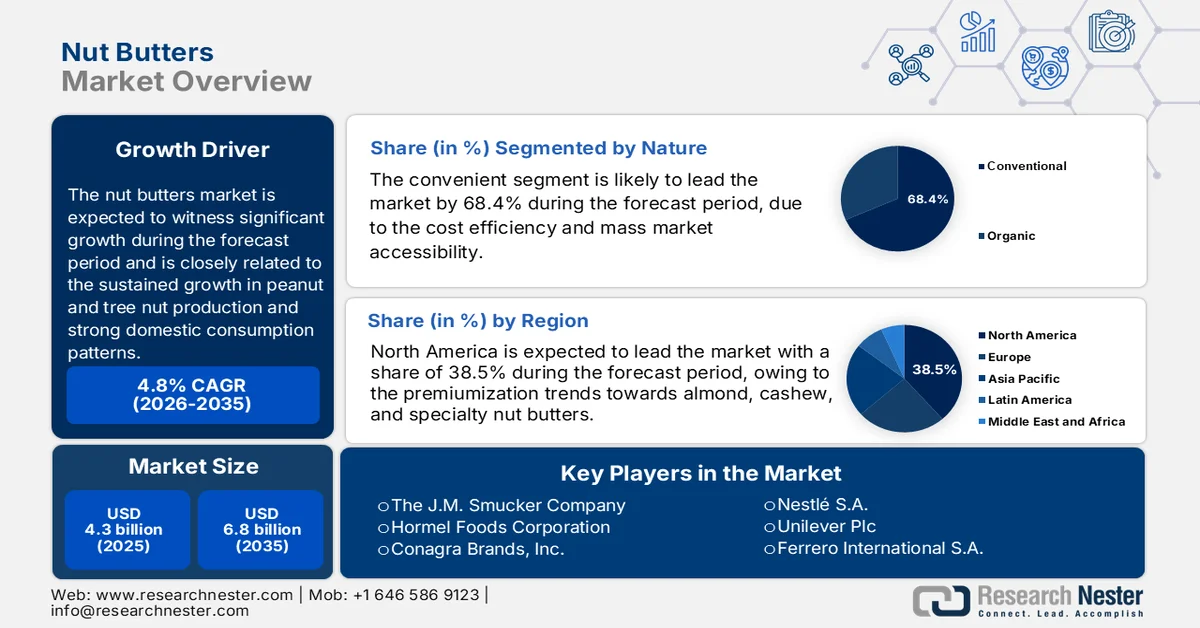
Nut Butters Market size was valued at USD 4.3 billion in 2025 and is projected to reach USD 6.8 billion by the end of 2035, rising at a CAGR of 4.8% during the forecast period, i.e., 2026-2035. In 2026, the industry size of nut butters is estimated at USD 4.5 billion.
The worldwide nut butters market is underpinned by the sustained growth in peanut and tree nut production, strong domestic consumption patterns, and export expansion supported by the agricultural policy frameworks. Peanuts and tree nuts are the energy dense foods and make a healthy diet for regular consumption. Moreover, the health benefits resulting from regular intake of nut reduces the risk of cancer, cardiovascular disease, and type 2 diabetes. According to the NLM study published in October 2024, it is recommended to consume 30 g of nuts per day for a healthy life. Further, this daily intake recommendation is aligned with the public health nutrition guidance promoting for plant-based protein and unsaturated fat consumption to support long term metabolic and cardiovascular health outcomes. Rising production of nuts and tree nuts demonstrates a strong international demand and supply chain competitiveness.
Besides, the USDA June 2024 data depict that the U.S. peanut production reached nearly 5.9 billion pounds in 2023, reflecting a stable raw material availability for peanut butter manufacturing. The domestic food use of peanuts is projected to grow 1.3%. Moreover, the tree nut butter demand is influenced by the rising almond and other tree nut production. As per the CDC May 2024 report, nearly 2 in 5 people are affected by obesity, prompting dietary shifts toward plant-based protein and the nutrient-dense spreads. On the other hand, the International Nuts and Dried Fruit Council's May 2023 report indicates that the global production of peanuts exceeds 50 million metric tons annually, supporting the cross-border raw material flows and the diversified sourcing strategies. Further, the stable agricultural output, institutional procurement channels, and evolving dietary guidelines are reinforcing a long term volume demand across industrial and export markets.
World Peanut Production
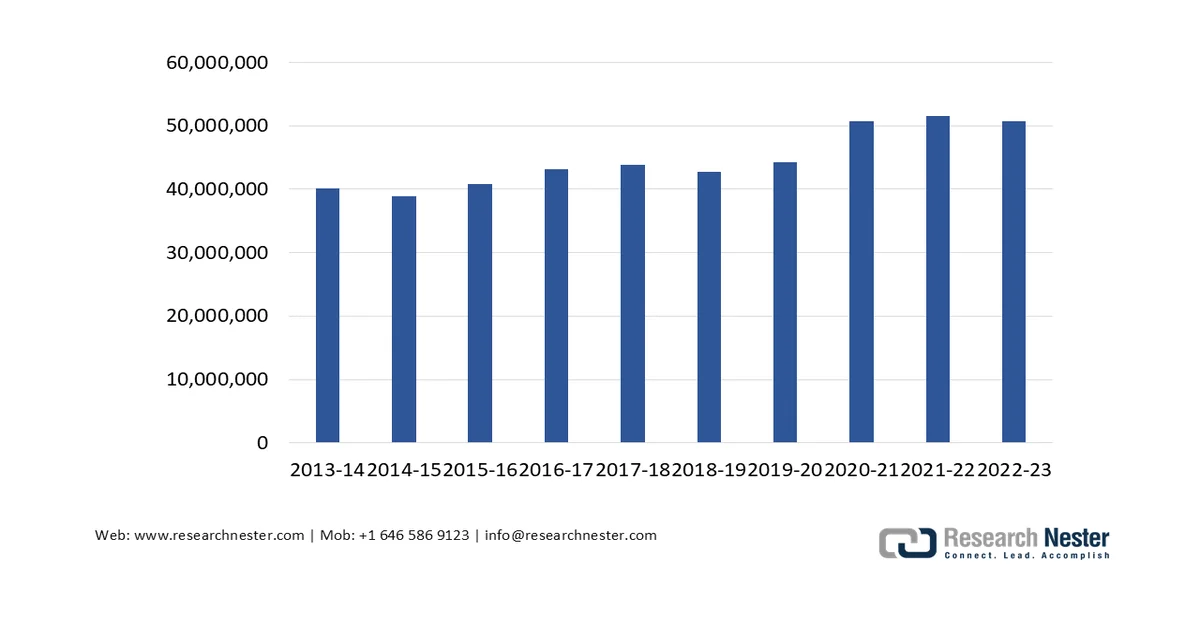
Source: International Nuts and Dried Fruit Council May 2023
Key Nut Butters Market Insights Summary:
Regional Highlights:
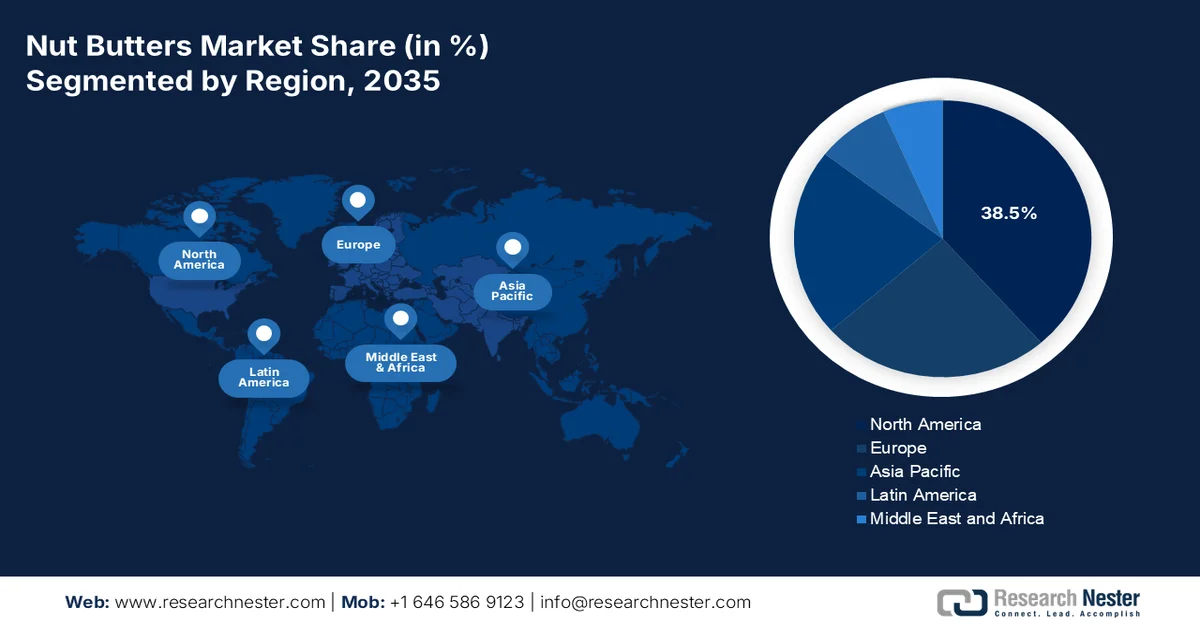
- The North America nut butters market is anticipated to command a 38.5% share by 2035, supported by premiumization trends toward almond, cashew, and specialty nut butters.
- Asia Pacific is projected to register a CAGR of 8.1% during 2026-2035, stimulated by rising disposable incomes, shifting dietary preferences, and expanding modern retail infrastructure.
Segment Insights:
- In the nut butters market, the Conventional segment is expected to capture a 68.4% share by 2035, propelled by its cost efficiency and mass market accessibility.
- Household/Residential is anticipated to remain the leading end-use segment through 2026–2035, fueled by nut butter’s role as a daily dietary staple in home kitchens.
Key Growth Trends:
- Expansion of government funded school nutrition programs
- Demand for plant based proteins
Major Challenges:
- Evolving consumer preferences and innovation pressure
- Food safety crises and contamination risks
Key Players: The J.M. Smucker Company (U.S.), Hormel Foods Corporation (U.S.), Conagra Brands, Inc. (U.S.), Nestlé S.A. (Switzerland), Unilever Plc (UK), Ferrero International S.A. (Italy), The Hain Celestial Group, Inc. (U.S.), Boulder Brands (U.S.), EdenNuts Inc. (U.S.), Once Again Nut Butter Collective (U.S.), Algood Food Company, Inc. (U.S.), Cache Creek Foods (U.S.), Justine's, Inc. (U.S.), Adams Group (Malaysia), Puratos (Belgium), Vör Foods (Sweden), Hormel Foods Corporation (U.S.), Tiptree (UK), Intersnack Group (Germany).
Global Nut Butters Market Forecast and Regional Outlook:
Market Size & Growth Projections:
- 2025 Market Size: USD 4.3 billion
- 2026 Market Size: USD 4.5 billion
- Projected Market Size: USD 6.8 billion by 2035
- Growth Forecasts: 4.8% CAGR (2026-2035)
Key Regional Dynamics:
- Largest Region: North America (38.5% Share by 2035)
- Fastest Growing Region: Asia Pacific
- Dominating Countries: United States, China, Germany, Japan, Canada
- Emerging Countries: India, South Korea, Brazil, Mexico, Indonesia
Last updated on : 9 March, 2026
Nut Butters Market - Growth Drivers and Challenges
Growth Drivers
- Expansion of government funded school nutrition programs: Public institutional food procurement is the primary volume driver in the nut butters market. According to the USDA October 2024, the U.S. National School Lunch Program served 4.7 billion meals in 2023, and 241 billion lunches were served from the start. Peanut butter is an approved meat or meat alternative under the federal meal pattern requirements, ensuring recurring bulk procurement demand. Moreover, the federal reimbursement rates to offset food cost inflation strengthen purchasing capacity at the district levels. Similar structured procurement exists under the school breakfast program and the child and adult care food program. This institutional baseline demand reduces the volatility for manufacturers and supports long term supply contracts. Suppliers aligned with the USDA nutrition standards and the allergen labeling compliance benefit from the predictable government purchasing cycles.
- Demand for plant based proteins: The market witnesses a surge in demand for plant-based proteins due to rising consumer awareness. As most of the people seek alternatives for animal based proteins, the nut butters are rich in nutrients and are the most preferred choice by individuals. Moreover, the NLM July 2024 study depicts that plant-based proteins prevent and treat various diseases. Further, the plant-based proteins improve insulin sensitivity by 60% to 90%. Further, the federal dietary guidance recommends nuts and seeds as core protein alternatives within healthy eating patterns, reinforcing the institutional and retail demand. This policy alignment, combined with increasing integration of plant-based options in public food programs, continues to strengthen volume growth prospects for nut-based protein formats across global markets.
- Food safety regulation and compliance standards: Government food safety mandates drive manufacturer investments in quality infrastructure while building consumer confidence that supports category growth. Enhanced recordkeeping requirements mainly for the nut butters, mandating that manufacturers must maintain detailed supply chain documentation from the growing locations to the point of sale. Though the compliance deadlines increase the operational cost, they also reduce the contamination risks that previously triggered category-wide demand contractions following recall events. The food safety authority in Europe maintains a maximum allowable aflatoxin level for nuts and nut products for direct human consumption among the strictest globally, requiring exporters to comply. Standardized regulations across major markets reduce trade friction and enable consistent product formulations.
Challenges
- Evolving consumer preferences and innovation pressure: Consumer expectations in the market are shifting rapidly towards the clean label, unique flavors, and functional benefits, pushing constant innovation. Spins data indicates that while traditional nut butters face sales pressure consumer increasingly seek organic non GMO and innovative flavor profiles. Startup companies are capturing the attention with indulgent flavors such as the churro and strawberry cashew butter, while the other players are focusing on flaxseed butter blends targeting fiber-conscious consumers.
- Food safety crises and contamination risks: Nut butters are susceptible to contamination issues that can destroy brands and result in costly recalls. Aflatoxins, naturally occurring toxins, pose particular risks for peanut-based products in warm, humid growing regions. For new entrants, a single contamination incident can be catastrophic, as they lack the brand equity and the financial reserves to survive extended shelf removals. The inclusion of nut butters on the Food Traceability List means manufacturers must maintain meticulous records and face the heightened scrutiny.
Nut Butters Market Size and Forecast:
| Report Attribute | Details |
|---|---|
|
Base Year |
2025 |
|
Forecast Year |
2026-2035 |
|
CAGR |
4.8% |
|
Base Year Market Size (2025) |
USD 4.3 billion |
|
Forecast Year Market Size (2035) |
USD 6.8 billion |
|
Regional Scope |
|
Nut Butters Market Segmentation:
Nature Segment Analysis
The conventional sub-segment is dominating and is poised to hold the largest share value of 68.4% by the end of 2035 in the nut butters market. The segment is driven by its cost efficiency and mass market accessibility. Unlike the organic variants, which command premium prices, conventional nut butters remain the default choice for price-sensitive consumers in developing regions and institutional buyers such as schools and food banks. Moreover, the conventional products benefit from well-established high-yield agricultural supply chains that ensure consistent shelf availability. Further, the conventional nut butters in supermarkets are combined with their role as a staple ingredient for the food manufacturers seeking to manage input costs and ensure that conventional remains as the revenue leader for the future.
End use Segment Analysis
Within the end use segment, the household/residential is the leading sub-segment in the nut butters market. The segment is driven by the product's role as a daily dietary staple in home kitchens. Nut butter serves as a fundamental component of breakfast routines and after-school snacking for millions of families, prized for its protein content, long shelf life, and versatility. According to the WHO January 2026 data, the protein intake by a person daily ranges from 50 grams to 75 grams, which might be any format, such as nuts or nut butters. This consumption directly translates to the sustained retail velocity. Further, the post pandemic stabilization of hybrid work models has maintained elevated rates of at-home lunch consumption compared to the historical averages.
Form Segment Analysis
The creamy/smooth form is anticipated to be the dominant sub-segment within the nut butters market. The segment dominance is due to its unparalleled versatility and broad demographic appeal. Its smooth, spreadable texture makes it the preferred choice for young children, the elderly, and individuals with swallowing difficulties, while also serving as the ideal base for culinary applications such as smoothies, sauces, and baked goods. According to the FDA, March 2025 data guidance on the food allergen labeling and the consumption patterns, smooth nut butters constitute the vast majority of retail sales due to their dual use capability as both a direct spread and a cooking ingredient. This functional flexibility ensures that the creamy variants maintain a higher inventory turnover rate in the supermarkets and deeper household penetration compared to the chunkier or powdered forms, solidifying their leading revenue position.
Our in-depth analysis of the market includes the following segments:
|
Segment |
Subsegments |
|
Type |
|
|
Nature |
|
|
Distribution Channel |
|
|
Packaging Type |
|
|
Form |
|
|
End use |
|
|
Claim/Label |
|

Vishnu Nair
Head - Global Business DevelopmentCustomize this report to your requirements — connect with our consultant for personalized insights and options.
Nut Butters Market - Regional Analysis
North America Market Insights
The North America is a mature and dominant market and is poised to hold the regional share value of 38.5% by the end of 2035. The market is driven by the premiumization trends towards almond, cashew, and specialty nut butters. The distribution is dominated by the supermarkets, and mass merchandisers via e-commerce channels are capturing the growth. Besides the trends in the nut butters market in North America includes sustained household penetration and ongoing product innovation in formats such as single-serve packs and proximity to major peanut and almond growing regions, ensuring supply chain stability. Further, the regulatory oversight by the FDA and the Canadian Food Inspection Agency maintains quality standards that support consumer trust. The market is projected to maintain steady growth and is driven by continued product diversification and export opportunities.
High household penetration and ongoing diversification beyond traditional peanut butter are driving the market in the U.S. According to the NLM study in August 2024, increasing the adoption of the plant based diets in the U.S ranges from 14.4% to 17.2% of adults, indicating the measurable dietary transition that supports the higher consumption of plant derived protein sources including peanut and other nut butters. On the other hand, the data from the USDA February 2026 report shows that peanut butter consumes the largest share of the total production and is 4% less compared to the previous year, demonstrating its growing contribution to value-added peanut utilization in international markets. Further, the peanut exports 0.35 billion pounds of peanuts. Together, these data show a sustained growth prospect for the U.S. nut butters market across both the retail and international B2B supply chains.
Distinct regulatory and trade frameworks and domestic food policies are shaping the market in Canada. According to the Government of Canada, July 2025 data, almonds are the primary input for the almond butter production and also reflect re-export and trade positioning within North America. Canada recorded USD 1,776 million in almond exports, which indicates significant trade activity in tree nuts. Moreover, the strong almond trade flows support raw material availability for domestic processors and strengthen Canada’s integration within the nut supply chain. This trade scale reinforces the growth potential for the almond butter manufacturing, particularly in private label and foodservice channels, therefore supporting expansion opportunities within Canada’s nut butters market.
Canada Almond Exports (Thousands of USD)
|
Year |
Value |
|
2020 |
550 |
|
2021 |
11,195 |
|
2022 |
5,224 |
|
2023 |
1,090 |
|
2024 |
1,776 |
|
2024 % share |
0.2 |
Source: Government of Canada July 2025
APAC Market Insights
The Asia Pacific represents a fastest growing market and is expected to grow at a CAGR of 8.1% during the forecast period 2026 to 2035. The market is driven by the rising disposable incomes, dietary influences, and expanding modern retail infrastructure. Consumption patterns vary significantly across the market, with India’s traditional peanut-based culinary application, Japan’s premium gifting culture, and China's emerging acceptance of nut butters as health foods. Distribution channels are rapidly evolving with e-commerce platforms capturing a significant share in China and India, while traditional trade remains important in rural areas. The key drivers in nut butters market in Asia Pacific include urbanization, expansion of organized retail, and government nutrition programs promoting protein consumption.
The raw material dependency, consumption trends, and trade concentration that influence domestic processing and retail supply are driving the nut butters market in Japan. According to the USDA May 2022 data, Japan’s fresh and dried nut imports totaled USD 491 million, with 78.2% sourced from the U.S., highlighting a strong reliance on the imported tree nuts for the downstream applications, including nut-based spreads. Moreover, the almond and walnut consumption has steadily increased, with the imports reaching a record 42,489 metric tons for the almonds and 22,527 MT for walnuts, indicating sustained demand growth in tree nut categories. Overall, Japan shows long-term prospects for premium and health-positioned nut butter products.
The nut butters market in China is driven by industrial and ingredient demand from the expanding bakery sector. As the world’s second-largest bakery market, China’s baked food retail market was estimated between USD 50 billion and USD 83 billion in 2025, based on USDA January 2026 data, with continued growth projected due to relatively low per capita consumption compared to mature markets. The baking ingredients market, valued at USD 18 billion in 2024, is expanding with tree nuts identified as a key growth category. Since nut butters are widely used in bakery fillings, spreads, confectionery applications, and ready-to-eat snack products, growth in industrial baking directly supports demand for processed nut ingredients, including almond and peanut butter. As China scales its bakery production capacity and diversifies product offerings, demand for imported tree nuts and value-added nut-based ingredients is expected to rise, strengthening long-term growth prospects for nut butter suppliers serving food manufacturing and foodservice channels.
Europe Market Insights
The rising health consciousness and diversifying consumption patterns are driving the nut butters market in Europe. Traditional preferences for hazelnut-based spreads, mainly in Italy and Germany, coexist with the growing demand for the peanut, almond, and cashew butters driven by the plant-based protein trends. Distribution varies significantly by country, with the discount retail model and hypermarket dominance. The key drivers include EU-funded school nutrition programs promoting protein-rich foods, increasing the prevalence of flexitarian diets, and premiumization toward organic and single-origin products. The market benefits from the established processing capabilities via the peanut butter import dependency. Further, the regulatory harmonization via the EU food safety frameworks facilitates cross-border trade, while country-specific labeling requirements necessitate localized packaging strategies.
The product innovation and export activity within the category is propelling the nut butters market in the UK. The expansion of Pip & Nut’s Stuffed Oat Bar in the July 2025 range to include the almond butter variant shows the diversification of the traditional peanut-based offerings. This makes the demand for nut formats and plant-based ingredients. This shift aligns with broader consumer preference trends toward varied nut proteins and the clean label snack formulations. Moreover, the CBI December 2023 data depicts that the UK exporting 3,200 tonnes of peanut butter demonstrates the country’s participation in the international nut butter trade, supporting manufacturing scale and cross-border distribution capabilities. These data reinforce steady growth prospects for the UK nut butters market across retail snack manufacturing and international supply channels.
The nut butters market in Germany is supported by strong import dependency for raw nuts, expanding plant-based consumption patterns, and its position as a key food processing hub within the EU. Germany imported several hundred thousand tonnes of nuts annually in recent years, reflecting sustained raw material inflows to meet the domestic processing and retail demand. Further increasing consumer preference for the plant-based protein sources under the national nutrition strategy initiatives, supporting higher intake of nuts and nut-based products. Additionally, the data from the USDA January 2026 reports that Germany remains one of Europe’s largest organic food markets, with organic food sales exceeding USD 17.7 billion in recent years, reinforcing demand for organic certified nut butter products across retail and private label channels. Together, these data show Germany as a stable and growth-oriented market for nut butter manufacturers.
Key Nut Butters Market Players:
- The J.M. Smucker Company (U.S.)
- Hormel Foods Corporation (U.S.)
- Conagra Brands, Inc. (U.S.)
- Nestlé S.A. (Switzerland)
- Unilever Plc (UK)
- Ferrero International S.A. (Italy)
- The Hain Celestial Group, Inc. (U.S.)
- Boulder Brands (U.S.)
- EdenNuts Inc. (U.S.)
- Once Again Nut Butter Collective (U.S.)
- Algood Food Company, Inc. (U.S.)
- Cache Creek Foods (U.S.)
- Justine's, Inc. (U.S.)
- Adams Group (Malaysia)
- Puratos (Belgium)
- Vör Foods (Sweden)
- Hormel Foods Corporation (U.S.)
- Tiptree (UK)
- Intersnack Group (Germany)
- Company Overview
- Business Strategy
- Key Product Offerings
- Financial Performance
- Key Performance Indicators
- Risk Analysis
- Recent Development
- Regional Presence
- SWOT Analysis
- The J.M. Smucker Company is a leading player and leverages its iconic Jif brand to maintain a formidable competitive edge. The company has advanced the nut butters market by investing heavily in brand extensions, moving beyond the creamy and crunchy to introduce whipped varieties, honey-infused blends, and portable squeeze packs. The company has made a net sale of USD 8,726.1 in 2025, based on the financial reports.
- Hormel Foods Corporation has carved a significant niche in the nut butters market via its strategic acquisition and expansion of the Skippy brand. Recognizing the global potential for convenient protein sources, Hormel has advanced its position in the nut butters market by optimizing Skippy’s supply chain and distribution networks, mainly in Asia markets.
- Conagra Brands, Inc maintains a robust presence in the nut butters market via its iconic Peter Pan brand offerings in its health-focused portfolio. Conagra has navigated the competitive landscape of the nut butters market by emphasizing value and nostalgic branding while simultaneously updating formulations to reduce sugar and eliminate artificial ingredients. In 2025, the company made a net sale of USD 4,899.3 in the grocery and snacks segment.
- Nestlé S.A., a global food and beverage player, competes in the nut butters market via its specialized brands and product integrations across the confectionery and nutrition divisions. Nestle has advanced its footprint in the nut butters market by focusing on premiumization and health-conscious formulations, often incorporating nuts and nut butters into its protein bars and shakes.
- Unilever Plc, via its flagship brand and its broader portfolio, including the Magnum ice cream and snack bars, plays a pivotal role in the global nut butters market. Unilever's strategic advancements in the nut butters market are driven by its immense marketing capabilities and a focus on plant-based nutrition. The company integrates the nut butters into convenient snack formats.
Here is a list of key players operating in the global market:
The global nut butters market is highly competitive, characterized by the presence of multinational food players and specialized natural food brands. The key players are increasingly focusing on product innovation, launching varieties with functional ingredients, unique flavor fusions, and sustainable packaging to cater to health-conscious millennials and Gen Z consumers. Strategic initiatives include mergers and acquisitions to expand the geographic footprint, investment in direct-to-consumer online platforms, and a strong emphasis on the clean-label organic and ethically sourced ingredients. For example, in January 2026, Puratos acquired Vör Foods, accelerating nut-based innovation. Companies are also diversifying beyond peanut butter into almond, cashew, and other exotic nut butters to capture the niche segments.
Corporate Landscape of the Nut Butters Market:
Recent Developments
- In October 2025, Hormel Foods Corporation, a Fortune 500 global branded food company, and Forward Consumer Partners, a private investment firm focused on branded consumer products, are pleased to announce they have signed a definitive agreement to establish a new strategic partnership.
- In September 2025, Tiptree has entered a new food category, launching a range of nut butters, to complement their breakfast range. The nut butters category has seen significant growth in recent years, with consumers increasingly turning towards protein-based options for breakfasts, smoothies, snacks, and baking.
- In July 2024, Intersnack Group acquires Whole Earth Foods, a leading European supplier of organic and plant-based foods, from Ecotone Group. It has achieved strong sales growth and has risen to become the No. 1 peanut butter brand in the United Kingdom
- Report ID: 8424
- Published Date: Mar 09, 2026
- Report Format: PDF, PPT
- Explore a preview of key market trends and insights
- Review sample data tables and segment breakdowns
- Experience the quality of our visual data representations
- Evaluate our report structure and research methodology
- Get a glimpse of competitive landscape analysis
- Understand how regional forecasts are presented
- Assess the depth of company profiling and benchmarking
- Preview how actionable insights can support your strategy
Explore real data and analysis
Frequently Asked Questions (FAQ)
About this Report
Connect with our Expert


Report, 2026-2035



Copyright @ 2026 Research Nester. All Rights Reserved.
