Natural Hair Care Products Market Outlook:
Natural Hair Care Products Market size was valued at USD 12.7 billion in 2025 and is projected to reach USD 24.5 billion by the end of 2035, rising at a CAGR of 6.8% during the forecast period, i.e., 2026-2035. In 2026, the industry size of natural hair care products is assessed at USD 13.5 billion.
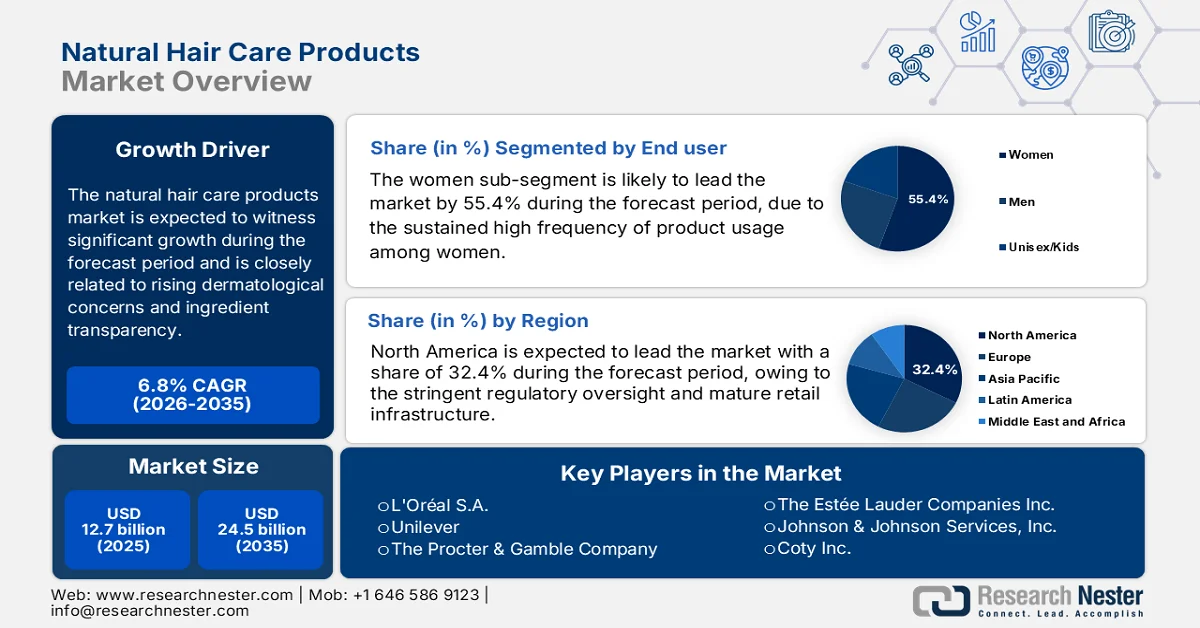
The natural hair care products market is shaped by the rising dermatological concerns, ingredient transparency, and the growing consumer preference for plant-based formulations supported by public health guidance. The cosmetic products, including hair care, must ensure the safety and proper labeling with the increased scrutiny on ingredients such as parabens, phthalates, and formaldehyde-releasing preservatives, which has influenced the manufacturers to reformulate toward naturally derived alternatives. According to the NLM May 2025 study, the natural and organic products industry reached USD 300 billion in 2023, showing consistent growth. Moreover, the regulatory shift necessitates significant compliance infrastructure for companies exporting to other countries, as they must follow the adverse event reporting and safety substantiation protocols that reflect the pharmaceutical-grade standards.
Moreover, from a supply and policy perspective, the international regulatory frameworks and sustainability initiatives are reinforcing the market expansion. According to the Cosmetics Europe 2026 data, nearly 30,000 substances used in cosmetic products are regulated under the EU Cosmetics Regulation, with strict bans and restrictions driving the innovation in plant-based and biodegradable ingredients. Further, in the emerging natural hair care products market, the government-backed initiatives supporting the herbal and traditional products are contributing to demand. Additionally, the widespread use of traditional and plant-based ingredients in personal care across developing economies is supporting long-term supply chain integration. These regulatory, environmental and public health factors collectively create a structured growth environment for natural hair care product manufacturers targeting compliant, scalable, and export-oriented production models.
Key Natural Hair Care Products Market Insights Summary:
Regional Highlights:
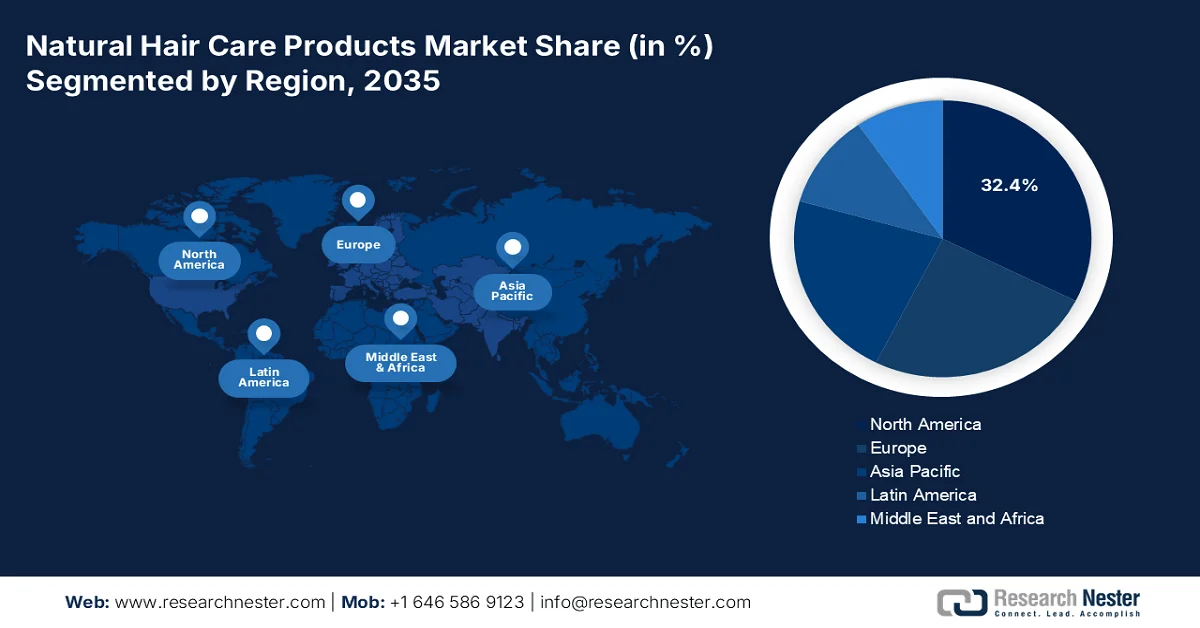
- North America natural hair care products market is anticipated to secure a 32.4% revenue share by 2035, supported by stringent regulatory oversight and mature retail infrastructure
- Asia Pacific is projected to expand at a CAGR of 8.5% during 2026–2035, fueled by government integration of traditional medicine systems and investment in herbal cultivation infrastructure
Segment Insights:
- In the natural hair care products market, the women segment is expected to account for a 55.4% share by 2035, propelled by high product usage frequency and growing demand for chemical-free formulations
- The premium segment is forecast to lead over 2026–2035, capturing a significant share, attributed to rising consumer preference for quality, efficacy, and ethically produced products
Key Growth Trends:
- Rising awareness on scalp health
- High preference on organic ingredients
Major Challenges:
- Greenwashing litigation and legal scrutiny
- High ingredient costs
Key Players: L'Oréal S.A. (France), Unilever (United Kingdom/Netherlands), The Procter & Gamble Company (P&G) (U.S.), The Estée Lauder Companies Inc. (U.S.), Johnson & Johnson Services, Inc. (U.S.), Coty Inc. (U.S.), Henkel AG & Co. KGaA (Germany), Kao Corporation (Japan), Shiseido Company, Limited (Japan), Amway Corporation (U.S.), Oriflame Holding AG (Sweden), The Hain Celestial Group, Inc. (U.S.), Davines S.p.A. (Italy), Aveda Corporation (U.S.), Nature’s Gate (U.S.), Marico Limited (India), The Himalaya Drug Company (India), Evonik (Germany), Henkel (Germany), Sensatia Botanicals (Indonesia).
Global Natural Hair Care Products Market Forecast and Regional Outlook:
Market Size & Growth Projections:
- 2025 Market Size: USD 12.7 billion
- 2026 Market Size: USD 13.5 billion
- Projected Market Size: USD 24.5 billion by 2035
- Growth Forecasts: 6.8% CAGR (2026-2035)
Key Regional Dynamics:
- Largest Region: North America (32.4% Share by 2035)
- Fastest Growing Region: Asia Pacific
- Dominating Countries: United States, China, Germany, Japan, United Kingdom
- Emerging Countries: India, South Korea, Brazil, Indonesia, Mexico
Last updated on : 25 March, 2026
Natural Hair Care Products Market - Growth Drivers and Challenges
Growth Drivers
- Rising awareness on scalp health: The significant demand driver in the natural hair care products market is the awareness of scalp health. Various research studies have highlighted that conditions such as dandruff, seborrheic dermatitis, and alopecia affect millions of people globally, with scalp disorders increasingly linked to inflammation, microbiome imbalance, and sensitivity to chemical irritants. According to the NLM April 2025 study the dandruff will affect over 50% of the global adult population in their lifetime. The public health agencies have highlighted consumer safety via strict oversight of cosmetic ingredients, reinforcing the need for non-irritating low toxicity formulations. Moreover, the demand for natural hair care products is expected to strengthen as scalp health becomes a central focus in preventive care and daily hygiene routines, supported by increased public health communication.
- High preference on organic ingredients: The consumer preference is driving the natural hair care products market. According to the Invest India October 2023 data, the organic products market in India, which includes cosmetics, is expected to grow to USD 10.1 billion by the end of 2026. This data reflects the sustained demand for certified organic inputs in personal care. Moreover, the government-backed initiatives are expanding the organic farming capacity, improving the supply availability of plant-based oils and extracts used in hair care formulations. These frameworks are promoting the buyers to prioritize certified organic suppliers to meet the compliance and traceability requirements. The demand is expected to grow further as the regulatory-backed certification and government spending strengthen both the supply chains and procurement standards.
- Government funding for traditional medicine: The public investment in the traditional medicine systems is expanding the use of the botanical ingredients in the hair care sector. According to the PIB February 2024 data, the budget allocation to the Ayush Ministry has surged by the 20%, supporting the Ayurveda Siddha and herbal product industries. This funding enhances the research cultivation and global promotion of plant-based formulations. Moreover, most of the global population relies on herbal products for primary care. These initiatives are formalizing the supply chains and improving the quality standards for the herbal inputs used in hair care manufacturing. This driver is particularly strong in APAC where the public funding is translating into the scalable production ecosystems.
Challenges
- Greenwashing litigation and legal scrutiny: Companies face substantial legal risks when marketing products as natural without a clear regulatory definition, leading to consumer protection lawsuits that damage brand reputation and incur high legal costs. Many top companies have faced consumer protection lawsuits filed in court regarding products containing many harmful ingredients and featuring natural sourcing imagery that misleads the marketing. Though the companies have successfully defeated it, the case exemplifies the litigation risks. This challenge is compounded by the fact that in markets, there is no legal definition of what constitutes a natural cosmetic.
- High ingredient costs: The premium cost of natural and organic ingredients creates significant pricing pressures, limiting consumer accessibility and squeezing the manufacturer's margins. Moreover, the high cost of the natural and organic ingredients acts as a primary barrier to market entry for new players in the natural hair care products market. This cost challenge is intensified by the resource-intensive nature of natural ingredient production. The annual usage of this single ingredient might reach tons, demonstrating the immense resource burden of natural sourcing.
Natural Hair Care Products Market Size and Forecast:
| Report Attribute | Details |
|---|---|
|
Base Year |
2025 |
|
Forecast Year |
2026-2035 |
|
CAGR |
6.8% |
|
Base Year Market Size (2025) |
USD 12.7 billion |
|
Forecast Year Market Size (2035) |
USD 24.5 billion |
|
Regional Scope |
|
Natural Hair Care Products Market Segmentation:
End user Segment Analysis
Within the end user segment, the women sub-segment is leading and is poised to hold the share value of 55.4% by the end of 2035 in the natural hair care products market. The segment is driven by the sustained high frequency of product usage among women who typically engage with multiple SKUs, including shampoos, conditioners, oils, and treatments as part of their regular hair care regimens. Further, the rising influence of the textured hair movement and the natural curl community has driven female consumers to seek specialized chemical-free formulations that cater to diverse hair types. According to the IJCRT November 2025, nearly 28% of women spend on hair care. The women continue to account for the majority of consumer spending in the personal care sector, with a significant portion of household budgets allocated to health and beauty products.
Price Point Segment Analysis
In the price point segment, the premium is leading in the natural hair care products market and is reflecting a global consumer shift toward quality, efficacy, and ethical production over cost. The natural hair care consumer is increasingly educated and willing to pay a higher price for products that offer certified organic ingredients, sustainable sourcing, and clinically proven results. This premiumization trend is driven by the perception that higher-cost natural products deliver better long-term scalp and hair health benefits compared to mass market alternatives. Moreover, the average annual expenditure on personal care products and services has risen, indicating the willingness to invest in premium self-care items. This economic behavior underscores the resilience of the premium segment as consumers prioritize quality.
Distribution Channel Segment Analysis
Online retail is expected to lead the distribution channel segment in the natural hair care products market. The segment is driven by the convenience of direct-to-consumer models and the ability for niche natural brands to reach global audiences without the barrier of traditional retail shelf space. Digital platforms excel at providing the transparency natural consumer demand offering detailed ingredient lists, sourcing stories, and user-generated reviews that build trust. According to the U.S. Census Bureau, March 2026 data, the ecommerce sales accounted for 16.6% of the total sales, with the health and personal care category outperforming the national average for the online growth. This trend confirms that the digital marketplace is the primary avenue for the discovery and purchase of natural hair care products.
Our in-depth analysis of the natural hair care products market includes the following segments:
|
Segment |
Subsegments |
|
Product Type |
|
|
End user |
|
|
Distribution Channel |
|
|
Price Point |
|
|
Ingredient Type |
|
|
Target Concern |
|
|
Packaging |
|

Vishnu Nair
Head - Global Business DevelopmentCustomize this report to your requirements — connect with our consultant for personalized insights and options.
Natural Hair Care Products Market - Regional Analysis
North America Market Insights
North America is projected to dominate the natural hair care products market and is expected to hold the regional revenue share of 32.4% by the end of 2035. The region is driven by the stringent regulatory oversight and mature retail infrastructure. The market benefits from high consumer awareness regarding ingredient safety and well-established base of manufacturers complying with FDA regulations. The key drivers include the USDA Biopreferred program, which mandates federal procurement of biobased products, creating a stable institutional demand. The trends indicate a shift toward supply chain transparency, enforcing strict documentation for the imported botanicals. Moreover, the government spending on the organic farming transitions supports domestic sourcing of ingredients like shea butter and aloe vera, reducing the reliance on the volatile international suppliers.
The increasing health risk awareness linked to synthetic ingredients and a rising prevalence of hair and scalp conditions are driving the natural hair care products market in U.S. According to the NLM November 2023 data, the U.S. FDA under the Modernization of Cosmetics Regulation Act 2022 has intensified oversight on the ingredients such as parabens and sterilants like ethylene oxide (EtO), which classifies as a carcinogen associated with breast cancer and lymphohematopoietic cancers as well as genotoxic effects. On the other hand, the Consumer Notice 2026 data reports that approximately 42.68% of U.S. males experience androgenetic alopecia, increasing the need for scalp-safe and restorative hair care solutions. These factors show an active upliftment in the natural hair care products market expansion and growth.
The stringent regulatory controls and expanding export potential are driving the natural hair care products market in Canada. According to the NLM 2021 study the Health Canada’s Cosmetic Ingredient Hotlist identifies over 800 substances as restricted or prohibited in personal care products, which is accelerating the shift toward plant-based and naturally derived formulations among manufacturers. This regulatory environment is compelling B2B players to reformulate their products to meet compliance standards, increasing demand for safer organic ingredients. On the other hand, the OEC 2026 data reports that hair product exports reached USD 462 million in 2024, highlighting the country’s growing role as a supplier in the global personal care value chain. These data are driving sustained demand for the natural hair care products across both the domestic and international channels.
Canada Hair Products Export Data
|
Country |
Value (USD million) |
|
U.S. |
462 |
|
UK |
4.96 |
|
Spain |
3.0 |
|
Germany |
2.72 |
|
Malaysia |
1.68 |
Source: OEC 2026
APAC Market Insights
The Asia Pacific is projected to emerge as the fastest-growing region during the assessed period, 2026 to 2035, and is poised to grow at a CAGR of 8.5%. The region is driven by the government's integration of traditional medicine systems into regulatory frameworks and substantial public investment in herbal cultivation infrastructure. The region benefits from diverse biodiversity and established herbal knowledge, mainly in India and China, where the ministries dedicated to traditional medicine formalize the ingredient standards and manufacturing goods. Moreover, the government procurement preferences for traditional medicine-based products in public healthcare systems create institutional demand. Furthermore, the Asian Development Bank has funded multiple projects supporting sustainable agriculture for the medicinal and aromatic plants across the region, enhancing supply chain resilience for natural ingredient sourcing.
The natural hair care products market in India is expanding rapidly and is driven by the strong government support for herbal industries, rising domestic consumption, and increasing export potential. According to the Madhavbaug 2023 to 2024 data, the Ministry of AYUSH has allocated USD 440 million to promote Ayurveda and plant-based products, strengthening the supply chain for natural hair care formulations. India’s large consumer base and growing preference for traditional remedies are further supporting demand. Moreover, the Government of India reports consistent growth in exports of cosmetics and personal care products supported by initiatives such as Make in India and Production Linked Incentive schemes. These factors are driving a highly growth, cost-competitive market for natural hair care products with strong domestic and international demand.
The environmental concerns linked to personal care product emissions and strong consumer spending are fueling the natural hair care products market in China. According to the NLM 2021 study, the personal care products contribute 506.35 mg/day/1000 people in total mass loading. Moreover, the shampoos and shower gels alone generate emissions of siloxanes, including decamethylcyclopentasiloxane at 8.33 μg/day and dodecamethylcyclohexasiloxane at 6109 μg/day per capita, highlighting the environmental burden of synthetic ingredients. Further, the ITA September 2025 data from China’s National Bureau of Statistics reported that total retail sales of consumer goods reached approximately USD 6.8 trillion in 2024, reflecting a large and expanding consumption base for personal care products, including natural segments. These data position China as a high-growth and transition-focused market for natural hair care products.
China Cosmetics and Personal Care Market Overview
|
Segment / Indicator |
2023 Value (USD) |
Growth Rate / CAGR |
Forecast Value |
|
Total Cosmetics Market |
$134.3 billion |
+4.8% YoY |
|
|
Cosmeceutical Market |
USD 4.68 billion |
3.9% CAGR |
USD 5.93 billion (2030) |
Source: ITA September 2025
Europe Market Insights
The natural hair care products market in Europe is expanding rapidly and is driven by the stringent regulatory frameworks and harmonized safety standards enforced by the EMA ad European Commission’s health directorate. The EU Cosmetics Regulation mandates comprehensive safety assessments for all the cosmetics products. This regulatory rigor has stimulated the reformulation toward the natural ingredients as synthetic compounds face increasing scrutiny. According to the NLM 2021 study, nearly 1,500 chemicals in Europe are banned from personal care products. The European Commission's Green Public Procurement criteria encourage member states to prioritize sustainable cosmetics in institutional purchasing, creating stable B2B demand. Further, the funding is directed toward sustainable chemistry and biotechnology for cosmetic applications, enabling ingredient innovation and supply chain optimization.
The natural hair care products market in Germany is experiencing steady growth, supported by the rising prevalence of hair loss conditions and strong import activity. According to the World Population Review 2026 report, nearly 41.51% of males in Germany experience baldness, driving the sustained demand for scalp care and restorative formulations. This trend is influencing the B2B manufacturers to expand portfolios focused on natural oils, botanical extracts, and dermatologically compatible ingredients. On the other hand, Germany imported USD 1.06 billion worth of hair care products as per the OEC 2026 report, reflecting its role as the major consumption hub and reliance on the international supply chains to meet the diverse consumer preferences. Further, these data show a high-demand market where the natural hair care products are gaining traction due to both clinical need and evolving consumer preferences.
The well established beauty and personal care industry's strong export orientation and growing international trade partnerships are driving the natural hair care products market in the UK. According to the Government of the UK, December 2024 data, the UK’s beauty sector is valued at USD 31.1 billion, indicating a substantial domestic base for product development and commercialization. Moreover the bilateral trade between the UK and India alone is valued at USD 53.3 billion annually, reflecting expanding demand for personal care products across high-growth natural hair care products markets. These developments are encouraging UK-based manufacturers to innovate in plant-based and clean-label formulations to remain competitive in both domestic and export markets. As a result, the UK is emerging as a key innovation and export hub within the natural hair care segment, driven by the strong industry value and increasing global trade integration.
Key Natural Hair Care Products Market Players:
- L'Oréal S.A. (France)
- Unilever (United Kingdom/Netherlands)
- The Procter & Gamble Company (P&G) (U.S.)
- The Estée Lauder Companies Inc. (U.S.)
- Johnson & Johnson Services, Inc. (U.S.)
- Coty Inc. (U.S.)
- Henkel AG & Co. KGaA (Germany)
- Kao Corporation (Japan)
- Shiseido Company, Limited (Japan)
- Amway Corporation (U.S.)
- Oriflame Holding AG (Sweden)
- The Hain Celestial Group, Inc. (U.S.)
- Davines S.p.A. (Italy)
- Aveda Corporation (U.S.)
- Nature’s Gate (U.S.)
- Marico Limited (India)
- The Himalaya Drug Company (India)
- Evonik (Germany)
- Henkel (Germany)
- Sensatia Botanicals (Indonesia)
- Company Overview
- Business Strategy
- Key Product Offerings
- Financial Performance
- Key Performance Indicators
- Risk Analysis
- Recent Development
- Regional Presence
- SWOT Analysis
- L’Oreal S.A. has established itself as a dominant player in the natural hair care products market by significantly leveraging its advanced research capabilities to integrate botanical ingredients into mobile digital platforms for consumer education. The company has pioneered the use of augmented beauty tools such as mobile apps that diagnose hair and scalp health, allowing consumers to find personalized natural hair care solutions. According to the 2024 annual report, the company occupies 4.5% of the global beauty market growth.
- Unilever commands a substantial share of the natural hair care products market via a strategic portfolio that masterfully blends heritage brands with culturally authentic acquisitions. The company has made significant advancements by adopting consumer insight data into its product development cycles, ensuring that its natural hair care offerings meet the specific needs of hair texture. According to the annual report, the company has sold its products to nearly 190 countries.
- The Procter & Gamble Company has reinforced its position in the natural hair care products market by leveraging its massive scale to democratize access to naturally derived hair care via its My Black is Beautiful and Herbal Essences botanical lines. P&G has pioneered the use of artificial intelligence to analyze natural hair care data, scanning millions of social media to identify the trends.
- The Estee Lauder Companies Inc. maintains a prestigious foothold in the natural hair care products market primarily via its Aveda brand, which is widely regarded as a pioneer in plant-based hair care. Estee Lauder has made significant advancements in the market by adopting traditional Ayurvedic principles and integrating them into a consumer engagement platform to track the product efficacy.
- Johnson & Johnson Services Inc. has carved out a significant space in the natural hair care products market by focusing on the intersection of dermatological science and nature, primarily via its consumer health brands. The company has made significant advancements by adopting natural ingredients data into its mobile health and wellness ecosystems, ensuring product recommendations for a sensitive scalp.
Here is a list of key players operating in the global natural hair care products market:
The natural hair care products market is highly fragmented, competitive, and is defined by the established multinational consumer goods giants and agile niche indie brands. The key strategic initiatives among top players include a heavy focus on product innovation via clean ingredients, sustainable sourcing, and eco-friendly packaging. For example, in September 2024, Evonik launched two natural actives, CapilAcid for haircare and Oleobiota for skincare applications. Major organizations are actively acquiring successful indie brands to capture their loyal customer base and the authenticity. Similarly, the companies are using digital marketing and direct-to-consumer models to build communities and bypass traditional retail channels. The competitive edge is increasingly defined by transparent, ethical supply chains and catering to diverse hair textures and specific scalp health needs across different demographics globally.
Corporate Landscape of the Natural Hair Care Products Market:
Recent Developments
- In March 2026, Henkel has signed an agreement to acquire Not Your Mother’s, a leading and fast‑growing hair care and styling consumer brand in North America, owned by PE investor Main Post Partners.
- In January 2025, Hindustan Unilever Limited announced it has signed a definitive agreement to acquire the premium actives-led beauty brand, Minimalist. This marks another step in the transformation journey of its Beauty & Wellbeing portfolio towards evolving and higher growth demand spaces.
- In July 2024, Sensatia Botanicals has announced the launch of advanced hair care collection for natural hair treatment. The solution addresses the hair damage or scalp issues that affect individuals for a multitude of reasons.
- Report ID: 8470
- Published Date: Mar 25, 2026
- Report Format: PDF, PPT
- Explore a preview of key market trends and insights
- Review sample data tables and segment breakdowns
- Experience the quality of our visual data representations
- Evaluate our report structure and research methodology
- Get a glimpse of competitive landscape analysis
- Understand how regional forecasts are presented
- Assess the depth of company profiling and benchmarking
- Preview how actionable insights can support your strategy
Explore real data and analysis
Frequently Asked Questions (FAQ)
About this Report
Connect with our Expert


Report, 2026-2035



Copyright @ 2026 Research Nester. All Rights Reserved.
