Mice Model Market Outlook:
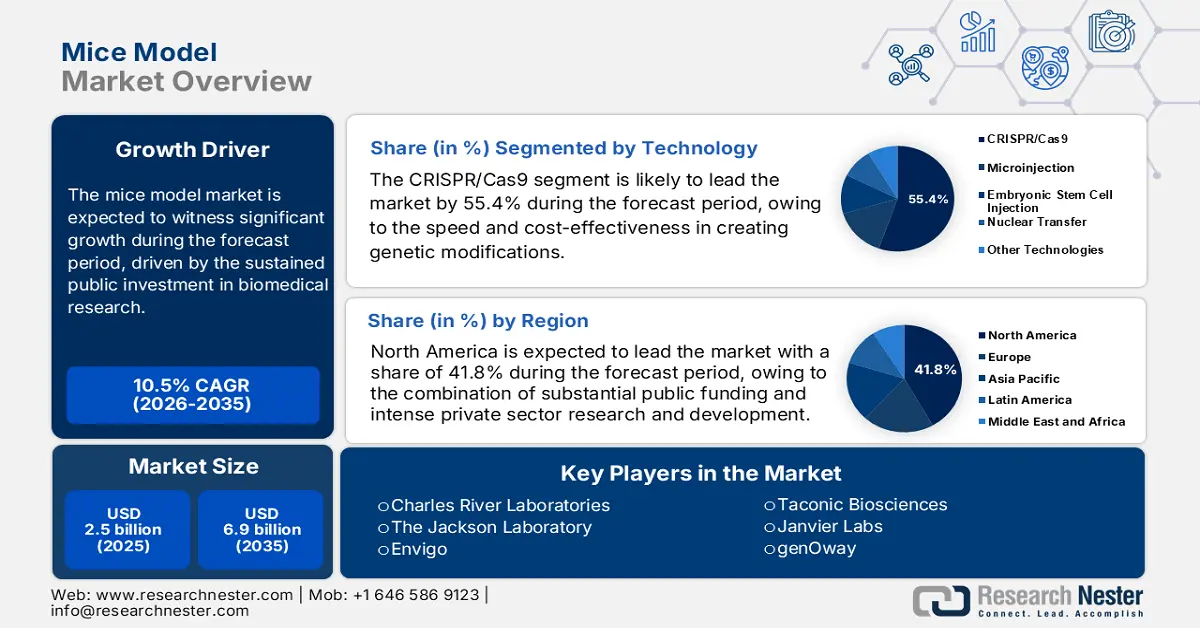
Mice Model Market size was valued at USD 2.5 billion in 2025 and is projected to reach USD 6.9 billion by the end of 2035, rising at a CAGR of 10.5% during the forecast period, i.e., 2026-2035. In 2026, the industry size of mice model is estimated at USD 2.8 billion.
The mice model market is primarily shaped by the sustained public investment in biomedical research and the scale of government-funded preclinical programs. In the U.S., the NIH June 2025 data depict that the NIH reported a total research funding of USD 48.0 billion, with 82% of the funding directed toward basic and translational research, where the murine model remains a core experimental platform. NIH’s Research Condition and Disease Categorization data show that therapeutic areas with the highest federal spending, oncology, neurology disorders, and infectious diseases all rely heavily on genetically defined and disease-specific mouse colonies for target validation and safety profiling. The parallel demand is supported by the federally backed infrastructure. The UC Davis data in February 2025 shows that it is the largest center of the consortium and holds 55,000 mutant alleles for thousands of genes in the mouse genome.
Outside the U.S., public funding and regulatory harmonization continue to underpin the mice model market expansion. The European Commission’s Horizon Europe program 2021-2027 has allocated EUR 95.5 billion to research and innovation, with health accounting for one of the largest thematic clusters. The European Research Council confirms that a significant percentage of the funded life science projects incorporate murine disease models for mechanistic studies. In the UK, the UK Research and Innovation report in July 2025 reported EUR 2.4 billion is allocated for innovation in 2022-2023, with the national medical facilities supporting the centralized breeding and phenotyping services to improve the reproductivity across institutions. Further, these funding flows, infrastructure investments, and regulatory mandates position the mice model market as a structurally supported segment of the life-science supply chain.
Key Mice Model Market Insights Summary:
Regional Highlights:
- The North America mice model market is expected to secure a 41.8% revenue share by 2035, supported by deep-rooted public research funding, dense pharmaceutical and biotechnology R&D activity, and stringent regulatory emphasis on high-quality preclinical validation.
- Asia Pacific is projected to expand at a CAGR of 9.2% during 2026–2035, reflecting accelerated growth fueled by large-scale government biotechnology investments and the rapid expansion of domestic pharmaceutical research ecosystems.
Segment Insights:
- The CRISPR/Cas9 technology segment in the mice model market is projected to command a 55.4% share by 2035, reflecting its strong adoption for rapid and precise genetic editing, catalyzed by sustained public funding and its efficiency in developing clinically relevant disease models.
- The genetically engineered mice segment is anticipated to lead the type category by 2035, underpinned by rising demand for high-fidelity disease modeling in oncology and neurology, reinforced by continued institutional support for large-scale production and distribution of advanced mouse models.
Key Growth Trends:
- Regulatory requirements for preclinical safety and efficacy
- Rising burden of chronic and age related diseases
Major Challenges:
- High capital investment and long development cycles
- Technological disruption and skill gaps
Key Players: Charles River Laboratories (U.S.), The Jackson Laboratory (U.S.), Envigo (U.S.), Taconic Biosciences (U.S.), Janvier Labs (France), genOway (France), TransCure bioServices (France), Ingenious Targeting Laboratory (U.S.), PolyGene (Switzerland), Crown Bioscience (U.S.), Cyagen Biosciences (U.S.), Shanghai Model Organisms Center (China), Harbour BioMed (China), Ozgene Pty Ltd (Australia), Pharmalegacy (U.S.), CLEA Japan, Inc. (Japan), Japan SLC, Inc. (Japan), Daegu Gyeongbuk Medical Innovation Foundation (Korea), Biocytogen (China), Inotiv (U.S.)
Global Mice Model Market Forecast and Regional Outlook:
Market Size & Growth Projections:
- 2025 Market Size: USD 2.5 billion
- 2026 Market Size: USD 2.8 billion
- Projected Market Size: USD 6.9 billion by 2035
- Growth Forecasts: 10.5% CAGR (2026-2035)
Key Regional Dynamics:
- Largest Region: North America (41.8% Share by 2035)
- Fastest Growing Region: Asia Pacific
- Dominating Countries: United States, China, Japan, Germany, United Kingdom
- Emerging Countries: China, India, South Korea, Canada, France
Last updated on : 13 January, 2026
Mice Model Market - Growth Drivers and Challenges
Growth Drivers
- Regulatory requirements for preclinical safety and efficacy: The regulatory agencies continue to mandate in vivo data for most drug development pathways, anchoring structural demand for mice model market. The U.S.FDA requires animal pharmacology and toxicology data to support investigational new drug applications, with murine models forming the first tier of safety assessment for small molecules, biologics, and vaccines. This regulatory baseline creates recurring demand from the pharmaceutical sponsors and CROs regardless of the therapeutic cycle fluctuations. The FDA report in 2022 shows that over 5,500 reviews of active IND submissions were conducted, each typically supported by multiple in vivo studies. As governments tighten standards for reproducibility and data integrity, demand is shifting toward well characterized pathogen free and genetically defined mouse lines that meet the inspection and documentation requirements, benefiting suppliers with certified breeding and quality systems.
- Rising burden of chronic and age related diseases: The government health agencies continue to highlight the growing burden of chronic diseases, directly increasing the reliance on mice model market for mechanistic and therapeutic research. The U.S. CDC report in April 2025 depicts that 6 in 10 adults live with at least one chronic condition, driving the federal research priorities in cancer, cardiovascular disease, diabetes, and neurodegeneration areas, where murine disease models remain central. The WHO data in September 2025 states that non-communicable disease accounts for 43 million global deaths, reinforcing the government funding toward translational research pipelines. These epidemiological pressures translate into sustained public investment in the disease specific mice colonies for pathophysiology studies and preclinical testing. The demand is strong for the aged mice, and comorbidity models reflecting real-world patient profiles are prioritized in the publicly funded grants.
U.S. Adults Chronic Conditions (2023)
|
Category |
Prevalence |
Population Affected |
|
≥1 Chronic Condition |
76.4% |
194 million |
|
Multiple Chronic Conditions (≥2) |
51.4% |
131 million |
Source: CDC April 2025
- Internationalization of biomedical research and funding: Research capacity and government funding are growing significantly in the Asia Pacific, diversifying geographic demand. China’s National Natural Science Foundation and other state-led biotech initiatives are increasing the domestic research output. This not only creates local demand for models but also boosts competition and innovation from regional suppliers. The mice model market is becoming less centralized, requiring global suppliers to establish local breeding facilities and partnerships to serve these expanding research ecosystems effectively and navigate the regional. This geographic shift is compelling Western leaders to transition from an export-based model to a true in-region for-region operational strategy to maintain market share.
Challenges
- High capital investment and long development cycles: Establishing state-of-the-art, specific pathogen-free facilities and breeding colonies requires staggering investment with a long time duration in years, ROI timeline, hence creating a formidable barrier to the mice model market entry. This necessitates not only immense upfront capital but also sustained operational funding long before any revenue is generated. The top companies overcome this by having invested a significant amount in the past decade specially in its genetic resource science infrastructure to maintain the leading position. The sheer scale of this financial commitment effectively locks out all the most well-funded new ventures or large corporations diversifying into the sector.
- Technological disruption and skill gaps: The adoption of CRISP technology has revolutionized model generation, but has created a severe shortage of specialized expertise with a global deficit of qualified researchers. This acute skill gap forces companies to invest heavily in proprietary internal training programs to build competency, adding significant time and cost to their operations. Companies mitigate this challenge by forming strategic partnerships with the academic CRISPR core facilities to access the critical talent and knowledge.
Mice Model Market Size and Forecast:
| Report Attribute | Details |
|---|---|
|
Base Year |
2025 |
|
Forecast Year |
2026-2035 |
|
CAGR |
10.5% |
|
Base Year Market Size (2025) |
USD 2.5 billion |
|
Forecast Year Market Size (2035) |
USD 6.9 billion |
|
Regional Scope |
|
Mice Model Market Segmentation:
Technology Segment Analysis
Within the technology segment, the CRISPR/Cas9 dominates the segment in the mice model market and is poised to hold the share value of 55.4% by 2035. The segment is driven by its unparalleled efficiency, speed, and cost-effectiveness in creating precise genetic modifications compared to older technologies such as microinjection. CRISPR enables the rapid development of complex clinically relevant models, such as those for oncology and rare diseases, which are in high demand for modern drug discovery. A key statistical driver is the sustained public investment in this foundational tool. For instance, the statistical data from the NIH indicates that CRISPR-related research projects total a significant amount, underscoring its transformative role in biomedical science and its direct commercial application in the mice model market.
Type Segment Analysis
The type segment is decisively led by the genetically engineered mice, which are forecast to account for the largest revenue in the mice model market. This dominance is due to their critical role in modeling complex human diseases with high genetic fidelity, making them indispensable for target validation and therapeutic efficacy testing. The demand for custom knockouts, humanized immune systems, and condition-specific models continues to surge, mainly in oncology and neurology. A concrete indicator of this trend is the scale of model production and distribution. The report from UC Davis is February 2025, states that NIH has renewed funding for the Mutant Mouse Resource & Research Center at USD 7.2 million, marking the fifth renewal to support distribution of genetically engineered mice (GEM) for human disease models, including cancer, heart disease, and aging.
End user Segment Analysis
Under the end user segment, the pharmaceutical & biotechnology companies are leading and are expected to hold the largest share value in the mice model market. The segment is driven by the high-value customers and large cohort models to support expansive internal preclinical pipelines. These companies invest heavily in complex models, such as PDX and humanized mice, to improve the translatability of drug candidates and reduce the clinical phase failure rates. Their substantial R&D budgets directly fuel the market growth. Substantiating this, the data from the Pharma in July 2022 shows that the Pharma member companies' annual expenditure on research and development increased to USD 102.3 billion in 2021, representing a sustained massive investment in the preclinical tools, including advanced mouse models that underpin this innovation.
Pharma Member Company R&D Expenditures (2001-2021)
|
Year |
R&D Expenditure (USD billion) |
|
2001 |
29.8 |
|
2003 |
34.5 |
|
2005 |
39.9 |
|
2007 |
47.9 |
|
2009 |
46.4 |
|
2011 |
48.6 |
|
2015 |
59.6 |
|
2020 |
91.1 |
|
2021 |
102.3 |
Source: Pharma July 2022
Our in-depth analysis of the mice model market includes the following segments:
|
Segment |
Subsegments |
|
Type |
|
|
Service |
|
|
Technology |
|
|
Application |
|
|
End user |
|
|
Disease Type |
|

Vishnu Nair
Head - Global Business DevelopmentCustomize this report to your requirements — connect with our consultant for personalized insights and options.
Mice Model Market - Regional Analysis
North America Market Insights
The North America mice model market is dominating and is expected to hold the revenue share of 41.8% by 2035. The market is leading the position via a powerful combination of substantial public funding and intense private sector research and development. The region’s preeminence is fundamentally driven by the scale of the U.S. National Institutes of Health budget, which exceed billion directly financing a vast portion of the academic and basic research that utilizes murine models. The dense concentration of global pharmaceutical and biotechnology companies on the continent channels annual private R&D expenditure, creating a sustained high-value demand for advanced genetically engineered and humanized models essential for drug discovery pipelines. This ecosystem is further reinforced by stringent regulatory frameworks from agencies like the FDA, which emphasize robust preclinical data, thereby elevating requirements for model quality, validation, and comprehensive phenotypic characterization.
The U.S. mice model market is strongly underpinned by the federally funded infrastructure, with the NIH supported Mutant Mouse Resource and Research Center serving as a central pillar of national supply and quality assurance. The NLM study in September 2024 depicts that the MMRRC maintains an archive covering nearly 65,000 alleles and has fulfilled over 20,000 orders for 13,651 scientists across 8,441 institutions worldwide demonstrating the scale and consistency of demand for disease relevant mouse models originating from the U.S. Its nationwide network of four regional centers and a centralized informatics coordination and service center illustrates how public investment has created an integrated ecosystem for model acquisition cryopreservation validation and global distribution. Beyond distributing the MMRRC’s service portfolio spanning genetic testing, microbiome analysis, phenotyping, breeding colony management, and infectious disease surveillance mirrors the commercial service stack of the broader mice model market, reinforcing the role of the public sector as both a demand anchor and a standards setter.
Mutant Mouse Strains Accepted into the MMRRC Program
|
Deposition type |
Cumulative (2000–2025) |
|
Type 1: Investigator initiated, MMRRC supported |
2437 |
|
Type 2: NIH initiated, MMRRC supported |
295 |
|
Type 3: Investigator initiated and supported |
62,064 |
|
Totals |
64,796 |
Source: NLM September 2024
The Canada mice model market is defined by the strategic government investment in a specialized research cluster and a strong focus on translational science. Major funding is channeled via the Canadian Institutes of Health Research. The CIHR report in March 2025 depicts that they have invested over USD 1 billion annually in health research. A key trend is the leveraging of national infrastructure, such as the Centre for Phenogenomics in Toronto, which provides centralized state-of-the-art model generation and phenotyping services, maximizing resource efficiency for academia and industry. The government strategies, including the Pan-Canadian Artificial Intelligence Strategy, are driving the demand for advanced models that generate complex data sets for computational analysis in fields such as neurobiology. This focus on collaborative data-intensive research using standardized models positions Canada as an innovative niche market increasingly integrated with U.S. biopharma pipelines.
APAC Market Insights
The Asia Pacific mice model market is the fastest growing and is expected to grow at a CAGR of 9.2% during the forecast period 2026 to 2035. The market is driven by the government investment in biotechnology and a rapidly expanding domestic pharmaceutical R&D sector. China is the central engine of this growth, with the government initiatives such as the Made in China 2025 plan prioritizing biopharma innovation. This is evidenced by the National Natural Science Foundation of China awarding significant amount in research grants directly fueling the demand for the advanced models. Japan remains a mature, high-quality market with strength in advanced model generation, while India and South Korea are emerging as powerful hubs for cost-effective research and contract services. The key regional trend is the shift from the reliance on imported Western models to the development of local state-supported breeding and genetic engineering facilities aiming for self-sufficiency and catering to the region-specific disease research.
Large scale government investment in next-gen disease modeling led by initiatives such as the National Human Disease Animal Model Resource Center is driving the China mice model market. The NLM study in March 2023 depicts that the program responds directly to a structural gap identified in current research, that while 8,916 mutant mouse lines have been phenotyped globally under public programs such as the Knockout Mouse Project, many single-gene models show limited translational relevance for complex human diseases. As a result, China is repositioning its national infrastructure toward multi-gene comorbidity and genetically diverse mouse models for high burden conditions, including cancer, cardiovascular disease, and other neurodegenerative disorders. The NAMR’s mandate to create, preserve, and distribute advanced disease models, combined with its reported distribution of over 2,000 live engineered mice in 2022, signals the emergence of a state-backed supply ecosystem.
The Japan mice model market is closely tied to sustained government investment in medical research. The Science, Technology, and Innovation Japan in July 2023 depicts that JPY 17.5 billion is allocated for healthcare-related R&D under the Cabinet Office’s Science and Technology Innovation Creation and Promotion Funds. With 11.65 billion JPY earmarked as the President’s discretionary funding across 143 priority projects, this flexible financing structure is designed to surge the translational and clinical-oriented research areas where the murine models remain essential for disease mechanism studies, target validation, and early safety assessment. The emphasis on rapid needs-based funding decisions supports faster procurement cycles for genetically engineered mice breeding services, phenotyping, and colony management, mainly within national universities, public research institutes, and government hospitals.
Europe Market Insights
The Europe mice model market is defined by strong regulatory frameworks, significant public investment in biomedical research, and a collaborative academic industry ecosystem. The key growth is driven by the major EU funding programs such as Horizon Europe, which has a significant budget with substantial portions dedicated to health and biotechnology research that relies on animal models. The trends include a push towards the 3Rs principle, which is increasing the demand for the higher quality genetically defined models that provide more relevant data using fewer animals. This focus aligns with the EU directives and initiatives from the European Partnership for Alternative Approaches to Animal Testing. Further, the consolidation of research and drug development activity in key bioclusters such as the UK’s Golden Triangle, Germany's BioRegionen, and France's Genopole, creates concentrated, high-value demand for sophisticated models, particularly in oncology, neuroscience, and rare diseases.
The Germany mice model market is strongly supported by its leadership in rare disease and functional genomics research, exemplified by the work of the German Mouse Clinic within the International Mouse Phenotyping Consortium and INFRAFRONTIER. The NLM study in June 2023 shows that only a few hundred of nearly 7,000 rare diseases have approved therapies. Germany’s public research ecosystem is increasingly reliant on knockout mouse models to establish gene-disease causality and advance the translational pathways. The GMC’s systematic phenotyping of single gene KO mutants for monogenic rare diseases covering targets such as Nacc1, Bach2, Klotho, and newly characterized genes, including Kans111, Acsf3, and Rabgap1, illustrates how national and pan-European infrastructure is driving the sustained demand for genetically engineered mice deep phenotyping services and cross-border model distribution.
The UK mice model market is driven by the combination of a strong regulatory oversight and demand from the publicly funded biomedical and safety research. The Government of the UK in November 2025 reported that the UK recorded 2.64 million regulated scientific procedures involving animals under the Animals Act, with 95% using rodents, fish, and birds, underscoring the central role of mice in national research infrastructure. Nearly 46% of all procedures were dedicated to the creation and breeding of genetically altered animals, of which 99% were mice, which first reflects the growing dependence on engineered mouse models for understanding gene function and developing disease-relevant systems for oncology, neurology, and immunology. The core research fields driving this demand include the nervous system (170,880 procedures), immune system (137,113), and cancer research (101,418), while the regulatory toxicity testing accounted for over 156,900 procedures, anchoring the steady procurement from pharmaceutical and safety assessment pipelines.

Key Mice Model Market Players:
- Charles River Laboratories (U.S.)
- The Jackson Laboratory (U.S.)
- Envigo (U.S.)
- Taconic Biosciences (U.S.)
- Janvier Labs (France)
- genOway (France)
- TransCure bioServices (France)
- Ingenious Targeting Laboratory (U.S.)
- PolyGene (Switzerland)
- Crown Bioscience (U.S.)
- Cyagen Biosciences (U.S.)
- Shanghai Model Organisms Center (China)
- Harbour BioMed (China)
- Ozgene Pty Ltd (Australia)
- Pharmalegacy (U.S.)
- CLEA Japan, Inc. (Japan)
- Japan SLC, Inc. (Japan)
- Daegu Gyeongbuk Medical Innovation Foundation (KOREA)
- Biocytogen (China)
- Inotiv (U.S.)
- Company Overview
- Business Strategy
- Key Product Offerings
- Financial Performance
- Key Performance Indicators
- Risk Analysis
- Recent Development
- Regional Presence
- SWOT Analysis
- In the mice model market, Charles River Laboratories uses its scale and vertical integration as a core strategy. Beyond its vast catalog of standard and immunodeficient models, CRL strategically acquires niche model providers and CROs to offer an end-to-end pipeline from model creation and breeding to preclinical testing. This One Charles River approach positions them as a comprehensive single source partner for pharmaceutical and biotech clients, embedding their models deeply into the drug discovery value chain and securing long term contracts. The company has made a revenue of USD 1,004.9 million in Q3 2025.
- As a non-profit leader in the mice model market, The Jackson Laboratory’s strategy is built on genetic fidelity, research credibility, and data resources. JAX invests heavily in the development and curation of next-gen genetically engineered models, mainly for complex human diseases. Its strategic initiatives center on coupling its unparalleled biorespiratory with extensive phenotyping data and genomic informatics platforms such as the Mouse Genome Informatics database, creating an indispensable research ecosystem that drives both scientific discovery and model demand.
- Within the competitive mice model market, Envigo, now part of Inotiv, has historically focused on operational excellence and a broad portfolio of research models and services. Its strategy involved providing reliable, high-quality standards models and custom breeding solutions at scale. By integrating with Inotiv’s CRO and discovery services, the strategic initiative is to create a seamless preclinical research continuum where their models are the foundation for subsequent pharmacology, toxicology, and analytical studies conducted within the same corporate umbrella.
- Taconic Biosciences competes in the mice model market by specializing in high complexity, custom-engineered models and germ-free solutions. Its strategy initiatives are built on advanced model generation capabilities, including humanized immune systems, mice, and microbiome-defined models. Taconic focuses on forming deep collaborative partnerships with academic and biopharmaceutical clients to co-develop custom clinically relevant models, positioning itself as a scientific innovator rather than just a large scale suppliers. In 2024, the company received the Novel Product Award at the Merck Technology symposium.
- In the mice model market, Janvier Labs differentiates itself via specialized breeding expertise and a strong focus on animal welfare and genetic stability. Its strategy emphasizes quality control, precise health status monitoring, and logistical reliability for international shipments. Strategic initiatives include expanding its portfolio of proprietary models and offering flexible breeding solutions catering to the precise needs of Europe research institutions that prioritize model consistency and ethical sourcing.
Here is a list of key players operating in the global mice model market:
The global mice model market is highly competitive and consolidating, and is dominated by the large diversified multinationals. The key players, such as Charles River and The Jackson Laboratory, leverage their extensive biorepositories and genetic engineering expertise as primary competitive advantages. Strategic initiatives are heavily focused on expanding genetically engineered model portfolios, mainly CRISPR/Custom models, and enhancing the contract research services. Geographic expansion via acquisitions in Europe and the Asia Pacific is common to access new markets. For example, in June 2025, Taconic Biosciences, a leader in animal model solutions and services, entered into a license agreement with Helmholtz Munich to provide preclinical researchers with enhanced CRISPR gene editing services. Further, major players invest heavily in phenotyping digital data platforms and forming strategic alliances with biopharma clients to provide end-to-end preclinical research solutions, driving the mice model market growth and integration.
Corporate Landscape of the Mice Model Market:
Recent Developments
- In July 2025, The Jackson Laboratory have developed mouse models that survive premature death and enable pre-clinical testing of alternating hemiplegia of childhood, or AHC, a devastating and sometimes fatal neurological disorder that affects about one in a million children with no treatment yet.
- In June 2025, Chiesi Group and Key2Brain announced a worldwide license agreement to advance the development of two blood-brain barrier (BBB)-crossing recombinant enzyme replacement therapies (ERT) for lysosomal storage disorders (LSD), including alpha-mannosidosis (aMann) and Krabbe disease (KD), ultra-rare diseases that affect the central nervous system.
- In May 2024, The Jackson Laboratory has announced a strategic partnership to develop and commercialize cutting-edge tools to expedite antibody discovery and derisk the development of vital new therapies. This collaboration will include co-development activities and leverages JAX’s extensive experience in model research and AbTherx’s Atlas Mouse platform to address critical challenges facing drug developers of all sizes.
- Report ID: 8337
- Published Date: Jan 13, 2026
- Report Format: PDF, PPT
- Explore a preview of key market trends and insights
- Review sample data tables and segment breakdowns
- Experience the quality of our visual data representations
- Evaluate our report structure and research methodology
- Get a glimpse of competitive landscape analysis
- Understand how regional forecasts are presented
- Assess the depth of company profiling and benchmarking
- Preview how actionable insights can support your strategy
Explore real data and analysis
Frequently Asked Questions (FAQ)
About this Report
Connect with our Expert


Report, 2026-2035



Copyright @ 2026 Research Nester. All Rights Reserved.
