Medical Image Management Market Outlook:
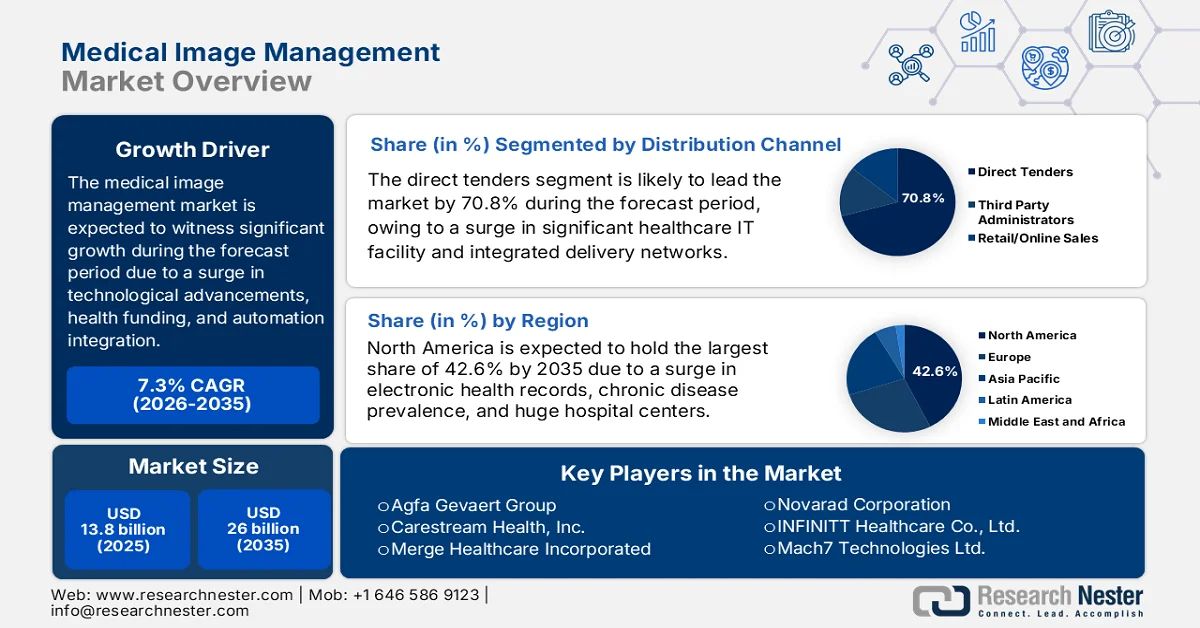
Medical Image Management Market size was valued at over USD 13.8 billion in 2025 and is expected to reach USD 26 billion by the end of 2035, growing at a CAGR of 7.3% during the forecast period, i.e., 2026-2035. In 2026, the industry size of medical image management is estimated at USD 14.8 billion.
The global medical image management market is presently undergoing a profound transformation, highly driven by technological convergence, evolving care delivery models, structural shifts in international healthcare financing, an increase in cloud adoption and AI integration, and focus on value-specific care models. According to official statistics published by NLM in January 2024, the AI model utilization accounted for a 93.8% diagnostic accuracy for aiding v-raf murine sarcoma viral oncogene homolog B1 V600E mutation in colorectal carcinomas. Besides, there has been the development of an AI system by researchers for diagnosing novel coronavirus pneumonia that constituted a 92.4% accuracy, 91.1% specificity, and 94.9% sensitivity. Therefore, with such benefits from utilizing AI, the market is continuously expanding across different nations.
Furthermore, the enterprise imaging consolidation, the automation integration into workflow, an increase in the cloud-native architecture adoption, an expansion in remote and teleradiology diagnostics, and a surge in natural language processing tools are a few trends that are responsible for uplifting the medical image management market globally. As per an article published by NLM in December 2023, the automation technology has displayed accessibility among the patient population, especially in the cataract follow-up pathway, wherein there can be a reduction in patient numbers demanding a clinician-based consultation by almost 60%. Besides, the integration of machine learning is strongly intertwined with magnetic resonance imaging (MRI) for ensuring long-term scan duration, operator dependency, and complicated workflows. This has deliberately resulted in an increase in MRI supply chain globally, which is positively impacting the market upliftment.
2024 Global MRI Export and Import Analysis
|
Countries/Components |
Export (USD) |
Import (USD) |
|
Germany |
1.7 billion |
685 million |
|
China |
1.0 billion |
- |
|
U.S. |
939 million |
832 million |
|
Netherlands |
- |
497 million |
|
Global Trade Valuation |
5.9 billion |
|
|
Global Trade Share |
0.026% |
|
|
Product Complexity |
1.31 |
|
Source: OEC
Key Medical Image Management Market Insights Summary:
Regional Highlights:
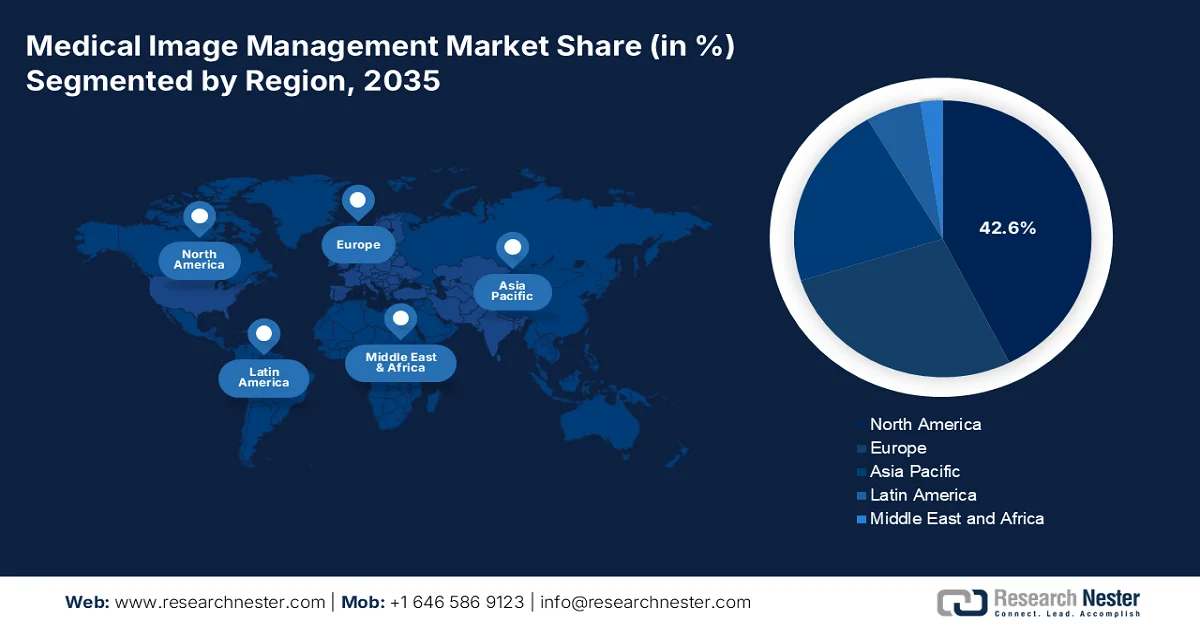
- North America medical image management market is projected to command a 42.6% share by 2035, attributed to advanced IT infrastructure, widespread EHR adoption, and expanding chronic disease burden
- Asia Pacific is set to witness the fastest growth in the forecast period, stimulated by rapid healthcare modernization, rising digital health adoption, and expanding aging population
Segment Insights:
- The direct tenders segment in the medical image management market is expected to secure a 70.8% share by 2035, propelled by the capital-intensive nature of healthcare IT procurement and structured acquisition processes
- The radiology sub-segment is anticipated to capture the second-largest share over the forecast period, fueled by rising chronic disease prevalence, aging demographics, and ongoing technological advancements
Key Growth Trends:
- Increase in medical imaging volumes
- Focus on government modernization strategies
Major Challenges:
- Data security and privacy concerns
- Workforce shortages and technical skills gaps
Key Players: McKesson Corporation (U.S.), GE HealthCare (U.S.), Siemens Healthineers AG (Germany), Koninklijke Philips N.V. (Netherlands), FUJIFILM Holdings Corporation (Japan), Agfa-Gevaert Group (Belgium), Carestream Health, Inc. (U.S.), Merge Healthcare Incorporated (U.S.), Sectra AB (Sweden), Novarad Corporation (U.S.), INFINITT Healthcare Co., Ltd. (South Korea), Mach7 Technologies Ltd. (Australia), Visage Imaging, Inc. (U.S.), Bridgehead Software (UK), Hyland Software, Inc. (U.S.), Optum, Inc. (U.S.), RamSoft, Inc. (Canada), Toshiba Medical Systems Corporation (Japan), Samsung Medison Co., Ltd. (South Korea), Canon Medical Systems Corporation (Japan), Hitachi Ltd. (Japan), AZmed (France).
Global Medical Image Management Market Forecast and Regional Outlook:
Market Size & Growth Projections:
- 2025 Market Size: USD 13.8 billion
- 2026 Market Size: USD 14.8 billion
- Projected Market Size: USD 26 billion by 2035
- Growth Forecasts: 7.3% CAGR (2026-2035)
Key Regional Dynamics:
- Largest Region: North America (42.6% Share by 2035)
- Fastest Growing Region: Asia Pacific
- Dominating Countries: United States, Germany, China, Japan, United Kingdom
- Emerging Countries: India, Brazil, South Korea, Mexico, Indonesia
Last updated on : 30 March, 2026
Medical Image Management Market - Growth Drivers and Challenges
Growth Drivers
- Increase in medical imaging volumes: This is one of the foundational drivers for the medical image management market, attributed to a rise in rare disorders, technological innovation, and a surge in per-capita imaging utilization. According to official statistics published by the NCBI in June 2025, there has been a continuous growth in CT units from 419 to 560 between 2022 and 2023, fueled by the demand for a suitable analysis for minutely understanding the present need and ongoing clinical requirements. In addition, the demand is readily influenced by clinical applications, including drainages, biopsies, and other interventional utilizes of CT, along with modified population demands, innovations in medical practices, and the availability of healthcare resources, thereby proliferating the market growth.
- Focus on government modernization strategies: Governments across different economies are effectively directing suitable funding opportunities to healthcare digitalization, with medical image facility continuously recognized as a priority investment area. As stated in an article published by NLM in July 2024, the revenue of the worldwide digitalized healthcare industry has been estimated to be USD 268.0 billion. This particular revenue reduced to USD 142.9 billion as of 2022, and further increased to USD 180.2 billion in 2023. In addition, this particular industrial revenue is expected to successfully reach USD 549.7 billion by the end of 2028, along with a yearly growth rate of 25%. Therefore, with this continuous increase in revenue growth, the medical image management market is continuously extending its exposure globally.
- Surge in interoperability mandates: The aspect of regulatory policies across developed economies are readily compelling healthcare companies to gain interoperability between electronic health records, imaging systems, and other clinical information systems, which is eventually boosting the medical image management market globally. For instance, the 21st Century Cures Act in the U.S. has mandated that healthcare providers ensure patients to significantly access their overall health-based data that includes images through application-based programming interfaces. Simultaneously in Europe, the Health Data Space has established a common reform for health data exchange across member states, with suitable provisions for imaging data, thus denoting an optimistic outlook for the medical image management market expansion.
Challenges
- Data security and privacy concerns: The aspect of medical imaging data represents one of the most sensitive categories of patient health information, making it a prime target for cyberattacks in the medical image management market. Regarding this, healthcare organizations face mounting pressure to secure increasingly vast repositories of imaging data against ransomware attacks, which have targeted hospital imaging systems with growing frequency. Besides, compliance with stringent regulations such as the Health Insurance Portability and Accountability Act in the U.S. and the General Data Protection Regulation in Europe adds layers of complexity to cloud migration strategies. Moreover, organizations must balance the operational benefits of cloud-based image management with rigorous encryption, access controls, and audit trail requirements.
- Workforce shortages and technical skills gaps: The successful implementation and operation of advanced medical image management systems depend heavily on specialized technical expertise that remains in short supply. Healthcare organizations face persistent shortages of clinical informaticists, imaging IT specialists, and data architects capable of managing complex enterprise imaging environments. Radiologist shortages, projected to worsen in the coming years, compound this challenge by increasing pressure on imaging IT systems to deliver efficient, AI-assisted workflows. Furthermore, training existing clinical staff to effectively utilize advanced features such as AI-powered triage tools requires dedicated time and resources that many departments lack, thus negatively impacting the medical image management market.
Medical Image Management Market Size and Forecast:
| Report Attribute | Details |
|---|---|
|
Base Year |
2025 |
|
Forecast Year |
2026-2035 |
|
CAGR |
7.3% |
|
Base Year Market Size (2025) |
USD 13.8 billion |
|
Forecast Year Market Size (2035) |
USD 26 billion |
|
Regional Scope |
|
Medical Image Management Market Segmentation:
Distribution Channel Segment Analysis
The direct tenders segment, which is part of the distribution channel, is anticipated to garner the largest share of 70.8% in the medical image management market by the end of 2035. The segment’s upliftment is highly driven by its high-stakes and capital-intensive nature of healthcare IT procurement. In addition, large-scale hospital networks, integrated delivery networks, and public healthcare systems universally employ formal tender processes to acquire enterprise imaging solutions, ensuring compliance with stringent regulatory and budgetary requirements. This particular channel is characterized by extended sales cycles, typically spanning six to eighteen months, involving detailed technical evaluations, proof-of-concept deployments, and multi-stakeholder approval committees comprising IT leadership, radiologists, and hospital administration.
Specialty Segment Analysis
During the forecast period, the radiology sub-segment, part of the specialty segment, is projected to hold the second-largest share in the medical image management market. The segment’s growth is highly fueled by a rise in incidences of chronic diseases, aging populations, and technological innovations. According to official statistics published by NLM in January 2024, chronic diseases remain as 8 of the 10 notable causes of death, particularly in the U.S. Additionally, during the pandemic, cancer and heart disorders readily account for almost 40% of overall domestic deaths as of 2022. Moreover, the estimated expenses of chronic disease are further projected to reach USD 47 trillion globally by the end of 2030. Besides, behaviors, individual lifestyle, and community factors play crucial roles in the management and development of chronic disorders, thus proliferating the segment’s growth.
Procurement Model Segment Analysis
The multi-departmental (enterprise) segment in the medical image management market is expected to account for the third-largest share by the end of the stipulated timeline. The segment’s development is highly propelled by reflecting a fundamental shift away from siloed, department-specific imaging systems toward unified platforms that consolidate radiology, cardiology, pathology, gastroenterology, and other imaging-intensive specialties into a single enterprise-wide architecture. Moreover, healthcare organizations adopting this model prioritize the development of a wide-ranging longitudinal imaging record accessible across all care settings. This has readily enabled clinicians to view a patient's complete imaging history regardless of department or facility, thus driving the segment’s growth.
Our in-depth analysis of the medical image management market includes the following segments:
|
Segment |
Subsegments |
|
Distribution Channel |
|
|
Specialty |
|
|
Procurement Model |
|
|
End user |
|
|
Product |
|
|
Delivery Model |
|

Vishnu Nair
Head - Global Business DevelopmentCustomize this report to your requirements — connect with our consultant for personalized insights and options.
Medical Image Management Market - Regional Analysis
North America Market Insights
North America in the medical image management market is anticipated to grab the highest share of 42.6% by the end of 2035. The market’s upliftment in the region is highly attributed to the presence of sophisticated IT infrastructure, the adoption of electronic health records, the increased prevalence of chronic diseases, and the existence of massive hospital networks. According to official statistics published by the CDC Government in July 2024, in August 2023, 53 PCORnet facilities, which account for 84% of their presence, comprised a 5-digit zip code that is readily available to almost 95% of the regional patient population. Besides, among 148,223 recently diagnosed atrial fibrillation patients are eligible for oral anticoagulant therapy, with just 43.3% on any type of this therapy within only a year of diagnosis, thereby making it suitable for bolstering the market growth.
The medical image management market in the U.S. is growing significantly, owing to regulatory standards and compliance, a rise in rare diseases, a shift to value-based, and the continuous growth in telemedicine. As per an article published by the CDC Government in October 2022, 37.05 of adults in the country utilize telemedicine, with its increased adoption among 42.0% of women in comparison to 31.7% of men. Besides, the telemedicine utilization accounts for 39.2% of non-Hispanic white, along with 40.6% for non-Hispanic America-based India, 32.8% of Hispanic, 33.1% as non-Hispanic, and 33.0% of non-Hispanic Asia-specific adults. Moreover, the aspects of family income and education level are also responsible for enhancing the telemedicine utilization, thereby making it suitable for enhancing and expanding the market growth and development in the overall country.
Telemedicine Utilization Among Adult Population in the U.S. (2022)
|
Population/Age Categories |
Utilization |
|
Total |
37.0% |
|
Men |
31.7% |
|
Women |
42.0% |
|
18 to 29 years |
29.4% |
|
30 to 44 years |
35.3% |
|
45 to 64 years |
38.9% |
|
More than 65 years |
43.3% |
Source: CDC Government
An increase in the adoption of digitalized healthcare technologies, technological innovations in imaging devices, the demand for cost-effective and efficient solutions, governmental focus on healthcare infrastructure, and the AI integration supported by health technology assessments are certain factors that are bolstering the medical image management market in Canada. Besides, as stated in an article published by the Digital Health and Discovery Platform in 2024, an overall USD 25 million is projected to be available by the end of March 2027, particularly through the Government of Canada’s Innovation, Science, Economic, and Development fund. This is expected to operate under a reimbursement model and is also estimated that individual eligible projects is poised to cost between USD 1 million to USD 7 million. Therefore, with such funding opportunities by government, the market in the country is gradually expanding.
APAC Market Insights
The Asia Pacific in the medical image management market is expected to emerge as the fastest-growing region during the forecast period. The market’s development in the region is highly propelled by rapid modernization in the healthcare infrastructure, an increase in adopting digital health technologies, along with a burgeoning patient population. Based on government estimates published by the Census Government in June 2022, the regional population exceeded 4.5 billion, particularly across India and China, which is more than one-half of the world’s population. In addition, there exists approximately 414 million regional people, aged more than 65 years, which is nearly 20% higher than the overall U.S.-based population, accounting for 331.4 million people. Moreover, it has been predicted that by the end of 2060, over 1.2 billion people is poised to be aged over 65 years, thereby ensuring market expansion in the overall region.
The medical image management market in China is gaining increased traction, owing to generous government investment in healthcare digitalization, an unprecedented volume of diagnostic imaging procedures, AI-infused medical imaging devices, and an increase in healthcare expenditure on image management solutions. As per an article published by NLM in October 2024, the digitalized healthcare industry in the country have effectively reached USD 28.3 billion as of 2022, along with an average yearly growth rate of 30% for over the past 5 years. Additionally, 125 domestic and regional medical facilities have been successfully established in Tier 1 and 2 cities. Meanwhile, the electronic medical record coverage reached 90% in tertiary hospitals, 60% across secondary hospitals, and 40% in primary hospitals. Simultaneously, more than 3,000 internet hospitals have been developed, with telemedicine services benefiting over 25.9 million people, thus denoting a huge growth opportunity for the medical image management market in the country.
The aspects of patients needing innovative diagnostic imaging procedures, the creation of a unified health IT infrastructure, growth in the telehealth industry, and the existence of standardized imaging data exchange protocols are a few factors that are responsible for fueling the medical image management market in India. As stated in an article published by the IBEF Organization in September 2025, the escalated telehealth service in the country is continuously increasing, with a surge in internet users, accounting for an estimated 820 million. Besides, telemedicine is deliberately rewriting the rules of healthcare accessibility for the country, wherein 65% of people reside in rural locations and more than 70% of doctors practicing in domestic cities. Moreover, as of 2023, eSanjeevani has readily facilitated approximately 372 million remote consultations within an estimated 220,000 nationwide providers, thereby making it suitable for developing the market in the country.
Europe Market Insights
Europe in the medical image management market is projected to witness considerable growth by the end of the stipulated timeline. The market’s growth in the region is highly driven by the convergence of digitalized health initiatives, the aging demographic, generous funding allocation through administrative programs, and the deployment of next-generation multi-modal AI-specific solutions in medical imaging. According to official statistics published by OECD in November 2024, countries in the region initiated suitable investments as of 2023 to enable reliable electronic health record and online digital health service increasing 8%-points from 2022 to reach an average of 79%. In addition, Ireland has also made outstanding innovations, with a rise in its score increasing from 0% to 11% as of the same year, thus denoting an optimistic outlook for the market growth.
The medical image management market in Germany is gaining increased exposure, owing to the presence of a string digital health policy, aggressive industrial infrastructure, government’s substantial commitment to healthcare modernization, and effectively upgrading imaging equipment and hospital facilities. As per an article published by the Foundation for Research on Equal Opportunity in December 2024, the country has significantly achieved the third spot in the 2024 World Index of Healthcare Innovation by gaining a total score of 58.5, demonstrating an improvement from its fourth position as of 2022. Besides, in terms of increasing healthcare demands, the country has generously allocated an estimated 11.7% of its GDP to domestic healthcare spending as of 2023, indicating a slight surge from 11.2% in the previous years, thus fueling the market demand.
The strategic focus on health capacity expansion, suitable funding opportunities for replacing imaging hardware and establishing community diagnostics centers, the demand for cloud-specific medical management platforms, and hospital systems integration are certain factors that are responsible for bolstering the medical image management market in the UK. Based on government estimates published by the UK Government in July 2025, the healthcare reform in the country is projected to develop a new Health Data Research Service (HDRS) by partnering with the Wellcome Trust and further backed by almost USD 800.0 million in terms of joint investment. Moreover, the reform significantly supports the Generation Study since it sequences the genomes of 100,000 newborn babies for informing the long-lasting ambition to ensure genomic sequencing at birth universal, which is positively impacting the market development.
Key Medical Image Management Market Players:
- McKesson Corporation (U.S.)
- GE HealthCare (U.S.)
- Siemens Healthineers AG (Germany)
- Koninklijke Philips N.V. (Netherlands)
- FUJIFILM Holdings Corporation (Japan)
- Agfa-Gevaert Group (Belgium)
- Carestream Health, Inc. (U.S.)
- Merge Healthcare Incorporated (U.S.)
- Sectra AB (Sweden)
- Novarad Corporation (U.S.)
- INFINITT Healthcare Co., Ltd. (South Korea)
- Mach7 Technologies Ltd. (Australia)
- Visage Imaging, Inc. (U.S.)
- Bridgehead Software (UK)
- Hyland Software, Inc. (U.S.)
- Optum, Inc. (U.S.)
- RamSoft, Inc. (Canada)
- Toshiba Medical Systems Corporation (Japan)
- Samsung Medison Co., Ltd. (South Korea)
- Canon Medical Systems Corporation (Japan)
- Hitachi Ltd. (Japan)
- AZmed (France)
- Company Overview
- Business Strategy
- Key Product Offerings
- Financial Performance
- Key Performance Indicators
- Risk Analysis
- Recent Development
- Regional Presence
- McKesson Corporation offers a comprehensive suite of medical imaging solutions through its enterprise imaging portfolio, designed to unify radiology, cardiology, and other imaging specialties across complex healthcare networks. The company focuses on providing interoperable systems that streamline image management workflows within large hospital systems.
- GE HealthCare maintains a strong presence in the market with its advanced picture archiving and communication systems and vendor-neutral archive platforms that prioritize AI-driven workflow efficiency. The company emphasizes scalable enterprise imaging strategies that support clinical decision-making across diverse care settings.
- Siemens Healthineers AG delivers integrated medical image management solutions that leverage its expertise in diagnostic imaging hardware and advanced data management software. The company focuses on creating seamless connectivity between imaging devices and enterprise storage systems to enhance operational efficiency.
- Koninklijke Philips N.V. provides a robust portfolio of enterprise imaging and vendor-neutral archive solutions designed to consolidate imaging data across departments and care sites. The company emphasizes intelligent workflow orchestration and interoperability to support precision diagnosis and collaborative care.
- FUJIFILM Holdings Corporation offers a comprehensive suite of medical image management platforms, including its Synapse family of products, which are designed for enterprise-wide imaging data consolidation. The company focuses on delivering scalable, cloud-ready solutions that integrate with existing healthcare IT infrastructures.
Here is a list of key players operating in the global medical image management market:
The medical image management market is characterized by a consolidated competitive landscape where a handful of established multinational corporations dominate the majority share. Additionally, notable players such as GE HealthCare, Siemens Healthineers, and Philips leverage their extensive R&D capabilities and global distribution networks to maintain leadership. Strategic initiatives are heavily focused on AI integration and cloud-native architectures; for instance, companies are acquiring AI specialists to embed workflow automation into Picture Archiving and Communication Systems (PACS) and Vendor Neutral Archives (VNA). Besides, in April 2024, Hitachi Ltd. deliberately signed a stock-based purchase deal and acquired shares of MA micro automation GmbH FROM Max Management GmbH to expand its robotic business in the medical field, thus boosting the medical image management industry.
Corporate Landscape of the Medical Image Management Market:
Recent Developments
- In March 2026, Samsung Medison effectively unified its U.S.-based imaging businesses, which has brought its digitalized radiography, computed tomography, and ultrasound operations within a single structure and effectively aligned with the worldwide Samsung brands.
- In March 2026, AGFA HealthCare significantly completed the regional enterprise imaging implementation across the overall Osakidetza public health network in Spain, with a focus on a multi-year tactical initiative to centralize, modernize, and unify medical imaging solutions.
- In February 2024, AZmed has effectively secured USD 17.4 million in Series A funding, with its operation, including investors such as Teampact Ventures, Techstars, and Maison Worms, that readily support the company’s overarching objective of shaping the future of medical imaging with AI by escalating the workflow of radiologists.
- Report ID: 8481
- Published Date: Mar 30, 2026
- Report Format: PDF, PPT
- Explore a preview of key market trends and insights
- Review sample data tables and segment breakdowns
- Experience the quality of our visual data representations
- Evaluate our report structure and research methodology
- Get a glimpse of competitive landscape analysis
- Understand how regional forecasts are presented
- Assess the depth of company profiling and benchmarking
- Preview how actionable insights can support your strategy
Explore real data and analysis
Frequently Asked Questions (FAQ)
About this Report
Connect with our Expert


Report, 2026-2035



Copyright @ 2026 Research Nester. All Rights Reserved.
