Long Duration Energy Storage Market Outlook:
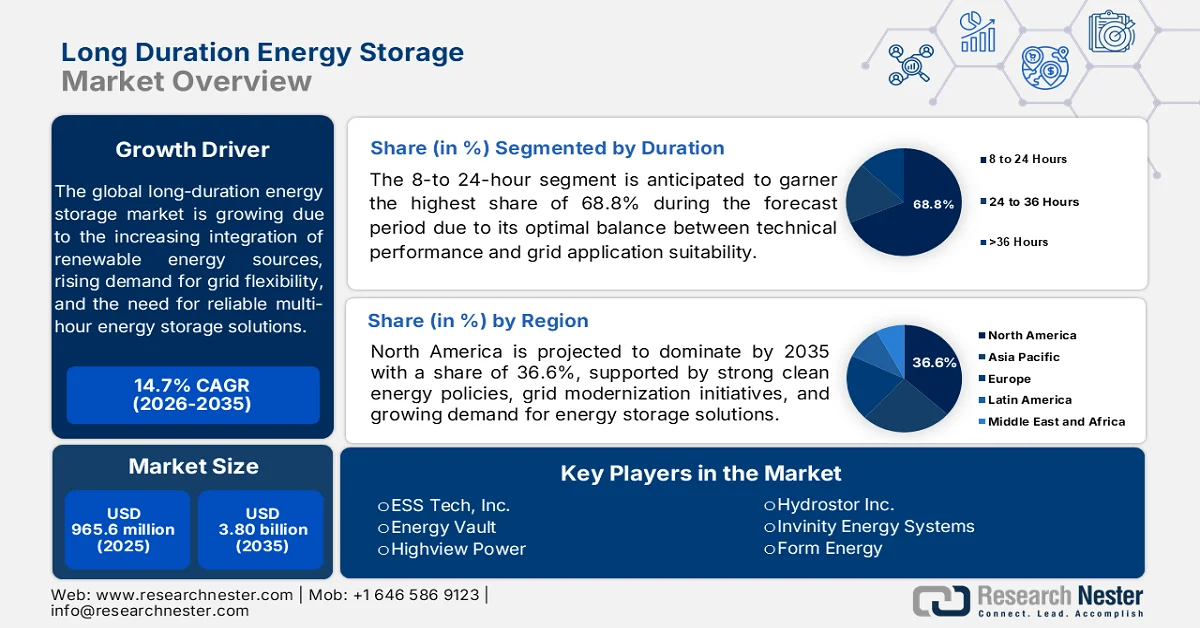
Long Duration Energy Storage Market size was valued at USD 965.6 million in 2025 and is projected to cross USD 3.80 billion by the end of 2035, expanding at more than 14.7% CAGR during the forecast period, i.e., 2026-2035. In 2026, the industry size of long duration energy storage is estimated at USD 1.10 billion.
The global long duration energy storage market exhibits a highly positive outlook in the long term, which is driven primarily by the accelerating transition toward fully decarbonized electrical grids. Most of the nations replace fossil-fuel generation with variable wind and solar power, due to which the demand for storage technologies capable of maintaining grid stability during extended periods of low renewable output is intensifying. In May 2025, Clean Energy Group disclosed that long-duration energy storage is gaining attention as renewable energy expands, wherein solar and wind contributed around 70% of new U.S. grid capacity in 2024, and batteries added another 23%. The article also mentioned that the U.S. energy storage installations increased to 12,300 MW in 2024 over a 3-hour duration, with projections suggesting average storage duration could exceed 8 hours by around 2035, thus contributing to the market’s expansion.
Furthermore, governments across different nations are responding by expanding clean energy mandates, introducing specialized capacity mechanisms, and providing direct financial backing to transition early-stage technologies into commercial deployments. In July 2024, the U.S. Department of Energy’s Office of Clean Energy Demonstrations (OCED) announced up to USD 100 million in funding for pilot-scale non-lithium long-duration energy storage projects with 10+ hour discharge capability. This initiative is supported by the Bipartisan Infrastructure Law, and it aims to advance LDES technologies toward commercial use and strengthen grid reliability as renewable energy grows. This program will fund 3 to 15 projects, providing up to USD 5 to 20 million per project with at least 50% non-federal cost sharing to support development, testing, and deployment, thus benefiting the overall market.
Key Long Duration Energy Storage Market Insights Summary:
Regional Highlights:
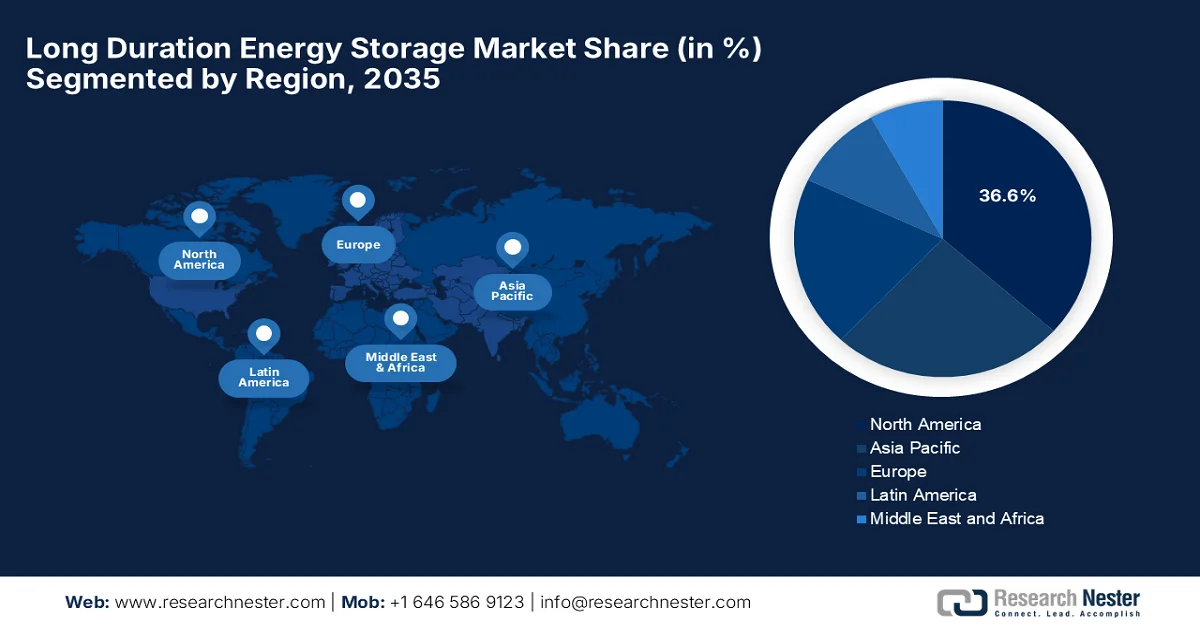
- North America is projected to command 36.6% of the market by 2035, underpinned by aggressive state-level clean energy mandates and supportive federal policy frameworks
- Asia Pacific is set to witness the fastest expansion in the market throughout 2026-2035, fueled by substantial renewable energy targets and intensive industrial decarbonization efforts
- The long duration energy storage market in the U.S. accounts for 87.7% of the share in North America, which is driven by the state-level storage targets and increasing investments in grid modernization
Segment Insights:
- The 8 to 24 hours segment is anticipated to capture 68.8% of the long duration energy storage market by 2035, supported by its optimal balance between technical performance, cost efficiency, and suitability for renewable intermittency, peak demand management, and multi-hour grid balancing requirements
- Mechanical storage is expected to secure a noteworthy share of the market by 2035, benefiting from growing demand for large-scale, long-duration energy discharge systems capable of balancing intermittent renewable energy supply fluctuations
Key Growth Trends:
- Grid resilience and modernization
- Technological diversity and cost reduction
Major Challenges:
- Technology commercialization and scalability complications
- Competition from lithium-ion battery technologies
Key Players: ESS Tech, Inc. (U.S.), Energy Vault (U.S.), Highview Power (UK), Hydrostor Inc. (Canada), Invinity Energy Systems (UK), Form Energy (U.S.), Sumitomo Electric Industries (Japan), RheEnergise (UK), Quidnet Energy (U.S.), VoltStorage GmbH (Germany).
Global Long Duration Energy Storage Market Forecast and Regional Outlook:
Market Size & Growth Projections:
- 2025 Market Size: USD 965.6 million
- 2026 Market Size: USD 1.10 billion
- Projected Market Size: USD 3.80 billion by 2035
- Growth Forecasts: 14.7% CAGR (2026-2035)
Key Regional Dynamics:
- Largest Region: North America (36.6% share by 2035)
- Fastest Growing Region: Asia Pacific
- Dominating Countries: United States, China, Germany, Australia, Canada
- Emerging Countries: India, Japan, South Korea, United Kingdom, Saudi Arabia
Last updated on : 20 July, 2026
Long Duration Energy Storage Market - Growth Drivers and Challenges
Growth Drivers
- Grid resilience and modernization: Rising frequencies of extreme weather conditions put an unprecedented stress on aging electrical infrastructure. In this context, long-duration storage enhances grid resilience by providing essential backup power during prolonged blackouts and severe supply disruptions, thus providing encouraging growth opportunities for pioneers in the long duration energy storage market. For instance, the California Energy Commission in December 2024 awarded a total of USD 42 million in grants for a long-duration energy storage project at Camp Pendleton, San Diego County, to improve grid reliability and provide backup power for up to 14 days during outages. This project initially deploys a 6 MW/48 MWh zinc hybrid cathode aqueous battery system, which also has plans to expand to 50 MW/400 MWh, supporting California’s clean energy goals by 2045.
- Technological diversity and cost reduction: Continuous innovations in non-lithium technologies, such as flow batteries and thermal systems, accelerate commercial viability. As manufacturing scales up and production costs decline, multi-day storage becomes economically attractive for utilities. In January 2025, the Press Information Bureau (PIB) stated that NTPC has launched a CO₂ Battery energy storage project at Kudgi through its R&D wing NETRA, in collaboration with Triveni Turbine Limited and Energy Dome, Italy, which marks a major step in long-duration energy storage. This system will have an energy capacity of 160 MWh and uses a closed Brayton thermodynamic cycle with CO₂ instead of lithium-based chemistry, thus suitable for bolstering the market globally.
Challenges
- Technology commercialization and scalability complications: Several LDES technologies have demonstrated strong potential, but scaling them from pilot projects to commercial, utility-scale deployments is considered to be a major challenge. Technologies such as flow batteries, compressed air energy storage, gravity storage, and thermal storage require validation in order to achieve cost competitiveness and manufacturing scalability. Also, most of the emerging solutions face challenges that are related to efficiency improvements, system integration, and reducing production costs. Additionally, the lack of standardized designs and limited large-scale operational experience creates uncertainty among utilities and investors, negatively impacting the growth of the market.
- Competition from lithium-ion battery technologies: The growing dominance of lithium-ion batteries presents a major challenge for the market. This dominance is mainly due to their established supply chains and adoption in short-duration storage applications. These lithium-ion systems are generally optimized for shorter discharge periods, but advancements in terms of battery chemistry are enabling longer-duration applications as well. In this context, LDES technologies need to demonstrate clear advantages in areas such as lifecycle performance, safety, environmental impact, and cost-effectiveness to compete even more effectively. The ability to provide reliable multi-hour and multi-day energy storage at competitive costs will determine the market position of alternative storage technologies as grid requirements are continuously evolving.
Long Duration Energy Storage Market Size and Forecast:
| Report Attribute | Details |
|---|---|
|
Base Year |
2025 |
|
Forecast Period |
2026-2035 |
|
CAGR |
14.7% |
|
Base Year Market Size (2025) |
USD 965.6 million |
|
Forecast Year Market Size (2035) |
USD 3.80 billion |
|
Regional Scope |
|
Long Duration Energy Storage Market Segmentation:
Duration Segment Analysis
The 8 to 24 hours segment is anticipated to garner the highest share of 68.8% of the duration category during the forecast period. The segment’s dominance in the long duration energy storage market is primarily driven by its optimal balance between technical performance, cost efficiency, and grid application suitability. This duration range effectively addresses key energy challenges such as renewable intermittency, peak demand management, and multi-hour grid balancing requirements. In May 2024, RWE announced its plans to build Australia’s first eight-hour battery energy storage system near Balranald, New South Wales, with a total capacity of 50+ MW/400+ MWh. This Limondale BESS will store excess renewable energy from the nearby 249 MWac Limondale Solar Farm and supply power to the grid during peak demand periods.
Technology Segment Analysis
By the end of the discussed time period, mechanical storage is expected to grow with a noteworthy share in the market. The ability to provide large-scale, long-duration energy discharge with high operational reliability and extended asset lifetimes is boosting the segment’s leadership. Technologies such as pumped hydro storage and compressed air energy storage offer advantages, i.e., low degradation, high storage capacity, and cost competitiveness for utility-scale applications. The increasing integration of intermittent renewable energy sources is creating extensive demand for storage systems capable of balancing supply fluctuations over several hours or days. In addition, the need for grid stability, energy security, and reduced dependence on fossil-fuel-based peaking plants is encouraging investments in mechanical storage projects, thus denoting a wider segment scope.
Application Segment Analysis
The renewable energy segment is projected to hold a considerable share in the market. The segment is growing on account of the increasing need to address the intermittency and variability challenges associated with renewable power generation. As the penetration of solar and wind resources rises, long-duration storage systems are becoming essential for shifting excess renewable electricity from periods of high generation to periods of peak demand. In February 2024, SECI commissioned India’s largest solar-integrated BESS in Rajnandgaon, Chhattisgarh, with a capacity of 40 MW/120 MWh and a 152.325 MW solar PV plant. This project stores solar energy during daylight hours and supplies electricity during peak evening demand, improving grid reliability and supporting renewable energy targets.
Our in-depth analysis of the long duration energy storage includes the following segments:
|
Segment |
Subsegments |
|
Duration |
|
|
Technology |
|
|
Application |
|

Vishnu Nair
Head - Global Business DevelopmentCustomize this report to your requirements — connect with our consultant for personalized insights and options.
Long Duration Energy Storage Market - Regional Analysis
North America Market Insights
North America long duration energy storage market is forecasted to account for the highest share of 36.6% during the projected timeframe. The region’s leadership is propelled mainly by aggressive state-level clean energy mandates and supportive federal policy frameworks. North America is seeing an acceleration in terms of utility-scale deployments as grid operators look to manage the high penetration of variable wind and solar energy, particularly across major regional transmission networks. In January 2025, Hydrostor reported that its Willow Rock Energy Storage Center in Rosamond, California, received a conditional amount of USD 1.76 billion in loan guarantee from the U.S. DOE to support a 500 MW advanced compressed air energy storage project. This facility will provide over eight hours of backup power in order to strengthen grid reliability and advance long-duration energy storage deployment in the U.S.
The federal tax incentives and progressive clean energy standards enacted by individual states are catalyzing the U.S. long duration energy storage market. Grid operators and utilities across major power states are accelerating the procurement of multi-hour storage systems to absorb massive amounts of curtailment-prone solar and wind generation. In September 2024, the American Solar Energy Society stated that LDES is highly essential for achieving clean energy goals by providing 10+ hours of multi-day power discharge, improving grid stability, and enabling greater renewable energy integration. It also mentioned that current lithium-ion batteries face limitations in cost, scalability, degradation, and safety for long-duration applications, which in turn creates opportunities for alternatives such as metal-hydrogen and gravity-based storage technologies. Supportive U.S. policies, including incentives, streamlined regulations, and market reforms, are needed to accelerate LDES development and support a reliable, decarbonized power system.
In Canada, the long duration energy storage market is projected to experience steady expansion, which is driven primarily by the country's diverse provincial energy profiles and a nationwide focus on achieving a net-zero electricity grid. The country benefits from a domestic abundance of critical minerals, which is fostering a robust environment for localized technological innovation. Based on the government data published in December 2024, e-Zinc demonstrated a 1 kW/24 kWh long-duration energy storage system in Toronto, Ontario, by using zinc-based electrochemical technology connected to both the grid and a solar array. This particular project proved the system has the potential to provide reliable power for approximately 24 hours, thereby helping improve monitoring and control systems and future commercial designs.
APAC Market Insights
Asia Pacific market is anticipated to grow with the highest growth rate during the discussed timeframe. The region benefits from substantial renewable energy targets and intense industrial decarbonization efforts. Also, major manufacturing powerhouses in the region are actively prioritizing localized supply chains and heavy investment in diverse non-lithium technologies. Based on the government data published in September 2024, Australia’s transition to a net-zero energy system requires large-scale long-duration energy storage in order to balance variable renewable sources such as solar and wind. Forecasts indicate that up to 95% of Australia’s national electricity market might depend on renewable energy by 2050, requiring storage capacity to grow from 3 GW today to 49 GW by 2050, thus making it suitable for standard market growth.
Propelled by central government directives which are aiming for full decarbonization, China long duration energy storage market is presenting lucrative growth opportunities for both domestic and foreign players. Apart from this, state-owned enterprises dominate this landscape, driving rapid deployment through mandatory storage pairing requirements for new renewable projects and hefty investment into domestic supply chains. In this context, in September 2025, China introduced a 2025 -2027 action plan with a primary goal to accelerate the development of new-type energy storage systems, thereby supporting renewable energy growth and grid stability. The country aims to achieve over 180 million kW of installed energy storage capacity by 2027, attracting around USD 35.2 billion in investment, thus boosting demand in the long-duration energy storage industry.
In India, the market is gaining enhanced momentum, which is driven by the country's massive renewable energy targets. The country is backed by policies aimed at fostering domestic manufacturing and securing critical mineral supply chains. India is positioning long-duration installations as a vital national infrastructure asset to replace fossil-fuel peaker plants. As stated by PIB in April 2025, India’s Ministry of Power is implementing a viability gap funding scheme for battery energy storage systems to accelerate energy storage deployment and renewable energy integration. The scheme capacity has increased from 4,000 MWh to 13,200 MWh within the approved budget of USD 440 million due to declining battery costs. The initiative supports grid stability, peak demand management, and renewable energy integration, thus making it suitable for bolstering the country’s market growth.
Europe Market Insights
The Europe market is expected to grow at a significant rate from 2026 to 2035. The region’s market is fueled mainly by stringent legally binding climate neutrality targets and a strategic focus on total energy independence. Countries in this region accelerate the phase-out of coal and natural gas generation, due to which grid operators face the complex challenge of balancing highly variable offshore wind and solar inputs across deeply interconnected transnational grids. Hence, this has led to strong policy support through restructured electricity market designs. In this context, Ofgem in April 2025 completed the eligibility assessment for Window 1 of the UK long-duration electricity storage cap and Floor scheme. Eligible projects will move to the Project Assessment stage, using a multi-criteria approach to evaluate their suitability for support.
The nation’s ambitious energy transition strategy accelerates the phase-out of both coal and nuclear power, fueling growth in Germany market. The federal government is introducing comprehensive power plant strategies and updated storage strategies designed to integrate multi-hour technologies into the national grid framework. Based on the government data published in February 2024, Germany’s Power Station Strategy aims to secure a climate-neutral electricity supply by expanding renewable energy alongside flexible, hydrogen-ready power plants. The government plans tenders for up to 10 GW of new hydrogen-ready gas-fired capacity, with conversion to hydrogen between 2035 and 2040, supported by the climate and transformation fund, thus positively benefiting the market’s growth.
In the UK, the long duration energy storage market is growing exponentially, which is influenced by factors such as the government introducing dedicated cap-and-floor regulatory mechanisms especially designed to provide investors with revenue certainty for multi-hour assets. This supportive policy landscape is unlocking a diverse pipeline of commercial projects, shifting focus beyond short-duration lithium-ion installations toward alternative technologies. In January 2024, the UK Department for Energy Security and Net Zero published the outcome of its consultation on long-duration electricity storage investment, thereby confirming a cap and floor scheme as the preferred approach to unlock investment. This consultation received 113 responses, with broad support for the mechanism to overcome investment barriers and accelerate LDES deployment.
Key Long Duration Energy Storage Market Players:
- ESS Tech, Inc. (U.S.)
- Energy Vault (U.S.)
- Highview Power (UK)
- Hydrostor Inc. (Canada)
- Invinity Energy Systems (UK)
- Form Energy (U.S.)
- Sumitomo Electric Industries (Japan)
- RheEnergise (UK)
- Quidnet Energy (U.S.)
- VoltStorage GmbH (Germany)
- Company Overview
- Business Strategy
- Key Product Offerings
- Financial Performance
- Key Performance Indicators
- Risk Analysis
- Recent Development
- Regional Presence
- SWOT Analysis
- ESS Tech, Inc. is a leading manufacturer of iron flow battery systems that are designed for long-duration energy storage applications. The company’s solutions provide scalable storage capabilities for commercial, industrial, and utility-scale customers.
- Energy Vault leverages prominence in developing utility-scale long-duration energy storage solutions based on gravity, battery, and hybrid storage technologies. The firm’s product portfolio includes gravity energy storage systems, which are designed to provide flexible, long-duration storage for renewable energy applications.
- Highview Power is yet another foundational player based in the UK and is a manufacturer of liquid air energy storage technology. The company is highly focused on supporting renewable energy integration, grid stability, and energy security with large-scale storage projects.
- Hydrostor Inc. is a specialist player in advanced compressed air energy storage systems for long-duration electricity storage. The firm’s technology utilizes compressed air stored in underground reservoirs to deliver reliable, large-scale energy storage without relying on lithium-ion batteries.
- Invinity Energy Systems is a leading manufacturer of vanadium flow battery systems, which are especially designed for long-duration energy storage applications. The company’s modular battery platforms provide scalable storage solutions for utilities, renewable energy developers, and commercial customers.
Here is a list of key players operating in the global market:
The long duration energy storage market is moderately consolidated, wherein competition is primarily being led by a small group of manufacturers. These players are specializing in advanced storage technologies such as iron flow batteries, gravity-based storage, compressed air energy storage, and pumped hydro systems. Market leaders are also making a differentiation through proprietary technologies, long discharge durations, lifecycle performance, and utility-scale deployment capabilities. Apart from this, emerging manufacturers are expanding commercialization efforts through strategic partnerships and large-scale renewable energy integration projects. For instance, in June 2026, Energy Dome and SRP announced a 19 MW/10-hour CO₂ Battery project in Arizona, which was also supported by Google, to advance long-duration energy storage. This facility will enhance grid reliability and renewable energy integration.
Corporate Landscape of the Market:
Recent Developments
- In June 2026, Ofgem provisionally selected 16 projects under its cap-and-floor support scheme to strengthen Great Britain's energy system and support renewable energy integration. These selected projects include four storage technologies and are intended to improve grid reliability, enhance energy security, and encourage investment in large-scale storage.
- In February 2026, ESS Tech announced the acquisition of the intellectual property and assets of VoltStorage GmbH to strengthen its long-duration energy storage portfolio. This acquisition combines complementary iron flow battery technologies and expands ESS's intellectual property.
- Report ID: 8677
- Published Date: Jul 20, 2026
- Report Format: PDF, PPT
- Explore a preview of key market trends and insights
- Review sample data tables and segment breakdowns
- Experience the quality of our visual data representations
- Evaluate our report structure and research methodology
- Get a glimpse of competitive landscape analysis
- Understand how regional forecasts are presented
- Assess the depth of company profiling and benchmarking
- Preview how actionable insights can support your strategy
Explore real data and analysis
Frequently Asked Questions (FAQ)
About this Report
Connect with our Expert


Report, 2026-2035



Copyright @ 2026 Research Nester. All Rights Reserved.
