Logistics & Transportation Market Outlook:
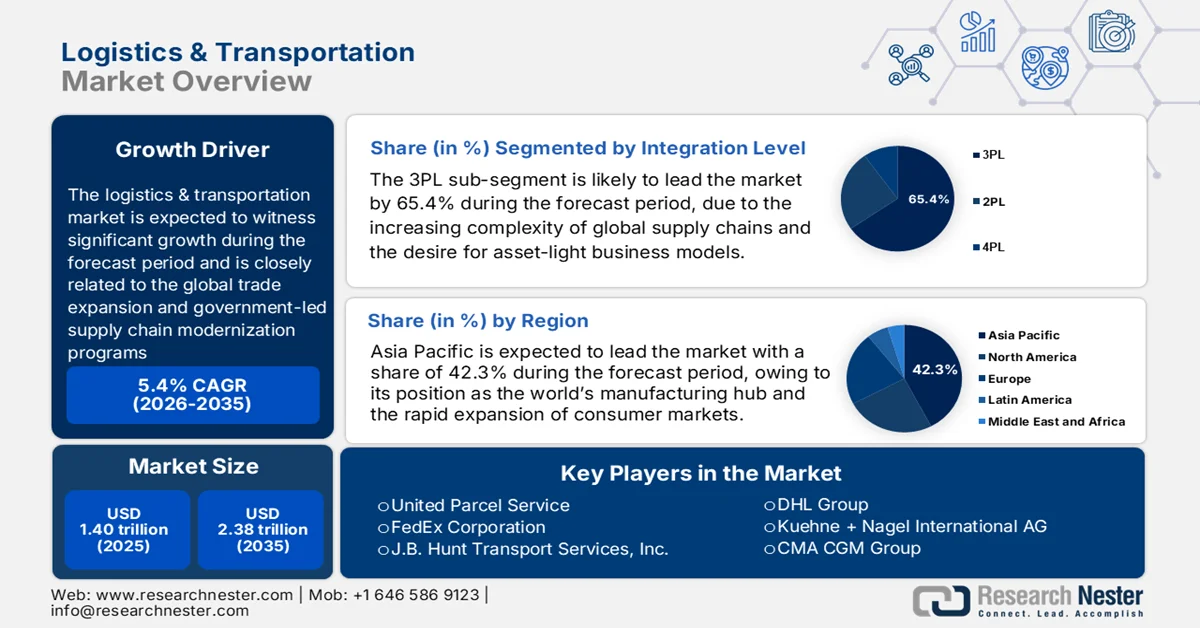
Logistics & Transportation Market size was valued at USD 1.40 trillion in 2025 and is projected to reach USD 2.38 trillion by the end of 2035, rising at a CAGR of 5.4% during the forecast period, i.e., 2026-2035. In 2026, the industry size of logistics & transportation is assessed at USD 1.48 trillion.
The logistics & transportation market is closely related to the global trade expansion, infrastructure investment, and government-led supply chain modernization programs. According to the World Trade Organization, April 2024 data, the global merchandise trade volume increased by 2.6% in 2024, reflecting a continued demand for freight transportation across road, rail, maritime, and air networks. Moreover, the freight mobility remains heavily dependent on road transport. The OECD 2025 data indicate that the rail freight transport in Mexico accounted for 95,764 million ton-kilometers in 2024, making it the backbone of regional distribution and industrial supply chains. On the other hand, the government investment in transport infrastructure continues to support this growth and reduce congestion, and improve freight efficiency across the major trade routes.
Moreover, the freight demand is also rising due to the expanding industrial output, urban consumption, and international e-commerce flows. The Climate Portal February 2023 data depicts that the growing economies such as Africa, Asia, and Latin America are expected to triple the global freight demand by 2050. Furthermore, the ports and maritime transportation remain central to global cargo movement, with the UN Trade & Development data in October 2024 indicating that nearly 80% of the global trade by volume is transported by sea, showing the continued importance of port logistics and maritime freight services. Additionally, governments are also strengthening the resilience and sustainability of freight operations. The freight and supply chain initiatives under the national freight strategic plan prioritize network efficiency, freight corridor capacity expansion, and multimodal integration, supporting a long term demand for logistics services.
Key Logistics & Transportation Market Insights Summary:
Regional Highlights:
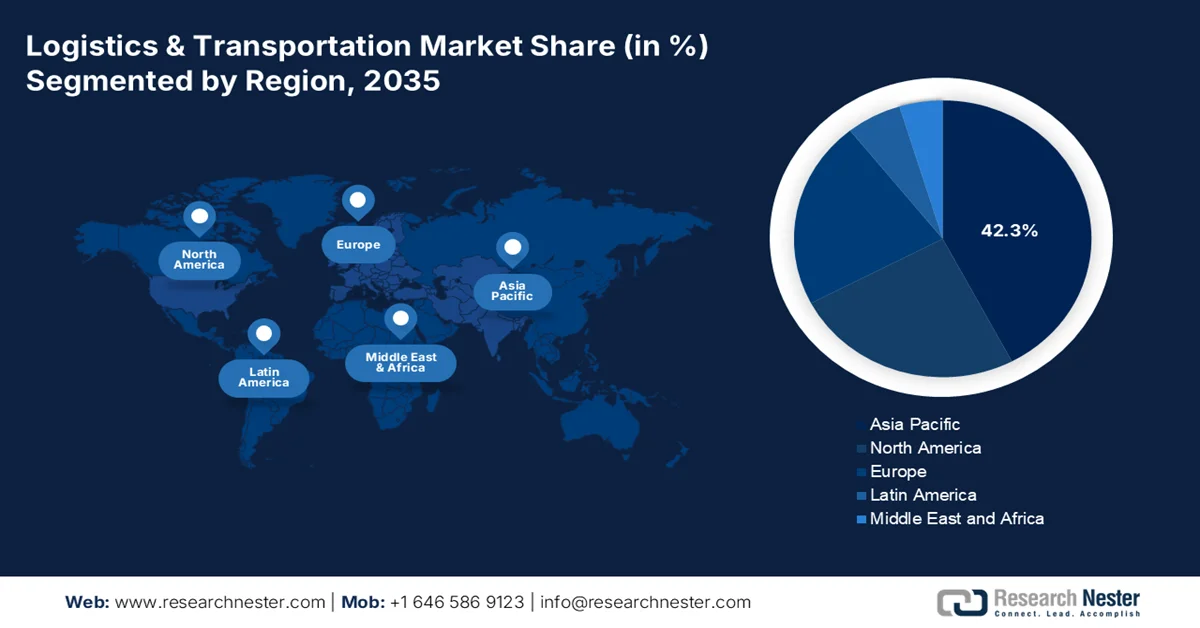
- The Asia Pacific logistics & transportation market is anticipated to command a 42.3% revenue share by 2035, attributed to its position as a global manufacturing hub and expanding consumer markets
- North America is projected to witness the fastest growth in the market with a CAGR of 4.1% during 2026–2035, supported by infrastructure investments and rising cross-border trade
Segment Insights:
- In the logistics & transportation market, the 3PL segment is expected to capture a 65.4% share by 2035, propelled by increasing complexity of global supply chains and the shift toward asset-light business models
- The domestic logistics segment is projected to lead the market over the forecast period 2026–2035, impelled by the surge in regional manufacturing and rapid expansion of local e-commerce
Key Growth Trends:
- Port modernization and maritime infrastructure investment
- E-commerce growth
Major Challenges:
- Freight rate depression
- Lack of digitalization
Key Players: United Parcel Service (UPS) (U.S.), FedEx Corporation (U.S.), J.B. Hunt Transport Services, Inc. (U.S.), DHL Group (Germany), Kuehne + Nagel International AG (Switzerland), CMA CGM Group (France), A.P. Moller - Maersk (Denmark), Nippon Express Holdings, Inc. (Japan), Yamato Holdings Co., Ltd. (Japan), Kintetsu World Express, Inc. (Japan), Toll Holdings Limited (Australia), CJ Logistics Corporation (South Korea), Container Corporation of India Ltd. (CONCOR) (India), Delhivery Limited (India), Blue Dart Aviation (India), Allcargo Logistics Limited (India), Thoma Bravo (U.S.), WWEX Group (U.S.), Volvo Trucks (Sweden), Sustainable Shared Transport Inc. (U.S.)
Global Logistics & Transportation Market Forecast and Regional Outlook:
Market Size & Growth Projections:
- 2025 Market Size: USD 1.40 trillion
- 2026 Market Size: USD 1.48 trillion
- Projected Market Size: USD 2.38 trillion by 2035
- Growth Forecasts: 5.4% CAGR (2026-2035)
Key Regional Dynamics:
- Largest Region: Asia Pacific (42.3% Share by 2035)
- Fastest Growing Region: North America
- Dominating Countries: United States, China, Germany, Japan, India
- Emerging Countries: Mexico, Vietnam, Indonesia, Brazil, Poland
Last updated on : 19 March, 2026
Logistics & Transportation Market - Growth Drivers and Challenges
Growth Drivers
- Port modernization and maritime infrastructure investment: Port infrastructure expansion is the major driver for the logistics and transportation market demand, mainly for containerized cargo and bulk commodity trade. The governments are increasing the funding for port modernization to handle the growing trade volumes and larger vessels. According to the UN Trade & Development October 2024, the global maritime trade volumes reached 12 billion tons, demonstrating the scale of cargo handled via ports worldwide. To support this growth, many countries are investing in port automation, container terminal expansion, and improved rail and road connectivity to inland logistics hubs. As maritime trade continues to grow, port development programs remain a central driver of global logistics and transportation demand.
- E-commerce growth: The expansion of e-commerce continues to be a powerful driver in the logistics & transportation market, altering the structure of parcel logistics. The total retail sales have stabilized, indicating a permanent increase in the volume of individual parcels moving via the supply chain. According to the International Trade Administration 2024 data, the global B2C e-commerce revenue reached USD 4.1 trillion in 2024, showing the demand for last-mile delivery infrastructure, including the urban micro fulfillment centers and specialized delivery fleets. Further, the companies are investing heavily in route optimization software and alternative delivery methods to manage the high cost of the final delivery segment, which remains the most labor-intensive and time-sensitive part of the logistics chain.
- Growth in multimodal transportation networks: Governments are promoting multimodal transportation to improve efficiency across freight systems and reduce the reliance on a single transport mode. The multimodal logistics integrates road, rail, inland waterways, and maritime transport into unified cargo movement networks. Moreover, the governments are also investing in intermodal freight terminals and rail freight corridors to improve the connectivity between the ports and inland markets. Multimodal infrastructure reduces transportation costs and improves cargo transit time. As global supply chains expand, logistics providers increasingly rely on integrated transport solutions combining rail, road, and maritime networks to support large-scale freight distribution.
Challenges
- Freight rate depression: New players in the logistics and transportation market face the challenge of excess capacity and compressed margins. The root cause is a significant imbalance between the supply and demand, with too many trucks chasing too little freight. Moreover, the oversupply forces new players to compete in a race to the bottom on pricing, where smaller carriers often have a cost structure advantage, making it difficult for new players with the higher initial costs to secure profitable contracts.
- Lack of digitalization: The logistics industry, mainly in maritime transport suffer from severe digital fragmentation, creating a high barrier for new tech-enabled players. The data formats, definitions, and accessibility vary wildly among the shipping lines, forwarders, and ports, making it difficult to build scalable automation solutions. Startups in the logistics and transportation market must invest heavily in technology to standardize disparate data before they can even begin to offer value. This fragmentation forces large cargo owners to use multiple, incompatible systems, creating vendor lock-in and inefficiency.
Logistics & Transportation Market Size and Forecast:
| Report Attribute | Details |
|---|---|
|
Base Year |
2025 |
|
Forecast Year |
2026-2035 |
|
CAGR |
5.4% |
|
Base Year Market Size (2025) |
USD 1.40 trillion |
|
Forecast Year Market Size (2035) |
USD 2.38 trillion |
|
Regional Scope |
|
Logistics & Transportation Market Segmentation:
Integration Level Segment Analysis
Under the integration level, the 3PL is dominating and is poised to hold the share value of 65.4% by the end of 2035 in the logistics & transportation market. The segment is driven by the increasing complexity of global supply chains and the desire for asset-light business models. Companies turn to 3PLs to gain access to advanced technology, scalable resources, and network efficiencies without the capital expenditure of owning fleets or warehouses. According to the Invest UP January 2023 data, in India, the 3PL market size was USD 37.31 billion in 2023 and is expected to grow further. This data is significantly outpacing the growth rate of private fleet operations, underscoring the accelerating shift toward logistics outsourcing.
Trade Type Segment Analysis
In the trade type segment, the domestic logistics is the leading sub-segment in the logistics & transportation market. This dominance is fueled by the resurgence of regional manufacturing and the explosive growth of local e-commerce, which requires rapid, reliable movement of goods within the national borders, allowing for faster transit times and more predictable supply chains. The focus on supply chain resilience has led many nations to boost their internal transportation networks. According to the U.S. Department of Energy, August 2023 data, nearly trucks with 12 billion tons of freight were moved domestically in 2021, highlighting the sheer volume and economic significance of keeping goods moving within the country.
Destination Segment Analysis
Within the destination segment, the outbound logistics stands as the leading sub-segment in the logistics & transportation market by the end of 2035. This segment encompasses the movement of finished goods from manufacturing plants or distribution centers to the end user, including retailers and consumers. The rise of direct-to-consumer business models has amplified the importance of outbound logistics as it represents the final and most customer-facing stage of the supply chain. The efficiency here directly impacts the brand reputation and customer satisfaction. Moreover, the total business sales inventory to shipments ratio for manufacturers suggests that the outbound logistics networks are operating at high velocity to move finished goods to market.
Our in-depth analysis of the logistics & transportation market includes the following segments:
|
Segment |
Subsegments |
|
Function |
|
|
Mode of Transport |
|
|
End user Industry |
|
|
Trade Type |
|
|
Destination |
|
|
Integration Level |
|
|
Solution Type |
|

Vishnu Nair
Head - Global Business DevelopmentCustomize this report to your requirements — connect with our consultant for personalized insights and options.
Logistics & Transportation Market - Regional Analysis
APAC Market Insights
The Asia Pacific is dominating and is expected to hold the regional revenue share of 42.3% by the end of 2035. The logistics and transportation market in APAC is driven by the position as the world’s manufacturing hub and the rapid expansion of consumer markets. the regions benefit from dense maritime trade networks. The key drivers include significant government investment in the Belt and Road initiative infrastructure, expanding rail and port connectivity, and the rise of cross-border ecommerce platforms serving Southeast Asia. Trends such as the shift toward nearshoring within Southeast Asia, digitalization of customs procedures under the Asia Pacific Economic Cooperation framework, and aggressive fleet electrification policies in the major economies are shaping the market growth. Labor productivity gains and infrastructure modernization remain critical priorities for sustaining growth.
Government led infrastructure programs, digital supply chain platforms, and strong economic growth are fueling the logistics and transportation market in India. As per the PIB August 2025 data, India is the fastest-growing major economies recording real GDP growth of about 6.5% in 2024 to 2025, which is increasing demand for freight transportation, warehousing, and distribution services across various sectors. The sector is also a major contributor to employment, supporting more than 22 million jobs across transportation, warehousing, and supply chain services. Cargo movement via alternative freight modes is expanding as well. India’s inland waterways recorded a cargo movement of about 145.5 million tons from 2024 to 2025, reflecting increased utilization of waterways for bulk logistics. In addition, the PIB August 2025 data depicts that the digital platforms, such as the Unified Logistics Interface Platform, are improving data integration, cargo tracking, and supply chain transparency. Collaboration between the FedEx SMART Centre established at IIT Madras is further advancing technology-driven logistics solutions, strengthening India’s position as an emerging logistics hub in Asia.
The extensive infrastructure investment, strong industrial output, and expanding domestic consumption are driving the logistics and transportation market in China. According to the People’s Republic of China, in January 2025, the country’s logistics prosperity index reached 53.1% in December 2024, indicating the continued expansion in logistics activity with increasing freight demand across sectors such as electrical machinery, semiconductors, communication equipment, and new energy vehicles. The total value of China’s logistics market is projected to exceed USD 50 trillion in 2024, maintaining its position as the world’s largest logistics market. China’s transportation network included 162,000 km of railways, 5.49 million km of highways, and 263 civil airports in 2024, significantly improving domestic freight movement and connectivity based on the People’s Republic of China July 2025 report, thus fueling the market expansion.
North America Market Insights
North America is projected to emerge as the fastest-growing region during the assessed period, 2026 to 2035, with a CAGR of 4.1%. The logistics and transportation market in North America is defined by high modal diversity, with trucking dominating the domestic freight. The primary drivers fueling the growth of the industry include significant government infrastructure spending and sustained cross-border trade under the USMCA. The key trends involve the nearshoring of manufacturing from Asia and Mexico, which increases the northbound freight into Canada and the U.S., and the stimulated adoption of zero-emission vehicles driven by the regulatory mandates. Moreover, the driver shortage is also another reason for the market demand and the need for modernizing the aging bridges and highways to accommodate growing freight volumes efficiently.
The logistics and transportation market in U.S. is supported by one of the world’s most extensive freight infrastructure networks, enabling large-scale domestic and international cargo movement. According to the Select USA August 2022 data, the top 150 U.S. ports handled approximately 2.61 billion tons of cargo, highlighting the critical role of maritime logistics in national and global trade. Inland freight distribution is further supported by about 12,000 miles of navigable waterways, including the Mississippi River system, which serves as a key route for bulk cargo transport. On the other hand, the rail freight also plays a major role with U.S. freight railroads transporting nearly 1.5 billion tons of goods annually across 140,000 miles of track, accounting for around 40% of long-haul freight movement. Further, the road transportation remains the backbone of domestic logistics, supported by over 4.2 million miles of public roads and nearly 49,000 miles of interstate highways, enabling nationwide goods distribution. These factors show a rising demand for market growth in the U.S.
The consistent government procurement spending and long-term transportation service contracts across federal departments are influencing the growth of the logistics and transportation market in Canada. According to the Government of Canada, November 2022 data, the nation has spent USD 833.8 million on transportation and logistics contracts, reflecting the ongoing public sector demand for freight movement, marine transport services, supply distribution, and operational logistics support. Moreover, 31,045 transportation and logistics contracts have been issued, demonstrating the scale of federal procurement in this sector. Departmental spending patterns show strong demand from federal agencies managing maritime and fisheries operations. For example, Fisheries and Oceans Canada allocated about USD 371.8 million to transportation and logistics services in 2021 to 2022, therefore enabling an active market expansion.
Government of Canada Transportation & Logistics Contract Spending by Department
|
Department |
2021–2022 Spending (USD) |
|
Fisheries and Oceans Canada |
371,789,180.18 |
|
Royal Canadian Mounted Police |
146,533,798.32 |
|
Public Health Agency of Canada |
80,232,648.75 |
|
Public Services and Procurement Canada |
57,737,606.75 |
|
Transport Canada |
55,602,139.55 |
|
Parks Canada |
29,994,724.43 |
|
Environment and Climate Change Canada |
19,581,170.11 |
|
Correctional Service of Canada |
18,676,447.74 |
|
Global Affairs Canada |
13,923,361.62 |
|
Natural Resources Canada |
13,389,413.54 |
Source: Government of Canada November 2022
Europe Market Insights
The logistics and transportation market in Europe is expanding rapidly and is driven by its dense multimodal network. The industry is valued for its efficiency in moving goods between the major industrial hubs and consumer centers. Moreover, the market is driven by the robust intra-regional trade, accounting for most of the freight activity. The key drivers include the EU’s ambitious Green Deal, which necessitates a 90% reduction in transport-related emissions, surging investment in rail freight, and alternative fuels. Furthermore, the infrastructure spending supports the cross-border rail and port modernization. Persistent trends include labor shortages among the drivers and the digitalization of freight documents. Supply chain resilience efforts stimulated by the recent geopolitical tension are pushing manufacturers to nearshore production, increasing the demand for logistics services within Europe.
The strong trade activity, advanced infrastructure, and strategic location are fueling the logistics and transportation market in Germany. According to the GTAI January 2025 data, the World Bank Logistics Performance Index in Germany ranked third among 139 countries, reflecting its strong logistics efficiency, infrastructure quality, and supply chain reliability. The country accounts for 20% of the total EU logistics market, with the sector generating about USD 320 billion in economic activity. The logistics industry is a major employer with more than 3.3 million people working across logistics and transportation activities supported by a network of over 60,000 logistics companies. Germany’s central location further enables access to over 500 million consumers across Europe, strengthening its position as a major logistics hub connecting Europe supply chains and global trade routes.
The national supply chains and economic activity in the movement of goods across the domestic and international routes are driving the logistics and transportation market in the UK. According to the UK Government's July 2023 report, the freight and logistics sector contributes approximately £127 billion in Gross Value Added to the UK economy, reflecting its importance as the core component of industrial and commercial operations. The industry is supported by more than 200,000 enterprises involved in freight transport, warehousing, distribution, and supply chain services. Logistics operations in the UK rely on a multimodal transportation network that includes road, rail, maritime, and air freight systems, enabling efficient cargo movement between ports, airports, rail freight interchanges, and distribution centers. Moreover, the sector also handles millions of deliveries daily, supporting retail distribution, manufacturing supply chains, and e-commerce fulfillment, therefore enabling an optimistic market growth.
Key Logistics & Transportation Market Players:
- United Parcel Service (UPS) (U.S.)
- FedEx Corporation (U.S.)
- J.B. Hunt Transport Services, Inc. (U.S.)
- DHL Group (Germany)
- Kuehne + Nagel International AG (Switzerland)
- CMA CGM Group (France)
- A.P. Moller - Maersk (Denmark)
- Nippon Express Holdings, Inc. (Japan)
- Yamato Holdings Co., Ltd. (Japan)
- Kintetsu World Express, Inc. (Japan)
- Toll Holdings Limited (Australia)
- CJ Logistics Corporation (South Korea)
- Container Corporation of India Ltd. (CONCOR) (India)
- Delhivery Limited (India)
- Blue Dart Aviation (India)
- Allcargo Logistics Limited (India)
- Thoma Bravo (U.S.)
- WWEX Group (U.S)
- Volvo Trucks (Sweden)
- Sustainable Shared Transport Inc., (U.S.)
- Company Overview
- Business Strategy
- Key Product Offerings
- Financial Performance
- Key Performance Indicators
- Risk Analysis
- Recent Development
- Regional Presence
- SWOT Analysis
- United Parcel Services is dominating the logistics & transportation market and has strategically integrated advanced logistics data analytics to transform its extensive small package delivery network. By using real-time telematics and route optimization software derived from transportation data, the company enhances delivery efficiency and reduces fuel consumption.
- FedEx Corporation maintains its competitive edge in the dynamic logistics & transportation market by using the transportation data to power its intelligent global network. The company uses advanced data analytics to optimize sortation processes, predict shipping volumes, and manage real-time package tracking from origin to destination. The company has earned USD 1,489 million in the freight segment as per the company’s annual report.
- J.B.Hunt Transport Services, Inc has established itself as a technological innovator within the North American logistics & transportation market by extensively integrating transportation data into its intermodal and dedicated contract services. The company uses data analytics to optimize the rail to truck transition, improve asset utilization, and provide customers with enhanced visibility.
- DHL Group, a global leader in the logistics & transportation market, has pioneered the use of transportation data to drive efficiency and innovation across its international mail express and supply chain division. By applying big data analytics, DHL optimizes complex global routing, enhances warehouse automation, and improves last-mile delivery accuracy in urban environments. In 2024, the company earned a revenue of USD 2.20 billion.
- Kuehne + Nagel International AG uses its technological expertise in the global logistics & transportation market by integrating vast amounts of transportation data into its sea freight, air freight, and contract logistics operations. The company utilizes advanced data platforms to provide customers with end-to-end supply chain visibility, enabling informed decision-making and proactive management.
Here is a list of key players operating in the global logistics & transportation market:
The global logistics and transportation market is intensely competitive and is defined by the mix of asset-heavy giants and asset-light logistics specialists. The key players are adopting strategies centered on digital transformation, investing heavily in AI for route optimization and warehouse automation. Sustainability is another critical battleground with firms transitioning fleets to electric vehicles and offering green supply chain solutions to meet the corporate ESG goals. Further, the major players are expanding their networks via strategic acquisitions to secure supply chain resilience and capture growth in e-commerce, mainly in high-demand regions such as APAC and North America. For example, in March 2026, Thoma Bravo announced the acquisition of WWEX Group and combined it with Auctane to form a global logistics leader.
Corporate Landscape of the Logistics & Transportation Market:
Recent Developments
- In September 2025, Allcargo Supply Chain, part of Allcargo Logistics, has announced the launch of its state-of-the-art, tech-enabled Logistics Park in Panapakkam, near Chennai. Spread across 2.75 lakh sq. ft. of Grade A warehousing space, the facility marks a significant expansion of the company’s southern network and reinforces its strategy of infrastructure-driven growth.
- In February 2025, Hon’ble Minister of Road Transport and Highways, Shri Nitin Gadkari, flagged off India’s first Road Train in Nagpur. Developed by Volvo Trucks and operated by Delhivery Ltd., this pioneering solution marks a new era for long-haul transportation, enhancing efficiency and capacity in the logistics industry.
- In January 2025, Sustainable Shared Transport Inc., a subsidiary of Yamato Holdings Co., Ltd. and Fujitsu Limited, announced the launch of a joint transportation and delivery system for shippers and logistics providers in Japan.
- Report ID: 8450
- Published Date: Mar 19, 2026
- Report Format: PDF, PPT
- Explore a preview of key market trends and insights
- Review sample data tables and segment breakdowns
- Experience the quality of our visual data representations
- Evaluate our report structure and research methodology
- Get a glimpse of competitive landscape analysis
- Understand how regional forecasts are presented
- Assess the depth of company profiling and benchmarking
- Preview how actionable insights can support your strategy
Explore real data and analysis
Frequently Asked Questions (FAQ)
About this Report
Connect with our Expert


Report, 2026-2035



Copyright @ 2026 Research Nester. All Rights Reserved.
