Road Freight Transportation Market Outlook:
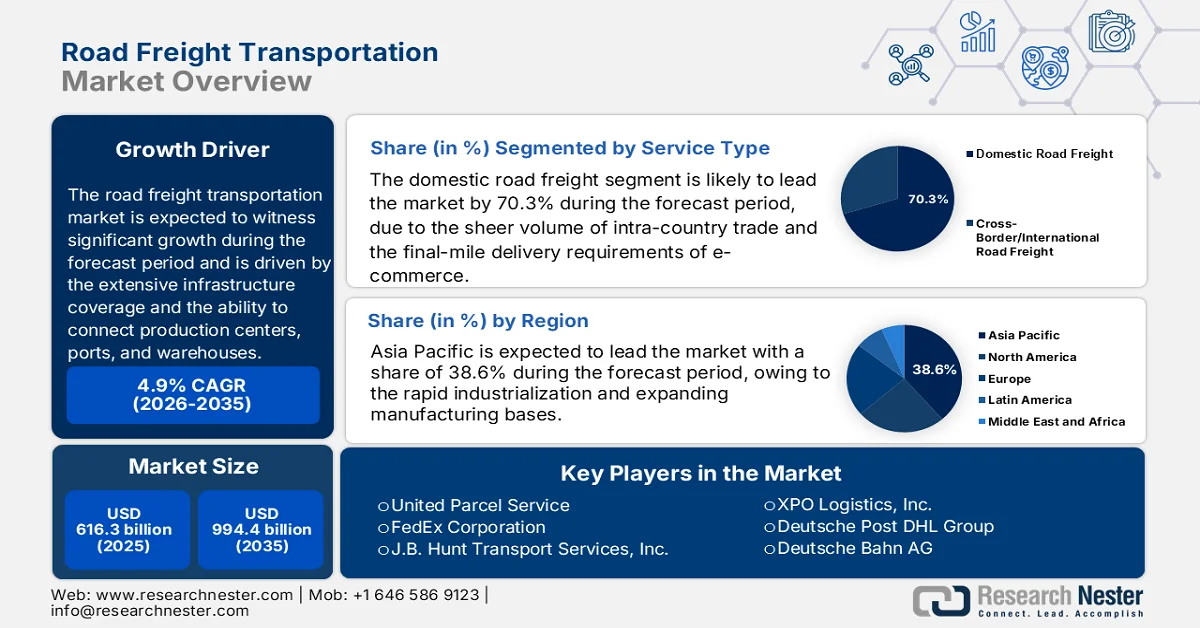
Road Freight Transportation Market size was valued at USD 616.3 billion in 2025 and is projected to reach USD 994.4 billion by the end of 2035, rising at a CAGR of 4.9% during the forecast period, i.e., 2026-2035. In 2026, the industry size of road freight transportation is assessed at USD 646.5 billion.
The global road freight transportation market is driven by extensive infrastructure coverage and the ability to connect production centers, ports, warehouses, and final distribution points. According to the Trucking January 2025 data, the total trucks moved in 2024 were about 11.27 billion tons, representing the largest share of domestic freight shipments by weight across all modes. The freight demand is expected to increase substantially with the economic growth, population expansion, and e-commerce distribution requirements, which are driving the higher utilization of long-haul and regional trucking networks. Moreover, the public sector investments in highway infrastructure continue to support freight capacity expansion. As per the House Committee on Transportation and Infrastructure, February 2023 data, USD 110 billion is allocated for roads and bridges to improve freight mobility and logistics efficiency.
Furthermore, the international organizations highlight the sustained freight demand growth driven by industrial production and supply chain restructuring. According to the International Transport Forum's May 2021 data, the global transport activity is expected to be more than 50% by 2050, with road transport expected to maintain a significant share of inland freight movements. Moreover, in the European Union the road transport is responsible for around 77% of inland freight, showing its central role in cross-border trade and regional distribution networks, based on the Eurostat April 2022 data. Governments across the major economies are simultaneously advancing decarbonization policies for the sector. These policy frameworks and trade-driven freight volumes shape long-term procurement fleet modernization and cross-border logistics strategies across the road freight transportation market.
Key Road Freight Transportation Market Insights Summary:
Regional Highlights:
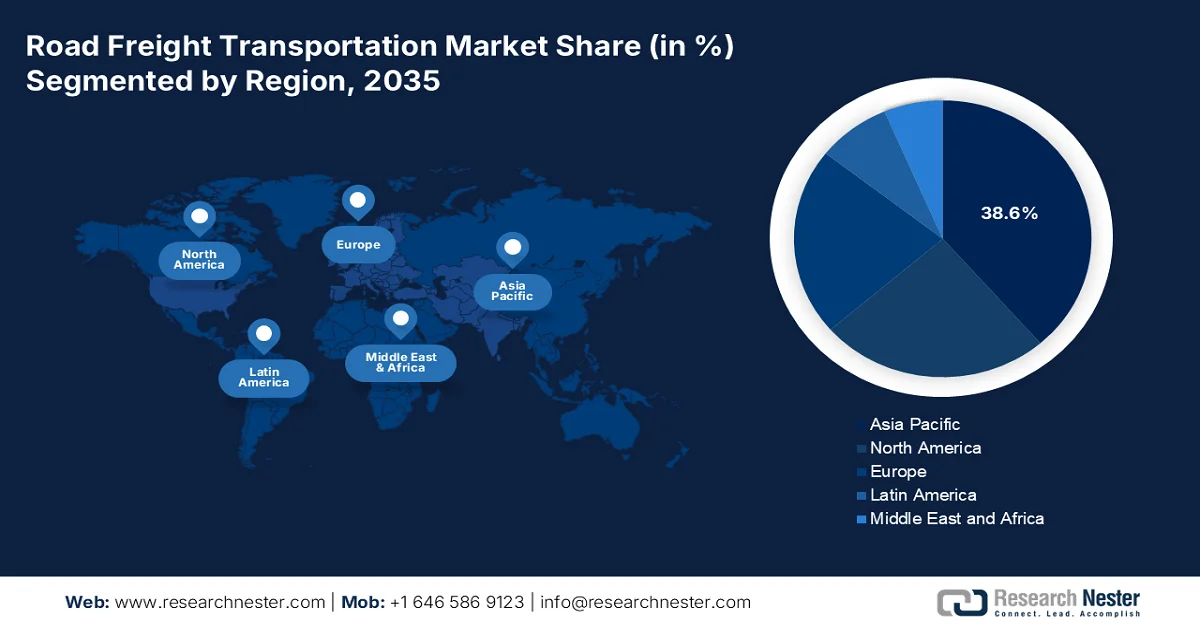
- Asia Pacific road freight transportation market is projected to command a 38.6% share by 2035, attributed to rapid industrialization, expanding manufacturing bases, and surging e-commerce penetration.
- North America is anticipated to witness growth at a CAGR of 3.8% during 2026–2035, fueled by increasing technological adoption and evolving safety and environmental regulations.
Segment Insights:
- Domestic Road Freight segment in the road freight transportation market is expected to account for a 70.3% share by 2035, propelled by the sheer volume of intra-country trade and final-mile delivery requirements of e-commerce.
- Telematics and IoT-enabled sub-segment is set to dominate within the technology segment over the forecast period 2026–2035, impelled by real-time fleet visibility and predictive maintenance capabilities enhancing operational efficiency and compliance.
Key Growth Trends:
- Expansion of e-commerce sales
- Cross border trade policies
Major Challenges:
- Severe driver shortages and aging workforce
- Extreme weather disruptions and climate volatility
Key Players: United Parcel Service (UPS) (U.S.), FedEx Corporation (U.S.), B. Hunt Transport Services, Inc. (U.S.), XPO Logistics, Inc. (U.S.), Deutsche Post DHL Group (Germany), Deutsche Bahn AG (DB Schenker) (Germany), Kuehne + Nagel International AG (Switzerland), P. Moller - Maersk A/S (Damco) (Denmark), GEODIS (France), Nippon Express Holdings, Inc. (Japan), Yamato Holdings Co., Ltd. (Japan), Kintetsu World Express, Inc. (Japan), Toll Holdings Limited (Australia), CJ Logistics Corporation (South Korea), Delhivery Limited (India), Container Corporation of India Ltd. (CONCOR) (India), NTG Nordic Transport Group (Denmark), DTK (Netherlands), Rhenus Group (Germany), CEVA Logistics (France).
Global Road Freight Transportation Market Forecast and Regional Outlook:
Market Size & Growth Projections:
- 2025 Market Size: USD 616.3 billion
- 2026 Market Size: USD 646.5 billion
- Projected Market Size: USD 994.4 billion by 2035
- Growth Forecasts: 4.9% CAGR (2026-2035)
Key Regional Dynamics:
- Largest Region: Asia Pacific (38.6% Share by 2035)
- Fastest Growing Region: North America
- Dominating Countries: United States, China, Germany, Japan, India
- Emerging Countries: South Korea, Brazil, Mexico, Indonesia, Vietnam
Last updated on : 19 March, 2026
Road Freight Transportation Market - Growth Drivers and Challenges
Growth Drivers
- Expansion of e-commerce sales: Government-backed digital economy initiatives are expanding the e-commerce ecosystem, which is driving the road freight demand via the last mile and regional distribution networks. According to the Census.gov March 2026 data, the total e-commerce sales in Q4 2025 reached USD 1,900.5 billion, increasing the freight movement between the warehouses, fulfillment centers, and urban delivery hubs that rely mainly on trucking. On the other hand, rising digital infrastructure investment is driving the growth of the road freight transportation market. Increased online retail activity generates higher demand for the regional trucking operations that move goods from ports and manufacturing centers to distribution warehouses. This trend prompts logistics providers to expand their road freight fleets and regional distribution routes.
- Cross border trade policies: The trade policies and customs modernization initiatives are increasing the freight flows across the international road corridors. Governments are investing in trade facilitation infrastructure to improve the cargo clearance efficiency and regional connectivity. According to the UN Trade & Development, December 2022, the global trade reached USD 32 trillion in 2022, with a significant share transported via multimodal logistics systems that rely on road networks for inland distribution. Moreover, the transport and border infrastructure programs continue to upgrade the freight crossings and port of entry road systems, enabling higher trucking volumes. These initiatives reduce border congestion and improve freight reliability, which encourages manufacturers and retailers to rely on road transport for cross-border shipments.
- Shift in spending patterns: Population growth and demographic changes drive the demand for the road freight transportation market. According to the U.S. Census Bureau, December 2024 data, the U.S. population will exceed 340 million by 2030, mainly in the South and West regions. This population redistribution requires extensive freight movements to supply growing communities far from traditional manufacturing centers. Moreover, the Bureau of the Fiscal Service 2025 report indicates that the personal consumption expenditure reached 3% in Q4 2024. Further, as the population ages, demand for pharmaceuticals, medical equipment, and home delivery of goods increases, each requiring specialized temperature-controlled and time-definite road freight services.
Challenges
- Severe driver shortages and aging workforce: The truck drivers are aging and creating a demographic time bomb as retirements surge, while the number of new players remains insufficient. The industry faces a demographic crisis that directly impacts the new players in the road freight transportation market. This structural challenge means new manufacturers struggle to secure reliable drivers, increasing the labor costs and limiting fleet utilization. Top players address this via innovative programs that train qualified forklift operators for CDL certification, creating an internal career pathway while improving retention.
- Extreme weather disruptions and climate volatility: Climate change is introducing the operational unpredictability that challenges the new players in the road freight transportation market, lacking robust contingency flows across Europe and North America, making it harder to access major hubs and slowing regional networks. As climate patterns shift, the longer warm spells, heavier rainfall, and more frequent storms increase delay risks. New players must build flexibility into supply chains.
Road Freight Transportation Market Size and Forecast:
| Report Attribute | Details |
|---|---|
|
Base Year |
2025 |
|
Forecast Year |
2026-2035 |
|
CAGR |
4.9% |
|
Base Year Market Size (2025) |
USD 616.3 billion |
|
Forecast Year Market Size (2035) |
USD 994.4 billion |
|
Regional Scope |
|
Road Freight Transportation Market Segmentation:
Service Type Segment Analysis
Under the service type segment, the domestic road freight is leading and is expected to hold the share value of 70.3% by the end of 2035 in the road freight transportation market. The segment is driven by the sheer volume of intra-country trade and the final-mile delivery requirements of e-commerce. As the cross-border freight is subjected to customs delays and international trade policies, domestic freight offers higher velocity and predictability, making it the revenue backbone for national carriers. According to the U.S. BTS 2025 data, the value of shipments moved by truck within the U.S. was USD 51.2 billion. This data shows the nation’s dependence on internal trucking networks to move goods from ports and manufacturing hubs to population centers. The growth of same-day and next-day delivery promises by major retailers continues to surge, ensuring domestic services capture the largest share of road freight revenue.
Technology Segment Analysis
Within the technology segment, the telematics and IoT-enabled sub-segment is projected to dominate in the road freight transportation market, revolutionizing how fleets manage safety, efficiency, and maintenance. By integrating GPS engine diagnostics and camera systems, carriers gain real-time visibility into vehicle health and driver behavior, moving from reactive repairs to predictive maintenance. This technological layer acts as a central nervous system for modern logistics. The adoption of electronic logging devices and advanced telematics has reduced the hours of service violations. This proves that technology not only boosts operational efficiency but also enhances compliance and safety. Moreover, as the hardware costs decline and 5G networks expand, the penetration of telematics will approach ubiquity, making it the highest-value technology sub-segment in the road freight transportation market.
Distance Segment Analysis
In the distance segment, the long-haul sub-segment remains dominant in the distance-based categorization, fueled by the geographic dispersion of manufacturing and consumption. The long-haul operations are capital-intensive, requiring sleeper cabs, team drivers, and extensive fuel management, which translates to higher revenue per shipment compared to short-haul runs. These routes form the arterial highways of the national economy, connecting resource-rich regions with population-dense metropolitan areas. According to the trucking January 2025 data, the total truck tonnage is expected to rise to 13.99 billion tons in 2035, which includes long haul truck. This sustained growth ensures that long-haul operations will continue to capture over half of the distance-based road freight transportation market revenue as the fundamental need to move goods across the vast geographic expanses remains unshakable.
Our in-depth analysis of the road freight transportation market includes the following segments:
|
Segment |
Subsegments |
|
Type |
|
|
Distance |
|
|
Cargo Type |
|
|
End user Industry |
|
|
Fleet Ownership |
|
|
Technology Integration |
|
|
Service Type |
|

Vishnu Nair
Head - Global Business DevelopmentCustomize this report to your requirements — connect with our consultant for personalized insights and options.
Road Freight Transportation Market - Regional Analysis
APAC Market Insights
The Asia Pacific is the largest and dominating region and is expected to hold the regional share value of 38.6% by the end of 2035. The road freight transportation market in APAC is driven by rapid industrialization, expanding manufacturing bases, and surging e-commerce penetration. The market is defined by significant diversity, ranging from the mature technology-enabled logistics sector in Japan and South Korea to rapidly modernizing high-growth markets in China and India. The key drivers include infrastructure investment under national strategies such as China’s Belt and Road Initiative, which is facilitating projects such as Malaysia’s East Coast Rail Link, expected to boost economic growth. Furthermore, the e-commerce growth remains a powerful force, with Malaysia’s e-commerce sector having grown to USD 1.13 trillion in 2024, as per the SEADS December 2025 report. Labor productivity and fleet modernization are central themes, with governments across the region prioritizing digitalization and multimodal connectivity to enhance supply chain efficiency.
The rapid economic growth, urbanization, and increasing e-commerce activity are driving the road freight transportation market in India. According to the PIB March 2025 data, the NITI Aayog reports Fast Tracking Freight in India. Road transport accounts for around 71% of India’s freight movement, significantly higher than railways, which account for about 18%, indicating the strong dependence of domestic logistics on trucking networks. Moreover, the freight demand in the country is already substantial. India currently transports approximately 4.6 billion tons of freight annually, generating nearly 2.2 trillion ton-kilometers of transport demand and costing about USD 114.5 billion in logistics expenditure as per NITI September 2022 data. As consumption levels and industrial output continue to rise, the freight movement is projected to expand, with the road freight demand expected to reach nearly 9.6 trillion ton-kilometers by 2050. These data show a huge growth opportunity for the road freight transportation market in the nation.
The rapid industrial output, regional trade integration, and logistics infrastructure development are driving the road freight transportation market in China. According to the People’s Republic of China November 2025 report, the New International Land-Sea Trade Corridor, a major logistics route connecting western China to international markets, recorded over 11,000 cross-border truck trips with cargo value exceeding USD 2.12 billion, representing YoY growth of 200% in truck movements and 450% in cargo value. Moreover, the People's Republic of China's November 2024 data depicts that China had established 1,267 county-level delivery centers and about 289,000 village-level logistics service stations, strengthening rural logistics connectivity and facilitating goods distribution between production regions and urban markets. These data show a high focus on logistics efficiency improvements and low-carbon freight initiatives.
North America Market Insights
The North America is projected to emerge as the fastest-growing region during the assessed period, 2026 to 2035, and is expected to grow at a CAGR of 3.8%. The road freight transportation market in North America operates as a highly integrated and essential network, facilitating trade and commerce across the U.S. and Canada. The industry is defined by its maturity and scale by a vast and fragmented carrier base ranging from thousands of small owner operators to large asset-based fleets that provide comprehensive service offerings. This interconnected ecosystem is built upon shared land borders and harmonized trade agreements, enabling the seamless flow of goods mainly in the key sectors such as the automotive manufacturing, agriculture, and retail. The market is navigating a period of significant transformation and is driven by technological adoption and evolving safety and environmental regulations.
The high freight dependence on trucking and sustained federal investment in transportation infrastructure are driving the road freight transportation market in the U.S. According to the International Trade Administration's May 2025 report, trucks moved 72.6% of total U.S. freight by weight in 2023, demonstrating the dominant role of road transport in domestic cargo distribution. Moreover, the cross-border trade activity further reinforces trucking demand as trucks carried 66.5% of the value of surface trade between the U.S. and Canada and 84.5% of the value of surface trade between the U.S. and Mexico in 2023, as per the U.S. Department of Transportation's October 2023 data. Freight transport activity has also continued to expand. The U.S. Freight Transportation Services Index reached about 139.2 in 2024 (2017=100) based on the Bureau of Transportation Statistics' November 2024 data. These data show an optimistic growth in the market expansion.
Freight Transportation Services Index (September 2021-September 2024)
|
Year |
Unit (Monthly Average of 2000=100) |
|
September 2021 |
133.8 |
|
March 2022 |
139.8 |
|
November 2022 |
135.4 |
|
February 2023 |
140.2 |
|
January 2024 |
134.3 |
|
August 2024 |
140.3 |
|
September 2024 |
139.2 |
Source: Bureau of Transportation Statistics November 2024
The central role in national logistics and trade distribution supported by extensive highway infrastructure and strong reliance on trucking across domestic and cross-border supply chains are fueling the road freight transportation market in Canada. According to the Government of Canada's May 2025 report, trucks handle approximately 90% of freight shipments in the country, highlighting the sector’s importance for moving goods. Moreover, the 2022 Emissions Reduction Plan, the Government of Canada allocated USD 75.8 million over five years to the Zero Emission Trucking Program (ZETP) to accelerate the deployment of medium- and heavy-duty zero-emission trucks. On the other hand, the October 2025 Government of Canada data indicates that there were about 232,680 trucking businesses operating in the country, with a significant concentration in Ontario, Quebec, Alberta, and British Columbia, therefore enabling a positive impact on market growth.
Europe Market Insights
The Europe road freight market represents a mature, highly integrated network moving goods across the continent. The market is shaped by the European Union’s regulatory framework, which harmonizes vehicle standards, driving hours, and cabotage rules across member states. According to European Commission data published in April 2022, road transport accounted for nearly 77% of inland freight movement, underscoring its critical role in European supply chains. The key drivers include the cross border e-commerce expansion, just-in-time manufacturing requirements, and the ongoing shift toward low-emission logistics. Moreover, the infrastructure investment via the Connecting Europe allocates billions for transport projects with a significant focus on freight corridors.
The industrial distribution system supported by the high freight volumes and extensive highway connectivity across the domestic and EU trade corridors is shaping the road freight transportation market in Germany. According to the Sachverständigenrat Wirtschaft, July 2024 data, around 70% of the total freight volume in Germany was transported by trucks, highlighting the dominant role of road transport in moving goods between manufacturing centers. The VDA May 2022 data indicates that the government transport statistics indicate that about 502.7 billion ton-kilometers of freight were moved on Germany roads, accounting for more than 73% of total inland freight transport across roads. Road freight is particularly important for short-distance logistics, with more than half of freight transported by Germany trucks in 2022 moving less than 50 km, reflecting strong demand from regional supply chains and industrial distribution networks. These factors enable a strong market upliftment.
The road freight transportation market in UK plays a critical role in domestic logistics, supporting the movement of goods across manufacturing, retail, and energy supply chains. According to the Government of the UK, July 2025 data, GB registered heavy goods vehicles lifted about 1.59 billion tons of goods in 2024, representing a 2% increase from 1.55 billion tons in 2023, reflecting a steady recovery in freight demand across domestic supply networks. In terms of freight transport performance, these vehicles moved 168 billion tons-kilometers of goods in 2024, also slightly higher than 167 billion tons-kilometers recorded in 2023, indicating sustained trucking activity across regional and long-distance routes. Moreover, the UK Government's March 2024 data depicts that nearly 46.20% transport is articulated by lorry, highlighting the extensive operational scale of road freight distribution across domestic logistics networks and suitable for market growth.
Industry Revenue Broken Down by Services
|
Service Type |
Revenue |
Market Share |
|
Transport by articulated lorry |
USD 19.69 billion |
46.2% |
|
Transport by rigid lorry |
USD 12.07 billion |
28.5% |
|
Transport by light goods vehicle |
USD 10.16 billion |
24% |
|
Other |
USD 552.96 million |
1.3% |
Source: Government of UK March 2024
Key Road Freight Transportation Market Players:
- United Parcel Service (UPS) (U.S.)
- FedEx Corporation (U.S.)
- B. Hunt Transport Services, Inc. (U.S.)
- XPO Logistics, Inc. (U.S.)
- Deutsche Post DHL Group (Germany)
- Deutsche Bahn AG (DB Schenker) (Germany)
- Kuehne + Nagel International AG (Switzerland)
- P. Moller - Maersk A/S (Damco) (Denmark)
- GEODIS (France)
- Nippon Express Holdings, Inc. (Japan)
- Yamato Holdings Co., Ltd. (Japan)
- Kintetsu World Express, Inc. (Japan)
- Toll Holdings Limited (Australia)
- CJ Logistics Corporation (South Korea)
- Delhivery Limited (India)
- Container Corporation of India Ltd. (CONCOR) (India)
- NTG Nordic Transport Group (Denmark)
- DTK (Netherlands)
- Rhenus Group (Germany)
- CEVA Logistics (France)
- Company Overview
- Business Strategy
- Key Product Offerings
- Financial Performance
- Key Performance Indicators
- Risk Analysis
- Recent Development
- Regional Presence
- SWOT Analysis
- United Parcel Service maintains its dominance in the road freight transportation market by using its massive integrated ground fleet and advanced data analytics. UPS uses telematics and sensor data from its delivery vehicles to monitor the fleet health and driver behavior in real time. The telematics approach allows UPS to predict maintenance issues before they cause breakdowns and optimize routing to reduce fuel consumption.
- FedEx Corporation remains a formidable force in the road freight transportation market, mainly via its FedEx Ground division. The company has embraced the concept of real-time data integration to enhance its sense and response capabilities. By adopting advanced road freight data, the company tracks shipment conditions monitor driver hours of service. According to the 2025 annual report, the company has made a consolidated revenue of USD 87,926.
- B. Hunt Transport Services Inc has positioned itself at the intersection of physical transportation and the digital intelligence within the road freight transportation market. Recognizing that modern logistics requires constant data flow, the company has invested heavily in its proprietary technology platform to integrate the road freight data into trucking operations.
- XPO Logistics, Inc. has distinguished itself in the road freight transportation market by pioneering the use of technology to create a more connected and efficient freight ecosystem. The company has extensively adopted road freight transportation data into its less-than-truckload and truck brokerage services. In 2024, the company made a net income of USD 387 million as per the annual report.
- Deutsche Post DHL Group uses its global scale to set benchmarks for data utilization in the road freight transportation market. Through its divisions, such as DHL Freight, the company integrates comprehensive road freight data into its operations to achieve a higher level of control and foresight. DHL uses real-time traffic data to monitor the pulse of its Europe and intercontinental road networks.
Here is a list of key players operating in the global road freight transportation market:
The global road freight transportation market is highly competitive and fragmented, featuring a mix of asset-based carriers and logistics service providers. The competitive landscape is defined by the intense pressure on pricing, fluctuating fuel costs, and the critical need for technological integration. The key players are increasingly adopting strategic initiatives focused on digitalization, including the use of telematics AI for route optimization and blockchain for supply chain transparency. To expand their geographic footprint and service portfolios, major companies are actively pursuing mergers and acquisitions while also investing heavily in sustainable practices such as electric vehicle fleets to meet the evolving regulatory and customer demands for greener logistics. For example, in March 2025, NTG Nordic Transport Group acquired DTK.
Corporate Landscape of the Road Freight Transportation Market:
Recent Developments
- In July 2025, the road freight business unit of the Rhenus Group has launched a dedicated UK domestic distribution service. Tailored for all freight types, the move strengthens the company’s existing portfolio of international road freight and charter services.
- In July 2025, CEVA Logistics launched a new sustainable transport model pilot that leverages three Duo Trailer vehicles fueled by renewable hydrotreated vegetable oil (HVO). Already in use across Spain’s highest transport corridor that connects Barcelona and Madrid, the solution is expected to reduce up to 520 tons of CO₂ and 180 kilograms of nitrogen oxide emissions annually—the equivalent to removing 440 trucks from the road.
- In April 2024, Bonn - DHL Freight put its first fully electric tractor-trailers from Mercedes-Benz Trucks into service. Effective immediately, the eActros 300 vehicles are being deployed for delivery and distribution transport at the Koblenz and Hagen sites.
- Report ID: 8448
- Published Date: Mar 19, 2026
- Report Format: PDF, PPT
- Explore a preview of key market trends and insights
- Review sample data tables and segment breakdowns
- Experience the quality of our visual data representations
- Evaluate our report structure and research methodology
- Get a glimpse of competitive landscape analysis
- Understand how regional forecasts are presented
- Assess the depth of company profiling and benchmarking
- Preview how actionable insights can support your strategy
Explore real data and analysis
Frequently Asked Questions (FAQ)
About this Report
Connect with our Expert


Report, 2026-2035



Copyright @ 2026 Research Nester. All Rights Reserved.
