Lithium Compound for Battery Application Market Outlook:
Lithium Compound for Battery Application Market size was valued at USD 8.8 billion in 2025 and is projected to reach USD 61.1 billion by the end of 2035, registering around 21.5% CAGR during the forecast period, i.e., 2026-2035. In 2026, the industry size of lithium compound for battery application is estimated at USD 10.6 billion.
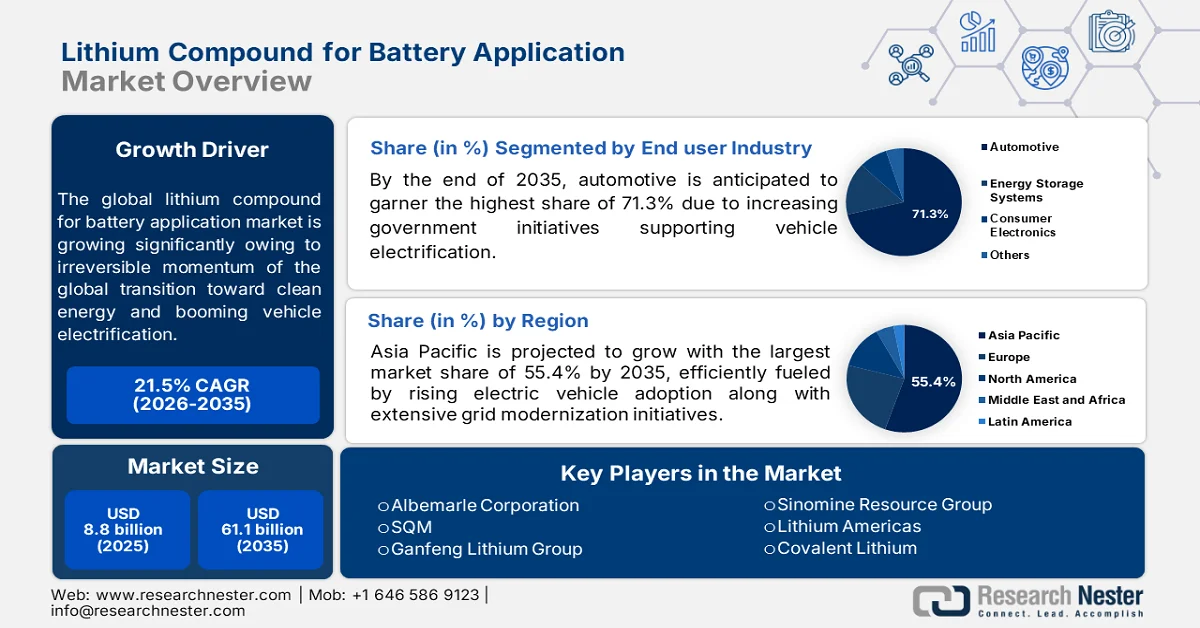
The lithium compound for battery application market is poised for surging growth, which is driven by irreversible momentum of the global transition toward clean energy and booming vehicle electrification. In addition, the downstream demand is scaling rapidly as automotive manufacturers expand their electric fleet production and utilities accelerate the deployment of grid-scale energy storage systems. In May 2025, an article published by the International Energy Agency (IEA) disclosed that lithium demand is projected to grow from 205 kt in 2024 to 928 kt by 2040 under the STEPS scenario and is driven primarily by electric vehicles and other clean energy technologies. It also mentions that primary lithium requirements will continue to rise significantly, increasing from 198 kt in 2024 to 846 kt by 2040, thus positively contributing to the market’s expansion.
Global Lithium Demand, Supply Requirements, and Market Outlook Forecast 2024-2040
|
Indicator |
2024 |
2030 |
2040 |
|
Cleantech demand (kt) |
128 |
369 |
809 |
|
Other uses (kt) |
77 |
87 |
119 |
|
Total demand (kt) |
205 |
455 |
928 |
|
Secondary supply & reuse (kt) |
7 |
16 |
82 |
|
Primary supply requirements (kt) |
198 |
440 |
846 |
|
Share of top three mining countries |
77% |
67% |
69% |
|
Share of top three refining countries |
96% |
85% |
85% |
Source: IEA
Furthermore, the market is witnessing a strategic shift toward localized supply chains, wherein major economic regions are subsidizing domestic refining infrastructure to secure material independence. The processing methodologies evolve to utilize direct extraction techniques, and thus the market is positioning itself to support a more high-throughput ecosystem geared for long-term energy transition goals. In September 2024, TerraVolta Resources was selected by the U.S. Department of Energy (DOE) to negotiate a USD 225 million award for Project Liberty Owl, which is a planned lithium production facility in the Texarkana region with a total investment exceeding USD 1 billion. Besides, this project will use direct lithium extraction technology to produce 25,000 tons of battery-grade lithium carbonate on a yearly basis, which is enough to support the production of around 500,000 electric vehicles each year.
Key Lithium Compound for Battery Application Market Insights Summary:
Regional Highlights:
- Asia Pacific is projected to command a 55.4% share by 2035, reinforcing its leadership in the lithium compound for battery application market as mass-market electric vehicle adoption and extensive grid modernization initiatives propel regional demand.
- Europe is positioned for prominent growth during 2026-2035, with strict sustainability compliance and regulatory frameworks for supply chain traceability and low-carbon battery components accelerating regional expansion.
Segment Insights:
- Automotive is projected to account for a 71.3% share by 2035, strengthening its dominance as government initiatives supporting vehicle electrification and rising investments in battery manufacturing infrastructure stimulate lithium compound consumption.
- Lithium carbonate is expected to secure a considerable revenue share during 2026-2035, with its widespread use in lithium iron phosphate and nickel manganese cobalt battery cathodes fueling segment demand.
Key Growth Trends:
- Surging electric vehicle adoption
- Expanding grid energy storage systems
Major Challenges:
- Severe price fluctuations and investment uncertainty
- Shifting cathode chemistries and substitute technologies
Key Players: Albemarle Corporation (U.S.), SQM (Chile), Ganfeng Lithium Group (China), Sinomine Resource Group (China), Lithium Americas (Canada), Covalent Lithium (Australia).
Global Lithium Compound for Battery Application Market Forecast and Regional Outlook:
Market Size & Growth Projections:
- 2025 Market Size: USD 8.8 billion
- 2026 Market Size: USD 10.6 billion
- Projected Market Size: USD 61.1 billion by 2035
- Growth Forecasts: 21.5% CAGR (2026-2035)
Key Regional Dynamics:
- Largest Region: Asia Pacific (55.4% Share by 2035)
- Fastest Growing Region: Europe
- Dominating Countries: China, United States, Japan, South Korea, Germany
- Emerging Countries: India, Australia, Canada, France, United Kingdom
Last updated on : 20 August, 2026
Lithium Compound for Battery Application Market - Growth Drivers and Challenges
Growth Drivers
- Surging electric vehicle adoption: The shift towards automotive electrification stands as the primary demand catalyst for the upliftment of the lithium compound for battery application market globally. Automakers across the globe are expanding their electric fleet production in order to comply with stringent regional emission targets. This mass-market transition requires vast quantities of lithium compounds to manufacture the high-capacity traction packs, thus powering modern passenger cars and commercial vehicles. IEA, in its 2026 review, stated that worldwide electric vehicle sales crossed 20 million units in 2025, with EVs accounting for one-fourth of all new car sales worldwide. Besides, China was the largest market, whereas Europe saw strong growth due to supportive policies and rising demand for affordable models.
- Expanding grid energy storage systems: Globally, the deployment of renewable energy is expanding, and it boosts demand for grid-scale battery demand. Solar and wind power require extensive stationary storage systems in order to mitigate intermittency efficiently. Utility companies favor lithium-based storage systems for their high energy efficiency, thereby fueling massive procurement of battery-grade lithium compounds for global energy grids. In March 2026, the Press Information Bureau (PIB) stated that India is accelerating the development of battery energy storage systems in order to support its goal of achieving 500 GW of non-fossil fuel power capacity by 2030 and managing the variability of renewable energy sources. The government has introduced multiple policy, regulatory, and financial measures to promote energy storage deployment, and the central electricity authority is estimating a requirement of 208 GWh of BESS capacity by 2030, boosting demand in the market.
Challenges
- Severe price fluctuations and investment uncertainty: Extreme price volatility is considered to be a major structural headwind for lithium compound producers, which causes disruptions to long-term capital planning. Due to massive historical spikes, the market has faced intense bearish pressure and industry overproduction, which drives lithium carbonate and hydroxide prices to historic lows. The existence of these depressed levels of price pushes most of the extraction and refining operations close to marginal profitability. The current market valuations are considered to be far below the incentive prices that are required to fund new mining ventures, thus negatively impacting the market’s growth.
- Shifting cathode chemistries and substitute technologies: The continuously escalating battery technologies cause unpredictable demand dynamics across the lithium value chain. The market has experienced considerable structural shift as lithium iron phosphate chemistries gain massive market share when compared to nickel-manganese-cobalt variants due to cost advantages. The existence of this transition reshapes downstream demand, which pivots procurement heavily toward lithium carbonate rather than lithium hydroxide and complicates long-term output forecasting for chemical refiners. On the other hand, the emergence of alternative energy storage chemistries, such as sodium-ion batteries, presents a viable substitute for lower-cost passenger cars and large-scale stationary grids, causing hindrance to market’s expansion.
Lithium Compound for Battery Application Market Size and Forecast:
| Report Attribute | Details |
|---|---|
|
Base Year |
2025 |
|
Forecast Period |
2026-2035 |
|
CAGR |
21.5% |
|
Base Year Market Size (2025) |
USD 8.8 billion |
|
Forecast Year Market Size (2035) |
USD 61.1 billion |
|
Regional Scope |
|
Lithium Compound for Battery Application Market Segmentation:
End use Industry Segment Analysis
By the end of 2035, automotive is anticipated to garner the highest share of 71.3% in the lithium compound for battery application market during the forecast period. The sub-segment’s dominating position is majorly propelled by increasing government initiatives supporting vehicle electrification and rising investments in battery manufacturing infrastructure. In addition, the demand for high-energy-density lithium-ion batteries in different vehicles is boosting the consumption of lithium compounds. In December 2024, the U.S. DOE approved a total of USD 9.63 billion in loans to BlueOval SK to expand domestic electric vehicle battery manufacturing through three new facilities in Tennessee and Kentucky. These projects deliver more than 120 GWh of annual battery production capacity and strengthen the U.S. EV supply chain.
Compound Segment Analysis
Lithium carbonate is expected to grow with a considerable revenue share in the market during the stipulated timeframe. The sub-segment’s growth in this sector is mainly fueled by its widespread use in the production of lithium iron phosphate and nickel manganese cobalt battery cathodes, which are preferred for electric vehicles, energy storage systems, and consumer electronics. In addition, increasing investments in terms of battery recycling technologies and expansion of gigafactories are supporting demand for battery-grade lithium carbonate. In June 2026, Lithium Americas secured a financing package of up to USD 175 million to strengthen its financial position as construction advances at the Thacker Pass lithium project in the U.S. This project is especially designed to produce 40,000 tons per year of battery-grade lithium carbonate, thus denoting a wider segment scope.
Our in-depth analysis of the lithium compound for battery application includes the following segments:
|
Segment |
Subsegments |
|
End user Industry |
|
|
Compound |
|

Vishnu Nair
Head - Global Business DevelopmentCustomize this report to your requirements — connect with our consultant for personalized insights and options.
Lithium Compound for Battery Application Market - Regional Analysis
APAC Market Insights
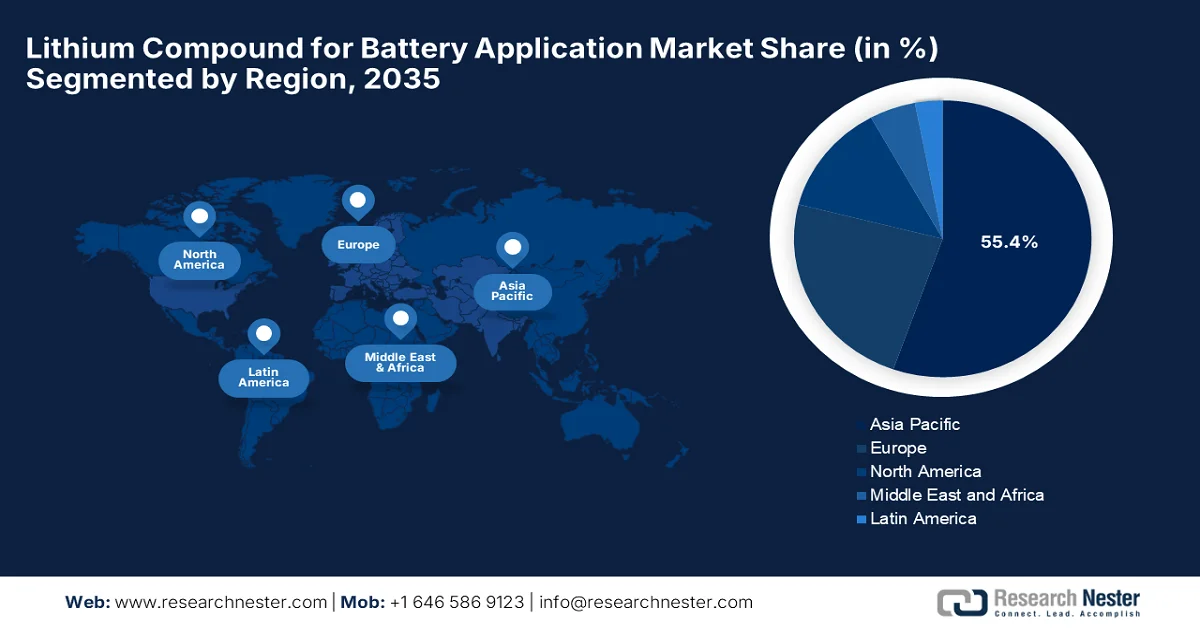
Asia Pacific lithium compound for battery application market is anticipated to hold the highest share of 55.4% during the stipulated timeframe. The region’s upliftment in this field is mainly propelled by mass-market electric vehicle adoption along with extensive grid modernization initiatives. Asia Pacific is considered to be the primary hub for both the manufacturing and consumption of battery-grade lithium compounds. In April 2024, the Defense Horizon Journal disclosed that lithium is an important mineral for India’s clean energy transition, and the Geological Survey of India identified 5.9 million tons of lithium resources in Salal-Haimana, Jammu and Kashmir, in 2023. India currently depends heavily on imports, receiving around 69% of its lithium imports from Hong Kong, China, and the country is investing in domestic exploration and international partnerships to support its target of increasing electric vehicle adoption to 30% of private car sales by 2030.
The escalating domestic demand for lithium carbonate and lithium hydroxide and strong export capabilities position China lithium compound for battery application market for solid growth. The domestic market functions as the undisputed worldwide powerhouse for lithium compound processing and battery manufacturing within the world’s electric vehicle supply chain. The nation leverages unparalleled midstream chemical refining infrastructure to convert raw global mineral resources into battery-grade lithium carbonate and hydroxide. World Integrated Trade Solution stated that China’s lithium carbonate exports in 2024 were valued at a total of 61.66 million, and the total quantity was 3.83 million kg. Japan was the largest destination, importing around 2.07 million kg worth of USD 34.21 million, followed by South Korea and India. Besides, China’s exports mainly served Asia-based markets, with Japan, South Korea, and India together accounting for substantial export volume, reflecting China’s role as a major lithium processing and supply-chain hub.
China’s Lithium Carbonate Trade in 2024: Export Growth and Global Supply Chain Dominance
|
Importing Country |
Export Value (USD Thousand) |
Quantity (Kg) |
|
Japan |
34,208.66 |
2,074,980 |
|
South Korea |
7,760.50 |
552,507 |
|
India |
3,441.11 |
229,595 |
|
Russian Federation |
3,322.15 |
250,175 |
|
Australia |
2,549.44 |
116,803 |
|
Canada |
1,823.13 |
49,725 |
|
Other Asia, nes |
1,761.19 |
112,102 |
|
Indonesia |
1,232.30 |
90,100 |
|
Turkey |
1,169.84 |
85,854 |
|
Italy |
1,133.06 |
90,050 |
|
Singapore |
500.35 |
50,016 |
|
U.S. |
469.48 |
28,551 |
Source: WITS
China’s Lithium Oxide and Hydroxide Exports in 2024: Supply Chain Analysis and Battery Industry Trade Trends
|
Importing Country |
Export Value (USD Thousand) |
Quantity (Kg) |
|
South Korea |
1,454,839.57 |
83,517,100 |
|
Japan |
684,010.89 |
32,263,500 |
|
Sweden |
34,608.85 |
1,854,060 |
|
India |
11,074.45 |
724,331 |
|
Singapore |
8,960.20 |
458,000 |
|
Thailand |
4,422.03 |
297,425 |
|
Other Asia, nes |
4,318.10 |
313,320 |
|
Netherlands |
3,670.81 |
306,000 |
|
Germany |
3,286.65 |
140,612 |
|
UAE |
2,782.46 |
217,600 |
Source: WITS
Japan lithium compound for battery application market is growing exponentially, and it operates as a highly specialized segment focused on the production of ultra-high-purity lithium compounds for high-performance battery applications. The market depends on strategic international sourcing partnerships to feed its chemical processing infrastructure, which excels at synthesizing advanced materials such as premium lithium hydroxide. In September 2024, Panasonic Energy and Subaru announced plans to prepare for the supply of automotive lithium-ion batteries and establish a new battery manufacturing facility in Japan. This partnership aims to strengthen Japan’s electric vehicle battery supply chain by supporting domestic production of advanced battery technologies, thus denoting a positive market outlook.
Europe Market Insights
The Europe market is anticipated to grow at a prominent rate from 2026 to 2035. The region’s upliftment in this field is majorly propelled by strict sustainability compliance to support its ambitious green transition goals. The regional market is reshaped by regulatory frameworks that mandate supply chain traceability and low-carbon footprints for all battery components. In April 2026, the Europe Chemicals Agency (ECHA) proposed occupational exposure limits for lithium compounds, which include lithium carbonate, lithium chloride, and lithium hydroxide, due to increasing industrial use in lithium-ion battery production and mining. These recommendations aim to improve workplace safety as global demand for lithium materials continues to expand, increasing demand for safer solutions under such compliance requirements.
An intense focus on advanced chemical processing and green localization is driving Germany lithium compound for battery application market. The nation accelerates its massive transition toward electromobility, leading domestic automakers and chemical conglomerates to establish direct, long-term procurement channels to secure premium lithium hydroxide and carbonate. In March 2025, Clean Energy Wire stated that Germany identified significant lithium resources in deep underground waters that could support its battery industry and energy transition. A Fraunhofer report estimates potential lithium deposits between 0.39 million tons and 26.51 million tons, with a likely availability of 4.3 million tons when compared with Germany’s projected lithium requirement of 0.17 million tons by 2030.
The UK lithium compound for battery application market is growing and evolving as a highly hub focused on building localized supply security to support its domestic automotive sector. The country’s market is defined by public-private initiatives which are aimed at establishing regional refining infrastructure, utilizing domestic mineral resources, and developing advanced chemical processing facilities. Based on government data published in January 2024, the country launched the critical imports and supply chains strategy to strengthen resilience against disruptions affecting essential goods, including critical minerals, medicines, and semiconductors. This strategy aims to reduce dependency on vulnerable suppliers, improve access to key materials such as lithium, and thereby support the development of a domestic battery supply chain for electric vehicles and clean energy industries.
North America Market Insights
The North America market is growing at a considerable rate and is undergoing a policy-driven transformation that is focused on establishing an independent supply chain for battery-grade lithium compounds. Also, the regional market is witnessing substantial investments in both traditional mining ventures and innovative processing techniques, such as extracting lithium from domestic geothermal brines as well as sedimentary clay deposits. In March 2023, Albemarle Corporation announced a total of USD 1.3 billion investment in a lithium hydroxide Mega-Flex processing facility in South Carolina in order to support rising demand for electric vehicles and lithium-ion batteries. This facility is especially designed to produce 50,000 metric tons of battery-grade lithium hydroxide on a yearly basis, with expansion potential to 100,000 metric tons, supporting battery production for around 2.4 million electric vehicles per year.
The federal clean energy mandates, extensive tax credits, and domestic procurement requirements are fueling intense demand in the U.S. lithium compound for battery application market. The country’s market is defined by substantial investments into commercializing alternative extraction methodologies, such as recovering lithium from domestic geothermal brines, sedimentary clay deposits, and oilfield wastewaters. In December 2024, the U.S. DOE’s Loan Programs Office approved a total USD 7.54 billion loan to StarPlus Energy to establish up to two lithium-ion battery manufacturing plants in Kokomo, Indiana. These facilities will have a combined production capacity of 67 GWh on a yearly basis, which is sufficient to supply batteries for approximately 670,000 electric vehicles each year.
Canada lithium compound for battery application market is gaining enhanced traction owing to substantial public and private investments which are aimed at constructing localized processing facilities. The country’s market closely aligns its production with clean, hydroelectric power grids, and it emphasizes a low-carbon footprint, appealing directly to automotive manufacturers who require sustainable material streams for regional electric vehicle gigafactories. In May 2023, Ford and Nemaska Lithium signed an 11-year agreement under which Nemaska will supply Ford with up to 13,000 tons of lithium hydroxide on a yearly basis, along with initial spodumene concentrate from its Whabouchi mine. This partnership supports Ford’s electric vehicle production and strengthens the region’s sustainable battery supply chain with low-carbon, responsibly sourced lithium.
Key Lithium Compound for Battery Application Market Players:
- Albemarle Corporation (U.S.)
- SQM (Chile)
- Ganfeng Lithium Group (China)
- Sinomine Resource Group (China)
- Lithium Americas (Canada)
- Covalent Lithium (Australia)
- Company Overview
- Business Strategy
- Key Product Offerings
- Financial Performance
- Key Performance Indicators
- Risk Analysis
- Recent Development
- Regional Presence
- SWOT Analysis
- Albemarle Corporation is considered to be a leading manufacturer of battery-grade lithium compounds, which include lithium carbonate and lithium hydroxide that are used in lithium-ion batteries. The company efficiently supports EV and energy storage markets through integrated lithium production capabilities along with a global supply footprint.
- SQM is a major producer of lithium carbonate and lithium hydroxide for battery applications. The firm serves global battery manufacturers, including large-scale lithium production capabilities and strong positions in EV and energy storage markets.
- Ganfeng Lithium Group is a vertically integrated lithium company that produces lithium carbonate and lithium hydroxide for EVs, energy storage, and electronics. In addition, the firm’s strengths include global lithium resources, advanced processing technologies, and battery supply chain integration.
- Sinomine Resource Group is yet another prominent manufactures battery-grade lithium carbonate, lithium hydroxide, and lithium fluoride products. Besides, the firm is highly focused on integrated lithium resource development and supply of lithium chemicals for lithium-ion battery production.
- Lithium Americas is developing battery-grade lithium carbonate production through its Thacker Pass project in the U.S. The company is highly focused on strengthening North America based lithium supply for EV and energy storage applications.
Here is a list of key players operating in the global market:
The lithium compound for battery application market is witnessing intense competition with the presence of leading manufacturers that are controlling significant global supply of battery-grade lithium carbonate and lithium hydroxide products. Competition in this field is effectively driven by production scale, battery-grade purity, geographic manufacturing footprints, and technological capabilities in lithium conversion. Major players in this field maintain integrated operations across different regions, whereas most regional specialists compete through focused product portfolios and localized supply advantages. In this context, Metso in May 2026 introduced an advanced single-pass lithium carbonate production process, which is especially designed to convert spodumene concentrate into battery-grade lithium carbonate with higher efficiency, lower costs, and improved sustainability.
Corporate Landscape of the Market:
Recent Developments
- In February 2026, Albemarle Corporation announced that it will place the remaining operating unit (Train 1) at its Kemerton lithium hydroxide processing plant in Western Australia into care and maintenance.
- In January 2026, Sinomine Resource’s Jiangxi lithium subsidiary successfully launched trial operations of its 30,000-ton-per-year high-purity lithium salt upgrade project to increase the company’s total battery-grade lithium salt capacity to 71,000 tons annually.
- In August 2025, Covalent Lithium, which is a joint venture between Sociedad Química y Minera de Chile S.A (SQM) and Wesfarmers, produced its first battery-grade lithium hydroxide at its Kwinana refinery in Western Australia, marking a major milestone for its integrated lithium operation.
- Report ID: 8738
- Published Date: Aug 20, 2026
- Report Format: PDF, PPT
- Explore a preview of key market trends and insights
- Review sample data tables and segment breakdowns
- Experience the quality of our visual data representations
- Evaluate our report structure and research methodology
- Get a glimpse of competitive landscape analysis
- Understand how regional forecasts are presented
- Assess the depth of company profiling and benchmarking
- Preview how actionable insights can support your strategy
Explore real data and analysis
Frequently Asked Questions (FAQ)
About this Report
Connect with our Expert


Report, 2026-2035



Copyright @ 2026 Research Nester. All Rights Reserved.
