LEO Satellite Communications Market Outlook:
LEO Satellite Communications Market size was valued at USD 67.6 billion in 2025 and is projected to reach USD 225.2 billion by the end of 2035, registering around 12.8% CAGR during the forecast period, i.e., 2026-2035. In 2026, the industry size of LEO satellite communications is estimated at USD 76.2 billion.
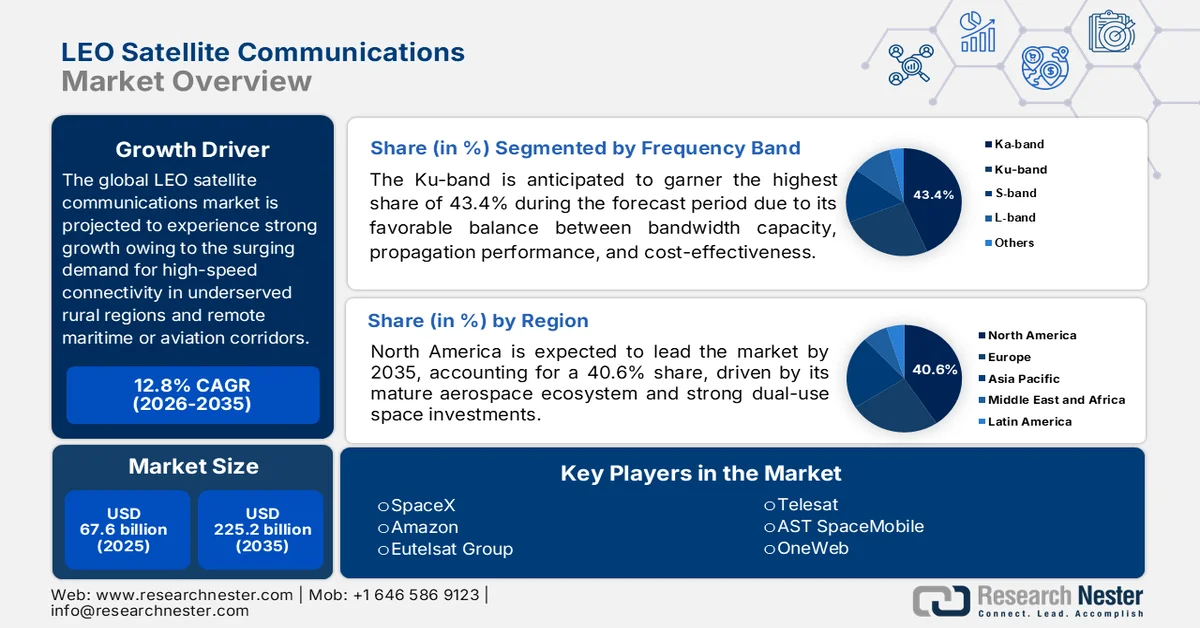
The global LEO satellite communications market is growing exponentially, fueled by the surging demand for high-speed connectivity in underserved rural regions and remote maritime or aviation corridors. In addition, advancements in reusable rocket technology have lowered launch barriers, thereby enabling operators to deploy massive constellations that offer low-latency data transmission competitive with terrestrial fiber networks. As per an article published by the National Institutes of Health (NIH) in July 2025, a low-Earth-orbit satellite handover recovery method based on an enhanced generic congestion control algorithm improves communication reliability during satellite link switching. It also mentioned that the approach integrates an RBF neural network for satellite attitude control, an intelligent handover detection mechanism, and a congestion-aware rate recovery algorithm with time-series prediction. Simulation results showcased reduced communication interruptions, higher data throughput, faster recovery times, and improved handover detection accuracy, thus positively benefiting the market’s growth.
Furthermore, the widespread commercial adoption of satellite-to-cellular connectivity, expanding military defense contracts for resilient communication frameworks, and the integration of satellite systems into the broader internet of things ecosystem are allowing the proliferation of the market. As corporate enterprises prioritize secure, uninterrupted digital infrastructure, the market is pivoting toward a collaborative telecom model where satellite networks complement existing terrestrial infrastructure to create a truly unified global network. In this context, AT&T and AST SpaceMobile, in May 2024, announced a commercial agreement to provide a space-based broadband network directly to everyday smartphones, thereby extending their collaboration through 2030. Besides, this partnership has plans to expand mobile connectivity by integrating low Earth orbit (LEO) satellites with AT&T's existing wireless network, thus enabling coverage in remote and underserved areas.
Key LEO Satellite Communications Market Insights Summary:
Regional Highlights:
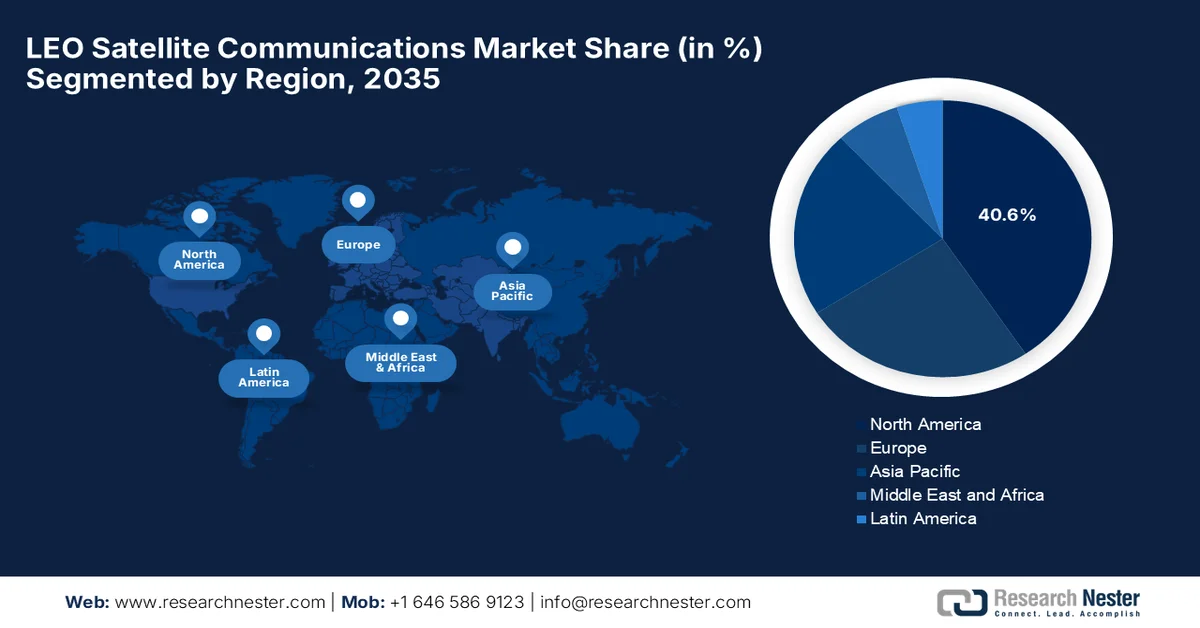
- The leo satellite communications market in North America is projected to capture 40.6% share by 2035, reinforced by a robust aerospace ecosystem and substantial dual-use investments, bolstered by rapid deployment of dense mega-constellations by major technology companies
- Asia Pacific is anticipated to register the fastest growth during 2026-2035, fueled by sovereign space initiatives and rising demand for high-throughput connectivity across maritime and aviation sectors
Segment Insights:
- The leo satellite communications market is expected to see the Ku-band segment account for 43.4% share by 2035, supported by its favorable balance between bandwidth capacity, propagation performance, and cost-effectiveness
- The telecommunication application segment is projected to maintain a considerable share during 2026-2035, underpinned by growing demand for high-speed, low-latency connectivity in remote and underserved regions
Key Growth Trends:
- Declining launch costs
- Bridge the digital divide
Major Challenges:
- Space debris and orbital congestion
- Astronomical and environmental interferences
Key Players: SpaceX (U. S.),Amazon (U.S.),Eutelsat Group (France),Telesat (Canada),AST SpaceMobile (U.S.),OneWeb (UK),Iridium Communications (U.S.),Kepler Communications (Canada).
Global LEO Satellite Communications Market Forecast and Regional Outlook:
Market Size & Growth Projections:
- 2025 Market Size: USD 67.6 billion
- 2026 Market Size: USD 76.2 billion
- Projected Market Size: USD 225.2 billion by 2035
- Growth Forecasts: 12.8% CAGR (2026-2035)
Key Regional Dynamics:
- Largest Region: North America (40.6% share by 2035)
- Fastest Growing Region: Asia Pacific
- Dominating Countries: United States, Germany, Japan, China, United Kingdom
- Emerging Countries: India, South Korea, Singapore, Brazil, Saudi Arabia
Last updated on : 22 July, 2026
LEO Satellite Communications Market - Growth Drivers and Challenges
Growth Drivers
- Declining launch costs: Reusable rocket technology has revolutionized space access by dramatically lowering cost-per-kilogram barriers. Frequent, predictable launch schedules allow operators to deploy massive LEO constellations even faster. This capital efficiency enables continuous network deployment and financially viable business models for global satellite communications providers. In this context, SpaceX, in May 2023, announced the launch of 56 Starlink satellites into low Earth orbit using a Falcon 9 rocket from Space Launch Complex 40 at Cape Canaveral Space Force Station, Florida. This mission marked another major step in expanding the Starlink satellite constellation for global broadband connectivity. The Falcon 9 first-stage booster completed its 11th launch and landing, demonstrating SpaceX’s reusable rocket technology, thus suitable for bolstering the LEO satellite communications market globally.
- Bridge the digital divide: The traditional fiber and cellular networks have been facing geographic and economic limitations in remote regions. Meanwhile, LEO constellations overcome these barriers by providing high-speed internet to isolated rural communities, oceanic maritime corridors, and high-altitude aviation routes, thereby unlocking previously untapped subscriber bases across the globe. In February 2024, Telstra and Eutelsat OneWeb reported the beginning of the world’s largest deployment of LEO satellite cellular backhaul in Australia, in which the first commercial voice call was completed at Oxford Falls, New South Wales. In addition, this particular initiative aims to connect more than 300 remote mobile sites by improving coverage through higher speeds, lower latency, and reliable satellite-based connectivity, thus driving growth of the market.
Challenges
- Space debris and orbital congestion: The proliferation of low-Earth orbit satellites leads to severe risks of orbital crowding and space debris. Operating in a confined spatial layer, massive mega-constellations elevate the statistical probability of hypervelocity satellite collisions. Also, any single impact can trigger a catastrophic chain reaction, which is known as the Kessler syndrome, thereby generating thousands of untrackable fragments that threaten all assets in nearby orbits. Operators in the market face intense pressure to develop precise collision-avoidance systems, automated maneuvering capabilities, and reliable post-mission disposal strategies. Therefore, de-orbiting defunct satellites within strict timelines is needed to keep orbits usable.
- Astronomical and environmental interferences: The aspect of huge LEO satellite constellations poses major light pollution and atmospheric interference challenges, which are disrupting critical scientific endeavors. These highly reflective surfaces and solar panels of thousands of low-orbit satellites create bright streaks across the night sky. This reflectivity severely compromises ground-based optical astronomy, ruining long-exposure deep-space imagery and masking near-Earth asteroids. In addition, the intensive radio frequency transmissions from these constellations bleed into adjacent bands and create electromagnetic noise that blinds sensitive radio telescopes. Apart from the observation challenges, the environmental footprint is drawing regulatory scrutiny, negatively impacting the growth of the market.
LEO Satellite Communications Market Size and Forecast:
| Report Attribute | Details |
|---|---|
|
Base Year |
2025 |
|
Forecast Year |
2026-2035 |
|
CAGR |
12.8% |
|
Base Year Market Size (2025) |
USD 67.6 billion |
|
Forecast Year Market Size (2035) |
USD 225.2 billion |
|
Regional Scope |
|
LEO Satellite Communications Market Segmentation:
Frequency Band Segment Analysis
The Ku-band is anticipated to garner the highest share of 43.4% in the frequency band segment of the LEO satellite communications market during the forecast period. The segment’s dominance is largely attributable to its favorable balance between bandwidth capacity, propagation performance, and cost-effectiveness. These factors are making it widely suitable for broadband internet access, maritime connectivity, in-flight connectivity, and enterprise communication services. In March 2026, Global Invacom and SatWave Arrays Inc. signed an MoU to develop a next-generation multi-orbit flat panel antenna for Ka/Ku-band satellite communications. This innovative antenna will enable proper switching between LEO, MEO, and GEO satellites without any signal loss, thus offering improved flexibility, reliability, and connectivity.
Application Segment Analysis
The telecommunication in the application segment is expected to hold a considerable share in the market. The growing demand for high-speed, low-latency connectivity in remote and underserved regions is propelling the growth of the subsegment. On the other hand, the increasing adoption of satellite broadband for consumer and enterprise applications and the inability of conventional terrestrial networks such as fiber and cellular infrastructure to economically cover geographically challenging areas are driving the segment’s leadership. For instance, in April 2026, Amazon announced the acquisition of Globalstar to enhance its Amazon Leo low Earth orbit satellite network with direct-to-device connectivity capabilities. The integration of Globalstar’s satellite assets, spectrum, and expertise will enable expanded voice, text, and data services other than cellular coverage, including support for Apple satellite features.
Component Segment Analysis
On the basis of component services is forecasted to grow with a significant share in the market by the end of 2035. The segment is growing on account of increasing demand for managed connectivity solutions, network operation services, satellite broadband subscriptions, and value-added services required to operate and maintain large-scale LEO constellations. As satellite operators expand commercial deployments, service providers are offering end-to-end solutions, which include connectivity-as-a-service, enterprise networking, mobility services, and government communication solutions, reducing the need for customers to manage complex satellite infrastructure directly. Hence, all of these factors responsibly boost the segment’s position in this sector.
Our in-depth analysis of the LEO satellite communications includes the following segments:
|
Segment |
Subsegments |
|
Frequency Band |
|
|
Application |
|
|
Component |
|
|
End user |
|

Vishnu Nair
Head - Global Business DevelopmentCustomize this report to your requirements — connect with our consultant for personalized insights and options.
LEO Satellite Communications Market - Regional Analysis
North America Market Insights
The North America LEO satellite communications market is projected to account for the highest share of 40.6% during the forecast period. The region’s leadership is largely attributable to a highly prominent aerospace ecosystem and substantial dual-use investments. Simultaneously, commercial expansion is surging as major tech giants accelerate the local production and deployment of dense mega-constellations. In December 2025, Keysight Technologies and KT SAT demonstrated the industry’s first-ever multi-orbit NTN handover between a GEO satellite and an emulated LEO link, achieving continuous service connectivity. This particular proof-of-concept used a live Ku-band GEO connection, which is through KOREASAT-6A, and validated key 6G satellite mobility capabilities, which are aligned with emerging 3GPP NTN standards.
An unparalleled concentration of advanced aerospace manufacturing and private launch capabilities is positioning the U.S. LEO satellite communications market for solid growth in the upcoming years. Market momentum is largely driven by deep institutional integration, where federal agencies such as the DoD award contracts to establish proliferated orbital architectures for tactical communications, missile warning tracks, and secure data routing. In August 2023, the space development agency awarded contracts which were worth around USD 1.5 billion to Northrop Grumman and Lockheed Martin to build 72 Beta variant satellites for the Tranche 2 Transport Layer. These satellites will provide persistent global encrypted communications, advanced tactical data links, and support missions such as missile warning and beyond line-of-sight targeting, thus making them suitable for standard market growth.
In Canada, the LEO satellite communications market is gaining enhanced traction, which is structurally shaped by the country's vast, low-density geography and strategic Arctic sovereignty requirements. Simultaneously, the country is solidifying its domestic space capabilities through substantial public-private financing for enterprise-grade constellations such as Telesat Lightspeed, manufactured locally by MDA Space. In April 2026, Canada’s Department of National Défense launched a challenge to develop resilient LEO satellite communication technologies that are capable of operating in contested environments. This initiative is highly focused on adaptive beamforming, anti-jamming techniques, and experimental validation to improve communication reliability against adversarial interference.
APAC Market Insights
The Asia Pacific market is expected to grow at the fastest rate from 2026 to 2035. The region’s upliftment is largely propelled by sovereign space initiatives, particularly in China, Japan and India, where governments are accelerating the development of domestic mega-constellations. In addition, the regional market is propelled by a booming maritime and aviation sector demanding constant, high-throughput connectivity for cargo shipping and commercial flights. In January 2026, Japan’s Ministry of Internal Affairs and Communications (MIC) announced subsidies for the Japan LEO Satellite Communications Project (J-LEO Project) with a primary aim of strengthening national autonomy in satellite communications. This initiative will support the development of LEO satellite constellations, satellites, and ground equipment through funding that is managed by the Communications and Information Network Association of Japan (CIAJ).
The massive, state-backed mega-constellation initiatives, which are treated as critical national infrastructure, are responsibly propelling the growth of the LEO satellite communications market in China. Besides, these initiatives aim to secure valuable orbital slots and frequency spectrum, thereby building a resilient domestic alternative to Western satellite networks. Based on government data, which was published in August 2024, China launched the first 18 satellites of the Spacesail LEO satellite constellation, which marks a major step in developing its global satellite internet capabilities. This particular constellation aims to provide low-latency, high-speed, and reliable broadband services, with plans to expand to thousands of satellites for regional and global coverage, thus denoting a positive market outlook.
The India LEO satellite communications market is entering a transformative phase of growth, which is driven mainly by sweeping regulatory overhauls and a heightened domestic demand for rural broadband. Commercial expansion is being propelled by spectrum allocation and joint ventures between global satellite operators and major domestic telecommunications giants, who are aiming to deliver high-speed, low-latency internet to isolated rural communities. In September 2025, the Press Information Bureau (PIB) stated that India is advancing satellite internet as a key component of its Digital India vision by utilizing LEO and MEO satellite systems to provide faster and more reliable broadband connectivity across remote and underserved regions. On the other hand, government reforms, private-sector participation, and initiatives such as the J-LEO ecosystem, BharatNet, and satellite communication policies are accelerating the growth of India’s space-based connectivity infrastructure.
Europe Market Insights
The Europe market is expected to witness considerable growth during the forecast period. The region’s market is reshaped by its intense focus on technological sovereignty, secure government communications, and digital independence from foreign infrastructure. The regional market is deliberately backed by a highly sophisticated domestic satellite manufacturing supply chain, proactive spectrum coordination through regional regulatory bodies, and growing integration into Europe’s multi-domain military frameworks. As stated by Europe parliament article, the region’s LEO satellite communication sector is accelerating through strategic investments in technological sovereignty, secure communications, and digital independence, driven by initiatives such as the EU’s IRIS² multi-orbital constellation.
Commercial growth is supported by partnerships among aerospace companies, startups, and telecom operators to expand connectivity across rural areas, maritime routes, and aviation networks.
The nation's advanced industrial manufacturing base and a growing emphasis on digital sovereignty for its critical economic sectors are responsibly driving the market in Germany. Market momentum is effectively fueled by the country’s automotive, logistics, and heavy industrial automation sectors, which are adopting LEO connectivity to power widespread Internet of Things (IoT) applications, autonomous vehicle testing, and smart supply chain management across remote corridors. In this context, the RAND Organization in November 2025 reported that Germany is investing around USD 38 billion by 2030 to strengthen sovereign military space capabilities by focusing on secure satellite communications, orbital surveillance, and protection against cyberattacks, jamming, and hostile space activities. This investment aims to reduce reliance on foreign providers, enhance Germany’s role in Europe’s space security, and accelerate advanced defense technologies.
In the UK, the LEO satellite communications market is growing significantly, which is due to the presence of major global satellite operators headquartered or heavily invested in the UK. Growth is also propelled by the government's focus on national digital sovereignty, securing resilient communications for the Ministry of Défense, and expanding high-speed connectivity to isolated rural areas through public-private hybrid network trials. In April 2026, the country’s government stated that the UK’s Connectivity in Low-Earth Orbit (C-LEO) programme is designed to strengthen the country’s position in the high-growth LEO satellite communications sector by accelerating advanced technology development, high-volume constellation manufacturing, and domestic supply chain capabilities. The initiative aims to help UK companies secure future satellite communication contracts, attract private investment, and advance critical technologies.
Key LEO Satellite Communications Market Players:
- SpaceX (U. S.)
- Amazon (U.S.)
- Eutelsat Group (France)
- Telesat (Canada)
- AST SpaceMobile (U.S.)
- OneWeb (UK)
- Iridium Communications (U.S.)
- Kepler Communications (Canada)
- Company Overview
- Business Strategy
- Key Product Offerings
- Financial Performance
- Key Performance Indicators
- Risk Analysis
- Recent Development
- Regional Presence
- SWOT Analysis
- SpaceX is a leading player which is propelled by its Starlink constellation, which is one of the world’s largest commercial satellite broadband networks. The company manufactures and operates its own LEO satellites, ground systems, and user terminals to deliver high-speed, low-latency internet service.
- Amazon is entering the market with Amazon Leo, which was formerly Project Kuiper, and is a planned satellite broadband constellation designed to provide global connectivity. The firm is developing and deploying LEO satellites and network infrastructure with the main goal of serving consumers, businesses, and government users.
- Eutelsat Group is a major satellite communications provider that consists of LEO capabilities through its OneWeb constellation. The company manufactures and operates a global LEO satellite network, which is focused on delivering high-speed connectivity solutions for enterprise, government, mobility, and telecom departments.
- Telesat is a Canada-based satellite communications company that is highly focused on developing its Lightspeed LEO constellation to deliver advanced broadband connectivity. The firm also leverages high-performance satellite networking, targeting applications such as remote connectivity, private networks, and critical communications.
- AST SpaceMobile is a specialized LEO satellite communications company that is focused on direct-to-device connectivity. The company is developing a space-based cellular broadband network that is especially designed to support voice, data, and internet services through partnerships with mobile network operators.
Here is a list of key players operating in the global market:
The global LEO satellite communications market is undergoing significant transformations, which hosts a small number of large-scale manufacturers operating extensive satellite constellations and providing end user connectivity solutions. Leading manufacturers in this field compete intensely through constellation scale, launch capability, network coverage, low-latency performance, and integration with enterprise and consumer communication services. On the other hand, companies such as SpaceX, Eutelsat Group, Telesat, and Amazon are expanding their LEO satellite platforms to address broadband, mobility, government, and IoT applications. For instance, Airbus and Spacesail in December 2025 entered into a partnership to integrate Spacesail’s future LEO satellite connectivity into Airbus’ HBCplus inflight connectivity solution. This collaboration will provide airlines with an additional high-bandwidth, low-latency connectivity option, enhancing passenger experiences and aircraft operations.
Corporate Landscape of the Market:
Recent Developments
- In July 2026, Amazon Leo entered into a partnership with Herotel to launch Evry, which is a satellite internet service aimed at connecting rural homes and businesses beyond traditional networks. The service will use Amazon Leo’s LEO satellite technology to deliver high-speed, low-latency connectivity across underserved areas in South Africa.
- In June 2026, Hitachi Construction Machinery partnered with Amazon Leo to test satellite connectivity for construction sites in Europe, becoming the first construction equipment manufacturer to join Amazon Leo’s enterprise preview. The portable Amazon Leo antennas will enable reliable high-speed connectivity at remote sites in the UK and Germany.
- Report ID: 8684
- Published Date: Jul 22, 2026
- Report Format: PDF, PPT
- Explore a preview of key market trends and insights
- Review sample data tables and segment breakdowns
- Experience the quality of our visual data representations
- Evaluate our report structure and research methodology
- Get a glimpse of competitive landscape analysis
- Understand how regional forecasts are presented
- Assess the depth of company profiling and benchmarking
- Preview how actionable insights can support your strategy
Explore real data and analysis
Frequently Asked Questions (FAQ)
About this Report
Connect with our Expert


Report, 2026-2035



Copyright @ 2026 Research Nester. All Rights Reserved.
