Lab Grown Diamonds Market Outlook:
Lab Grown Diamonds Market size was valued at USD 30.2 billion in 2025 and is projected to reach USD 99.7 billion by the end of 2035, rising at a CAGR of 14.2% during the forecast period, i.e., 2026-2035. In 2026, the industry size of lab grown diamonds is estimated at USD 34.4 billion.
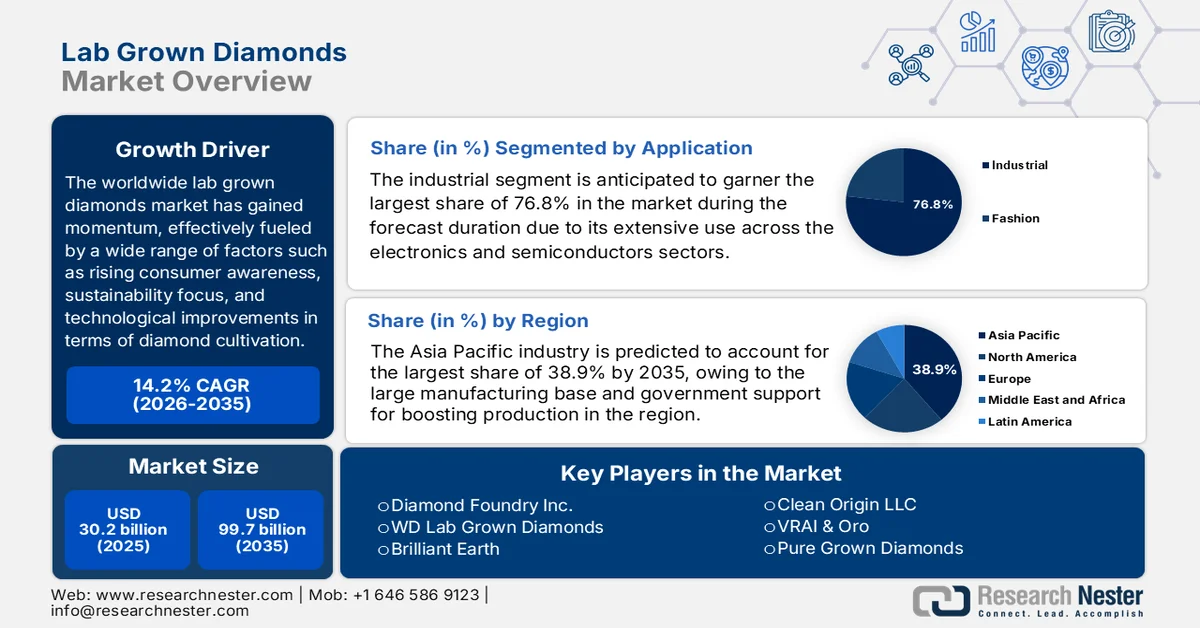
The worldwide lab grown diamonds market has gained momentum, effectively fueled by a wide range of factors such as rising consumer awareness, sustainability focus, and technological improvements in terms of diamond cultivation. Industry-validated analysis by the International Gem Society in July 2025 reported that lab-grown diamond production grew from an estimated 6 to 7 million carats five years back, which was led by China, India, and the U.S. Also, the cost to produce a lab-grown diamond reduced from USD 4,000 per stone in 2008 to approximately USD 200 to USD 300 per stone today, thereby making them 30% to 40% affordable when compared to natural diamonds. The findings also observed that consumer adoption is increasing annually, driven by ethical sourcing and affordability, in which younger buyers are particularly preferring lab-grown stones.
Furthermore, the expansion in terms of global trade and manufacturing capacity, which is supported by government-backed initiatives, especially in major production hubs such as emerging nations, is also facilitating consistent revenue in the market. Based on the government data from India, the Ministry of Commerce & Industry in February 2023 revealed that the country’s government has approved a five-year Rs. 242.96 crore (USD 29.63 million) grant to IIT-Madras to establish the India Centre for Lab Grown Diamond (InCent-LGD), with a key goal to develop indigenous machinery, seeds, and recipes for HPHT and CVD production. It also stated that India’s lab-grown diamond exports have grown, accounting for 25.8% of worldwide trade in 2021-22. In addition, the project is expected to enhance domestic manufacturing, reduce import dependence, expand employment, and hence increase the growth potential of the market in the years ahead.
India Lab-Grown Diamond Exports: Official Trade Data (2017-2023)
|
Financial Year |
Cut & Polished LGD Exports (USD Million) |
|
2017-18 |
237.89 |
|
2018-19 |
274.75 |
|
2019-20 |
473.65 |
|
2020-21 |
637.97 |
|
2021-22 |
1,348.24 |
|
2022-23 (April-December) |
1,387.33 |
Source: Ministry of Commerce & Industry
Key Lab Grown Diamonds Market Insights Summary:
Regional Highlights:
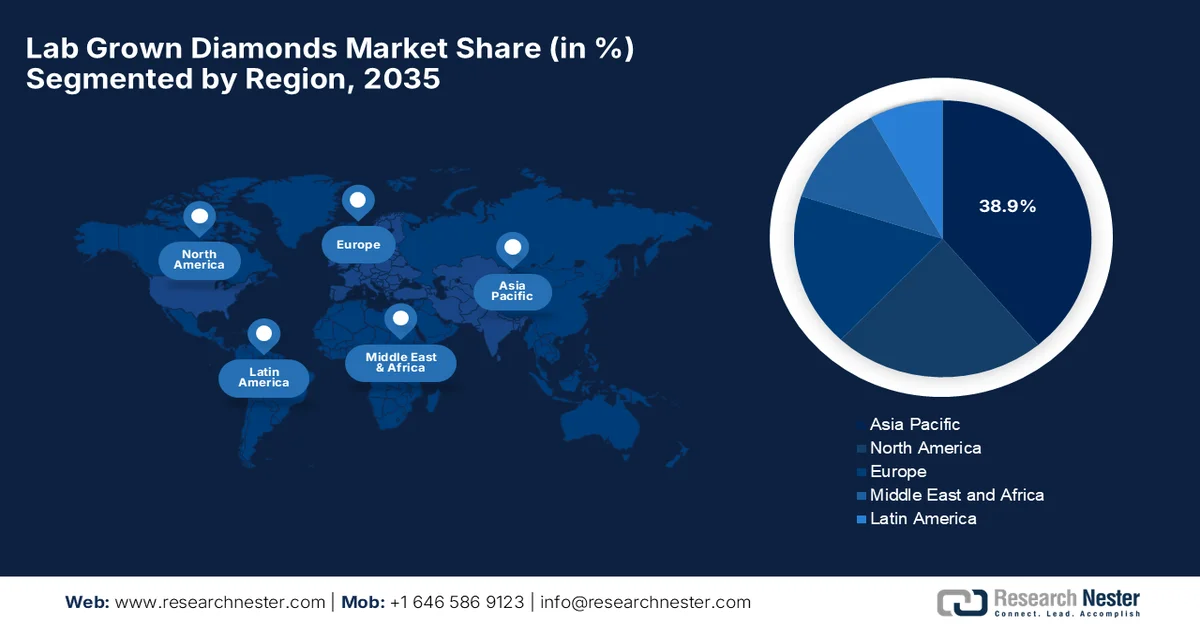
- Asia Pacific is forecasted to hold a 38.9% share by 2035, driven by a large manufacturing base, government support, and rising disposable incomes.
- North America is anticipated to expand steadily, impelled by the shift toward sustainable luxury and ethical sourcing, along with adoption of direct-to-consumer and virtual retail models.
Segment Insights:
- Industrial sub-segment is projected to account for 76.8% share by 2035, owing to its extensive use across electronics, semiconductors, and scientific research.
- Chemical vapor deposition sub-segment is expected to grow at a considerable rate by 2035, propelled by its capability to produce high-purity crystals efficiently and at scale.
Key Growth Trends:
- Ethical & sustainable consumer preferences
- Government backing
Major Challenges:
- Price volatility and margin pressure
- Consumer perception and value retention
Key Players: Diamond Foundry Inc. (U.S.), WD Lab Grown Diamonds (U.S.), Brilliant Earth (U.S.), Clean Origin LLC (U.S.), VRAI & Oro (U.S.), Pure Grown Diamonds (U.S.), ALTR Created Diamonds (U.S.), MiaDonna (U.S.), Scio Diamond Technology Corporation (U.S.), D. Nea Diamond (Belgium), De Beers Group (UK), Element Six (UK), Orro (U.S.), Takara Diamonds (U.S.), ABD Diamonds Pvt. Ltd. (India), KIRA Diamonds (India), Green Lab Diamonds LLP (India), Goldiam International Ltd. (India).
Global Lab Grown Diamonds Market Forecast and Regional Outlook:
Market Size & Growth Projections:
- 2025 Market Size: USD 30.2 billion
- 2026 Market Size: USD 34.4 billion
- Projected Market Size: USD 99.7 billion by 2035
- Growth Forecasts: 14.2% CAGR (2026-2035)
Key Regional Dynamics:
- Largest Region: Asia Pacific (38.9% Share by 2035)
- Fastest Growing Region: North America
- Dominating Countries: United States, China, India, Japan, Germany
- Emerging Countries: South Korea, Brazil, United Arab Emirates, Australia, Canada
Last updated on : 9 March, 2026
Lab Grown Diamonds Market - Growth Drivers and Challenges
Growth Drivers
- Ethical & sustainable consumer preferences: The rising awareness of environmental and social harms associated with mining encouraged consumers to prefer sustainably produced lab-grown diamonds. In this context, the World Jewellery Confederation announced that it introduced its Environmental, Social, and Governance (ESG) Principles for diamonds that are grown in labs at the 2023 CIBJO Congress in India. Also, it included a proper guidance document which outlines 14 principles across environmental, social, and governance areas, making it suitable with the UN sustainable development goals. In addition, these principles were efficiently designed to help LGD companies build sustainable strategies, meet consumer expectations for ethical practices, and prepare for stricter government ESG regulations in the future. Therefore, such evidence-based administrative guidelines provide encouragement towards widespread adoption in the market.
- Government backing: This is the fundamental growth driver for the lab grown diamonds market since governments across most of the nations are offering significant funding grants, making it accessible to a wider audience group. Their lower prices also stimulate first-time diamond purchases, expanding the overall diamond consumer base. In November 2025, Australia opened the world’s first-ever commercial quantum diamond foundry in Victoria, which was backed by investments from both the Albanese Labor Government and the Allan Labor Government. The facility is operated by Quantum Brilliance, and it uses lab-grown diamonds to power quantum devices by advancing sovereign manufacturing capability. Hence, such projects reflect the government's support for lab-grown diamonds, encouraging innovation in quantum technologies.
- Mutually profitable collaborations: The market is witnessing rising collaborations between designers, manufacturers, and technology providers, which are fostering expanded product offerings, thereby positioning lab-grown diamonds as a mainstream choice in the international jewelry industry. In September 2024, KAY Jewelers notified that it entered into a partnership with designer Monique Lhuillier to launch its first collection of colored lab-created diamond engagement rings, in 18K gold. Therefore, the collaboration expands the Monique Lhuillier Bliss collection, wherein the 12-piece collection, ranging from 1½ to 2⅝ carats, is priced between USD 4,099.99 and USD 7,299.99. Hence, such partnerships between major designers and retailers are attracting new customers with designer-led diamonds, prompting a profitable business environment for the market.
Challenges
- Price volatility and margin pressure: One of the biggest challenges in the market is the aspect of continued price erosion influenced by rapid capacity expansion and technological efficiency. The market is witnessing a reduction in production costs, due to which new entrants are establishing their footprint. This, in turn, causes wholesale and retail prices for lab-grown diamonds to fall, putting pressure on margins for manufacturers, brands, and retailers. Also, these lab-grown stones do not face the inherent supply constraints, making oversupply a recurring risk. Therefore, this pricing aspect complicates inventory valuation, long-term contracts, and brand positioning, especially for companies that are targeting the premium segment. Furthermore, maintaining profitability requires proper scaling, vertical integration, and differentiation, which can be challenging for small and mid-scale players.
- Consumer perception and value retention: There has been a growing acceptance, but still, lab-grown diamonds face challenges associated with long-term value and emotional significance. Most of the consumers see lab-grown diamonds as technology products rather than enduring luxury assets, which leads to concerns about resale value and longevity. Also, the comparisons with natural diamonds, which are mostly influenced by the traditional industry messaging, can create confusion at the point of sale. In addition, declining prices reinforce the belief that lab-grown diamonds depreciate quickly. Therefore, educating consumers on quality, certification, and intended use is highly essential, but inconsistent messaging across brands and retailers continues to hinder uniform market understanding.
Lab Grown Diamonds Market Size and Forecast:
| Report Attribute | Details |
|---|---|
|
Base Year |
2025 |
|
Forecast Year |
2026-2035 |
|
CAGR |
14.2% |
|
Base Year Market Size (2025) |
USD 30.2 billion |
|
Forecast Year Market Size (2035) |
USD 99.7 billion |
|
Regional Scope |
|
Lab Grown Diamonds Market Segmentation:
Application Segment Analysis
The industrial sub-segment, which is a part of the application, is anticipated to garner the largest share of 76.8% in the lab grown diamonds market during the forecast duration. The dominance of the segment is mainly driven by its extensive use across sectors such as electronics, semiconductors, and scientific research. Also, these lab-grown diamonds are being utilized for their exceptional hardness, making them highly suitable for industrial processes. In addition, the growing demand for miniaturized and high-performance electronic devices necessitates superior thermal management and wear-resistant materials, which are also fueling the subsegment’s use. Furthermore, research institutions and laboratories are also leveraging lab-grown diamonds for quantum computing experiments and high-precision scientific instruments, highlighting their versatility beyond traditional applications.
Manufacturing Method Segment Analysis
In terms of manufacturing method, the chemical vapor deposition is expected to grow at a considerable rate by 2035. The growth of the segment is highly propelled by its capability to produce high-purity crystals efficiently and at scale, enabling broader adoption in both jewelry and advanced industrial applications. Both the governments and industry bodies note that laboratory production technologies such as CVD and HPHT are foundational factors for the world‑scale lab‑grown diamond capacity. In June 2024, SF Diamond established a 700,000-carat annual capacity lab-grown diamond factory in Henan, which marks China’s largest CVD-based diamond producer. Furthermore, the facility uses microwave plasma CVD technology to produce high-quality industrial diamonds for sectors such as electric vehicles, electronics, and quantum technologies, thereby addressing domestic demand in the market.
Type Segment Analysis
In the market, the polished diamonds segment is likely to gain a significant share owing to direct consumer demand for ready-to-wear stones in engagement, fashion, and luxury sectors. Also, the polished lab-grown stones require less downstream processing than rough stones and carry higher retail value. In addition, the jewelry brands mostly leverage polished lab-grown diamonds in customized designs, which is pushing consumer adoption and capitalizing on ethical and sustainability preferences. In February 2025, Mini Diamonds (India) Ltd announced the commencement of manufacturing sized polished lab-grown diamonds, which range from 0.5 to 10 carats at its Mumbai facility. Besides, the initiative aims to provide high-quality, ethically sourced diamonds for both luxury and retail markets, by making it suitable to consumer demand for ready-to-wear, customizable stones, hence denoting a wider segment scope.
Our in-depth analysis of the global market includes the following segments:
|
Segment |
Subsegments |
|
Application |
|
|
Manufacturing Method |
|
|
Type |
|
|
Distribution Channel |
|
|
Carat |
|
|
Color |
|
|
End use |
|

Vishnu Nair
Head - Global Business DevelopmentCustomize this report to your requirements — connect with our consultant for personalized insights and options.
Lab Grown Diamonds Market - Regional Analysis
APAC Market Insights
The Asia Pacific lab grown diamonds market is forecasted to lead with a commendable share of 38.9% over the discussed timeframe. The region benefits from a large manufacturing base and consistent government support for boosting production. Also, the aspect of rising disposable incomes is fostering a heightened demand for lab-grown diamonds in the luxury fashion and gifting sectors. Based on the government data from Japan published in February 2025, Ookuma Diamond Device Co., Ltd., with support from Hokkaido University and AIST, is building the world’s first-ever diamond semiconductor factory in Okuma Town, Fukushima Prefecture. It also stated that these synthetic diamond semiconductors are born from research after the Fukushima Daiichi accident, can withstand extreme heat and radiation, making them suitable for nuclear decommissioning. Therefore, with the presence of such a research ecosystem, the region will create new industries contributing to extensive market growth.
The government-led industrial investments in ultra-hard materials and advanced CVD diamond production drive growth in China lab grown diamonds market. Companies such as SF Diamond are spearheading large-scale manufacturing, whereas lab-grown diamonds are used in electronics and semiconductors. As stated in the World Branding Forum in December 2025, Messi Jewelry is expanding the lab-grown diamond industry with the launch of its fancy colour collection, in pink, blue, yellow, and green diamonds, which are produced through CVD and HPHT methods. It also mentioned that the company vertically integrates production from crystal growth to finished jewellery, and more than over 2,500 carats are produced monthly. Hence, the domestic pioneers in the country are attracting more players to operate in China through CVD and HPHT diamonds and vertically integrated jewelry production.
The large export hub and strong government backing allowed the market in India to establish itself as a predominant leader in the global landscape. The country’s market also benefits from the integration of lab-grown diamonds into traditional jewelry clusters. Industry-validated analysis by IBEF in October 2025 stated that the country is emerging as a global leader in lab-grown diamonds, which produced more than three million stones in 2023, accounting for more than 15% of the world’s output. In addition, government initiatives such as seed grants at IIT Madras, duty-free import of carbon seeds, and 100% FDI in the sector are efficiently boosting domestic manufacturing. The country is witnessing rising consumer demand, especially from Millennials and Gen Z, which is driving growth in both urban and tier-two/three cities through companies such as Limelight Diamonds and Cartland. Therefore, with continued policy support, export activities, and a skilled workforce, India is all set to progress as both a major manufacturing hub and consumer market for lab-grown diamonds.
Lab-Grown Diamonds Gross Exports: April - September 2023 (USD Million) - Government-Reported Estimates
|
Months |
Gross Exports 2022-2023 (USD million) |
Gross Exports (P) 2023-2024 (USD million) |
|
April |
148.13 |
102.40 |
|
May |
177.32 |
139.36 |
|
June |
149.91 |
97.66 |
|
July |
147.37 |
105.75 |
|
August |
143.14 |
117.84 |
|
September |
177.77 |
132.81 |
|
April-September |
943.64 |
695.82 |
Source: GJEPC
Top Export Destinations for Lab-Grown Diamonds: Official Trade Data and Year-on-Year Growth Analysis (April - September 2022-2023)
|
Countries |
April - September 2022 (USD million) |
April - September 2023 (USD million) |
% Growth / Decline (Yo-Y) |
|
U.S. |
605.16 |
404.6 |
-33.14 |
|
Hongkong |
132.96 |
126.1 |
-5.16 |
|
U.A. E |
108.02 |
97.53 |
-9.71 |
|
Belgium |
14.27 |
12.43 |
-12.9 |
|
Israel |
24.14 |
10.11 |
-58.13 |
|
UK |
5.94 |
9.54 |
60.66 |
|
China P.Rp |
5.06 |
8.14 |
60.87 |
|
Thailand |
6.06 |
7.72 |
27.43 |
|
Singapore |
19.59 |
5.74 |
-70.72 |
|
Australia |
8.65 |
4.07 |
-52.99 |
|
Others |
13.79 |
9.84 |
-28.65 |
|
Total |
943.64 |
695.82 |
-26.26 |
Source: GJEPC
North America Market Insights
Lab grown diamonds market in North America is highly fueled by a major shift toward sustainable luxury and ethical sourcing, in which buyers are showcasing a preference towards lab-grown diamonds when compared to mined alternatives. On the other hand, the retail models, such as direct-to-consumer platforms and virtual try-on technologies, are enhancing both accessibility and engagement in this field. In January 2024, Lavalier Personal Jewelry Insurance entered into a partnership with the International Gemological Institute (IGI) to offer integrated services and discounted premiums of up to 10% for consumers with IGI grading reports. Also, this particular collaboration provides education on appraisals, lab-grown gemstones, and jewelry-specific insurance, along with worldwide coverage for loss, damage, theft, and wear. Hence, such instances in the region will promote transparency, ultimately driving market growth in the upcoming forecasted years.
The aspects of jewelry customization and regulatory frameworks are major revenue drivers for the U.S. lab grown diamonds market. The country also benefits from cross-border collaborations, which have the complete potential to boost the market’s revenue growth. GJEPC in January 2026 reported that the U.S. and Japan are looking to form a synthetic diamond manufacturing facility in the US as part of Japan’s USD 550 billion investment program, targeting lab-grown diamonds (LGDs) for semiconductors, precision tools, and other advanced industrial applications. Also, this initiative aims to strengthen strategic supply chains, along with concerns over global reliance on China, which is leading the synthetic diamond production and has imposed a few export controls on certain materials. Companies such as Element Six, part of the De Beers Group, can be involved, and considerable financial backing is expected from Japan’s state-supported institutions.
Canada lab grown diamonds market is also growing efficiently, backed by the government’s innovation initiatives and industrial applications. Lab-grown diamonds are being used in various sectors, supported by local academic partnerships and research institutes exploring their properties for quantum computing and high-performance devices. Based on the government data from the country in September 2025, Canada participates in the Kimberley Process Certification Scheme (KPCS) to regulate the import and export of rough diamonds, aiming to prevent any type of trade of conflict diamonds and promote transparency in the industry. It also stated that the synthetic lab-grown diamonds are classified separately under the Customs Tariff and do not need this certificate, increasing participation from both national & foreign players. The existence of such a framework, which is administered by Natural Resources Canada, solidifies the country’s position in responsible resource development and compliance with global standards.
Europe Market Insights
In Europe, the lab grown diamonds market is primarily propelled by the rising consumer interest in terms of eco-conscious luxury and certified sustainable products. Retailers in the region are highlighting lab-grown diamonds for their carbon footprint advantages, whereas the luxury brands are incorporating them into high-end collections. In February 2025 Responsible Jewellery Council (RJC) officially reported that it has launched its Laboratory Grown Materials Standard (LGMS) to provide clear guidelines for lab-grown diamonds as well as colored gemstones. Besides, this standard promotes responsible business practices, legal compliance, and supply chain transparency for all RJC members who are handling lab-grown materials. Therefore, such standards will enhance consumer trust and encourage wider adoption of ethically produced lab-grown diamonds, benefiting the overall market growth.
Huge technical applications and evidence-based adoption, which is encouraging applications in precision engineering, high-frequency electronics, and industrial cutting tools, fosters the continued growth of Germany lab grown diamonds market. Simultaneously, the collaborations between universities and private companies are fostering a favourable business environment in diamond-based technologies. Fraunhofer Institutes are extensively working on CVD-grown synthetic diamond materials for power electronics, sensors, and thermal management solutions, thereby effectively translating laboratory research into industrial use. Meanwhile, the aspect of academia-industry partnerships, which are supported by Germany’s applied-research ecosystem, is fostering the commercialization of advanced lab-grown diamond technologies, positioning the country as a predominant leader in this field.
Ethical consumerism, as well as designer collaborations and exclusive jewelry collections, are gaining popularity in the UK lab grown diamonds market, allowing an increased uptake. Also, initiatives to increase transparency in the supply chain, coupled with digital retailing and influencer-led marketing, are creating a huge awareness and acceptance among younger buyers in the country. As stated by the country’s government, the UK Department for Business and Trade issued a General Trade Licence (GBSAN0003) on 24 April 2025, permitting the import of sanctioned Russian synthetic diamonds processed in third countries. Besides, this permission applies to stones of 0.5 carats or larger that were outside Russia on that date and have remained outside since. The licence also requires aligning with statutory guidance on Russia sanctions and Notice to Importers 2953. Hence, such instances help ensure stable supply chains and give traders confidence to continue operations despite the presence of any sanctions.
Key Lab Grown Diamonds Market Players:
- Diamond Foundry Inc. (U.S.)
- WD Lab Grown Diamonds (U.S.)
- Brilliant Earth (U.S.)
- Clean Origin LLC (U.S.)
- VRAI & Oro (U.S.)
- Pure Grown Diamonds (U.S.)
- ALTR Created Diamonds (U.S.)
- MiaDonna (U.S.)
- Scio Diamond Technology Corporation (U.S.)
- D. Nea Diamond (Belgium)
- De Beers Group (UK)
- Element Six (UK)
- Orro (U.S.)
- Takara Diamonds (U.S.)
- ABD Diamonds Pvt. Ltd. (India)
- KIRA Diamonds (India)
- Green Lab Diamonds LLP (India)
- Goldiam International Ltd. (India)
- Novita Diamonds (Australia)
- Company Overview
- Business Strategy
- Key Product Offerings
- Financial Performance
- Key Performance Indicators
- Risk Analysis
- Recent Development
- Regional Presence
- SWOT Analysis
- De Beers Group is the major player in the diamond industry, and it readily expanded into lab-grown diamonds through its Lightbox jewelry brand by offering fashionable, affordable stones. The company attracts the young and style-conscious consumers, thereby focusing on transparency and consistent pricing to differentiate Lightbox from mined diamonds.
- Diamond Foundry Inc. is yet another prominent player in this field that is mainly focused on sustainable, renewable energy-powered production. The firm has invested in advanced CVD technologies and expanded capacity internationally, including a facility in Spain backed by EU funding, to produce premium-quality diamonds exceeding 10 carats.
- ALTR Created Diamonds is a part of the R.A. Riam Group, and it specializes in premium lab-grown diamonds with a prime focus on craftsmanship, sustainability, and vertically integrated production. On the other hand, the company has achieved net-zero sustainability certifications and emphasizes renewable energy use and high-quality Type IIa stones.
- WD Advanced Materials, LLC, formerly WD Lab Grown Diamonds, has been a major leader in CVD lab-grown diamond technology. In addition, the company is recognized for producing large, high-quality diamonds and also serves advanced materials applications other than jewelry, including quantum and optical technologies.
- KIRA Diamonds is one of the world’s largest growers and wholesalers of CVD lab-grown diamonds, which is extensively leveraging vertical integration from seed to jewelry to maintain quality and cost control. The company holds decades of industry experience, and it emphasizes sustainability, ethical production, and advanced manufacturing technology to serve global markets.
Below is the list of some prominent players operating in the global market:
The lab grown diamonds market is recognized for the continued technological advancements, sustainability branding, and direct-to-consumer retail expansion. Major manufacturers in the U.S. and Europe are making increased investments in terms of HPHT and CVD production technologies to improve quality and scale, whereas the companies that are focused on brand building are focused on ethical sourcing and environmental credentials to attract conscious consumers. Simultaneously, the firms based in emerging nations leverage manufacturing scale and supply chain integration, and global firms form strategic retail alliances and expand online platforms to increase market penetration. In October 2025, Charles & Colvard announced that it entered into a partnership with Ethara Capital to expand its lab-grown diamond offerings across both consumer and wholesale channels, supported by Ethara’s large-scale CVD manufacturing capabilities.
Corporate Landscape of the Lab Grown Diamonds Market:
Recent Developments
- In August 2025, GIA announced that it will launch updated evaluation services for D-to-Z laboratory-grown diamonds by replacing traditional natural-diamond grading with a new laboratory-grown diamond quality assessment. It also stated that assessments will cost USD 15 per carat (minimum USD 15), include laser inscription and a printed report, and apply to stones 0.15 carats and above.
- In September 2025, Kira Jewels notified that it added 1,400 CVD reactors to its India-based manufacturing facility, increasing total reactors to 4,000, thereby increasing lab-grown diamond production. The expansion will raise output from 250,000 to more than 325,000 polished carats per month.
- In January 2024, IGI announced the launch of a same-day diamond verification program for members of the Diamond Manufacturers and Importers Association (DMIA), with a prime focus to strengthen diamond authenticity and trade integrity with plans to expand access across the industry.
- Report ID: 8426
- Published Date: Mar 09, 2026
- Report Format: PDF, PPT
- Explore a preview of key market trends and insights
- Review sample data tables and segment breakdowns
- Experience the quality of our visual data representations
- Evaluate our report structure and research methodology
- Get a glimpse of competitive landscape analysis
- Understand how regional forecasts are presented
- Assess the depth of company profiling and benchmarking
- Preview how actionable insights can support your strategy
Explore real data and analysis
Frequently Asked Questions (FAQ)
About this Report
Connect with our Expert


Report, 2026-2035



Copyright @ 2026 Research Nester. All Rights Reserved.
