Intumescent Coatings Market Outlook:
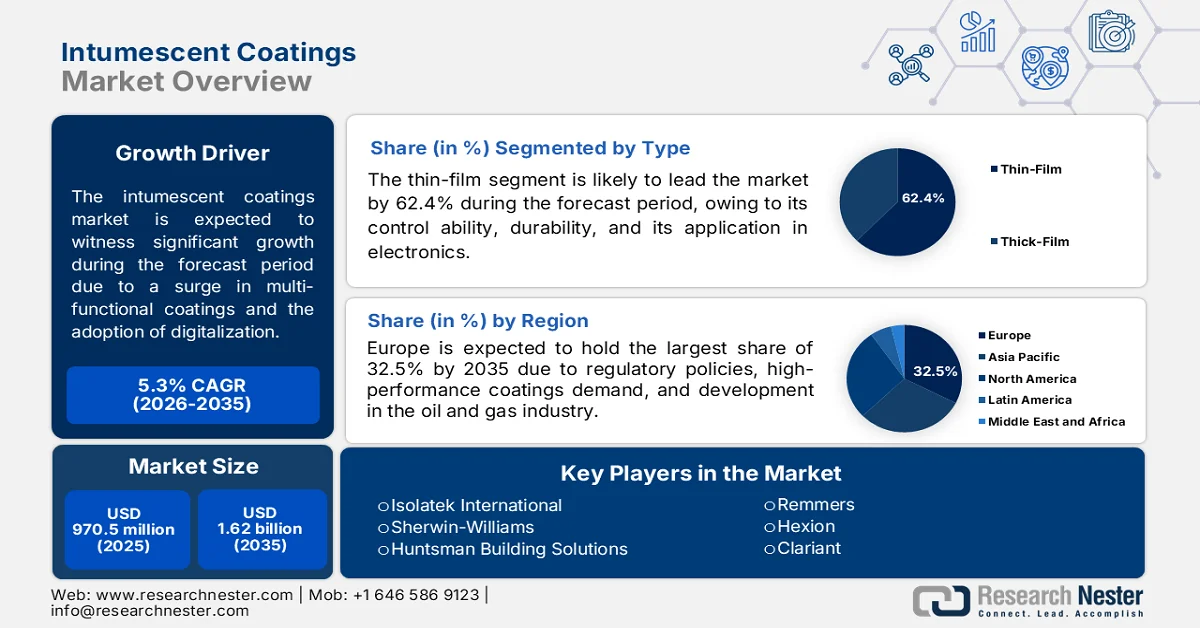
Intumescent Coatings Market size was valued at USD 970.5 million in 2025 and is expected to cross USD 1.62 billion by the end of 2035, expanding at more than 5.3% CAGR during the forecast period, i.e., 2026-2035. In 2026, the industry size of intumescent coatings is assessed at USD 1.02 billion.
The worldwide intumescent coatings market is witnessing steady growth based on urbanization, a shift towards water-borne formulations, digital transformation through artificial intelligence (AI)-specific simulation tools, and the emergence of multi-functional coatings. According to an article published by NLM in January 2025, the food and beverage industry accounts for the highest post-harvest losses that range from 28% to 55% of overall production. Likewise, worldwide climate change is predicted to diminish industrial production by 0.3% across developed nations and 5% across developing countries by the end of 2050. Therefore, based on these barriers, there is a huge demand for edible films or coatings, which have gained increased attention as the most suitable solution for lowering food and beverage post-harvest loss, thus positively impacting market growth and demand.
Furthermore, the integration of prefabricated and modular construction, AI-based fire simulation, lifecycle performance, and multi-function coatings availability are other trends that are also responsible for driving the intumescent coatings market globally. As stated in an article published by NLM in June 2025, corrosion has emerged as one of the most consequential issues, such as the damage of metallic equipment and industrial machines, all of which are estimated to account for nearly 3.4% of the worldwide gross domestic product (GDP). Besides, in the electronic and metallurgical manufacturing sectors, corrosion control is considered a major aspect of increased importance. In this regard, an organic layer or paint is usually applied, especially to the metal substrate, as the most suitable corrosion prevention method, thus enhancing the intumescent coatings market growth and expansion.
Key Intumescent Coatings Market Insights Summary:
Regional Highlights:
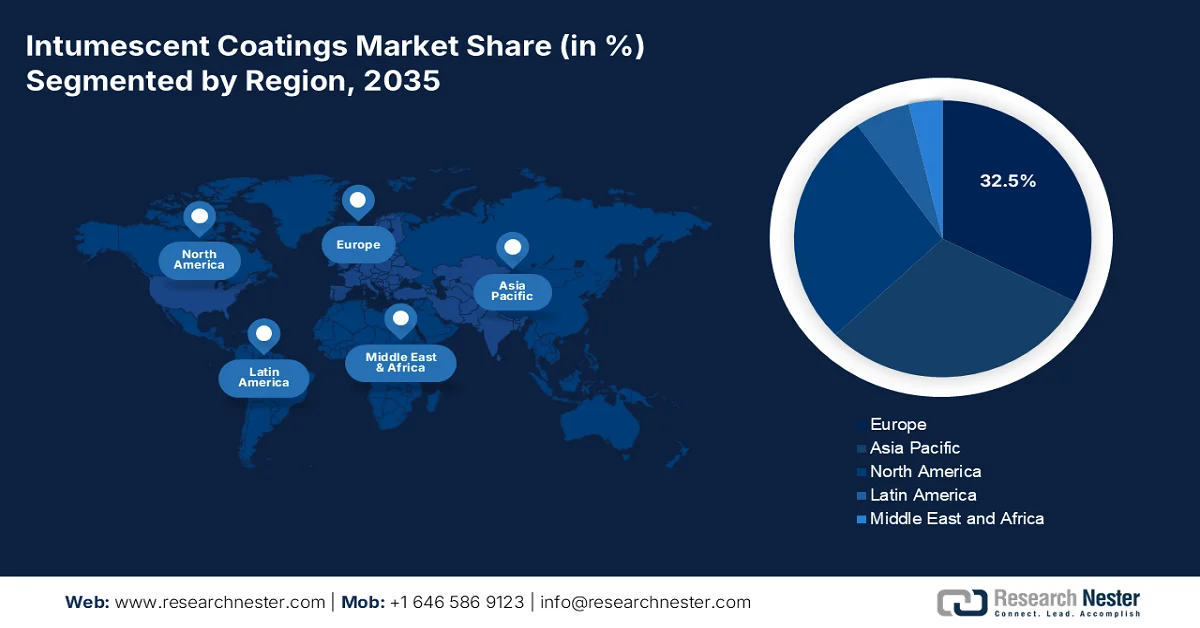
- Europe is expected to command 32.5% of the intumescent coatings market by 2035, reinforced by expanding oil and gas activities, stringent environmental regulations, and rising demand for certified high-performance coatings
- North America is poised to secure a 27.5% share of the market by 2035, underpinned by strict fire safety regulations, a mature construction sector, updated building codes, and growing adoption of low-VOC and water-borne formulations
Segment Insights:
- The thin-film sub-segment is forecast to capture 62.4% of the intumescent coatings market by 2035, supported by its vital role in enhancing durability, advancing modernized electronics, and regulating heat and light
- The building and construction segment is projected to hold a 55.4% share of the market by 2035, stimulated by its reliance on coatings as a critical barrier against thermal transfer, moisture ingress, and environmental degradation
Key Growth Trends:
- An increase in profit prioritization
- Innovation in the application technique
Major Challenges:
- Regulatory fragmentation and compliance burden
- Performance validation and long-lasting durability risks
Key Players: Isolatek International (U.S.), Sherwin-Williams (U.S.), Huntsman Building Solutions (U.S.), Remmers (Germany), Hexion (U.S.), Clariant (Switzerland), PPG (U.S.), Hempel (Denmark).
Global Intumescent Coatings Market Forecast and Regional Outlook:
Market Size & Growth Projections:
- 2025 Market Size: USD 970.5 million
- 2026 Market Size: USD 1.02 billion
- Projected Market Size: USD 1.62 billion by 2035
- Growth Forecasts: 5.3% CAGR (2026-2035)
Key Regional Dynamics:
- Largest Region: Europe (32.5% Share by 2035)
- Fastest Growing Region: North America
- Dominating Countries: United States, Germany, China, United Kingdom, Japan
- Emerging Countries: India, Saudi Arabia, Brazil, South Korea, United Arab Emirates
Last updated on : 27 July, 2026
Intumescent Coatings Market - Growth Drivers and Challenges
Growth Drivers
- An increase in profit prioritization: Tier-1 organizations are continuously divesting commoditized and low-margin assets to significantly reallocate capital towards differentiated and high-purity offerings with superior pricing power, thus driving the intumescent coatings market. For instance, in January 2025, Isolatek International launched the FireSolve® SB, which is considered a revolutionary solvent-specific intumescent fireproofing product. This particular product significantly redefines industrial standards for environmental safety, application efficiency, and durability. Additionally, this also caters to the organization’s long-lasting commitment to advancement and its outstanding position as the ultimate provider of a wide-ranging suite of passive fireproof solutions, thus positively fueling the market’s upliftment.
- Innovation in the application technique: The continuous refinement and dominance of spray application is considered a notable driver for the intumescent coatings market. Based on an article published by NLM in January 2022, the worldwide industry for thermal spray applications is expected to increase to USD 17 billion by the end of 2027. In addition, almost 138,000 workers were readily employed as spraying and coating machine operators, which is further projected to grow since the requirement for thermal spray coating is gradually increasing. In this regard, airborne concentrations of toxic metals at workplaces have been witnessed during thermal spray coating, thereby making it suitable for boosting the market’s exposure.
Challenges
- Regulatory fragmentation and compliance burden: The lack of harmonized fire safety standards across jurisdictions creates a significant compliance burden for manufacturers. Besides, North America, Europe, and the Asia Pacific maintain distinct certification requirements, testing protocols, and performance benchmarks. This fragmentation forces manufacturers to maintain multiple product formulations and undergo repeated testing cycles for different markets, escalating R&D costs and lengthening time-to-market. The complexity is further amplified by evolving regulations that frequently introduce new compliance criteria, requiring continuous monitoring and adaptation, thus causing a hindrance to the intumescent coatings market growth.
- Performance validation and long-lasting durability risks: One of the most persistent challenges in the intumescent coatings market is proving the long-term durability and reliability of intumescent coatings under real-world conditions. While laboratory testing provides baseline performance metrics, end-users demand assurance that coatings will maintain their fire-resistant properties over decades of exposure to environmental stressors, such as UV radiation, moisture, temperature fluctuations, and mechanical abrasion. The lack of standardized accelerated aging protocols that accurately predict long-term performance creates uncertainty among specifiers and building owners. This performance validation gap often leads to conservative specification practices or preference for alternative passive fire protection methods.
Intumescent Coatings Market Size and Forecast:
| Report Attribute | Details |
|---|---|
|
Base Year |
2025 |
|
Forecast Period |
2026-2035 |
|
CAGR |
5.3% |
|
Base Year Market Size (2025) |
USD 970.5 million |
|
Forecast Year Market Size (2035) |
USD 1.62 billion |
|
Regional Scope |
|
Intumescent Coatings Market Segmentation:
Type Segment Analysis
The thin-film sub-segment under the type segment is anticipated to garner the largest share of 62.4% in the intumescent coatings market by the end of 2035. The sub-segment’s upliftment is primarily fueled by its crucial role in boosting durability, enabling modernized electronics, and controlling heat and light. According to an article published by NLM in November 2025, solar energy utilization is currently restricted, accounting for 0.01% of electricity generation, 0.3% of heat, and 11% of natural biomass photosynthesis. Besides, there has been an increase in efforts made in solar cells to utilize economical and efficient materials during the fabrication procedure. This significantly accounts for the requirements for optimal materials, which include a band gap between 1.1 eV and 1.7 eV, a direct band structure, low toxicity, high solar conversion efficiency, and facile availability, thus enhancing the sub-segment’s demand globally.
End use Segment Analysis
Based on end use, the building and construction segment is projected to account for the second-largest share of 55.4% in the intumescent coatings market during the forecast period. The segment’s growth is highly driven by the role of coatings as the ultimate foundational pillar in the segment, which serves as a severe barrier against thermal transfer, moisture ingress, and environmental decay. As per an article published by the UNEP Organization in May 2026, building and construction presently account for the central part of the worldwide economy, indicating an 11% to 13% share of global GDP. In addition, the segment also employs almost 9% of the world’s workforce across engineering, demolition, renovation, and construction. Likewise, the segment also constitutes nearly 7% of global carbon dioxide emissions and around 50% of material extraction, thus bolstering the segment’s exposure.
Application Segment Analysis
By the end of the stipulated timeline, the cellulosic coatings sub-segment, which is part of the application segment, is expected to grab the third-largest share of 53.6% in the intumescent coatings market. The sub-segment’s development is effectively attributed to its importance for modern packaging, textiles, and paints made from natural cellulose and its derivatives. In this regard, and as stated by NLM in October 2025, global plastic production is predicted to be almost 400 million tons per year. Besides, the UN Environmental Programme (UNEP) noted that 1,050 million tons of food were wasted as of 2022, indicating 19% food availability for consumers. Therefore, based on this, containers originating from cellulosic materials, including cardboard and paper, are considered a suitable alternative for food packaging due to their compostable, biodegradable, and renewable nature, thus positively impacting their usability.
Our in-depth analysis of the intumescent coatings market includes the following segments:
|
Segment |
Subsegments |
|
Type |
|
|
End use |
|
|
Application |
|
|
Technology |
|
|
Resin Type |
|

Vishnu Nair
Head - Global Business DevelopmentCustomize this report to your requirements — connect with our consultant for personalized insights and options.
Intumescent Coatings Market - Regional Analysis
Europe Market Insights
Europe intumescent coatings market is anticipated to grab the highest share of 32.5% by the end of 2035. The market’s upliftment in the region is primarily attributed to development in the oil and gas industry, environmental regulations, and the demand for certified and high-performance coatings. According to official statistics published by the Royal Society of Chemistry in 2024, suitable coatings for the automotive sector in the region comprise different categories with differences in dry thickness and industrial share. For instance, clearcoat coating type constitutes a dry thickness of 40 to 50 μm with less than 1% industry share, while basecoat caters to 10 to 30 μm with more than 80% share. Likewise, primer accounts for 25 to 40 μm with more than 10% share, and e-coat with 20 μm dry thickness and 100% share, thus proliferating the market exposure in the region.
The Germany intumescent coatings market is growing significantly, owing to development in the construction industry, demand from the automotive industry, strict regulatory environment, high-tech manufacturing capacity, and a robust commitment to technological advancements. As stated in an article published by Climate Scorecard in March 2025, there has been a rapid transformation in the automotive industry, with electric vehicles accounting for 55% of the car industry in the country, battery electric vehicles for 33.2%, and plug-in hybrid electric vehicles for 22.2% as of 2023. In addition, these vehicles continued to grow, with sales reaching USD 68.2 billion as of 2025, with a further predicted increase in sales surpassing 1 million vehicles every year by the end of 2029 and a 6.6% growth rate, thus making it suitable for bolstering the market’s upliftment in the country.
The tactical position for industrial and logistic centers, high concentration of manufacturing and chemical sectors, the dense network of warehouses, and governmental support through innovation and sustainability are certain factors that are boosting the intumescent coatings market in the Netherlands. As per an article published by the Eindhoven University of Technology in November 2025, the country comprises an estimated 430 chemical production facilities, with yearly revenues amounting to roughly USD 99.1 billion (87 billion euros), which makes the chemical sector highly responsible for 2% of the GDP. Besides, the ARRRA hub presently supplies 50% of regional chemical goods demand, including fuels, lubricants, cleaning agents, medicines, building materials, and fertilizers, thus enhancing the market growth in the overall country.
North America Market Insights
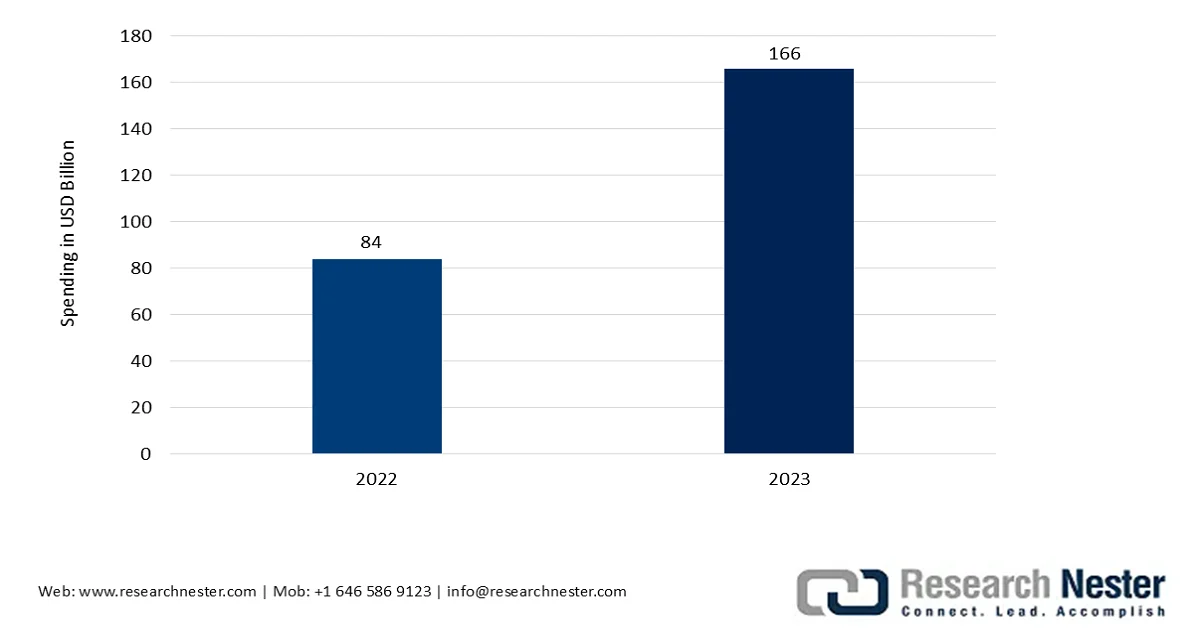
The North America intumescent coatings market is projected to emerge as the fastest-growing region with a share of 27.5% during the forecast. The market’s development in the region is highly propelled by strict fire safety regulatory policies, the presence of a mature construction industry, updated building codes, and a shift to low-VOC and water-borne formulations. According to an article published by the Associated General Contractors of America in 2026, construction is regarded as one of the major contributors to the U.S.-based economy. Additionally, there are over 919,000 construction establishments in the country, particularly in the first quarter of 2023. Simultaneously, the industry also employs 8.0 million employees and creates almost USD 2.1 trillion in structures every year. Besides, real manufacturing construction expenditure in terms of chemical, transportation, computer, electrical and electronic, along with food, beverage, and tobacco also demonstrates a huge growth opportunity for the market in the overall region.
U.S. Real Manufacturing Construction Spending by Type, 2022
Source: Associated General Contractors of America
The U.S. intumescent coatings market is gaining increased traction, owing to generous government programs and spending on advanced manufacturing, clean energy, EPA policy, and suitable proposals for renewable chemicals legislation. As stated in an article published by Coatings Tech-Digital Organization in October 2025, the paint and coatings sector in the country accounted for a shipment of 1.34 billion gallons, along with a valuation of USD 34 billion, indicating a surge of 0.9% from 2023 in volume and 1.7% in value as of 2024. Likewise, in 2025, there was an increase of 1.1% in full-year shipment production, which totaled 1.35 billion gallons, further demonstrating an upsurge by 2.9% in value to USD 35 billion. Therefore, with this particular increase in the industry, there is a huge growth and demand for the market in the country.
The presence of fire safety regulations, innovative government policies, an increase in the demand from domestic industries, and extreme weather resistance are a few trends that are responsible for bolstering the intumescent coatings market in Canada. As per an article published by ISED Canada in May 2026, manufacturing sectors in the country significantly contribute to national innovation and economic health by readily employing 1.7 million people, which accounts for 10% of the total workforce, along with paying workers in overall compensation, amounting to USD 114 billion, and effectively generating 42% of private and sector-based research and development activity. Besides, the country readily targets a surge in manufacturing sales by 50% to USD 1 trillion by the end of 2030, while an increase in manufacturing exports by 50% to USD 540 billion by the same year, thus positively impacting the market’s development.
APAC Market Insights
The Asia Pacific intumescent coatings market is projected to witness a considerable share of 30.3% by the end of the stipulated timeline. The market’s growth is highly fueled by an increase in urbanization, strict regulatory evolution, suitable investments in critical infrastructure, and an expansion in the oil and gas industry. According to an article published by Carnegie Endowment for International Peace in April 2026, Southeast Asia demands almost 5 million barrels of oil every day. Besides, with regular oil production of nearly 2 million bpd, notable producing nations include Brunei with 103,000 bpd, Vietnam with 197,000 bpd, Thailand with 418,000 bpd, Malaysia with 570,000 bpd, and Indonesia with 840,000 bpd. Additionally, Vietnam also sources 49%, which is followed by Indonesia sourcing 37%, Thailand 28%, and Singapore with 17% of their respective liquid natural gas from Gulf nations, thus driving the market’s upliftment.
The China intumescent coatings market is gaining increased exposure, owing to the largest manufacturing center, an expansion in construction activity, compulsory requirements for fire-resistant materials, and the adoption of updated standards for battery safety. As stated in an article published by Engineering in April 2026, the country’s electric vehicle boom is focused on generating an unprecedented volume of battery waste. Despite this, more than 70% of end-of-life electric vehicle batteries presently flow to informal recyclers that usually operate outside regulated channels. Besides, retired electric vehicle volumes are projected to reach a production of 22.3 million tons by the end of 2040 under the carbon neutrality scenario, which indicates a 112-fold surge from the 2020 level, thereby demonstrating an optimistic outlook for the market’s growth and exposure.
The aspects of strict fire safety regulations, urban redevelopment, infrastructure renewal, a push for green building, decarbonization, low-carbon supply chains, technological advancements, and industry advocacy are a few trends that are responsible for bolstering the intumescent coatings market in Japan. As per a data report published by COP Japan, the Net-Zero 2050 commits to a 46% reduction in emissions by the end of 2030. In addition, this particular commitment is focused on continuously expanding efforts in its risk to cater to the lofty objective of reducing its emissions by 50%. Therefore, to effectively achieve this, the Long-Term Strategy under the Paris Agreement and the Plan for Global Warming Countermeasures have been successfully revised. Therefore, with such objectives and solutions, there is a huge growth opportunity for the market in the country.
Key Intumescent Coatings Market Players:
- Isolatek International (U.S.)
- Sherwin-Williams (U.S.)
- Huntsman Building Solutions (U.S.)
- Remmers (Germany)
- Hexion (U.S.)
- Clariant (Switzerland)
- PPG (U.S.)
- Hempel (Denmark)
- Company Overview
- Business Strategy
- Key Product Offerings
- Financial Performance
- Key Performance Indicators
- Risk Analysis
- Recent Development
- Regional Presence
- SWOT Analysis
- Isolatek International is a leader in thin-film intumescent fireproofing technology, with its CAFCO® SprayFilm® line enabling architects to showcase exposed structural steel while maintaining fire protection compliance. The company focuses on innovation in application efficiency and low-VOC formulations, positioning itself as a specialist in decorative, high-performance fire protection.
- Sherwin-Williams holds a dominant position in the intumescent coatings market with its comprehensive FIRETEX® product range, offering tailored cellulosic and hydrocarbon fire protection solutions for steel structures across commercial, industrial, and municipal projects. The company differentiates itself through its extensive industry standards compliance, corrosion resistance capabilities, and support for LEED-certified projects.
- Huntsman Building Solutions manufactures non-flammable, non-toxic intumescent coatings designed primarily as thermal barriers for spray foam insulation systems in walls, attics, and crawlspaces. The company targets the residential and commercial building sector with products meeting LEED and EPA VOC requirements, operating as a specialized niche player in the thermal barrier sub-segment.
- Remmers is a German manufacturer specializing in water-based, transparent intumescent coatings for interior wood protection, with its Intumescent Coat product designed for applications in schools, restaurants, hospitals, and residential buildings. The company maintains a niche focus on decorative wood fire protection within the European architectural and woodworking market.
- Hexion is not a finished intumescent coatings manufacturer but rather a strategic raw material supplier, providing VeoVa™ vinyl ester monomers and blending resin technologies used by paint formulators to produce high-performance intumescent paints. The company collaborates with additive suppliers, such as Clariant, to advance fire protection technology, positioning itself as an upstream enabler rather than a direct market competitor in the finished coatings space.
Here is a list of key players operating in the global intumescent coatings market:
The global intumescent coatings market is moderately consolidated, dominated by a few multinational coatings manufacturers with broad geographic footprints and comprehensive fire protection portfolios. Moreover, competition centers on technical expertise in formulating high-performance, certified systems for cellulosic and hydrocarbon fire scenarios, with key differentiators including certification breadth, dry film thickness optimization, and aesthetic finish quality. Regional specialists maintain strong positions by catering to local building codes and substrate preferences. Besides, in August 2024, Hexion collaborated with Clariant and successfully advanced fire protection solutions through expertise in VeoVa™ vinyl ester-based binders and intumescent binders, thus bolstering the intumescent coatings industry.
Corporate Landscape of the Market:
Recent Developments
- In February 2026, PPG introduced PPG TEELGUARD® 652 high-performance, water-based intumescent fire protection coating, which is designed for interior general-purpose structural steelwork, with availability in North America.
- In May 2025, Huntsman Building Solutions unveiled the newest intumescent polyurethane coating system, which was developed for automotive applications that offer passive fire protection to composite and metal substrates.
- In December 2023, Hempel introduced suitable intumescent coating estimation software, known as the Hempel Engineering and Estimation Technology (HEET) Dynamic, which is suitable to ensure steel section estimates and enable accurate and structural engineers.
- Report ID: 8701
- Published Date: Jul 27, 2026
- Report Format: PDF, PPT
- Explore a preview of key market trends and insights
- Review sample data tables and segment breakdowns
- Experience the quality of our visual data representations
- Evaluate our report structure and research methodology
- Get a glimpse of competitive landscape analysis
- Understand how regional forecasts are presented
- Assess the depth of company profiling and benchmarking
- Preview how actionable insights can support your strategy
Explore real data and analysis
Frequently Asked Questions (FAQ)
About this Report
Connect with our Expert


Report, 2026-2035



Copyright @ 2026 Research Nester. All Rights Reserved.
