Hydraulic Equipment Market Outlook:
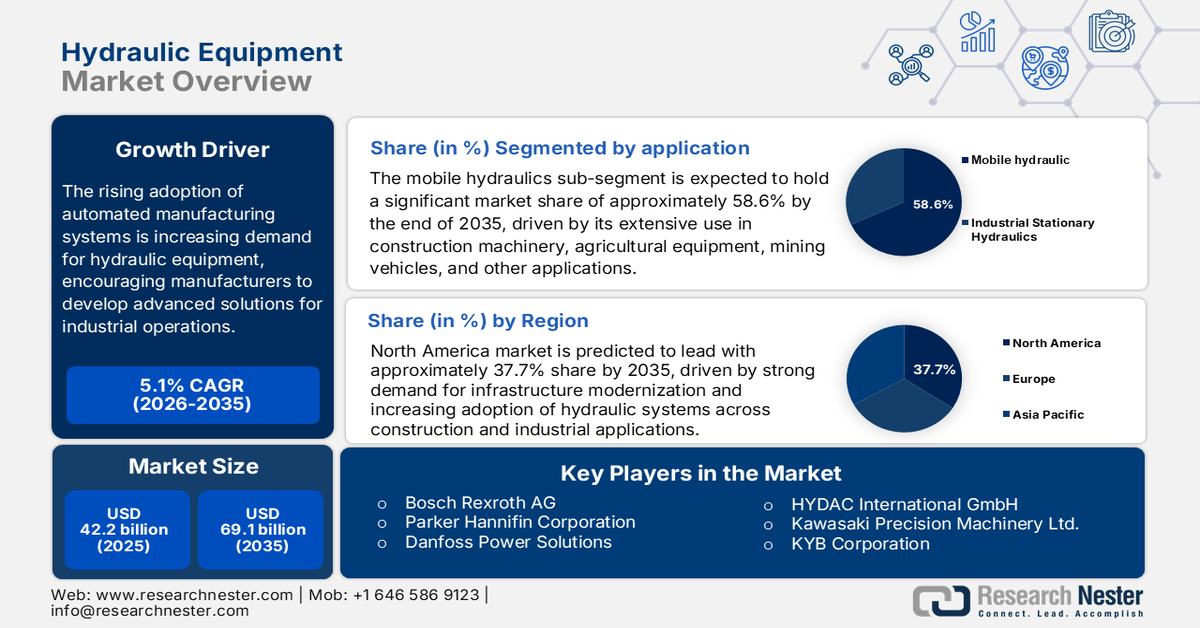
Hydraulic Equipment Market size was valued at USD 42.2 billion in 2025 and is anticipated to reach USD 69.1 billion by the end of 2035, expanding at around 5.1% CAGR during the forecast period, i.e., 2026-2035. In 2026, the industry size of hydraulic equipment is assessed at USD 44.3 billion.
The global hydraulic equipment market is primarily fueled by the rising investment in transport and infrastructure development, which continues to enhance the demand for construction and heavy machinery equipped with hydraulic systems. Hydraulic equipment is largely used in excavators, loaders, cranes, and other heavy equipment because of its capability to deliver high power, precision, and reliable performance under difficult operating conditions. These systems also help improve operational efficiency and support a wide range of construction activities. Moreover, it is stated by the World Bank that private investment in infrastructure has reached approximately USD 86 billion in 2023. The constant expansion of infrastructure projects is anticipated to create favorable opportunities for the market worldwide.
In the hydraulic market, the growing mechanization of agricultural operations is creating new growth opportunities, as modern farming highly depends on hydraulic-powered tractors, harvesters, sprayers, and other equipment to improve productivity and reduce manual effort. Hydraulic systems allow farm equipment to operate multiple tools efficiently while improving field productivity. Therefore, according to the Food and Agriculture Organization, new agricultural investment and capital stock statistics were released in 2025, which cover the period from 2013 to 2023. The increasing focus on modern agricultural machinery is expected to encourage the implementation of hydraulic equipment across the farming sector.
Key Hydraulic Equipment Market Insights Summary:
Regional Highlights:
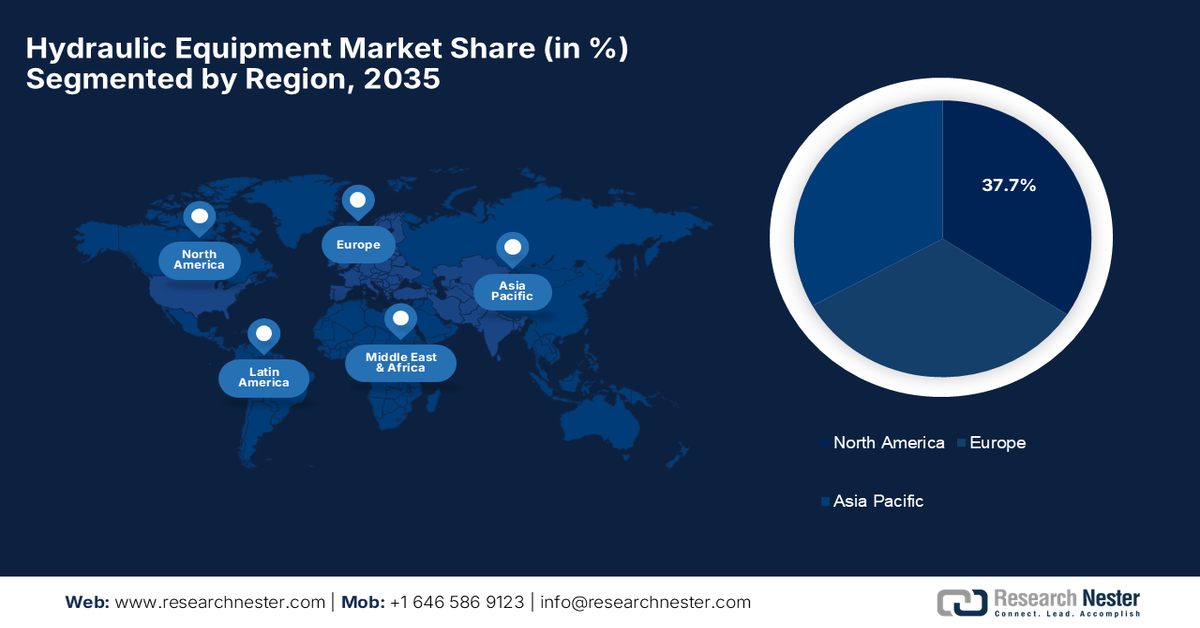
- North America is projected to command 37.7% of the hydraulic equipment market by 2035, underpinned by the widespread adoption of hydraulic equipment across construction, manufacturing, mining, agriculture, and material handling industries, alongside sustained infrastructure modernization and water infrastructure investments
- Europe is expected to secure a significant share of the 2026-2035, bolstered by the increasing replacement of legacy machinery with advanced hydraulic systems and rising public and private industrial investments
Segment Insights:
- The mobile hydraulics sub-segment of the hydraulic equipment market is anticipated to capture 58.6% share by 2035, fueled by the extensive adoption of hydraulic systems in construction, agricultural, and mining machinery alongside the integration of advanced electro-hydraulic systems and intelligent controls
- The construction sub-segment is expected to witness significant growth during the 2026-2035 forecast period, supported by the rising deployment of hydraulic-powered machinery for excavation, lifting, drilling, and material handling activities amid increasing global infrastructure investment
Key Growth Trends:
- Rising mining activities
- Growing oil and gas exploration activities
Major Challenges:
- Growing Shift Toward Electric Actuation Systems
- Volatility in raw material prices
Key Players: Bosch Rexroth AG, Parker Hannifin Corporation, Danfoss Power Solutions, HYDAC International GmbH, Kawasaki Precision Machinery Ltd., KYB Corporation.
Global Hydraulic Equipment Market Forecast and Regional Outlook:
Market Size & Growth Projections:
- 2025 Market Size: USD 42.2 billion
- 2026 Market Size: USD 44.3 billion
- Projected Market Size: USD 69.1 billion by 2035
- Growth Forecasts: 5.1% CAGR (2026-2035)
Key Regional Dynamics:
- Largest Region: North America (37.7% share by 2035)
- Fastest Growing Region: Asia Pacific
- Dominating Countries: United States, China, Germany, Japan, India
- Emerging Countries: India, Vietnam, Indonesia, Brazil, Mexico
Last updated on : 22 July, 2026
Hydraulic Equipment Market - Growth Drivers and Challenges
Growth Drivers
- Rising mining activities: The hydraulic equipment market is gaining momentum due to the increasing development of mining operations globally. Where hydraulic systems are largely used in mining equipment due to the power required for excavation, drilling, lifting, and material handling under difficult operating conditions. The growing need for critical minerals is encouraging investments in new mining projects and the modernization of existing sites. Therefore, according to the International Energy Agency (IEA), investment in critical mineral mining has reached approximately USD 54 billion in 2023. This rise in mining investments is expected to grow the adoption of hydraulic equipment across mineral extraction and processing activities.
- Growing oil and gas exploration activities: The expansion of upstream oil and gas projects is creating favorable opportunities for the market. Higher investments in exploration and production are increasing the use of hydraulic equipment across oil and gas operations. The need for efficient and reliable equipment is also inspiring companies to upgrade existing facilities that can support new energy projects. Moreover, the increase in upstream investments is anticipated to encourage the implementation of hydraulic equipment, contributing to the market's growth during the forecast period.
- Expansion of the shipbuilding industry: The increasing investments in vessel manufacturing across leading shipbuilding countries are generating favorable opportunities for the market. The rising production of commercial vessels, naval ships, and offshore support vessels is increasing the use of hydraulic equipment in marine operations. Where manufacturers are also enhancing production capabilities to meet the developing demand for modern vessels equipped with efficient onboard systems. Additionally, according to the United Nations Conference on Trade and Development, the global merchant fleet had approximately 2.4 billion dead-weight tons (DWT) in 2024. This continued growth is likely to support the need for hydraulic equipment across the marine industry.
Challenges
- Growing Shift Toward Electric Actuation Systems: Manufacturers of industrial and mobile equipment are gradually integrating electric actuators into systems that do not need high-force output. The hydraulic equipment market is facing increasing competition from electric actuation technologies, especially in applications where lower noise, higher energy efficiency, and reduced maintenance are key factors. This shift is supported by ongoing developments in electrification and digital control technologies, enabling large-scale use of electric alternatives across several equipment categories. Although hydraulic systems continue to dominate heavy-duty operations, the broader implementation of electric actuation solutions is expected to limit the demand for hydraulic equipment in selected industrial and mobile applications over the forecast period.
- Volatility in raw material prices: The production of hydraulic components depends on metals such as steel and aluminum, making manufacturers vulnerable to changing commodity prices. Fluctuations in raw material prices are posing a challenge for the market. Sudden cost variations can affect procurement decisions and disrupt production planning across the supply chain. Moreover, unstable material prices make it difficult for manufacturers to maintain consistent equipment pricing in a competitive market. This cost uncertainty is one of the key reasons for the reduction of purchasing confidence among end users, which creates a challenge for the steady growth of the market during the forecast period.
Hydraulic Equipment Market Size and Forecast:
| Report Attribute | Details |
|---|---|
|
Base Year |
2025 |
|
Forecast Year |
2026-2035 |
|
CAGR |
5.1% |
|
Base Year Market Size (2025) |
USD 42.2 billion |
|
Forecast Year Market Size (2035) |
USD 69.1 billion |
|
Regional Scope |
|
Hydraulic Equipment Market Segmentation:
Application Segment Analysis
The mobile hydraulics sub-segment under the application segment is projected to grab the largest share of approximately 58.6% in the hydraulic equipment market by 2035. The sub-segment’s uplift is primarily attributed to the excessive implementation of hydraulic systems in mobile machinery, which includes excavators, loaders, agricultural equipment, and mining vehicles, where high power density and precise control are important. Furthermore, according to the Association of Equipment Manufacturers, the global construction equipment industry continues to represent a major equipment market, with a need for construction machinery that is supported by rising infrastructure and industrial development activities. The growing integration of advanced electro-hydraulic systems and intelligent controls is improving machine efficiency and reducing energy consumption, thereby helping in the growth of the sub-segment.
End-user Industry Segment Analysis
Based on the end-user segment, the construction sub-segment is expected to register a significant growth in the market by the end of the forecast period. The sub-segment’s growth is mostly driven by the increasing utilization of hydraulic-powered machinery in construction activities, including excavation, lifting, drilling, and material handling operations. Based on the data from the Global Infrastructure Hub, global infrastructure investment requirements are expected to reach approximately USD 97 trillion by 2040 to help economic growth and development needs across regions. This increasing infrastructure investment requirement is likely to generate a strong need for construction equipment integrated with hydraulic systems, thereby strengthening the expansion of this sub-segment.
Operating-Pressure Range Segment Analysis
The medium-pressure systems sub-segment under the operating-pressure range segment is estimated to attain significant growth in the market by 2035. Its expansion is mainly attributed to its widespread implementation in construction machinery, manufacturing equipment, and material-handling systems due to its balanced power output and operational efficiency. Figures from the International Organization for Standardization show that the hydraulic components are standardized for pressure levels of up to 250 bar (25 MPa), supporting their application across various industrial systems. The rising need for consistent fluid power solutions in heavy equipment is encouraging manufacturers to improve pumps, cylinders, and control systems, which is one of the reasons for the growing implementation of medium-pressure systems across industrial applications.
Our in-depth analysis of the hydraulic equipment includes the following segments:
|
Segment |
Subsegments |
|
Application |
|
|
End user |
|
|
Equipment Type |
|
|
Operating-Pressure Range
|
|

Vishnu Nair
Head - Global Business DevelopmentCustomize this report to your requirements — connect with our consultant for personalized insights and options.
Hydraulic Equipment Market - Regional Analysis
North America Market Insights
North America is projected to hold the largest share of the hydraulic equipment market, accounting for approximately 37.7% by the end of 2035. The region's growth is reinforced by the extensive use of hydraulic equipment among industries such as construction, manufacturing, mining, agriculture, and material handling. As there is constant investment in infrastructure modernization and the replacement of aging equipment are also encourages the need for advanced hydraulic systems. Besides this, it is recorded by the EPA that the Water Infrastructure Finance and Innovation Act (WIFIA) program has announced more than USD 9 billion in financing for water infrastructure projects. The increasing number of infrastructure projects is anticipated to drive the demand for hydraulic equipment, which is used in construction and material handling applications across the region.
The U.S. hydraulic equipment market is projected to maintain its position in North America, due to its well-established manufacturing sector and strong demand for heavy industrial machinery. The country has several equipment manufacturers that continue to develop advanced machinery for construction, industrial, and agricultural applications, supporting the need for hydraulic systems. Additionally, according to the National Association of Manufacturers, the contribution of manufacturing is more than USD 2.9 trillion to the U.S. economy in 2024. This continuous development of production is anticipated to support the need for hydraulic equipment across a wide range of industrial applications.
The country is supported by the continuous investments in mining, construction, and transportation infrastructure, which is one of the reasons for Canada hydraulic equipment market to register steady progress. It continues to modernize public infrastructure while inspiring the use of advanced heavy machinery across major development projects. These activities are growing the demand for hydraulic systems that are used in earthmoving, lifting, and material handling equipment. Based on data from the Government of Canada, the Investing in Canada Plan commits more than CAD 180 billion toward infrastructure development. These developments are inspiring the widespread use of hydraulic equipment among mining, construction, and public utility projects across this country.
Europe Market Insights
During the forecast period, Europe is anticipated to account for a significant share of the hydraulic equipment market, which is helped by the growing use of modern machinery among industries which include manufacturing, construction, and industrial sectors. Whereas many businesses are replacing older equipment with advanced hydraulic systems to improve daily operations and meet changing industry needs. Additionally, according to the European Commission, the Invest EU programme is expected to mobilize more than EUR 372 billion in public and private investment. These investments are one of the reasons for the use of hydraulic equipment across different industrial activities throughout the region.
Germany is projected to remain one of the leading markets for hydraulic equipment in Europe due to its strong machinery manufacturing industry and continuous focus on industrial development. Several manufacturers in this country produce construction, industrial, and material handling equipment that depends on hydraulic systems. Besides this, it is recorded by Germany Trade & Invest that the volume of international business projects in Germany amounted to EUR 23.2 billion in 2024. The steady development of industrial activities is inspiring the use of hydraulic equipment across manufacturing and heavy machinery applications.
Owing to the increasing investment in manufacturing, engineering, and clean energy projects, the U.K. is expected to witness steady growth in the market. Businesses across the country are enhancing industrial activities and adopting modern equipment to improve productivity and help new development projects. Moreover, it is stated by the HM Treasury that the National Wealth Fund, announced in 2024, could mobilise at least GBP 70 billion in private investment. The growing funding for industrial and energy projects is anticipated to encourage the wider use of hydraulic equipment in the country.
APAC Market Insights
This region has a strong position as a major manufacturing hub for industrial machinery and construction equipment, which is one of the key factors for the Asia Pacific market to witness growth. Countries across the region continue to increase production capacity to meet growing domestic and export demand, with the rising use of hydraulic systems in equipment manufacturing. Additionally, according to the ADB, that the Asia and the Pacific require around USD 1.7 trillion in infrastructure investment every year through 2030. The expanding manufacturing base is expected to create steady opportunities for hydraulic equipment manufacturers across the region.
Japan is projected to witness steady growth in the market, fueled by its advanced manufacturing ecosystem and high implementation of automation technologies. The country’s focus on precision engineering, robotics, and smart factory development is raising the need for hydraulic components that are used in industrial machinery, production systems, and automated equipment. Therefore, it is recorded by the Japan External Trade Organization that Japan’s inward foreign direct investment (FDI) stock has reached approximately JPY 53.3 trillion at the end of 2024, which reflects constant investment interest in the country’s industrial sector. The growing integration of advanced manufacturing technologies and modernization of production facilities are expected to support the adoption of hydraulic equipment across Japan.
The country has a large machinery manufacturing base and a rising demand for heavy-duty industrial applications, which is an important driver of the China hydraulic equipment market, to remain a key player in Asia Pacific. The country’s development of construction machinery, agricultural equipment, and industrial systems is enhancing the requirement for hydraulic solutions that are used in power transmission, load handling, and equipment control. Besides this, it is recorded by the China Machinery Industry Federation that the added value of major machinery enterprises has increased by 6% in 2024, reinforced by equipment upgrades and industrial development initiatives. The continued expansion of machinery production and modernization of industrial equipment is expected to generate sustained demand for hydraulic equipment across China.
Key Hydraulic Equipment Market Players:
- Bosch Rexroth AG (Germany)
- Parker Hannifin Corporation (U.S.)
- Danfoss Power Solutions (Denmark)
- HYDAC International GmbH (Germany)
- Kawasaki Precision Machinery Ltd. (Japan)
- KYB Corporation (Japan)
- Company Overview
- Business Strategy
- Key Product Offerings
- Financial Performance
- Key Performance Indicators
- Risk Analysis
- Recent Development
- Regional Presence
- SWOT Analysis
- Bosch Rexroth AG (Germany) is a well-established manufacturer of hydraulic pumps, valves, and cylinders used in construction and industrial equipment. The company continues to strengthen its presence by supplying hydraulic solutions for difficult conditions.
- Parker Hannifin Corporation (U.S.) it is one of the major suppliers of motion and control technologies. They provide hydraulic pumps, hoses, filters, valves, and cylinders while serving industries such as mining, agriculture, transportation, and industrial manufacturing.
- Danfoss Power Solutions (Denmark) mainly serves the off-highway machinery market. There are hydraulic pumps and steering solutions that are largely adopted in construction and agricultural equipment.
- HYDAC International GmbH (Germany) maintains hydraulic and fluid engineering solutions for industrial applications. Its solutions are largely implemented in sectors which include manufacturing, mining, marine, and energy, where efficient fluid management is important.
- Kawasaki Precision Machinery Ltd. (Japan) it provides hydraulic solutions for construction machinery, marine equipment, and industrial applications. The company supplies hydraulic products that are used in equipment where strong and consistent performance is needed.
- KYB Corporation (Japan) provides hydraulic solutions mainly for construction machinery and earthmoving equipment. Its hydraulic technologies are mainly applied in excavators and other equipment used in construction activities.
Here is a list of key players operating in the global market:
The hydraulic equipment market includes several well-established companies with a strong presence across global markets. To stay competitive, manufacturers are introducing new products, which enhances there operations, and improve existing solutions based on customer needs. Many companies are also building closer relationships with equipment manufacturers and distributors to improve their market reach. Along with this, to retain customers, upgrading service support and consistent, timely product availability remain important factors. There is a growing need from the construction, mining, agriculture, manufacturing, and energy industries, which is inspiring companies to develop their presence in existing markets while exploring opportunities in new regions.
Corporate Landscape of the Market
Recent Developments
- In March 2026, Bosch Rexroth and Kawasaki plan profound collaboration to power the next generation of heavy machines and hydrogen solutions.
- In March 2026, KYB proclaimed organizational changes in its Hydraulics Components (HC) Operations to improve responsiveness to market changes and strengthen global business planning.
- In April 2025, Danfoss Power Solutions launched the X1P open-circuit piston pump in 2025, which is designed for mobile machinery applications such as compact loaders and excavators, strengthening its hydraulic product portfolio.
- Report ID: 8680
- Published Date: Jul 22, 2026
- Report Format: PDF, PPT
- Explore a preview of key market trends and insights
- Review sample data tables and segment breakdowns
- Experience the quality of our visual data representations
- Evaluate our report structure and research methodology
- Get a glimpse of competitive landscape analysis
- Understand how regional forecasts are presented
- Assess the depth of company profiling and benchmarking
- Preview how actionable insights can support your strategy
Explore real data and analysis
Frequently Asked Questions (FAQ)
About this Report
Connect with our Expert




Copyright @ 2026 Research Nester. All Rights Reserved.
