Arc Welding Equipment Market Outlook:
Arc Welding Equipment Market size was over USD 14.7 billion in 2025 and is expected to reach USD 24.6 billion by the end of 2035, growing at around 5.3% CAGR during the forecast period, i.e., 2026-2035. In 2026, the industry size of arc welding equipment is estimated at USD 15.5 billion.
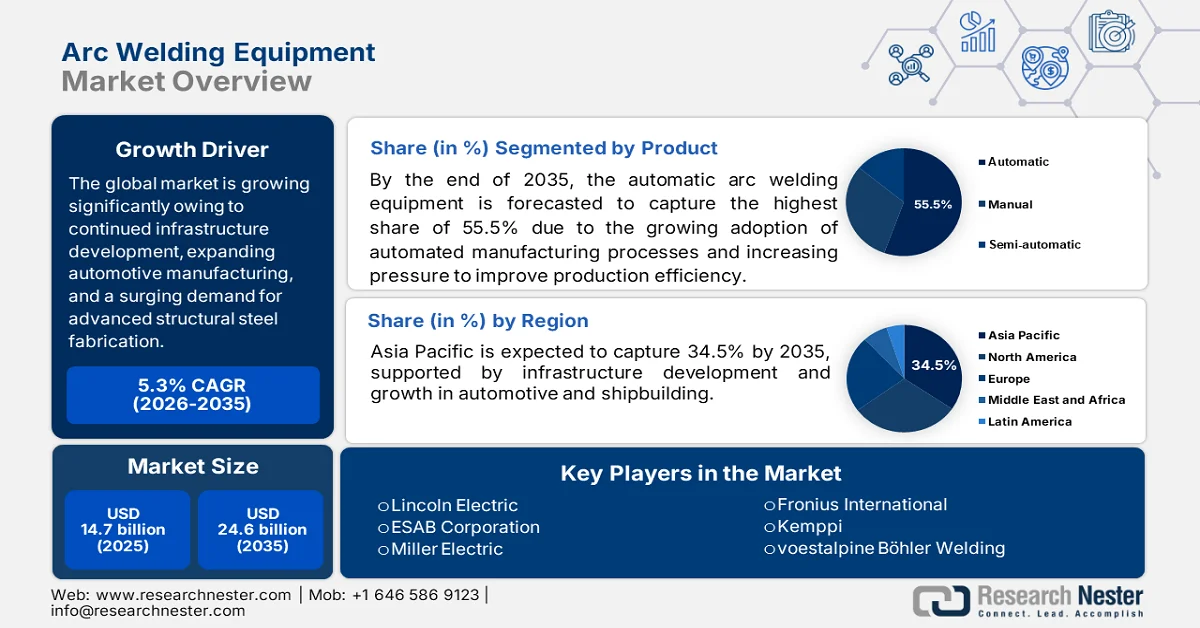
The global arc welding equipment market is projected to experience steady expansion, which is fueled by continued infrastructure development, expanding automotive manufacturing, and a surging demand for advanced structural steel fabrication. Industrial operations are making a transition from aging transformer machines to lightweight inverter units that offer superior arc stability as well as lower power consumption. In October 2025, an Advanced Manufacturing Organization stated that welding is rapidly evolving from a manual trade into a smarter, more digital manufacturing process, in which technologies such as handheld lasers, robotic systems, and multi-process welding platforms are helping manufacturers improve quality and productivity. These solutions also aim to address the shortage of skilled welders by making complex operations easier to perform, thus contributing to market expansion.
India Electric Machines & Apparatus for Arc (Including Plasma Arc) Welding Imports by Country 2024 Import Value & Quantity Data
|
Partner country |
Trade value (USD '000) |
Quantity (Items) |
|
Japan |
13,096.16 |
1,202 |
|
China |
12,495.28 |
80,302 |
|
Germany |
5,388.74 |
463 |
|
Korea, Rep. |
2,815.69 |
1,136 |
|
Austria |
2,657.42 |
523 |
|
France |
2,273.54 |
41 |
|
Czech Republic |
1,232.44 |
14 |
|
U.S. |
1,229.12 |
21 |
|
Denmark |
918.83 |
293 |
|
Finland |
905.51 |
633 |
|
Italy |
678.25 |
76 |
Source: WITS
Furthermore, the arc welding equipment market is making a shift toward smart, interconnected ecosystems, wherein power sources are being integrated with Internet of Things tracking software to monitor weld quality and productivity metrics. This ongoing digital evolution, paired with the rising adoption of collaborative robotics in production lines, propels a strong long-term growth trajectory across the manufacturing sector. In this context, ESAB in December 2025 launched the ROBBI™ 360, which is an enclosed collaborative robot welding cell designed to simplify automation for medium- and high-volume MIG/MAG welding applications. The company also mentioned that its dual-sided manual turntable can handle up to 150 kg per side, helping increase productivity and thereby enabling higher arc-on time when compared with manual welding.
Global Welding Industry Statistics by Region, Industry, and Application 2023
|
Statistic |
Value |
|
North America share of global welding market |
28% |
|
China’s share of global welding electrode production |
60% |
|
India welding market CAGR through 2028 |
9.2% |
|
EU welding exports (2023) |
USD 15.6 billion |
|
Brazil welding market (2023) |
USD 2.1 billion |
|
Middle East oil-sector welding demand growth |
7% |
|
Africa welding infrastructure spending |
USD 1.8 billion |
|
Japan automotive welding performed robotically |
40% |
|
South Korea share of global shipbuilding welding |
35% |
|
Russia pipeline welding market |
USD 1.4 billion |
|
Mexico welding growth from nearshoring |
12% |
|
Australia mining welding equipment imports |
USD 450 million |
|
Southeast Asia welding consumables market |
USD 3.1 billion |
|
Canada energy-sector welding contribution |
22% |
|
UK offshore wind welding contracts |
USD 2.5 billion |
|
Turkey construction welding growth |
6.8% |
|
Saudi Arabia welding investment under Vision 2030 |
USD 10 billion |
|
Indonesia infrastructure welding demand growth |
15% |
|
Vietnam EV welding capacity increase |
20% |
Source: Gitnux Organization
Key Arc Welding Equipment Market Insights Summary:
Regional Highlights:
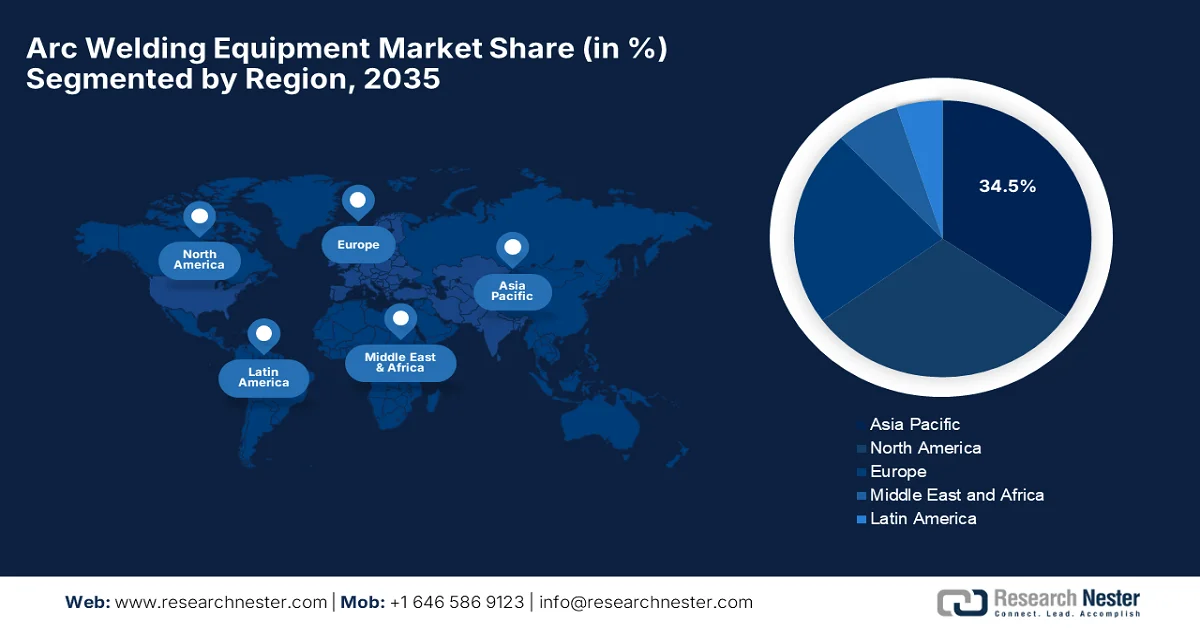
- Asia Pacific is projected to command the largest 34.5% share by 2035 in the arc welding equipment market, with rapid industrialization, accelerating infrastructure development, and expanding automotive and shipbuilding sectors driving regional expansion.
- North America is poised for significant growth during 2026-2035, supported by industrial automation, reshoring initiatives, and the modernization of aging infrastructure.
Segment Insights:
- Automatic arc welding equipment is forecast to account for a leading 55.5% share by 2035, with rising automation adoption, increasing pressure for production efficiency, and limited skilled welding personnel accelerating its uptake.
- Shielded metal/stick arc welding is expected to register lucrative growth during the assessment period, owing to its portability, operational simplicity, and suitability for outdoor and field-based welding applications.
Key Growth Trends:
- Rapid global infrastructure development
- Surging automotive and aerospace production
Major Challenges:
- High equipment and automation costs
- Severe skilled labor shortages
Key Players: Lincoln Electric (U.S.), ESAB Corporation (U.S.), Miller Electric (U.S.), Fronius International (Austria), Kemppi (Finland), voestalpine Böhler Welding (Austria).
Global Arc Welding Equipment Market Forecast and Regional Outlook:
Market Size & Growth Projections:
- 2025 Market Size: USD 14.7 billion
- 2026 Market Size: USD 15.5 billion
- Projected Market Size: USD 24.6 billion by 2035
- Growth Forecasts: 5.3% CAGR (2026-2035)
Key Regional Dynamics:
- Largest Region: Asia Pacific (34.5% Share by 2035)
- Fastest Growing Region: North America
- Dominating Countries: China, United States, Japan, Germany, France
- Emerging Countries: Canada, India, South Korea, Italy, Mexico
Last updated on : 25 August, 2026
Arc Welding Equipment Market - Growth Drivers and Challenges
Growth Drivers
- Rapid global infrastructure development: Substantial government investments in terms of transit networks, public utilities, and smart cities positively drive growth in the market. These large-scale projects depend on structural steel fabrication for bridges and pipelines, which requires reliable arc welding. In this context, construction firms are purchasing high-deposition, portable systems to meet tight deadlines and modern engineering standards. According to the article published by the World Bank, private participation in infrastructure (PPI) investment in low- and middle-income countries reached USD 86.0 billion in 2023, and investment represented around 0.2% of the GDP of low- and middle-income nations.
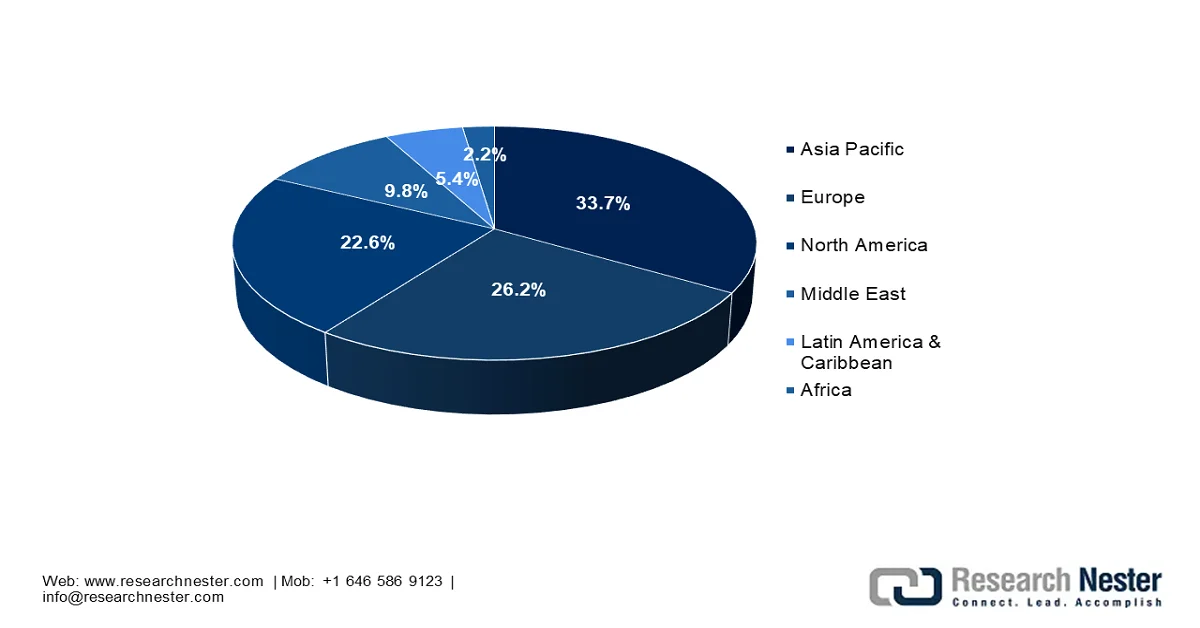
- Surging automotive and aerospace production: Globally, automotive and aerospace sectors are growing at an extensive pace, which directly accelerates demand for precision welding machinery. Factories need to join lightweight, high-strength steels and aluminum alloys that are crucial for electric vehicles and aircraft frames. Meeting these strict safety and quality standards compels manufacturers to make investments in advanced, multi-process power sources that handle specialized materials accurately. International Civil Aviation Organization (ICAO) reported a strong recovery and expansion in global air transport during 2024, with 4.7 billion passengers carried on scheduled services, up 7.9% from 2023, thus increasing the growth potential of the market.
Global Passenger Traffic by Region in 2024: Market Share and Aviation Trends
Source: ICAO
Challenges
- High equipment and automation costs: Upgrading to advanced arc welding equipment needs a substantial capital investment, which strains the budgets of small and medium enterprises. Most of the modern multi-process power sources, high-efficiency inverter units, and automated robotic systems are very expensive. Other than initial purchase, companies also face substantial secondary costs for specialized software licensing, system integration, and safety infrastructure like advanced ventilation. In addition, maintenance and replacement parts for digitalized machinery are also more expensive than for legacy transformer units. For most manufacturing facilities, these high financial barriers delay necessary equipment modernization, negatively impacting the arc welding equipment market.
- Severe skilled labor shortages: The global manufacturing sector has been facing an escalating crisis which is due to a severe shortage of certified welding professionals. Younger generations are not entering trade professions at the rate required to replace a rapidly aging workforce. This demographic shift forces market manufacturers to redesign their machinery completely. In this context, companies need to make investments in developing ultra-intuitive user interfaces, pre-programmed synergic lines, and AI-assisted parameter selectors in order to compensate for this lack of human expertise. These smart features help less-skilled operators achieve quality welds, and this highly complex hardware and software lengthens manufacturers' product development cycles and significantly drives up research expenses.
Arc Welding Equipment Market Size and Forecast:
| Report Attribute | Details |
|---|---|
|
Base Year |
2025 |
|
Forecast Period |
2026-2035 |
|
CAGR |
5.3% |
|
Base Year Market Size (2025) |
USD 14.7 billion |
|
Forecast Year Market Size (2035) |
USD 24.6 billion |
|
Regional Scope |
|
Arc Welding Equipment Market Segmentation:
Product Segment Analysis
By the end of 2035, automatic arc welding equipment product segment is forecasted to capture the highest share of 55.5%. The sub-segment’s growth in the arc welding equipment market is largely driven by the growing adoption of automated manufacturing processes, increasing pressure to improve production efficiency, and the limited availability of skilled welding personnel. In this context, FR San Martino S.r.l., in June 2025, adopted ABB’s OmniVance™ collaborative arc-welding cells to meet rising demand for customized, low-volume production while improving speed, quality, and workplace safety. The two cells use ABB GoFa™ cobots, allowing operators to quickly set welding paths and adapt to different part designs, thus denoting a wider segment scope.
Type Segment Analysis
The shielded metal/stick arc welding sub-segment, which is a part of the type segment, is anticipated to grow with a lucrative revenue share during the assessment period. Its portability, operational simplicity, and suitability for outdoor and field-based welding applications are some of the important factors positioning the sub-type for extensive growth in the market. Also, the process does not require external shielding gas, which makes it advantageous in windy or remote environments where maintaining gas shielding can be challenging. For instance, in February 2023, Lincoln Electric introduced the Sprinter™ 180Si, which is a lightweight inverter welder that combines reliable stick-welding performance with advanced TIG capabilities in a portable design. Besides, this machine has up to 180 amps for stick welding and 200 amps for TIG.
End use Segment Analysis
The automotive segment in the market is expected to grow at a notable rate in the next decade owing to increasing adoption of automated and robotic welding systems across vehicle and component manufacturing, and rising production of electric vehicles. In addition, the growing use of lightweight materials such as aluminum in vehicle structures and battery assemblies is driving the sub-segment’s leadership in this sector. Automakers and Tier 1 suppliers are making investments in terms of advanced welding technologies to achieve higher production throughput, consistent weld quality, greater dimensional accuracy, and reduced manufacturing cycle times. Furthermore, the expansion of EV production is creating additional demand for automated welding solutions.
Our in-depth analysis of the arc welding equipment includes the following segments:
|
Segment |
Subsegments |
|
Product |
|
|
Type |
|
|
End use |
|

Vishnu Nair
Head - Global Business DevelopmentCustomize this report to your requirements — connect with our consultant for personalized insights and options.
Arc Welding Equipment Market - Regional Analysis
APAC Market Insights
Asia Pacific arc welding equipment market is anticipated to attain the highest share of 34.5% during the stipulated timeframe. The region’s progress in this field is majorly propelled by rapid industrialization, accelerating infrastructural development, and the expansion of the automotive and shipbuilding sectors. In addition, rising investments in smart manufacturing and automation are encouraging industries to opt for advanced, energy-efficient welding technologies to enhance productivity and precision. In this context, KUKA in June 2024 secured a major order to supply 23 robotic friction stir welding cells for electric vehicle production, which is its largest single order in this field to date. The systems will manufacture battery trays and connect cooling plates by using robot-based FSW to achieve strong, leak-resistant joints and handle complex 3D welding applications.
The country's manufacturing sector and its position as a primary hub for automotive and electronics production are two main factors that are positioning the market in China for sustained growth. In addition, government initiatives that are aimed at industrial modernization and high-tech manufacturing are also accelerating the transition toward automated and robotic welding systems. Based on government data, as of April 2024, China has set a goal to boost industrial equipment investment by more than 25% by 2027 in comparison to 2023 to support smarter, greener, and more efficient manufacturing. In addition, this initiative deliberately promotes replacing outdated machinery with advanced equipment, i.e., industrial robots, CNC systems, automated production lines, and intelligent inspection technologies.
The Japan arc welding equipment market is gaining enhanced traction, and it represents a mature industrial landscape that showcases a priority towards technological innovation, precision engineering, and automation. The country has been facing a shrinking labor force, due to which domestic industries are making heavy investments in robotic welding systems and AI integration to maintain high productivity and consistent quality. The market is highly supported by the country's automotive, machinery manufacturing, and shipbuilding sectors, which demand advanced, energy-efficient, and highly stable power sources, thus indicating a positive market outlook.
North America Market Insights
North America market is forecasted to grow at a significant rate from 2026 to 2035. The region’s upliftment in this sector is propelled by a high emphasis on industrial automation, reshoring initiatives, and the modernization of aging infrastructure. North America also benefits from substantial investments in renewable energy infrastructure, oil and gas pipelines, and commercial construction projects. In February 2024, the U.S. Department of Energy stated that it is investing in advanced manufacturing methods in order to produce large metal components for clean energy systems faster, more efficiently, and with less material waste. It also mentioned that its projects are developing large-scale 3D printing, advanced casting, and robotic welding for wind and hydropower components.
A strong focus on supply chain localization and widespread industrial automation is driving growth of the market in the U.S. The country’s market is supported by federal infrastructure funding, which boosts demand for durable welding machinery across bridge, highway, and energy grid projects. In this context, the U.S. DOE in February 2024 allocated a generous USD 29.9 million to GE Research and Oak Ridge National Laboratory to develop advanced methods for producing large metal components for renewable energy systems.
These projects combine 3D-printed casting molds, robotic welding, and hybrid additive manufacturing with a main goal of producing large wind and hydropower components while reducing costs and production lead times.
The Canada arc welding equipment market has a strong opportunity in the upcoming years, which is facilitated by the country's vast natural resource sector and major infrastructure upgrades. The market depends primarily on demand from the oil and gas, mining, and power generation industries, which require highly durable and specialized welding equipment that is capable of performing in extreme environments. In addition, the increasing investment in industrial infrastructure and resource development is expected to support demand for these welding solutions across Canada. The need for reliable equipment capable of meeting stringent safety and quality requirements is sustaining market growth over the coming years.
Europe Market Insights
The Europe market is projected to grow with a noteworthy share during the assessment period. The region’s growth in this sector is largely propelled by strict environmental regulations, high labor costs, and a strong shift toward advanced automation and Industry 4.0 integration. To comply with rigorous regional sustainability standards, manufacturers in Germany, Italy, and France are prioritizing energy-efficient inverter technologies and eco-friendly welding power sources. In addition, substantial investments in renewable energy infrastructure, such as wind and solar installations, along with the modernization of transport networks, are driving continuous demand for highly reliable arc welding solutions.
The country’s strong automotive and metalworking industries are driving growth in Germany arc welding equipment market. The shift toward Industry 4.0 and digitally connected production is also encouraging the integration of robotic welding cells, sensor-based seam tracking, digital process monitoring, and flexible programming technologies. In this context, KUKA in February 2025 introduced the KR IONTEC ultra, which is a compact industrial robot designed for handling and lightweight spot-welding applications, with payloads of up to 120 kg and a reach of up to 2,700 mm. Its slim design enables smaller automation cells, and it delivers high performance, making it suitable for battery handling, electromobility, and automotive welding applications.
The France arc welding equipment market is expected to witness immense growth, which is due to a major push for industrial re-industrialization, advanced automation, and the integration of digital technologies within factories. The market benefits from the country's prominent aerospace, defense, and automotive sectors, which are opting for automated robotic welding systems and collaborative robots to maintain high-precision manufacturing. Based on government data published in March 2024, France recorded 201 net new industrial site openings in 2023, which is up from 176 in 2022, highlighting continued momentum in the country’s reindustrialization efforts. Agri-food, green industries, transport, healthcare, and textiles led industrial growth, and Auvergne-Rhône-Alpes and Nouvelle-Aquitaine accounted for half of the net openings.
Key Arc Welding Equipment Market Players:
- Lincoln Electric (U.S.)
- ESAB Corporation (U.S.)
- Miller Electric (U.S.)
- Fronius International (Austria)
- Kemppi (Finland)
- voestalpine Böhler Welding (Austria)
- Company Overview
- Business Strategy
- Key Product Offerings
- Financial Performance
- Key Performance Indicators
- Risk Analysis
- Recent Development
- Regional Presence
- SWOT Analysis
- Lincoln Electric is a leading arc welding equipment manufacturer which is offering Invertec and other industrial welding systems. The company competes in this sector through digital controls, precise current adjustment, along with broad application coverage.
- ESAB Corporation manufactures a wide range of arc welding equipment, which includes the RS 400x MMA welding system for high-productivity and heavy-duty applications. The firm’s competitive strength lies in industrial-grade performance and a broad welding technology portfolio.
- Miller Electric is a prominent player in this sector that provides finished welding equipment across MIG, TIG, Stick, and multiprocess categories. The company is highly focused on durable equipment, application-specific solutions, product reliability, and technical support for professional and industrial users.
- Fronius International provides manual, robotic, and automated welding systems by covering MIG/MAG, TIG, and MMA processes. In addition, the firm’s key differentiators are advanced welding technology, digitalization, process control, and automation capabilities.
- Kemppi is a specialist player in this sector in professional welding equipment, including Stick/MMA welding machines. The company differentiates through portable designs, reliable arc performance, digital technologies, and equipment suited to demanding industrial applications.
Here is a list of key players operating in the global market:
The global arc welding equipment market hosts well-established manufacturers who are intensely competing through broad product portfolios, welding-process expertise, automation capabilities, and strong regional service networks. Leading players such as Lincoln Electric, ESAB, Miller Electric, Fronius, and Kemppi have captured significant positions across industrial, fabrication, construction, automotive, and heavy-engineering applications. Competition in this sector is being reshaped by inverter-based technology, digital welding controls, energy efficiency, portability, and integration with robotic welding systems. Furthermore, Europe-based manufacturers have a strong presence in advanced welding technologies, whereas U.S.-based companies maintain prominent positions across North America as well as most international industrial markets.
Corporate Landscape of the Market:
Recent Developments
- In May 2026, Lincoln Electric introduced the AlumaFab® aluminum MIG welding system, which was developed with MK Products to simplify high-volume aluminum welding through reliable wire feeding and advanced arc-control technology. The system is especially designed to provide smooth, consistent performance.
- In June 2025, ESAB Corporation agreed to acquire Germany-based EWM GmbH, thereby expanding its capabilities in advanced welding equipment and automation, and the acquisition is expected to strengthen ESAB’s equipment portfolio and global market reach.
- Report ID: 8745
- Published Date: Aug 25, 2026
- Report Format: PDF, PPT
- Explore a preview of key market trends and insights
- Review sample data tables and segment breakdowns
- Experience the quality of our visual data representations
- Evaluate our report structure and research methodology
- Get a glimpse of competitive landscape analysis
- Understand how regional forecasts are presented
- Assess the depth of company profiling and benchmarking
- Preview how actionable insights can support your strategy
Explore real data and analysis
Frequently Asked Questions (FAQ)
About this Report
Connect with our Expert


Report, 2026-2035



Copyright @ 2026 Research Nester. All Rights Reserved.
