Home Decor Market Outlook:
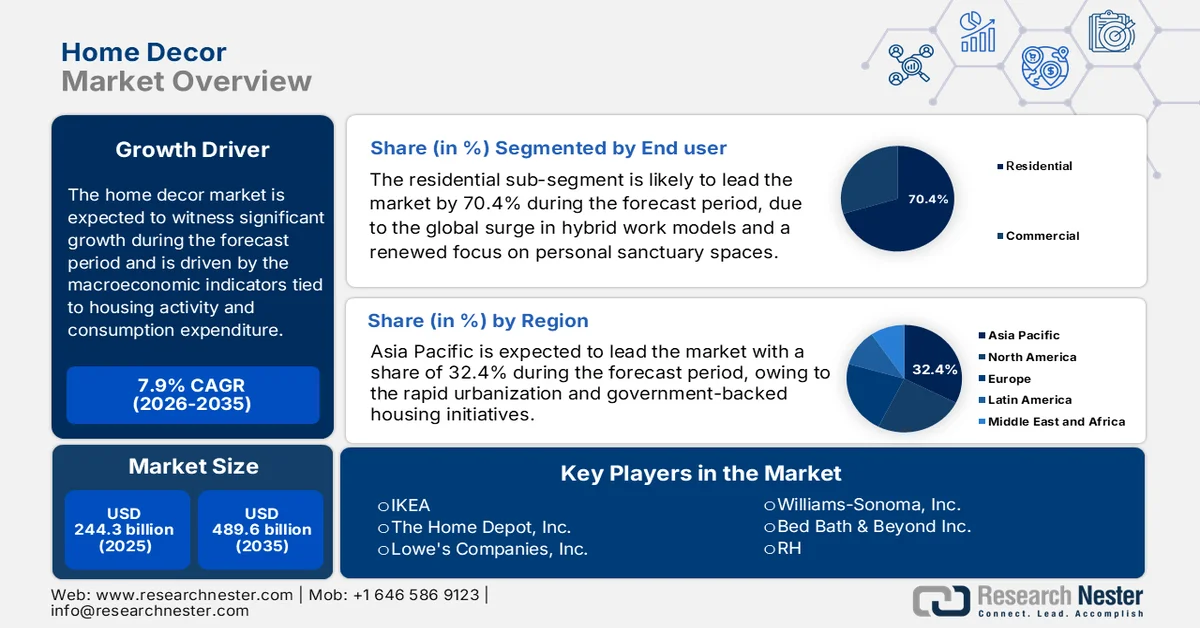
Home Decor Market size was valued at USD 244.3 billion in 2025 and is projected to reach USD 489.6 billion by the end of 2035, rising at a CAGR of 7.9% during the forecast period, i.e., 2026-2035. In 2026, the industry size of home decor is assessed at USD 261.8 billion.
The home decor market is shaped by the macroeconomic indicators tied to housing activity, disposable income, and household consumption expenditure. According to the U.S. Census Bureau, March 2026 data, the exports of furniture and other goods in January 2026 were nearly USD 384 million, reflecting the sustained consumer allocation toward interior-related products even amid inflationary pressure. Housing turnover remains a vital demand driver in the market expansion. On the other hand, the personal consumption expenditure on durable household equipment and furnishings reached USD 511.202 billion in Q2 2025, showing a steady upward trajectory supported by wage growth and hybrid work adoption, which continues to influence the residential space utilization. In Europe, the household expenditure on furnishings, household equipment, and routine maintenance is underscoring stable baseline demand across replacement and discretionary categories.
Furthermore, the sustainability regulations and material sourcing standards are influencing the procurement and manufacturing strategies within the market. As per the EPA October 2025 data, furniture and furnishings contribute 12 million tons of municipal solid waste, prompting regulatory focus on circular economy practices, recycling, and extended product lifecycles. Energy efficiency programs and green building certifications are indirectly supporting décor demand aligned with compliant interior solutions. Moreover, these is a rise in the imports of furniture and other related products, indicating a continued reliance on the global supply chains. These factors reinforce the steady institutional and commercial demand mainly in residential real estate developers, hospitality operators, and large-format retail procurement channels.
Key Home Decor Market Insights Summary:
Regional Highlights:
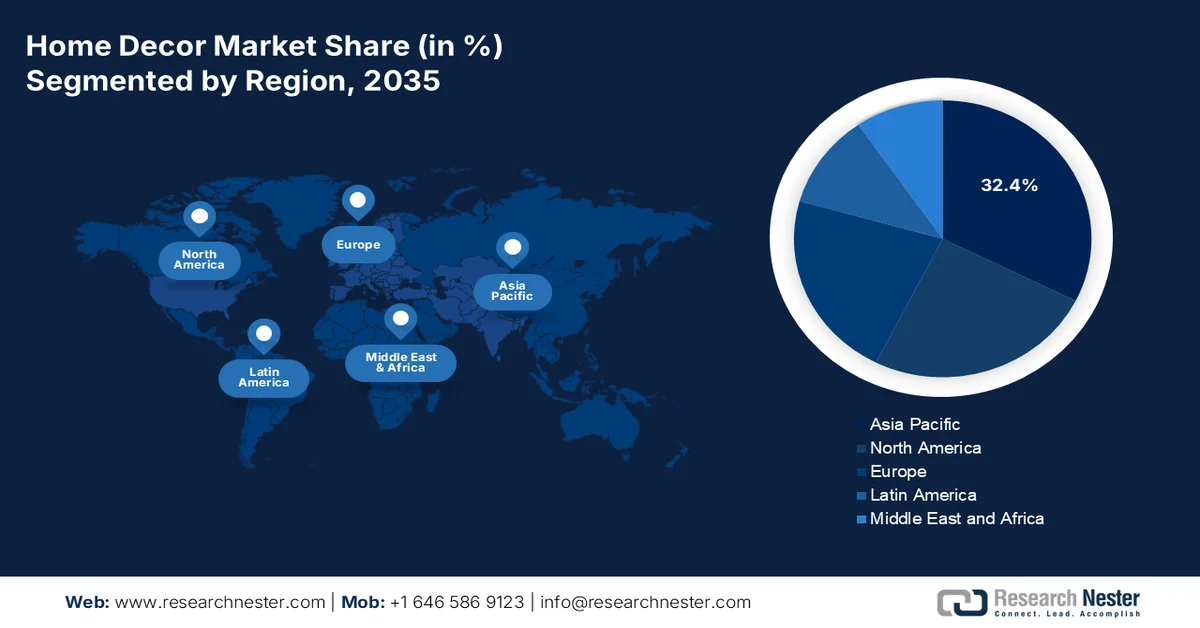
- In the home decor market, Asia Pacific is projected to command a leading 32.4% share by 2035, attributed to rapid urbanization, rising middle-class population, and supportive government housing initiatives
- North America is anticipated to witness the fastest growth at a CAGR of 4.5% during 2026–2035, fueled by high consumer spending on home upgrades and stringent regulatory standards promoting energy-efficient renovations
Segment Insights:
- In the home decor market, the residential sub-segment is anticipated to capture a dominant 70.4% share by 2035, propelled by the global surge in hybrid work models and heightened emphasis on personal sanctuary spaces
- The mid-range price point segment is expected to lead with a significant share by 2035, supported by its strong appeal to middle-class consumers seeking a balance between quality, durability, and affordability amid evolving spending patterns
Key Growth Trends:
- Housing construction and public infrastructure spending
- Rising household consumption
Major Challenges:
- Tariff volatility and trade policy uncertainty
- Supply chain disruption
Key Players: IKEA, The Home Depot Inc., Lowe's Companies Inc., Williams-Sonoma Inc., Bed Bath & Beyond Inc., RH (Restoration Hardware), Haworth Inc., Herman Miller Inc., Steelcase Inc., Nitori Holdings Co. Ltd., Wayfair Inc., Arc International SA, Zara Home, H&M Home, Kimball International Inc., Godrej & Boyce Mfg. Co. Ltd., Hanssem Co. Ltd., Barlow Tyrie, Koda Ltd, Greenway Group.
Global Home Decor Market Forecast and Regional Outlook:
Market Size & Growth Projections:
- 2025 Market Size: USD 244.3 billion
- 2026 Market Size: USD 261.8 billion
- Projected Market Size: USD 489.6 billion by 2035
- Growth Forecasts: 7.9% CAGR (2026-2035)
Key Regional Dynamics:
- Largest Region: Asia Pacific (32.4% Share by 2035)
- Fastest Growing Region: North America
- Dominating Countries: United States, China, Germany, Japan, United Kingdom
- Emerging Countries: India, Brazil, Indonesia, Vietnam, Mexico
Last updated on : 30 March, 2026
Home Decor Market - Growth Drivers and Challenges
Growth Drivers
- Housing construction and public infrastructure spending: Government-backed housing programs directly influence the home decor market demand by expanding the residential base. As per the Congressional Budget Office, September 2024 data, nearly 1.45 million housing starts in 2023 were reported, reflecting the sustained construction activity despite macroeconomic pressures. Moreover, the Pradhan Mantri Awas Yojana has sanctioned millions of houses, significantly increasing the demand for interior furnishings and décor products as homes transition from construction to occupancy. The public housing expansion creates a predictable demand from the contractors, developers, and institutional buyers. This trend in the market is relevant in emerging economies where urban housing deficits remain high.
- Rising household consumption: Government fiscal stimulus and wage support programs are sustaining the spending on home improvement and décor. The U.S. BEA January 2025 data depict that the personal consumption expenditures price index increased 2.3%, which includes household furnishings and equipment. Similarly, the EU has also shown a rise in household spending supported by the social welfare programs and inflation mitigation policies. These fiscal measures stabilize the purchasing power mainly in mid-income households, enabling a consistent demand for the décor upgrades and replacements. This translates into stable order volumes from retail and e-commerce channels, even during economic slowdowns.
- Urbanization and smart city investments: Government-led urbanization and smart city investments are surging the demand for the modern home decor market. The UN 2022 data depicts that nearly 68% of the global population is projected to live in urban areas by 2050, increasing the demand for compact, functional, and aesthetic interiors. India’s Smart Cities Mission, which has invested billions, is transforming the urban housing infrastructure, indirectly boosting the demand for modular décor lighting and space-efficient furnishings. These programs push standardized housing layouts, creating scalable demand patterns for décor manufacturers. Moreover, suppliers align product portfolios with the urban housing specifications and participate in government tenders or developer partnerships.
Challenges
- Tariff volatility and trade policy uncertainty: Manufacturers entering the home decor market face huge pressure from tariff policies that can reduce the profit margins overnight. The sector’s deep reliance on global supply chains makes it exceptionally vulnerable to geopolitical trade disputes. The home goods imports from China became subject to a staggering tariff. This volatility forces the companies into a reactive stance, constantly shifting production at high cost. Top companies overcome this experience by moving the manufacturing from China to Mexico to India to face new tariffs at each destination. For new players without diversified sourcing networks, the sudden shift makes it impossible for them to compete.
- Supply chain disruption: The home decor market is plagued by supply chain instability that complicates market entry. New manufacturers must navigate a landscape where the freight costs remain volatile, and delivery timelines are unpredictable. For new entrants, replicating the logistics networks of the established competitors requires substantial capital reserves. Without economies of scale, smaller manufacturers struggle to absorb these fluctuating costs, pushing them to operate at lower margins or pass expenses to the consumers, potentially pricing themselves out of the market.
Home Decor Market Size and Forecast:
| Report Attribute | Details |
|---|---|
|
Base Year |
2025 |
|
Forecast Year |
2026-2035 |
|
CAGR |
7.9% |
|
Base Year Market Size (2025) |
USD 244.3 billion |
|
Forecast Year Market Size (2035) |
USD 489.6 billion |
|
Regional Scope |
|
Home Decor Market Segmentation:
End user Segment Analysis
Under the end user segment, the residential sub-segment is leading and is poised to hold the largest share value of 70.4% by the end of 2035 in the home decor market. The segment is fueled by the global surge in hybrid work models and a renewed focus on personal sanctuary spaces. Homeowners are increasingly investing in décor that enhances comfort and productivity, transforming living rooms into multi-functional areas for work and leisure. A key driver is the rising number of first-time homebuyers and the expansion of the rental market, both of which necessitate furnishing and personalization. According to the U.S. Census Bureau, June 2024 data, the median size of a single-family home is 2,286 square feet, representing a significant space that requires substantial furniture and decorative investment. This demand for the outfitting living spaces ensures that the residential applications from bedroom textiles to living room furniture remain the primary revenue engine for the global home décor industry.
Price Point Segment Analysis
Within the price point segment, the mid-range price point is projected to dominate the home decor market as it perfectly balances the consumer demand for quality and durability with the necessity for affordability amid fluctuating economic conditions. This segment appeals to the vast middle-class demographic worldwide, offering products that feature better materials and craftsmanship than budget lines without the prohibitive cost of luxury designer goods. Consumers in these segments are willing to invest in timeless, versatile pieces that offer longevity, often mixing them with a few statement items. The expenditure on furniture and house furnishing is demonstrating a sustained commitment to mid-tier décor spending. This willingness to allocate disposable income to quality home enhancements solidifies the mid-range as the most lucrative price segment.
Material Segment Analysis
In the material segment, the wood remains the leading subsegment in the market for its timeless aesthetic, structural integrity, and natural warmth that aligns with the enduring popularity of biophilic design trends. From the solid hardwood flooring and cabinetry to engineered wood furniture, this material is foundational to the industry. Its dominance is reinforced by the global shift towards sustainability, with consumers actively seeking products made from certified renewable sources. According to the USDA, the October 2024 data, the worldwide wood and paper products trade reached USD 482 billion in 2023. This data highlights the material resilience and continued preference for the home décor manufacturers who value wood for its ability to be refinished and its long lifecycle, making it a sustainable and economically dominant choice in home décor.
Our in-depth analysis of the home decor market includes the following segments:
|
Segment |
Subsegments |
|
Product Type |
|
|
Material |
|
|
Distribution Channel |
|
|
Price Point |
|
|
End user |
|
|
Application |
|

Vishnu Nair
Head - Global Business DevelopmentCustomize this report to your requirements — connect with our consultant for personalized insights and options.
Home Decor Market - Regional Analysis
APAC Market Insights
The Asia Pacific dominates the global home decor market and is expected to hold the regional revenue share of 32.4% by the end of 2035. The region is driven by the rapid urbanization, expanding middle-class population, and government-backed housing initiatives. The region’s urban population is projected to rise, necessitating millions of new housing units requiring complete furnishing. Moreover, China’s Ministry of Housing and Urban Rural Development continues to prioritize affordable housing construction, with millions of units completed annually. Japan’s aging population drives the demand for universally designed products, while South Korea’s smart home initiatives integrate the technology into furniture. The region exhibits diverse regulatory landscapes with Japan’s JIS standards and China’s GB standards requiring manufacturers to maintain the country specific certifications. The ecommerce infrastructure varies widely with mature logistics versus rapidly expanding networks in India and Southeast Asia.
The government-led consumption stimulus and housing quality initiatives aimed at boosting domestic demand are shaping the home decor market in China. According to the People’s Republic of China, September 2024 data, the local governments, such as Shanghai, have introduced subsidies of up to 15% on home décor and household purchases, including sofas and mattresses, directly incentivizing replacement demand. Similar policies are being implemented nationwide, with Chongqing disbursing USD 1.13 million in subsidies in a single day, indicating strong consumer uptake. Additionally, the March 2025 data indicate that a structural demand is reinforced by housing upgrades, with China initiating 56,000 urban residential renovation projects and improving living standards, including increased per-capita urban housing space to over 40 square meters. These factors show sustained opportunities across renovation replacement cycles and smart home integrated décor solutions.
The strong government backed housing expansion, rising household consumption, and urbanization are shaping the home decor market in India. According to the ORF October 2024 data under the Pradhan Mantri Awas Yojana, the Government of India has sanctioned over 11.8 million houses, creating large-scale downstream demand for interior products such as furniture, lighting, and textiles as these homes reach completion stages. Additionally, the IBEF January 2026 data reports that private final consumption expenditure accounts for nearly 61.4% of India’s GDP, indicating sustained spending capacity on household goods, including décor. Moreover, government-led electrification and housing quality improvements are increasing demand for functional décor categories. These data represent India as a high-growth environment with demand anchored in affordable housing expansion, urban development, and rising middle-class consumption, ensuring consistent procurement opportunities across both residential and institutional segments.
North America Market Insights
The North America home decor market is projected to emerge as the fastest-growing region and is poised to expand at a CAGR of 4.5% during the assessed period, 2026 to 2035. The market is driven by the high consumer spending on residential upgrades and strict regulatory frameworks for material safety. The demand is further supported by the government-led energy efficiency programs, such as those administered by the U.S. Department of Energy, which incentivize the replacement of lighting and window coverings. In Canada the affordable and accessible housing is stimulating the demand for universally designed décor products. Both markets are defined by a mature e-commerce logistics infrastructure, enabling high online penetration for bulky goods. Additionally, the aging housing stock necessitates continuous renovation and replacement cycles that sustain long-term demand for furniture and fixtures.
The steady housing activity, consumer spending, and retail performance across the furnishings are driving the home decor market in the U.S. According to the U.S. BLS March 2026 report, furniture and home furnishings store sales reached 105.347 in November 2025. Fluctuations in the PPI B2B procurement costs for retailers and hospitality buyers. Moreover, the U.S. Bureau of Economic Analysis stated that personal consumption expenditures reached USD 21,536.6 billion in January 2026, with a measurable share directed toward household equipment and furnishings. These indicators highlight a stable demand environment driven by both the new housing supply and the ongoing replacement cycles. Additionally, institutional demand from the commercial real estate and hospitality refurbishment continues to support the bulk procurement of décor products, reinforcing the U.S. as a mature and steadily expanding market with predictable B2B demand patterns.
The federal housing initiatives aimed at accelerating residential construction and improving affordability are shaping the home decor market in Canada. According to the Government of Canada's March 2025 report, the government allocated USD 11.6 million to develop a Housing Design Catalogue featuring 50 standardized housing designs, including rowhouses, fourplexes, and accessory dwelling units. This initiative is designed to reduce the construction timelines and costs, thereby increasing the volume of the new housing units entering the market. As these standardized homes move from concept to construction, they create scalable and predictable demand for décor categories such as furniture, lighting, textiles, and wall finishes. This translates into structured procurement opportunities tied to government-backed housing pipelines, reinforcing the long-term demand visibility in Canada’s home décor ecosystem.
Europe Market Insights
The home decor market in Europe continues to expand significantly and is defined by the stringent regulatory oversight and a strong emphasis on sustainability, directly shaping the product design and material sourcing. The EU market is designed for durability, reparability, and recyclability, affecting the furniture, textiles, and flooring manufacturers. The demand is further driven by the Renovation Wave strategy, which aims to renovate millions of buildings to improve energy efficiency, surging replacement cycles for windows, insulation, integrated décor, and lighting. Moreover, the housing expenditure has shown a consistent growth, with the online retail penetration increasing steadily due to a mature logistics infrastructure. Furthermore, compliance with REACH regulations governing chemical safety in textiles and finishes, enforced by the European Chemicals Agency, ensures product safety while raising entry barriers for non-compliant suppliers.
The expansion of digital retail channels supported by measurable transaction volumes in online sales is driving the home decor market in the UK. According to the UK Office for National Statistics, August 2022 data, the online retail sales for furniture, lighting, and household articles reached USD 340 million in July 2022, with an average weekly value of USD 85 million, indicating sustained consumer engagement in décor-related purchases through e-commerce platforms. Additionally, the consistency in weekly sales volumes suggests stable demand patterns despite broader economic fluctuations, supporting long term planning for suppliers targeting the UK market. The continued growth of online retail infrastructure, backed by national statistics, positions digital channels as a critical driver of home décor demand across both residential and small-scale commercial segments.
The home decor market in Germany is influenced by the macroeconomic slowdown, supported by the stable consumption patterns. According to the Destatis February 2025 data, Germany’s GDP declined by 0.2% in Q4 2024 and fell by 0.4% YoY, reflecting weaker economic momentum mainly due to a 2.2% drop in exports and continued contraction in manufacturing and construction sectors. However, the resilience is visible as household final consumption expenditure increased by 0.3% YoY, indicating a continued spending on the essential and non-durable goods, which includes the home related products. On the other hand, the government consumption expenditure rose by 4%, highlighting the public sector support that helps stabilize the overall demand conditions. This environment indicates demand, and the public spending supports stability, while new project-driven demand remains sensitive to the broader economic conditions.
Key Home Decor Market Players:
- IKEA (Sweden)
- The Home Depot, Inc. (U.S.)
- Lowe's Companies, Inc. (U.S.)
- Williams-Sonoma, Inc. (U.S.)
- Bed Bath & Beyond Inc. (U.S.)
- RH (Restoration Hardware) (U.S.)
- Haworth Inc. (U.S.)
- Herman Miller, Inc. (U.S.)
- Steelcase Inc. (U.S.)
- Nitori Holdings Co., Ltd. (Japan)
- Wayfair Inc. (U.S.)
- Arc International SA (France)
- Zara Home (Spain)
- H&M Home (Sweden)
- Kimball International, Inc. (U.S.)
- Godrej & Boyce Mfg. Co. Ltd. (India)
- Hanssem Co., Ltd. (South Korea)
- Barlow Tyrie (UK)
- Koda Ltd (Malaysia)
- Greenway Group (Australia)
- Company Overview
- Business Strategy
- Key Product Offerings
- Financial Performance
- Key Performance Indicators
- Risk Analysis
- Recent Development
- Regional Presence
- SWOT Analysis
- IKEA has solidified its dominance in the global home decor market by pioneering a strategy of democratic design, which balances form, function, sustainability, and affordability. The company has advanced its market position by integrating smart home technology directly into its furniture and decor, moving beyond the traditional offerings.
- The Home Depot Inc has made significant advancements in the home decor market by leveraging its extensive supply chain and focusing on the integration of technology and interior aesthetics. The company has enhanced its market leadership by adopting advanced inventory and data analytics to understand the regional decor trends.
- Lowe’s Companies, Inc has carved out a competitive edge in the home decor market by focusing on technological innovation to simplify the shopping journey. The company has significantly advanced its service offering by adopting immersive technologies, such as augmented reality, allowing customers to preview paint colors, flooring, and décor items in their homes before purchase.
- Williams Sonoma Inc has reinforced its position as a leader in the premium home decor market by mastering the art of omnichannel retailing and design personalization. The company has significantly advanced its market presence by adopting a borderless commerce strategy, which integrates its brands into a cohesive customer experience. According to the 2024 annual report, the company has made a profit of USD 3,582,299.
- Bed Bath & Beyond Inc has historically been a significant player in the home decor market by focusing on assortment breadth and convenience. The company has aimed to revitalize its market position by adopting a more data-centric approach to inventory, optimizing its product mix to focus on the owned brands and exclusive labels that offer higher margins. In 2024, the company made sales of USD 1,394,964.
Here is a list of key players operating in the global home decor market:
The global home decor market is highly fragmented and competitive, and is defined by a mix of strong multinational players and direct-to-consumer digital natives. The key players are engaged in intense rivalry, focusing on product differentiation, pricing strategies, and brand loyalty. A major strategic initiative driving the market is the significant investment in omnichannel capabilities. The companies are integrating their physical retail footprint with robust e-commerce platforms, offering services such as virtual room design to enhance customer convenience. Furthermore, to capture diverse regional tastes and expand market share, companies are forming strategic collaborations with local designers and celebrities, also leveraging data analytics to personalize product offerings and marketing campaigns. For example, in January 2026 Amstrong expands its design and fabrication capabilities with the acquisition of Eventscape, Inc.
Corporate Landscape of the Home Decor Market:
Recent Developments
- In September 2025, Bed Bath & Beyond, Inc., owner of Bed Bath & Beyond, Overstock, buybuy BABY, and a blockchain asset portfolio, announced the USD 10 million purchase of the Kirkland’s Home trade name and related brand assets from The Brand House Collective, Inc.
- In April 2025, Lowe's announces agreement to acquire Artisan Design Group, a leading provider of design, distribution, and installation services for interior finishes to home builders and property managers
- In March 2024, The Home Depot, the world's largest home improvement retailer, entered into a definitive agreement to acquire SRS Distribution Inc, a leading residential specialty trade distribution company across several verticals serving the professional roofer, landscaper and pool contractor.
- Report ID: 8480
- Published Date: Mar 30, 2026
- Report Format: PDF, PPT
- Explore a preview of key market trends and insights
- Review sample data tables and segment breakdowns
- Experience the quality of our visual data representations
- Evaluate our report structure and research methodology
- Get a glimpse of competitive landscape analysis
- Understand how regional forecasts are presented
- Assess the depth of company profiling and benchmarking
- Preview how actionable insights can support your strategy
Explore real data and analysis
Frequently Asked Questions (FAQ)
About this Report
Connect with our Expert


Report, 2026-2035



Copyright @ 2026 Research Nester. All Rights Reserved.
