High Strength Aluminum Alloys Market Outlook:
High Strength Aluminum Alloys Market size was over USD 46.6 billion in 2025 and is expected to reach USD 108.3 billion by the end of 2035, growing at around 8.8% CAGR during the forecast period, i.e., 2026-2035. In 2026, the industry size of high strength aluminum alloys is evaluated at USD 50.7 billion.
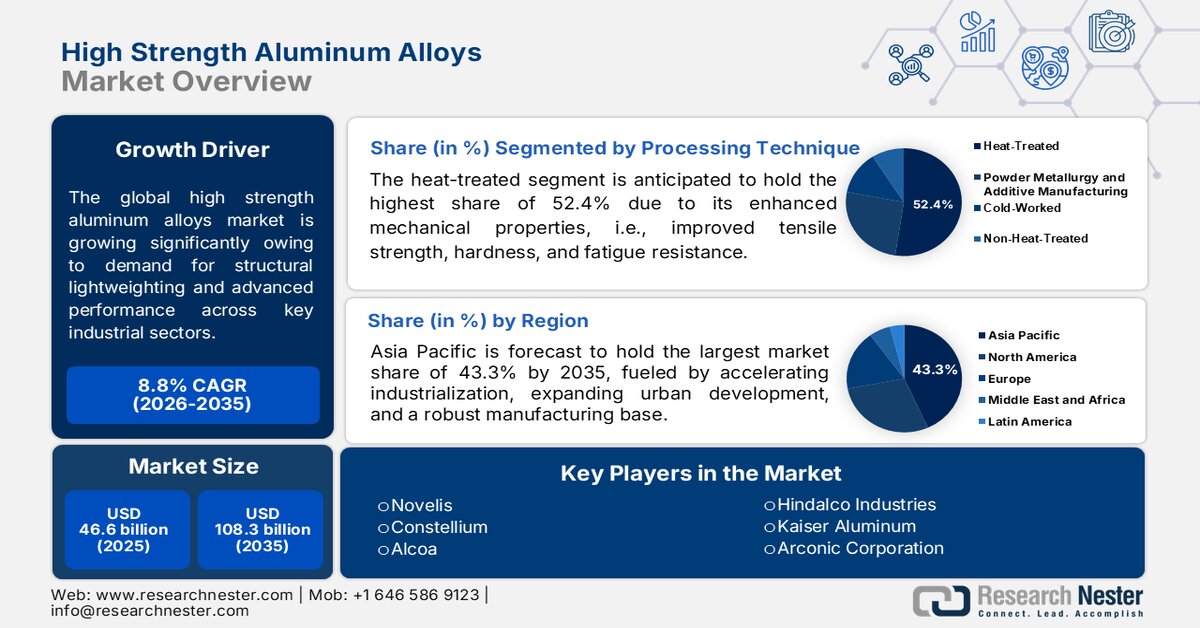
The global high strength aluminum alloys market is entering a transformative growth phase, which is driven by the heightened demand for structural lightweighting and advanced performance across key industrial sectors. In addition, sectors such as aerospace and defense are adopting next-generation variations such as aluminum-lithium to enhance fuel efficiency, payload capacity, and ballistic protection in commercial aircraft, defense vehicles, and space exploration systems. In this context, the U.S. Geological Survey stated that in January 2026, U.S. primary aluminum production reached 58,000 metric tons, with an average daily output of 1,860 tons, which is higher than January 2025. It also mentioned that the U.S. aluminum alloy inventories in LME-approved warehouses were stable at 120 tons.
U.S. Aluminum Alloy Production Statistics by Type in January 2026: Stocks, Output, and Shipments (Metric Tons)
|
Aluminum alloys |
Stocks, opening |
Production |
Net shipments |
Stocks, closing |
|
Die-cast alloys |
||||
|
13% Si, 360, etc. (0.6% Cu, max.) |
3,160 |
2,140 |
2,140 |
3,160 |
|
380 and variations |
6,830 |
19,600 |
19,600 |
6,830 |
|
Sand and permanent mold alloys |
||||
|
95/5 Al-Si, 356, etc. (0.6% Cu, max.) |
1,940 |
2,110 |
2,110 |
1,940 |
|
No. 319 and variations |
1,200 |
1,380 |
1,380 |
1,200 |
|
F-132 alloy and variations |
89 |
231 |
231 |
89 |
|
Al-Zn alloys |
339 |
70 |
70 |
339 |
|
Al-Si alloys (0.6% to 2.0% Cu) |
230 |
193 |
193 |
230 |
|
Al-Cu alloys (1.5% Si, max.) |
139 |
718 |
718 |
139 |
|
Other |
4,230 |
30,200 |
30,200 |
4,250 |
In parallel, the automotive sector is accelerating consumption to optimize electric vehicle architecture, offsetting heavy battery packs with lightweight crash management and chassis components, with a main goal to maximize driving range. Besides, this demand extends to the marine, consumer electronics, and infrastructure industries, which are for high-stress applications requiring superior durability, increasing uptake in the high strength aluminum alloys market. In June 2026, researchers at Oak Ridge National Laboratory developed DuAlumin-3D, which is a heat-resistant 3D-printable aluminum alloy especially designed for high-temperature automotive and aerospace applications. This alloy delivers exceptional creep resistance at 400°C, supports complex additive manufacturing designs, and it can operate at temperatures significantly higher than conventional aluminum alloys.
Key High Strength Aluminum Alloys Market Insights Summary:
Regional Highlights:
- The Asia Pacific high strength aluminum alloys market is projected to command a 43.3% share during 2026-2035, underpinned by rapid industrialization, extensive urbanization, and a well-established manufacturing ecosystem
- The North America high strength is poised for strong expansion through 2035, bolstered by extensive aircraft manufacturing, advanced heat-treatment investments, EV adoption, and stringent fuel-efficiency standards
Segment Insights:
- The heat-treated variants segment of the high strength aluminum alloys market is projected to command a 52.4% share through 2035, supported by enhanced tensile strength, hardness, fatigue resistance, and performance under high-stress conditions
- The plates and sheets segment is poised for a considerable revenue share during 2026-2035, fueled by rising adoption in aircraft fuselage structures, automotive body panels, marine vessels, and industrial equipment
Key Growth Trends:
- Rising space and defense expenditures
- Advancing additive manufacturing technologies
Major Challenges:
- Supply chain constraints and raw material availability
- Technological complexity in alloy development
Key Players: Novelis U.S., Constellium France, Alcoa U.S., Hindalco Industries India, Kaiser Aluminum U.S., Arconic Corporation U.S., Norsk Hydro Norway, Hindalco-Almex Aerospace Limited India, Haomei Aluminum China, NioCorp U.S., Lockheed Martin U.S., NALCO.
Global High Strength Aluminum Alloys Market Forecast and Regional Outlook:
Market Size & Growth Projections:
- 2025 Market Size: USD 46.6 billion
- 2026 Market Size: USD 50.7 billion
- Projected Market Size: USD 108.3 billion by 2035
- Growth Forecasts: 8.8% CAGR (2026-2035)
Key Regional Dynamics:
- Largest Region: Asia Pacific (43.3% Share)
- Fastest Growing Region: North America
- Dominating Countries: China, United States, Japan, Germany, India
- Emerging Countries: India, South Korea, Canada, Mexico, Italy
Last updated on : 10 August, 2026
High Strength Aluminum Alloys Market - Growth Drivers and Challenges
Growth Drivers
- Rising space and defense expenditures: The worldwide defense budgets and space exploration initiatives are identified as the major factors boosting high strength aluminum alloys market demand. High-strength aluminum alloys are essential for manufacturing military armored vehicles, missile hulls, and naval vessels, which need ballistic resistance. Apart from this, satellite systems and launch vehicles also rely on these advanced materials to endure extreme mechanical stresses. In this context, NioCorp Developments Ltd. and IBC Advanced Alloys in October 2025 produced a 0.2% aluminum-scandium alloy at IBC’s Franklin, Indiana foundry, with independent testing confirming that the alloy met the complete required purity and quality specifications. This demonstrates the feasibility of manufacturing Al-Sc alloys for casting, forging, extrusion, and additive manufacturing, thereby also supporting applications in the aerospace, automotive, electronics, and defense industries.
- Advancing additive manufacturing technologies: The integration of 3D printing in industrial manufacturing is yet another major growth catalyst for the market globally. Advanced additive manufacturing allows companies to fabricate complex, single-piece aluminum components with zero material waste. In October 2023, Airbus Helicopters expanded its additive manufacturing capabilities by establishing a new 3D printing center in Donauwörth, which also includes advanced equipment for producing aluminum components. This technology enables lightweight, complex aircraft parts with improved material efficiency, supporting applications in prototypes and future aircraft such as CityAirbus NextGen and Racer, thus positively benefiting the market’s growth.
Challenges
- Supply chain constraints and raw material availability: The market is negatively affected by supply chain uncertainties, which are related to aluminum availability, alloying elements, as well as global trade conditions. Fluctuations in terms of supply as well as pricing of materials such as copper, zinc, magnesium, and lithium can impact production costs and manufacturing stability. In addition, geopolitical conflicts and transportation disruptions may also affect the availability of critical inputs and finished alloy products. Therefore, dependence on a limited number of sources for certain specialty alloying elements can create supply risks. In this context, manufacturers need to develop more resilient supply networks.
- Technological complexity in alloy development: Developing next-generation high-strength aluminum alloys needs strong research and development investment, advanced processing technologies, and deep knowledge in materials science. Therefore, manufacturers need to put constant efforts to improve alloy strength, corrosion resistance, formability, and recyclability in order to meet evolving customer requirements. Balancing multiple performance characteristics can be technically challenging, as increasing strength may negatively affect ductility and weldability. Apart from this, industries such as electric vehicles and aerospace demand customized alloy solutions and require close collaboration between manufacturers and end users in the market.
High Strength Aluminum Alloys Market Size and Forecast:
| Report Attribute | Details |
|---|---|
|
Base Year |
2025 |
|
Forecast Year |
2026-2035 |
|
CAGR |
8.8% |
|
Base Year Market Size (2025) |
USD 46.6 billion |
|
Forecast Year Market Size (2035) |
USD 108.3 billion |
|
Regional Scope |
|
High Strength Aluminum Alloys Market Segmentation:
Processing Technique Segment Analysis
The heat-treated variants segment is anticipated to hold the highest share of 52.4% in the high strength aluminum alloys market during the stipulated timeframe. The segment’s dominating position is largely attributable to its enhanced mechanical properties, which include improved tensile strength, hardness, and fatigue resistance, which make it suitable for demanding applications. In addition, these alloys provide superior performance under high-stress conditions, which enables manufacturers to meet stringent requirements for lightweight yet durable components. For instance, in July 2026, Constellium and EOS partnered in order to accelerate the industrial adoption of advanced aluminum alloys for additive manufacturing applications. This collaboration combines Constellium’s alloy development knowledge with EOS’s 3D printing technology to improve material performance and commercialization pathways.
Product Segment Analysis
The plates and sheets segment, which is under the product category projected to attain a considerable revenue share in market from 2026 to 2035. This growth is mainly propelled by the rising adoption of large-format aluminum sheets and plates in aircraft fuselage structures, automotive body panels, marine vessels, and industrial equipment. In addition, advancements in aluminum rolling technologies and growing investments in lightweight vehicle platforms are also supporting the demand for high-strength aluminum plate and sheet products. Meanwhile, increasing emphasis on fuel efficiency and emission reduction across transportation industries is encouraging manufacturers to replace heavier materials with advanced aluminum solutions, thus denoting a wider segment scope.
Grade Segment Analysis
The 6xxx series is projected to hold a substantial share in the market by the end of the forecast period. The sub-segment’s leadership in this field is mainly propelled by excellent extrudability, weldability, and corrosion resistance. Also, the ability of 6xxx series alloys to be formed into complex profiles makes them suitable for lightweight structural components, which include vehicle frames, crash management systems, architectural structures, and energy-efficient equipment. In November 2024, Novelis collaborated with Li Auto to integrate advanced lightweight aluminum solutions into the Li MEGA electric MPV, which improves vehicle efficiency and performance. This use of Novelis Advanz™ 6HS-s650 alloy in key structural components helped achieve an 11% weight reduction, thus enhancing strength and crash protection.
Our in-depth analysis of the high strength aluminum alloys includes the following segments:
|
Segment |
Subsegments |
|
Processing Technique |
|
|
Product Form |
|
|
Grade |
|
|
End User Industry |
|

Vishnu Nair
Head - Global Business DevelopmentCustomize this report to your requirements — connect with our consultant for personalized insights and options.
High Strength Aluminum Alloys Market - Regional Analysis
APAC Market Insights
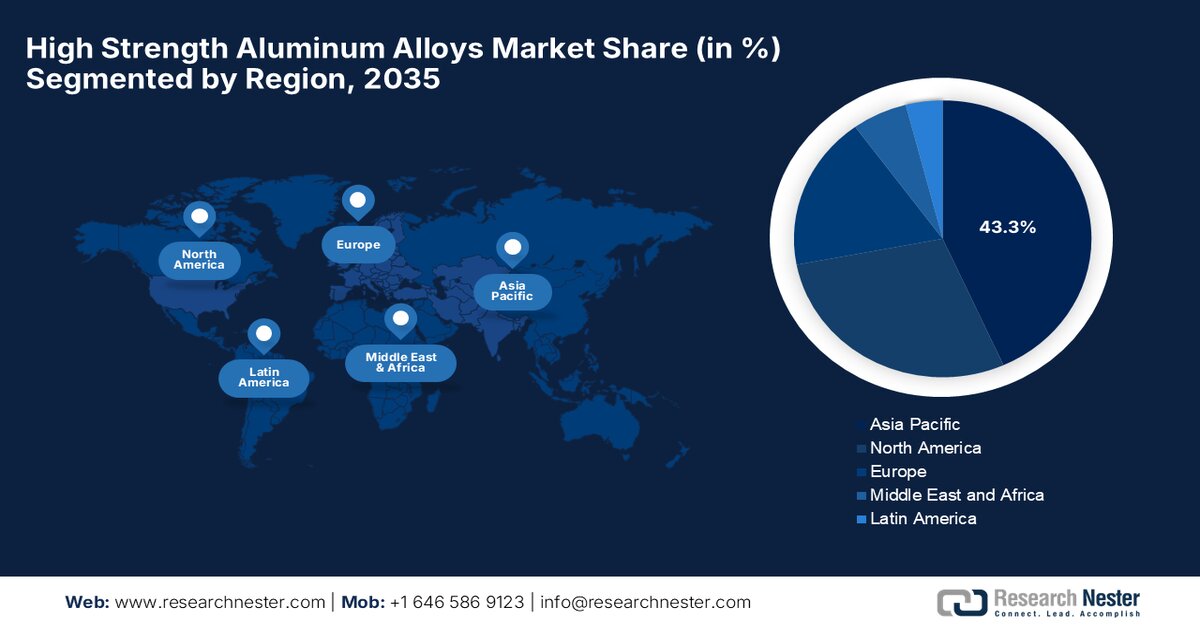
Asia Pacific high strength aluminum alloys market is forecasted to dominate with a total share of 43.3% during the forecast period. The region’s dominating position is majorly propelled by rapid industrialization, extensive urbanization, and an established manufacturing ecosystem. In addition, major regional economies are primary growth engines, which is due to their domestic manufacturing initiatives, infrastructure developments, and supportive government regulations. For instance, in June 2026, the Press Information Bureau stated that India has taken a major step toward strengthening defense self-reliance with the foundation of a 10,000-ton aluminum extrusion press at Yantra India Limited in Nagpur, which is aimed at producing critical components for defense, aerospace, and strategic industries. The article emphasized that investment in research, innovation, and advanced manufacturing infrastructure is essential for building a prominent defense sector.
Accelerating demand from the aerospace, defense, and automotive sectors is a significant factor uplifting the high strength aluminum alloys market in China. Government initiatives supporting domestic manufacturing and advanced materials development also propel market expansion, in turn encouraging local producers to upgrade their technological capabilities. In this context, the implementation plan for high-quality development of the aluminum industry 2025 – 2027 was jointly issued by the country’s Ministry of Industry and Information Technology and nine other government departments in March, 2025. This particular policy establishes a coordinated framework to promote sustainable, efficient, and innovation-driven growth in the aluminum industry.
The Japan high strength aluminum alloys market is poised to witness solid growth in the years ahead, positively influenced by various factors including a strong focus on premium quality and heavily expanding advanced automotive and aerospace industries. In addition, profitable collaborations between domestic research institutes, material science corporations, and industrial end users are allowing a steady pipeline of innovation in high-stress applications. In March 2025, Japan's UACJ Corporation, in collaboration with Mitsubishi Heavy Industries and Toyama Sumitomo Electric Industries, was selected by JAXA to develop high-strength aluminum-scandium alloy wire for rocket applications by using wire arc additive manufacturing. This particular project aims to achieve Japan's first practical use of aluminum-scandium alloys in rockets once commercialized.
North America Market Insights
The North America market is expected to achieve a commanding position in the global landscape, supported by massive industrial footprints from aircraft original equipment manufacturers and substantial investments in advanced heat-treatment infrastructure to enhance alloy toughness. Market expansion is also being accelerated by the rapid transition toward electric vehicles and stringent regulatory standards for fuel efficiency. In May 2026, the Aluminum Association reported that in North America, aluminum demand increased by 0.8% in 2025 and reached 26.65 billion pounds, up from 26.45 billion pounds in 2024. Demand for aluminum extrusions declined by 3.1%, whereas aluminum scrap inventories rose by 18.6%, imports increased by 9.1%, and exports of aluminum mill products fell by 13.2%. Furthermore, the report also noted that the U.S. aluminum industry has invested more than USD 11 billion in domestic operations during the past decade, with a main goal to strengthen production and competitiveness.
An immense defense sector and an aggressive automotive lightweighting push are boosting growth of the U.S. high strength aluminum alloys market. The market benefits from substantial domestic research and development investments, which foster continuous innovation in advanced heat-treatment processes and the formulation of specialized, fracture-resistant alloy grades. In this context, the U.S. government in July 2026 announced new measures with a primary goal of strengthening domestic primary aluminum production by encouraging investment in aluminum smelters through a Section 232 trade policy initiative. This move aims to reduce dependence on imported primary aluminum, support defense industries requiring advanced aluminum alloys, and thereby enhance U.S. economic and national security, thus positively benefiting the market’s expansion.
The Canada high strength aluminum alloys market is highly influential and integrated, primarily benefiting from the nation's position as one of the world's primary producers of low-carbon primary aluminum. The market has exceptional access to clean hydroelectric power, which allows domestic manufacturers to produce premium, sustainable alloy grades that attract environmentally conscious global supply chains. In June 2026, the country’s government stated that Canada will extend steel and aluminum tariff measures for one year until 2027 to protect domestic industries and workers. The policy aims to strengthen Canada’s industrial resilience and reduce trade diversion. In May 2026, it made a total investment of USD 100 million in Rio Tinto Alcan’s USD 440 million ELYSIS™ technology project to advance low-carbon aluminum production.
Canada Aluminum Alloy Imports by Country of Origin in 2026: Volume, Import Value (USD), and Price per Ton Analysis
|
Release Month |
Country of Origin |
Tons |
Amount (USD '000) |
USD/Ton |
|
1 |
Netherlands |
30.95 |
172.87 |
5,585 |
|
1 |
U.S. |
98.51 |
284.81 |
2,891 |
|
2 |
Belgium |
10.00 |
89.78 |
8,978 |
|
3 |
Netherlands |
23.67 |
140.03 |
5,917 |
|
3 |
U.S. |
60.30 |
211.22 |
3,503 |
|
4 |
Belgium |
24.00 |
243.10 |
10,129 |
|
4 |
Germany |
20.36 |
217.09 |
10,662 |
|
4 |
U.S. |
59.40 |
246.05 |
4,142 |
|
5 |
UAE |
38.44 |
135.74 |
3,531 |
|
5 |
Netherlands |
10.91 |
66.16 |
6,067 |
|
5 |
U.S. |
29.53 |
141.47 |
4,789 |
|
6 |
Belgium |
8.71 |
54.18 |
6,221 |
|
6 |
Germany |
20.10 |
226.13 |
11,250 |
|
6 |
U.S. |
66.62 |
289.77 |
4,350 |
|
7 |
U.S. |
19.90 |
102.93 |
5,172 |
|
8 |
U.S. |
14.12 |
52.75 |
3,736 |
|
Total |
- |
535.51 |
2,674.27 |
4,994 |
Source: Government of Canada
Europe Market Insights
The Europe market is projected for sustained expansion owing to a focus on environmental sustainability, technological innovation, and circular economy principles. The regional players focus heavily on pioneering advanced recycling methodologies to produce high-purity secondary aluminum, reducing the carbon footprint of production. In this context, Novelis and TSR Recycling in October 2024 signed a three-year partnership to supply around 75,000 tons of processed end-of-life aluminum scrap for producing low-carbon aluminum sheets for the automotive industry. This particular collaboration will strengthen aluminum circularity in Europe by increasing the use of recycled materials and thereby supporting the transition toward sustainable manufacturing.
The country's automotive manufacturing sector and premium vehicle brands are driving the overall market in Germany. The market is intensely fueled by technical partnerships between Germany’s engineering clusters, academic institutions, and Tier-1 industrial suppliers to propel a continuous pipeline of innovation for advanced aerospace, machinery, and transport applications. In March 2024, BMW Group stated that it is advancing wire arc additive manufacturing for producing lightweight aluminum vehicle components with improved stiffness-to-weight performance. It also stated that this technology uses metal wire and electric arc welding in order to build complex parts layer by layer, reducing material waste, weight, and energy consumption when compared with conventional manufacturing methods.
The UK high strength aluminum alloys market is growing exponentially, which is driven by a strong alignment with high-value manufacturing ecosystems, especially within the nation’s globally competitive aerospace, motorsport, and defense sectors. In addition, the country’s transition toward electrification across the transport sector accelerates the deployment of high-strength alloys for electric vehicle structures and battery enclosures. In June 2026, the country’s government announced a USD 63.5 million investment with the main goal of strengthening critical minerals supply chains, which includes aluminum, by supporting extraction, processing, recycling, and infrastructure projects. This particular initiative aims to improve supply security, expand recycling capacity, and support the UK aluminum industry, positively benefiting high strength aluminum alloys.
Key High Strength Aluminum Alloys Market Players:
- Novelis (U.S.)
- Constellium (France)
- Alcoa (U.S.)
- Hindalco Industries (India)
- Kaiser Aluminum (U.S.)
- Arconic Corporation (U.S.)
- Norsk Hydro (Norway)
- Hindalco-Almex Aerospace Limited (India)
- Haomei Aluminum (China)
- NioCorp (U.S.)
- Lockheed Martin (U.S.)
- NALCO (India)
- Company Overview
- Business Strategy
- Key Product Offerings
- Financial Performance
- Key Performance Indicators
- Risk Analysis
- Recent Development
- Regional Presence
- SWOT Analysis
- Novelis is a leading aluminum solutions provider which is offering high-strength alloys such as Advanz® 7UHS–s701 for lightweight automotive structures. The company is highly focused on advanced alloy development, strength optimization, and sustainable aluminum solutions.
- Constellium manufactures high-performance aluminum products, which include aluminum-lithium alloys for aerospace and defense applications. In addition, the firm’s Airware® solutions are well recognized for high strength and improved fatigue resistance.
- Alcoa is a predominant leader in this field and a major global aluminum producer supplying high-strength alloy products for aerospace, defense, transportation, and industrial applications. The company leverages advanced metallurgy and manufacturing expertise in order to deliver durable lightweight aluminum solutions.
- Hindalco Industries produces advanced aluminum hard alloys for aerospace, defense, and industrial sectors. In addition, through its specialized alloy manufacturing capabilities, the company offers high-strength 2xxx, 5xxx, 6xxx, and 7xxx series aluminum products.
- Kaiser Aluminum is yet another central player that specializes in engineered aluminum products, i.e., high-strength alloys for aerospace, automotive, and industrial markets. The firm focuses on lightweight, high-performance materials with enhanced strength, as well as recyclability.
Here is a list of key players operating in the global market:
The high strength aluminum alloys market is hosting leading manufacturers that are leveraging advanced alloy development capabilities, aerospace certifications, and global production networks to maintain competitiveness. Major players in this field are highly focused on producing specialized aluminum alloy products for different applications wherein differentiation is based on strength-to-weight performance, corrosion resistance, and customized alloy solutions. In this context, Scandium Canada in June 2026 acquired Ferreol Technologies and rebranded it as Scalium+, which is a subsidiary focused on advancing and commercializing aluminum-scandium alloy solutions. This acquisition combines Scandium Canada’s alloy development with Ferreol’s production knowledge and market-ready Scalium® products, with the main goal of speeding up commercialization.
Corporate Landscape of the Market:
Recent Developments
- In August 2026, NioCorp and Lockheed Martin signed a non-binding MoU to explore the long-term supply of up to 15 tons of scandium oxide or aluminum-scandium alloys annually over a 10-year period. This agreement supports ongoing collaboration to strengthen a domestic U.S. scandium supply chain for aerospace and defense applications.
- In February 2026, NALCO introduced its new IA91 grade aluminum alloy ingot, which is a high-performance silicon-based casting alloy designed for enhanced castability, strength, and corrosion resistance. This product is intended for automotive, electrical, industrial, and foundry applications.
- Report ID: 8735
- Published Date: Aug 10, 2026
- Report Format: PDF, PPT
- Explore a preview of key market trends and insights
- Review sample data tables and segment breakdowns
- Experience the quality of our visual data representations
- Evaluate our report structure and research methodology
- Get a glimpse of competitive landscape analysis
- Understand how regional forecasts are presented
- Assess the depth of company profiling and benchmarking
- Preview how actionable insights can support your strategy
Explore real data and analysis
Frequently Asked Questions (FAQ)
About this Report
Connect with our Expert


Report, 2026-2035



Copyright @ 2026 Research Nester. All Rights Reserved.
