Heart Rate Monitoring Devices Market Outlook:
Heart Rate Monitoring Devices Market size was over USD 24.25 billion in 2025 and is anticipated to cross USD 45.09 billion by 2035, witnessing more than 6.4% CAGR during the forecast period i.e., between 2026-2035. In the year 2026, the industry size of heart rate monitoring devices is assessed at USD 25.65 billion.
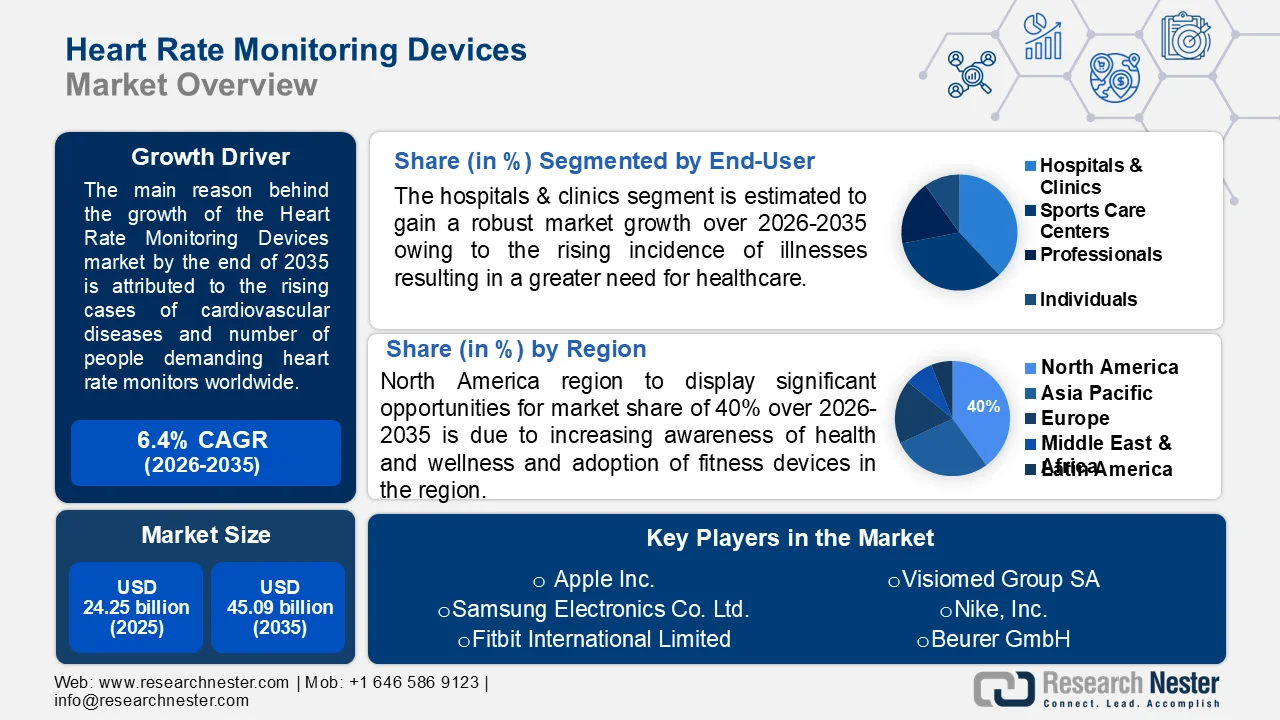
The heart rate monitoring devices are devised for sports activities that connect to a chest strap to allow for seamless heart rate monitoring by sending data to a wrist monitor. The growth of the heart rate monitoring devices market is primarily attributed to increasing concern about the rising cases of cardiovascular diseases along with an increasing number of people demanding heart rate monitors worldwide. As per recent statistics disclosed by the World Health Organization (WHO) in 2021, cardiovascular diseases were responsible for approximately 17.9 million deaths across the world in 2019, an estimated 32% of all global deaths.
Key Heart Rate Monitoring Devices Market Insights Summary:
Regional Highlights:
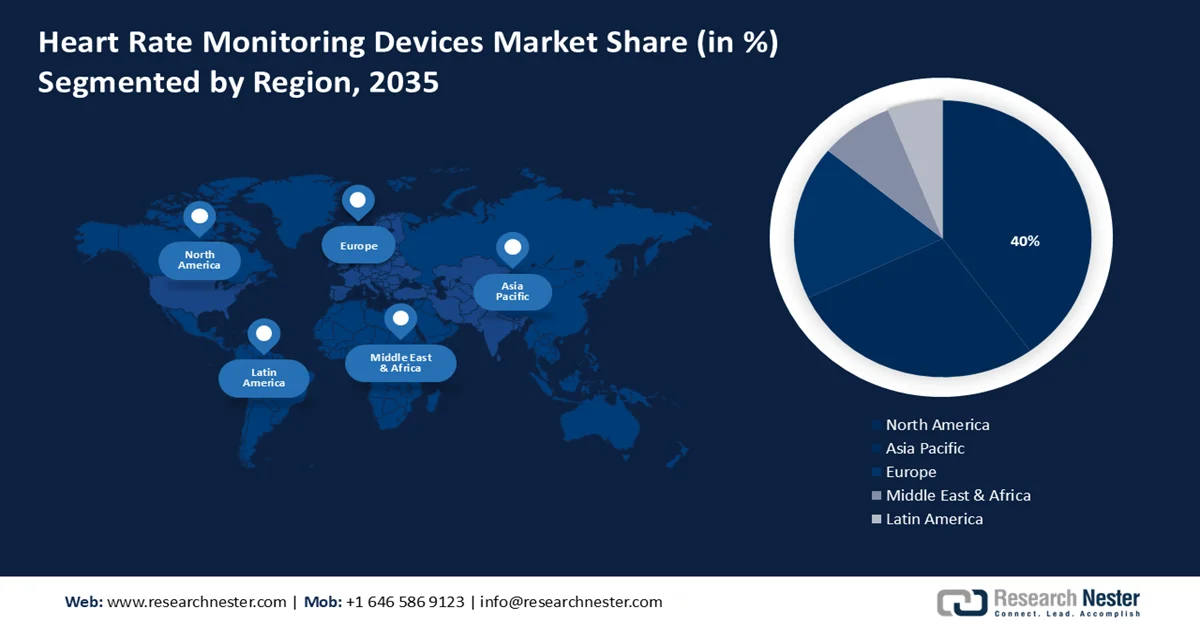
- North America in the heart rate monitoring devices market is projected to command a 40% revenue share by 2035, attributed to increasing awareness about health and wellness alongside the widespread adoption of fitness devices and applications.
- APAC is anticipated to witness considerable growth during 2026–2035, stimulated by the growing population with rising incidences of cardiovascular diseases and a surge in fitness trend.
Segment Insights:
- The hospitals & clinics segment in the heart rate monitoring devices market is projected to account for the highest revenue share by 2035, propelled by the rising incidence of illnesses increasing the need for accurate and continuous patient monitoring in critical care and diagnostic settings.
- The wearable segment is expected to witness considerable growth during 2026–2035, fueled by growing health consciousness among consumers and the rising popularity of wearable devices with real-time data tracking and mobile connectivity features.
Key Growth Trends:
- Worldwide rising concern of non-communicable diseases
- Increasing per capita income
Major Challenges:
- Variability in accuracy
- Limited awareness in underdeveloped regions
Key Players: BASF S.E., Braskem S.A, Exxon Mobil Chemical Company, S&P Global Inc., Lyondell Basell Industry N.V., Royal Dutch Shell PLC., DYNASOL Group, TPC Group Incorporation, Nizhnekamskneftekhim O.A.O, Lanxess A.G.
Global Heart Rate Monitoring Devices Market Forecast and Regional Outlook:
Market Size & Growth Projections:
- 2025 Market Size: USD 24.25 billion
- 2026 Market Size: USD 25.65 billion
- Projected Market Size: USD 45.09 billion by 2035
- Growth Forecasts: 6.4% CAGR (2026-2035)
Key Regional Dynamics:
- Largest Region: North America (40% Share by 2035)
- Fastest Growing Region: Asia Pacific
- Dominating Countries: United States, Germany, Japan, China, United Kingdom
- Emerging Countries: China, India, Japan, South Korea, Malaysia
Last updated on : 25 February, 2026
Heart Rate Monitoring Devices Market - Growth Drivers and Challenges
Growth Drivers
-
Worldwide rising concern of non-communicable diseases: Heart rate monitoring devices are anticipated to help diagnose health conditions and prevent deaths caused by non-communicable diseases. According to the data released by the World Health Organization (WHO), it is estimated that 41 million people are killed by non-communicable diseases each year, which is equivalent to 74% of all deaths globally. Cardiovascular diseases account for most NCD deaths accounting for up to 17.9 million people annually, and respiratory diseases account for 4.1 million people.
-
Increasing per capita income: It fuels the heart rate monitoring devices market as consumers increasingly prioritize health and wellness. As per the International Monetary Fund, North America is projected to witness an annual GDP growth of 2.1% in 2025. Furthermore, the Bureau of Economic Analysis stated that disposable personal income (DPI) increased by USD 61.1 billion, 0.3%, in November 2024 in the U.S. Higher disposable income enables individuals to invest in advanced health-tracking technologies, such as fitness wearables and smart watches which are now considered essential tools for proactive health management.
Challenges
-
Variability in accuracy: Inconsistent results across devices, particularly in non-medical-grade wearables challenge the adoption of these devices significantly. Factors such as improper device placement, and motion artifacts can affect readings, leading to unreliable data. This undermines consumer trust and limits adoption, especially for critical health monitoring applications.
-
Limited awareness in underdeveloped regions: Lack of knowledge regarding these devices and their benefits and applications hampers the global market growth. Limited access to healthcare education and technology, coupled with lower prioritization of preventive health measures, restricts adoption. Addressing these gaps requires targeted awareness campaigns and affordability initiatives.
Heart Rate Monitoring Devices Market Size and Forecast:
| Report Attribute | Details |
|---|---|
|
Base Year |
2025 |
|
Forecast Year |
2026-2035 |
|
CAGR |
6.4% |
|
Base Year Market Size (2025) |
USD 24.25 billion |
|
Forecast Year Market Size (2035) |
USD 45.09 billion |
|
Regional Scope |
|
Heart Rate Monitoring Devices Market Segmentation:
End-user Segment Analysis
Based on end user, the hospitals & clinics segment is anticipated to garner the highest heart rate monitoring devices market revenue share by the end of 2035. The rising incidence of illnesses resulting in a greater need for healthcare is driving up the global demand for hospitals and clinics. According to the American Hospital Association 2024, there are a total number of 6,120 hospitals in the United States. The need for accurate and continuous patient monitoring in critical care and diagnostic settings is boosting the segment growth further.
Type Segment Analysis
The wearable segment in the heart rate monitoring devices market is projected to register considerable growth in the upcoming years. Growing health consciousness among consumers, coupled with the rising popularity of wearable devices has driven their growth. Real-time data tracking and connectivity with mobile apps are trending features in the market. In July 2023, Coros launched the Coros Heart Rate Monitor, which is a strap to be worn on the upper arm, designed to combine characteristics of chest strap, and simple wrist-worn monitors.
Our in-depth analysis of the global heart rate monitoring devices market includes the following segments:
|
By Type |
|
|
By Indication |
|
|
By End-User |
|

Vishnu Nair
Head - Global Business DevelopmentCustomize this report to your requirements — connect with our consultant for personalized insights and options.
Heart Rate Monitoring Devices Market - Regional Analysis
North America Market Insights
North America heart rate monitoring devices market is predicted to hold the largest revenue share of 40% by 2035, owing to increasing awareness about health and wellness along with the adoption of fitness devices & applications in the region. For instance, according to the Health and Fitness Association, over 1 out of 5 people from America were part of a health club or studio in 2021, making a total of 66.5 million consumers aged 6 years and above. The rising awareness of good physical health in addition to mental and emotional well-being is boosting the market in the region.
The heart rate monitoring devices market in the U.S. is driven by increasing cardiovascular health awareness, and growing adoption of fitness tracking devices. In June 2022, participation rates in the U.S. fitness industry stretched up to 21.8%, which is the highest in the country’s history. Technological advancements including wearable and wireless monitors, coupled with increasing demand for personalized healthcare solutions also boost the country’s market expansion.
APAC Market Insights
The heart rate monitoring devices market of APAC is driven by the growing population with rising incidences of cardiovascular diseases and a surge in fitness trend, and projected to witness considerable growth. Rapid urbanization, rising disposable incomes, and expanding access to healthcare technologies contribute to the adoption of these devices. Additionally, the integration of wearable technology and government initiatives promoting preventive healthcare are further fuelling the market growth.
The rising prevalence of lifestyle diseases in India, an expanding middle-class population, improving healthcare infrastructure, and the affordability of wearable technologies such as fitness bands and smartwatches are the key factors propelling the demand, and motivating development. In February 2022, Amrita University, announced a partnership with Tranquility IOT and Big Data Solutions, intending to launch Amrita Spandanam. It is a non-invasive wearable device intended to monitor blood glucose, blood pressure, heart rate, blood oxygen, respiratory rate, and 6-lead ECG.
Heart Rate Monitoring Devices Market Players:
- Apple Inc.
- Company Overview
- Business Strategy
- Key Product Offerings
- Financial Performance
- Key Performance Indicators
- Risk Analysis
- Recent Development
- Regional Presence
- SWOT Analysis
- Samsung Electronics Co. Ltd.
- Fitbit International Limited
- Visiomed Group SA
- Nike, Inc.
- Beurer GmbH
- Omron Healthcare, Inc.
- LG Electronics Inc.
- TomTom International BV
- Sony Group Corporation
- Abbott
Companies in the heart rate monitoring devices market are launching several advanced devices for customer convenience and ease of use. In February 2024, Samsung introduced the Galaxy Ring which is a smart ring that incorporates wearable technologies, convenient for fitness tracking, and is designed as a piece of jewellery. Such advancements are projected to keep the market competitive and bring further expansion opportunities. Some of the most prominent players in the market include:
Recent Developments
- In June 2024, Abbott received the CE Mark for the first-of-its-kind i2i technology incorporated AVEIR dual chamber (DR) leadless pacemaker system, in Europe. The leadless pacemaker is approximately one-tenth the size of a traditional pacemaker and smaller in comparison to a AAA battery.
- In June 2021, Apple Inc., introduced the latest iOS 15 configuration that allows users to share their health-related data with their families, or a physician to receive health insights. Also, the newly added tools in iOS 15 were upgraded to identify, measure, and understand the changes in an individual’s health data.
- In February 2021, Samsung Electronics Co., Ltd., announced that users of the Galaxy Watch3 and Galaxy Watch Active2 can track their blood pressure and receive electrocardiogram benefits via the Samsung Health Monitor app. This means that, in addition to heart rate, people are now kept informed about their health throughout the day.
- Report ID: 411
- Published Date: Feb 25, 2026
- Report Format: PDF, PPT
- Explore a preview of key market trends and insights
- Review sample data tables and segment breakdowns
- Experience the quality of our visual data representations
- Evaluate our report structure and research methodology
- Get a glimpse of competitive landscape analysis
- Understand how regional forecasts are presented
- Assess the depth of company profiling and benchmarking
- Preview how actionable insights can support your strategy
Explore real data and analysis
Frequently Asked Questions (FAQ)
About this Report
Connect with our Expert


Report, 2026-2035



Copyright @ 2026 Research Nester. All Rights Reserved.
