Intracranial Pressure Monitoring Devices Market Outlook:
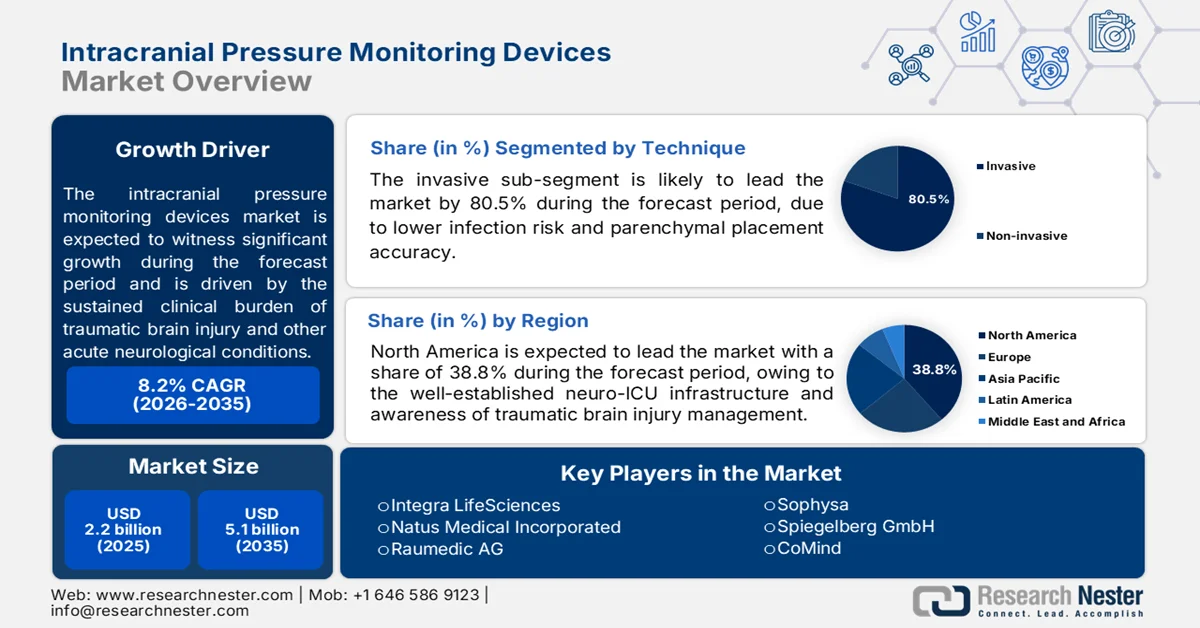
Intracranial Pressure Monitoring Devices Market size was valued at USD 2.2 billion in 2025 and is expected to reach USD 5.1 billion by the end of 2035, growing at around 8.2% CAGR during the forecast period, i.e., 2026-2035. In 2026, the industry size of intracranial pressure monitoring devices is estimated at USD 2.4 billion.
The intracranial pressure monitoring devices market is being supported by the sustained clinical burden of traumatic brain injury, stroke, hydrocephalus, and other acute neurological conditions that require continuous monitoring in intensive care settings. According to the U.S. Centers for Disease Control and Prevention April 2026 data, more than 214,110 TBI-related hospitalizations occurred in 2020 and approximately 68.663 TBI-related deaths were recorded in the United States, highlighting a large patient population that may require neurological assessment and monitoring during critical care management. Demand is also supported by the increasing utilization of specialized neurocritical care services and the expansion of hospital capabilities for managing complex neurological emergencies.
Another important growth factor is the increasing burden of cerebrovascular disease and hydrocephalus, which frequently require close neurological observation during treatment. The NLM January 2025 study reports that over 12 million people experience a stroke annually worldwide, creating substantial pressure on healthcare providers to improve neurological outcomes through advanced monitoring and critical care pathways. Government-funded healthcare systems and nonprofit organizations continue to support investments in neuroscience research, critical care capacity, and improved patient outcomes, contributing to demand for monitoring technologies used in intensive care units. Hospitals are increasingly focused on reducing complications, optimizing resource utilization, and improving survival rates for patients with severe neurological conditions.
Key Intracranial Pressure Monitoring Devices Market Insights Summary:
Regional Highlights:
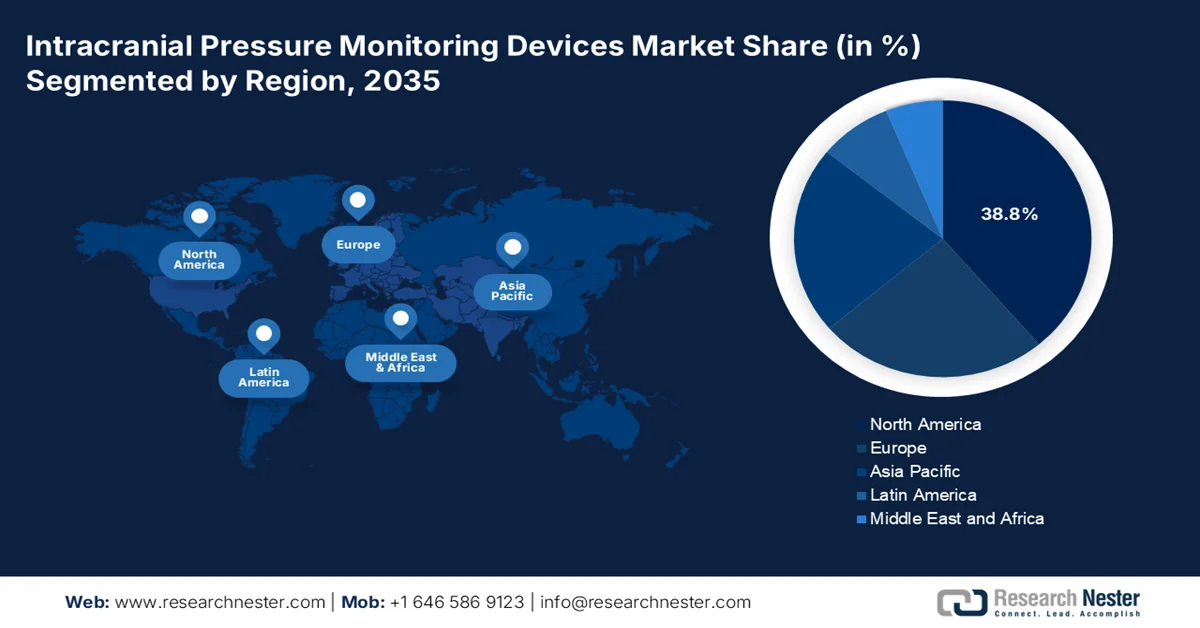
- In the intracranial pressure monitoring devices market, North America is forecast to account for 38.8% of regional revenue share by 2035, underpinned by well-established neuro-ICU infrastructure and high awareness of traumatic brain injury management
- Asia Pacific is anticipated to witness robust expansion during 2026-2035, fueled by expanding trauma care networks and rising road traffic accident rates
Segment Insights:
- In the intracranial pressure monitoring devices market, the Invasive sub-segment is anticipated to capture 80.5% share by 2035, reinforced by its widespread adoption in neurocritical care settings on account of lower infection risk and parenchymal placement accuracy
- Intraventricular Catheters are projected to retain the highest revenue share through 2035 owing to their ability to simultaneously provide precise intracranial pressure monitoring and therapeutic cerebrospinal fluid drainage
Key Growth Trends:
- Expanding public expenditure on stroke management programs
- Increasing burden of hydrocephalus
Major Challenges:
- Stringent regulatory approvals
- High infection risk management
Key Players: Integra LifeSciences, Natus Medical Incorporated, Raumedic AG, Sophysa, Spiegelberg GmbH, CoMind, Crainio.
Global Intracranial Pressure Monitoring Devices Market Forecast and Regional Outlook:
Market Size & Growth Projections:
- 2025 Market Size: USD 2.2 billion
- 2026 Market Size: USD 2.4 billion
- Projected Market Size: USD 5.1 billion by 2035
- Growth Forecasts: 8.2% CAGR (2026-2035)
Key Regional Dynamics:
- Largest Region: North America (38.8% share by 2035)
- Fastest Growing Region: Asia Pacific
- Dominating Countries: United States, Germany, Japan, China, United Kingdom
- Emerging Countries: India, South Korea, Brazil, Saudi Arabia, Singapore
Last updated on : 24 June, 2026
Intracranial Pressure Monitoring Devices Market - Growth Drivers and Challenges
Growth Drivers
- Expanding public expenditure on stroke management programs: Stroke remains one of the largest contributors to elevated intracranial pressure, creating a direct demand pathway for monitoring technologies. The World Stroke Organization 2022 data estimates that more than 101 million people are living with stroke-related consequences. Governments are responding with significant investments in stroke prevention, treatment, and specialized stroke units. Public healthcare systems increasingly allocate resources to neurocritical-care facilities where ICP monitoring is frequently used during management of severe ischemic and hemorrhagic stroke cases. This trend is creating recurring demand for invasive monitoring systems, disposable sensors, and related neurocritical-care equipment.
- Increasing burden of hydrocephalus: Hydrocephalus remains a significant clinical indication for intracranial pressure monitoring. The Hydrocephalus Association September 2025 data estimates that more than 1 million Americans are living with hydrocephalus, while the condition affects infants, adults, and elderly populations. Government-funded pediatric hospitals and neurological treatment programs are expanding diagnostic and monitoring capabilities to improve patient outcomes. Growing awareness and earlier diagnosis are increasing referral volumes to neurosurgical centers, which in turn supports demand for ICP monitoring equipment. As governments strengthen pediatric and neurological care pathways, procurement of monitoring devices for hydrocephalus management is expected to remain a consistent demand contributor across major healthcare markets.
Challenges
- Stringent regulatory approvals: Obtaining FDA and CE mark approvals for invasive ICP devices is time-consuming and costly, requiring extensive clinical trials for safety and accuracy. Manufacturers must prove device reliability, infection resistance, and MRI compatibility. Companies have invested significantly in clinical validation for its Camino® catheter upgrades.
- High infection risk management: Invasive ICP monitors, especially intraventricular catheters, carry ventriculitis and meningitis risks requiring antimicrobial coatings or disposable designs. New entrants must demonstrate superior infection control. Top companies have developed silver nanoparticle-coated sensors to reduce bacterial colonization.
Intracranial Pressure Monitoring Devices Market Size and Forecast:
| Report Attribute | Details |
|---|---|
|
Base Year |
2025 |
|
Forecast Period |
2026-2035 |
|
CAGR |
8.2% |
|
Base Year Market Size (2025) |
USD 2.2 billion |
|
Forecast Year Market Size (2035) |
USD 5.1 billion |
|
Regional Scope |
|
Intracranial Pressure Monitoring Devices Market Segmentation:
Technique Segment Analysis
Under the technique segment, invasive sub segment is leading and is poised to hold the share value of 80.5% by the end of 2035. The segment is driven for lower infection risk and parenchymal placement accuracy. These devices also allow simultaneous temperature monitoring and MRI compatibility. Their ease of bedside insertion and reliable drift-free readings make them preferred for traumatic brain injury patients without hydrocephalus. According to the NLM March 2026 study, minimally invasive procedures accounted for 28,243,407 procedures across relevant neurosurgical and neuromonitoring indications. Within ICP monitoring specifically, these solid-state micro-sensors eliminate the need for fluid-coupled columns, reducing ventriculitis risk and enabling accurate parenchymal pressure readings. Their ease of bedside placement and compatibility with MRI environments make them preferable for traumatic brain injury patients without hydrocephalus.
Product Type Segment Analysis
Intraventricular catheters remain the leading product type in the market because they uniquely combine accurate intracranial pressure measurement with therapeutic cerebrospinal fluid drainage. This dual functionality allows clinicians to both monitor elevated pressure and actively lower it by draining fluid, making them indispensable in managing hydrocephalus, severe traumatic brain injury, and subarachnoid hemorrhage. They also enable cerebrospinal fluid sampling for diagnostic testing. Recent innovations include antimicrobial-coated catheters to reduce infection risk and telemetric versions for wireless pressure readouts. Their gold-standard status in neurocritical care protocols ensures they will continue capturing the highest revenue share among all ICP monitoring product types through 2035.
Application Segment Analysis
Traumatic brain injury is the largest application driving the ICP monitoring market, as raised intracranial pressure is a major cause of secondary brain injury and mortality. Clinical guidelines mandate ICP monitoring in severe TBI with abnormal CT findings. According to the NLM May 2024 study, over 320,000 U.S. hospitalizations for TBI required invasive neuromonitoring, with ICP monitoring performed in 42% of severe cases. The aging population and rise in fall-related TBIs among those over 65 have further increased demand. By 2035, TBI is forecast to hold largest share of the application segment, driven by expanding neurocritical care infrastructure globally.
Our in-depth analysis of the intracranial pressure monitoring devices includes the following segments:
|
Segment |
Subsegments |
|
Technique |
|
|
Product Type |
|
|
Application |
|
|
End user |
|
|
Patient Age Group |
|
|
Usability |
|

Vishnu Nair
Head - Global Business DevelopmentCustomize this report to your requirements — connect with our consultant for personalized insights and options.
Intracranial Pressure Monitoring Devices Market - Regional Analysis
North America Market Insights
North America is dominating the intracranial pressure monitoring devices market and is expected to hold the regional revenue share of 38.8% by the end of 2035. The region is driven by a well-established neuro-ICU infrastructure and high awareness of traumatic brain injury management. The United States leads due to concentrated trauma center networks and consistent reimbursement frameworks for invasive monitoring procedures. Canada follows with a single-payer system that supports neuromonitoring through provincial health budgets, though capital approval cycles are longer. Key trends include the shift toward disposable micro-transducer catheters to reduce infection risks, antimicrobial-coated devices, and integration of ICP data with bedside monitoring platforms. Hospitals prioritize products meeting infection control benchmarks, while group purchasing organizations negotiate multi-year supplier contracts. Demand remains stable, supported by clinical guidelines mandating ICP monitoring in severe TBI cases.
The growing need for continuous neurological monitoring in patients with traumatic brain injury, hydrocephalus, brain tumors, and other neurocritical conditions is driving the intracranial pressure monitoring devices market in the U.S. The NLM May 2023 study shows that normal ICP ranges from 0.7–2.0 kPa (70–180 mm H₂O) in adults and 0.5–1.0 kPa (50–100 mm H₂O) in children, making accurate monitoring essential for timely intervention. Hospitals continue to rely heavily on invasive wired ICP monitoring systems because of their established accuracy and stability in neurosurgical practice. Studies evaluating the Camino ICP monitor reported an actual average measurement drift of 1.4 ± 5.3 mmHg, supporting its continued use while also encouraging interest in newer wireless and non-invasive monitoring technologies.
The rising investments in hospital infrastructure and the growing burden of neurological injuries requiring critical care is shaping the market in Canada. According to the EPHPP 2026 data, Canada’s total health expenditure is projected to reach CAD 372 billion, representing approximately CAD 9,054 per person, reflecting continued investment in advanced monitoring and intensive-care technologies. Additionally, Government of Canada 2023 data reported 1,931 deaths from transport accidents in 2023, highlighting the ongoing incidence of severe trauma cases that can lead to traumatic brain injuries requiring ICP monitoring. Demand is further supported by expanding neurocritical-care capabilities, modernization of tertiary hospitals, and increased adoption of advanced monitoring systems aimed at improving neurological outcomes and reducing complications in acute-care settings.
APAC Market Insights
The Asia Pacific is projected to emerge rapidly during the assessed period, 2026 to 2035 in the market. The region is characterized by diverse growth trajectories across developed and emerging economies. Japan, Australia, and South Korea maintain established neuro-ICU infrastructures with steady replacement demand. China and India present the highest growth potential due to expanding trauma care networks and rising road traffic accident rates. Government tender processes dominate procurement, with price competitiveness being critical. Local manufacturing in China and India is increasing, challenging Western suppliers. Non-invasive alternatives receive attention in price-constrained settings. Training and technical support remain essential for clinical adoption across the region.
The strong policy support and expanding investment in the medical devices sector is driving the intracranial pressure monitoring devices market in India. According to the IBEF February 2026 data, the government continues to promote manufacturing, research, infrastructure development, and investment across the medical technology ecosystem. In addition, the Union Budget 2025–26 allocated INR 99,858 crore (USD 11.48 billion) to the healthcare sector, supporting hospital modernization and critical-care capacity expansion. The broader medical devices market is also gaining momentum, with a Rubix Industry Insights report projecting growth from USD 15.2 billion in 2025 to USD 50.1 billion by 2030. These developments are expected to strengthen adoption of advanced neuro-monitoring technologies, including ICP monitoring systems, across India's tertiary healthcare facilities.
The growing clinical focus on traumatic brain injury management and neurocritical care is driving the intracranial pressure monitoring devices market in China. The Frontiers September 2024 study indicates that low- and middle-income countries account for approximately 72% of the global TBI incidence, creating substantial demand for neurological monitoring technologies. Despite increasing adoption, China's reported ICP monitoring rate in TBI patients is approximately 11%, significantly below levels observed in several developed healthcare systems, highlighting considerable room for market expansion. As Chinese hospitals continue to strengthen intensive care capabilities and neurosurgical services, demand for ICP monitors, catheters, and sensors is expected to rise. Greater emphasis on reducing mortality from intracranial hypertension and improving TBI outcomes is also supporting technology adoption across tertiary medical centers.
Europe Market Insights
The Europe market for Intracranial Pressure Monitoring Devices is mature but fragmented, with procurement patterns varying significantly by country. Germany, France, and the United Kingdom lead in adoption, supported by centralized trauma networks and public health system funding. Southern and Eastern European markets exhibit slower growth due to budget constraints. The EU’s Medical Devices Regulation has raised compliance barriers, favoring established suppliers with full documentation. Nordic countries emphasize infection control protocols, driving demand for disposable catheters. Hospital tenders across the region prioritize clinical validation and total cost of ownership over upfront pricing. Non-invasive ICP technologies receive research funding but have not displaced invasive devices in severe TBI cases. Cross-border group purchasing is emerging in select markets.
The intracranial pressure monitoring devices market in Germany benefits from the country's strong medical technology ecosystem and extensive imports of advanced healthcare equipment. According to OEC 2024 data under HS 9018 (Medical Instruments and Appliances), Germany imported approximately USD 12.7 billion worth of medical instruments, highlighting the scale of demand for sophisticated diagnostic and monitoring technologies used across hospitals and specialty care centers. The country's well-established neurosurgical infrastructure and emphasis on high-quality critical care continue to support the adoption of ICP monitoring systems. Growing demand for advanced neurological monitoring in traumatic brain injury, stroke, hydrocephalus, and other neurocritical conditions is expected to encourage further procurement of ICP monitors, catheters, and sensor-based technologies throughout Germany's healthcare sector.
The growing interest in telemetric monitoring technologies that can improve patient management while reducing healthcare resource utilization is driving the intracranial pressure monitoring devices market in the UK. The NLM March 2024 study involving 136 hydrocephalus patients found that implantable telemetric ICP sensors significantly reduced neurosurgical admissions, imaging procedures, and invasive monitoring requirements compared with conventional systems. The analysis further demonstrated an average cost saving of £5,236 per patient within two years, with financial break-even achieved in approximately eight months after implantation. In addition to lowering service demand, telemetric monitoring reduced imaging-associated radiation exposure by 4 mSv over two years. These outcomes support increasing adoption of advanced ICP monitoring solutions across UK neurosurgical and hydrocephalus care pathways.
Key Intracranial Pressure Monitoring Devices Market Players:
- Integra LifeSciences (U.S.)
- Natus Medical Incorporated (U.S.)
- Raumedic AG (Germany)
- Sophysa (France)
- Spiegelberg GmbH (Germany)
- CoMind (UK)
- Crainio (UK)
- Company Overview
- Business Strategy
- Key Product Offerings
- Financial Performance
- Key Performance Indicators
- Risk Analysis
- Recent Development
- Regional Presence
- SWOT Analysis
- Integra LifeSciences is a leading player in the intracranial pressure monitoring devices market, offering the popular Camino® line of fiber-optic ICP monitors and catheters. The company focuses on accurate, drift-resistant pressure readings for traumatic brain injury and hydrocephalus management.
- Natus Medical Incorporated competes strongly in the market through its NeuroCare® ICP monitoring solutions. The company emphasizes ease of use, bedside display integration, and compatibility with intraventricular and subdural catheters.
- Raumedic AG is a precision engineering leader in the market, known for its neurovent®-P and neurovent®-TO lines using pneumatic and strain-gauge sensors. Raumedic focuses on infection-resistant materials and real-time waveform accuracy.
- Sophysa is a prominent European innovator in the market, famous for its Sophysa® telemetric ICP sensors and programmable shunt valves. The company pioneers non-invasive, implantable pressure monitors that enable wireless reading.
- Spiegelberg GmbH holds a specialized position in the market with its pneumatic pressure measurement technology, including the Spiegelberg ICP sensor and 3PN strain-gauge catheters.
Here is a list of key players operating in the global market:
The intracranial pressure monitoring market is moderately consolidated, led by established neurocritical care specialists from the U.S. and Europe. Key players focus on technological integration, such as non-invasive monitoring methods and telemetry-enabled systems. Strategic initiatives include mergers (e.g., Natus acquiring NeuroWave), partnerships for AI-based analytics, and geographic expansion into emerging Asian markets. Companies are increasingly investing in fiber-optic and micro-transducer technologies to improve accuracy and reduce infection risks, while price competition intensifies from Indian and Malaysian manufacturers offering cost-effective solutions for developing regions.
Corporate Landscape of the Market:
Recent Developments
- In October 2025, CoMind has announced that they have secured $102.5m funding to redefine clinical monitoring of the brain. CoMind One is designed to make critical information about cerebral blood flow and intracranial pressure easily and continually available at the bed-side for the first time.
- In September 2025, Crainio announced that the U.S. Patent and Trademark Office (USPTO) had granted its patent for non-invasive intracranial pressure (ICP) measurement covering the use of photoplethysmography (PPG).
- In April 2024, Integra LifeSciences Holdings Corporation announced that the company had relaunched its CereLink® ICP Monitoring System, an innovative product that will be featured at the upcoming AANS Annual Scientific Meeting in Chicago, Illinois.
- Report ID: 7428
- Published Date: Jun 24, 2026
- Report Format: PDF, PPT
- Explore a preview of key market trends and insights
- Review sample data tables and segment breakdowns
- Experience the quality of our visual data representations
- Evaluate our report structure and research methodology
- Get a glimpse of competitive landscape analysis
- Understand how regional forecasts are presented
- Assess the depth of company profiling and benchmarking
- Preview how actionable insights can support your strategy
Explore real data and analysis
Frequently Asked Questions (FAQ)
About this Report
Connect with our Expert


Report, 2026-2035



Copyright @ 2026 Research Nester. All Rights Reserved.
