Solar Charged Jacket Market Outlook:
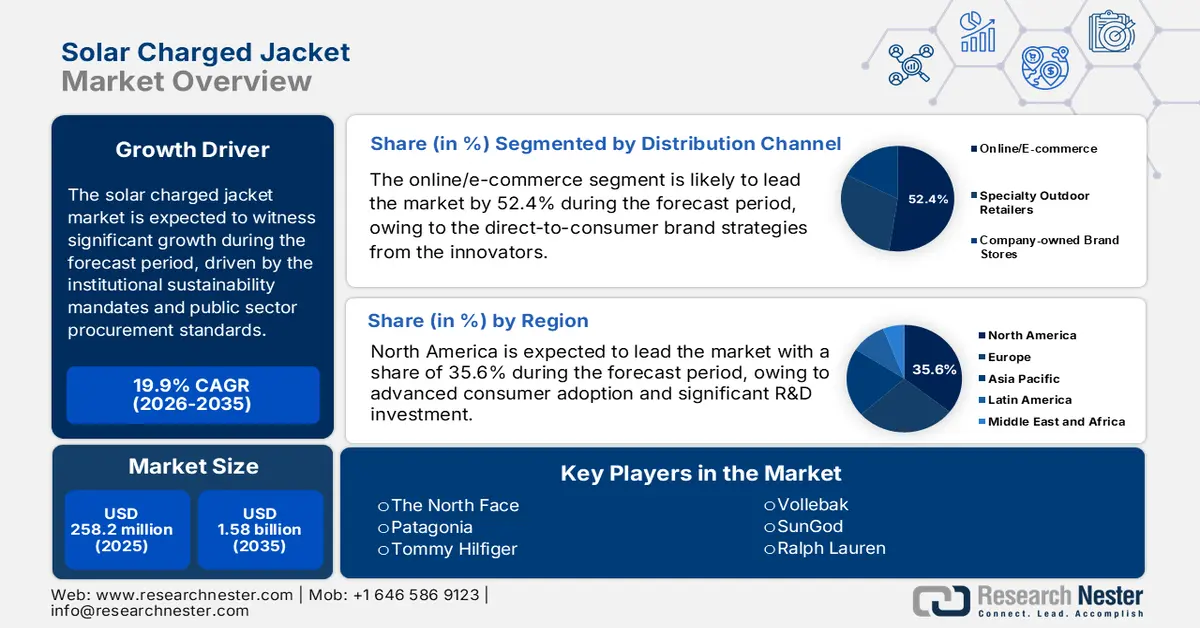
Solar Charged Jacket Market size was valued at USD 258.2 million in 2025 and is projected to reach USD 1.58 billion by the end of 2035, rising at a CAGR of 19.9% during the forecast period, i.e., 2026-2035. In 2026, the industry size of solar charged jacket is evaluated at USD 309.6 million.
The solar charged jacket market is emerging at the intersection of advanced textiles, distributed energy use, and occupational safety apparel, driven primarily by institutional sustainability mandates and public sector procurement standards rather than consumer fashion cycles. The government-backed energy transition programs are indirectly supporting demand by funding research and pilot deployments in wearable energy harvesting systems. For instance, the Department of Energy continues to allocate funding toward lightweight photovoltaic materials and flexible electronics under its Solar Energy Technologies Office, with the federal solar R&D funding being boosted by 84% and providing a funding of USD 318 million as per the AIP March 2023 data. This funding supports the non-traditional solar applications, such as portable and wearable systems.
Besides, the European Commission’s Horizon Europe framework prioritizes smart and functional textiles for energy efficiency and resilience, allocating a significant amount to advance the materials and digital textiles programs. These initiatives create a favorable environment for the B2B adoption of the solar-charged jackets in defense logistics, disaster response, infrastructure maintenance, and remote field operations, where reducing the dependency on external power sources is a measurable operational advantage. Further, from the demand side perspective, the occupational safety, climate exposure, and workforce electrification policies are shaping the procurement behavior. According to the International Labor Organization report in July 2025, nearly 17.3% of the workers are exposed to excessive heat annually, promoting the governments to update the occupational safety standards for outdoor and industrial workers, demanding for solar charged jackets.
Key Solar Charged Jackets Market Insights Summary:
Regional Highlights:
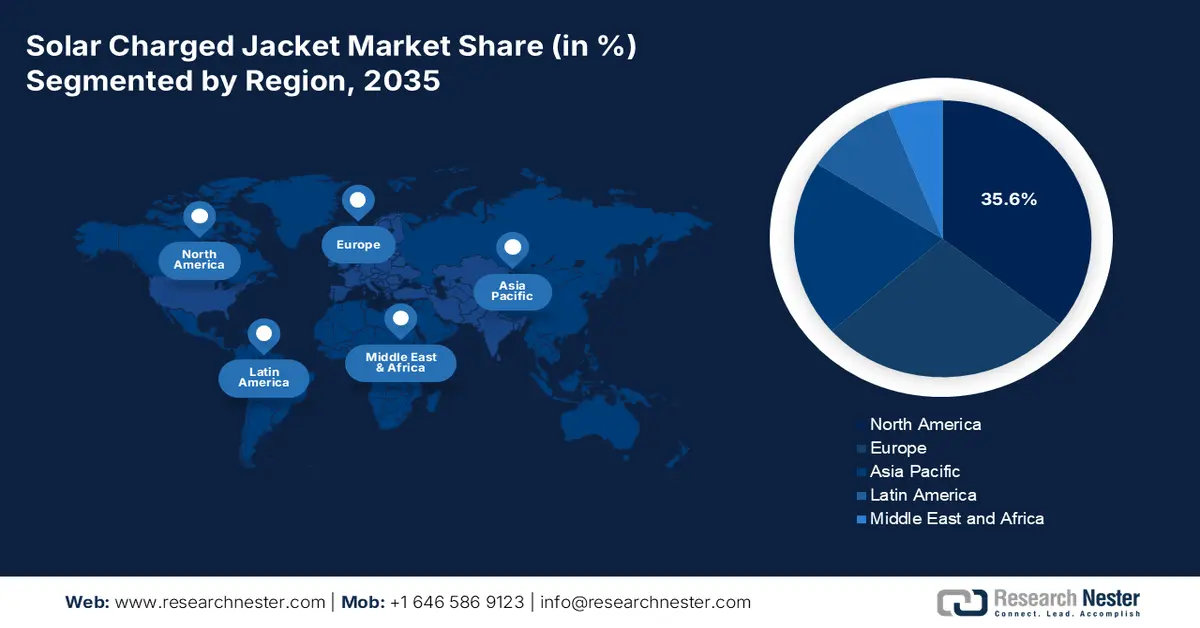
- North America is anticipated to command a 35.6% share by 2035 in the solar charged jacket market, anchored by early consumer adoption, sustained R&D spending, and institutional backing aligned with defense, emergency preparedness, and outdoor recreation priorities.
- Asia Pacific is forecast to expand at a CAGR of 16.8% during 2026–2035, accelerated by leadership in solar photovoltaic manufacturing, rapid urbanization, and rising disposable incomes.
Segment Insights:
- Within the distribution channel, the online/e-commerce segment is projected to secure a 52.4% share by 2035, supported by direct-to-consumer digital engagement and frictionless global reach, culminating in the continued expansion of mobile commerce.
- Under the power output segment, the medium power category is expected to retain dominance through 2035 by offering a balanced mix of functionality, cost efficiency, and manageable weight, aligned with the growing ubiquity of personal electronics.
Key Growth Trends:
- Rising occupational heat exposure and regulatory response
- Defense and disaster response modernization programs
Major Challenges:
- High cost and pricing pressure
- Supply chain and component sourcing complexity
Key Players: The North Face, Patagonia, Tommy Hilfiger, Vollebak, SunGod, Ralph Lauren, Gobi Gear, W.L. Gore, Kompass, Bundok, Smart Jacket by Baukjen, Wearable X, Silvr, HiFun, Solpro, MASCOT, Yamamoto, Jackery, Skugga.
Global Solar Charged Jackets Market Forecast and Regional Outlook:
Market Size & Growth Projections:
- 2025 Market Size: USD 258.2 million
- 2026 Market Size: USD 309.6 million
- Projected Market Size: USD 1.58 billion by 2035
- Growth Forecasts: 19.9% CAGR (2026-2035)
Key Regional Dynamics:
- Largest Region: North America (35.6% Share by 2035)
- Fastest Growing Region: Asia Pacific
- Dominating Countries: United States, China, Germany, Japan, Canada
- Emerging Countries: India, South Korea, Australia, United Kingdom, France
Last updated on : 19 December, 2025
Solar Charged Jacket Market - Growth Drivers and Challenges
Growth Drivers
- Rising occupational heat exposure and regulatory response: Heat exposure is increasingly treated as the regulated workplace hazard directly influencing the demand for advanced protective apparel. According to the Open Access Government report in August 2025, 71% of the working population is exposed to excessive work-related heat, promoting governments to strengthen the occupational safety frameworks for outdoor and industrial workers. Regulatory agencies are responding by encouraging or mandating adaptive PPE solutions that support longer outdoor duty cycles under extreme conditions. The solar-charged jackets support this shift by enabling self-powered cooling accessories, safety lighting, and monitoring devices, reducing the dependency on external batteries. As compliance-driven procurement expands across construction utilities, mining, and public works, employers are prioritizing garments that combine protection with the embedded energy functionality.
- Defense and disaster response modernization programs: Defense ministries and civil protection agencies are the major institutional adopters of the energy-autonomous wearables. The government modernization programs increasingly emphasize mobility endurance and power resilience for the personnel operating in remote or disaster-affected environments. The U.S. Department of Defense and allied agencies continue to fund soldier systems and emergency response equipment that reduce the logistical dependence on spare batteries and generators. Solar-charged jackets directly address this requirement by enabling on-body power generation for radios, GPS units, and emergency lighting. Disaster preparedness budgets managed via agencies such as FEMA and civil defense organizations further reinforce the demand for the equipment that functions independently of damaged infrastructure.
- Expansion of remote infrastructure and field workforce activity: Governments are investing heavily in the infrastructure of workers operating in remote or off-grid environments. The report from the U.S. Department of Transportation and energy agencies indicates that a sustained capital allocation is needed for highways, transmission lines, and renewable installations. These projects require field teams to operate for extended periods without reliable access to the fixed power sources. The solar-charged jackets provide auxiliary power for inspection tools, sensors, and safety equipment, improving uptime and reducing the downtime linked to charging logistics, as the infrastructure spending remains elevated. Via mid-decade procurement teams are prioritizing the apparel that enhances operational efficiency in dispersed work settings.
Challenges
- High cost and pricing pressure: The integration of the photovoltaic cells, specialized fabrics, and power management systems creates high unit costs that often exceed the standard jacket, which is the prime barrier for the solar charged jacket market. This places the product in a premium niche, limiting mass market adoption. Top brands have tackled this by treating solar jackets as a high-fashion, limited-edition item to justify the price via brand prestige rather than pure utility. Consumer price sensitivity remains high, the solar technology market is expected to grow, and the consumer price points remain the primary adoption barrier.
- Supply chain and component sourcing complexity: Manufacturers must navigate distinct supply chains for high-performance apparel textiles, advanced PV cells, and lithium-ion batteries, each with its own volatility and ethical sourcing concerns in the solar charged jacket market. For instance, the strategic moves by the leading players move to outsource the core power technology to a specialist, simplifying their supply chain and leveraging a partner’s expertise in ethical battery sourcing.
Solar Charged Jacket Market Size and Forecast:
| Report Attribute | Details |
|---|---|
|
Base Year |
2025 |
|
Forecast Year |
2026-2035 |
|
CAGR |
19.9% |
|
Base Year Market Size (2025) |
USD 258.2 million |
|
Forecast Year Market Size (2035) |
USD 1.58 billion |
|
Regional Scope |
|
Solar Charged Jacket Market Segmentation:
Distribution Channel Segment Analysis
Within the distribution channel, the online/e-commerce segment dominates in the solar charged jacket market and is expected to hold the share value of 52.4% by 2035. The segment is fueled by the direct-to-consumer brand strategies from the innovators, such as Vollebak and SunGod, which use digital platforms to explain the complex technology and sustainability narratives directly to early adopters. The channel’s growth is underpinned by the broader permanent shift in retail consumption online. A key driver is the continued expansion of mobile commerce. For example, the U.S. Census Bureau data in February 2025 reported that the fourth quarter retail e-commerce sales in the U.S. reached USD 308.7 billion in 2024. This strong digital sales environment provides the ideal the low friction marketplace for selling a considered purchase tech-integrated apparel item directly to a global audience.
Power Output Segment Analysis
Under the power output segment, the medium power is leading the segment in the solar charged jacket market. The critical driver is balancing the practical utility with the cost and weight constraints. This output range is sufficient to power essential modern devices such as smartphones, GPS units, and smartwatches via a full day of use, aligning perfectly with the needs of hikers, urban commuters, and casual campers. It represents the optimal trade-off offering meaningful functionality without the prohibitive cost, weight, or bulk of high-power systems needed for expedition use. The segment’s relevance is amplified by the ubiquity of personal electronics. Supporting this, the International Energy Agency update noted that global electricity demand from consumer electronics continues its steady rise, highlighting the persistent consumer need for the convenient portable charging solutions that this power band effectively serves.
Application Segment Analysis
The everyday urban commute sub segment is leading the application and is expected to hold a significant share value by 2035. The segment is driven by the transition of solar jackets from the niche outdoor gear to practical urban tech apparel. The growth is driven by the convergence of micro mobility, smart city infrastructure, and the need for constant device connectivity. Commuters using e-bikes, e-scooters, and public transit require reliable on-the-go power for navigation, communication, and safety lights. A key enabling statistic comes from the ICCT, April 2025 has reported that there are nearly 204,000 public chargers in the U.S. for public and private non-residential electric vehicle charging ports. This massive infrastructure build-out for vehicle electrification normalizes the concept of mobile power dependency, creating a receptive solar charged jacket market for personal solar charging solutions integrated into daily wear.
Our in-depth analysis of the solar charged jacket market includes the following segments:
|
Segment |
Subsegments |
|
Product Type |
|
|
Technology |
|
|
Power Output |
|
|
Distribution Channel |
|
|
Application |
|

Vishnu Nair
Head - Global Business DevelopmentCustomize this report to your requirements — connect with our consultant for personalized insights and options.
Solar Charged Jacket Market - Regional Analysis
North America Market Insights
North America is dominating the solar charged jacket market and is expected to hold the share of 35.6% by 2035. The solar charged jacket market is driven by the advanced consumer adoption, significant R&D investment, and a strong alignment with the federal priorities in defense, emergency preparedness, and outdoor recreation. The U.S., as the dominant force, drives innovation via the Department of Defense funding for soldier modernization and the Department of Energy support for flexible photovoltaics. A robust outdoor recreation economy valued at over USD 1.1 trillion in output by the Outdoor Recreation Roundtable in November 2023 creates a substantial consumer base for the high-tech gear. In Canada, the federal strategies for Arctic sovereignty are remote community resilience, coupled with the provincial investments in emergency management for climate related disaster shape the demand.
The solar charged jacket market in the U.S. is propelled by the substantial federal spending targeting energy resilience and operational independence for the key personnel. The Department of Defense’s focus on reducing the logistical battery burden for dismounted soldiers, as evidenced by programs such as the Integrated Visual Augmentation System, creates direct procurement potential. Further, the agency grants from FEMA’s Homeland Security Grant Program that allocated USD 1.12 billion in 2023 for emergency preparedness, funds equipment for the first responders, where solar-charged gear enhances the mission endurance during the prolonged outages. Demand is bifurcating between professional-grade applications for defense and emergency services and premium products for the high-value outdoor consumer segment.
In Canada, the solar-charged jacket market is shaped by the geographic necessity and federal climate adaptation strategies. The key drivers include operations in the Arctic supported by the Polar Continental Shelf Program and enhancing the resilience of the remote and indigenous communities vulnerable to grid disruptions. The public safety in Canada’s Disaster Financial Assistance Arrangements and investments in wildfire management following a record-breaking season prioritize equipment that ensures the communication and safety for first responders in the extended field deployments. The mandate for greening government operations also encourages the procurement of renewable energy solutions for field staff. One major development is the emphasis on low-light and cold-weather performance improvement, as solar jackets must work efficiently in high-latitude areas with limited winter sunshine.
APAC Market Insights
Asia Pacific is the fastest-growing solar-charged jacket market and is expected to grow at a CAGR of 16.8% during the forecast period 2026 to 2035. The market is driven by the dominance in the solar photovoltaic manufacturing, rapid urbanization, and increasing disposable incomes. China is the undisputed production and technology hub, supplying key components such as the flexible thin film panels and batteries to global brands, while also cultivating an advanced domestic consumer market for high-tech apparel. The growth is fueled by the severe urban air pollution that fuels the demand for outdoor activities and eco-conscious products, and substantial government investments in renewable energy under the national plans, such as India’s production-linked initiative scheme. The regional trend is the division between the export-oriented manufacturing and the rising domestic consumption, with South Korea and Japan leading in the adoption of premium, design-integrated wearable technology.
China’s solar charged jacket market is anchored by its global dominance in the photovoltaic manufacturing and electronics supply chains. The country is both the world’s primary production hub for flexible solar panels and batteries and a rapidly growing domestic consumer market for the high tech wearables. The demand is driven by the severe urban air pollution, pushing consumers toward outdoor activities and a strong cultural affinity for innovative electronics. A key statistical driver is the massive scale of its solar industry. The Frontiers study in August 2023 indicates that nearly 40% of the labor capacity is expected to be reduced due to high occupational heat stress. This demands the new apparel and stimulates the adoption of the energy-assisted and heat-resilient workwear, such as solar-charged jackets.
Japan’s market prioritizes high-value innovation, premium quality, and technical integration for both outdoor performance and urban design in the solar charged jacket market. The solar charged jacket market is driven by a culture of precision engineering and high consumer trust in the domestic brands. The market demands products that offer reliability, durability, and seamless functionality. The growth is supported by the national energy security goals and an advanced outdoor recreation culture. The size of the apparel industry in Japan in 2022 was estimated to be 8.059,1 billion-yen, demanding quality products at a good price, based on the EU Business in Japan report in November 2023. Further, Japan’s government emphasis on distributed energy resilience and disaster preparedness reinforces the institutional interest in self-powered apparel supporting steady adoption of solar-charged jackets across the outdoor professionals, emergency readiness, and design-led urban segments.
Europe Market Insights
The solar charged jacket market in the Europe is driven by the robust environmental policies, high consumer sustainability awareness, and a robust outdoor culture. The EU’s Green Dealand Circular Economy Action Plan creates a favorable regulatory landscape for renewable energy integrated products. The demand is strongest in Northern and Western Europe, where premium technical apparel brands and a high participation rate in activities such as alpine hiking and cycling fuel innovation. The key trends include the integration of advanced flexible thin film photovoltaics for better aesthetics and durability, and the development of jackets suited for better aesthetics and durability of jackets suited for both urban commuting and extreme outdoor use. The solar charged jacket market is defined by the collaborations among the outdoor apparel giants and specialized solar technology startups.
The solar charged jacket market in Germany is the largest in Europe and most technically driven, underpinned by engineering excellence and a deep cultural commitment to the energy transition. The demand is fueled by the country’s powerful outdoor recreation sector, represented by the report in Deutscher Alpenverein in September 2023, indicating over 1.4 million members are recreating a substantial base for the high-performance gear. Consumers prioritize durability, efficiency, and integration from the established outdoor brands. A key government driver is the push for energy independence and innovation in green technology. Further, the federal support for the applied renewable energy research and sustainable manufacturing has channeled via public funding for energy-efficient technologies, which reinforces the supplier investment in advanced solar-integrated apparel, stimulating the commercialization and adoption within both the high-performance outdoor and professional segments.
The UK’s solar charged jacket market is defined by its fusion of advanced fashion tech and a strong outdoor heritage. London serves as a hub for the material science startups that prioritize aesthetic integration of the solar technology into the urban wear design. The solar charged jacket market benefits from the high consumer electronics adoption and a culture of innovation. The government policy actively blends the landscape via its net-zero commitments and support for green tech. The significant driver is the growth of the outdoor economy; the data from the State of Natural Capital in October 2024 depicts that the annual expenditure on recreation and tourism in the natural environment is expected to be £10.6 billion in 2022. This report indicates the vast potential user base for the gear that enhances these experiences with off-grid power.
Key Solar Charged Jacket Market Players:
- The North Face (U.S.)
- Company Overview
- Business Strategy
- Key Product Offerings
- Financial Performance
- Key Performance Indicators
- Risk Analysis
- Recent Development
- Regional Presence
- SWOT Analysis
- Patagonia (U.S.)
- Tommy Hilfiger (USA/Netherlands)
- Vollebak (UK)
- SunGod (UK)
- Ralph Lauren (U.S.)
- Gobi Gear (U.S.)
- W.L. Gore (U.S.)
- Kompass (Germany)
- Bundok (Australia)
- Smart Jacket by Baukjen (UK)
- Wearable X (U.S./Australia)
- Silvr (South Korea)
- HiFun (China)
- Solpro (Germany)
- MASCOT (Denmark)
- Yamamoto (Japan)
- Jackery (U.S.)
- Skugga (Sweden)
- The North Face is leveraging its massive brand authority in the outdoor industry to advance the solar charged jacket market from the fringe towards the mainstream. Its key strategic initiative announced is a high-profile R&D partnership with a U.S. Department of Energy laboratory. This collaboration focuses on developing next-generation photovoltaic textiles that are more efficient and seamlessly integrated into its Futurelight membrane, signaling a long-term commitment to making solar power a core feature of performance apparel rather than a gadget. The company has reported that 100% of the materials are cotton, nylon, and polyester, and can be recycled.
- Patagonia’s strategy in the solar charged jacket market is deeply aligned with its activist brand ethos and ecosystem approach. Instead of solely developing in-house solar garments, it formalized and expanded its partnership with the portable power leader Goal Zero. This move creates a certified interoperable system where Patagonia’s durable solar-ready shells work seamlessly with Goal Zero’s high-efficiency panels and power banks. The company has witnessed more than USD 1 billion in 2024.
- Tommy Hilfiger approaches the solar charged jacket market via the lens of fashion tech hybridization and limited edition marketing. Its strategy involves periodic high-visibility launches, such as its earlier solar panel jacket, that blend the brand’s classic aesthetic with the functional solar elements. These initiatives are less about raw technical power and more about branding targeting fashion conscious consumer who value innovation and sustainability as style statements, thereby expanding the market’s reach beyond the hardcore outdoor enthusiasts.
- Vollebak is a true material science innovator that pushes the technical boundaries of the solar charged jacket market. Its primary initiative is the launch of the solar-charged jacket that features a significant generational upgrade in the flexible solar cell efficiency and battery integration. The company’s strategy is rooted in positioning its jackets as experimental platforms for the future of wearable technology, using advanced, often patented materials to appeal to early adopters and tech pioneers and setting a high bar for functional performance in the sector.
- SunGod has executed a classic dual strategy to cement its position in the solar jacket market. The company has made a critical partnership with the thin-film solar expert PowerFilm to launch its most advanced jacket, the Voltair. Further, it has coupled this technical innovation with a powerful sustainability narrative, marketing the jacket as climate positive via recycled materials and recycling programs. This approach allows SunGod to compete on both the high-performance and environmental impact, targeting ethically minded adventurers.
Here is a list of key players operating in the global solar charged jacket market:
The solar charged jacket market is fragmented, blending established outdoor apparel giants with the agile tech-focused startups. Competition centers on the technological integration, design aesthetics, and power efficiency. The strategic initiatives include collaborative partnerships, such as the apparel brands teaming with flexible solar panel specialists to improve the core technology. Leaders are heavily investing in R&D for the lighter and more efficient photovoltaic fabrics and energy storage solutions. Further, the sustainability market is paramount, with companies such as Patagonia leveraging their eco-conscious brand equity. The focus is shifting from the nice gadgetry to durable functional fashion, expanding the addressable solar charged jacket market beyond the early adopters to mainstream outdoor enthusiasts.
Corporate Landscape of the Solar Charged Jacket Market:
Recent Developments
- In March 2025, Anker Solix, a subsidiary of the Chinese tech giant Anker specializing in solar energy and energy storage, has launched an innovative smart jacket capable of charging phones and other devices using solar power.
- In March 2024, Designboom has launched Vollebak and Solar Charged's range of glow-in-the-dark apparel, with another color-changing addition, the Firefly Jacket. Vollebak’s new Firefly Jacket is made up of a single fabric with five ultra-thin, alternating layers.
- Report ID: 2285
- Published Date: Dec 19, 2025
- Report Format: PDF, PPT
- Explore a preview of key market trends and insights
- Review sample data tables and segment breakdowns
- Experience the quality of our visual data representations
- Evaluate our report structure and research methodology
- Get a glimpse of competitive landscape analysis
- Understand how regional forecasts are presented
- Assess the depth of company profiling and benchmarking
- Preview how actionable insights can support your strategy
Explore real data and analysis
Frequently Asked Questions (FAQ)
About this Report
Connect with our Expert


Report, 2026-2035


Copyright @ 2026 Research Nester. All Rights Reserved.
