Forage Seed Market Outlook:
Forage Seed Market size was valued at USD 15.1 billion in 2025 and is projected to reach USD 36.4 billion by the end of 2035, rising at a CAGR of 10.3% during the forecast period, i.e., 2026-2035. In 2026, the industry size of forage seed is evaluated at USD 16.6 billion.
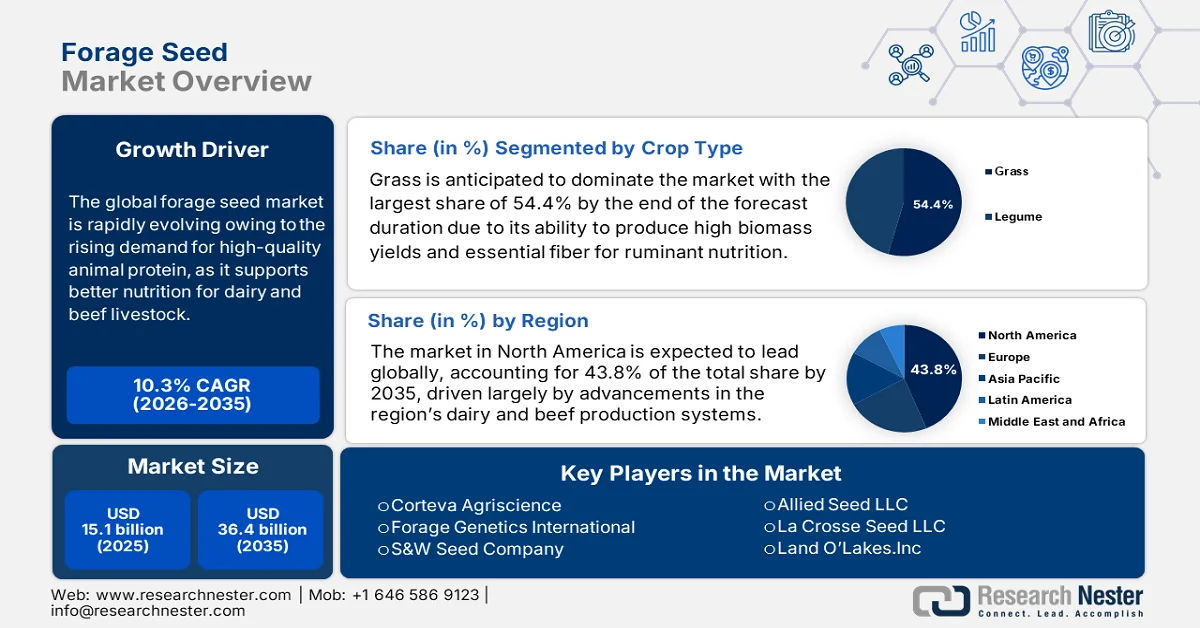
The global forage seed market is rapidly evolving owing to the rising demand for high-quality animal protein, as it supports better nutrition for dairy and beef livestock. In this context, governments across most nations are making generous investments, encouraging more players to operate in this field. According to the USDA report, which was published in November 2025, its National Institute of Food and Agriculture (NIFA) allocated a total amount of USD 3.7 million to five projects under the Alfalfa Seed and Alfalfa Forage Systems (ASAFS) program by targeting improvements in alfalfa seed and forage production. These grants are highly focused on enhancing yields and quality through plant breeding and management practices, optimizing harvest and storage systems, including automation, and developing methods to estimate forage yield and quality to support livestock feed sectors, hence positively impacting the forage seed market’s growth.
Furthermore, there has been a shift towards improved hybrid and drought-tolerant seed varieties to ensure a consistent feed supply under most challenging climate conditions, making it suitable for accelerating the forage seed market growth globally. Ministry of Fisheries, Animal Husbandry & Dairying in July 2025 revealed that the government of India has been proactively promoting climate-resilient fodder varieties and advanced breeding programs with the main aim to support livestock productivity in drought-prone and climate-vulnerable regions. It stated that Forage Pearl Millet variety 16ADV0111, which was released in 2024, is tolerant to drought and biotic stresses and recommended across multiple states for dairy and livestock systems. Also, these efforts are complemented by initiatives such as the Rashtriya Gokul Mission and the National Livestock Mission, which provide genetic upgradation, fodder development, and infrastructure support to dairy farmers, hence denoting a huge growth opportunity for the market’s growth and exposure.
Key Forage Seed Market Insights Summary:
Regional Highlights:
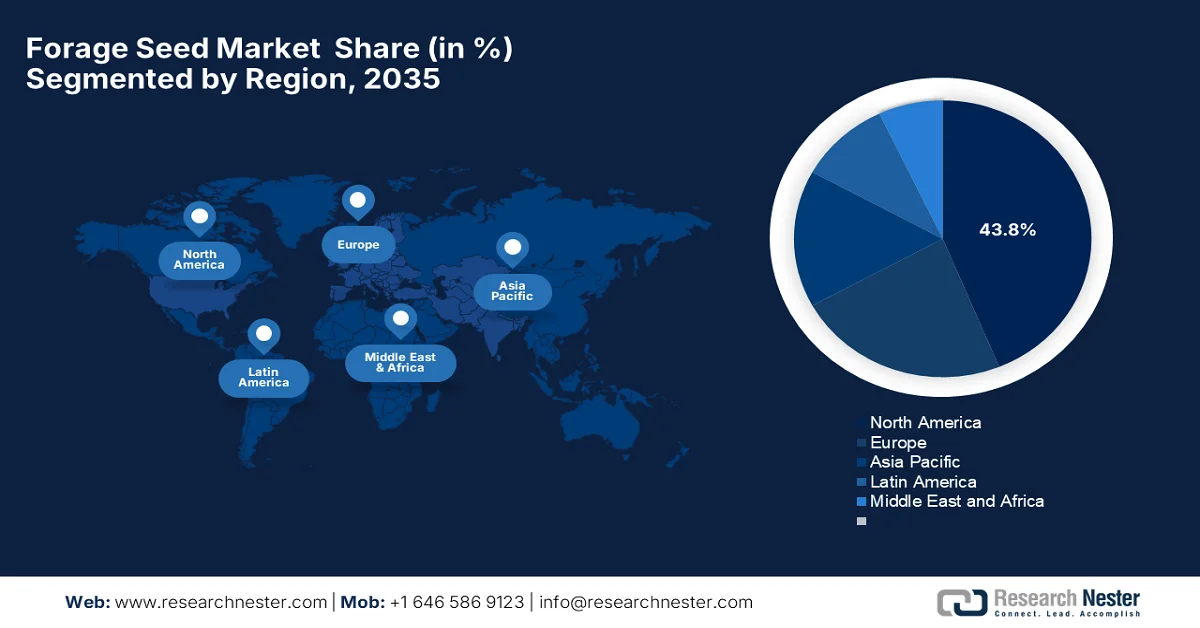
- North America is anticipated to command a 43.8% share of the forage seed market by 2035, reinforced by advancements in dairy and beef production systems together with strong research infrastructure and widespread adoption of improved forage varieties.
- Asia Pacific is projected to witness notable expansion in the market during 2026-2035 as livestock system modernization and policy initiatives supporting improved forage cultivation accelerate demand for quality feed crops.
Segment Insights:
- Grass is projected to dominate the forage seed market with a 54.4% share by 2035, attributed to its high biomass productivity and essential fiber contribution supporting ruminant nutrition.
- Alfalfa is expected to secure a notable revenue share by 2035, propelled by its high protein content and widespread use in dairy and beef feed systems.
Key Growth Trends:
- Expansion of livestock & dairy industries
- Technological advances in seed breeding
Major Challenges:
- Climate variability and extreme weather
- Limited genetic diversity and breeding constraints
Key Players: Corteva Agriscience (U.S.), Royal Barenbrug Group (Netherlands), Forage Genetics International (U.S.), S&W Seed Company (U.S.), Allied Seed LLC (U.S.), La Crosse Seed LLC (U.S.), Land O’Lakes, Inc. (U.S.), Ampac Seed Company (U.S.), Millborn Seeds, Inc. (U.S.), Pennington Seed, Inc. (U.S.), Grassland Oregon Inc. (U.S.), DLF Seeds A/S (Denmark), RAGT Semences (France), Groupe Limagrain (France), BrettYoung Seeds Limited (Canada), PGG Wrightson Seeds (New Zealand), Advanta Seeds (UPL Group - India), Foragen Seeds (India), BioLumic (New Zealand), Sakata Seed Corporation (Japan), Takii & Co., Ltd. (Japan).
Global Forage Seed Market Forecast and Regional Outlook:
Market Size & Growth Projections:
- 2025 Market Size: USD 15.1 billion
- 2026 Market Size: USD 16.6 billion
- Projected Market Size: USD 36.4 billion by 2035
- Growth Forecasts: 10.3% CAGR (2026-2035)
Key Regional Dynamics:
- Largest Region: North America (43.8% Share by 2035)
- Fastest Growing Region: Asia Pacific
- Dominating Countries: United States, China, Germany, Canada, France
- Emerging Countries: India, Japan, Brazil, Australia, South Korea
Last updated on : 9 March, 2026
Forage Seed Market - Growth Drivers and Challenges
Growth Drivers
- Expansion of livestock & dairy industries: The rise in livestock populations in the emerging nations efficiently boosts the demand for nutrient-rich forage seeds to support larger herds and improve feed efficiency. According to the official statistics published by OECD in July 2025, the OECD‑FAO agricultural outlook 2025-2034 projects that the worldwide milk production will grow at 1.8% per year. Rising incomes and urbanization in emerging regions are expected to increase per capita consumption of fresh dairy products to 30 kg in India and 46 kg in Pakistan. From a strategic perspective, this expansion of the dairy and livestock sectors underscores that there will be a heightened demand for high-quality feed and forage seeds to sustain this huge production, hence benefiting the forage seed market.
- Technological advances in seed breeding: Innovations such as genetic improvements, hybridization, seed coatings, and precision seed genetics are boosting yields, stress resistance, and nutritional value. Based on these benefits, there is a lucrative growth opportunity for the forage seed market. As per the article by Frontiers Organization in March 2024, its study has demonstrated that multi-trait-based stability selection methods, which include MGIDI, MTSI, MTMPS, and FAI-BLUP, have the potential to identify high-performing forage sorghum genotypes with enhanced yield and stress resilience across different types of environments. It also notes that, evaluating 95 genotypes in multiple seasons in India, the study observed significant genetic gains in dry and green forage yield, plant height, and other important traits by maintaining stability across environments. Therefore, these techniques underscore the potential to accelerate the development of climate-resilient, high-yielding forage varieties, providing encouraging opportunities for the pioneers in this market.
- Growing global forage seed exports: The trade activities across major nations are also a great revenue booster for the forage seed market. Countries beyond the top exporters are also contributing to the market upliftment, reflecting rising demand for feed. According to the official trade data kept forward by WITS, in 2024, Brazil exported a total of USD 62.41 million worth of seeds, Italy shipped 15.04 million kg, which was valued at USD 39.28 million, and Canada and Poland contributed 8.94 million kg (USD 27.93 million) and 14.04 million kg (USD 24.96 million). Therefore, this steady expansion of forage seed exports highlights there is a growing investment in livestock feed production and the strategic importance of these seeds to support global dairy and meat industries, hence denoting a positive market outlook.
Top Forage Seed Exporting Countries in 2024 by Trade Value and Volume
|
Reporter |
Trade Value (1000 USD) |
Quantity (Kg) |
|
France |
21,342.17 |
5,127,160 |
|
Hungary |
15,763.41 |
7,010,090 |
|
New Zealand |
10,938.47 |
2,487,530 |
|
Czech Republic |
8,179.29 |
2,874,770 |
|
Belgium |
7,961.17 |
10,448,300 |
|
Lithuania |
7,448.77 |
3,756,490 |
|
Switzerland |
7,301.83 |
1,054,970 |
|
Argentina |
5,800.99 |
3,543,490 |
|
Turkey |
5,642.82 |
8,876,690 |
|
Portugal |
4,306.72 |
1,592,330 |
Source: WITS
Challenges
- Climate variability and extreme weather: The forage seed market faces major challenges influenced by the changing climatic conditions and weather conditions such as droughts, floods, and heatwaves. These conditions can negatively impact seed germination, crop yields, as well as quality of forage. On the other hand, the aspect of unpredictable weather patterns also severely complicates breeding programs, as selecting stable and high-performing genotypes becomes more difficult. Farmers in regions with variable rainfall or temperature fluctuations might find it challenging to maintain consistent forage production. In addition, climate-induced pest and disease outbreaks can also impact the forage crops, thereby increasing the risk for producers and suppliers, causing obstacles to forage seed market expansion.
- Limited genetic diversity and breeding constraints: Another major roadblock causing hindrance in the forage seed market is the limited availability of genetically diverse seed varieties that are suitable for specific climates and soils. Most of the forage species have been bred for high-yielding, single-trait performance by neglecting traits such as stress tolerance, nutrient content, or adaptability to certain lands. Therefore, these limited genetic resources hinder the development of new varieties, ultimately slowing innovation and the ability to respond to evolving market demands. Meanwhile, the small-scale breeding programs, especially in emerging regions, face resource constraints, restricting access to advanced genotypes. As a result, farmers face risks of crop failure and reduced feed quality, limiting the adoption of improved forage seeds.
Forage Seed Market Size and Forecast:
| Report Attribute | Details |
|---|---|
|
Base Year |
2025 |
|
Forecast Year |
2026-2035 |
|
CAGR |
10.3% |
|
Base Year Market Size (2025) |
USD 15.1 billion |
|
Forecast Year Market Size (2035) |
USD 36.4 billion |
|
Regional Scope |
|
Forage Seed Market Segmentation:
Crop Type Segment Analysis
Grass is anticipated to dominate the entire forage seed market with the largest share of 54.4% by the end of the forecast duration. Their ability to produce high biomass yields and essential fiber for ruminant nutrition is the main factor driving the subtype’s leadership. Many pasture-based systems rely on grasses such as ryegrass and fescue, supported by regenerative agriculture adoption that enhances both soil health and livestock performance. According to the USDA’s FY2023 annual reports, Orchardgrass and wheatgrass play a critical role in enhancing forage production and restoring degraded rangelands in the U.S., particularly in temperate and high-elevation regions. Also, the USDA-ARS researchers have developed the winter-hardy USDA-Yeti orchardgrass and destination snake river wheatgrass, which offer improved biomass, seed yield, and stand establishment, addressing limitations of traditional varieties such as Discovery and Secar. These advancements support the livestock and dairy sectors by improving pasture resilience and promoting sustainable rangeland management.
Species Type Segment Analysis
The alfalfa is expected to attain a significant revenue share in the forage seed market by the conclusion of 2035. This alfalfa is often called the queen of forages due to its high protein content, adaptability, and deep root system, making it essential for dairy and beef feed. In April 2024 USDA disclosed that alfalfa hay is China’s primary imported forage, which is mostly valued for its high protein and quality, which supports dairy production. In 2023, China imported about 999,518 MT, wherein the U.S. supplied nearly 89.9% of imports, which were valued at USD 461.7 million, benefiting from its consistent quality and availability. Besides, the report also notes that alfalfa remains essential for improving milk yield and quality, and demand is expected to stay neutral based on factors such as falling milk prices and high production costs. Therefore, the alfalfa continues to play a crucial role in livestock nutrition, particularly for dairy and beef production.
Application Segment Analysis
In the forage seed market, cattle, which are a part of the application segment, are predicted to grow at a considerable rate over the forecasted years. The regions where dairy and beef production are at a surge increase demand for nutrient-dense forage seed varieties. This drives a higher revenue share in cattle-focused forage seed sales. Besides, the aspect of the rising investment in advanced dairy farming practices has led to increased adoption of specialized forage seeds that enhance feed efficiency and animal health. Regions with expanding feedlot operations are looking for forage varieties that improve weight gain and milk production. In addition, the integration of precision agriculture technologies enables farmers to optimize forage seed planting and yield. Market trends also show growing interest in drought-tolerant and pest-resistant forage seed cultivars that are suitable for cattle nutrition. These factors collectively contribute to the robust growth of the cattle segment within the market.
Our in-depth analysis of the forage seed market includes the following segments:
|
Segment |
Subsegments |
|
Crop Type |
|
|
Species Type |
|
|
Application |
|
|
Breeding Technology |
|

Vishnu Nair
Head - Global Business DevelopmentCustomize this report to your requirements — connect with our consultant for personalized insights and options.
Forage Seed Market - Regional Analysis
North America Market Insights
The forage seed market in North America is anticipated to lead the entire global dynamics, accounting for the largest revenue share of 43.8% by 2035. The region’s leadership is largely driven by advancements in dairy and beef production systems. The higher adoption of improved forage varieties, strong R&D infrastructure, and the presence of key market players, each with unique developmental strategies prompts a favorable business environment for the market in this region. In March 2024, Millborn Seeds reported that it had expanded its presence in North America by acquiring Union Forage in Calgary, Alberta, to solidify its vertically integrated seed supply chain. Union Forage, which is known for innovative forage solutions and a strong dealer network, will integrate Millborn’s pre-built seed mixes while continuing its existing product lineup. Hence, such tactical moves from leading players will efficiently enhance productivity and sustainability across the region.
The accelerated uptake of hybrid and coated seeds designed for superior establishment and nutrient profiles is the main factor driving growth in the U.S. forage seed market. Regulatory support for sustainable pasture systems also reshapes breeding and supply chains, wherein the significant trade activity denotes the presence of lucrative growth opportunities in the country’s market. As per the trade flow data by WITS in 2023, the U.S. has exported other seeds of forage plants totaling more than 51 million kilograms, which were valued at approximately USD 96.3 million. Besides, the major destinations were China, Mexico, and Canada, which together accounted for a significant share of the exports by both value and quantity. On the other hand, markets such as Japan and South Korea also received notable volumes, whereas countries such as France, Italy, and India imported smaller but significant volumes. Hence, these trade flows highlight the U.S.’s role as a leading global supplier of forage seeds for diverse agricultural regions.
2023 U.S. Exports of Forage Plant Seeds by Country: Value and Quantity Analysis
|
Destination Country |
Export Value (USD 1000) |
Quantity (Kg) |
|
China |
24,262.21 |
6,343,140 |
|
Mexico |
15,223.79 |
13,386,800 |
|
Canada |
11,408.71 |
10,729,900 |
|
Japan |
8,885.12 |
3,170,270 |
|
South Korea |
4,908.70 |
2,449,550 |
|
France |
3,568.38 |
1,565,180 |
|
Italy |
3,255.29 |
2,129,640 |
|
India |
2,802.76 |
325,689 |
Source: WITS
Strong government backing, institutional support for seed certification, and quality standards that ensure performance in challenging northern climates are certain drivers responsible for uplifting the forage seed market in Canada. Farmer adoption in the country is influenced by growing emphasis on soil health and pasture regeneration under cooler temperate conditions. In January 2026, the governments of Canada and Manitoba announced lower Agri Insurance premiums for 2026 to offer farmers more affordable coverage and predictable protection against crop production and quality losses caused by natural perils. As part of the program, Manitoba’s MASC is piloting the forage advantage incentive by providing a 15% discount on forage establishment insurance for perennial forage crops and additional discounts for hay and forage seed insurance in subsequent years. The program also expands coverage to new crops such as meadow fescue for seed and broadens the wildlife damage compensation program to include more species, supporting both sustainability and risk management for producers.
APAC Market Insights
The Asia Pacific forage seed market is all set to witness extensive growth, which is fueled by modernization and structural changes in terms of livestock production systems. Governments in major markets such as Japan, India, and China are proactively promoting improved feeds to support growing dairy and meat demand, compelling a shift towards intensive forage cultivation. In this regard the OECD in October 2023 stated that in MAFF allocated a total of USD 1.25 billion in December 2022, to strengthen Japan’s food security by boosting domestic agricultural production and reducing import dependence. The main focus areas were to support payments for forage crop production, promote organic fertilizer use, and establish domestic supply chains. The government’s Food Security Reinforcement Policy Framework also underscores 2030 targets such as expanding feed crop areas, increasing compost use, and halving food loss and waste.
The expansion of commercial dairy and beef enterprises drives the forage seed market in China, as there’s increasing emphasis on seed traits that support high annual forage yields. The domestic industry is also looking for traits that are associated with carbon efficiency and integration into broader national food security objectives. In this regard, the country’s government in November 2024 reported its plans to expand forage grass cultivation to 9 million hectares by 2030 by promoting domestic production, improving dietary supply for dairy and cattle products, and utilizing idle, saline-alkali, and marginal lands. Besides, the policy is mainly focused on developing high-yield, high-protein, stress-tolerant forage grass varieties and boosting domestic seed production to cover 75% of demand. Hence, this showcases that there is a huge growth opportunity for the forage seed market expansion in China.
The need to address the fodder deficits that challenge one of the world’s largest milk production systems is the main factor driving the forage seed market in India. Simultaneously, the high livestock populations, rural livelihood programs, and efforts to enhance pasture productivity through government extension support are also certain factors bolstering the country’s market growth. As per the Ministry of Fisheries, Animal Husbandry & Dairying report, which was published in February 2026, the National Livestock Mission provides 50% capital subsidy up to approximately USD 60,000 for establishing fodder value-addition units, including hay, silage, total mixed ration, fodder blocks, and fodder seed processing, grading and storage units, thereby strengthening the forage seed value chain. Also, this particular scheme supports individuals, FPOs, SHGs, cooperatives, and Section 8 companies by encouraging rural entrepreneurship across arid and hilly regions, hence denoting a positive forage seed market outlook.
Europe Market Insights
Europe forage seed market is growing significantly based on factors such as well-established agricultural frameworks that are mainly focused on quality, sustainability, and regulatory oversight of seed standards. National and region-wide policies encourage the use of cover crops and forage mixes that support soil health and biodiversity. The players in the region are innovating newer cover crops and forage seed mixtures that are aimed at serving both traditional feed demand and broader ecological goals. In December 2023, MAS Seeds announced that it had launched the MAS4 portfolio of cover crops and forage mixtures in France and Italy. The product portfolio includes specialized blends, i.e., MAS4 COVER, NUTRI, ENERGY, and EXPERT, which are designed to enhance soil protection and support sustainable agriculture. Hence, from a strategic perspective, such instances will accelerate product differentiation and value-added innovation in the region.
The focus on increasing production capabilities for the beef and dairy cattle sector effectively drives the forage seed market in Germany. The country’s market also benefits from sustainability-driven policies, which incentivize the use of cover crops and legumes with the main goal of enhancing soil health and biodiversity. In July 2024, the Federal Ministry of Food and Agriculture announced that from 2025, farmers in the country will have greater flexibility in crop rotations under the region’s agricultural subsidy framework, which allows integration of at least two main crops over three years and the use of winter cover crops to meet rotation requirements. Also, these changes aim to provide planning security while promoting sustainable practices, which include forage and grass-based crops, hence supporting soil health, biodiversity, and livestock feed systems, positively impacting forage seed market growth.
The UK forage seed market acquired a prominent position in the region, facilitated by diversified demand linked to mixed livestock farms and a strong emphasis on pasture quality. Seed use in the country is associated with the rotational practices that support soil carbon objectives and nutrient cycling, and there’s growing interest in mixes that are suitable for wetter maritime climates. Ryegrass is considered to be a cornerstone for dairy and beef production, and there is a rising focus on varieties that can withstand erratic weather patterns. In December 2025, the Agri-Food and Biosciences Institute reported that it had launched Richhill, which is a late-heading tetraploid perennial ryegrass variety developed through its DAERA-funded Grass Breeding Programme. Besides, Richhill delivers high yields and quality forage for both grazing and silage, topping UK and Scotland recommended grass lists and exemplifying climate-resilient, high-performance forage suited to UK livestock systems.
Key Forage Seed Market Players:
- Corteva Agriscience (U.S.)
- Royal Barenbrug Group (Netherlands)
- Forage Genetics International (U.S.)
- S&W Seed Company (U.S.)
- Allied Seed LLC (U.S.)
- La Crosse Seed LLC (U.S.)
- Land O’Lakes, Inc. (U.S.)
- Ampac Seed Company (U.S.)
- Millborn Seeds, Inc. (U.S.)
- Pennington Seed, Inc. (U.S.)
- Grassland Oregon Inc. (U.S.)
- DLF Seeds A/S (Denmark)
- RAGT Semences (France)
- Groupe Limagrain (France)
- BrettYoung Seeds Limited (Canada)
- PGG Wrightson Seeds (New Zealand)
- Advanta Seeds (UPL Group - India)
- Foragen Seeds (India)
- BioLumic (New Zealand)
- Sakata Seed Corporation (Japan)
- Takii & Co., Ltd. (Japan)
- Company Overview
- Business Strategy
- Key Product Offerings
- Financial Performance
- Key Performance Indicators
- Risk Analysis
- Recent Development
- Regional Presence
- SWOT Analysis
- DLF Seeds A/S is identified as one of the worldwide leaders in forage and turf seed production, that is operating in many countries with a strong emphasis on grass, clover, alfalfa, and cover crop genetics. The company is well known for extensive R&D and expanding regional production facilities with the main aim of serving global livestock and turf markets.
- Royal Barenbrug Group has built its presence from a century of breeding knowledge with a growing international distribution network. The company is mainly focused on forage and turf seed varieties that offer adaptability and nutritional value, targeting dairy, beef, and equine sectors.
- Allied Seed LLC is identified as one of the prominent forage seed suppliers from North America, and it emphasizes customized seed blends and suitable forage solutions. The company leverages strong regional dealer networks and agronomic support to work for different livestock and environmental seeding applications.
- S&W Seed Company is a specialist player in this field, which has expertise in advanced forage genetics, particularly in sorghum and hybrid forage crops. The company makes strong investments in proprietary trait technologies and expanded market access across semi-arid regions.
- Corteva Agriscience is a part of a major agribusiness group, and it develops forage seed lines with a great emphasis on genetics, hybrid performance, and integration with broader crop management technologies. The company benefits from a global reach and R&D scale allow it to support livestock producers with high-yield forage solutions.
Below is the list of some prominent players operating in the global forage seed market:
The global forage seed market is moderately fragmented, which hosts both multinational agribusinesses and regional players who are competing in categories such as alfalfa, clover, ryegrass, and sorghum. Key pioneers in this field are focused mainly on advanced breeding programs, hybrid seed development, and climate-adapted varieties to meet livestock nutrition. Both national and internationally operating companies are expanding their presence through tactical acquisitions, international distribution partnerships, and R&D collaborations. For instance, in March 2024, Millborn Seeds announced that it had acquired Luhrs Certified Seed in Imperial, Nebraska, with the main goal of expanding its production capacity and strengthening its footprint across the Western Plains. The addition enhances Millborn’s vertically integrated supply chain by adding improved cleaning lines and processing facilities to improve seed accessibility and distribution, hence positively impacting forage seed market growth.
Corporate Landscape of the Forage Seed Market:
Recent Developments
- In December 2025, BioLumic expanded its light-activated xTraits seed technology into South America by partnering with GDM, TMG, and Grupo Scheffer to test corn, with future plans for soybean and ryegrass to enhance the crop yield.
- In August 2025, DLF announced the launch of five new turfgrass varieties, LAUTREC, MOLEKO, MELISANDRA, COPTIC, and EPOS, which are designed to enhance durability and disease resistance, followed by extensive genetic refinement and trials in Europe. The product portfolio includes perennial ryegrasses, slender creeping red fescue, and tall fescue.
- In October 2024, Millborn Seeds announced the launch of its new forage mix, OptiHarv, which is an eight-species blend designed for baleage, haylage, or grazing, offering season-long growth with high tonnage and strong nutritional performance for dairy and cattle producers.
- Report ID: 8427
- Published Date: Mar 09, 2026
- Report Format: PDF, PPT
- Explore a preview of key market trends and insights
- Review sample data tables and segment breakdowns
- Experience the quality of our visual data representations
- Evaluate our report structure and research methodology
- Get a glimpse of competitive landscape analysis
- Understand how regional forecasts are presented
- Assess the depth of company profiling and benchmarking
- Preview how actionable insights can support your strategy
Explore real data and analysis
Frequently Asked Questions (FAQ)
About this Report
Connect with our Expert


Report, 2026-2035



Copyright @ 2026 Research Nester. All Rights Reserved.
