Financial Data Services Market Outlook:
Financial Data Services Market size was valued at USD 28.1 billion in 2025 and is projected to reach USD 59 billion by the end of 2035, rising at a CAGR of 8.6% during the forecast period, i.e., 2026-2035. In 2026, the industry size of financial data services is estimated at USD 30.5 billion.
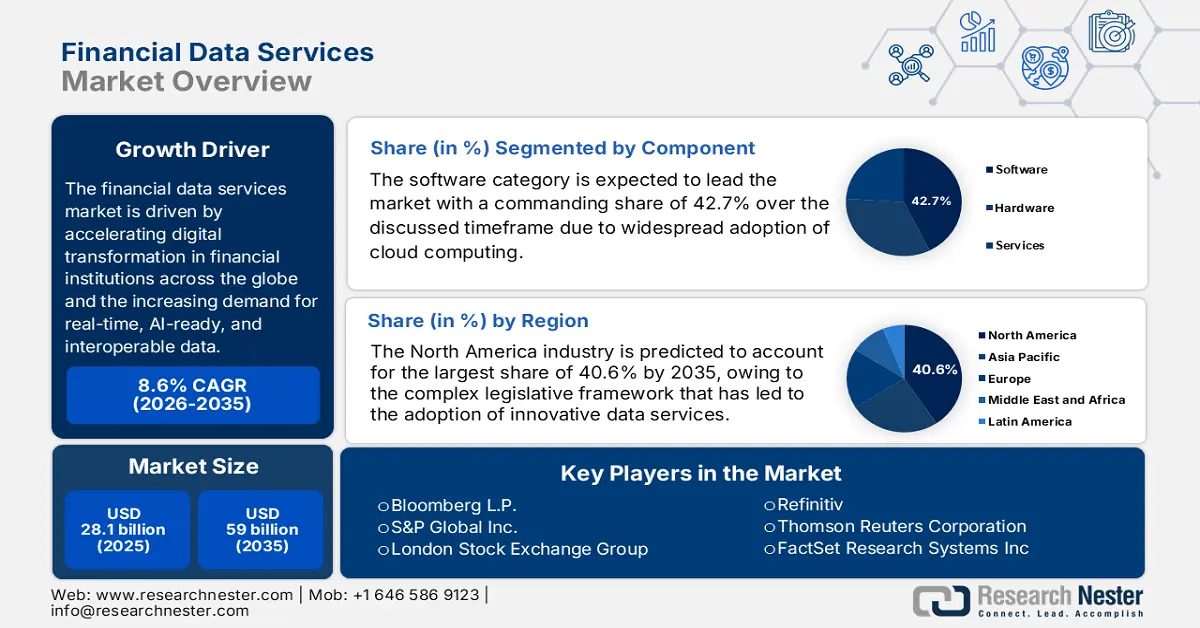
The financial data services market is driven by accelerating digital transformation in financial institutions across the globe and the increasing demand for real-time, AI-ready, and interoperable data. As per the article published by the International Monetary Fund in October 2025, its Financial Access Survey and the World Bank’s Findex observed a rapid digital adoption, particularly in emerging markets, wherein the mobile money agents in Sub-Saharan Africa nearly doubled, and digital financial transactions rose from 55 to 251 per adult in a span of seven years. It also mentioned that non-branch retail outlets in Latin America and the Caribbean have also expanded, while POS access points have surged globally, owing to e-commerce and digital payments. Hence, this expansion elevates financial data services market potential by increasing demand for financial data services, analytics, and technology solutions across banks, fintechs, and enterprises.
Furthermore, the agencies such as the Ministry of Statistics and Programme Implementation in India are constantly highlighting the importance of harmonized financial‑sector statistics, by highly recommending integration of banking, external sector, and payment‑system data for better macroeconomic stability as well as policymaking. In August 2023, it was also revealed that the country’s National Policy on Official Statistics aims to strengthen the statistical system by identifying core data across national income, banking, capital markets, and social indicators. Besides, the policy emphasizes collaboration among government agencies and stakeholders, thereby promoting data sharing, harmonization, and coordination to improve both data quality and accessibility. In addition, by creating a statistical infrastructure, it supports financial institutions, analysts, and service providers in developing targeted solutions, enhancing the growth potential of the financial data services market in the upcoming years.
Key Financial Data Services Market Insights Summary:
Regional Insights:
- By 2035, North America is projected to secure a 40.6% share in the financial data services market, propelled by its complex legislative framework and strong financial infrastructure.
- Across Asia Pacific, the market is set to expand rapidly through 2026-2035, supported by accelerating financial-sector digitalization and the rise of mobile payments.
Segment Insights:
- The software segment in the financial data services market is forecast to command a 42.7% share by 2035, driven by the widespread adoption of cloud computing.
- The banking segment is expected to capture a lucrative revenue share over 2026-2035, owing to the massive volumes of transactional data generated through connected banking services.
Key Growth Trends:
- Rising data volumes
- Regulatory compliance
Major Challenges:
- Data fragmentation
- Regulatory pressure
Key Players: Bloomberg L.P. (U.S.), S&P Global Inc. (U.S.), London Stock Exchange Group - LSEG (U.K.), Refinitiv, an LSEG Business (U.K.), Thomson Reuters Corporation (Canada), FactSet Research Systems Inc. (U.S.), Moody’s Corporation (U.S.), Morningstar, Inc. (U.S.), ICE Data Services - Intercontinental Exchange (U.S.), MSCI Inc. (U.S.), Nasdaq, Inc. (U.S.), Fitch Group – Hearst Corporation (U.S.), Nikkei Inc. / QUICK Corp. (Japan), Six Group AG (Switzerland), Deutsche Börse Group (Germany).
Global Financial Data Services Market Forecast and Regional Outlook:
Market Size & Growth Projections:
- 2025 Market Size: USD 28.1 billion
- 2026 Market Size: USD 30.5 billion
- Projected Market Size: USD 59 billion by 2035
- Growth Forecasts: 8.6% CAGR (2026-2035)
Key Regional Dynamics:
- Largest Region: North America (40.6% Share by 2035)
- Fastest Growing Region: Asia Pacific
- Dominating Countries: United States, China, United Kingdom, Germany, Japan
- Emerging Countries: India, South Korea, Singapore, Brazil, United Arab Emirates
Last updated on : 12 December, 2025
Financial Data Services Market - Growth Drivers and Challenges
Growth Drivers
- Rising data volumes: Financial institutions across the world are readily adopting digital banking, online transactions, mobile‑banking, and other digital financial services, which are increasing the data volumes, providing an encouraging opportunity for the financial data services market. In April 2025, the Reserve Bank of India notes that the growth of digital banking has increased risks of cyber-attacks, fraud, data breaches, and operational failures, which reflects the rising volumes of digital transactions and data. Therefore, to manage this, RBI’s July 2024 master directions on fraud risk management necessitate banks to set up specialized committees to monitor fraud and report incidents properly to law enforcement, demonstrating the recognition of the growing data handling burden on banks, thereby underscoring the need for robust financial data services.
- Regulatory compliance: There has been an increasing regulatory scrutiny, coupled with anti-money laundering requirements, data‑governance, and reporting obligations globally, heightening the demand in the financial data services market. In September 2024, Oracle announced its financial crime and compliance management monitor cloud service, which enables banks, fintechs, and other financial institutions to gain a centralized view of their FCCM efforts. Besides, the solution offers interactive visualizations, drill-down capabilities to help identify potential financial crime risks, manage compliance, and meet AML regulatory requirements. It provides KPIs to allow institutions to proactively assess and address risks across business units by demonstrating compliance with regulators. Hence, this cloud service addresses the growing transaction volumes and the need for more efficient and transparent compliance operations.
- Rise of fintech open banking: Expansion of fintech firms and emerging collaborations between financial institutions and fintech startups are creating strong demand for data‑services to support digital lending, payments, wealth‑management, and other fintech-driven offerings. Testifying to this, Open Banking Limited in September 2025 reported that in the U.K., open banking adoption reached 15.16 million users in July, which marks one out of three adults, with services used being identified to be a record 2.04 billion times. It also mentioned that payments are the primary driver, that is, 29.89 million transactions and an increasing uptake of variable recurring payments across sectors such as retail, travel, and tax. Furthermore, the surge reflects strong consumer demand, whereas strategic activities from both public and private organizations are driving innovation and growth in the financial data services market across key economies.
Key Global Financial Inclusion and Digital Payments Statistics 2021
|
Category |
Statistic |
Region / Country |
|
Global account ownership |
76% of adults have an account |
Global |
|
Countries with strong growth |
34 countries saw double-digit increases |
Global |
|
First-time digital merchant payments |
40% of adults made their first digital payment |
Low & middle-income economies (ex-China) |
|
First-time digital utility bill payments |
> one-third made their first digital utility payment |
Low & middle-income economies |
|
First-time digital merchant payments |
>80 million adults made their first digital merchant payment |
India |
|
First-time digital merchant payments |
>100 million adults made their first digital merchant payment |
China |
|
Adults making/receiving digital payments. |
Two-thirds of adults |
Global |
|
Account ownership |
71% of adults have an account |
Developing economies |
|
Mobile money accounts |
33% of adults have mobile money accounts |
Sub-Saharan Africa |
|
Adults receiving payments into accounts |
36% of adults |
Developing economies |
|
Use of accounts after receiving payments |
83% used accounts to make digital payments |
Developing economies |
Source: World Bank Global Findex 2021
Key Financial Data Services Initiatives and Market Opportunities
|
Organization |
Description |
Year |
Market Opportunity |
|
Infront AS & Nordea Bank |
Partnership to provide Nordic fixed income market data for wealth and asset managers |
2025 |
Expands access to high-quality fixed income data across Europe, enabling enhanced portfolio management and investment decision-making |
|
DFS - Jan Samarth Startup Portal |
Digital platform for startups to access credit through PSBs |
2025 |
Facilitates financial data integration for loan processing, improving transparency and speed for startup financing |
|
Fujitsu & FICO |
Partnership to provide predictive analytics, fraud prevention, and decisioning solutions to Japan-based financial institutions |
2025 |
Enables advanced financial analytics, risk management, and digital transformation in banking and financial services |
|
EU FIDA Framework |
Proposed framework for consumer and SME financial data access |
2024 |
Expands open finance by allowing secure sharing of nearly all financial services data |
Source: Official Press Releases
Challenges
- Data fragmentation: One of the most considerable challenges in the financial data services market is the integration complexities and fragmentation of data across multiple platforms, legacy systems, and proprietary databases. The financial institutions depend on different data feeds, references, and risk, which creates both inconsistencies and integration hurdles. Therefore, bringing these resources together necessitates heavy investments in data pipelines, normalization tools, and standards such as FDC3 or open APIs, in turn making it challenging for firms to maintain data quality, lineage, and consistency at scale. Furthermore, without unified architectures, organizations face delays in analytics and higher operational risks, negatively affecting financial data services market growth.
- Regulatory pressure: This, coupled with compliance burden, is posing a major burden for the financial data services market expansion. Financial data providers and institutions must navigate through regulatory frameworks which are covering privacy, market transparency, reporting, and data governance. Simultaneously, regulations such as GDPR, MiFID II, Basel III, and emerging AI governance rules require strict controls on factors as how data is collected, stored, used, and shared. Also, the aspect of compliance demands continuous updates to data processes, increased auditability, and more robust risk management systems. Since there has been a rapid progress in cloud adoption and AI integration acceleration, regulators impose additional scrutiny on model explainability, security, and cross-border data flows, thereby slowing down innovation.
Financial Data Services Market Size and Forecast:
| Report Attribute | Details |
|---|---|
|
Base Year |
2025 |
|
Forecast Year |
2026-2035 |
|
CAGR |
8.6% |
|
Base Year Market Size (2025) |
USD 28.1 billion |
|
Forecast Year Market Size (2035) |
USD 59 billion |
|
Regional Scope |
|
Financial Data Services Market Segmentation:
Component Segment Analysis
The software category is expected to lead the financial data services market with a commanding share of 42.7% over the discussed timeframe. The segment’s dominance in this field is effectively attributable to the widespread adoption of cloud computing, which is allowing financial institutions to scale operations without heavy infrastructure investment. Simultaneously, the integration of AI and machine learning into software platforms is enabling predictive analytics, fraud detection, and personalized customer insights. Real-time data processing and visualization tools are highly essential to manage risk and meet compliance requirements even more efficiently. In addition, there has been a growing demand for proper integration with fintech applications and open banking platforms. Hence, this combination of scalability, automation, and intelligence is reinforcing software’s leading position in the financial data services market.
Application Segment Analysis
In the financial data services market, the banking segment based on application is expected to capture a lucrative revenue share over the forecasted years. The banking sector drives financial data services adoption owing as millions of consumers and businesses across the world are currently reliant on connected banking services, generating massive volumes of transactional data, in turn requiring analysis and secure handling. The Government of India in July 2025 reported that the country’s UPI has become a global leader in terms of real-time payments, which is processing more than 18 billion transactions and ₹24 lakh crore (USD 26.6 billion) in June 2025 alone, surpassing Visa in daily transaction volume. It also mentioned that by connecting 675 banks and enabling interoperability across apps, UPI drives financial inclusion, convenience, and a shift toward a cashless economy for 491 million individuals and 65 million merchants, hence denoting a wider segment scope.
Service Segment Analysis
By the conclusion of 2035, the analytics & reporting services will grow at a considerable rate in the financial data services market. The growth of the segment is highly subject to the exponential increase in digital transactions across financial institutions, creating a need to process and analyze vast amounts of data more efficiently. Simultaneously, the existence of regulatory compliance obligations, such as anti-money laundering and fraud monitoring, requires robust reporting capabilities to satisfy both internal governance and external oversight. In addition, banks and financial institutions depend on these services to detect anomalies, assess risk exposure, and make data-driven strategic decisions. Furthermore, the advancements in terms of AI and machine learning will enhance predictive analytics, enabling more proactive risk management and operational efficiency.
Our in-depth analysis of the financial data services market includes the following segments:
|
Segment |
Subsegments |
|
Component |
|
|
Application |
|
|
Service |
|
|
Deployment Mode |
|
|
Analytics |
|
|
Investment Platforms |
|

Vishnu Nair
Head - Global Business DevelopmentCustomize this report to your requirements — connect with our consultant for personalized insights and options.
Financial Data Services Market - Regional Analysis
North America Market Insights
By 2035, North America is projected to hold the largest revenue share of 40.6% in the financial data services market. This growth is propelled by several factors, which include the complex legislative framework that has led to the adoption of innovative data services and a very strong financial infrastructure. For instance, in October 2022, dxFeed announced the launch of the Bixie Index, which is a USDX crypto-twin designed to measure Bitcoin’s value relative to a basket of over 100 cryptocurrencies, using proprietary analytics and market data. It also mentioned that this index moves away from dollar-centric valuations, leveraging historical and real-time data to provide accurate crypto-to-crypto valuations. Hence, the launch highlights the domestic firm’s growing focus on index management and advanced financial data services for institutional clients and fintechs, making it suitable for overall financial data services market growth.
The U.S. represents one of the largest landscapes for the financial data services market since it hosts a large number of financial institutions, tech firms, which in turn are impacting the adoption of blockchain. In addition, the country’s market also benefits from regulatory compliance and the heightened demand for digital payment solutions. In December 2025, IBM announced that it acquired Confluent for USD 11 billion to create an end-to-end smart data platform for enterprises that leverages AI and generative applications. The company also notes that Confluent’s platform is built on Apache Kafka, enabling secure and real-time data flow across cloud and on-premises environments, addressing the growing demand for connected and trusted data. Also, the acquisition aligns with IBM’s hybrid cloud and AI strategy, and is expected to drive synergies, accelerate revenue growth, and be accretive to EBITDA within the first year.
Canada is efficiently growing in the regional financial data services market owing to the increasing digitization of banking and investment activities, the adoption of advanced analytics, and government initiatives promoting open banking and data interoperability. Also, there has been a heightened demand for cloud-based services and automated reporting tools, which is encouraging continued innovation in data analytics and financial intelligence solutions. In this context, MindBridge in April 2022 announced that it had partnered with Equifax Canada to develop an AI-based solution for early detection of synthetic identity fraud by integrating the firm’s risk discovery platform with Equifax’s credit reporting data and analytics. Besides, the solution identifies anomalous patterns and suspicious behavior, thereby providing insights to help businesses manage credit risk and protect consumers. Hence, such collaborations in the country reflect the strong adoption of financial data services to mitigate sophisticated fraud.
APAC Market Insights
Asia Pacific is likely to register the fastest growth in the financial data services market from 2026 to 2035. The growth of the sector in this region is backed by the digitalization of the financial sector and the advent of mobile payments. The region also benefits from the larger population base, which is creating heightened demand for financial data services. The Asian Development Bank in October 2025 declared that it signed a cooperation agreement with the Japan Financial Services Agency with a prime goal of strengthening financial sector development in the Asia Pacific, focusing on technology for financial inclusion, capital market growth, and resilient financial systems. Besides, the partnership aims to connect investors with regional opportunities, unlock market-based financing, and foster sustainable economic growth, hence promoting sustainable finance to channel regional savings into development.
China is readily blistering growth in the regional financial data services market owing to the government’s emphasis on digital finance, data governance, and financial technology innovation. Regulators in the country are promoting secure, cross-institutional data sharing, and financial institutions rely on data-driven solutions for credit assessment and investment analytics. The constant expansion of data-exchange platforms and the formalization of data as a strategic asset are also fueling demand for services. In August 2025, GLP Pte Ltd reported that it secured an investment from Zhejiang government-affiliated entities to scale up its China data center by enhancing infrastructure for cloud computing, AI, and digital services. Besides, the partnership supports expansion across 20 data centers and leverages Zhejiang’s growing digital economy and AI ecosystem, including robotics and large language model applications, hence enhancing computing infrastructure, enabling more robust and scalable financial data services in the country.
India is growing exponentially in the financial data services market due to its strong digital finance ecosystem, regulatory initiatives, and widespread fintech adoption. The country’s market also benefits from government-backed frameworks and initiatives to standardize data reporting and promote secure sharing across banks, NBFCs, and fintechs are creating encouraging opportunities for analytics providers, data platforms, and AI-based data solutions. In September 2025, Tata Consultancy Services announced that it had partnered with the Government of Odisha to implement IFMS 3.0, which is a next-generation AI-enabled integrated financial management system that automates public finance workflows and efficiently enhances decision-making. The firm also stated that the system leverages its AI Workbench to apply analytics and machine learning, thereby enabling real-time monitoring, reporting, and AI-assisted interactions for users, hence strengthening financial data integration and supporting data-driven governance.
UPI and Digital Payments: Statistical Indicators for the Financial Data Services Market (As of 2025)
|
Category |
Statistic |
|
Monthly UPI Transactions (Volume) |
>20 billion |
|
Monthly UPI Transaction Value |
₹24.85 lakh crore (USD 276.2 billion) |
|
IMF Reported Monthly Transactions |
>19 billion |
|
UPI Share of India’s Digital Transactions |
~85% |
|
Revised UPI P2M Transaction Limit |
₹10 lakh/day (USD 11,120) |
|
Bank Account Penetration (Adults) |
>89% |
Source: Government of India
Europe Market Insights
Europe is also a central player in the international financial data services market, highly subject to its focus on data privacy, investments in advanced technologies, and the heightened demand for RegTech solutions. In addition, the extended focus on data privacy and security is efficiently fueling the adoption of cybersecurity. The Council of the European Union in December 2024 reported that it agreed on a framework for financial data access to make consumers’ financial data more accessible among financial institutions, which fosters transparency and fair competition. Besides, the initiative aims to enhance personalized financial services, improve access to finance for individuals and SMEs, and ensure customers retain control over their data. Furthermore, this complements ongoing digital reforms in the regional financial sector, hence supporting data-driven business models, making it suitable for overall financial data services market growth.
In Germany, the financial data services market is rapidly growing on account of open banking initiatives, frameworks, such as GDPR and BaFin guidelines, which ensure that data privacy and security are maintained. In this regard German Banking Industry Committee (BVR, DSGV, VÖB, and the Association of German Banks) in January 2025 announced that it has launched the giroAPI, which marks the first standardized account API in Europe, enabling third-party providers to access account information and simplify payments with client consent. Based on the Berlin Group’s openFinance API framework and PSD2 technical standards, giroAPI aims to drive more innovations in payment and account services by modernizing Germany’s financial systems. Also, the initiative plans to expand into areas such as request-to-pay and open finance, thereby supporting collaboration between banks and third-party providers to enhance efficiency and competitiveness in this region.
The U.K. is maintaining a strong position in the financial data services market, owing to the technological integration, with a strong emphasis on cloud-based financial platforms. Providers in the country are delivering a range of services, which include credit scoring, fraud detection, financial reporting, and predictive analytics, to both consumers and businesses. According to the article published by the country’s Competition and Markets Authority in September 2024, it confirmed the full completion of the open banking roadmap, in which all nine mandated banking providers are delivering the required functionality, including variable recurring payments for sweeping. Besides, this milestone enables enhanced financial control, smarter payments, and greater collaboration between banks and third-party providers, thereby fostering progress across the UK’s financial sector. Hence, the achievement positions the country for the next phase of financial innovation, thereby expanding opportunities for fintechs.

Key Financial Data Services Market Players:
- Bloomberg L.P. (U.S.)
- Company Overview
- Business Strategy
- Key Product Offerings
- Financial Performance
- Key Performance Indicators
- Risk Analysis
- Recent Development
- Regional Presence
- SWOT Analysis
- S&P Global Inc. (U.S.)
- London Stock Exchange Group - LSEG (U.K.)
- Refinitiv, an LSEG Business (U.K.)
- Thomson Reuters Corporation (Canada)
- FactSet Research Systems Inc. (U.S.)
- Moody’s Corporation (U.S.)
- Morningstar, Inc. (U.S.)
- ICE Data Services - Intercontinental Exchange (U.S.)
- MSCI Inc. (U.S.)
- Nasdaq, Inc. (U.S.)
- Fitch Group – Hearst Corporation (U.S.)
- Nikkei Inc. / QUICK Corp. (Japan)
- Six Group AG (Switzerland)
- Deutsche Börse Group (Germany)
- Bloomberg L.P. is identified as the dominating pioneer in the financial data services market through its integrated Terminal ecosystem, which combines real-time data, analytics, trading tools, and proprietary news. The company is making extensive investments in AI-driven analytics, alternative datasets, and workflow automation to reinforce its leadership, helping preserve its strong consumer base across trading, research, and risk functions.
- S&P Global Inc. is yet another strong force in this field and is a leading provider of credit ratings and financial intelligence, serving enterprises, governments, and investment markets across the globe. The company’s advantage is highly subject to its proprietary indices, such as the S&P 500, credit rating authority, and deep quantitative datasets, which readily strengthen its position as a trusted source for decision-critical financial information.
- London Stock Exchange Group has emerged as a major global data powerhouse that has combined extensive financial data services market infrastructure. The company’s strategy lies around the LSEG Everywhere initiative, which efficiently expands AI-ready content and forms partnerships with OpenAI, Microsoft, Snowflake, and other cloud and AI providers. Furthermore, LSEG’s global footprint and regulatory expertise are also solidifying its competitive positioning.
- Refinitiv is a core pillar of LSEG’s data services, which provides market data, trading platforms, and risk intelligence to institutions worldwide. The firm is best known for products such as Eikon, DataScope, and World-Check, and it continues to invest in open APIs, AI-driven analytics, and cloud-native data access. In addition, as part of LSEG, Refinitiv benefits from increased scale, distribution capabilities, and technology partnerships that strengthen its role in the global landscape.
- FactSet Research Systems Inc. leverages a unified, user-friendly analytics platform, making it suitable for asset managers, investment banks, and wealth advisors. The company’s corporate strategy strongly prioritizes open data, modular solutions, and cloud-native architecture to offer integration into client workflows. Furthermore, FactSet has a strong client retention and a focus on personalized analytics, positioning itself as a predominant leader and innovation-focused competitor.
Below is the list of some prominent players operating in the global financial data services market:
The global financial data services market is dominated by pioneers that are leveraging proprietary datasets, advanced analytics, and expanding cloud-AI capabilities. Companies such as Bloomberg, LSEG, S&P Global, and FactSet are accelerating innovations in terms of generative AI, real-time analytics to strengthen customer retention. Mergers& acquisitions, partnerships with major cloud providers, and expansion into emerging markets are a few strategies opted for by these players to uplift the market growth at an extensive pace. In February 2025, State Street and SS&C Technologies announced that they are restructuring their nearly 20-year IFDS joint venture in Ireland and Luxembourg, with each company assuming direct responsibility for its respective transfer agency services. In this context, State Street will insource these capabilities for its clients, whereas SS&C will rebrand and operate the existing entities as part of its Global Investor & Distribution Solutions division, aiming to simplify operating models, maintain service continuity.
Corporate Landscape of the Financial Data Services Market:
Recent Developments
- In December 2025, LSEG announced that it entered into a collaboration with OpenAI to bring its licensed, AI-ready financial data into ChatGPT through a model context protocol connector, enabling users with LSEG credentials to access market data and analytics directly within the platform.
- In November 2025, JPXI notified that it has launched J-Quants DataCube, which is a revamped marketplace providing easy access to high-quality financial data through a one-time purchase model.
- In September 2025, the UK’s Financial Conduct Authority (FCA) announced that it had partnered with industry players to accelerate open finance, enabling consumers and SMEs to manage finances more effectively and securely.
- In June 2025, Microsoft notified that it had joined FINOS as a Platinum Member first cloud provider to sit on its Governing Board, along with GitHub, strengthening industry-wide collaboration on open-source standards in financial services. This expanded commitment supports key FINOS initiatives such as FDC3, CDM, the AI Governance Framework, and Common Cloud Controls.
- Report ID: 8310
- Published Date: Dec 12, 2025
- Report Format: PDF, PPT
- Explore a preview of key market trends and insights
- Review sample data tables and segment breakdowns
- Experience the quality of our visual data representations
- Evaluate our report structure and research methodology
- Get a glimpse of competitive landscape analysis
- Understand how regional forecasts are presented
- Assess the depth of company profiling and benchmarking
- Preview how actionable insights can support your strategy
Explore real data and analysis
Frequently Asked Questions (FAQ)
About this Report
Connect with our Expert


Report, 2026-2035



Copyright @ 2026 Research Nester. All Rights Reserved.
