Epoxidized Soybean Oil Market Outlook:
Epoxidized Soybean Oil Market size was valued at over USD 682.2 billion in 2025 and is expected to reach USD 1.78 trillion by the end of 2035, growing at a CAGR of 11.3% during the forecast period, i.e., 2026-2035. In 2026, the industry size of epoxidized soybean oil is evaluated at USD 759.2 billion.
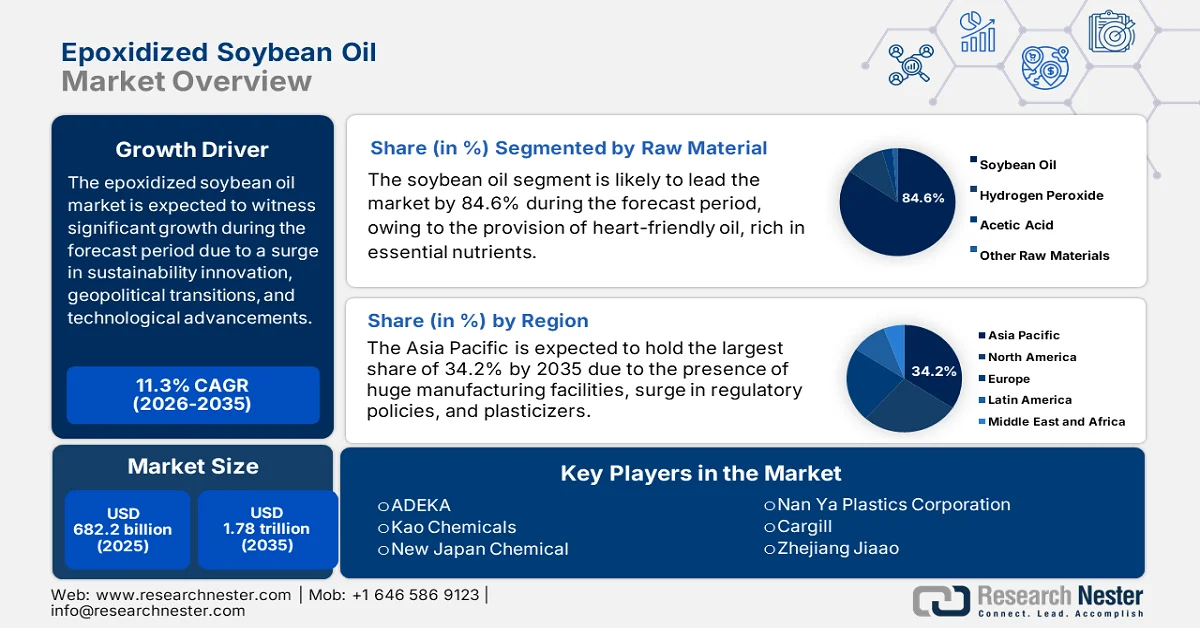
The worldwide epoxidized soybean oil market is effectively navigating a complex landscape, wherein technological innovation, sustainability imperatives, and geopolitical shifts converge with each other. Additionally, the overarching narrative centers on replacing toxic phthalates with different nuanced factors that are shaping the market’s growth. According to official statistics published by the International Institute for Sustainable Development Organization in February 2024, soy is reliably easy to double crop in the same season and is increasingly grown, owing to nutritional benefits, accounting for 20% of oil and 40% of protein content, along with affordability and versatility. Besides, presently, nearly 76% of soy production is utilized as quality and low-cost protein for animal feed, 20% is consumed as human food and edible oil products, and the remaining 4% is utilized for industrial purposes, thus driving the market expansion.
Furthermore, the integration of epoxidized soybean oil into circular economy models and waste-based feedstocks, the development of specialty-grade and high-performance soybean oil for niche applications, and the transformation of global supply chains in response to tariff measures and trade policy are a few trends for bolstering the epoxidized soybean oil market. As per an article published by Heliyon in August 2024, the increased protein content, ranging between 36% and 40%, readily makes soybean one of the most protein-rich legumes globally. Besides, the international soybean industry, which is currently valued at USD 155 billion, is projected to reach USD 278 billion by the end of 2031, along with a 6% yearly growth rate. Additionally, there has been a surge in South America, owing to a 3-fold increase in yields, along with a 200-fold expansion in cultivated land, thereby positively impacting the market’s growth.
Key Epoxidized Soybean Oil Market Insights Summary:
Regional Highlights:
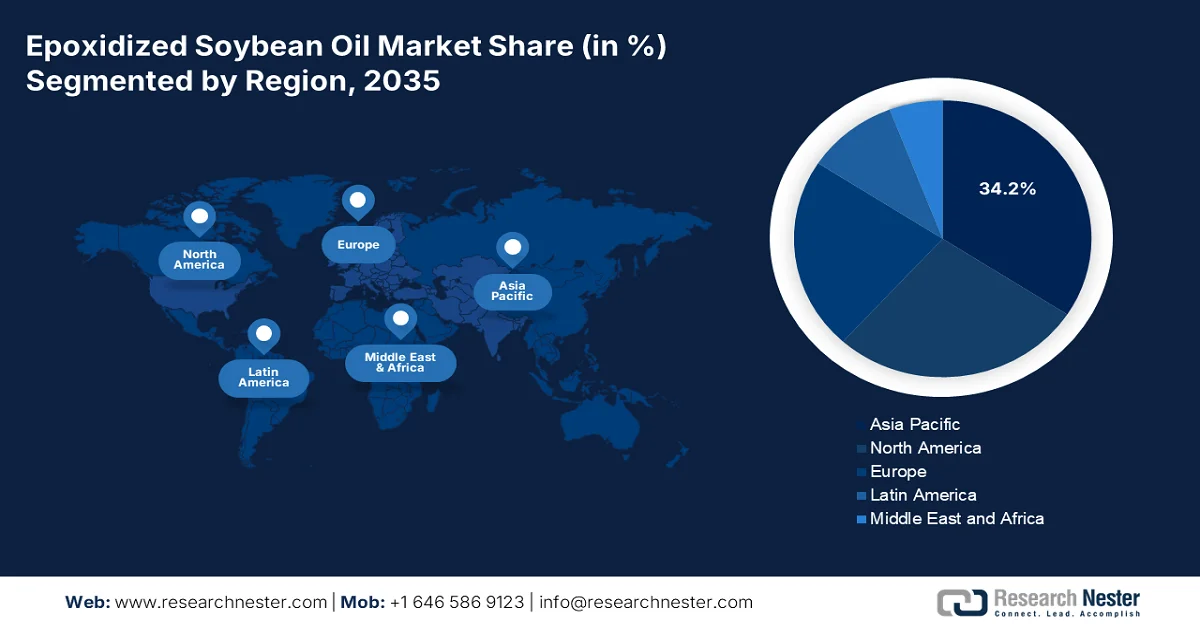
- Asia Pacific is projected to command a 34.2% share of the epoxidized soybean oil market by 2035, propelled by expanding manufacturing base, rapid industrialization, and rising regulatory transition toward phthalate-free plasticizers
- Europe is anticipated to emerge as the fastest-growing region over 2026–2035, impelled by stringent chemical safety frameworks and increasing adoption of bio-based plasticizer alternatives across industries
Segment Insights:
- In the epoxidized soybean oil market, the soybean oil sub-segment is expected to account for 84.6% share by 2035, driven by its nutritional richness and expanding global production and availability
- The plasticizer and stabilizer segment is projected to secure the second-largest share over 2026–2035, owing to its rising utilization in PVC applications alongside increasing global plastics production
Key Growth Trends:
- Expansion in pharmaceutical medical-grade applications
- Adoption of advanced epoxidation technologies
Major Challenges:
- Feedstock price volatility and supply chain instability
- Performance limitations in high-performance applications
Key Players: Arkema (France), Hairma Chemicals (China), CHS Inc. (U.S.), Galata Chemicals (U.S.), Valtris Specialty Chemicals (U.S.), Xinjinlong Chemical Additives (China), The Chemical Company (U.S.), Makwell Plasticizers Pvt. Ltd. (India), ADEKA (Japan), Kao Chemicals (Japan), New Japan Chemical (Japan), Chang Chun Group (China), Nan Ya Plastics Corporation (China), Cargill (U.S.), Zhejiang Jiaao (China), Shandong Longkou Longda Chemical (China), Baolilai Plastic Additives (China), KLJ Group (India), Vikas Ecotech (India), American Chemical Service (U.S.), ADM (U.S.), Louis Dreyfus Company (LDC) (Netherlands), Bunge (U.S.).
Global Epoxidized Soybean Oil Market Forecast and Regional Outlook:
Market Size & Growth Projections:
- 2025 Market Size: USD 682.2 billion
- 2026 Market Size: USD 759.2 billion
- Projected Market Size: USD 1.78 trillion by 2035
- Growth Forecasts: 11.3% CAGR (2026-2035)
Key Regional Dynamics:
- Largest Region: Asia Pacific (34.2% Share by 2035)
- Fastest Growing Region: Europe
- Dominating Countries: United States, China, Germany, Brazil, Japan
- Emerging Countries: India, South Korea, Mexico, Indonesia, Vietnam
Last updated on : 17 March, 2026
Epoxidized Soybean Oil Market - Growth Drivers and Challenges
Growth Drivers
- Expansion in pharmaceutical medical-grade applications: This is one of the powerful growth drivers for the epoxidized soybean oil market that is accelerating the need for non-toxic and ultra-pure materials, particularly in the healthcare industry. According to official statistics published by the Health Affairs Organization in January 2026, the healthcare expenditure, especially in the U.S., reached USD 5.3 trillion and further increased by 7.2% as of 2024, which is almost similar to the 7.4% growth in 2023. Besides, the insured share of the population has relatively remained high as of 2024, accounting for 91.85, after achieving its peak by 92.5% as of 2023. Moreover, the healthcare share of the economy surged from 17.7% in 2023 to 18% as of 2024, thereby making it suitable for bolstering the epoxidized soybean oil market globally.
- Adoption of advanced epoxidation technologies: The epoxidized soybean oil market’s growth is being proactively uplifted by technological advancements, particularly in the overall manufacturing process. As per an article published by NLM in September 2025, there has been an increase in the worldwide soybean harvested area from 23.8 Mha to 136.9 Mha as of 2024. Besides, Brazil surpassed the U.S. as one of the world’s leading soybean exporters and reached an export volume of 98.8 million tons in 2024, significantly accounting for an estimated 50% of global soybean exports. Furthermore, Argentina, the U.S., and Brazil collectively cater to a roughly 80% of worldwide soybean production, with Argentina accounting for 12%, the U.S. for 28%, and Brazil for 40%, thereby proliferating the market development.
- Surging demand in electronics and the electrical industry: A rapidly escalating growth driver for the epoxidized soybean oil market is enhancing the utilization across electronics and the electrical industry, especially for cable and wire insulation as well as jacketing. Based on government estimates published by the PIB Government in October 2025, there has been an increase in the electronics production in India by almost 6-fold from USD 21 billion to USD 122.3 billion between 2024 and 2025. Besides, there has been the creation of 2.5 million employment opportunities since the past 10 years, significantly underscoring its crucial role as one of the notable drivers of economic growth and employment. Therefore, with all these increase in the overall industry, the market is gradually gaining increased exposure globally.
Challenges
- Feedstock price volatility and supply chain instability: The most significant and persistent challenge facing the epoxidized soybean oil market is the extreme volatility in raw material prices, particularly soybean oil, which constitutes the majority of total production costs. Besides, soybean production is inherently dependent on agricultural conditions, including weather patterns, seasonal variability, and climate change impacts such as droughts and floods that directly affect yield and pricing stability. Furthermore, global supply is concentrated in just a few countries, such as the U.S., Brazil, Argentina, and China, making the market vulnerable to regional disruptions, trade policy changes, and export restrictions. The situation is compounded by intensifying competition from alternative uses of soybean oil, thus limiting the epoxidized soybean oil market growth.
- Performance limitations in high-performance applications: Despite its environmental benefits and regulatory advantages, the epoxidized soybean oil market faces significant technical limitations that prevent its adoption in certain high-value applications where synthetic alternatives continue to dominate. In automotive applications requiring extreme temperature stability, soybean oil formulations sometimes fail to meet original equipment manufacturer (OEM) specifications. This performance gap is particularly critical for under-the-hood components, interior parts exposed to temperature variations, and wiring systems that must maintain flexibility across extreme conditions.
Epoxidized Soybean Oil Market Size and Forecast:
| Report Attribute | Details |
|---|---|
|
Base Year |
2025 |
|
Forecast Year |
2026-2035 |
|
CAGR |
11.3% |
|
Base Year Market Size (2025) |
USD 682.2 billion |
|
Forecast Year Market Size (2035) |
USD 1.78 trillion |
|
Regional Scope |
|
Epoxidized Soybean Oil Market Segmentation:
Raw Material Segment Analysis
The soybean oil sub-segment, part of the raw material segment, is anticipated to garner the largest share of 84.6% in the epoxidized soybean oil market by the end of 2035. The sub-segment’s upliftment is highly driven by its importance as a heart-friendly and versatile vegetable oil, effectively rich in polyunsaturated fats, vitamin E, and omega-3 fatty acids. According to official statistics published by the USDA Government in February 2026, the worldwide soybean stocks for 2025 and 2026 account for a high level of 125.5 million metric tons, denoting a rise from 1.1 million metric tons. In addition, the global soybean production has also increased by 2.5 million metric tons to 428.2 million metric tons, with Brazil’s production expected to reach a record high of 180 million metric tons. Likewise, the production in Paraguay is projected to account for 11.5 million metric tons, thus proliferating the sub-segment’s growth.
Function Segment Analysis
Based on function, the plasticizer and stabilizer segment in the epoxidized soybean oil market is projected to hold the second-largest share during the forecast period. The segment’s growth is highly fueled by its increased valuation in the plastics sector, especially for polyvinyl chloride for acting as both a plasticizer and a stabilizer. According to official statistics published by the Journal of Environmental Management in December 2023, the yearly global production and utilization of plastics was 390 million tons, and this is further predicted to reach 1,480 million tons by the end of 2050. Besides, the weathering of plastics by different means, such as sunlight, biodegradation, abrasion, and water, results in the generation of microplastics of less than 1 μm to 5 mm. These are further broken down into small plastics, thereby making it suitable for bolstering the segment expansion.
Grade Segment Analysis
By the end of the stipulated timeline, the industrial grade sub-segment, which is part of the grade segment, is expected to account for the third-largest share in the epoxidized soybean oil market. The sub-segment’s development is effectively propelled by the grade's cost-effective formulation, characterized by specifications including oxirane oxygen content, which provides adequate performance for general-purpose applications without the premium pricing associated with higher-purity variants. Besides, industrial-grade ESBO serves as the workhorse plasticizer and stabilizer across diverse high-volume applications where extreme purity requirements are not paramount. The construction sector represents the largest consumer, utilizing industrial-grade ESBO in PVC profiles, window frames, flooring materials, cables, and hoses that require flexibility, durability, and resistance to degradation.
Our in-depth analysis of the epoxidized soybean oil market includes the following segments:
|
Segment |
Subsegments |
|
Raw Material |
|
|
Function |
|
|
Grade |
|
|
Production Process |
|
|
Application |
|
|
End use Industry |
|

Vishnu Nair
Head - Global Business DevelopmentCustomize this report to your requirements — connect with our consultant for personalized insights and options.
Epoxidized Soybean Oil Market - Regional Analysis
APAC Market Insights
The Asia Pacific in the epoxidized soybean oil market is anticipated to garner the highest share of 34.2% by the end of 2035. The market’s upliftment in the region is primarily attributed to the presence of a massive manufacturing base, rapid industrialization, and an increase in regulatory transitions towards phthalate-free plasticizers across notable economies. According to official statistics published by The Innovation in February 2026, there has been a rapid growth in soybean imports, effectively reaching an estimated 105 million tons as of 2024, along with an import dependency ratio of 85%. This significantly denotes an import volume surge from almost 12 million tons, accounting for more than 60% of worldwide imports. Besides, the reliance on imports and exports denotes an optimistic outlook for the overall epoxidized soybean oil market’s growth in the region.
2024 Soybean Export and Import Analysis in the Asia Pacific
|
Countries |
Export (USD) |
Import (USD) |
|
China |
137 million |
47.2 billion |
|
Malaysia |
8.9 million |
327 million |
|
India |
8.1 million |
407 million |
|
Indonesia |
1.8 million |
1.3 billion |
|
Japan |
1 million |
1.8 billion |
|
Singapore |
1.6 million |
- |
|
Thailand |
382,000 |
1.8 billion |
Source: OEC
The epoxidized soybean oil market in China is growing significantly, owing to generous allocation for green chemical manufacturing, the comprehensive vertical integration of domestic soybean production, expanded epoxidation infrastructure, and proximity to end user industries, including packaging, automotive, and construction. As stated in an article published by the Arkansas Cooperative Extension Service in June 2025, the country significantly imported 1.3 million metric tons of soybeans from the U.S. in April 2025. Besides, farmers in Arkansas planned to develop 3 million acres of soybeans as of 2025. Moreover, the country imported 35.2% more soybeans from the U.S., and meanwhile, Brazil-based bean imports to the country reduced by 42.5% with the same period. Despite this reduction, the market is still continuing to expand in the overall country.
The escalation in government investments, focus on research and development, expansion in the food processing sector, focus on innovation capacity, as well as an increase in the demand for food-grade packaging applications, are certain trends that are responsible for boosting the epoxidized soybean oil market in India. Based on government estimates published by Invest India in January 2026, the gross value added of the country’s food processing industry has recorded a strong expansion, rising from USD 16 billion to USD 27 billion between 2023 and 2024, fueling the industry’s sustained growth and the increased contribution to the economy. Besides, between 2024 and 2025, the country’s food exports crossed USD 49 billion, effectively underscoring robust worldwide demand and a rise in acceptance of domestic processed food products across international economies, thus driving the epoxidized soybean oil market growth.
Europe Market Insights
Europe in the epoxidized soybean oil market is expected to emerge as the fastest-growing region during the forecast period. The market’s development in the region is highly propelled by the existence of a strict chemical safety framework, an increase in plasticizers, and a surge in bio-based alternatives across sectors, such as construction materials, medical devices, automotive components, and food packaging. According to official statistics published by NLM in May 2025, the worldwide consumption of plasticizers in West Europe accounted for 14% of the total consumption. Besides, epoxidized soybean oil is considered a plasticizer in the Swiss industry, with concentrations of almost 1,170 mg/g, and these quantities are significantly greater than the regional mitigation limit of 60 mg/kg by the Europe Food Safety Authority (EFSA), thereby fueling the market exposure in the overall region.
The epoxidized soybean oil market in Germany is gaining increased traction, owing to the presence of the largest chemical industry, an increase in yearly sales, a suitable industrial base, strict environmental regulations, and an upsurge in the automotive industry. As per an article published by the USDA Government in November 2023, the country imported over 5.8 million metric tons of soybeans as well as soybean meal as of 2022, and meanwhile, soybean imports totaled 3.4 million metric tons in the same year. Additionally, it has been estimated that more than half of the production originated from the U.S. through the Netherlands. Therefore, altogether this adds up to USD 1.2 billion in the U.S. sales to the country as of 2022. Moreover, the country also imported almost 2.4 million metric tons of soybean meal in the same year, thus positively impacting the market growth.
The aspects of the bio-plasticizers industry, ambitious government sustainability initiatives, an increase in sustainable technologies and bio-based products, the implementation of rigorous circular economy policies, and a surge in bio-based content in manufactured products are factors bolstering the epoxidized soybean oil market in France. Based on an article published by the UN Food Systems Coordination Hub Organization in July 2023, the country has forecasted to double the relevant production area by the end of 2030 by 2 m hectares, which is resulting in a 7% reduction in its utilization of nitrogen fertilizers. Regarding this, there has been a notable increase in the budget, which is expected to rise to USD 270.7 million by the end of 2027, further denoting an increase from USD 157.1 million. Therefore, with this increase in the production facility, the market is gradually growing in the country.
North America Market Insights
North America in the epoxidized soybean oil market is projected to witness considerable growth by the end of the stipulated timeline. The market’s growth in the region is highly driven by its focus on regulatory-driven and high-value applications, stringent manufacturing standards, and ensuring suitable raw material availability for manufacturers. According to official statistics published by the USDA Government in August 2025, soybeans are regarded as the most dominant oilseed in the U.S., accounting for nearly 90% of U.S.-based oilseed production. There has been an expansion in the soybean acreage, such as yield improvements, and increased planting flexibility from narrow-rowed seeding practices, to low production expenses, and a massive number of 50-50 corn and soybean rotations. Therefore, based on such production, there is a huge growth opportunity for the epoxidized soybean oil market in the region.
Soybean Exports and Crush Analysis in the U.S. (2013-2024)
|
Year |
Exports (Million Bushels) |
Crush (Million Bushels) |
|
2013-2014 |
1,639 |
1,734 |
|
2014-2015 |
1,842 |
1,873 |
|
2015-2016 |
1,943 |
1,886 |
|
2016-2017 |
2,167 |
1,901 |
|
2017-2018 |
2,134 |
2,055 |
|
2018-2019 |
1,753 |
2,092 |
|
2019-2020 |
1,683 |
2,165 |
|
2020-2021 |
2,266 |
2,141 |
|
2021-2022 |
2,152 |
2,204 |
|
2022-2023 |
1,979 |
2,212 |
|
2023-2024 |
1,700 |
2,285 |
Source: USDA Government
The epoxidized soybean oil market in the U.S. is gaining increased exposure, owing to the presence of strict regulatory pressure to replace toxic chemicals, the availability of a vertically and strong integrated supply chain, state and federal regulations, and significant government investment in bio-based technologies. As stated in an article published by the United Soybean Board in January 2026, the overall soy products, such as oil, meal, and soybean accounts for 68.7 million metric tons, which is significantly valued at USD 29.6 billion. Besides, there exists 1.88 billion bushels, which is 51.2 million metric tons of whole soybeans, amounting to USD 22.3 billion. Additionally, the soybean meal accounts for 16.3 million metric tons, which is worth USD 6 billion, and meanwhile, soybean oil caters to 1.1 million metric tons with a USD 1.2 billion valuation, thus driving the market expansion.
The increased focus on sustainable manufacturing, green chemistry innovation, and a surge in its integration into the regional construction and automotive supply chains are certain factors that are responsible for proliferating the epoxidized soybean oil market in Canada. As per an article published by the Canada Grain Commission in April 2025, 275 samples of oilseed-based soybeans have been effectively received by the Harvest Sample Program as of 2024. Besides, soybean samples originated from Saskatchewan, Manitoba, Ontario, Quebec, and New Brunswick, with 30% graded as Soybeans, No. 1 Canada, and 70% graded as Soybeans, No. 2 Canada. Moreover, the quality of soybeans availability based on oil and protein content, along with different acid content, there is a huge growth opportunity for the market in the overall country.
Soybean Quality Analysis in Canada (2019-2024)
|
Quality Parameter |
2019-2023 (%) |
2023 (%) |
2024 (%) |
|
Oil content by dry basis |
21.8 |
21.8 |
22.2 |
|
Oil content by moisture |
19 |
19 |
19.3 |
|
Protein content by dry basis |
38.6 |
38.6 |
38 |
|
Protein content by moisture |
33.6 |
33.6 |
33.1 |
|
Protein content by moisture of defatted meal |
43 |
42.9 |
42.5 |
|
Chlorophyll content of seeds |
0.4 |
0.3 |
0.3 |
|
Free fatty acid content |
0.1 |
0.1 |
0.1 |
|
Oleic acid content |
20 |
20.4 |
20.4 |
|
Linoleic acid in oil |
54.6 |
54.1 |
54.2 |
|
Alpha-linoleic acid in oil |
9 |
9.3 |
9 |
|
Total SFA in oil |
15.3 |
15.4 |
15.5 |
|
Iodine valuation in units |
135.8 |
136 |
135.3 |
Source: Canada Grain Commission
Key Epoxidized Soybean Oil Market Players:
- Arkema (France)
- Hairma Chemicals (China)
- CHS Inc. (U.S.)
- Galata Chemicals (U.S.)
- Valtris Specialty Chemicals (U.S.)
- Xinjinlong Chemical Additives (China)
- The Chemical Company (U.S.)
- Makwell Plasticizers Pvt. Ltd. (India)
- ADEKA (Japan)
- Kao Chemicals (Japan)
- New Japan Chemical (Japan)
- Chang Chun Group (China)
- Nan Ya Plastics Corporation (China)
- Cargill (U.S.)
- Zhejiang Jiaao (China)
- Shandong Longkou Longda Chemical (China)
- Baolilai Plastic Additives (China)
- KLJ Group (India)
- Vikas Ecotech (India)
- American Chemical Service (U.S.)
- ADM (U.S.)
- Louis Dreyfus Company (LDC) (Netherlands)
- Bunge (U.S.)
- Company Overview
- Business Strategy
- Key Product Offerings
- Financial Performance
- Key Performance Indicators
- Risk Analysis
- Recent Development
- Regional Presence
- Arkema leverages its advanced research capabilities to produce high-performance epoxidized soybean oil grades that cater to stringent Europe-based regulatory standards for food contact and medical applications. The company integrates its bio-based plasticizers into a comprehensive sustainability strategy, reinforcing its commitment to green chemistry and the circular economy across downstream industries, such as coatings and adhesives.
- Hairma Chemicals commands a significant position in the global supply chain through massive production scale and extensive distribution networks for industrial-grade epoxidized soybean oil. The company's strategic focus remains on optimizing conventional epoxidation processes to meet the voracious demand from the Asia Pacific construction and consumer goods sectors.
- CHS Inc. maintains a uniquely integrated position in the epoxidized soybean oil market by utilizing its vast supply of domestically sourced soybean oil as a primary raw material. This vertical integration allows the company to ensure supply chain stability and cost-effectiveness for its customers across North America in applications ranging from industrial plastics to food packaging.
- Galata Chemicals offers a comprehensive portfolio of epoxidized soybean oil products designed to function as both plasticizers and secondary stabilizers in demanding PVC applications. The company's strength lies in its technical service capabilities and its ability to formulate ESBO solutions that comply with complex global regulations for toys, medical devices, and food contact materials.
- Valtris Specialty Chemicals focuses on the development of high-performance and sustainable plasticizers and stabilizers, with its epoxidized soybean oil grades serving as a cornerstone of its non-phthalate portfolio. The company strategically serves niche end-use segments, including automotive interiors and specialty coatings, where product consistency, thermal stability, and regulatory compliance are paramount.
Here is a list of key players operating in the global epoxidized soybean oil market:
The competitive landscape of the epoxidized soybean oil market is characterized by a mix of global chemical giants and specialized regional producers, with the top five players, such as Arkema, Hairma, CHS, Xinjinlong, and Galata, holding a combined market share. China's dominance in production intensifies competition on cost and volume. In response, key players are strategically pivoting towards sustainability and regulatory compliance. Strategic initiatives are heavily focused on securing upstream integration of raw materials, including soybean oil, to mitigate price volatility, while simultaneously investing in R&D to produce higher-margin, specialty grades. Besides, in December 2023, ADM made an expansion in food security and sustainable demands with Brazil crush and refined glycerin acquisition by adding 400,000 metric tons of crush capacity every year across 3 infrastructures, thereby making it suitable for bolstering the epoxidized soyabean oil industry globally.
Corporate Landscape of the Epoxidized Soybean Oil Market:
Recent Developments
- In November 2023, Cargill successfully expanded and modernized a project at its integrated soybean crush and refined oils infrastructure in Sidney, thus assisting the company in serving farmers and readily meeting the increasing demand for soy products across renewable fuel, feed, and food industries.
- In October 2023, Louis Dreyfus Company (LDC) declared the construction of a soybean processing facility in Upper Sandusky by effectively integrating vegetable oil refining, crushing, and lecithin production as well as packaging capabilities.
- In February 2023, Bunge significantly achieved 80% traceability and monitoring of soybeans from its indirect supply chain, particularly in the Brazilian Cerrado. This is considered a large-scale and pioneering initiative for tracking indirect purchases in the biome, which is part of the company’s Sustainable Partnership Program and underscores the consistent performance in developing responsible and sustainable supply chains.
- Report ID: 8438
- Published Date: Mar 17, 2026
- Report Format: PDF, PPT
- Explore a preview of key market trends and insights
- Review sample data tables and segment breakdowns
- Experience the quality of our visual data representations
- Evaluate our report structure and research methodology
- Get a glimpse of competitive landscape analysis
- Understand how regional forecasts are presented
- Assess the depth of company profiling and benchmarking
- Preview how actionable insights can support your strategy
Explore real data and analysis
Frequently Asked Questions (FAQ)
About this Report
Connect with our Expert


Report, 2026-2035



Copyright @ 2026 Research Nester. All Rights Reserved.
