End User Experience Monitoring Market Outlook:
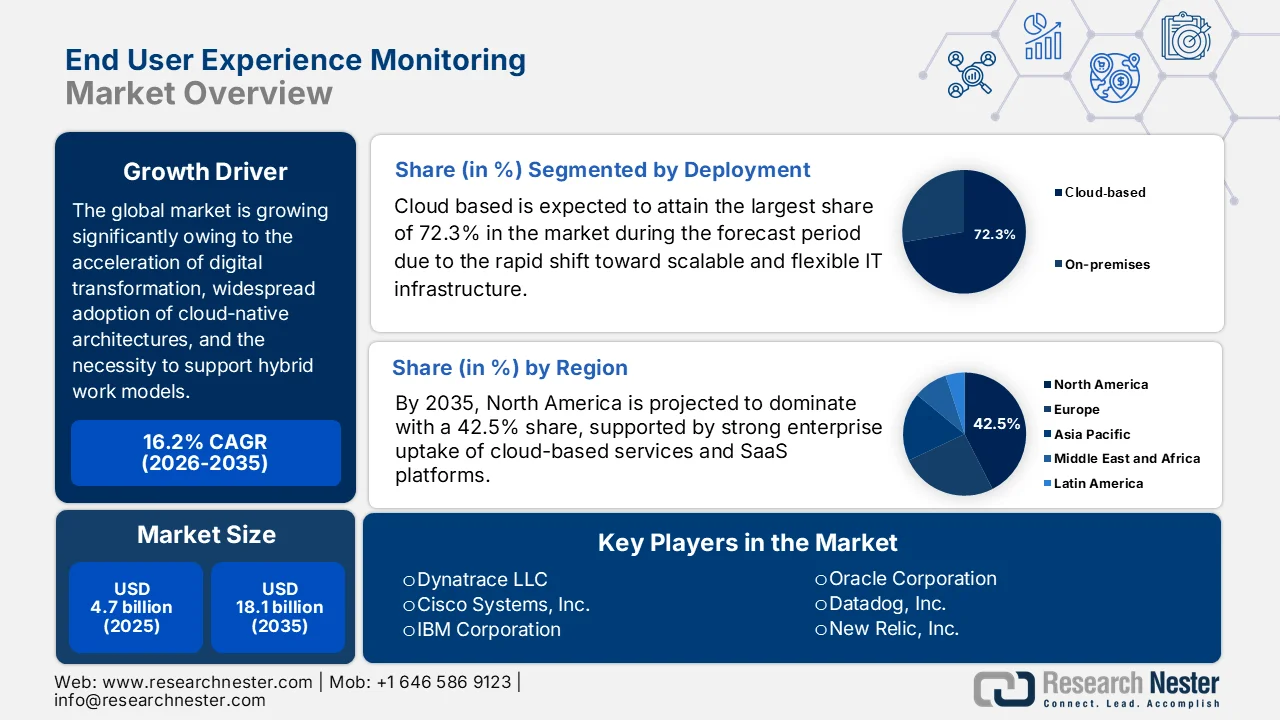
End User Experience Monitoring Market size was valued at USD 4.7 billion in 2025 and is expected to reach USD 18.1 billion by 2035, registering a CAGR of 16.2% during the forecast period, i.e., 2026-2035. In 2026, the industry size of end user experience monitoring is evaluated at USD 5.4 billion.
The end user experience monitoring market is poised for immense growth owing to the acceleration of digital transformation, widespread adoption of cloud-native architectures, and the necessity to support hybrid work models. As stated by the European Commission, the digital decade policy programme, which was formally adopted in December 2022, sets the framework for Europe’s digital transformation by the end of 2030 with measurable targets across connectivity, skills, business, and public services. Besides, it also stated that from 2023 onward, the region has been issuing annual progress reports in order to track Member States’ advancement toward these goals. Moreover, this particular policy places strong emphasis on improving digital public service delivery and ensuring reliable, secure, and user-centric digital experiences, solidifying the need for continuous performance visibility and monitoring of end user interactions in large-scale digital systems, thus denoting a positive market outlook.
Furthermore, organizations across different nations are showcasing increased prioritization towards proactive performance monitoring and AI-based analytics to ensure proper digital journeys, reducing latency, and enhancing productivity across various sorts of applications and devices. Apart from these, the end user experience monitoring market is expanding at an exponential pace with considerable investments in mobile app performance optimization and automated IT solutions, which are aimed at providing a user-centric view of application performance. In May 2024, Cisco announced AI-based enhancements to its AppDynamics on-premises observability platform by introducing automated anomaly detection and root cause analysis with the main goal of accelerating the identification as well as resolution of application performance issues. It also stated that this particular solution leverages AI-based intelligence to correlate application behavior with business impact, improving visibility across self-hosted environments.
Key End User Experience Monitoring Market Insights Summary:
Regional Highlights:
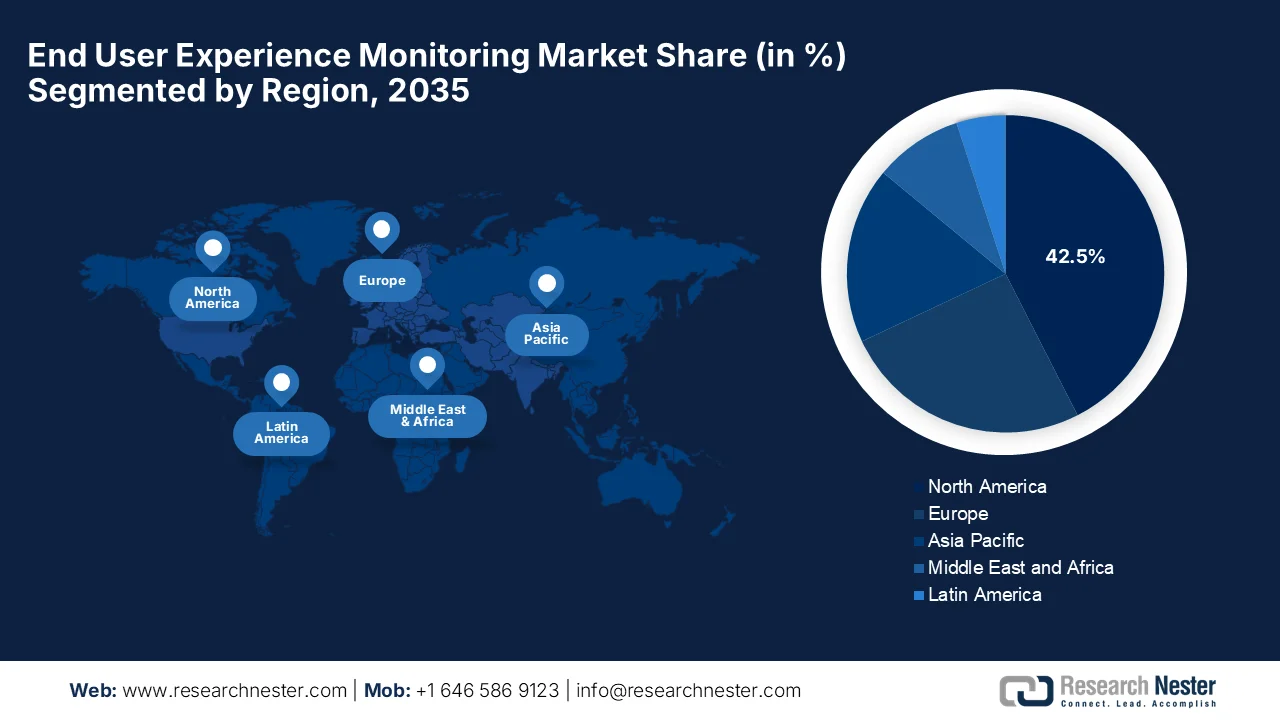
- North America end user experience monitoring market is projected to capture a dominant 42.5% share by 2035, fueled by the extensive adoption of cloud computing and SaaS platforms across enterprises
- Asia Pacific is anticipated to witness the fastest growth in the forecast period 2026–2035, spurred by large-scale digitalization and rapid expansion of e-commerce ecosystems
Segment Insights:
- Cloud-based segment in the end user experience monitoring market is expected to hold a leading 72.3% share by 2035, driven by the rapid shift toward scalable and flexible IT infrastructure
- Product segment is projected to maintain a strong position during 2026–2035, propelled by the increasing need for real-time insights into application performance and user behavior
Key Growth Trends:
- Expansion of cloud and SaaS environments
- Rising customer experience expectations
Major Challenges:
- Data privacy and regulatory compliance
- Complexity of multi-cloud and hybrid environments
Key Players: Dynatrace LLC (U.S.), Cisco Systems, Inc. (U.S.), IBM Corporation (U.S.), Oracle Corporation (U.S.), Datadog, Inc. (U.S.), New Relic, Inc. (U.S.), EY (UK), Riverbed Technology, Inc. (U.S.), BMC Software, Inc. (U.S.), Catchpoint Systems, Inc. (U.S.), Lakeside Software, LLC (U.S.), SmartBear Software (U.S.), Microsoft Corporation (U.S.), SAP SE (Germany), Centreon (Luxembourg), Nexthink S.A. (Switzerland), Micro Focus International plc (United Kingdom), TeamViewer SE (Germany), Fujitsu Limited (Japan), Tata Consultancy Services Limited (India), Zoho Corporation (India), Silverlake Axis Ltd (Malaysia).
Global End User Experience Monitoring Market Forecast and Regional Outlook:
Market Size & Growth Projections:
- 2025 Market Size: USD 4.7 billion
- 2026 Market Size: USD 5.4 billion
- Projected Market Size: USD 18.1 billion by 2035
- Growth Forecasts: 16.2% CAGR (2026-2035)
Key Regional Dynamics:
- Largest Region: North America (42.5% Share by 2035)
- Fastest Growing Region: Asia Pacific
- Dominating Countries: United States, China, Germany, United Kingdom, Japan
- Emerging Countries: India, South Korea, Singapore, Brazil, Indonesia
Last updated on : 28 April, 2026
End User Experience Monitoring Market - Growth Drivers and Challenges
Growth Drivers
- Expansion of cloud and SaaS environments: There has been a rising adoption of cloud computing and software-as-a-service, which in turn has increased IT complexity. Applications are now hosted across multiple environments, making performance monitoring more challenging, driving demand in the end user experience monitoring market. In February 2025, Royal Philips announced the expansion of its cloud-based health suite imaging platform across Europe, which is delivered as a SaaS solution on Amazon Web Services, and it allows clinicians to access radiology data and workflows from anywhere. The platform integrates AI-enabled tools, including generative AI for radiology reporting, and this shift reflects the rising IT complexity, as healthcare providers need to manage performance, data access, and user experience across cloud-hosted systems. Hence, such instances enhanced the need for advanced monitoring and observability solutions.
- Rising customer experience expectations: Most of the modern users are expecting a fast, reliable, and proper digital experience across all platforms. Even minor performance issues can lead to dissatisfaction, increased bounce rates, and customer churn. Businesses are prioritizing monitoring experience as a competitive differentiator, thereby benefiting the overall end user experience monitoring market. In June 2024, Cisco and Splunk announced a unified full-stack observability solution that integrates their technologies with the main goal of delivering real-time understandings, enhanced visibility, and streamlined troubleshooting across hybrid and multi-cloud environments. This particular integration combines Cisco AppDynamics with Splunk’s observability and AI capabilities, introducing features such as Log Observer Connect, AI-based insights, and expanded SaaS hosting on Microsoft Azure to improve performance monitoring and reduce alert noise.
- Growth of remote and hybrid work models: The structural shift towards remote and hybrid work environments has increased dependency on digital tools, virtual desktops, and collaboration platforms. In this context, the solutions from the end user experience monitoring market help IT teams monitor employee experience and detect connectivity or performance issues. The article published by the Central Bureau of Labor Statistics in October 2024 states that the COVID-19 pandemic resulted in a surge in remote and hybrid work, wherein the work-from-home participation jumped from about 6.5% to significantly higher levels across most industries. This shift was effectively driven by necessity but quickly became a widespread experiment in new work models. It also mentioned that remote and hybrid work expanded across nearly all sectors, especially in industries such as technology, finance, and professional services, where a large share of employees could perform tasks digitally, noting a huge opportunity for the end user experience monitoring market to grow.
Challenges
- Data privacy and regulatory compliance: One of the constant challenges in the end user experience monitoring market is the aspect of managing user data while complying with strict global privacy regulations. EUEM solutions mostly collect the detailed data of the device, which can raise concerns around user consent and data misuse. In this context, organizations need to implement robust anonymization, encryption, and governance practices, which increase both operational complexity and expenses. In addition, cross-border data transfer restrictions also complicate deployment for multinational enterprises. Therefore, vendors who are operating in this field need to focus on updating compliance capabilities, making regulatory adherence a moving target that can slow adoption and innovation.
- Complexity of multi-cloud and hybrid environments: Modern IT infrastructures are mostly distributed across on-premises, private cloud, and public cloud platforms such as Amazon Web Services and Microsoft Azure. Therefore, monitoring end user experience across such different types of environments represents one of the most significant technical challenges. Data silos, inconsistent performance metrics, and a lack of unified visibility hinder accurate analysis in the end user experience monitoring market. EUEM tools need to integrate seamlessly across heterogeneous systems, which often requires custom configurations as well as skilled expertise. As organizations scale digitally, maintaining consistent monitoring performance becomes highly difficult, thereby negatively impacting the effectiveness of insights and causing delays in issue resolution.
End User Experience Monitoring Market Size and Forecast:
| Report Attribute | Details |
|---|---|
|
Base Year |
2025 |
|
Forecast Year |
2026-2035 |
|
CAGR |
16.2% |
|
Base Year Market Size (2025) |
USD 4.7 billion |
|
Forecast Year Market Size (2035) |
USD 18.1 billion |
|
Regional Scope |
|
End User Experience Monitoring Market Segmentation:
Deployment Segment Analysis
Under the deployment segment, cloud-based is expected to attain the largest share of 72.3% in the end user experience monitoring market during the forecast period. The segment’s dominance is attributable to the rapid shift toward scalable and flexible IT infrastructure. Enterprises rely on cloud platforms to support remote work, digital services, and global operations. The ability to integrate AI-based analytics and support hybrid environments also solidifies the dominance of cloud-based EUEM solutions. In July 2024, Cloudera announced the expansion of observability premium offerings that provide a single observability layer across public cloud and on-premises environments, thereby enabling enterprises to monitor applications, data pipelines, and infrastructure. This particular on-premises solution enables highly secure enterprises to run observability entirely within their data centers, whereas the public cloud option extends advanced monitoring and governance to cloud users.
Component Segment Analysis
The product, which is a part of a component, is forecasted to maintain a strong position in the end user experience monitoring market during the discussed timeframe. Organizations’ growing need for real-time insights into application performance and user behavior to deliver smooth digital experiences is the main factor driving the sub-segment’s leadership in this sector. Solutions that provide live tracking of user sessions, page load performance, and transactional activity are important for identifying and addressing issues. In October 2023, Splunk announced the general availability of RUM Session Replay, which is a feature that lets teams view real user sessions to troubleshoot issues faster and reduce mean time to resolution. It replays clicks, scrolls, and interactions, and engineers gain clear visibility into user journeys without relying on incomplete repro steps or customer calls.
End use Segment Analysis
By the end of 2035, the BFSI segment is anticipated to grow with a considerable revenue share in the end user experience monitoring market. The segment’s growth is largely driven by the critical need to deliver secure and high-performing digital financial services. Banks and financial institutions are mostly dependent on monitoring tools in order to track application performance, detect latency issues, and ensure smooth execution of sensitive transactions such as online banking, fund transfers, and mobile payments. Apart from this, even any type of minor disruptions can impact customer trust and satisfaction, making continuous visibility into user interactions highly essential. These EUEM solutions help BFSI organizations proactively identify performance bottlenecks, prevent any type of service outages, and enhance platform reliability. As digital banking and fintech adoption grow, maintaining a consistent and secure user experience has become a priority, directly linking superior digital performance with customer retention and competitive advantage in the financial services industry.
Our in-depth analysis of the end user experience monitoring market includes the following segments:
|
Segment |
Subsegments |
|
Deployment |
|
|
Component |
|
|
End use |
|
|
Enterprise Size |
|
|
Monitoring Type |
|

Vishnu Nair
Head - Global Business DevelopmentCustomize this report to your requirements — connect with our consultant for personalized insights and options.
End User Experience Monitoring Market - Regional Analysis
North America Market Insights
By the end of the forecast duration, the North America end user experience monitoring market is poised to account for the largest share of 42.5%. The region’s dominance in this field is mainly propelled by the extensive adoption of cloud computing and SaaS platforms across enterprises. As cloud usage has expanded in the region, the need for effective user experience monitoring is highly essential for maintaining application reliability and customer satisfaction. In February 2023, the U.S. Department of the Treasury stated that the growing adoption of cloud-based technologies in the financial sector offers significant benefits such as improved resilience, reliability, and access to advanced digital infrastructure. The report also stated that cloud services can help financial institutions, including community banks, to better compete with financial technology firms and enhance service delivery to customers, thus suitable for bolstering the region’s market growth.
A primary emphasis on digital performance optimization is responsible for uplifting the end user experience monitoring market in the U.S. The acceleration of digital transformation and the rise of remote and hybrid work models encourage enterprises across sectors such as banking, retail, and healthcare to rely on these tools to gain real-time visibility into application responsiveness and employee productivity. In July 2023, the Center for Strategic & International Studies reported that accelerating federal cloud adoption in the country is highly essential to modernize IT, reduce reliance on legacy systems, some of which are 8 to 51 years old, and strengthen cybersecurity. It also mentioned that in the financial year 2022, the U.S. government spent more than USD 100 billion on IT, wherein USD 12 billion was allocated to cloud services, and more than half went to maintaining outdated infrastructure. Furthermore, the study stated that there is an urgent need for proper funding, regulation reform, and secure cloud frameworks to improve efficiency.
There is a huge opportunity for the end user experience monitoring market in Canada to grow owing to the presence of regulatory obligations regarding employee privacy and data sovereignty. The country’s market also benefits from the emergence of technology, due to which the country’s enterprises are shifting from reactive IT management to proactive management that integrates artificial intelligence for performance understanding. In December 2025, Microsoft announced a total of USD 14.1 billion in Canada between 2023 and 2027, including USD 5.6 billion for the next two years, to expand AI and cloud infrastructure. The company is deepening its role in Canada’s digital economy, where the investment will expand Azure datacenters, strengthen cybersecurity through a new threat intelligence hub, and ensure data stays in the country, thus positively impacting the end user experience monitoring market’s growth and exposure.
APAC Market Insights
The Asia Pacific end user experience monitoring market is anticipated to grow at the fastest rate from 2026 to 2035. The region’s upliftment is mainly attributable to large-scale digitalization and the massive expansion of e-commerce markets in China, India, and Japan. Driven by some of the world's highest mobile and internet penetration rates, enterprises are opting for real-time performance analytics to manage the complexity of mobile-first business strategies and the rollout of 5G networks. In July 2024, the article published by Enterprise Asia Organization reported that the region’s mobile economy is forecast to surpass almost USD 1 trillion by 2030, owing to the continued 5G adoption and accelerating digital transformation. It also mentioned that mobile technologies contributed about 5.3% of regional GDP in 2023, which is around USD 880 billion, and are expected to grow faster than the global average through 2030. Operators are leveraging cloud computing and generative AI to modernize infrastructure and improve enterprise services across the region.
The central government’s digital construction plan imposes mandates for a robust digital infrastructure and a sophisticated data resource system, prompting a profitable business environment for pioneers in the end user experience monitoring market in China. The country’s market is making a shift toward indigenous, AI-based observability platforms that leverage home-grown large language models and agentic AI to automate root-cause analysis and predictive maintenance. Based on the government data published in May 2025, the country has released an action plan with a main goal to advance its digital China strategy by focusing on AI plus infrastructure upgrades, data market reforms, and digital talent development. This particular plan aims to accelerate a unified national data market and promote a data-driven digital economy tailored to local conditions, thus denoting a huge opportunity for end user experience monitoring industry.
The presence of a massive, mobile-first internet user base and the explosive growth of UPI-led financial transactions and a booming e-commerce sector are certain drivers responsibly boosting the overall end user experience monitoring market in India. As 5G infrastructure rolls out across the country, there is a heightened demand for lightweight, mobile-specific monitoring tools that can handle the huge scale of digital interactions from both urban and rural users. As stated by Press Information Bureau (PIB) in June 2025, the country’s digital expansion grew remarkably owing to the large-scale 5G deployment, rising internet penetration, and strong adoption of digital public infrastructure such as UPI, Aadhaar, and DigiLocker. Internet connections reached 969.6 million, whereas 5G rollout achieved 474,000 towers covering 99.6% of districts, enabling near-universal high-speed connectivity, thus suitable for bolstering the country’s market growth.
Europe Market Insights
Europe end user experience monitoring market is considered to be one of the largest and most influential landscapes, which is effectively driven by a mandatory focus on compliance and strict data sovereignty standards. The region’s market is evolving toward the integration of AI-driven predictive analytics and real-user monitoring to proactively resolve performance bottlenecks and meet rising consumer expectations for digital interactions. In April 2025, the Organisation for Economic Co-operation and Development (OECD) reported that the General Data Protection Regulation (GDPR), adopted in the region, effectively harmonizes data privacy laws across member states and applies to any organization processing citizens’ personal data. It requires explicit consent for sensitive data, mandates data protection impact assessments, and regulates international data transfers. Apart from this, GDPR strengthens enforcement, ensuring consistent compliance, thus denoting a huge need for monitoring solutions.
The strong industrial base and a culture of high-quality engineering are the main factors behind the robust growth of end user experience monitoring market in Germany. The integration of digital tools into categories such as manufacturing, automotive, and finance encourages the regional enterprises to prioritize solutions that offer exceptional operational reliability and service continuity for complex legacy and cloud-native environments. In March 2025, Siemens announced major advancements in terms of industrial AI, software-defined automation, and digital twin technology, with the main goal to accelerate AI-based industries. It also mentioned some of the key highlights, which include the development of the first industrial foundation model with Microsoft and Audi’s adoption of virtual programmable logic controllers for AI-supported production, thus positively impacting the market’s expansion.
The presence of a vibrant financial services landscape and a continuously evolving retail sector are progressively uplifting the UK end user experience monitoring market. At the same time, the country’s market is majorly propelled by compliance with regional data privacy standards, such as the UK GDPR, which remains one of the most important factors, fostering a strong preference for secure, vendor-neutral observability platforms that provide visibility into digital interactions. Based on the government data published in December 2024, digital transformation, i.e., initiatives such as the federated data platform, is being designed with strong UK GDPR-aligned safeguards, requiring strict governance, auditability, and transparency in how patient data is accessed and used. Therefore, this creates a need for robust monitoring and visibility mechanisms to ensure data is used only for approved purposes, along with maintaining public trust.
Key End User Experience Monitoring Market Players:
- Dynatrace LLC (U.S.)
- Cisco Systems, Inc. (U.S.)
- IBM Corporation (U.S.)
- Oracle Corporation (U.S.)
- Datadog, Inc. (U.S.)
- New Relic, Inc. (U.S.)
- EY (UK)
- Riverbed Technology, Inc. (U.S.)
- BMC Software, Inc. (U.S.)
- Catchpoint Systems, Inc. (U.S.)
- Lakeside Software, LLC (U.S.)
- SmartBear Software (U.S.)
- Microsoft Corporation (U.S.)
- SAP SE (Germany)
- Centreon (Luxembourg)
- Nexthink S.A. (Switzerland)
- Micro Focus International plc (United Kingdom)
- TeamViewer SE (Germany)
- Fujitsu Limited (Japan)
- Tata Consultancy Services Limited (India)
- Zoho Corporation (India)
- Silverlake Axis Ltd (Malaysia)
- Company Overview
- Business Strategy
- Key Product Offerings
- Financial Performance
- Key Performance Indicators
- Risk Analysis
- Recent Development
- Regional Presence
- SWOT Analysis
- Dynatrace LLC functions as a foundational pillar in this end user experience monitoring market owing to its stronger focus on AI-based observability and automation. The company makes heavy investments in R&D and product innovations by launching platforms that unify real user monitoring, synthetic monitoring, and an understanding of application performance.
- Datadog, Inc. has positioned itself as a disruptive force in the end user experience monitoring market, propelled by its cloud-native architecture and unified observability platform. The firm deliberately provides end-to-end visibility across infrastructure, applications, and user experience through a single SaaS platform.
- Cisco Systems, Inc. AppDynamics, which is a subsidiary of Cisco, leverages its parent company’s networking and IT management ecosystem to deliver the most appropriate solutions. The platform integrates application performance monitoring with business transaction understandings, enabling organizations to link IT performance with business outcomes.
- New Relic, Inc. is best known for its developer-centric and highly flexible observability platform, which offers full-stack monitoring with an emphasis on openness and extensibility. The firm opted for a consumption-based pricing model and promotes open instrumentation standards, making it highly attractive to both enterprises and SMEs.
- Nexthink S.A. specializes in terms of digital employee experience, which is a growing segment within the market that focuses on workforce productivity and IT service quality. Besides, the company makes a differentiation through deep endpoint analytics, real-time visibility into employee interactions, and automation-driven remediation capabilities.
Below is the list of some prominent players operating in the global end user experience monitoring market:
The end user experience monitoring market is extremely competitive and somewhat fragmented, wherein the dominating global vendors and emerging regional players are competing through constant innovations and platform breadth. At the same time, leading pioneers in this field are emphasizing AI-based analytics, cloud-native observability, and unified monitoring platforms by integrating real user monitoring and synthetic monitoring capabilities. Apart from these strategic initiatives, adopted by the major companies are mergers and acquisitions, expansion into digital employee experience, and integration with IT service management ecosystems. Vendors are making heavy investments in automation and hybrid-cloud monitoring with the main goal of enhancing real-time insights and reducing downtime. In June 2025, Centreon acquired Quanta.io by integrating advanced real user monitoring, synthetic transaction monitoring, and digital sobriety metrics. This move delivers full-stack visibility from infrastructure to user experience, strengthening businesses with proactive, cost-effective performance monitoring.
Corporate Landscape of the End User Experience Monitoring Market:
Recent Developments
- In April 2026, EY announced the global rollout of enterprise-scale agentic AI in Assurance by embedding Microsoft-powered multi-agent frameworks into EY Canvas. This initiative will support 160,000 audit engagements in modernizing workflows.
- In January 2026, Dynatrace introduced real user monitoring at Perform 2026, combining front-end telemetry with back-end context that delivers end-to-end visibility in terms of the modern web and mobile applications.
- In February 2025, New Relic announced the launch of its streaming video and ads intelligence and engagement intelligence solutions. These AI-based observability tools unify video QoE metrics, app performance, and user behavior data to deliver streaming experiences and optimize digital engagement across platforms.
- In July 2024 New Relic introduced the first fully-integrated, AI-based digital experience monitoring solution by combining real user monitoring, APM, and AI monitoring into one platform for end-to-end visibility.
- Report ID: 8537
- Published Date: Apr 28, 2026
- Report Format: PDF, PPT
- Explore a preview of key market trends and insights
- Review sample data tables and segment breakdowns
- Experience the quality of our visual data representations
- Evaluate our report structure and research methodology
- Get a glimpse of competitive landscape analysis
- Understand how regional forecasts are presented
- Assess the depth of company profiling and benchmarking
- Preview how actionable insights can support your strategy
Explore real data and analysis
Frequently Asked Questions (FAQ)
About this Report
Connect with our Expert


Report, 2026-2035



Copyright @ 2026 Research Nester. All Rights Reserved.
