EMC Filter Market Outlook:
EMC Filter Market size was over USD 3.8 billion in 2025 and is projected to exceed USD 7.6 billion by the end of 2035, witnessing over 7.2% CAGR during the forecast period i.e., between 2026-2035. In 2026, the industry size of EMC filter assessed at USD 4.1 billion.
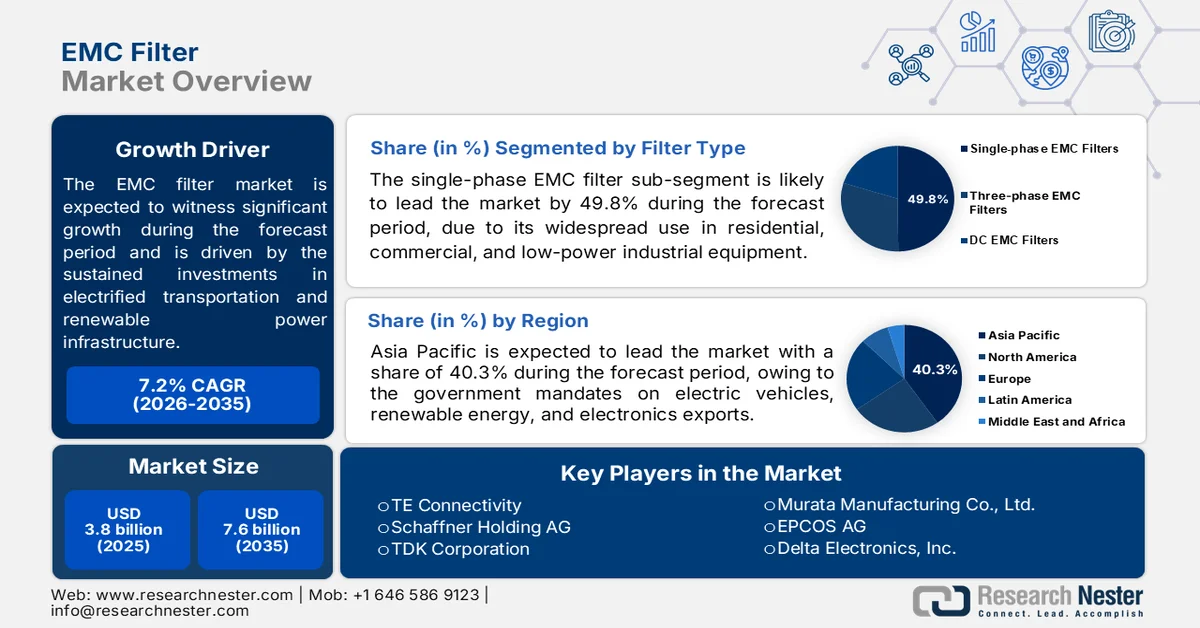
The EMC filter market is driven by sustained investments in electrified transportation, industrial automation, renewable power infrastructure, and high-frequency communication systems. According to the International Energy Agency's 2024 data, global electric car sales exceeded 17 million units, representing a continued expansion in onboard electronics, battery management systems, charging infrastructure, and power conversion equipment that require compliance with electromagnetic compatibility regulations. Moreover, the Renewable Energy Institute's May 2026 data reported that global renewable electricity capacity additions reached nearly 510 GW, led by solar PV deployment across Asia Pacific, Europe, and North America. Grid-connected inverters, energy storage systems, and industrial power electronics require electromagnetic interference mitigation to comply with utility and regulatory standards, increasing procurement demand for industrial-grade filtering components.
World – Annual Solar PV Capacity Additions, 2010–2025
|
Year |
Capacity (GW) |
|
2010 |
17 |
|
2011 |
31 |
|
2012 |
29 |
|
2013 |
35 |
|
2014 |
38 |
|
2015 |
48 |
|
2016 |
72 |
|
2017 |
94 |
|
2018 |
95 |
|
2019 |
102 |
|
2020 |
131 |
|
2021 |
145 |
|
2022 |
192 |
|
2023 |
364 |
|
2024 |
458 |
|
2025 |
510 |
Source: Renewable Energy Institute, May 2026
Government-backed electrification programs in the U.S., EU, China, Japan, and India are also increasing the installation of fast charging stations and smart grid infrastructure, expanding demand across commercial and utility-scale applications. Industrial manufacturing modernization is also contributing to stable procurement activity for EMC filtering solutions. The International Federation of Robotics September 2024 data reported that 4,281,585 units of robots are operating in factories. Increased deployment of servo drives, programmable controllers, switching power supplies, and variable frequency drives in manufacturing facilities is reinforcing demand for power line filtering and signal protection systems. In telecommunications, the International Telecommunication Union (ITU), November 2025 data estimated that 5.5 billion people were using the internet, accelerating investments in data centers, 5G base stations, networking equipment, and high-density computing infrastructure, where electromagnetic compliance remains mandatory for operational reliability.
Key EMC Filter Market Insights Summary:
Regional Highlights:
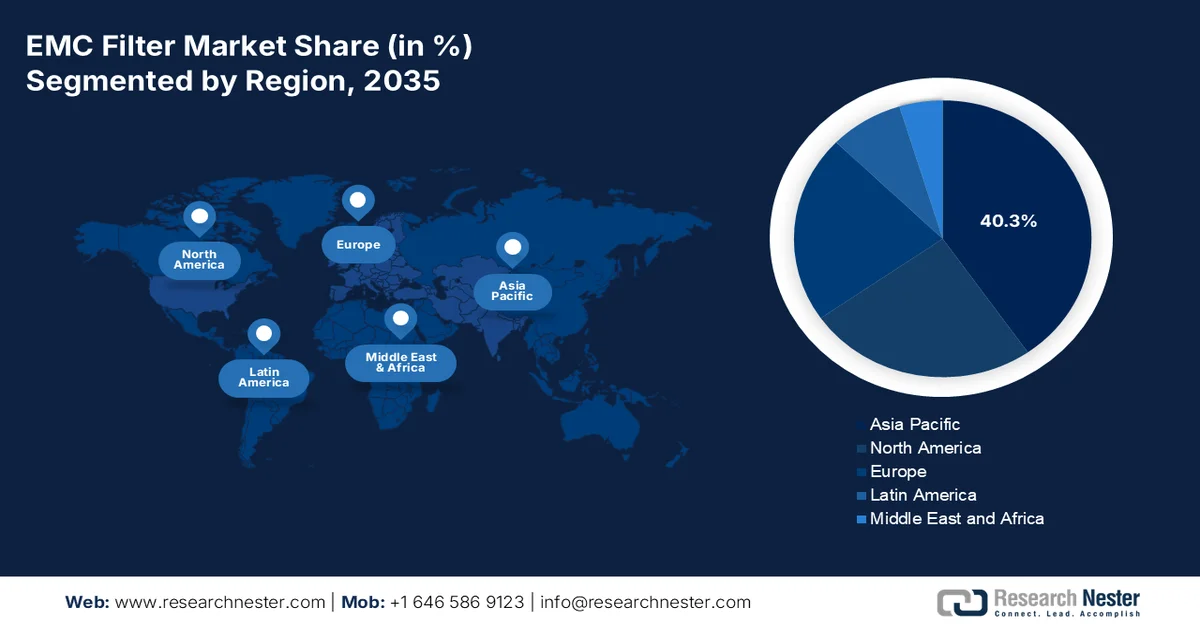
- Asia Pacific is anticipated to account for 40.3% revenue share by 2035, driven by aggressive government mandates supporting electric vehicles, renewable energy adoption, electronics exports, and rapid 5G infrastructure deployment
- North America is forecast to witness robust expansion in the EMC filter market during 2026-2035, stimulated by stringent FCC and ISED electromagnetic compatibility regulations alongside rising investments in EV charging infrastructure, defense modernization, and smart grid systems
Segment Insights:
- The single-phase EMC filters segment in the EMC filter market is anticipated to capture 49.8% share by 2035, propelled by its extensive adoption across residential, commercial, and low-power industrial equipment requiring effective electromagnetic interference suppression
- The direct B2B sub-segment is projected to maintain a leading position through 2035, fueled by long-term supply agreements and co-engineering partnerships between filter manufacturers and global OEMs seeking regulatory-compliant custom EMC filters
Key Growth Trends:
- Defense electronics and aerospace modernization programs
- Rising investments in data centers and AI infrastructure
Major Challenges:
- High manufacturing costs and price pressure
- Evolving customer requirements and customization demands
Key Players: TE Connectivity, Schaffner Holding AG, TDK Corporation, Murata Manufacturing Co., Ltd., EPCOS AG, Delta Electronics, Inc., Samsung Electro-Mechanics, Kyocera AVX Components Corporation, Vicor Corporation, Astrodyne TDI, API Technologies, NXP Semiconductors, Würth Elektronik GmbH & Co. KG, REO UK Ltd, Premo S.L., Smiths Interconnect, Nancal Technology, Samsung Electro-Mechanics, Murata Power Solutions, Alpha 3 Manufacturing, Cincon.
Global EMC Filter Market Forecast and Regional Outlook:
Market Size & Growth Projections:
- 2025 Market Size: USD 3.8 billion
- 2026 Market Size: USD 4.1 billion
- Projected Market Size: USD 7.6 billion by 2035
- Growth Forecasts: 7.2% CAGR (2026-2035)
Key Regional Dynamics:
- Largest Region: Asia Pacific (40.3% Share by 2035)
- Fastest Growing Region: North America
- Dominating Countries: China, United States, Japan, Germany, South Korea
- Emerging Countries: India, Canada, Vietnam, Brazil, Indonesia
Last updated on : 27 May, 2026
EMC Filter Market - Growth Drivers and Challenges
Growth Drivers
- Defense electronics and aerospace modernization programs: Defense modernization initiatives are generating the demand for high-reliability EMC filters used in the radar systems, communication equipment, avionics, and electronic warfare platforms. Governments are increasing the defense electronics budgets amid geopolitical tensions and cybersecurity concerns. As per the U.S. Department of Defense, March 2024 data, Congress proposed the defense budget exceeding USD 849.8 billion, including investments in advanced communications, aerospace systems, and next-generation battlefield electronics. NATO countries are also expanding military electronics procurement under long-term modernization targets. Electromagnetic protection is critical in mission-critical systems where the signal integrity and operational reliability directly affect defense readiness. Space agencies are similarly investing in satellite communication systems requiring advanced filtering technologies. EMC filter manufacturers are benefiting from an increased procurement across military vehicles, unmanned systems, secure communications infrastructure, and aerospace navigation systems.
- Rising investments in data centers and AI infrastructure: The expansion of AI-focused hyperscale data centers is driving the global EMC filter market. This dominance is due to the increasing deployment of high-density power electronics and the advanced computing infrastructure. OpenAI, Oracle, and SoftBank, in September 2025, announced five new U.S. AI data center sites under the Stargate platform, bringing total planned capacity to nearly 7 gigawatts alongside more than USD 400 billion in investment over the next three years. The companies also stated that the initiative remains on track toward the broader USD 500 billion and 10 gigawatt infrastructure commitment. These facilities require extensive integration of switching power supplies, AI accelerator servers, backup power systems, liquid cooling infrastructure, transformers, and high-speed networking equipment, all of which must comply with electromagnetic compatibility requirements to maintain system reliability and prevent interference-related operational failures. As governments and private operators continue investing in sovereign AI infrastructure and large-scale cloud computing capacity, EMC filter adoption is expected to rise steadily across North America, Europe, and Asia-Pacific.
Challenges
- High manufacturing costs and price pressure: The EMC filter market faces intense price competition, particularly from Asian manufacturers with lower production costs. The global EMC filtration market is growing, with new entrants often remaining low due to raw material costs for ferrite cores, capacitors, and specialized magnetic components. Market research indicates that cost pressure in mass production remains one of the primary challenges for EMC filter manufacturers, especially for standard single-phase filters, where the commoditization has driven prices over five years.
- Evolving customer requirements and customization demands: End users across the automotive, medical, and industrial sectors demand customized EMC filter solutions customized to specific application requirements rather than standard off-the-shelf products. The EMC filter market is shifting from one-size-fits-all filters toward application-specific designs optimized for particular impedance conditions, form factors, and environmental requirements. Research indicates that burgeoning demand for miniaturized electronic devices creates opportunities but also pressures manufacturers to develop smaller, more efficient filters without compromising performance.
EMC Filter Market Size and Forecast:
| Report Attribute | Details |
|---|---|
|
Base Year |
2025 |
|
Forecast Year |
2026-2035 |
|
CAGR |
7.2% |
|
Base Year Market Size (2025) |
USD 3.8 billion |
|
Forecast Year Market Size (2035) |
USD 7.6 billion |
|
Regional Scope |
|
EMC Filter Market Segmentation:
Filter Type Segment Analysis
Under the filter type segment, the single-phase EMC filters are dominating in the EMC filter market and are expected to hold the share value of 49.8% by the end of 2035. The segment is driven due to its widespread use in residential, commercial, and low-power industrial equipment, such as LED lighting, office automation, and home appliances. As per the NITI Aayog March 223 data in S 17017 Part 2, single-phase AC charging operates at currents up to 70A, generating substantial conducted electromagnetic interference that must be suppressed before entering the vehicle's onboard charger. These filters are installed directly at the AC input stage between the socket and the vehicle inlet, ensuring compliance with international EMI standards. The standard's dimensional compatibility requirements for single-phase pins and contact tubes directly influence filter design, as filters must fit within compact charging connectors without compromising attenuation performance.
Sales Channel Segment Analysis
The direct B2B sub-segment dominates the sales channel segment in the EMC filter market. The segment is driven by long-term supply agreements between filter manufacturers and global electronics producers. Overseas OEMs in automotive, telecom, and medical devices require custom EMC filters to accompany semiconductors. The Semiconductor Industry Association 2025 reported that 70% of U.S. semiconductor industry revenue comes from sales to overseas customers. This export-heavy model compels overseas OEMs to source compatible EMC filters directly from trusted suppliers to ensure regulatory compliance and signal integrity. Moreover, the U.S. and Europe EMC filter manufacturers secure multi-year high-volume contracts with Asia and Europe OEMs. Direct B2B relationships enable co-engineering of application-specific filters, reducing time-to-market.
Insertion Loss Level Segment Analysis
The insertion loss level segment categorizes EMC filters based on their ability to attenuate the electromagnetic interference across frequency ranges. High insertion loss emerges as the leading sub-segment driven by the mission-critical applications. These filters are essential in medical imaging devices, military communications equipment, precision industrial automation, and electric vehicle powertrains. High insertion loss filters employ advanced multi-stage filtering topologies, including multiple inductive and capacitive elements, to achieve superior attenuation across the wide frequency bands. Unlike low or medium insertion loss variants, they effectively suppress both differential mode and common mode noise simultaneously. As electronic systems become denser and more sensitive, demand for high-performance filtering continues to grow. Manufacturers are increasingly engineering compact high attenuation filters that fit within space-constrained assemblies without compromising suppression capability, ensuring this sub-segment maintains EMC filter market leadership.
Our in-depth analysis of the EMC filter market includes the following segments:
|
Segment |
Subsegments |
|
Filter Type |
|
|
Mounting Type |
|
|
Application |
|
|
End user Industry |
|
|
Insertion Loss Level |
|
|
Sales Channel |
|

Vishnu Nair
Head - Global Business DevelopmentCustomize this report to your requirements — connect with our consultant for personalized insights and options.
EMC Filter Market - Regional Analysis
APAC Market Insights
Asia pacific is dominating the EMC filter market and is expected to hold a regional revenue share of 40.3% by the end of 2035. The aggressive government mandates on electric vehicles, renewable energy, and electronics exports drive the EMC filter market. China’s CCC certification and India’s MeitY EMI/EMC rules require stringent compliance for all grid-connected and consumer devices. The rapid buildout of 5G infrastructure across South Korea, Japan, and Southeast Asia demands high-frequency filters for base stations and small cells. Industrial automation, particularly servo drives and robotics in manufacturing hubs, enforces IEC 61800-3 standards. A key emerging trend is the localization of EMC component production to bypass trade barriers and reduce costs, alongside the miniaturization of filters for wearables and IoT devices in densely packed consumer electronics.
The EMC filter market in India is growing steadily due to expanding renewable energy deployment, electric vehicle infrastructure, and semiconductor manufacturing investments. According to the PIB December 2025 data, India’s installed renewable energy capacity exceeded 220 GW in 2025, increasing the deployment of grid-connected inverters and industrial power electronics requiring EMC compliance. In transportation infrastructure, the Ministry of Heavy Industries allocated INR 10,900 crore under the PM E-DRIVE scheme and related EV initiatives to accelerate electric mobility adoption and charging infrastructure expansion as per the PIB February 2025 report. Moreover, the Government of India approved semiconductor projects under the India Semiconductor Mission to strengthen domestic electronics manufacturing capabilities. These investments are increasing demand for EMC filters across renewable energy systems, EV charging stations, industrial automation equipment, and advanced electronics manufacturing facilities.
The Japan EMC filter market is estimated to grow from USD 57 million in 2025 to USD 115 million by the end of 2035 at a CAGR of 6.7%. The market is projected to reach USD 64 million in 2026. The nation is witnessing a stable growth due to the country’s accelerating transition toward electric and hybrid mobility. The government has established a target for 100% of new passenger car sales to be electrified by 2035, as per Influence Map January 2026 data, while aiming for electric and decarbonized fuel vehicles to account for 100% of commercial vehicle sales by 2040. The government also plans to accelerate heavy-duty electric vehicle deployment, targeting more than 5,000 units in the early 2020s and advancing 2040 penetration goals to 2030. Rising electronic component density in next-generation vehicles is therefore strengthening long-term demand for EMC filters across Japan’s automotive and electronics industries.
North America Market Insights
North America is projected to emerge rapidly during the assessed period, 2026 to 2035, in the EMC filter market. The market is driven by the stringent regulatory frameworks and ISED standards in Canada, which mandate electromagnetic compatibility across all electronic devices. Defense modernization efforts, particularly NORAD and next-gen military platforms, demand ruggedized high attenuation filters for radar communications and unmanned systems. The rapid buildout of EV charging infrastructure and smart grid projects further accelerates adoption as power electronics generate significant EMI. Additionally, the medical device sector’s shift toward wireless implantables and diagnostic imaging requires miniaturized high-reliability filters. A key emerging trend is the integration of active filtering into power modules rather than relying solely on passive components, reducing size while improving performance in dense electronic environments.
The rising investments in electric vehicles, grid modernization, semiconductor manufacturing and AI driven data center infrastructure is driving the EMC filter market in the U.S. According to the The U.S. Department of Energy’s December 2024 data, Office of Electricity is administering a USD 10.5 billion Grid Resilience and Innovation Partnerships (GRIP) Program to improve grid flexibility and strengthen power system resilience increasing deployment of grid connected electronics and industrial power systems requiring EMC compliance. The IEA 2025 data indicated that the U.S. increased its public EV charging stock by 20% in 2024 to nearly 200,000 charging points under the National EV Infrastructure Program supported by USD 5 billion in federal funding. Additionally, the NIST October 2025 data, the CHIPS Act allocated USD 52.7 billion for domestic semiconductor expansion, including USD 39 billion in semiconductor manufacturing incentives supporting fabrication facilities where EMC-controlled environments are critical for operational precision and equipment reliability.
The increasing investments in clean energy infrastructure, electric vehicle adoption, and semiconductor and digital connectivity projects are driving the EMC filter market in Canada. According to the Government of Canada, February 2024 data, ZEVs are increasing the share of new light-duty vehicle (LDV) sales, from 20% to 60% by 2030 and 100% by 2035, increasing demand for EMC filters in charging equipment and power conversion systems. The Government of Canada's August 2025 data indicated that the Canada Infrastructure Bank committed USD 10 billion via its Growth Plan for clean power grid modernization and renewable energy projects requiring EMC-compliant electrical infrastructure. Additionally, the Government of Canada's February 2022 data indicated that they have invested up to USD 240 million in semiconductor and photonics development through the Strategic Innovation Fund to strengthen domestic electronics manufacturing capabilities. These investments are increasing the deployment of high-frequency electronic systems across industrial transportation and telecommunications sectors, supporting sustained demand for EMC filtering solutions.
Europe Market Insights
The EMC filter market in Europe is shaped by the strict EU directives, including the EMC Directive (2014/30/EU) and the CE marking requirement, which mandate compliance for all electronic equipment sold across member states. The rapid expansion of renewable energy systems—solar inverters, wind turbines, and battery storage—under the REPowerEU plan drives demand for grid-tied filters meeting IEC/EN 61000-6-3 standards. Industrial automation, particularly collaborative robots and servo drives under Industrie 4.0 initiatives, requires ruggedized filters for factory floors. Additionally, the shift toward electric mobility and rail signaling modernization (ERTMS) enforces EN 50121 series compliance. A notable trend is the adoption of embedded filtering inside power modules to reduce weight and improve reliability in space-constrained applications.
The strong investments in industrial automation, electric mobility, and renewable energy infrastructure are shaping the EMC filter market in Germany. In 2024, Germany’s Federal Ministry for Economic Affairs and Climate Action (BMWK) continued supporting the national energy transition via multi-billion-euro grid expansion and renewable integration programs under the Energiewende strategy, increasing deployment of power electronics requiring EMC compliance. The ITA November 2024 data depicted that Germany also registered more than 1.4 million fully electric passenger cars on roads, accelerating demand for EMC filters in EV powertrains and charging systems. In semiconductor manufacturing, the European Commission's August 2024 article depicts that the commission has approved up to EUR 5 billion in German state aid for the European Semiconductor Manufacturing Company (ESMC) facility in Dresden, strengthening advanced electronics production. These developments are increasing the use of EMC filtering systems across automotive, industrial machinery, telecom, and renewable energy applications throughout Germany.
The rising investments in the electric vehicle infrastructure, renewable energy expansion, and the advanced semiconductor and telecommunications projects are shaping the EMC filter market in the UK. In August 2025, the UK government confirmed GBP 381 million via the Local EV Infrastructure (LEVI) Fund to support nationwide EV charging deployment, increasing the demand for EMC filters in charging stations and vehicle electronics. The UK also generated a record 50.8% of its electricity from renewable sources, according to the Solar Power Portal March 2024 data, accelerating the deployment of grid-connected inverters and the industrial power systems requiring electromagnetic compatibility solutions. These investments are increasing the adoption of EMC filtering technologies across automotive, telecom, industrial automation, and renewable energy infrastructure applications.
UK Renewable Energy Expansion, 2024
|
Renewable Energy Indicator (UK, 2024) |
Statistical Data |
|
Wind Electricity Generation |
84.1 TWh generated, up 2.1% from 2023 |
|
Share of UK Electricity from Wind |
29.5% of total electricity generation |
|
Solar Electricity Generation |
14.8 TWh generated, up 6.5% from 2023 |
|
UK Solar Capacity Milestone |
UK surpassed 18 GW solar capacity |
|
Renewable Capacity Added in 2024 |
4.2 GW added, highest annual increase since 2017 |
|
Solar Capacity Added in 2024 |
1.6 GW added, highest since 2016 |
|
Domestic Solar Installations |
147,000 new domestic solar PV installations |
Source: Solar Power Portal March 2024
Key EMC Filter Market Players:
- TE Connectivity (U.S.)
- Schaffner Holding AG (Switzerland)
- TDK Corporation (Japan)
- Murata Manufacturing Co., Ltd. (Japan)
- EPCOS AG (a TDK Group company) (Japan)
- Delta Electronics, Inc. (Taiwan)
- Samsung Electro-Mechanics (South Korea)
- Kyocera AVX Components Corporation (Japan)
- Vicor Corporation (U.S.)
- Astrodyne TDI (U.S.)
- API Technologies (U.S.)
- NXP Semiconductors (Netherlands)
- Würth Elektronik GmbH & Co. KG (Germany)
- REO UK Ltd (United Kingdom)
- Premo S.L. (Spain)
- Smiths Interconnect (UK)
- Nancal Technology (Australia)
- Samsung Electro-Mechanics (South Korea)
- Murata Power Solutions (Japan)
- Alpha 3 Manufacturing (U.S.)
- Cincon (Taiwan)
- Company Overview
- Business Strategy
- Key Product Offerings
- Financial Performance
- Key Performance Indicators
- Risk Analysis
- Recent Development
- Regional Presence
- SWOT Analysis
- TE Connectivity is a global leader in connectivity and sensor solutions, and it has significantly advanced the EMC Filter market by integrating high-performance EMI filters into its connector and antenna systems for electric vehicles and industrial automation. The company's strategic focus on miniaturized board-mounted EMC filters ensures reliable signal integrity in high-density electronic environments, reducing electromagnetic interference in real-time.
- Schaffner Holding AG is a premier specialist in electromagnetic compatibility, and it has made significant advancements in the EMC Filter market by developing intelligent IoT-enabled filter solutions for renewable energy systems and EV charging infrastructure. The company's proprietary single and three-phase EMC filters are engineered to suppress conducted emissions in high-power applications, such as solar inverters and fast chargers.
- TDK Corporation has leveraged its core expertise in magnetic materials to drive significant advancements in the EMC Filter market, particularly via its portfolio of multilayer chip beads and common-mode filters for 5G and automotive ADAS systems. The company's operating profit increased by 8.2% in 2024 as per the integrated report.
- Murata Manufacturing Co., Ltd. is a foundational player in the EMC filter market, pioneering the integration of three-terminal capacitors and ferrite bead technologies into mobile cardiac telemetry and wireless medical monitoring systems. In 2025, the company made a revenue of USD 12.6 billion.
- EPCOS AG has historically been a driving force in the EMC filter market, renowned for its high-power three-phase filters and suppression chokes for industrial motor drives and railway systems. The company's advancements include Leakage Current Optimized filters that significantly reduce earth leakage currents while maintaining robust EMI attenuation.
Here is a list of key players operating in the global EMC filter market:
The global EMC filter market is highly competitive, characterized by the presence of the established electronic component giants and specialized filter manufacturers. Key players focus on the miniaturization, higher frequency attenuation, and integration with IoT and EV systems to gain an edge. Strategic initiatives include mergers and acquisitions to expand product portfolios, increased R&D for custom-designed filters for renewable energy and medical devices, and strengthening distribution networks in APAC. For example, in January 2024, Astrodyne TDI acquired the assets of Powertronix. Further, the companies are also investing in compliance with stringent electromagnetic interference regulations, such as IEC and FCC standards, to solidify their EMC filter market position and cater to the growing demand from the automotive and telecommunications sectors.
Corporate Landscape of the EMC Filter Market:
Recent Developments
- In April 2026, TDK Corporation has announced the launch of its latest noise suppression filters of the MAF0603GWY series. These products measure only 0.6 mm x 0.3 mm x 0.3 mm (L x W x H) for use in small consumer devices such as smartphones and wearables.
- In October 2025, Alpha 3 Manufacturing, a leading provider of interconnect solutions, integrated electronic assemblies and EMC filters to demanding regulated markets, has announced the acquisition of Midway Manufacturing Limited and Midway Scientific Limited.
- In May 2025, Cincon has announced the launch of the MF10/MF20D EMI filter modules, which is designed to meet the stringent requirements of MIL-STD-461 (F, G) for airborne applications and defense ground. These modules streamline compliance by providing a ready-made solution for EMI.
- Report ID: 8583
- Published Date: May 27, 2026
- Report Format: PDF, PPT
- Explore a preview of key market trends and insights
- Review sample data tables and segment breakdowns
- Experience the quality of our visual data representations
- Evaluate our report structure and research methodology
- Get a glimpse of competitive landscape analysis
- Understand how regional forecasts are presented
- Assess the depth of company profiling and benchmarking
- Preview how actionable insights can support your strategy
Explore real data and analysis
Frequently Asked Questions (FAQ)
About this Report
Connect with our Expert


Report, 2026-2035



Copyright @ 2026 Research Nester. All Rights Reserved.
