Global Education Industry Market
- An Outline of the Global Education Industry Market
- Market Definition and Segmentation
- Study Assumptions and Abbreviations
- Research Methodology & Approach
- Primary Research
- Secondary Research
- Data Triangulation
- SPSS Methodology
- Executive Summary
- Growth Drivers
- Major Roadblocks
- Opportunities
- Prevalent Trends
- Government Regulation
- Growth Outlook
- Competitive White Space Analysis – Identifying Untapped Market Gaps
- Risk Overview
- SWOT
- Technological Advancement
- Technology Maturity Matrix for Education Industry Market Recent News
- Regional Demand
- Global Education Industry by Geography – Strategic Comparative Analysis
- Strategic Segment Analysis: Education Industry Demand Landscape
- Education Industry Demand Trends Driven by Sustainability, Strategic Collaborations, and Regulatory Compliance (2026-2036)
- Root Cause Analysis (RCA) for discovering problems of the Education Industry Market
- Porter Five Forces
- PESTLE
- Comparative Positioning
- Global Education Industry – Key Player Analysis (2036)
- Competitive Landscape: Key Suppliers/Players
- Competitive Model: A Detailed Inside View for Investors
- Company Market Share, 2036 (%)
- Age of Learning, Inc.
- Blackboard Education & Research Foundation
- BYJU'S
- Chegg Inc
- Coursera Inc.
- DUOLINGO, INC.
- Instructure, Inc.
- PowerSchool
- Stride, Inc.
- Udemy, Inc.
- Global Education Industry Market Outlook
- Market Overview
- Market Revenue by Value (USD Thousand), Volume (Thousand Tons), and Compound Annual Growth Rate (CAGR)
- Education Industry Market Segmentation Analysis (2026-2036)
- By Education Level
- Early Childhood, Market Value (USD Thousand), and CAGR, 2026-2036F
- Elementary School Education, Market Value (USD Thousand), and CAGR, 2026-2036F
- Others, Market Value (USD Thousand), and CAGR, 2026-2036F
- By Provider Type
- Public Institutions, Market Value (USD Thousand), and CAGR, 2026-2036F
- Private Institutions, Market Value (USD Thousand), and CAGR, 2026-2036F
- Corporate & Enterprise Providers, Market Value (USD Thousand), and CAGR, 2026-2036F
- EdTech Platforms & Content Providers (Including Generative AI), Market Value (USD Thousand), and CAGR, 2026-2036F
- By End User
- Students, Market Value (USD Thousand), and CAGR, 2026-2036F
- Parents, Market Value (USD Thousand), and CAGR, 2026-2036F
- Educational Institutions, Market Value (USD Thousand), and CAGR, 2026-2036F
- Others, Market Value (USD Thousand), and CAGR, 2026-2036F
- Regional Synopsis, Value (USD Thousand), 2026-2036
- North America Market Value (USD Thousand) and CAGR & Y-o-Y Growth Trend, 2026-2036F
- Europe Market Value (USD Thousand) and CAGR & Y-o-Y Growth Trend, 2026-2036F
- Asia Pacific Market Value (USD Thousand) and CAGR & Y-o-Y Growth Trend, 2026-2036F
- Latin America Market Value (USD Thousand) and CAGR & Y-o-Y Growth Trend, 2026-2036F
- Middle East and Africa Market Value (USD Thousand) and CAGR & Y-o-Y Growth Trend, 2026-2036F
- By Education Level
- Market Overview
- North America Market
- Overview
- Market Value (USD Thousand), Current and Future Projections, 2026-2036
- Increment $ Opportunity Assessment, 2026-2036
- Segmentation (USD Thousand), 2026-2036, By
- By Education Level
- Early Childhood, Market Value (USD Thousand), and CAGR, 2026-2036F
- Elementary School Education, Market Value (USD Thousand), and CAGR, 2026-2036F
- Others, Market Value (USD Thousand), and CAGR, 2026-2036F
- By Provider Type
- Public Institutions, Market Value (USD Thousand), and CAGR, 2026-2036F
- Private Institutions, Market Value (USD Thousand), and CAGR, 2026-2036F
- Corporate & Enterprise Providers, Market Value (USD Thousand), and CAGR, 2026-2036F
- EdTech Platforms & Content Providers (Including Generative AI), Market Value (USD Thousand), and CAGR, 2026-2036F
- By End User
- Students, Market Value (USD Thousand), and CAGR, 2026-2036F
- Parents, Market Value (USD Thousand), and CAGR, 2026-2036F
- Educational Institutions, Market Value (USD Thousand), and CAGR, 2026-2036F
- Others, Market Value (USD Thousand), and CAGR, 2026-2036F
- Country Level Analysis, Value (USD Thousand)
- U.S. Market Value (USD Thousand) and CAGR & Y-o-Y Growth Trend, 2026-2036F
- Canada Market Value (USD Thousand) and CAGR & Y-o-Y Growth Trend, 2026-2036F
- By Education Level
- Overview
- Europe Market
- Overview
- Market Value (USD Thousand), Current and Future Projections, 2026-2036
- Increment $ Opportunity Assessment, 2026-2036
- Segmentation (USD Thousand), 2026-2036, By
- By Education Level
- Early Childhood, Market Value (USD Thousand), and CAGR, 2026-2036F
- Elementary School Education, Market Value (USD Thousand), and CAGR, 2026-2036F
- Others, Market Value (USD Thousand), and CAGR, 2026-2036F
- By Provider Type
- Public Institutions, Market Value (USD Thousand), and CAGR, 2026-2036F
- Private Institutions, Market Value (USD Thousand), and CAGR, 2026-2036F
- Corporate & Enterprise Providers, Market Value (USD Thousand), and CAGR, 2026-2036F
- EdTech Platforms & Content Providers (Including Generative AI), Market Value (USD Thousand), and CAGR, 2026-2036F
- By End User
- Students, Market Value (USD Thousand), and CAGR, 2026-2036F
- Parents, Market Value (USD Thousand), and CAGR, 2026-2036F
- Educational Institutions, Market Value (USD Thousand), and CAGR, 2026-2036F
- Others, Market Value (USD Thousand), and CAGR, 2026-2036F
- Country Level Analysis, Value (USD Thousand)
- UK Market Value (USD Thousand) and CAGR & Y-o-Y Growth Trend, 2026-2036F
- Germany Market Value (USD Thousand) and CAGR & Y-o-Y Growth Trend, 2026-2036F
- France Market Value (USD Thousand) and CAGR & Y-o-Y Growth Trend, 2026-2036F
- Italy Market Value (USD Thousand) and CAGR & Y-o-Y Growth Trend, 2026-2036F
- Spain Market Value (USD Thousand) and CAGR & Y-o-Y Growth Trend, 2026-2036F
- Netherlands Market Value (USD Thousand) and CAGR & Y-o-Y Growth Trend, 2026-2036F
- Russia Market Value (USD Thousand) and CAGR & Y-o-Y Growth Trend, 2026-2036F
- Switzerland Market Value (USD Thousand) and CAGR & Y-o-Y Growth Trend, 2026-2036F
- Poland Market Value (USD Thousand) and CAGR & Y-o-Y Growth Trend, 2026-2036F
- Belgium Market Value (USD Thousand) and CAGR & Y-o-Y Growth Trend, 2026-2036F
- Rest of Europe Market Value (USD Thousand) and CAGR & Y-o-Y Growth Trend, 2026-2036F
- By Education Level
- Overview
- Asia Pacific Market Excluding Japan
- Overview
- Market Value (USD Thousand), Current and Future Projections, 2026-2036
- Increment $ Opportunity Assessment, 2026-2036
- Segmentation (USD Thousand), 2026-2036, By
- By Education Level
- Early Childhood, Market Value (USD Thousand), and CAGR, 2026-2036F
- Elementary School Education, Market Value (USD Thousand), and CAGR, 2026-2036F
- Others, Market Value (USD Thousand), and CAGR, 2026-2036F
- By Provider Type
- Public Institutions, Market Value (USD Thousand), and CAGR, 2026-2036F
- Private Institutions, Market Value (USD Thousand), and CAGR, 2026-2036F
- Corporate & Enterprise Providers, Market Value (USD Thousand), and CAGR, 2026-2036F
- EdTech Platforms & Content Providers (Including Generative AI), Market Value (USD Thousand), and CAGR, 2026-2036F
- By End User
- Students, Market Value (USD Thousand), and CAGR, 2026-2036F
- Parents, Market Value (USD Thousand), and CAGR, 2026-2036F
- Educational Institutions, Market Value (USD Thousand), and CAGR, 2026-2036F
- Others, Market Value (USD Thousand), and CAGR, 2026-2036F
- Country Level Analysis, Value (USD Thousand)
- China Market Value (USD Thousand) and CAGR & Y-o-Y Growth Trend, 2026-2036F
- India Market Value (USD Thousand) and CAGR & Y-o-Y Growth Trend, 2026-2036F
- South Korea Market Value (USD Thousand) and CAGR & Y-o-Y Growth Trend, 2026-2036F
- Australia Market Value (USD Thousand) and CAGR & Y-o-Y Growth Trend, 2026-2036F
- Indonesia Market Value (USD Thousand) and CAGR & Y-o-Y Growth Trend, 2026-2036F
- Malaysia Market Value (USD Thousand) and CAGR & Y-o-Y Growth Trend, 2026-2036F
- Vietnam Market Value (USD Thousand) and CAGR & Y-o-Y Growth Trend, 2026-2036F
- Thailand Market Value (USD Thousand) and CAGR & Y-o-Y Growth Trend, 2026-2036F
- Singapore Market Value (USD Thousand) and CAGR & Y-o-Y Growth Trend, 2026-2036F
- New Zealand Market Value (USD Thousand) and CAGR & Y-o-Y Growth Trend, 2026-2036F
- Rest of Asia Pacific Excluding Japan Market Value (USD Thousand) and CAGR & Y-o-Y Growth Trend, 2026-2036F
- By Education Level
- Overview
- Japan Market
- Overview
- Market Value (USD Thousand), Current and Future Projections, 2026-2036
- Increment $ Opportunity Assessment, 2026-2036
- Segmentation (USD Thousand), 2026-2036, By
- By Education Level
- Early Childhood, Market Value (USD Thousand), and CAGR, 2026-2036F
- Elementary School Education, Market Value (USD Thousand), and CAGR, 2026-2036F
- Others, Market Value (USD Thousand), and CAGR, 2026-2036F
- By Provider Type
- Public Institutions, Market Value (USD Thousand), and CAGR, 2026-2036F
- Private Institutions, Market Value (USD Thousand), and CAGR, 2026-2036F
- Corporate & Enterprise Providers, Market Value (USD Thousand), and CAGR, 2026-2036F
- EdTech Platforms & Content Providers (Including Generative AI), Market Value (USD Thousand), and CAGR, 2026-2036F
- By End User
- Students, Market Value (USD Thousand), and CAGR, 2026-2036F
- Parents, Market Value (USD Thousand), and CAGR, 2026-2036F
- Educational Institutions, Market Value (USD Thousand), and CAGR, 2026-2036F
- Others, Market Value (USD Thousand), and CAGR, 2026-2036F
- By Education Level
- Overview
- Latin America Market
- Overview
- Market Value (USD Thousand), Current and Future Projections, 2026-2036
- Increment $ Opportunity Assessment, 2026-2036
- Year-on-Year Growth Forecast (%)
- Segmentation (USD Thousand), 2026-2036, By
- By Education Level
- Early Childhood, Market Value (USD Thousand), and CAGR, 2026-2036F
- Elementary School Education, Market Value (USD Thousand), and CAGR, 2026-2036F
- Others, Market Value (USD Thousand), and CAGR, 2026-2036F
- By Provider Type
- Public Institutions, Market Value (USD Thousand), and CAGR, 2026-2036F
- Private Institutions, Market Value (USD Thousand), and CAGR, 2026-2036F
- Corporate & Enterprise Providers, Market Value (USD Thousand), and CAGR, 2026-2036F
- EdTech Platforms & Content Providers (Including Generative AI), Market Value (USD Thousand), and CAGR, 2026-2036F
- By End User
- Students, Market Value (USD Thousand), and CAGR, 2026-2036F
- Parents, Market Value (USD Thousand), and CAGR, 2026-2036F
- Educational Institutions, Market Value (USD Thousand), and CAGR, 2026-2036F
- Others, Market Value (USD Thousand), and CAGR, 2026-2036F
- Country Level Analysis, Value (USD Thousand)
- Brazil Market Value (USD Thousand) and CAGR & Y-o-Y Growth Trend, 2026-2036F
- Argentina Market Value (USD Thousand) and CAGR & Y-o-Y Growth Trend, 2026-2036F
- Mexico Market Value (USD Thousand) and CAGR & Y-o-Y Growth Trend, 2026-2036F
- Rest of Latin America Market Value (USD Thousand) and CAGR & Y-o-Y Growth Trend, 2026-2036F
- By Education Level
- Overview
- Middle East & Africa Market
- Overview
- Market Value (USD Thousand), Current and Future Projections, 2026-2036
- Increment $ Opportunity Assessment, 2026-2036
- Year-on-Year Growth Forecast (%)
- Segmentation (USD Thousand), 2026-2036, By
- By Education Level
- Early Childhood, Market Value (USD Thousand), and CAGR, 2026-2036F
- Elementary School Education, Market Value (USD Thousand), and CAGR, 2026-2036F
- Others, Market Value (USD Thousand), and CAGR, 2026-2036F
- By Provider Type
- Public Institutions, Market Value (USD Thousand), and CAGR, 2026-2036F
- Private Institutions, Market Value (USD Thousand), and CAGR, 2026-2036F
- Corporate & Enterprise Providers, Market Value (USD Thousand), and CAGR, 2026-2036F
- EdTech Platforms & Content Providers (Including Generative AI), Market Value (USD Thousand), and CAGR, 2026-2036F
- By End User
- Students, Market Value (USD Thousand), and CAGR, 2026-2036F
- Parents, Market Value (USD Thousand), and CAGR, 2026-2036F
- Educational Institutions, Market Value (USD Thousand), and CAGR, 2026-2036F
- Others, Market Value (USD Thousand), and CAGR, 2026-2036F
- Country Level Analysis, Value (USD Thousand)
- Saudi Arabia Market Value (USD Thousand) and CAGR & Y-o-Y Growth Trend, 2026-2036F
- UAE Market Value (USD Thousand) and CAGR & Y-o-Y Growth Trend, 2026-2036F
- Israel Market Value (USD Thousand) and CAGR & Y-o-Y Growth Trend, 2026-2036F
- Qatar Market Value (USD Thousand) and CAGR & Y-o-Y Growth Trend, 2026-2036F
- Kuwait Market Value (USD Thousand) and CAGR & Y-o-Y Growth Trend, 2026-2036F
- Oman Market Value (USD Thousand) and CAGR & Y-o-Y Growth Trend, 2026-2036F
- South Africa Market Value (USD Thousand) and CAGR & Y-o-Y Growth Trend, 2026-2036F
- Rest of Middle East & Africa Market Value (USD Thousand) and CAGR & Y-o-Y Growth Trend, 2026-2036F
- By Education Level
- Overview
- Global Economic Scenario
- World Economic Outlook
- About Research Nester
- Our Global Clientele
- We Serve Clients Across World
Education Industry Market Outlook:
Education Industry Market size is valued at USD 7.13 trillion in 2025 and is anticipated to surpass USD 13.62 trillion by 2036, expanding at a CAGR of 5.86% during the forecast period, i.e., 2026 to 2036. In 2026, the industry size of education industry is evaluated at USD 7.70 trillion.

Investment in education acts as a primary growth driver in the global education industry market by strengthening infrastructure, expanding access to learning opportunities, and accelerating the adoption of digital transformation strategies. According to the OECD, countries typically dedicate around 4.7–4.9% of their GDP to education across primary, secondary, and tertiary levels, highlighting the emphasis placed on learning and skills development in advanced economies. In addition, government expenditure on education represents approximately 10% of total public service spending in OECD nations, ranking it among the largest budgetary allocations after social protection and healthcare. Moreover, Government funding and private investment play a crucial role in advancing educational infrastructure, including schools, universities, smart classrooms, and digital learning ecosystems, thereby expanding overall education industry market opportunities. Investment in EdTech innovation fuels the development of AI-enabled learning systems and immersive digital environments, intensifying and diversifying educational services.
At the same time, the swift expansion is fueled by the adoption of EdTech and AI-driven solutions in education. In line with this, in December 2025, Vietnam introduced a national initiative to incorporate AI education at all school levels, focusing on AI literacy, ethical considerations, and hands-on applications to modernize learning and equip students for a technology-focused economy. Interactive learning platforms and digital resources are changing education by tailoring instruction to each student’s skills and learning pace. Resources such as online tutors, automatic grading systems, and performance-tracking tools help teachers make better decisions and support student success. Meanwhile, interactive and game-based learning platforms make lessons more engaging, accessible, and effective for students everywhere. These innovations are playing a major role in shaping the growth and future of education industry market.
Key Education Industry Market Insights Summary:
Regional Highlights:
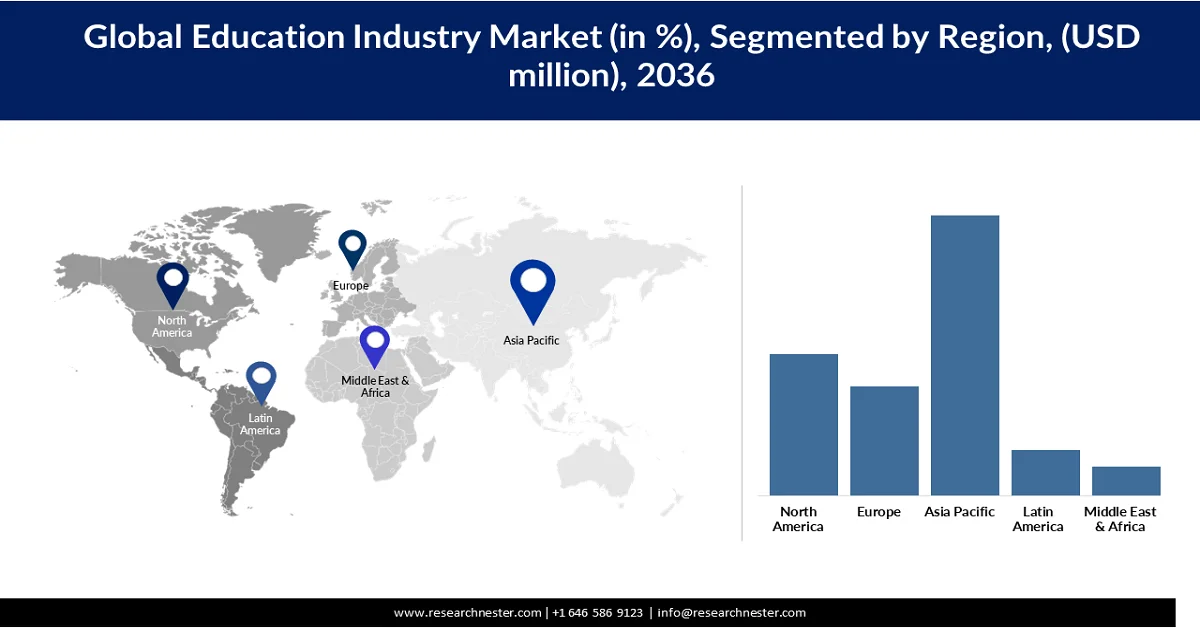
- Asia Pacific is projected to command a 46.3% share of the education industry market by 2036, propelled by the rapid adoption of online learning platforms and increasing government support for educational initiatives.
- North America is anticipated to secure 23.37% share of the market by 2036, attributed to strong government funding and accelerating integration of digital learning technologies in educational institutions.
Segment Insights:
- The others segment in the education industry market is projected to account for 51.52% share by 2036, impelled by growing participation in non-traditional learning programs including adult education, vocational courses, skill-building initiatives, and online learning opportunities.
- The educational institutions segment is expected to hold 45.9% share of the by 2036, fueled by sustained enrollment across schools, colleges, and universities along with ongoing government support and infrastructure investment.
Key Growth Trends:
- Growing importance of skill-based learning and lifelong education
- Policy shifts and education reforms
Major Challenges:
- Resistance to change and skill gaps among educators
- Digital divide and unequal access
Key Players: Age of Learning, Inc. (U.S.), Blackboard Education & Research Foundation (U.S.), BYJU'S (India), Chegg Inc. (U.S.), Coursera Inc. (U.S.), Duolingo, Inc. (U.S.), Instructure, Inc. (U.S.), PowerSchool (U.S.), Stride, Inc. (U.S.), Udemy, Inc. (U.S.).
Global Education Industry Market Forecast and Regional Outlook:
Market Size & Growth Projections:
- 2025 Market Size: 7.13 trillion
- 2026 Market Size: USD 7.70 trillion
- Projected Market Size: USD 13.62 trillion by 2036
- Growth Forecasts: 5.86% CAGR (2026-2036)
Key Regional Dynamics:
- Largest Region: Asia Pacific (46.3% Share by 2036)
- Fastest Growing Region: North America
- Dominating Countries: United States, China, India, United Kingdom, Germany
- Emerging Countries: Indonesia, Vietnam, Brazil, Mexico, Saudi Arabia
Last updated on : 5 March, 2026
Education Industry Market - Growth Drivers and Challenges
Growth Drivers
- Growing importance of skill-based learning and lifelong education: Skill-focused learning and lifelong education are gradually shaping the global education industry market. Fast-paced changes in technology and evolving job demands have driven a strong interest in programs that help people strengthen and update their skills. The OECD Skills Outlook 2025 highlights the importance of education systems achieving a balance between excellence, equity, and workforce relevance. This includes improving the alignment between skills and job opportunities, integrating essential 21st-century skills into curricula, and adopting funding and credential structures that address skill gaps while making competencies clear and meaningful to employers. Moreover, credentials, including professional certifications, micro-credentials, and short-term specialized courses, are attracting both students and working professionals. Continuous learning programs, such as virtual classes and workplace training, assist people develop new competencies throughout their professional lives. Prioritizing hands-on, career-oriented education enhances employability while offering considerable growth potential for educational institutions and service providers globally.
- Policy shifts and education reforms: Governments around the world are introducing reforms to enhance access, quality, and inclusivity in education, including expanding digital learning, encouraging science, technology, engineering, mathematics (STEM) programs, and supporting education for students with special needs. Policies that promote partnerships between the public and private sectors, set accreditation standards, and foster international collaboration are creating more opportunities for schools, universities, and educational service providers. For instance, in August 2025, the Government of Odisha in India unveiled significant reforms in primary education in line with the National Education Policy (NEP) 2020. The reforms focus on recruiting and regularizing teachers, providing free textbooks, strengthening the curriculum, incorporating tribal languages, and enhancing digital governance to improve both the quality and accessibility of education. By establishing a supportive framework for innovation, funding, and modernization, these reforms boost enrollment, improve learning outcomes, and open new education industry markets. Consequently, education reform acts as a key driver of long-term growth in the sector.
- Rising demand for digital & online learning: The popularity of online learning is steadily increasing, transforming how education is delivered worldwide. The COVID-19 pandemic sped up this change, generating strong demand for virtual classrooms, mobile learning platforms, and course management systems. Building on this, in 2026, the Punjab Cabinet in India approved the Punjab Private Digital Open Universities Policy, allowing private institutions to set up fully digital universities that provide online and open distance learning (ODL) programs. The policy follows the UGC Regulations, 2020, and establishes state-level standards for quality, digital infrastructure, data management, accessibility, and student protection. Rising demand for flexible, on-demand, and self-paced learning is accelerating the growth of digital education. This trend is creating strong opportunities for online schools, EdTech firms, and content providers to expand globally, making digital learning a key driver of sector growth.
Challenges
- Resistance to change and skill gaps among educators: Educational institutions frequently face challenges in implementing new technologies due to limited technical expertise and low confidence among teachers and staff. The Technology in Schools Survey 2024–2025, conducted by the UK Department for Education, indicated a marked decline in staff confidence with educational technology. Between 2023 and 2024, the proportion of school leaders stating that over 75% of their staff were confident in using digital tools decreased from 53% to 40% in primary schools and from 58% to 44% in secondary schools.
Educators who feel unprepared or overwhelmed may resist using digital tools or apply them superficially, reducing their potential to improve learning outcomes. Overcoming these obstacles requires continuous professional development, targeted training initiatives, and the development of intuitive technology platforms that enable effective adoption. - Digital divide and unequal access: A persistent issue in the education sector is the digital divide, which prevents many students, especially those in rural or economically disadvantaged communities, from accessing reliable internet and cost-effective digital devices. As a result, they are unable to make full use of online learning platforms and digital educational content. Consequently, educational disparities widen, weakening efforts to ensure inclusive and equitable learning opportunities. Students in underserved areas could fall behind if schools and communities do not invest in reliable infrastructure and affordable technology. Bridging this gap is essential for advancing the growth of the education sector and ensuring access for learners worldwide.
Education Industry Market Size and Forecast:
| Report Attribute | Details |
|---|---|
|
Base Year |
2025 |
|
Forecast Period |
2026-2036 |
|
CAGR |
5.86% |
|
Base Year Market Size (2025) |
USD 7.13 trillion |
|
Forecast Year Market Size (2036) |
USD 13.62 trillion |
|
Regional Scope |
|
Education Industry Market Segmentation:
Education Level Segment Analysis
The others segment is expected to hold 51.52% of the education industry market share. The segment includes a wide variety of non-traditional education programs, such as adult education, vocational courses, skill-building programs, and online learning opportunities. According to the National Center for Education Statistics (NCES), total enrollment in degree-granting postsecondary institutions increased by 32% between 2000 and 2014, rising from 15.3 million to 20.2 million students. Enrollment is expected to grow by a further 15% between 2014 and 2025, reaching approximately 23.3 million students. These programs are quickly gaining popularity as more individuals look for opportunities to upgrade their skills and learn on their own schedule. Serving learners of all ages, from working professionals to lifelong learners, the affordability, ease of access, and global reach of these programs help the segment capture a larger share of the education industry market.
End-User Segment Analysis
The educational institutions segment is likely to hold a 45.9% education industry market share by 2036. Schools, colleges, and universities make up a large portion of student enrollment, infrastructure spending, and educational expenditure. With steady demand across primary, secondary, and higher education, both public and private institutions contribute significantly to the education industry market, holding nearly half of the total share. This segment also encourages investment in teachers, educational materials, and campus infrastructure, strengthening the overall education system. Moreover, ongoing government funding, favorable policies, and a stronger emphasis on quality education reinforce the position of these institutions as the backbone of the education sector.
Provider Type Segment Analysis
The public institutions segment is expected to grow at a education industry market share of 44.3% by 2036. Publicly funded educational institutions remain the primary choice for students worldwide. According to OECD’s Education at a Glance 2024, the annual government-sourced statistical report, public institutions still educate the majority of tertiary students worldwide. High enrollment rates across bachelor’s, master’s, and doctoral programs underscore the pivotal role of government-funded higher education systems. Supported by consistent funding, government initiatives, and subsidies, they offer affordable and accessible education to a wide range of learners, including those in underserved areas. Their organized curricula and validated qualifications play a key role in preparing students for advanced studies and professional opportunities. Continued investments in facilities, teacher development, and digital learning resources enhance their ability to handle high student enrollment, allowing public institutions to maintain a large share of the education industry market.
Our in-depth analysis of the education industry market includes the following segments:
|
Segments |
Subsegments |
|
Education Level |
|
|
Provider Type |
|
|
End-User |
|

Vishnu Nair
Head - Global Business DevelopmentCustomize this report to your requirements — connect with our consultant for personalized insights and options.
Education Industry Market - Regional Analysis
Asia Pacific Market Insights
Asia Pacific is expected to dominate the education industry market, accounting for 46.3% of the total share by 2036. Education in the region is advancing as more students and institutions embrace online learning solutions. For instance, in June 2025, Bangkok saw the opening of Thailand’s first AI-centered high school, HOG International Academy, which incorporates artificial intelligence, machine learning, and robotics into its curriculum, offering students practical, hands-on experience and equipping them for a future driven by technology. At the same time, governments are increasing support for educational initiatives, and skill development is becoming essential to meet the demands of a changing job education industry market. The proliferation of e-learning platforms is broadening access, allowing students of all backgrounds to take advantage of educational opportunities. These developments are enhancing the overall quality of education, encouraging active participation, supporting tailored learning experiences, and promoting wider educational inclusion across the region.
The education industry in China is expanding as government support for technology-based learning and practical skill programs rises to strengthen the economy. Greater connectivity and smartphone penetration are making online learning accessible to students across the country. At the same time, vocational training and specialized skill development are gaining importance to meet workforce demands. Simultaneously, education technology companies are rolling out interactive platforms and tools that enhance learning experiences and make access to education easier for students across the nation.
India’s education industry market is growing quickly, led by a large population of young learners and strong demand for quality education. Digital learning and EdTech innovations are reaching even remote regions, breaking long-standing barriers to access. As stated by the India Brand Equity Foundation, in 2024, India had more than 886 million internet users, over half of whom were in rural areas, benefiting from some of the world’s cheapest mobile data at around USD 0.16 per GB. As a result, digital learning has become a regular part of life for many, with YouTube standing out as the top platform for informal education, providing accessible, flexible, and contextually relevant content to a wide audience. Government policies, such as the National Education Policy 2020, together with initiatives in skill development and vocational training, are driving progress. Alongside private sector investments and the societal focus on education as a route to advancement, are fuelling a vibrant growth environment. The adoption of hybrid learning post-COVID has further accelerated this transformation.
North America Market Insights
The education industry market in North America is expected to hold a share of 23.37% by 2036. The education industry market is driven by government initiatives and financial investments in modern teaching tools, schools, and colleges, creating more lively and interactive learning spaces. In FY 2025, the U.S. Department of Education, through the Fund for the Improvement of Postsecondary Education (FIPSE), announced approximately USD 50 million in funding across seven key areas. The initiative places strong focus on adopting artificial intelligence, digital learning platforms, and technology-supported teaching and student services, driving forward the digital transformation of postsecondary education in the U.S. By adopting digital solutions for tracking performance, assisting instruction, and handling administrative work, educational institutions are building a more streamlined and efficient education system.
The U.S. education sector is growing as demand rises for K-12 education, college programs, and vocational training, especially in STEM and professional fields. The growth of online learning and modern teaching tools is making education more accessible and adaptable. For instance, in April 2025, the U.S. introduced a mandate requiring AI education in all K–12 schools to improve workforce preparedness and maintain global competitiveness with China. Government programs and funding are promoting new instructional methods and workforce training, while lifelong learning and skill development are becoming increasingly important. At the same time, private investment and continued innovation in educational resources are boosting further growth throughout the sector.
Growth in Canada’s education sector is being fuelled by increasing enrolment from a growing youth population and steady international student inflows. Strong government support for educational infrastructure, technology integration, and STEM programs is improving learning quality and modernizing institutions. At the same time, the emphasis on vocational training, online courses, and lifelong learning is driving demand for adaptable and varied educational options. These factors combined are making Canada’s education sector a rapidly growing and active education industry market.
Europe Market Insights
Europe's education industry market will grow with a share of 18% by 2036 backed by rising student enrolment and a steady increase in international students across the region. Expanding cross-border education initiatives, supported by programs like Erasmus+, are accelerating academic mobility and strengthening institutional collaborations. This boosts university revenues, enhances cultural exchange, and increases demand for diverse academic programs. The growing use of online courses and contemporary teaching methods is making learning more flexible and personalized. In July 2025, Skidos Labs ApS partnered with The Peyo Company to launch inclusive Smurfs‑themed learning games. The collaboration integrates beloved characters into neurodiversity‑friendly, interactive mini‑games that promote essential skill development, offering accessible and engaging play experiences for children. Government investment is enhancing STEM initiatives, improving educational infrastructure, and supporting lifelong learning opportunities. Meanwhile, skill-focused training and vocational initiatives, coupled with cooperation between universities and the private sector, are strengthening workforce preparation and fostering innovation, contributing to ongoing expansion in the sector.
The education sector in Germany is expanding as more domestic students enrol and international student inflows remain strong. Well-established vocational and technical programs, reinforced by the dual education system, are helping produce a skilled workforce to meet labor education industry market demands. The adoption of digital courses and learning technologies is expanding access and offering personalized instruction. Along with government support for STEM education, infrastructure, and lifelong learning, collaboration between universities and industry is strengthening the sector and supporting steady growth.
The education sector in the UK is gaining momentum as domestic student enrollment rises and international students continue to choose the country for its respected universities and globally recognized programs. The growing use of digital learning platforms and online courses is making education more accessible and suited to individual learning needs. Support from the government for STEM initiatives, vocational programs, and adult learning is enhancing both education standards and workforce preparedness. At the same time, collaboration between universities and industry is encouraging applied learning and innovative practices, helping the education industry market grow steadily.
Key Education Industry Market Players:
- Age of Learning, Inc. (U.S.)
- Blackboard Education & Research Foundation (U.S.)
- BYJU'S (India)
- Chegg Inc. (U.S.)
- Coursera Inc. (U.S.)
- Duolingo, Inc. (U.S.)
- Instructure, Inc. (U.S.)
- PowerSchool (U.S.)
- Stride, Inc. (U.S.)
- Udemy, Inc. (U.S.)
- Company Overview
- Business Strategy
- Key Product Offerings
- Financial Performance
- Key Performance Indicators
- Risk Analysis
- Recent Development
- Regional Presence
- SWOT Analysis
- Age of Learning, Inc. is leading growth in the global education industry by developing highly effective, research‑based digital learning solutions that are used by millions of children worldwide. Their flagship platforms like ABCmouse Early Learning Academy, My Math Academy, and My Reading Academy deliver personalized, adaptive learning experiences that improve literacy and math outcomes for learners and are grounded in proven educational research. These programs have reached over 50 million children and are used in hundreds of thousands of classrooms, accelerating academic gains and driving engagement globally.
- Blackboard Education & Research Foundation focuses on transforming education delivery through technology and comprehensive e‑learning solutions. With over two decades in the education sector, it provides career counselling, vocational training, and 360° EdTech services to institutions and learners, helping bridge gaps between learners and educational opportunities. Its platforms and partner networks support student acquisition, university management services, and digital skills development, driving adoption of technology‑enabled education.
- BYJU'S has become one of the world’s largest EdTech companies by offering engaging, interactive learning content for students from early years through exam preparation. Its mobile‑first app combines animated lessons, personalized learning paths, and curriculum‑aligned content, making learning more accessible and enjoyable. With tens of millions of users and aggressive expansion into international education industry markets, BYJU’S continues to drive digital education adoption globally. Its strategic acquisitions and diversified offerings bolster education industry market reach and enhance learning experiences across age groups.
- Chegg Inc. has been a prominent provider of digital student services like homework help, textbook rentals, online tutoring, and study resources — empowering learners with flexible academic support. Historically, its subscription‑based model and broad service mix helped millions of students with study resources and academic assistance worldwide. While facing competitive and technological pressures, Chegg’s ecosystem including acquired assets such as language‑learning platforms, continues to influence student engagement and support services in higher education.
- Coursera Inc. is a leading online learning platform partnering with hundreds of top global universities and companies to offer MOOCs, professional certificates, and full degree programs to learners in every region. With well over 150 million registered learners, Coursera makes high‑quality education and career‑focused credentials accessible worldwide. Its scalable model for both individual learners and enterprise training, along with innovative features (like AI‑powered learning pathways), drives growth in workforce upskilling and lifelong learning.
Below is the list of the key players operating in the global education industry market:
The education industry is growing as leading organizations drive progress through new teaching methods, expansion into new regions, and strategic partnerships. Prominent EdTech companies, private schools, and universities are introducing digital learning platforms, interactive tools, and customized teaching approaches to enhance student performance. They are broadening their reach internationally, attracting students from abroad, and providing flexible online and blended learning options. Working together with governments, businesses, and other schools or universities enables the expansion of facilities, enrichment of academic offerings, and delivery of skill-oriented training, promoting sustained growth in the sector.
Corporate Landscape of the Global Education Industry Market:
Recent Developments
- In November 2025, Green Gold Animation launched Learn with Bheem, a global interactive learning app for children aged 2–8 years. The app offers age-appropriate modules developed with educators to build skills in language, numeracy, creativity, memory, logic, and problem-solving. Additionally, the platform provides both free and premium ad-free experiences in a child-safe digital environment, aiming to make learning enjoyable and globally accessible.
- In April 2025, the U.S. federal government issued an executive order directing the expansion of AI education and literacy for young Americans as part of a broader strategy to maintain national leadership in technological innovation. The initiative emphasizes exposing students early to AI concepts, preparing teachers to effectively use and teach AI, and strengthening the skills of the future workforce. Additionally, the program aims to integrate AI learning across schools and educational programs, ensuring students are equipped to thrive in an increasingly technology-driven economy.
- Report ID: 8416
- Published Date: Mar 05, 2026
- Report Format: PDF, PPT
- Explore a preview of key market trends and insights
- Review sample data tables and segment breakdowns
- Experience the quality of our visual data representations
- Evaluate our report structure and research methodology
- Get a glimpse of competitive landscape analysis
- Understand how regional forecasts are presented
- Assess the depth of company profiling and benchmarking
- Preview how actionable insights can support your strategy
Explore real data and analysis
Frequently Asked Questions (FAQ)
About this Report
Connect with our Expert


Report, 2026-2036



Copyright @ 2026 Research Nester. All Rights Reserved.
