AI in Education Market Outlook:
AI in Education Market is valued at USD 7.5 billion in 2025 and is projected to reach USD 113.2 billion by the end of 2035, growing at a CAGR of 35.2% during the forecast period, i.e., 2026-2035. In 2026, the industry size of AI in education is estimated at USD 10.1 billion.
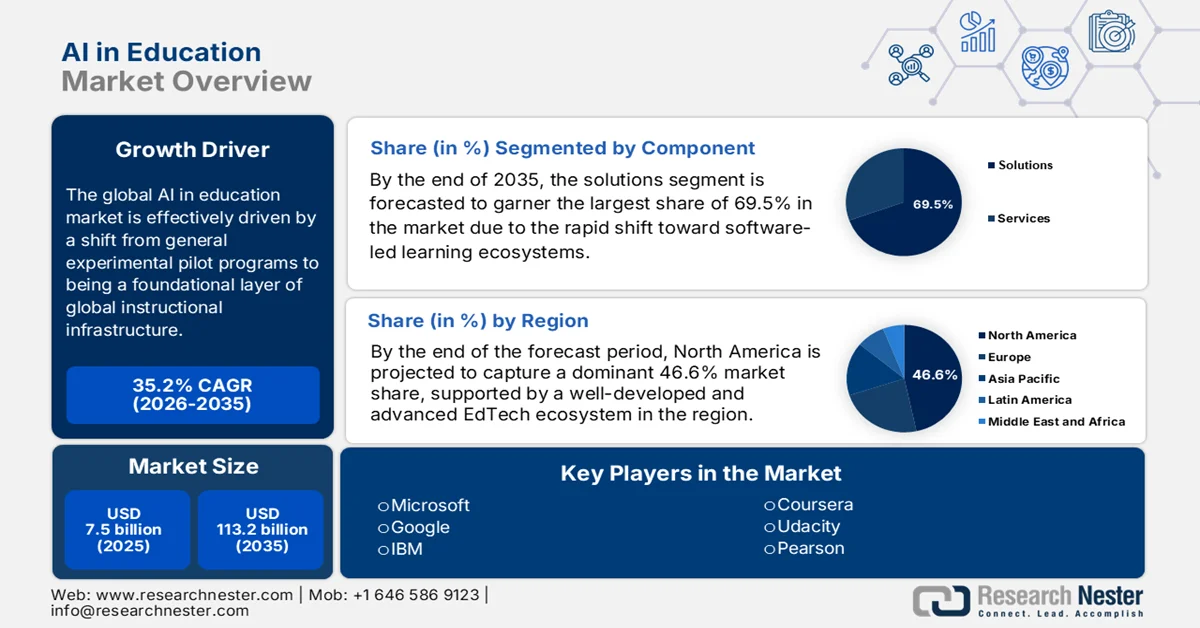
The AI in education market is poised for solid growth in the next decade, owing to the shift from general experimental pilot programs to being a foundational layer of global instructional infrastructure. This outlook is also carried forward by a surge in demand for hyper-personalized learning ecosystems where adaptive algorithms efficiently analyze individual patterns to make content suitable. Exemplifying the same, the article published by Gitnux Organization in February 2026 stated that AI in the education industry is growing remarkably on account of widespread adoption of tools such as generative AI, adaptive learning platforms, and intelligent tutoring systems across schools and universities worldwide. It stated that in 2023, AI education tools were already used by up to 89% of educators in some K-12 systems, whereas more than half of higher education institutions had integrated AI into administrative processes, thus denoting a lucrative opportunity for the AI in education market to grow.
Global AI in Education Statistics 2023-2033: Adoption, Market Growth & Learning Impact Data
|
Category |
Statistic |
Year |
|
Educator usage (US K-12) |
89% use AI tools daily |
2023 |
|
Higher education adoption |
55% use AI for admin tasks |
2022 |
|
India edtech AI integration |
67% platforms use AI personalization |
2023 |
|
AI lesson planning (US teachers) |
73% usage |
2023 |
|
Global K-12 AI adoption |
42% schools use adaptive learning |
2023 |
|
Europe universities |
64% use AI chatbots |
2023 |
|
Market size |
USD 5.4 billion to USD 75.1 billion projected |
2023-2033 |
|
Student improvement |
37% average grade improvement |
Multi-country trials |
|
AI tutoring impact |
25% faster math mastery |
Carnegie Learning study |
|
Dropout reduction |
18% decrease via AI analytics |
University data |
Source: Gitnux Organization
Furthermore, machine learning and natural language processing, integrated with immersive tools such as augmented reality and virtual reality to create interactive, multimodal digital classrooms, are stimulating consistent growth of AI in education market. As per an official press release published in August 2023, countries worldwide are opting for AI in education with the main goal to personalize learning and prepare students for the future. Besides, Singapore’s Smart Nation strategy uses AI for customized feedback and teacher support, whereas South Korea is integrating AI tutors and curriculum-wide training. Apart from these, India leverages AI through platforms such as Embibe to simplify complex concepts and predict student performance, and Finland promotes equity with free AI literacy courses and tools such as ViLLE. Meanwhile, China is making heavy investments in adaptive tutoring systems, though with less focus on ethics, thus denoting an encouraging opportunity for pioneers in this sector.
Key AI in Education Market Insights Summary:
Regional Highlights:
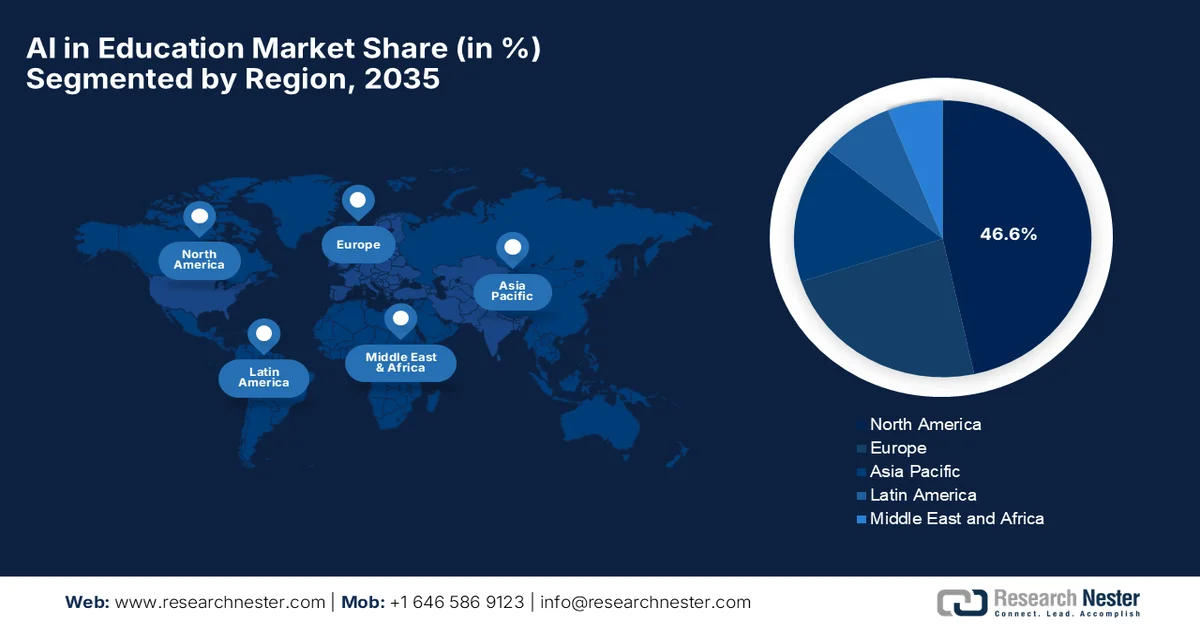
- By 2035, North America is projected to command a leading 46.6% share in the ai in education market, impelled by advanced edtech infrastructure and strong government investments supporting widespread AI adoption
- Across 2026–2035, Asia Pacific is expected to witness the fastest growth, stimulated by massive student populations and aggressive national digital agendas accelerating AI integration in education systems
Segment Insights:
- By 2035, the solutions segment is anticipated to capture a dominant 69.5% share in the ai in education market, fueled by the rapid shift toward software-led learning ecosystems enabling personalization, automation, and analytics at scale
- Over the 2026–2035 period, the cloud segment is projected to secure a considerable revenue share, propelled by scalability, flexibility, and cost-effectiveness enabling AI deployment without heavy infrastructure investment
Key Growth Trends:
- Demand for personalized learning
- Expansion of e-learning and digital education
Major Challenges:
- Digital divide and infrastructure limitations
- Teacher training and resistance to adoption
Key Players: Microsoft, Google, IBM, Coursera, Udacity, Instructure, Pearson, Sana Labs, Knowunity, Multiverse, Benesse Corporation, Class Technologies, OpenLearning, Go1, ClearSteps, Accenture, TalentSprint, NSE Academy, Riiid, upGrad, PhysicsWallah, Pandai, OpenAcademy.
Global AI in Education Market Forecast and Regional Outlook:
Market Size & Growth Projections:
- 2025 Market Size: USD 7.5 billion
- 2026 Market Size: USD 10.1 billion
- Projected Market Size: USD 113.2 billion by 2035
- Growth Forecasts: 35.2% CAGR (2026-2035)
Key Regional Dynamics:
- Largest Region: North America (46.6% Share by 2035)
- Fastest Growing Region: Asia Pacific
- Dominating Countries: United States, China, United Kingdom, Germany, Japan
- Emerging Countries: India, South Korea, Brazil, Indonesia, United Arab Emirates
Last updated on : 30 April, 2026
AI in Education Market - Growth Drivers and Challenges
Growth Drivers
- Demand for personalized learning: One of the strongest growth drivers of the AI in education market is the surging demand for personalized and adaptive learning. In this context, AI systems have the capability to analyze learning patterns and performance in order to deliver customized content. As per an article published by the National Institute of Health (NIH) in August 2023, personalized learning aims to address student diversity by adapting instruction to individual needs, thereby moving away from traditional tracking systems that often cause inequality. At the same time, it emphasizes that these educational methods can better support varied learning needs. The research suggests that personalized learning aligns most closely with the adequacy view of equity by ensuring all students achieve a basic level of competence, which is highly necessary for meaningful participation in society. Overall, personalized learning has the complete potential to improve educational equity.
- Expansion of e-learning and digital education: The continued growth of e-learning platforms has resulted in accelerated AI adoption in the educational category. At the same time, online and hybrid learning models are mostly dependent on AI for content delivery, assessments, and virtual tutoring. This shift toward digital education ecosystems has created sustained demand for AI tools. In September 2024, the article published by UNESCO stated that digital innovation is highly essential for transforming education into an inclusive, resilient system. Besides, it deliberately promotes a human-centered approach wherein the digital tools, including AI, are used ethically to support equity, inclusion, and achievement of global education goals, particularly Sustainable Development Goal 4. It also encourages policies, teacher training, and open access resources, thus benefiting the overall AI in education market.
- Increasing availability of smart devices and government support: The extensive utilization of smartphones, tablets, and consumers allows proper integration of AI into the education systems. At the same time, there has been improved internet connectivity and emerging technologies, encouraging governments to support AI with suitable initiatives. As per an article published by Press Information Bureau (PIB) in March 2026, India has positioned itself as a global AI leader, wherein education is at the core of this transformation. Through initiatives such as NEP 2020, DIKSHA, SOAR, and SWAYAM, AI learning is being integrated from school to higher education, ensuring inclusivity and skill readiness. The government-backed missions, such as IndiaAI and partnerships with institutions and industry, are allowing the country to build a robust AI talent pipeline to drive innovation and global leadership, thus benefiting the overall AI in education market.
IndiaAI Mission & AI in Education 2024-2027: Key Statistics on Adoption, Growth, Talent Demand
|
Category |
Statistic |
Details (Year / Context) |
|
AI Startup Growth |
89% of new startups are AI-powered |
2024 |
|
Enterprise AI Adoption |
87% of enterprises use AI |
2024 |
|
AI Market Growth Rate |
25% - 35% CAGR |
Projected till 2027 |
|
AI Talent Pool |
600,000 - 650,000 professionals |
2024 |
|
Required AI Workforce |
1.2 million professionals needed |
By 2027 |
|
Talent Growth Rate |
15% CAGR |
Required to meet demand |
|
SWAYAM AI Courses |
110+ AI courses offered |
Ongoing |
|
SWAYAM Enrollment |
41.2 lakh+ students enrolled |
As of 2026 |
|
DIKSHA Accessibility |
Available via mobile app |
Students, teachers, parents |
|
SOAR Program Structure |
3 student modules + 1 teacher module |
School-level AI training |
|
AICTE Reach (Perplexity partnership) |
40 million students |
Across 14,000 institutions |
|
YuvAi Initiative Target |
100,000 students/developers |
Over 3 years |
|
IndiaAI Mission Budget |
USD 1.2 billion |
5-year allocation (from 2024) |
Source: PIB
Challenges
- Digital divide and infrastructure limitations: This is the major obstacle hindering the growth of AI in education market, especially in terms of developing markets. AI-based learning tools require proper internet connectivity and modern devices, which are not always available in all regions. Most of the schools in rural or economically disadvantaged areas such do not have the essential infrastructure which is needed to implement advanced educational technologies. This creates inequality in access to high-quality, AI-enhanced learning experiences. Therefore, students in well-funded urban institutions benefit disproportionately when compared to those in under-resourced environments. Therefore, without large-scale investment in infrastructure and equitable access to technology, AI risks reinforcing rather than reducing existing educational inequalities.
- Teacher training and resistance to adoption: Another major challenge in the AI in education market is the absence of adequate teacher training and resistance to adopting AI-based tools. Most of the educators across different nations are not well-trained to integrate AI technologies into their teaching practices, which leads to underutilization of these systems. Apart from this, there exists a psychological barrier as some teachers fear that AI can replace their roles or reduce their professional autonomy. This resistance can slow down implementation and limit the benefits of AI in classrooms. In addition, integrating AI requires changes in curriculum design and classroom management strategies, which can be overwhelming without the presence of proper institutional support. Therefore, continuous professional development and awareness initiatives are highly essential to help educators adapt and confidently use AI tools in education.
AI in Education Market Size and Forecast:
| Report Attribute | Details |
|---|---|
|
Base Year |
2025 |
|
Forecast Year |
2026-2035 |
|
CAGR |
35.2% |
|
Base Year Market Size (2025) |
USD 7.5 billion |
|
Forecast Year Market Size (2035) |
USD 113.2 billion |
|
Regional Scope |
|
AI in Education Market Segmentation:
Component Segment Analysis
By the end of 2035, the solutions segment in the component category is forecasted to garner the largest share of 69.5% in the AI in education market. The segment’s leadership is largely attributable to the rapid shift toward software-led learning ecosystems that enable personalization, automation, and analytics at scale. At the same time, these AI platforms integrate capabilities such as automated grading and predictive performance tracking, making them an important aspect of an institutional digital strategy. As per an official press release in September 2024, Microsoft is bringing AI directly into classrooms and school operations, helping educators, leaders, and IT teams save time and personalize learning. The company benefits from tools such as Copilot for Microsoft 365, Teams for Education, and Learning Accelerators, in which teachers can generate lesson plans, streamline grading, and tailor feedback to individual students, thus positively benefiting the segment’s growth.
Deployment Mode Segment Analysis
On the basis of deployment mode, cloud is expected to grow with a considerable revenue share in the AI in education market during the forecast period. Scalability, flexibility, and cost-effectiveness are allowing institutions to deploy AI tools without heavy infrastructure investment, thus positioning the subtype at the forefront of growth in this category. Cloud platforms support remote learning environments and updates, which are highly essential for modern education systems. In February 2024, ConveGenius raised a total of USD 1.8 million from Searce Inc. to expand its AI-based education solutions. This particular partnership enhanced the cloud services and accelerated the development of SwiftChat, which is its flagship conversational AI platform. In this context, ConveGenius aims to deliver scalable, cloud-based tools to underserved regions, thus suitable for bolstering the segment’s growth.
End user Segment Analysis
Higher education in the end user category is anticipated to achieve a significant share in the AI in education market during the discussed timeframe. The segment’s growth is mainly propelled by its strong focus on research, innovation, and workforce readiness. Universities are early adopters of AI for applications such as intelligent tutoring, academic research, and student success analytics, encouraging more players to establish their footprint in the AI in education market. In addition, institutions across the world are integrating AI-based learning management systems to personalize education at scale. The rising demand for data-driven decision-making in academic administration also supports adoption. Collaborations between universities and EdTech companies are accelerating the deployment of advanced AI tools, thus indicating an optimistic market opportunity.
Our in-depth analysis of the AI in education market includes the following segments:
|
Segment |
Subsegments |
|
Component |
|
|
Deployment Mode |
|
|
End user |
|
|
Technology |
|
|
Application |
|

Vishnu Nair
Head - Global Business DevelopmentCustomize this report to your requirements — connect with our consultant for personalized insights and options.
AI in Education Market - Regional Analysis
North America Market Insights
The North America AI in education market is anticipated to garner the largest share of 46.6% during the forecast period. The region’s leadership is largely propelled by advanced edtech infrastructure, which has facilitated the widespread adoption of AI in education. In addition, government investments in the education sector also drive market growth. Based on the government data published in April 2025, a presidential executive order titled Advancing Artificial Intelligence Education for the Country’s youth was issued to strengthen AI literacy and skills across the U.S. Besides, it emphasizes integrating AI education from K–12 through higher education to prepare a future-ready workforce. This particular order clearly establishes a White House Task Force on AI Education to coordinate national efforts and partnerships, thus making it suitable for standard AI in education market growth.
The surge in demand for hyper-personalized learning experiences is driving consistent growth in the AI in education market in the U.S. Technological advancements in generative AI and natural language processing are enabling the mass adoption of intelligent tutoring systems and autonomous teaching assistants that handle routine administrative tasks, such as grading and lesson planning. In March 2026, the U.S. Department of Labor announced the launch of the Make America AI-Ready initiative, which is a free artificial intelligence literacy course designed to equip the country’s workers with foundational AI skills. Besides, this program allows users to enroll by texting READY to 20202 and complete a seven-day course, which is a text-based learning course. Apart from this, it delivers short daily lessons covering core AI concepts, practical applications, prompt creation, evaluation of outputs, and responsible AI use.
The AI in education market in Canada is poised for extensive growth in the next decade, owing to the strong public and private investments in digital infrastructure, along with a strong emphasis on fostering AI literacy and ethical governance frameworks. At the same time, institutional demand is highly focused on intelligent tutoring systems and automated administrative solutions, such as grading and scheduling, to alleviate educator workloads and enhance operational efficiency. Based on the government data published in July 2024, the British Columbia education framework highlights the use of AI as a supportive tool to enhance K-12 learning, thereby also maintaining a strong human-centered approach. Besides, it emphasizes that AI can assist in improving efficiency, streamlining administrative tasks, and enriching classroom practices, thus encouraging more players to make investments in the country’s market.
APAC Market Insights
The Asia Pacific AI in education market is expected to register the fastest growth from 2026 to 2035. The region’s leadership is effectively driven by a unique combination of massive student populations and aggressive national digital agendas. Apart from these strategic public-private partnerships, the rise of mobile-first educational tools is efficiently accelerating accessibility, whereas regional governments work to establish robust data governance frameworks to ensure the responsible deployment of these intelligent systems. The government data published in March 2026 stated that AI is transforming higher education at an unprecedented pace, with regional universities leading adoption through government‑driven innovation and digital strategies. It mentions that business schools are including AI into curricula, whereas faculty and leadership are highly focused on balancing technology with human skills such as ethics, creativity, and critical thinking.
The strong government backing with suitable action plans is fostering a highly profitable business environment for AI in education market in China. The country’s market is entering into a stage of systemic, state-led transformation, shifting away from private sector experimentation to a mandated pillar of national development. The domestic educational institutions are shifting toward AI+ models, wherein large language models and smart campus solutions are being integrated into core curricula and vocational training. In this context, the government in April 2026 stated that China has introduced the AI + education action plan to build an AI literacy system across all levels of education and lifelong learning, with the main goal to integrate AI deeply into the national education framework. This particular plan requires AI to be included in school curricula, university public courses, vocational training, and the development of specialized programs and textbooks to support future workforce needs, thus denoting an optimistic AI in education market opportunity.
The AI in education market in India is entering into a massive phase of growth facilitated by a strategic push from the government and a booming EdTech ecosystem, which is focused on upskilling. The country’s market is witnessing hyper-localization in which generative AI is utilized to translate complex materials and offer voice-based tutoring in regional languages, effectively bridging the rural-urban digital divide. In February 2026, Kyndryl announced the expansion of its AI skilling programs in India to train 50,000 students and 30,000 youth, thereby strengthening its CSR commitment to future-ready talent. These initiatives include integrating AI for governance courses into the government’s Karmayogi iGOT platform, launching foundational AI education in schools, and empowering youth to drive AI literacy in communities. Hence, such instances in the country will position it as a predominant leader in the sector.
India AI in Education Growth: Key Government Policies, Skilling Programs, and School Partnerships 2025-2026
|
Year |
Initiative |
Key Focus |
Market Opportunity |
|
2026 |
IIT Gandhinagar–Navneet AI Partnership |
School AI curriculum & teacher training |
Expands K–12 AI adoption via academic-industry collaboration |
|
2026 |
India AI Impact Summit Youth Initiatives |
Skilling & innovation ecosystem |
Drives large-scale AI talent development and employability |
|
2026 |
AI Literacy & Youth Talent Ecosystem (India) |
National AI skilling & infrastructure access |
Builds a strong pipeline for AI education and workforce readiness |
|
2025 |
SOAR Program (India) |
AI literacy in schools & educators |
Strengthens foundational AI education and curriculum integration |
Source: PIB
Europe Market Insights
In Europe, the AI in education market is extensively supported by administrative automation, as there is a growing demand for AI tools and a rising demand for reskilling. This allows educators to focus more on direct instruction and student support. This maturation of the ecosystem is supported by targeted public funding through suitable initiatives fostering a regional innovation landscape where startups are shifting from standalone content toward integrated systems. The Digital Education Action Plan from 2021 to 2027 sets a strategic vision for inclusive, high‑quality digital learning across Europe, effectively shaped by lessons from the COVID‑19 pandemic. Also, it defines digital education as the use of tools and technologies to support teaching, learning, and assessment, making education more flexible and accessible. This particular initiative has two strategic priorities and 14 actions, whereas the plan addresses challenges such as low digital skills, limited infrastructure, and teacher training gaps.
The AI in education market in the UK has gained enhanced traction owing to the shift toward alleviating the critical teacher retention crisis by using generative AI to automate crushing administrative workloads, such as lesson planning and resource creation. The country’s market is also driven by universities that deploy predictive analytics to enhance student retention and pastoral care. In this context, the government data published in August 2025 outlined a policy on generative AI in education, underscoring its complete potential to enhance teaching, reduce workload, and support personalised learning if used safely and effectively. At the same time, it defines generative AI tools such as ChatGPT and Microsoft Copilot and notes both opportunities, such as lesson planning and feedback support, and risks, including bias, inaccuracy, and data privacy concerns. The policy stresses strict safeguards, legal compliance, and teacher oversight when using AI, especially with students, thus positively impacting the market’s growth and exposure in the overall country.
A primary shift from exploratory pilots to standardized national implementation is responsibly uplifting AI in education market in France. The country’s market is also fueled by a rapid shift toward adaptive learning pathways, such as the compulsory AI training program for secondary students on the Pix platform, and the integration of AI into corporate training to address critical skill gaps. In September 2025, the data from the digital society lab stated that there has been a rise of AI in schools and the urgent need for large-scale teacher and student training to ensure its effective use in education. At the same time, it stresses the importance of creating a coordinated national strategy to manage AI integration, address infrastructure gaps, and resolve policy contradictions such as balancing AI adoption with digital breaks and traditional learning methods, thus indicating a positive AI in education market outlook.
Key AI in Education Market Players:
- Microsoft (U.S.)
- Google (U.S.)
- IBM (U.S.)
- Coursera (U.S.)
- Udacity (U.S.)
- Instructure (U.S.)
- Pearson (UK)
- Sana Labs (Sweden)
- Knowunity (Germany)
- Multiverse (UK)
- Benesse Corporation (Japan)
- Class Technologies (Japan)
- OpenLearning (Australia)
- Go1 (Australia)
- ClearSteps (India)
- Accenture (Ireland)
- TalentSprint (India)
- NSE Academy (India)
- Riiid (South Korea)
- upGrad (India)
- PhysicsWallah (India)
- Pandai (Malaysia)
- OpenAcademy (Malaysia)
- Company Overview
- Business Strategy
- Key Product Offerings
- Financial Performance
- Key Performance Indicators
- Risk Analysis
- Recent Development
- Regional Presence
- SWOT Analysis
- Microsoft has registered itself as a dominant force in AI-based education through its cloud platform Azure and tools such as Microsoft 365 Copilot. The company is highly focused on embedding AI into everyday learning workflows, ranging from automated content generation to personalized tutoring and classroom analytics.
- Google has gained a prominent position in this field as it leverages its ecosystem, Google Classroom, Workspace for education, and AI models, to deliver intelligent learning experiences. Also, its AI capabilities enhance adaptive learning, automated assessments, and real-time feedback, allowing uptake in a widespread audience group.
- IBM has long focused on enterprise AI, and its education strategy reflects strength through platforms such as Watson. The firm emphasizes AI for workforce development, offering professional certifications, AI curricula, and partnerships with universities.
- Coursera is a foundational pillar in this sector, which operates as a global online learning marketplace enhanced by AI-based personalization and course recommendations. This particular platform collaborates with top universities and companies with the main goal of delivering job-relevant courses and certifications.
- Pearson is a traditional education giant that is transitioning into an AI-based digital learning company. The firm is highly focused on digital transformation and lifelong learning, and it is repositioning itself as a modern, technology-enabled education provider in the AI in education market.
Below is the list of some prominent players operating in the global AI in education market:
The AI in education market is considered to be a fragmented but consolidating landscape, which hosts large technology firms such as Microsoft and Google building AI platforms. Meanwhile, the educational specialists, such as Coursera, are highly focused on scalable learning ecosystems. Apart from these startups, such as Riiid emphasize adaptive learning and personalization. Partnerships with universities, AI-based content generation, and workforce upskilling programs are some of the growth strategies adopted by players in this sector. Companies are also investing in generative AI tutors, cloud-based learning infrastructure, and global expansion through acquisitions, reflecting intense competition. In April 2025, Accenture announced the acquisition of TalentSprint from NSE Academy with a collective goal to strengthen its LearnVantage platform with deep tech education and future-ready talent development, thus positively impacting the market’s growth.
Corporate Landscape of the AI in Education Market:
Recent Developments
- In April 2026 ClearSteps, launched India’s first AI-powered CBSE exam preparation platform, which delivers predictive learning and competency-based practice to help students prepare smarter and more effectively.
- In January 2026, Microsoft announced the launch of the Elevate for Educators program to offer free AI-powered tools in Microsoft 365 Copilot and global resources to help educators confidently integrate AI into classrooms. Along with this, new credentials, communities, and student promotions aim to strengthen teaching, learning, and career pathways in an AI-based future.
- Report ID: 8540
- Published Date: Apr 30, 2026
- Report Format: PDF, PPT
- Explore a preview of key market trends and insights
- Review sample data tables and segment breakdowns
- Experience the quality of our visual data representations
- Evaluate our report structure and research methodology
- Get a glimpse of competitive landscape analysis
- Understand how regional forecasts are presented
- Assess the depth of company profiling and benchmarking
- Preview how actionable insights can support your strategy
Explore real data and analysis
Frequently Asked Questions (FAQ)
About this Report
Connect with our Expert


Report, 2026-2035



Copyright @ 2026 Research Nester. All Rights Reserved.
