Dynamic Positioning System Market Outlook:
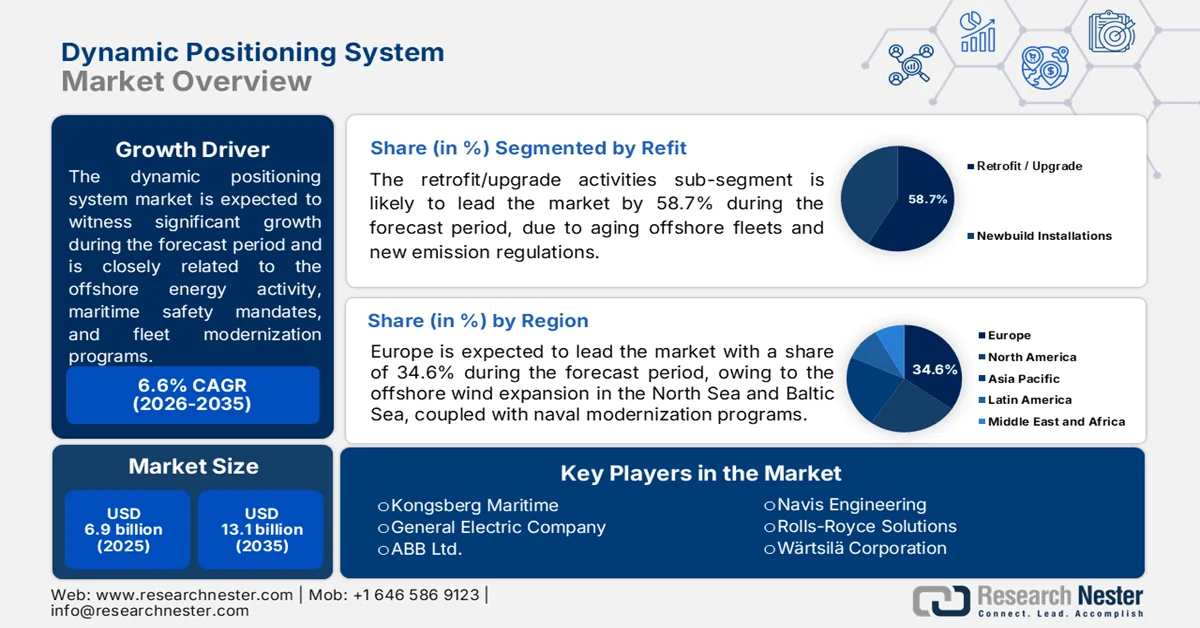
Dynamic Positioning System Market size was valued at USD 6.9 billion in 2025 and is projected to account for USD 13.1 billion by 2035, rising at a CAGR of 6.6% during the forecast period 2026 to 2035. In 2026, the industry size of dynamic positioning system is assessed at USD 7.3 billion.
The global dynamic positioning system market is closely tied to offshore energy activity, maritime safety mandates, and fleet modernization programs supported by the government and intergovernmental bodies. According to Earth Justice's October 2024 data, the offshore oil production accounted for nearly 30% of global crude output in 2023, with sustained investments in deepwater and ultra-deepwater fields requiring high-precision vessel station-keeping capabilities. On the other hand, the International Maritime Organization continues to enforce strict safety and environmental frameworks under conventions such as SOLAS, which drive the demand for advanced vessel control systems to reduce collision and grounding risks. Additionally, the global offshore capital expenditure is expected to maintain a steady growth over the decade, reinforcing the procurement cycles for DP integrated vessels across oil & gas and renewable energy segments.
Besides, the maritime administrations and defense agencies are allocating budgets toward fleet upgrades and autonomous navigation capabilities that incorporate DP architectures. As per the U.S. Department of War, April 2024 data, the Department of Defense budget includes over USD 48 billion for shipbuilding and maritime systems supporting integration and advanced navigation and control technologies across naval platforms. Similarly, there is an increased adoption of digital navigation and positioning systems in Europe to enhance operational safety and reduce emissions across EU waters. Fisheries and oceanographic research programs funded by agencies such as the National Oceanic and Atmospheric Administration, in September 2023 data, also utilize DP-equipped vessels for the precise survey operations, with NOAA operating a fleet of 15+ research and survey ships. These data are sustaining demand for the market across commercial and government maritime applications.
Key Dynamic Positioning System Market Insights Summary:
Regional Highlights:
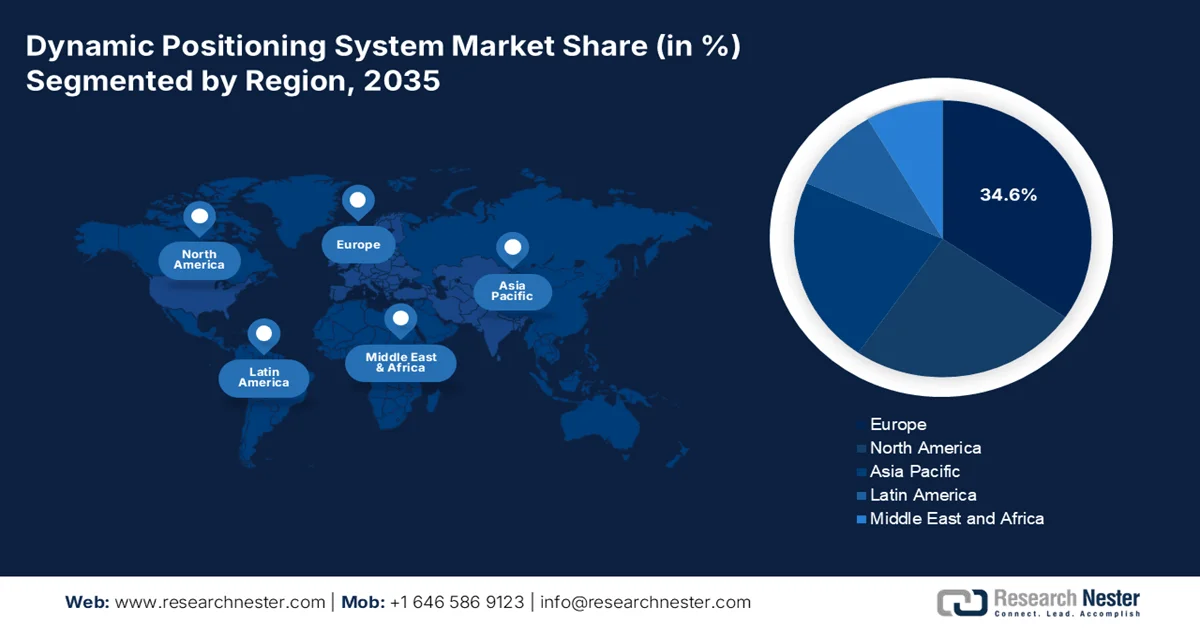
- Europe dynamic positioning system market is projected to capture a 34.6% share by 2035, impelled by offshore wind expansion in the North Sea and Baltic Sea alongside naval modernization across NATO member states
- Asia Pacific is anticipated to witness the fastest growth with a CAGR of 7.8% over 2026-2035, attributable to rising naval modernization, offshore energy exploration, and expanding wind farm installations
Segment Insights:
The retrofit/upgrade activities sub-segment within the dynamic positioning system market is anticipated to account for a 58.7% share by 2035, propelled by aging offshore fleets and tightening emission regulations
The diesel electric sub-segment under propulsion is expected to maintain a leading position through 2035, supported by its widespread adoption in vessel modernization and ferry operations alongside compliance with stringent emission standardsKey Growth Trends:
- Growth in offshore wind installation and maintenance
- Environmental regulations and emission reduction targets
Major Challenges:
- Complex integration and technical challenges
- Regulatory compliance and periodic system audits
Key Players: ABB Ltd., Navis Engineering, Rolls-Royce Solutions, Wärtsilä Corporation, Praxis Automation & Technology B.V., Reygar Ltd, Marine Technologies, LLC, Norcontrol, Mitsui E&S Shipbuilding Co., Ltd., Tokyo Keiki Inc., Navis Navtech, L3Harris Technologies, Offshore Systems & Marine Dynamics.
Global Dynamic Positioning System Market Forecast and Regional Outlook:
Market Size & Growth Projections:
- 2025 Market Size: USD 6.9 billion
- 2026 Market Size: USD 7.3 billion
- Projected Market Size: USD 13.1 billion by 2035
- Growth Forecasts: 6.6% CAGR (2026-2035)
Key Regional Dynamics:
- Largest Region: Europe (34.6% Share by 2035)
- Fastest Growing Region: Asia Pacific
- Dominating Countries: United States, China, Norway, South Korea, Germany
- Emerging Countries: India, Brazil, Vietnam, Indonesia, Saudi Arabia
Last updated on : 30 April, 2026
Dynamic Positioning System Market - Growth Drivers and Challenges
Growth Drivers
- Growth in offshore wind installation and maintenance: Public funding and policy mandates for renewable energy are expanding the dynamic positioning system market deployment. As per the U.S. Department of Energy, March 2023 data indicates that the nation targets 30 GW of offshore wind capacity by 2030. On the other hand, the European Commission aims for 300 GW by 2050 based on the European Hydrogen Observatory June 2025 data. These reports are driving the demand for the specialized vessels requiring DP systems for the turbine installations and subsea cabling. These operations demand a high positional accuracy in the harsh marine environments, making the DP systems essential. Partnerships with shipyards and renewable EPC firms can unlock long-term contracts. Additionally, maintenance operations for the installed wind farms create demand for service vessels equipped with DP, ensuring a steady aftermarket revenue stream.
- Environmental regulations and emission reduction targets: Government-imposed emission reduction targets are influencing the vessel design and dynamic positioning system integration. According to the Climate Action Accelerator, October 2025 data, the IMO targets a 50% reduction in greenhouse gas emissions from shipping by 2050, pushing operators toward fuel-efficient and hybrid vessels equipped with optimized DP systems. These systems reduce the fuel consumption by improving station-keeping efficiency and minimizing unnecessary propulsion usage. Additionally, national policies promoting green shipping corridors and low-emission vessels are stimulating the retrofit and newbuild demand. The shift toward sustainable maritime operations creates opportunities for innovation in low-power DP architectures and software optimization.
- Digitalization and autonomous maritime initiatives: Government-supported digital transformation programs are stimulating the adoption of advanced dynamic positioning system market as part of autonomous vessel frameworks. The European Maritime Safety Agency emphasizes digital navigation and automation to enhance maritime safety and efficiency. Similarly, national maritime strategies in countries such as Japan and Norway promote autonomous shipping trials where the SP systems play a critical role in maintaining the vessel position without manual intervention. These initiatives are supported by public funding and regulatory sandboxes, enabling real-world deployment of the autonomous technologies. The trend toward autonomy represents a long-term growth avenue with governments acting as early adopters and the enablers via funding and regulatory support.
Challenges
- Complex integration and technical challenges: Implementing a dynamic positioning system market is not a simple plug-and-play operation; it necessitates seamless integration with a vessel’s propulsion, navigation, communication, and power systems. Inadequate integration may lead to erratic performance, elevated downtime, and heightened operational hazards. Further sensor calibration and control software customization require specialized engineering and technical supervision, frequently resulting in commissioning delays and extended learning curves for ship crews. These complications hinder adoption among less technologically proficient maritime entities.
- Regulatory compliance and periodic system audits: The dynamic positioning system market manufacturers must navigate the complex international maritime regulations, including IMO guidelines and class society requirements. Each vessel class demands specific redundancy levels, fail-safe mechanisms, and periodic audits to verify safety compliance. Moreover, the regulatory compliance and periodic system audits are a key market restraint, noting that it increases the operational costs and create entry hurdles for new suppliers lacking established certification pathways.
Dynamic Positioning System Market Size and Forecast:
| Report Attribute | Details |
|---|---|
|
Base Year |
2025 |
|
Forecast Year |
2026-2035 |
|
CAGR |
6.6% |
|
Base Year Market Size (2025) |
USD 6.9 billion |
|
Forecast Year Market Size (2035) |
USD 13.1 billion |
|
Regional Scope |
|
Dynamic Positioning System Market Segmentation:
Refit Segment Analysis
Under the refit segment, the retrofit/upgrade activities sub-segment is dominating in the dynamic positioning system market and is poised to hold the share value of 58.7% by the end of 2035. The segment is driven by the aging offshore fleets and new emission regulations. As per the U.S. Maritime Administration, November 2022 data, ship operators are increasingly upgrading existing vessels to improve fuel efficiency and meet sustainability targets. For instance, the Yang Ming Marine Transport reported energy savings of 3% to 5% after retrofitting two ships with Wartsila slow steaming propellers and the EnergoProFin boss cap. This upgrade involved reducing operating speed from 24 to 18 knots and replacing the original propellers with 27% lighter fixed pitch propellers, enabled by lower rotational speeds and reduced blade loads. Such retrofitting solutions highlight the growing emphasis on cost-effective performance optimization and emission reduction without requiring new vessel investments.
Propulsion Segment Analysis
Within the propulsion segment in the dynamic positioning system market, diesel electric remains the leading sub-segment due to its superior fuel efficiency and lower emissions during station keeping. Moreover, the steady adoption, particularly in vessel modernization and ferry operations, due to its efficiency and compliance with stringent emission standards, is also driving the DEP. For instance, the EPD May 2021 data indicates that the ferry upgrade replaced a conventional 357 kW pre-1990 diesel engine with a DEP system comprising two 275 kW Caterpillar diesel generators, two frequency inverters, and two 350 kW electric motors, along with the integrated control equipment. The system operates with one generator powering the propulsion motors while the second serves as a standby unit for safety compliance, as mandated by marine authorities. Additionally, the generators meet IMO Tier II and USEPA Tier III emission standards, highlighting the environmental advantages of DEP systems.
Type Segment Analysis
The type segment of the dynamic positioning system market is led by Class 2 DP, which offers redundancy without full compartmentalization, making it ideal for most deepwater and offshore wind operations. The Class 1, which loses position upon a single fault, Class 2 DP systems incorporate redundant components such as power supplies, control computers, and thrusters, allowing a vessel to maintain position even after any single active failure. This makes Class 2 the preferred choice for most deepwater drilling, offshore wind installation, and subsea construction vessels. Class 3 offers the highest redundancy with compartmentalization but is reserved for the specialized naval or ultra-deepwater assets due to its high cost. Moreover, Class 2 dominates the Type segment, serving the majority of commercial offshore operations that require high uptime without the extreme expense of full Class 3 systems.
Our in-depth analysis of the dynamic positioning system market includes the following segments:
|
Segment |
Subsegments |
|
Type |
|
|
Component |
|
|
Vessel Type |
|
|
End user |
|
|
Propulsion |
|
|
Autonomy Level |
|
|
Refit |
|

Vishnu Nair
Head - Global Business DevelopmentCustomize this report to your requirements — connect with our consultant for personalized insights and options.
Dynamic Positioning System Market - Regional Analysis
Europe Market Insights
The dynamic positioning system market in Europe is dominating and is poised to hold the regional revenue share of 34.6% by the end of 2035. The region is driven due to the offshore wind expansion in the North Sea and Baltic Sea, coupled with naval modernization programs across the NATO member states. The European Commission’s REPowerEU plan has accelerated vessel demand for turbine installation, cable laying, and service operations. Norway, the UK, Germany, and Denmark lead in DP-equipped wind farm support vessels. Additionally, EMSA has updated the DP inspection protocols requiring class 2 systems on all vessels operating within offshore energy infrastructure. Key trends include integration of DP with battery-hybrid propulsion for emissions reduction, remote DP monitoring from shore-based centers, and standardization of position reference interfaces across vessel types operating in crowded wind farm arrays.
The expanding in line with legally mandated offshore wind targets and active project pipeline is driving the dynamic positioning system market in Germany. According to the DEUTSCHE WINDGUARD 2023 data, Germany operated 1,566 offshore wind turbines with 8.5 GW capacity, and additional installations, including 74 new foundations, indicate ongoing construction activity. Under the Offshore Wind Energy Act, the government targets at least 30 GW by 2030, 40 to 50 GW by 2035, and 70 GW by 2045, providing long-term visibility for offshore infrastructure development. The Federal Maritime and Hydrographic Agency’s Site Development Plan further supports this demand with 8 GW scheduled by 2030 and 16 GW planned between 2031 and 2035. This sustained expansion is driving the demand for DP-enabled installation cable laying and maintenance vessels, positioning Germany as a key dynamic positioning system market for advanced positioning and control systems.
Government backed offshore wind deployment and maritime investment are shaping the dynamic positioning system dynamic positioning system market in the UK. The Government of the UK's April 2023 data indicates that over 14 GW of installed offshore wind capacity in 2023, the highest in Europe. The government has set a binding target of 50 GW of offshore wind capacity by 2030, including up to 5 GW of floating wind, driving the demand for DP-enabled installation and service vessels. In addition, REGEN July 2022 data indicates that the government has invested USD 205 million in an offshore wind manufacturing investment scheme to support port and vessel infrastructure, further stimulating the adoption of dynamic positioning system market across offshore construction and maintenance activities.
APAC Market Insights
The Asia Pacific is projected to emerge as the fastest-growing region in the dynamic positioning system market and is projected to expand at a CAGR of 7.8% during the assessed period, 2026 to 2035. The region is driven by naval modernization, offshore energy exploration, and expanding wind farm installation. China leads in DP-equipped drillships for deepwater oil and gas in the South China Sea. Japan and South Korea focus on DP-capable naval vessels and Arctic-bound shuttle tankers. India’s market is propelled by the Ministry of Petroleum and Natural Gas deepwater exploration incentives and the India Navy’s fleet expansion. Malaysia maintains a steady DP vessel fleet supporting the domestic offshore production and decommissioning activities. Key trends include the integration of DP with autonomous navigation for uncrewed survey vessels, the adoption of hybrid propulsion to comply with IMO Tier III emissions standards, and the expansion of DP training centers in India and Malaysia to address skilled crew shortages.
The rising defense spending, indigenous manufacturing policies, and naval fleet expansion are driving the dynamic positioning system market in India. According to the PIB December 2024 data, the Ministry of Defense allocated USD 75 billion, with 27.66% toward capital expenditure, and 75% of procurement reserved for the domestic industry, strengthening demand for advanced vessel systems and onboard technologies. Moreover, the acceptance of Necessity worth USD 51 billion, with over 94% earmarked for indigenous sourcing, is stimulating the local production of critical components such as sensors, control systems, and power modules relevant to DP architectures. Programs such as Positive Indigenization Lists and contracts for patrol vessels, interceptors, boats, and naval platforms further reinforce the domestic supply chains. This policy-driven ecosystem is positioning India as a growing hub for the dynamic positioning systems integration across defense and offshore maritime applications.
The large scale offshore wind deployment and extensive renewable energy pipelines are shaping the dynamic positioning system market in China. According to the Global Energy Monitor July 2025 report, China’s offshore wind capacity reached 42.7 GW, accounting for nearly 50% of global installed capacity, highlighting its dominant position in offshore infrastructure development. The country is also advancing a 1.3 TW pipeline of solar and wind projects with 510 GW already under construction, indicating sustained vessel demand for installation and maintenance activities. Additionally, offshore wind alone represents a significant share, with China contributing over 50% of global offshore wind capacity under construction. This scale of development is driving demand for DP-enabled installation, cable laying, and service vessels, positioning China as a key growth hub for advanced positioning and control systems across offshore energy operations.
North America Market Insights
The dynamic positioning system market in North America is primarily shaped by the U.S. deepwater oil and gas operations in the Gulf of Mexico, where DP-equipped drillships, semisubmersibles, and production vessels are essential for maintaining station over subsea wells that cannot accommodate traditional anchoring. Canada contributes via its Arctic vessel regulations, which mandate higher redundancy DP classes for ships operating in ice-prone northern waters. Federal maritime agencies in both countries continue to specify DP capability for new naval coast guard and oceanographic research vessels, creating a stable demand. Competition among DP suppliers focuses on system reliability, cybersecurity integration, and compatibility with hybrid propulsion architectures.
The large-scale offshore wind investments and federal leasing programs are expanding the dynamic positioning system market in the U.S. According to the American Clean Power July 2024 data, the industry is expected to attract USD 65 billion in investment by 2030, with 56 GW of offshore wind capacity under development across 37 lease areas, creating a sustained demand for dynamic positioning-enabled installation service and maintenance vessels. Over 40 vessels, including crew transfer and service operation vessels, are already on order or under construction, directly increasing the procurement of DP systems. Additionally, the Bureau of Ocean Energy Management plans to open 1.9 million acres of new lease sales, potentially adding over 20GW of future capacity. With projections of 14 GW by 2030 and 40 GW by 2035, the expanding project pipeline continues to reinforce the long-term demand for advanced positioning systems across U.S. offshore operations.
The offshore energy development, marine research funding, and fleet modernization initiatives are driving the dynamic positioning system market in Canada. According to the Canadian Oil and Gas Production October 2025 data, the offshore oil production accounted for 4% of total Canada crude output, sustaining the demand for DP-enabled offshore support vessels. The Government of Canada's September 2025 data depicted that USD 3.5 billion is allocated under the Oceans Protection Plan to enhance the marine safety infrastructure and vessel capabilities supporting the adoption of advanced positioning systems. Moreover, the Government of Canada's March 2025 data highlights that USD 2.3 billion annually is allocated for coastal and naval fleet renewal programs, including research and patrol vessels requiring precise station-keeping technologies. These investments strengthen the demand for the DP system across offshore defense and scientific applications.
Key Dynamic Positioning System Market Players:
- Kongsberg Maritime (Norway)
- General Electric Company (U.S.)
- ABB Ltd. (Switzerland)
- Navis Engineering (Finland)
- Rolls-Royce Solutions (Germany)
- Wärtsilä Corporation (Finland)
- Praxis Automation & Technology B.V. (Netherlands)
- Reygar Ltd (UK)
- Marine Technologies, LLC (U.S.)
- Norcontrol (Norway)
- Mitsui E&S Shipbuilding Co., Ltd. (Japan)
- Tokyo Keiki Inc. (Japan)
- Navis Navtech (India)
- L3Harris Technologies (U.S.)
- Offshore Systems & Marine Dynamics (Australia)
- Hyundai Marine Solutions Co., Ltd. (South Korea)
- Daewoo Shipbuilding & Marine Engineering (South Korea)
- Cadeler (Denmark)
- International Marine Contractors Association (UK)
- Sonardyne (UK)
- Company Overview
- Business Strategy
- Key Product Offerings
- Financial Performance
- Key Performance Indicators
- Risk Analysis
- Recent Development
- Regional Presence
- SWOT Analysis
- Kongsberg Maritime is a dominant global leader in the dynamic positioning system market, renowned for its advanced DP class 3 systems and integrated vessel control solutions. The company continuously innovates with green DP technology, combining dynamic positioning with energy optimization for offshore vessels. Its strategic initiatives include digital twin simulations and autonomous ship trials. In 2024, the company witnessed a rise of 20% in operating revenue.
- General Electric Company has carved a significant niche in the dynamic positioning system market by leveraging its expertise in power conversion and maritime automation. GE’s DP systems are recognized for high reliability and seamless integration with electric propulsion drives. The key strategic moves include developing cyber-secured DP controls and forming an alliance with shipbuilding to offer fully controlled marine solutions.
- ABB Ltd. stands out in the dynamic positioning system market for its ability to unify DP control with onboard DC grids and energy storage systems. ABB focuses on enhancing vessel efficiency and redundancy while reducing fuel consumption. Its strategic initiatives include introducing remote diagnostic services and AI-assisted DP operations to support dynamic positioning for next-gen offshore construction. In 2024, the company made a revenue of USD 1.47 billion.
- Navis Engineering has established a strong presence in the dynamic positioning system market by offering highly modular, cost-effective DP solutions customized for smaller and medium-sized vessels. Originating from Finland, the company emphasizes simplicity, reliability, and ease of installation. Strategic initiatives include expanding its product line into DP-assisted anchoring and developing hybrid-ready DP systems.
- Rolls-Royce Solutions remains a key innovator in the dynamic positioning system market, mainly via its MTU brand and intelligent marine automation. The company focuses on integrating DP functionality with its diesel engine and propulsion control systems. Strategic initiatives include launching autonomous DP functionality for tugboats and supply vessels alongside developing smart condition monitoring to enhance system uptime and operational safety for fleet operators globally.
Here is a list of key players operating in the global dynamic positioning system market:
The global dynamic positioning system market is highly consolidated, dominated by a few multinational marine technology giants alongside specialized regional players. The key strategies include significant investment in the next-gen DP systems with enhanced redundancy, AI-driven predictive maintenance, and integration with the autonomous vessel platforms. Major players are focusing on strategic partnerships with shipbuilders and digital upgrades for existing fleets to overcome supply chain disruptions. For example, in May 2025, Cadeler announced that it had agreed to acquire the Boqiang 3060, a newly constructed jack-up wind turbine installation vessel. To capture niche markets, companies are offering cost-effective customized solutions for offshore wind and smaller vessels. Mergers and acquisitions remain a core tactic to expand geographical reach and technology portfolios.
Corporate Landscape of the Dynamic Positioning System Market:
Recent Developments
- In January 2026, the International Marine Contractors Association (IMCA) announced the launch of its new Dynamic Positioning (DP) incident reporting system, now live via the IMCA portal. This modern, intuitive platform will make it easier and faster for DP professionals and contractors to submit reports and contribute to safer offshore operations.
- In October 2025, Navis Engineering OY, together with its partner Lido Marine, completed the installation and full commissioning of the NavDP4000 dynamic positioning control systems on five new vessels for Jana Marine Services in Saudi Arabia.
- In February 2025, Sonardyne announced the launch of our new shallow water dynamic positioning (DP) reference system. Building on our decade-long expertise in hybrid acoustic-inertial navigation systems, SPRINT-Nav DP integrates high-grade inertial navigation with Doppler velocity log (DVL) technology in a single, pre-calibrated unit.
- Report ID: 8543
- Published Date: Apr 30, 2026
- Report Format: PDF, PPT
- Explore a preview of key market trends and insights
- Review sample data tables and segment breakdowns
- Experience the quality of our visual data representations
- Evaluate our report structure and research methodology
- Get a glimpse of competitive landscape analysis
- Understand how regional forecasts are presented
- Assess the depth of company profiling and benchmarking
- Preview how actionable insights can support your strategy
Explore real data and analysis
Frequently Asked Questions (FAQ)
About this Report
Connect with our Expert


Report, 2026-2035



Copyright @ 2026 Research Nester. All Rights Reserved.
