Dry Flue Gas Desulfurization System Market Outlook:
Dry Flue Gas Desulfurization System Market size was valued at USD 2.8 billion in 2025 and is poised to exceed USD 4.4 billion by the end of 2035, registering over 4.6% CAGR during the forecast period, i.e., 2026-2035. In 2026, the industry size of dry flue gas desulfurization system is assessed at USD 2.9 billion.
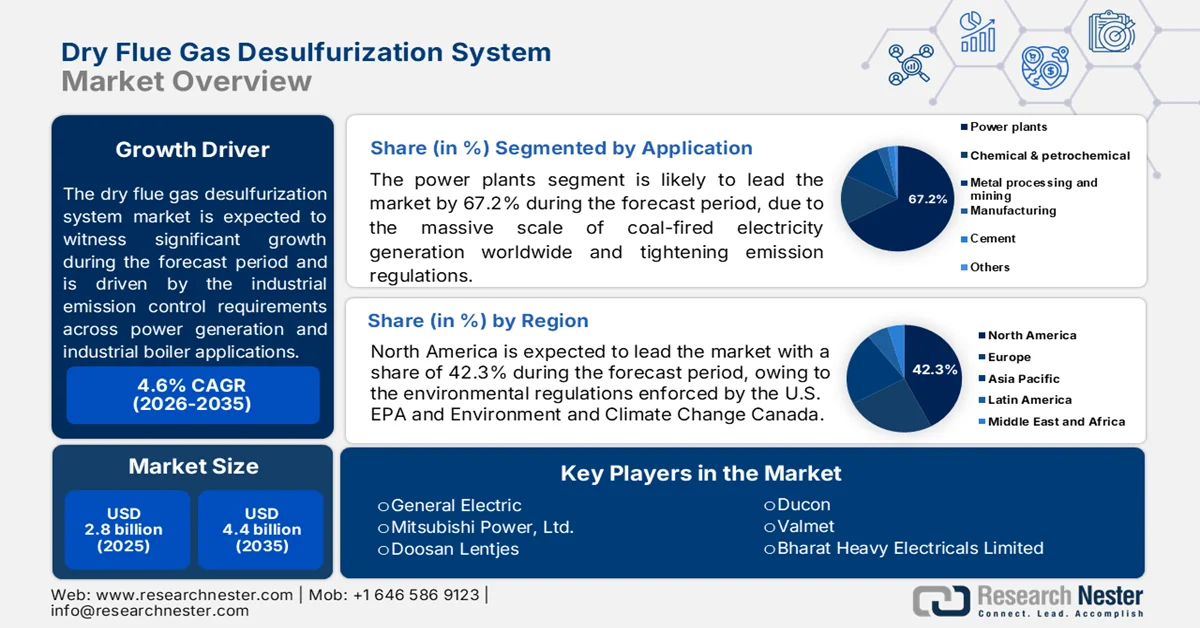
The dry flue gas desulfurization system market continues to benefit from tightening industrial emission control requirements across power generation, cement, steel, waste-to-energy, and industrial boiler applications. Regulatory pressure on sulfur dioxide (SO₂) emissions remains a primary investment driver, particularly in facilities seeking compliance while managing water consumption and operating costs. According to the U.S. Environmental Protection Agency (EPA) February 2026 data, national SO₂ emissions declined by approximately 95%, reflecting the sustained deployment of flue gas treatment infrastructure across major stationary emission sources.
In parallel, the Climate Central 2024 data reported that coal-fired generation still accounted for about 16% of U.S. utility-scale electricity generation, sustaining the need for emission-control upgrades and lifecycle maintenance services at existing plants. Beyond power generation, industrial operators are investing in environmental compliance projects as governments strengthen air-quality targets and industrial permitting requirements. Demand is also supported by modernization programs at aging facilities, replacement of legacy emission-control assets, and capital expenditure directed toward improving operational efficiency. Procurement decisions increasingly emphasize long-term operating performance, reagent utilization, maintenance requirements, and compliance assurance, creating opportunities for system manufacturers, engineering contractors, and aftermarket service providers.
Key Dry Flue Gas Desulfurization System Market Insights Summary:
Regional Highlights:
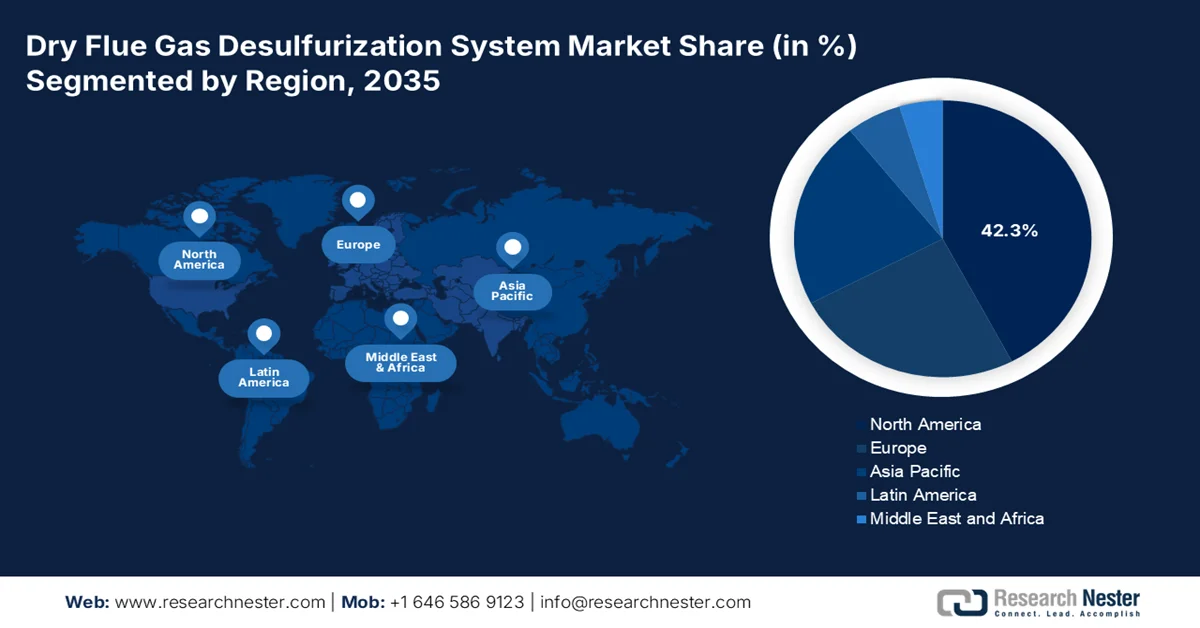
- Dry flue gas desulfurization system market North America is projected to secure 42.3% of the regional revenue share by 2035, propelled by stringent environmental regulations, continued retrofitting of coal-fired utilities, and rising adoption of dry FGD technologies across industrial applications
- Asia Pacific is anticipated to register the fastest growth throughout 2026-2035, stimulated by rapid industrialization, expanding coal-fired power generation, and increasingly stringent emission norms across developing economies
Segment Insights:
- Dry flue gas desulfurization system market the power plants segment is expected to account for 67.2% of the market share by 2035, underpinned by the vast installed base of coal-fired power plants and tightening sulfur dioxide emission regulations
- The Spray Dryer Absorber (SDA) Systems segment is forecast to maintain its dominant position by 2035, reinforced by its operational flexibility, wastewater-free operation, and reliable performance across utility and industrial applications
Key Growth Trends:
- Rising public investment in industrial decarbonization
- Growth in coal-based electricity generation capacity
Major Challenges:
- Stringent environmental regulations
- Technology obsolescence and rapid innovation
Key Players: General Electric (U.S.), Mitsubishi Power, Ltd. (Japan), Doosan Lentjes (Germany), Ducon (U.S.), Valmet (Finland), Bharat Heavy Electricals Limited (India).
Global Dry Flue Gas Desulfurization System Market Forecast and Regional Outlook:
Market Size & Growth Projections:
- 2025 Market Size: USD 2.8 billion
- 2026 Market Size: USD 2.9 billion
- Projected Market Size: USD 4.4 billion by 2035
- Growth Forecasts: 4.6% CAGR (2026-2035)
Key Regional Dynamics:
- Largest Region: North America (42.3% share by 2035)
- Fastest Growing Region: Asia Pacific
- Dominating Countries: United States, China, Germany, Japan, India
- Emerging Countries: Indonesia, Malaysia, Vietnam, Thailand, Philippines
Last updated on : 8 July, 2026
Dry Flue Gas Desulfurization System Market - Growth Drivers and Challenges
Growth Drivers
- Rising public investment in industrial decarbonization: National governments are directing substantial funding toward cleaner industrial operations. The Clean Investment Monitor February 2026 data reported that USD 1 billion is allocated for industrial decarbonization projects under the Industrial Demonstrations Program. Facilities receiving modernization support are investing in emission-control technologies that help meet environmental requirements while extending plant life. DFGD systems benefit from these upgrades because sulfur dioxide reduction remains a regulatory priority for many industrial facilities. This spending is encouraging replacement of aging pollution-control assets and creating demand for advanced dry desulfurization installations integrated into broader plant modernization strategies.
- Growth in coal-based electricity generation capacity: Many emerging economies continue investing in coal-fired generation to support industrialization and electricity security. According to the PIB March 2026 data, India’s thermal generation capacity reached 8,810 MW, including a significant coal-based component. New and existing coal-fired facilities must comply with sulfur-emission regulations, creating demand for DFGD installations during both construction and retrofit phases. This trend is particularly relevant in regions where coal remains a critical energy source for industrial development. Equipment manufacturers are therefore seeing opportunities not only in new plant installations but also in upgrading aging generating assets. Continued coal utilization combined with stricter environmental enforcement creates a stable.
Challenges
- Stringent environmental regulations: The dry flue gas desulfurization system market is governed by complex, region-specific emission standards that vary across jurisdictions. Manufacturers must navigate diverse regulatory frameworks, requiring dedicated compliance teams and extensive certification processes. This complexity increases time-to-market and raises product development costs for new entrants.
- Technology obsolescence and rapid innovation: Manufacturers entering the Dry Flue Gas Desulfurization System Market must continuously invest in R&D to keep pace with evolving sorbent chemistries, digital monitoring systems, and efficiency improvements. Rapid technological advancement risks early obsolescence, compelling new players to allocate substantial resources to innovation and product development.
Dry Flue Gas Desulfurization System Market Size and Forecast:
| Report Attribute | Details |
|---|---|
|
Base Year |
2025 |
|
Forecast Year |
2026-2035 |
|
CAGR |
4.6% |
|
Base Year Market Size (2025) |
USD 2.8 billion |
|
Forecast Year Market Size (2035) |
USD 4.4 billion |
|
Regional Scope |
|
Dry Flue Gas Desulfurization System Market Segmentation:
Application Segment Analysis
Under the application segment, the power plants is leading in the dry flue gas desulfurization system market and is poised to hold the share value of 67.2% by the end of 2035. The segment is driven by the massive scale of coal-fired electricity generation worldwide and tightening emission regulations. India's total installed power capacity reaching 476 GW as of June 2025 underscores the immense scale of the power sector, with coal-based thermal power plants constituting a significant portion of this capacity, as per the PIB June 2025 data. This installed base creates substantial demand for dry FGD retrofits and new installations, as utilities must comply with the Ministry of Environment, Forest and Climate Change (MoEFCC) emission norms mandating SO₂ reduction.
Type Segment Analysis
In the dry flue gas desulfurization system market, the spray dryer absorber (SDA) systems lead type segment as the most widely adopted technology. SDA systems atomize lime slurry into flue gas, enabling simultaneous SO₂ absorption and evaporation, producing a dry powder byproduct. This technology is favored for operational flexibility, eliminating wastewater treatment, and accommodating varying sulfur loads across utility and industrial applications. While alternatives offer specific advantages—DSI for lower capital costs and CFB for high-sulfur coals—SDA systems maintain leadership through proven reliability and balanced performance in the Dry Flue Gas Desulfurization System Market.
Technology Type Segment Analysis
In the dry flue gas desulfurization system market, calcium-based systems utilizing hydrated lime (Ca(OH)₂) as the primary sorbent represent the dominant technology sub-segment, particularly in Spray Dryer Absorber (SDA) and Dry Sorbent Injection (DSI) configurations. The NLM December 2022 data reveals that while sulfur dioxide (SO₂) preferentially reacts with Ca(OH)₂ over carbon dioxide (CO₂) under thermodynamic standard conditions, the absolute dominance of CO₂ concentration in flue gas atmospheres leads to significant calcium carbonate (CaCO₃) formation in the desulfurization ash. This competitive reaction pathway impacts reagent utilization efficiency, as in-situ generated CaCO₃ exhibits desulfurization capability, though inferior to fresh Ca(OH)₂. The research further establishes that humidity levels around 20% relative humidity optimize desulfurization performance, while elevated temperatures inhibit the reaction.
Our in-depth analysis of the dry flue gas desulfurization system market includes the following segments:
|
Segment |
Subsegments |
|
Application |
|
|
Type |
|
|
Technology Type |
|
|
End user |
|
|
Installation Type |
|

Vishnu Nair
Head - Global Business DevelopmentCustomize this report to your requirements — connect with our consultant for personalized insights and options.
Dry Flue Gas Desulfurization System Market - Regional Analysis
North America Market Insights
North America is dominating the dry fuel gas desulfurization market and is projected to hold the regional revenue share of 42.3% by the end of 2035. The region is driven by the stringent environmental regulations enforced by the U.S. Environmental Protection Agency and Environment and Climate Change Canada, mandating significant sulfur dioxide reductions across power generation and industrial sectors. The region is experiencing a gradual transition from coal to natural gas and renewables, yet remaining coal-fired utilities require advanced dry FGD retrofits for compliance. Industrial applications including cement manufacturing, metal processing, and mining are emerging as growth areas, adopting spray dryer absorber and dry sorbent injection technologies.
The ongoing investments in emission-control upgrades across coal-fired power plants, industrial boilers, cement facilities, and waste-to-energy plants is shaping the dry flue gas desulfurization system market in the U.S. Demand is being driven by compliance with federal and state air-quality regulations, as operators seek cost-effective sulfur dioxide reduction technologies while managing operating expenses. A key indicator of continued emissions-control requirements is the scale of coal-based generation assets still in operation. According to the NLM May 2022 data, coal-fired power plants generated approximately 327 GW of electricity, sustaining demand for flue-gas treatment infrastructure and retrofit projects across the country.
The industrial emission-control requirements across mining, metal processing, power generation, and waste-management facilities is shaping the dry flue gas desulfurization system market in Canada. Demand is supported by federal and provincial initiatives aimed at reducing air pollutants while maintaining industrial productivity. The market also benefits from modernization projects at existing industrial plants seeking compliance with increasingly stringent environmental regulations. According to Environment and Climate Change Canada 2023 data, Canada’s sulfur oxides (SOx) emissions totaled approximately 0.6 million tonnes in 2021, highlighting the continued need for sulfur-emission mitigation technologies across major industrial sectors. This regulatory focus is expected to support ongoing investments in DFGD systems and related environmental control equipment.
APAC Market Insights
The Asia Pacific is projected to emerge during the assessed period, 2026 to 2035 in the dry flue gas desulfurization system. The region is driven by the rapid industrialization, expanding coal-fired power generation, and stringent emission norms across China, India, and Southeast Asian nations. China's aggressive air pollution control policies and India's revised environmental standards for thermal power plants are major demand drivers. Emerging economies such as Indonesia, Malaysia, and Vietnam are witnessing increasing adoption of dry FGD systems for both new power projects and retrofit applications. The market is characterized by intense price competition, technology localization, and growing preference for modular, quick-deployment systems for industrial applications.
Thermal power producers and industrial facilities invest in emission-control infrastructure to meet environmental compliance requirements is shaping the dry flue gas desulfurization system market in India. Demand is particularly strong in the power sector, where large coal-fired generating fleets continue to operate and require sulfur dioxide mitigation solutions. Government-backed environmental monitoring and pollution-control initiatives are encouraging utilities to modernize existing assets and incorporate advanced flue gas treatment systems. According to the Energy and Clean Air 2025 data, India’s coal-based installed electricity generation capacity reached approximately 222 GW, creating a substantial installed base requiring long-term emissions management and supporting continued demand for DFGD technologies.
The stringent industrial air-pollution control policies and ongoing investments in emissions management across power generation, steel, cement, and chemical manufacturing sectors is driving the dry flue gas desulfurization system market in China. Demand is supported by government efforts to improve air quality while maintaining industrial output and energy security. Retrofit projects at existing facilities and environmental compliance requirements for new industrial installations are creating sustained opportunities for DFGD system suppliers. According to Global Energy Price February 2025 data, thermal power generation reached approximately 6.34 trillion kilowatt-hours, underscoring the scale of combustion-related emissions management needs and supporting continued investment in sulfur-removal technologies.
Europe Market Insights
The dry flue gas desulfurization system market in Europe is mature and technologically advanced, driven by the Industrial Emissions Directive (IED) and stringent Best Available Techniques (BAT) reference documents for large combustion plants. The region has largely transitioned away from coal-fired power generation, shifting demand toward waste-to-energy facilities, biomass plants, and industrial sectors including cement, steel, and chemical manufacturing. The market emphasizes circular economy principles, focusing on byproduct utilization and reagent optimization. Retrofitting aging industrial infrastructure with compact, modular dry FGD systems represents a significant growth area. Digitalization and AI-driven process control are key differentiators among European suppliers in this competitive landscape.
The strict industrial emission standards and continued investment in pollution-control infrastructure across power generation, waste-to-energy, cement, and metallurgical industries is driving the dry flue gas desulfurization system market in Germany. Industrial operators are increasingly upgrading emission-control systems to comply with evolving environmental regulations while maintaining operational efficiency. The market also benefits from ongoing modernization of industrial facilities and the country’s focus on improving air quality. According to Enerdata March 2026 data, electricity generation from conventional thermal power plants totaled approximately 181 TWh, highlighting the continued presence of combustion-based industrial activities that require effective sulfur-emission control solutions.
The dry flue gas desulfurization system market in UK is driven by stringent industrial emissions regulations, ongoing modernization of waste-to-energy facilities, and environmental compliance requirements across cement, refining, and industrial processing sectors. While coal-fired power generation has largely declined, demand for sulfur-emission control technologies remains supported by industrial combustion sources and energy-from-waste plants. Operators are investing in emissions-management systems to meet air-quality standards and maintain regulatory compliance. According to the Government of UK September 2022 data, sulphur dioxide (SO₂) emissions in the UK were approximately 136 thousand tonnes, demonstrating the continued importance of sulfur-reduction measures across industrial activities.
Key Dry Flue Gas Desulfurization System Market Players:
- General Electric (U.S.)
- Mitsubishi Power, Ltd. (Japan)
- Doosan Lentjes (Germany)
- Ducon (U.S.)
- Valmet (Finland)
- Bharat Heavy Electricals Limited (India)
- Company Overview
- Business Strategy
- Key Product Offerings
- Financial Performance
- Key Performance Indicators
- Risk Analysis
- Recent Development
- Regional Presence
- SWOT Analysis
- GE Vernova is a global leader in the dry flue gas desulfurization system market, offering advanced spray dryer absorber technology. The company focuses on digital integration and regional expansion to deliver reliable emissions control solutions for utility-scale power plants worldwide.
- Mitsubishi Power holds a commanding position in the dry flue gas desulfurization system market with proprietary SDA and CFB technologies. The company emphasizes AI-driven optimization and aftermarket support, ensuring high system availability for coal-fired and industrial applications across Asia.
- Babcock & Wilcox is a prominent manufacturer in the market, specializing in dry scrubbers and sorbent injection systems. The company differentiates itself through innovative reagent delivery technologies and long-term service agreements for power generation customers.
- FLSmidth is a major European player in the market, offering complete air pollution control solutions. The company leverages its cement and mining industry expertise to deliver robust dry FGD systems for heavy industrial applications globally.
- Doosan Lentjes is a technology leader in the dry flue gas desulfurization system market, renowned for circulating fluidized bed dry scrubbing. The company focuses on high-efficiency systems for waste-to-energy and power plants, with strong project execution in Europe and the Middle East.
Here is a list of key players operating in the global market:
The global dry flue gas desulfurization system manufacturing landscape remains highly consolidated, with the top players controlling the market share. These leaders are aggressively pursuing strategic initiatives including vertical integration of digital monitoring solutions, acquisitions of niche technology portfolios, and geographic expansion into high-growth Asian and Middle Eastern markets. European and Japanese manufacturers dominate the high-efficiency segment with proprietary spray dryer absorber (SDA) and circulating fluidized bed (CFB) technologies, while Indian and Chinese players compete aggressively on cost-optimized turnkey solutions for domestic coal-fired utilities. Key differentiators now include AI-driven predictive maintenance capabilities, reagent consumption optimization, and modular system designs for faster deployment.
Corporate Landscape of the Market:
Recent Developments
- In July 2026, Valmet has completed the acquisition of Severn Group specializing in severe service flow control solutions. The acquisition covers all three Severn divisions: Severn Glocon, ValvTechnologies, and LB Bentley.
- In June 2026, Bharat Heavy Electricals Limited (BHEL) has bagged a major order, valued at Rs. 560 Crore, for supply and installation of the Flue Gas Desulphurization (FGD) system from NTPC for 2x490 MW National Capital Power Station (NCPS) at Dadri in Uttar Pradesh. The order has been secured by BHEL against stiff competition from Indian and multinational companies.
- Report ID: 6564
- Published Date: Jul 08, 2026
- Report Format: PDF, PPT
- Explore a preview of key market trends and insights
- Review sample data tables and segment breakdowns
- Experience the quality of our visual data representations
- Evaluate our report structure and research methodology
- Get a glimpse of competitive landscape analysis
- Understand how regional forecasts are presented
- Assess the depth of company profiling and benchmarking
- Preview how actionable insights can support your strategy
Explore real data and analysis
Frequently Asked Questions (FAQ)
About this Report
Connect with our Expert


Report, 2026-2035



Copyright @ 2026 Research Nester. All Rights Reserved.
