Direct Lithium Extraction Market Outlook:
Direct Lithium Extraction Market size was valued at USD 1.6 billion in 2025 and is anticipated to reach USD 6.1 billion by the end of 2035, expanding at around 13.9% CAGR during the forecast period, i.e., 2026-2035. In 2026, the industry size of direct lithium extraction is estimated at USD 1.9 billion.
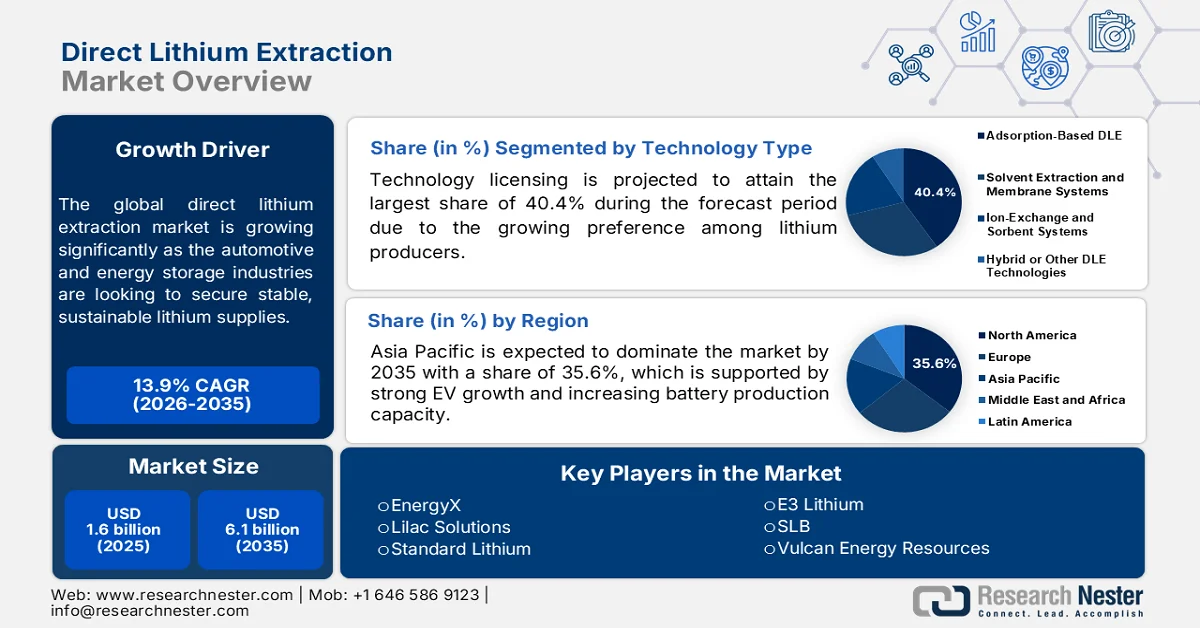
The global direct lithium extraction market is positioned for solid growth as the automotive and energy storage industries are looking to secure stable, sustainable lithium supplies. Governments and major automotive manufacturers are supporting these projects to diversify supply chains and move away from geopolitical bottlenecks. In this context, the U.S. Department of Energy in April 2026 announced the launch of a USD 69 million funding opportunity through its Critical Minerals and Materials Accelerator Program, with a main goal to support technologies that advance domestic production and refining of critical materials, which includes lithium extraction from geothermal brines and clay sources. Besides, this initiative is highly focused on bridging the gap between laboratory innovations and commercial-scale solutions, wherein projects involve industry, national laboratories, and geothermal energy applications.
Global Lithium Reserves by Country 2024: Top 10 Nations, Resource Distribution, and Market Share
|
Country |
Lithium Reserves (tons) |
Share of Global Reserves (%) |
|
Chile |
9,300,000 |
30.8% |
|
Australia |
7,000,000 |
23.2% |
|
Argentina |
4,000,000 |
13.3% |
|
China |
3,000,000 |
9.9% |
|
U.S. |
1,800,000 |
6.0% |
|
Canada |
1,336,178 |
4.4% |
|
Zimbabwe |
480,000 |
1.6% |
|
Brazil |
390,000 |
1.3% |
|
Portugal |
60,000 |
0.2% |
|
Namibia |
14,000 |
- |
|
Other Countries |
2,800,000 |
9.3% |
|
World |
30,180,200 |
100.0% |
Source: Government of Canada
Furthermore, the stringent global climate mandates and the accelerating transition to electric mobility are allowing DLE to emerge as the critical technology needed to unlock unconventional brine resources worldwide. Apart from this, as proprietary extraction technologies mature through successful commercial testing, standardization will improve, allowing for more predictable project financing and faster deployment. As per an article published by the National Institutes of Health (NIH) in November 2024, the global lithium demand is rapidly increasing due to electric vehicle and renewable energy growth, with lithium production reaching 180,000 metric tons in 2023. The article also mentions that lithium extraction from traditional mining can generate about 15,000 kg of CO₂ emissions per metric ton of lithium produced. In addition, the study emphasizes that expanding recycling, direct lithium extraction technologies, and circular economy approaches are highly essential to secure lithium supply, thus driving the direct lithium extraction market globally.
Global Lithium Mine Production by Country 2024: Top Producing Nations, Output Volumes in Tons
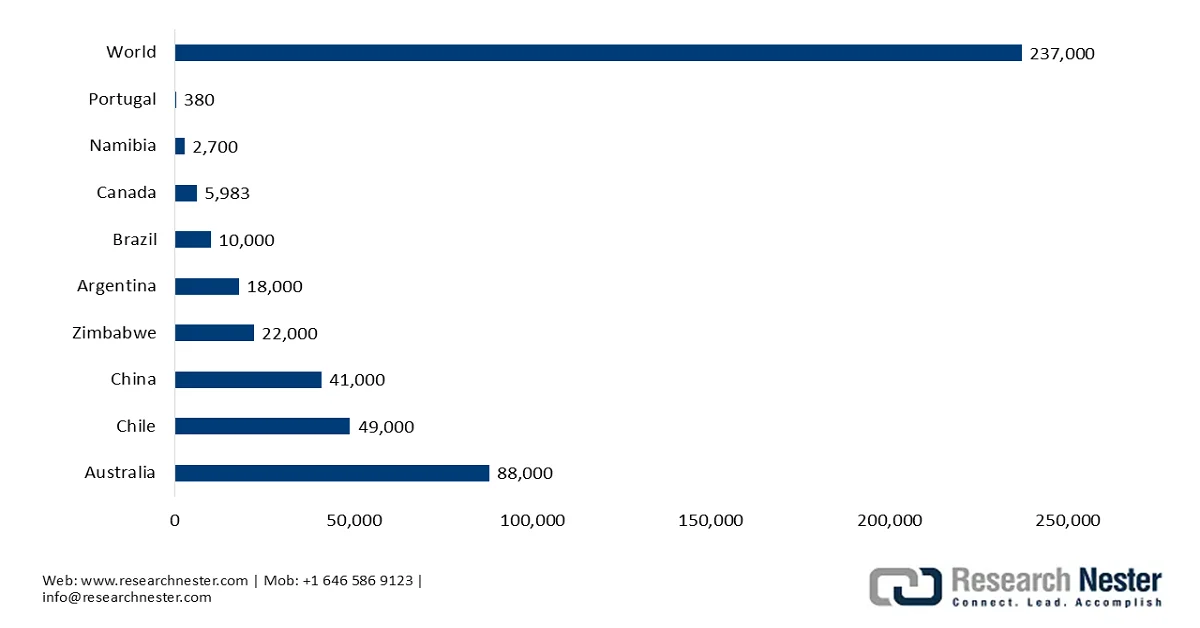
Source: Government of Canada
Key Direct Lithium Extraction Market Insights Summary:
Regional Highlights:
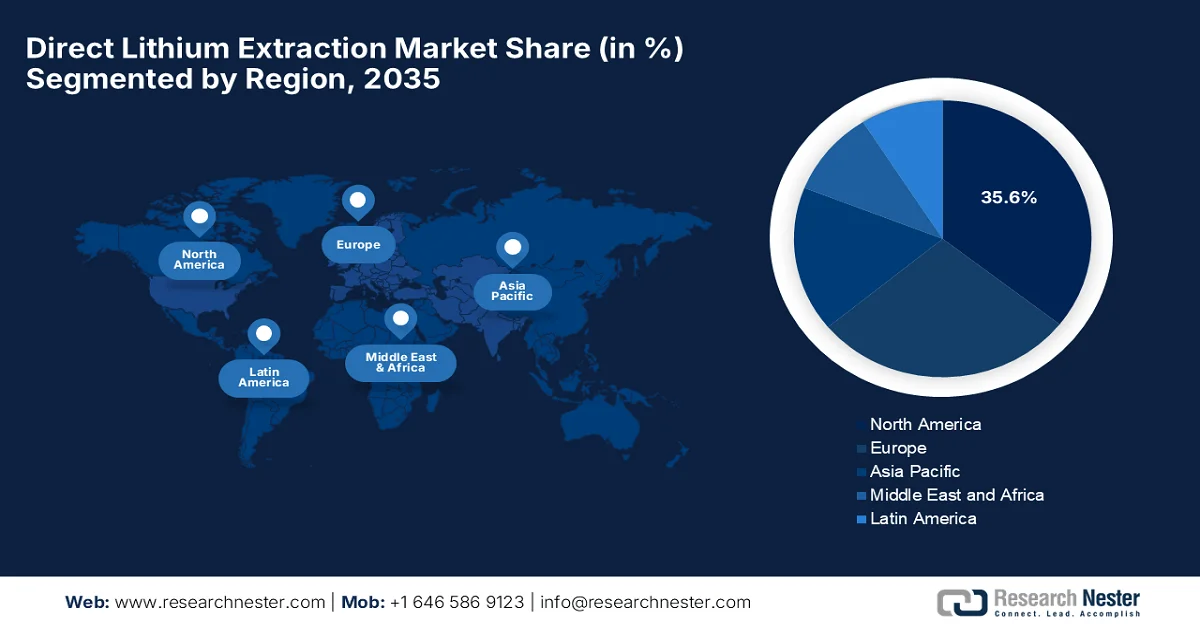
- Asia Pacific is projected to command 35.6% of the direct lithium extraction market share by 2035, underpinned by the region’s position as a global hub for electric vehicle and lithium-ion battery manufacturing
- North America is poised to witness the fastest expansion during 2026-2035, bolstered by substantial government funding and critical mineral supply chain development initiatives
Segment Insights:
- The technology licensing segment is anticipated to account for 40.4% of the direct lithium extraction market share by 2035, stimulated by the growing preference among lithium producers to access advanced extraction technologies without developing proprietary systems internally
- By 2035, adsorption-based DLE is expected to secure a considerable market share, reinforced by its high lithium selectivity, operational efficiency, and ability to process low-concentration brines with complex chemical compositions
Key Growth Trends:
- Meeting strict sustainability mandates
- Unlocking unconventional brine resources
Major Challenges:
- High technology development and implementation costs
- Complexity of brine chemistry and resource variability
Key Players: EnergyX (U.S.), Lilac Solutions (U.S.), Standard Lithium (U.S.), E3 Lithium (Canada), SLB (U.S.), Vulcan Energy Resources (Australia), Adionics (France), Summit Nanotech (Canada), Eni (Italy), Black Giant SpA (Chile), Compass Minerals (U.S.), KBR (U.S.), Geolith (France).
Global Direct Lithium Extraction Market Forecast and Regional Outlook:
Market Size & Growth Projections:
- 2025 Market Size: USD 1.6 billion
- 2026 Market Size: USD 1.9 billion
- Projected Market Size: USD 6.1 billion by 2035
- Growth Forecasts: 13.9% CAGR (2026-2035)
Key Regional Dynamics:
- Largest Region: Asia Pacific (35.6% Share by 2035)
- Fastest Growing Region: North America
- Dominating Countries: China, United States, Australia, Chile, Japan
- Emerging Countries: India, Canada, Argentina, South Korea, Brazil
Last updated on : 23 July, 2026
Direct Lithium Extraction Market - Growth Drivers and Challenges
Growth Drivers
- Meeting strict sustainability mandates: Automakers across the globe have been facing intense pressures to eliminate environmental damage from their supply chains. DLE appeals heavily to green investors as it eliminates massive solar evaporation ponds, whereas the technology minimizes land destruction, preserves local biodiversity, and lowers carbon footprints. For instance, in March 2024, a California Energy Commission pilot project demonstrated the recovery of lithium from geothermal brines by using direct lithium extraction technology, thus supporting both geothermal energy production and domestic lithium supply. The pilot-scale process efficiently produced lithium carbonate from synthetic brine, extracting lithium in hours, and it offers higher efficiency and lower environmental impacts when compared with conventional methods, thus making it suitable for driving the overall direct lithium extraction market.
- Unlocking unconventional brine resources: Traditional mining cannot efficiently extract lithium from low-grade or high-impurity subterranean brines. Advanced DLE chemical sorbents solve this by targeting lithium ions directly, leaving impurities behind, and therefore this technological improvement unveils massive, previously unviable reserves across North America and Europe, drastically expanding global resource availability. Standard Lithium in April 2024 successfully commissioned North America’s first commercial-scale DLE column at its demonstration plant in Arkansas by using Koch Technology Solutions’ Li-Pro™ lithium-selective sorption technology. This DLE system processed Smackover Formation brine at 90 gallons per minute (20.4 m³/hr) and achieved an average 97.3% lithium recovery efficiency from brine containing 208 mg/L lithium, positively benefiting the overall direct lithium extraction market.
Top Lithium Carbonate Importing Countries in 2024: Global Trade Value, Shipment Volume, and Market Leaders
|
Country |
Import Value (USD Million) |
Import Volume (Kg) |
|
China |
2,725.57 |
234,957,000 |
|
South Korea |
483.65 |
26,964,900 |
|
Japan |
242.08 |
11,519,800 |
|
U.S. |
202.30 |
15,464,600 |
|
Europe |
196.72 |
13,472,600 |
|
Netherlands |
109.88 |
8,586,630 |
|
Germany |
40.47 |
2,796,150 |
|
UK |
34.01 |
2,792,250 |
|
France |
23.21 |
1,571,710 |
|
Belgium |
13.55 |
1,133,380 |
Source: WITS
Challenges
- High technology development and implementation costs: The direct lithium extraction market faces intense challenges that are associated with high research, development, and deployment costs required to commercialize advanced extraction technologies. DLE systems require huge investments in terms of pilot testing, process optimization, and specialized equipment before achieving large-scale production. Apart from this, the performance of DLE technologies can vary depending on brine chemistry, lithium concentration, impurities, and geological conditions, which in turn increases project complexity and financial risks. In this context, companies need to make investments in order to validate extraction efficiency and ensure consistent lithium recovery rates, thus limiting widespread adoption in this sector.
- Complexity of brine chemistry and resource variability: Another major burden for the direct lithium extraction market is the variability and complexity that are associated with lithium brine resources in different geographic locations. These DLE technologies need to be customized with the main goal of handling differences in lithium concentration, mineral composition, impurity levels, and water chemistry, which can affect extraction performance and operating efficiency. On the other hand, managing impurities such as magnesium, calcium, and boron is considered to be technically challenging, as these elements can reduce lithium selectivity and increase processing requirements, thus creating barriers to rapid commercialization of DLE solutions in terms of different lithium-producing regions.
Direct Lithium Extraction Market Size and Forecast:
| Report Attribute | Details |
|---|---|
|
Base Year |
2025 |
|
Forecast Period |
2026-2035 |
|
CAGR |
13.9% |
|
Base Year Market Size (2025) |
USD 1.6 billion |
|
Forecast Year Market Size (2035) |
USD 6.1 billion |
|
Regional Scope |
|
Direct Lithium Extraction Market Segmentation:
Technology Type Segment Analysis
On the basis of technology type category, technology licensing is projected to attain the largest share of 40.4% in the direct lithium extraction market during the forecast period. The segment’s dominant position is effectively propelled by the growing preference among lithium producers to access advanced extraction technologies without developing proprietary systems internally. These licensing models enable companies to reduce research and development costs, accelerate project commercialization, and deploy proven DLE platforms with lower technical risks. In April 2024, KBR and GeoLith SAS formed a global alliance in order to commercialize Li-Capt®, which is an advanced DLE technology designed for zero-emission lithium recovery from geothermal and oil well brines. The technology produces high-purity lithium concentrate with strong selectivity and adaptability to different brine sources, thus denoting a wider segment scope.
Service Model Segment Analysis
By the end of 2035, adsorption-based DLE is anticipated to grow with a considerable share in the direct lithium extraction market. The segment’s growth is largely attributable to its high lithium selectivity, operational efficiency, and ability to process low-concentration brines with complex chemical compositions. In addition, adsorption-based technologies use specialized sorbent materials that selectively capture lithium ions, thereby rejecting impurities, enabling higher recovery rates compared with conventional extraction methods. Also, the technology requires lower energy input, supports reduced water consumption, and can be integrated with existing brine operations, which makes it attractive for sustainable lithium production, thus denoting a positive segment outlook.
Brine Source Segment Analysis
Salt Lake brine is expected to hold a noteworthy share in the direct lithium extraction market during the discussed time frame. The abundant availability of lithium-rich brine resources across major producing regions, such as South America, North America, and Asia, is the main boosting factor for the segment’s growth. DLE technologies enable efficient lithium recovery from Salt Lake brines with low lithium concentrations and complex mineral compositions by selectively extracting lithium, thereby minimizing water consumption and reducing the environmental footprint which is associated with conventional evaporation ponds. In June 2026, Lilac Solutions selected Hatch as the EPCM partner for its Phase 1 commercial lithium carbonate facility at Utah’s Great Salt Lake, targeting 5,000 tons per annum (tpa) production. This project will use Lilac’s Gen 5 ion exchange DLE technology, which achieved 87% average lithium recovery from ultra-low-grade brine containing 70 mg/L lithium during pilot operations.
Our in-depth analysis of the direct lithium extraction market includes the following segments:
|
Segment |
Subsegments |
|
Technology Type |
|
|
Service Model |
|
|
Brine Source |
|
|
Deployment Model |
|
|
Application |
|
|
End use Industry |
|

Vishnu Nair
Head - Global Business DevelopmentCustomize this report to your requirements — connect with our consultant for personalized insights and options.
Direct Lithium Extraction Market - Regional Analysis
APAC Market Insights
Asia Pacific direct lithium extraction market is anticipated to garner the highest share of 35.6% during the forecast period. The region’s dominance is effectively propelled by its role as global epicenter for electric vehicle and lithium-ion battery manufacturing. Fueled by extensive industrial ecosystems in prominent nations such as China, South Korea, and Japan, the regional market outlook is positively driven by an urgent need to secure immediate, high-purity, battery-grade lithium to support localized supply chains. Based on the government data published in February 2025, Japan and South Korea held their first high-level dialogue on critical minerals in Tokyo to strengthen cooperation and resilience in critical mineral supply chains. Both of the countries discussed policy coordination, mineral resource stockpiling, and joint development, production, and offtake projects in regions such as South America, Asia, and Africa, thus making it suitable for standard direct lithium extraction market growth.
The central government mandates under national industrial and R&D strategies are driving the direct lithium extraction market in China. The country proactively leverages high-tech domestic manufacturing to achieve total supply chain security for its massive electric vehicle and battery energy storage sectors. Based on the government data published in January 2026, China launched the world’s first 20,000-ton lithium production line using advanced technology to extract lithium from Salt Lake brines in Qinghai Province, thereby improving resource utilization and supply security. This new process increased lithium recovery rates from below 50% to over 78% at the salt pan stage and raised overall workshop recovery from 75.38% to 90.41%, thus denoting a positive direct lithium extraction market outlook.
In India, the direct lithium extraction market is gaining enhanced traction owing to its transition towards green mobility and domestic battery manufacturing. The central government’s aggressive push to establish localized supply chains for electric vehicles and large-scale grid energy storage is encouraging the country to actively explore advanced extraction methods to secure sovereign raw material access. As stated by the Press Information Bureau (PIB) in March 2026, India is accelerating exploration and development of critical minerals such as lithium and rare earth elements, with a target to increase rare earth permanent magnet production capacity to 5,000 tons by 2030. In this context, the government is advancing lithium exploration in regions that include Degana (Rajasthan) and Reasi (Jammu & Kashmir), simultaneously promoting domestic capabilities for clean energy, electric vehicles, electronics, and defense applications.
North America Market Insights
The North America direct lithium extraction market is expected to expand at the fastest rate from 2026 to 2035. The region benefits from substantial government funding, such as the U.S. Inflation Reduction Act and Canada’s Critical Minerals Strategy, which aims to reduce dependence on foreign critical mineral processing. In May 2024, the U.S. Department of State disclosed that Chile, which is the world’s second-largest lithium producer, is promoting new opportunities for investment in lithium extraction and value chain development under its National Lithium Strategy. It also mentioned that the country holds about half of the world’s viable lithium reserves, offering opportunities for private companies to participate in exploration, brine extraction, mining technologies, and downstream value chains. A U.S.-Chile Direct Line event highlighted partnerships with state-owned entities and private investors to advance sustainable lithium industry development.
The consistent efforts to establish a prominent domestic lithium supply chain and reduce reliance on imported battery materials are the main factors that are responsibly boosting the U.S. direct lithium extraction market. In addition, the country is witnessing substantial investments in terms of advanced extraction technologies, especially for unconventional brine resources, which are progressively accelerating commercialization across key lithium-producing regions. In January 2025, the U.S. Department of Energy’s Loan Programs Office announced a conditional commitment of up to USD 1.36 billion for Project ATLiS in California to produce lithium hydroxide from geothermal brine using direct lithium extraction (DLE) technology. This facility is in Imperial County, California, and is expected to produce up to 20,000 metric tons of lithium hydroxide annually, thus supporting approximately 52 GWh of lithium-ion battery production per year.
In Canada, the direct lithium extraction market is gaining traction, which is facilitated by the federal critical minerals strategy and lucrative provincial tax incentives. Domestic developers are proactively moving to unlock massive, unconventional domestic assets without the heavy environmental footprint of traditional open-pit mining. The direct lithium extraction market is highly focused on extracting lithium from deep, low-concentration oilfield brines within the Devonian formations of Alberta and Saskatchewan, as well as complex subterranean aquifers in Manitoba. In January 2026, the country’s government reported that Canada produced an estimated 5,983 tons of lithium in 2024 from two operating lithium mines, with production driven by the TANCO Mine in Manitoba and the restarted North America’s Lithium mine in Quebec. Several projects across Ontario, Quebec, Alberta, Manitoba, Nova Scotia, and Saskatchewan are advancing lithium development, including new mining, refining, and extraction from oilfield brines and industrial wastewaters.
Canada's Lithium Trade Statistics 2024: Exports, Imports, Battery Market Growth, and Key Supply Chain Trends
|
Category |
2023 |
2024 |
Key Statistics |
|
Lithium oxide, hydroxide & carbonate imports |
USD 38.7 million |
USD 16.9 million |
56% decrease in 2024 |
|
Lithium primary (non-rechargeable) & lithium-ion battery exports |
USD 190 million |
USD 1.1 billion |
Nearly 6× increase in 2024 |
|
Share of battery exports to the U.S. |
- |
97% |
82% of total exports went to Michigan |
|
Lithium oxide & hydroxide import source |
- |
73% |
Imported from the United States |
|
Lithium carbonate import source |
- |
63% |
Imported from Chile |
|
Lithium primary battery imports |
USD 119 million |
USD 117 million |
Slight decline in 2024 |
|
Lithium-ion battery imports |
USD 1.6 billion |
USD 3.0 billion |
87.5% increase in 2024 |
Source: Government of Canada
Europe Market Insights
The Europe direct lithium extraction market is growing at a notable pace as the region is pursuing domestic resource autonomy to fuel its massive electric vehicle and battery manufacturing sectors. In addition, the stringent regional decarbonization targets are encouraging policymakers and energy developers to eliminate their heavy dependence on imported battery materials. In this context, the EU-funded LiCORNE project has received a total of USD 7.3 million in funding, with the project duration from October 2022 to September 2026 to develop sustainable lithium recovery and battery-grade material production technologies from regional resources. The project aims to establish Europe’s first lithium supply chain by processing lithium from ores, geothermal brines, continental brines, and recycled cathode materials, reducing dependence on imported lithium, with 100% of EU lithium currently imported and 78% sourced from Chile.
The urgent need to secure a localized supply chain for its massive automotive industry is the major boosting factor for Germany direct lithium extraction market. It is also supported by federal initiatives aimed at critical mineral sovereignty, whereas automotive manufacturers and utility companies are backing these domestic DLE projects to satisfy strict environmental criteria and lower logistics risks. In December 2025, Vulcan Energy started construction of a combined geothermal and lithium extraction plant in Landau, Germany, to produce lithium chloride from geothermal brines while generating renewable heat and electricity. The facility is expected to produce up to 24,000 tons of lithium hydroxide monohydrate annually and provide 275 GWh of clean electricity and 560 GWh of renewable heat per year.
The UK direct lithium extraction market is gaining structured momentum as the nation accelerates its transition toward green mobility. The country’s market is primarily centered on the deep geothermal brines of Cornwall, in which specialized mining and energy firms are deploying advanced, closed-loop DLE technologies such as selective adsorption. For instance, in December 2025, Watercycle Technologies commissioned the UK’s first-ever commercial DLE plant in Runcorn by deploying its proprietary DLEC™ technology to produce lithium carbonate from domestic sources. This facility can process both geothermal brines and industrial wastewater streams, creating a circular and lower-impact pathway for lithium recovery while producing quantities sufficient to support around 50 electric vehicles per month, thus suitable for bolstering the country’s market growth.
Key Direct Lithium Extraction Market Players:
- EnergyX (U.S.)
- Lilac Solutions (U.S.)
- Standard Lithium (U.S.)
- E3 Lithium (Canada)
- SLB (U.S.)
- Vulcan Energy Resources (Australia)
- Adionics (France)
- Summit Nanotech (Canada)
- Eni (Italy)
- Black Giant SpA (Chile)
- Compass Minerals (U.S.)
- KBR (U.S.)
- Geolith (France)
- Company Overview
- Business Strategy
- Key Product Offerings
- Financial Performance
- Key Performance Indicators
- Risk Analysis
- Recent Development
- Regional Presence
- SWOT Analysis
- EnergyX is a major player in the sector and is a technology-focused company that is advancing next-generation lithium extraction and refining solutions through its proprietary direct lithium extraction and lithium refining technologies. The company has been expanding its commercial footprint through strategic partnerships and projects.
- Lilac Solutions is a leading DLE technology developer which is specializing in ion-exchange-based lithium extraction systems for brine resources. The firm’s proprietary technology is especially designed to selectively extract lithium, thereby reducing water consumption and minimizing environmental impacts when compared with conventional evaporation methods.
- Standard Lithium is highly focused on commercializing DLE technology for extracting lithium from brine resources in North America. Besides, the firm is advancing its major projects in the U.S., especially in Arkansas.
- E3 Lithium is a Canada-based lithium development company that is focused on advancing DLE technology for extracting lithium from extensive brine resources in Alberta. The company’s proprietary extraction approach has the primary aim of producing battery-grade lithium products with improved efficiency and lower environmental impact.
- SLB is a predominant global energy technology company that is expanding into the lithium sector through its direct lithium extraction market solutions and integrated lithium production technologies. The company has decades of expertise in subsurface engineering, processing, and digital technologies, and it aims to provide scalable DLE solutions that improve lithium recovery.
Here is a list of key players operating in the global direct lithium extraction market:
The direct lithium extraction market is technology-driven, wherein the competition is mostly structured around proprietary extraction processes, scalability, recovery efficiency, and environmental performance. The market hosts specialized technology developers and integrated lithium producers commercializing DLE solutions for end user lithium production applications. Key players in this field differentiate themselves through patented extraction technologies, pilot-to-commercial scale deployment capabilities, and partnerships with lithium resource owners. For instance, Albemarle Corporation in March 2026 announced the initiation of the environmental review process for its transition to a direct lithium extraction project in Chile’s Salar de Atacama, which is aimed at improving lithium production efficiency through DLE technology.
Corporate Landscape of the Direct Lithium Extraction Market:
Recent Developments
- In July 2026, Eni announced the acquisition of a 25% stake in EnergyX's Black Giant SpA through a phased investment of USD 225 million to advance a direct lithium extraction project near Chile's Salar de Punta Negra. This particular project aims to produce 52.5 thousand tons of lithium carbonate equivalent annually in two phases.
- In May 2026, EnergyX and Compass Minerals signed an agreement to advance the project powder hound™, which is a planned 30,000 tons-per-annum commercial-scale direct lithium extraction and refinery facility near Utah’s Great Salt Lake.
- In April 2026, KBR made a strategic investment in Geolith to accelerate the global commercial deployment of the company's Li-Capt® direct lithium extraction technology. This partnership combines Geolith's DLE process with KBR's PureLi® refining technology to deliver an integrated solution from lithium extraction to battery-grade lithium production.
- Report ID: 8686
- Published Date: Jul 23, 2026
- Report Format: PDF, PPT
- Explore a preview of key market trends and insights
- Review sample data tables and segment breakdowns
- Experience the quality of our visual data representations
- Evaluate our report structure and research methodology
- Get a glimpse of competitive landscape analysis
- Understand how regional forecasts are presented
- Assess the depth of company profiling and benchmarking
- Preview how actionable insights can support your strategy
Explore real data and analysis
Frequently Asked Questions (FAQ)
About this Report
Connect with our Expert


Report, 2026-2035



Copyright @ 2026 Research Nester. All Rights Reserved.
