Digital Microscopes Market Outlook:
Digital Microscopes Market size was valued at USD 690.5 million in 2025 and is projected to reach USD 1.38 billion by the end of 2035, registering around 7.2% CAGR during the forecast period, i.e., 2026-2035. In 2026, the industry size of digital microscopes is estimated at USD 740.2 million.
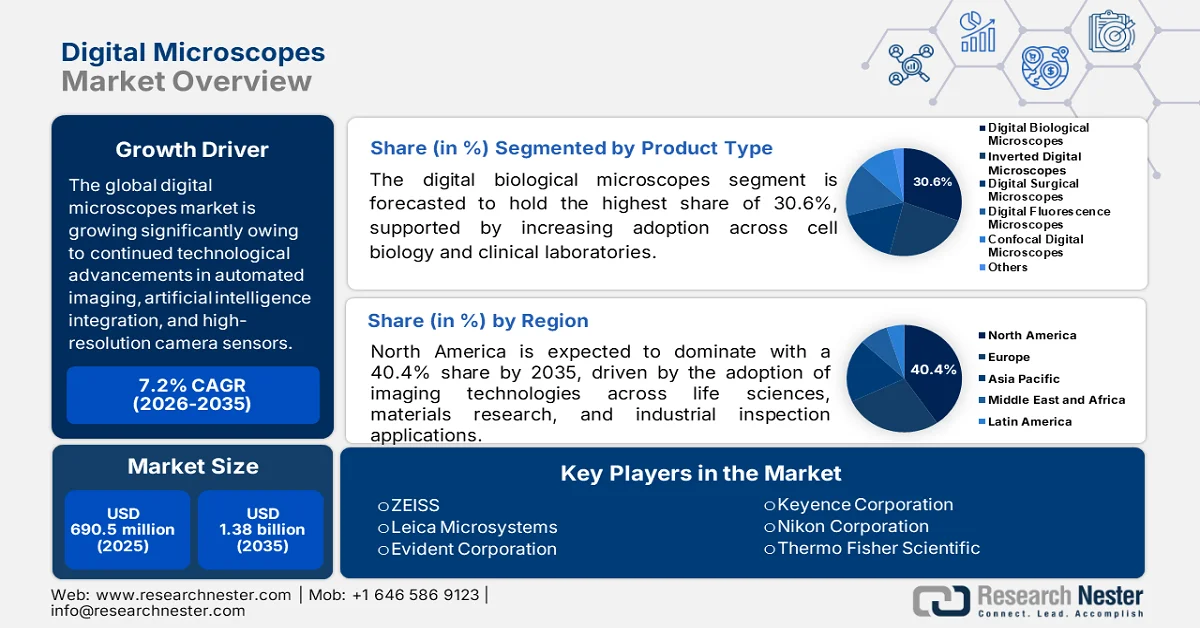
The global digital microscopes market is growing on account of continued technological advancements in automated imaging, artificial intelligence integration, and high-resolution camera sensors. The global market is witnessing unprecedented demand in areas including life sciences, clinical diagnostics, and semiconductor manufacturing, in which the need for precise, collaborative, and digitized workflows is very high. In November 2025, an article published by the National Institutes of Health (NIH) disclosed that a survey conducted across 12 malaria-endemic sites in India during 2023 - 2024 assessed malaria detection by using rapid diagnostic tests and microscopy among 10,290 febrile individuals. The study found that 14.7% of participants were malaria-positive by RDT, whereas microscopy confirmed 14% positivity. Also, it states the importance of microscopy for accurate parasite detection and for evaluating the performance of rapid diagnostic tests in malaria control programs, thus elevating the growth potential of the market.
Furthermore, the digital microscopes market is making a shift towards cloud-based data sharing and advanced software analytics that enable remote pathology and automated defect inspection. In addition, increased funding for academic research and a rising emphasis on hardware-software integration are accelerating adoption. For instance, in December 2024, ZEISS and Mindpeak partnered to develop an integrated multiplex immunofluorescence solution that combines advanced microscopy with AI-based pathology analysis. This particular collaboration aims to support research, diagnostic development, and clinical pathology by improving image analysis, workflow efficiency, and accuracy in tissue assessment, thus positively benefiting the market’s expansion.
Key Digital Microscopes Market Insights Summary:
Regional Highlights:
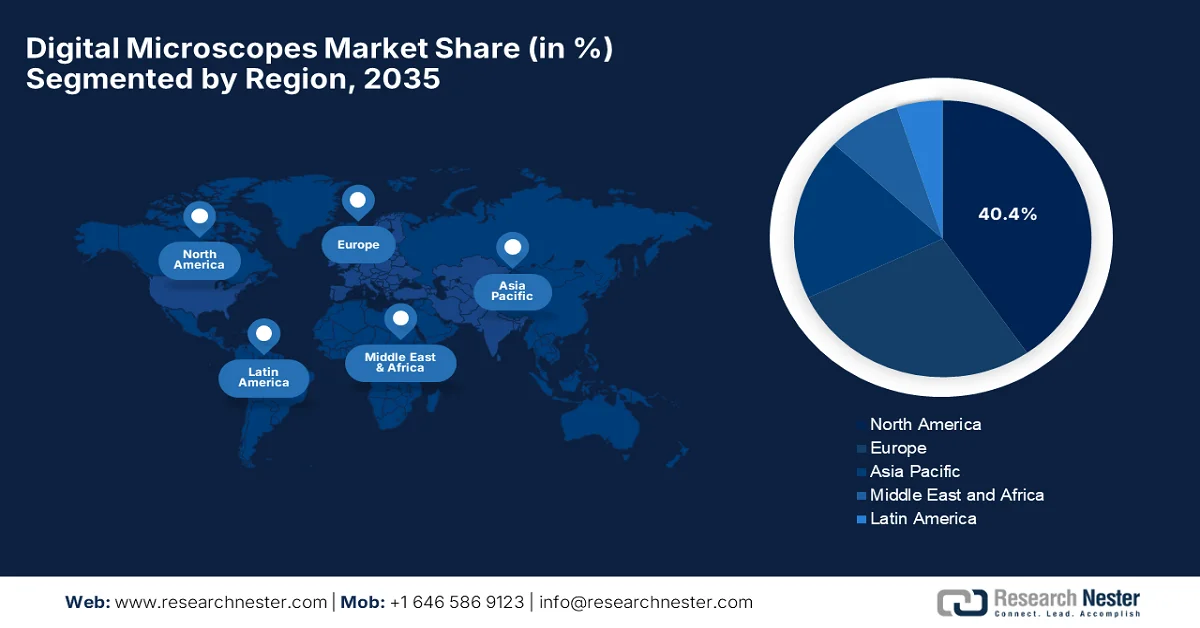
- The North America in the digital microscopes market is projected to capture 40.4% share by 2035, reinforced by the rising adoption of improved imaging technologies across life sciences, material sciences, and industrial inspection sectors.
- Asia Pacific is anticipated to witness the fastest growth in the 2026-2035 forecast period, underpinned by massive investments in healthcare infrastructure and rising academic research initiatives.
Segment Insights:
- The digital microscopes market in digital biological microscopes segment is anticipated to account for 30.6% share by 2035, supported by increasing adoption across life science research, pharmaceutical discovery, cell biology, and clinical laboratories.
- The brightfield imaging segment is expected to secure a notable share by 2035, bolstered by the widespread adoption of brightfield microscopy techniques across research laboratories, clinical diagnostics, and educational institutions.
Key Growth Trends:
- Rising R&D investments
- Growth in healthcare needs
Major Challenges:
- Complexity and training requirements
- Data management and storage burden
Key Players: ZEISS (Germany), Leica Microsystems (Germany), Evident Corporation (Japan), Keyence Corporation (Japan), Nikon Corporation (Japan), Thermo Fisher Scientific (U.S.), Motic (China), Hirox Co., Ltd. (Japan), INSPECTIS AB (Sweden), Vision Engineering Ltd. (UK).
Global Digital Microscopes Market Forecast and Regional Outlook:
Market Size & Growth Projections:
- 2025 Market Size: USD 690.5 million
- 2026 Market Size: USD 740.2 million
- Projected Market Size: USD 1.38 billion by 2035
- Growth Forecasts: 7.2% CAGR (2026-2035)
Key Regional Dynamics:
- Largest Region: North America (40.4% share by 2035)
- Fastest Growing Region: Asia Pacific
- Dominating Countries: United States, Japan, China, Germany, United Kingdom
- Emerging Countries: India, Singapore, South Korea, Canada, Australia
Last updated on : 6 August, 2026
Digital Microscopes Market - Growth Drivers and Challenges
Growth Drivers
- Rising R&D investments: Globally, investments in terms of pharmaceutical, biotechnology, and life sciences research are escalating, which is fueling digital microscopes market expansion. Both governments and private entities are allocating substantial funding to academic labs and R&D facilities with the main goal of accelerating drug discovery and genetic research. For instance, in May 2026, the National Institute of General Medical Sciences (NIH) awarded an almost USD 1.84 million R01 grant to the University of Arizona for the development of an ultra-broadband microscope, which is aimed at advancing biomedical research. This particular project will support the creation of advanced microscopy technologies with broad-spectrum imaging capabilities.
- Growth in healthcare needs: The worldwide surge in chronic diseases and aging populations is creating exceptional pressure on diagnostic infrastructure. Digital microscopes streamline high-volume pathology workloads through automated screening and digital sample archiving, and this capability helps overextended medical facilities meet the rising demand for accurate patient diagnoses. In March 2024, Philips and Amazon Web Services (AWS) reported the expansion of their collaboration to develop scalable cloud-based digital pathology solutions that improve data management and diagnostic workflows. This particular partnership combines Philips’ knowledge in digital pathology with AWS cloud technologies in order to support AI integration and efficient image analysis, thus boosting the digital microscopes market.
Challenges
- Complexity and training requirements: The technical complexity which is associated with digital microscopy needs certain specific operating skills, which creates a notable adoption bottleneck. These digital variants depend on software interfaces, complex calibration protocols, and digital workflows for data capture as well as analysis. On the other hand, laboratory technicians, pathologists, and researchers need to undergo extensive training to master these advanced systems and avoid user errors. Furthermore, a worldwide shortage of skilled histotechnicians and digital pathology experts exacerbates the issue, causing obstacles to the expansion of the digital microscopes market. Organizations face ongoing financial and time burdens to continuously train staff, which deters smaller clinics from adopting fully digital environments.
- Data management and storage burden: Digital microscopes generate huge volumes of data, which is creating management and storage infrastructure strains restricting growth of the digital microscopes market. A single whole-slide image can range from megabytes to multiple gigabytes in size. Therefore, accumulating these files across daily operations requires expensive, high-capacity storage solutions, whether it might be through secure on-premises servers or cloud infrastructure. On the other hand, organizations need to implement data security measures and strict backup protocols to protect sensitive patient information and proprietary research data from cyber threats. Also, managing these large datasets requires high-speed networks for efficient transfer and sharing among remote collaborators, thus negatively impacting the market’s growth.
Digital Microscopes Market Size and Forecast:
| Report Attribute | Details |
|---|---|
|
Base Year |
2025 |
|
Forecast Period |
2026-2035 |
|
CAGR |
7.2% |
|
Base Year Market Size (2025) |
USD 690.5 million |
|
Forecast Year Market Size (2035) |
USD 1.38 billion |
|
Regional Scope |
|
Digital Microscopes Market Segmentation:
Product Type Segment Analysis
The digital biological microscopes segment is forecasted to hold the highest share of 30.6% in the product type segment of the digital microscopes market during the stipulated timeframe. The segment is supported by increasing adoption across life science research, pharmaceutical discovery, cell biology, and clinical laboratories. In addition, the need for advanced biological imaging techniques for studying cellular structures, disease mechanisms, and drug responses is readily accelerating demand for digital biological microscopy solutions. In November 2024, MUSE Microscopy announced the development of SmartPath MUSE Technology™, which is a tissue-to-digital imaging platform designed to transform digital pathology workflows. The system uses microscopy with ultraviolet surface excitation technology to capture high-resolution images from fresh or fixed tissue and generate H&E-like digital images for review.
Imaging Technology Segment Analysis
By the end of the forecast period, brightfield imaging is expected to grow with a notable share. The segment’s growth in the digital microscopes market is supported by the widespread adoption of brightfield microscopy techniques across research laboratories, clinical diagnostics, and educational institutions. In addition, its cost-effectiveness, ease of operation, compatibility with a wide range of samples, and ability to provide high-resolution visualization of biological specimens. Moreover, improvements in image acquisition, workflow automation, and data management capabilities are enhancing the usability of these systems. Furthermore, the ability to integrate brightfield imaging with advanced analytical platforms is readily expanding its applications across various research and diagnostic environments.
Application Segment Analysis
The surgical and intraoperative visualization subsegment is projected to grow by capturing a substantial share in the digital microscopes market during the assessed timeframe. This growth is highly supported by increasing demand for precision-guided procedures, improved surgical decision-making, and enhanced visualization of complex anatomical structures. In addition, the rising adoption of minimally invasive techniques and the need for intraoperative accuracy are also encouraging the use of these visualization platforms. In this context, in September 2024, Stryker introduced its advanced 1788 surgical imaging platform in India, which offers surgeons enhanced 4K visualization and advanced fluorescence imaging capabilities in multiple specialties. The company also notes that this camera system provides proper anatomical clarity, better perfusion assessment, and color-segmented fluorescence mode to support more precise intraoperative decision-making.
Our in-depth analysis of the digital microscopes market includes the following segments:
|
Segment |
Subsegments |
|
Product Type |
|
|
Imaging Technology |
|
|
Application |
|
|
End user |
|

Vishnu Nair
Head - Global Business DevelopmentCustomize this report to your requirements — connect with our consultant for personalized insights and options.
Digital Microscopes Market - Regional Analysis
North America Market Insights
North America digital microscopes market is forecasted to hold the highest share of 40.4% during the discussed timeframe. The region’s leadership is largely propelled by the rising adoption of improved imaging technologies across life sciences, material sciences, and industrial inspection sectors. This expansion is also being fueled by increasing demand for high-resolution automated inspection tools and the rising prevalence of chronic diseases requiring precise diagnostic imaging. In July 2026, a procurement opportunity was announced by the U.S. Embassy in Colombia for the supply of digital microscopes and related laboratory equipment. Besides, this open tender looks for eligible commercial vendors to provide advanced microscopy systems, probe station components, computers, soldering tools, and associated technical equipment under a complete and open competition process, thus making it suitable for standard market growth.
The continued technological innovation and incorporation in healthcare, academic, and industrial sectors are main factors responsibly driving the overall U.S. digital microscopes market. This market is propelled by a domestic research and development ecosystem and substantial funding grants for life science studies. In this context in July 2024, the hyperspectral chemical imaging through sum-frequency generation microscopic holography project was funded by the NIH and the National Institute of Biomedical Imaging and Bioengineering (NIBIB) in the U.S. This research was awarded to the University of California, Irvine, and it aims to develop a high-speed nonlinear digital microscopic holography platform which is for 3D chemical imaging of biological samples hence indicating a lucrative opportunity for the market to grow.
Canada digital microscopes market has gained enhanced traction, which is propelled by steady advancements in healthcare infrastructure and academic research. Market expansion is mainly driven by rising government and private funding for life sciences, biotechnology, and nanotechnology studies across major universities and research hubs. In this context, the National Research Council Canada funded a quantum microscope for biomedical applications project through a total grant of USD 458,700 and is running from March 2025 to March 2028. It is being led by the University of Victoria, British Columbia, and the initiative focuses on developing advanced quantum imaging systems using nanotechnology, optical instrumentation, and molecular spectroscopy for highly sensitive biomedical analysis.
APAC Market Insights
Asia Pacific digital microscopes market is anticipated to grow with the highest growth rate from 2026 to 2035. The region’s growth is extensively supported by massive investments in healthcare infrastructure and rising academic research initiatives. In addition, the regional market benefits from a surging volume of clinical diagnostics, expanding biotechnology sectors, and government initiatives aimed at modernizing laboratory automation. For instance, in November 2024, Eli Lilly announced a USD 32,508,000 investment to establish a digital health innovation hub in Singapore, with a collective goal to support a five-year initiative to advance AI-powered digital health research. The hub is based at the Lilly Centre for Clinical Pharmacology, and it will develop innovative technologies for monitoring sleep, gait, and computer vision by using AI and wearable sensor data to enhance global clinical research.
A high concentration of leading global optics manufacturers and superior technological innovation are propelling the growth of Japan digital microscopes market. The country’s market also benefits from a rapidly aging population, government support for scientific research, and an ongoing corporate shift toward completely advanced diagnostic environments. Based on government data published in November 2025, Japan announced the third health and medical strategy and the third medical research and development promotion plan for the 2025 - 2029 period. This particular strategy is highly focused on strengthening infectious disease preparedness, enhancing drug discovery and medical device development, and thus positively benefiting the market’s expansion.
China digital microscopes market has gained enhanced traction owing to government funding for domestic life science research, university laboratories, and healthcare infrastructure modernization. In addition, local manufacturing innovation has led to the widespread availability of cost-effective, high-performance digital imaging systems, which are increasingly integrated with home-grown artificial intelligence and 5G technology for cloud-based diagnostic sharing. Based on the government data published in May 2026, researchers at the Dalian Institute of Chemical Physics, China Academy of Sciences, announced the world's first AI-based transmission electron microscope system, Aeye-1. It also mentioned that this AI-based microscope automates the entire workflow from sample handling and imaging to analysis, achieving image analysis speeds more than 300 times faster than manual methods.
Europe Market Insights
The Europe digital microscopes market is expected to grow at a considerable rate, which is driven by strict industrial quality standards and advanced healthcare infrastructure. The region's expansion is majorly propelled by heavy investments in life sciences, pharmaceutical research, and clinical diagnostics. For instance, in January, 2026, the Europe Investment Bank announced a total of USD 20.8 million in financing for Belgian med-tech company SamanTree Medical to advance real-time microscopy technology for surgical procedures. This particular funding will support the development and commercialization of the Histolog® scanner, which is an advanced confocal microscopy system that produces high-resolution images of fresh tissue samples during operations, particularly in cancer surgery.
Advanced clinical infrastructure, a shift toward digital pathology, and substantial funding for biomedical research are main factors uplifting the digital microscopes market in Germany. The market is largely fueled by a rising volume of patient samples requiring complex diagnostic testing, which drives hospitals and medical laboratories to opt for high-throughput automated imaging systems. In this context, ZEISS in May 2025 launched the Smartzoom 100 digital microscope, which is an advanced solution for industrial optical inspection and quality assurance. Besides, this particular system combines high-resolution 4K imaging at 60 frames per second, real-time visualization, and a user-friendly interface to enable faster inspections and reduced errors, thus denoting a positive market outlook.
France digital microscopes market is growing exponentially, which is driven by the country’s growing adoption of digital health technologies and government-backed initiatives focused on advanced medical imaging and healthcare innovation. The country’s extensive network of hospitals, research institutions, and biotechnology organizations efficiently drives demand for digital microscopy in areas such as pathology, genomics, and life science research. In October 2024, France launched its digital health acceleration strategy under France 2030, with a collective goal to position the country as a global leader in innovative digital health solutions and e-health technologies. This initiative is highly focused on advancing preventive and personalized healthcare, thus supporting secure health data management, AI-based medical devices, research programs, imaging technologies, and digital health innovation ecosystems.
Key Digital Microscopes Market Players:
- ZEISS (Germany)
- Leica Microsystems (Germany)
- Evident Corporation (Japan)
- Keyence Corporation (Japan)
- Nikon Corporation (Japan)
- Thermo Fisher Scientific (U.S.)
- Motic (China)
- Hirox Co., Ltd. (Japan)
- INSPECTIS AB (Sweden)
- Vision Engineering Ltd. (UK)
- Company Overview
- Business Strategy
- Key Product Offerings
- Financial Performance
- Key Performance Indicators
- Risk Analysis
- Recent Development
- Regional Presence
- SWOT Analysis
- ZEISS is offering advanced digital microscopy solutions for industrial inspection, research, and academic applications. Besides, the company’s products include ZEISS Smartzoom 100 and ZEISS Smartzoom 5, which provide high-resolution acquisition, measurement, and proper analysis capabilities.
- Leica Microsystems is a prominent global manufacturer of digital microscopy systems that serves life sciences, industrial inspection, and research markets. The firm’s digital microscope portfolio includes solutions such as Emspira 3, Mateo, and DVM6, designed for high-quality imaging and documentation.
- Evident Corporation is a predominant player in this industry which is providing industrial and life science digital imaging solutions. The firm’s portfolio includes the DSX2000 digital microscope series, which delivers ultra-high-resolution imaging.
- Keyence Corporation is based in Japan, and its VHX series digital microscopes provide high-resolution imaging, 2D and 3D observation, and automated measurement. The company differentiates its products through all-in-one microscope systems, powerful imaging software, a large depth of field, and ease of operation.
- Nikon Corporation is a major global microscopy manufacturer which is offering digital microscope solutions for life sciences, clinical research, and advanced imaging applications. In addition, the company’s products include systems such as ECLIPSE Ji and ECLIPSE Ui, which integrate high-quality optics and AI-assisted workflows.
Here is a list of key players operating in the global market:
Manufacturers such as ZEISS, Leica Microsystems, Keyence, and Nikon are leading with strong positions in the global digital microscopes market with advanced imaging technologies, software integration, and application-specific solutions. Apart from this, continued product innovation, including AI-enabled analysis and 3D visualization, is driving intense competition in this field. Established players dominate developed markets, whereas regional manufacturers compete through cost-effective solutions. For instance, Evident, in October 2025, reported that its DSX2000 digital microscope series received the Good Design Award 2025 for its advanced imaging capabilities and intuitive workflow support. This microscope is especially designed for research and quality control applications, and it delivers automated operation, integrated measurement, and reporting functions.
Corporate Landscape of the Digital Microscopes Market:
Recent Developments
- In February 2026, ZEISS received NMPA approval in China for its ARTEVO 750 and ARTEVO 850 ophthalmic microscopes, which offer enhanced optical and digital imaging, 3D visualization, RGB illumination, and integrated workflows to improve precision.
- In January 2026, INSPECTIS AB launched the F40/F40s full HD digital microscope, which consists of an upgraded image sensor and motorized zoom lens for high-resolution optical inspection. This system delivers 60 fps imaging, fast autofocus, and integrated measurement and analysis tools.
- Report ID: 8726
- Published Date: Aug 06, 2026
- Report Format: PDF, PPT
- Explore a preview of key market trends and insights
- Review sample data tables and segment breakdowns
- Experience the quality of our visual data representations
- Evaluate our report structure and research methodology
- Get a glimpse of competitive landscape analysis
- Understand how regional forecasts are presented
- Assess the depth of company profiling and benchmarking
- Preview how actionable insights can support your strategy
Explore real data and analysis
Frequently Asked Questions (FAQ)
About this Report
Connect with our Expert


Report, 2026-2035



Copyright @ 2026 Research Nester. All Rights Reserved.
