Surgical Microscopes Market Outlook:
Surgical Microscopes Market size was valued at USD 2.5 billion in 2025 and is expected to cross USD 7.7 billion by the end of 2035, expanding at more than 11.9% CAGR during the forecast period, i.e., 2026-2035. In 2026, the industry size of surgical microscopes is estimated at USD 2.8 billion.
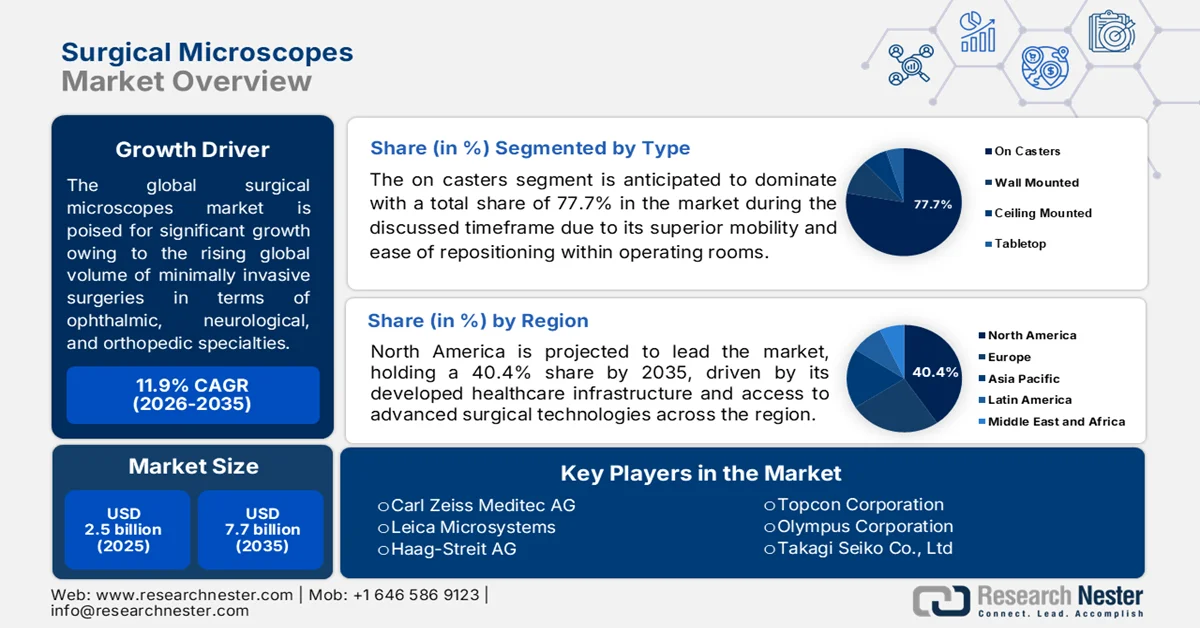
The global surgical microscopes market is witnessing a forward momentum primarily fueled by the rising global volume of minimally invasive surgeries across ophthalmic, neurological, aesthetic, and orthopedic specialties. Technological innovation is also the primary growth engine for this growth, with manufacturers making investments in integrating digital visualization pipelines, augmented reality overlays, and artificial intelligence-driven automated tracking into systems. In June 2024, the International Society of Aesthetic Plastic Surgery disclosed that aesthetic procedures worldwide reached 34.9 million in 2023, including 15.8 million surgical procedures, which is up by 5.5%, and 19.1 million non-surgical procedures, representing an overall annual increase of 3.4% and a 40% growth over the past four years. It also mentioned that liposuction was the most common surgical procedure with 2.2 million cases, whereas botulinum toxin was the leading non-surgical treatment with 8.8 million procedures, followed by 5.5 million hyaluronic acid treatments, thus denoting a positive opportunity for surgical microscopes.
Furthermore, the market is advancing with innovations that enable rapid, high-precision tissue assessment during operations. Supporting this trend, new investment initiatives are readily accelerating the commercialization of technologies that are designed to enhance real-time surgical decision-making and improve clinical outcomes. In this context, the Europe Investment Bank in January 2026 has provided USD 23 million in InvestEU-backed financing to SamanTree Medical to accelerate the development and commercialization of its Histolog Scanner across Europe and the U.S. This Histolog Scanner uses parallel confocal microscopy to generate high-resolution, histology-like images of excised tissue in about one minute, which enables surgeons to assess surgical margins and thereby supporting faster, more informed intraoperative decisions.
Key Surgical Microscopes Market Insights Summary:
Regional Highlights:
- North America is projected to capture 40.4% of the surgical microscopes market by 2035, underpinned by advanced healthcare infrastructure, expanding surgical facilities, and favorable reimbursement policies
- Asia Pacific is anticipated to witness considerable growth during 2026-2035, bolstered by healthcare infrastructure modernization and the rapid expansion of medical tourism
- The surgical microscopes market in the U.S. accounts for 86.7% of the share in North America, which is driven by the high adoption of technologically advanced surgical equipment and favorable reimbursement policies
Segment Insights:
- The on casters segment is expected to account for 77.7% of the surgical microscopes market by 2035, fueled by superior mobility and seamless integration into multi-specialty surgical workflows
- The ophthalmology segment is poised to secure a noteworthy share by 2035, stimulated by the rising global burden of vision impairment and age-related eye diseases driving demand for microsurgical interventions
Key Growth Trends:
- Proliferation of ambulatory surgical centers
- Aging global population and disease burden
Major Challenges:
- High capital investment and total cost of ownership
- Stiff competition from alternative visualization technologies
Key Players: Carl Zeiss Meditec AG (Germany), Leica Microsystems (Germany), Haag-Streit AG (Switzerland), Topcon Corporation (Japan), Olympus Corporation (Japan), Takagi Seiko Co., Ltd. (Japan), Seiler Instrument Inc. (U.S.), Alcon (Switzerland).
Global Surgical Microscopes Market Forecast and Regional Outlook:
Market Size & Growth Projections:
- 2025 Market Size: USD 2.5 billion
- 2026 Market Size: USD 2.8 billion
- Projected Market Size: USD 7.7 billion by 2035
- Growth Forecasts: 11.9% CAGR (2026-2035)
Key Regional Dynamics:
- Largest Region: North America (40.4% share by 2035)
- Fastest Growing Region: Asia Pacific
- Dominating Countries: United States, Germany, Japan, China, United Kingdom
- Emerging Countries: India, South Korea, Singapore, Brazil, United Arab Emirates
Last updated on : 9 July, 2026
Surgical Microscopes Market - Growth Drivers and Challenges
Growth Drivers
- Proliferation of ambulatory surgical centers: The global surge in ambulatory surgical centers and outpatient clinics is deliberately reshaping procurement landscapes in the surgical microscopes market. Cost-efficiency and faster patient turnover offered by these facilities are allowing greater investment opportunities in surgical equipment. This decentralized healthcare model creates a highly lucrative customer base for compact and versatile microscopes. In October 2025, the NIH article stated that ASCs in the U.S. increased from 5,012 a decade ago to 5,293 in 2021, with ASC openings rising significantly, thus showing a strong upward industry trend. Counties with higher healthcare resources had much higher ASC opening rates, including existing ASC presence.
- Aging global population and disease burden: The continuously escalating aging population worldwide has triggered an unprecedented rise in age-related chronic conditions. Degenerative ophthalmic disorders such as cataracts, complex spinal issues, and neurological diseases require precise surgical interventions, thus elevating the growth potential of the market. In this context, the National Institutes of Health (NIH) in June 2025 disclosed that cataract prevalence rose from 42.33 million to 100.57 million cases, which is a rise of almost 138% over the last two decades, with global age-standardized prevalence increasing from 1145 to 1181 per 100,000 (EAPC +0.21), thus positively benefiting the market’s expansion.
Challenges
- High capital investment and total cost of ownership: The exorbitant initial purchase price is considered to be the primary barrier preventing widespread market adoption. High-end surgical microscopes, which are integrated with advanced modalities, such as real-time intraoperative optical coherence tomography and 4K fluorescence imaging, frequently exceed the affordability for small-scale players. Apart from procurement costs, hospitals need to face substantial ongoing financial obligations, which include specialized maintenance contracts, expensive replacement parts, and software updates. This heavy financial burden severely limits adoption rates in developing economies, and it also forces community hospitals and standalone ambulatory surgical centers (ASCs) in developed nations to depend on refurbished equipment.
- Stiff competition from alternative visualization technologies: The global market faces intense market encroachment from continuously evolving, alternative medical visualization systems. Advanced 3D exoscopes and high-definition surgical endoscopes are being preferred by healthcare facilities due to their superior ergonomic designs and smaller operating rooms. Also, these exoscopes allow surgeons to view high-magnification fields on heads-up external monitors, in order to reduce physical strain when compared to generally used microscope eyepieces. In addition, the fast-paced development of heads-up displays, augmented reality headsets, and robotic-assisted visualization systems offers viable, highly flexible alternatives that dilute the market share of standalone surgical microscopes.
Surgical Microscopes Market Size and Forecast:
| Report Attribute | Details |
|---|---|
|
Base Year |
2025 |
|
Forecast Period |
2026-2035 |
|
CAGR |
11.9% |
|
Base Year Market Size (2025) |
USD 2.5 billion |
|
Forecast Year Market Size (2035) |
USD 7.7 billion |
|
Regional Scope |
|
Surgical Microscopes Market Segmentation:
Type Segment Analysis
In the type category, the on casters segment is anticipated to dominate with a total share of 77.7% in the surgical microscopes market during the discussed timeframe. The segment’s dominance is largely propelled by its superior mobility and ease of repositioning within operating rooms, allowing proper integration into multi-specialty surgical workflows and improving procedural efficiency. Its widespread adoption is also supported by growing demand for flexible operating room setups, where equipment must be quickly adjusted for different surgical procedures. For instance, in September 2024, Carl Zeiss Meditec AG announced the launch of the ZEISS KINEVO 900 S as an upgraded robotic visualization system for neurosurgery, which was built on the earlier KINEVO 900 platform. This system delivers 4K 3D digital imaging, enhanced depth-of-field (DepthPro mode), hybrid optical-exoscopic workflow.
Application Segment Analysis
Under the application segment, ophthalmology is forecasted to grow with a noteworthy share in the market by the end of 2035. The segment’s growth is mainly driven by the rising global burden of vision impairment and age-related eye diseases such as cataracts, diabetic retinopathy, and glaucoma, which are increasing demand for microsurgical interventions worldwide. In December 2025, NIH disclosed that the global ophthalmic surgical capacity constraints across the UK, Germany, Australia, Singapore, and India are driven primarily by rising disease prevalence, i.e., cataract, retinal disease, diabetic eye disease, and ageing populations, which are increasing demand beyond available surgical supply. Therefore, the review concludes that capacity expansion through task shifting, AI-assisted diagnostics, telemedicine, and workflow optimization is essential to address the increasing surgical burden.
End use Segment Analysis
By the conclusion of the forecast period, the hospital segment is expected to hold a significant share in the market. The segment’s growth is effectively propelled by the rising volume of complex surgical procedures that are performed in hospital operating rooms, where advanced microsurgical precision and multidisciplinary care capabilities are highly essential for patient management. Growth is also supported by continuous investments in hospital infrastructure and operating room modernization, which include the adoption of high-end imaging and visualization systems. Hospitals are considered to be the primary centers for emergency, neurological, ophthalmic, and oncological surgeries, which require surgical microscopes for accuracy and improved clinical outcomes. Furthermore, strong reimbursement frameworks and the availability of skilled surgical specialists solidify hospital dominance in the market.
Our in-depth analysis of the surgical microscopes includes the following segments:
|
Segment |
Subsegments |
|
Type |
|
|
Application |
|
|
End use |
|

Vishnu Nair
Head - Global Business DevelopmentCustomize this report to your requirements — connect with our consultant for personalized insights and options.
Surgical Microscopes Market - Regional Analysis
North America Market Insights
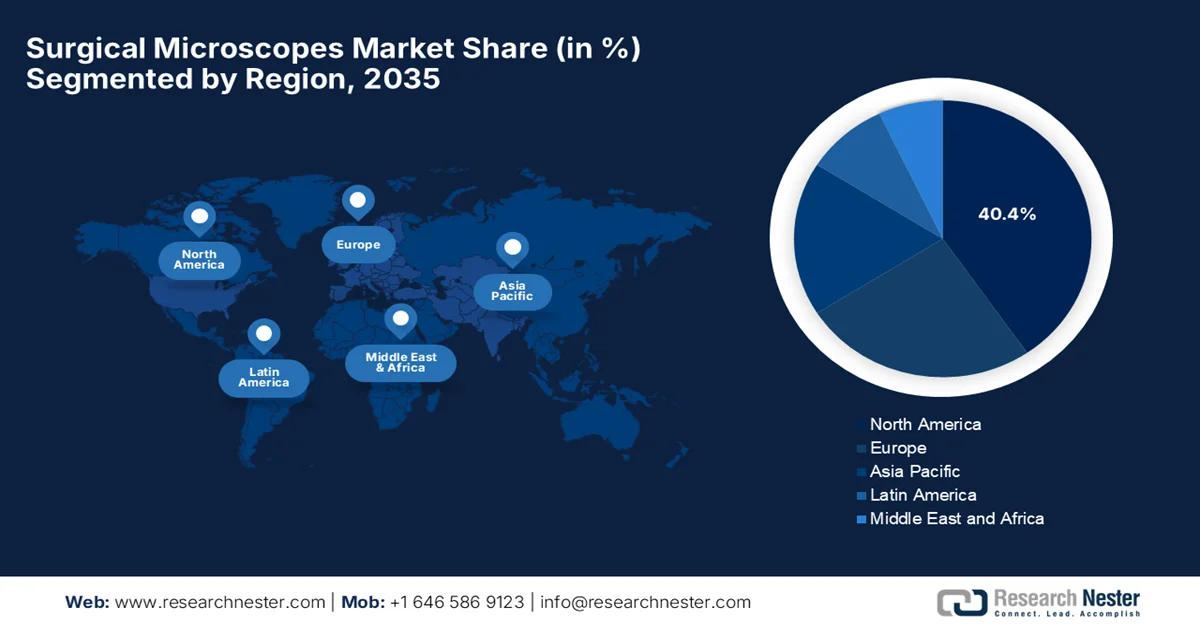
North America surgical microscopes market is projected to account for the largest share of 40.4% over the forecasted years. The dominance of the region is highly attributable to its advanced healthcare infrastructure, widespread availability of surgical equipment, and a strong base of skilled neuro and cosmetic surgeons. In addition, the expansion of surgical facilities, increasing preference for outpatient microsurgical procedures, and a favorable reimbursement environment for medical treatments also support market growth across the region. In March 2026, the Ambulatory Surgery Center Association supported the proposed Outpatient Surgery Access Act of 2026, which was introduced by U.S. lawmakers to reform Medicare reimbursement for ambulatory surgical centers and improve payment stability. The bill aims to align ASC payment updates with the hospital market basket index, thereby replacing the less accurate CPI-U model and removing budget-neutrality adjustments that have reduced ASC reimbursement rates over time.
The escalating volume of complex ophthalmic, neurological, and spine surgeries that necessitate exceptional intraoperative visualization is responsibly driving the surgical microscopes market in the U.S. Key technological integrations reshaping standard clinical workflows in the country include 4K three-dimensional imaging, augmented reality overlays, and robotic-controlled microscopic arms. In this context in April 2025 Medivis Inc. announced that it received FDA 510(k) clearance for its spine navigation platform, to enable commercial deployment across hospitals and ambulatory surgical centers in the U.S. This platform uses augmented reality, AI-based computer vision, and real-time imaging to provide holographic guidance for neurosurgery and orthopedic spine procedures, improving surgical precision and workflow efficiency thus making it suitable for standard market growth.
In Canada, the market is poised to witness solid growth largely due to its publicly funded healthcare system and a strong emphasis on optimizing patient outcomes. Market expansion is primarily propelled by a high clinical demand for complex neurosurgery, ophthalmology, and advanced reconstructive procedures within provincial healthcare networks. For instance, Bausch + Lomb and Heidelberg Engineering in April 2023 introduced the SeeLuma Fully Digital Surgical Visualization Platform in order to enhance ophthalmic surgery through advanced digital imaging and heads-up visualization. This system provides a high-resolution 3D 4K display, color reproduction, and contrast, which allows surgeons to perform complex eye surgeries using monitor-based heads-up workflows instead of traditional optical microscopes.
APAC Market Insights
The Asia Pacific market is expected to witness considerable growth during the discussed timeframe. The region’s leadership is largely driven by massive healthcare infrastructure modernization and a booming medical tourism sector across major emerging economies. Market momentum is also driven by private healthcare networks across the region, which are upgrading public and corporate hospitals with advanced digital visualization platforms. The Task Force to Secure Supplies of Pharmaceuticals, Medical Devices, and Medical Supplies was established in Japan in March, 2026, jointly by the Ministry of Economy, Trade and Industry and the Ministry of Health, Labour and Welfare. It was created to address potential disruptions in medical product supply chains caused by instability in the Middle East. This task force is highly focused on ensuring stable availability of pharmaceuticals, medical devices, and medical supplies through coordinated government analysis and response planning, positively benefiting the market’s expansion.
The government's healthcare modernization initiatives and robust domestic medical infrastructure expansion are major factors reshaping the growth dynamics of the market in China. Market demand is propelled by a rapidly aging demographic and expanding public health insurance coverage. Domestic hospitals are actively replacing optical instruments with high-definition digital visualization cockpits, preferring systems that are integrated with 4K 3D imaging, real-time indocyanine green fluorescence, and localized navigation software. In May 2025, Shanghai Bright Eye Hospital in Shanghai, China, launched a new ophthalmic surgery center, which is equipped with the ZEISS ARTEVO 800, marking a major step toward digital and intelligent eye surgery. This system combines optical and digital technologies to provide 3D large-screen, high-definition visualization, thereby allowing surgeons to operate using a heads-up display instead of traditional eyepiece microscopes.
In India, the surgical microscopes market is primarily catalyzed by extensive private sector healthcare investments and a rapidly expanding medical tourism industry. The continuous volume of cataract extractions, complex neurosurgeries, and dental micro-procedures across both metropolitan tertiary hospitals and tier-two cities is positioning the market for sustained growth. For instance, in April 2025, the Press Information Bureau (PIB) revealed that the Army Hospital introduced a 3D digital surgical microscope system for ophthalmic procedures. This particular system uses 3D polarized glasses and a 55-inch 4K ultra-HD display, enabling heads-up surgery for conditions such as glaucoma, cataract, corneal, squint, and retinal disorders, thus denoting a positive market outlook.
Europe Market Insights
The Europe market is one of the largest and most influential landscapes, which is characterized by a strict adherence to clinical efficacy standards. Market progression is primarily sustained by well-funded public healthcare systems and universal insurance coverage. Apart from this, procurement strategies are influenced by the stringent safety criteria of the Medical Device Regulation (MDR), which is driving a demand for highly reliable, long-lasting equipment. For instance, in May 2024, the Council of the European Union adopted new measures with a prime aim to help prevent shortages of critical medical devices and in vitro diagnostic devices by extending transition periods for certain IVDs and strengthening supply chain oversight. This particular regulation enables the phased implementation of the EUDAMED, requiring manufacturers to begin registering product information before the full database is completed.
An exceptionally well-funded healthcare system, a dense network of university research hospitals, and an aging demographic are certain visible factors boosting the market in Germany. The country’s medical facilities lead the global shift toward fully integrated digital operating theaters, actively procuring systems featuring robotic-assisted positioning, intraoperative optical coherence tomography, and 4K 3D visualization. For instance, Leica Microsystems introduced the latest version of its ARveo 8 in January 2024, thereby adding advanced 3D fluorescence visualization and augmented reality capabilities to improve real-time decision-making during neurosurgery. This upgraded system consists of the new GLOW400 application for brain tumor surgery and GLOW800 for vascular procedures, which enables high-resolution 3D visualization of anatomical structures, fluorescence signals, and blood flow while supporting more precise tumor resection.
The UK surgical microscopes market is projected for solid growth facilitated by the National Health Service (NHS) procurement frameworks and a rapidly expanding private healthcare sector. Market development is primarily driven by the continuous clinical demand for advanced neurosurgery, complex ophthalmic treatments, and intricate plastic surgeries within major regional trauma centers and teaching hospitals. In addition, the steady growth of private medical centers and specialized ambulatory day-case clinics across the country propels a consistent demand for highly multi-disciplinary and mobile visualization platforms. Based on the government data published in March 2024, the Whittington Hospital NHS Trust awarded a total of USD 143,000 contract to Carl Zeiss Ltd for the procurement of the ZEISS OPMI LUMERA 700 ophthalmic microscope. This purchase supports advanced ophthalmic surgical services by equipping the hospital with high-precision visualization technology for eye surgery.
Key Surgical Microscopes Market Players:
- Carl Zeiss Meditec AG (Germany)
- Leica Microsystems (Germany)
- Haag-Streit AG (Switzerland)
- Topcon Corporation (Japan)
- Olympus Corporation (Japan)
- Takagi Seiko Co., Ltd. (Japan)
- Seiler Instrument Inc. (U.S.)
- Alcon (Switzerland)
- Company Overview
- Business Strategy
- Key Product Offerings
- Financial Performance
- Key Performance Indicators
- Risk Analysis
- Recent Development
- Regional Presence
- SWOT Analysis
- Carl Zeiss Meditec AG is the global leader in the market, which is well-recognized for its premium optical technologies and extensive portfolio. The company benefits from a global distribution network, continuous investment in R&D, and a focus on digital surgery, which enables ZEISS to maintain a dominant competitive position.
- Leica Microsystems is one of the leading manufacturers of surgical microscopes and is best known for delivering high-precision optical visualization systems across neurosurgery and various procedures. The firm's M530 and Proveo microscope platforms emphasize superior optics, fluorescence imaging, and digital connectivity to improve surgical accuracy.
- Haag-Streit AG has registered itself as a prominent manufacturer specializing in ophthalmic surgical microscopes and diagnostic technologies. In addition, the company's long-standing knowledge in ophthalmology, along with a reputation for precision engineering, has enabled Haag-Streit to establish a strong presence across various end users.
- Topcon Corporation is a leading Japan-based manufacturer of ophthalmic surgical microscopes. Besides, the firm proactively develops operating microscope systems designed to deliver high-resolution visualization and seamless integration with ophthalmic imaging equipment.
- Olympus Corporation is yet another participant in the market that is offering advanced microscope and imaging solutions primarily for neurosurgery, ENT, and microsurgical applications. The company is supported by its extensive global healthcare business, strong innovation capabilities, and established relationships with healthcare providers.
Here is a list of key players operating in the global market:
The global surgical microscopes market hosts a handful of multinational manufacturers accounting for a significant share of worldwide revenue through strong optical technologies and established distribution networks. Market leaders in this field compete in terms of visualization quality, digital imaging integration, fluorescence-guided surgery, and specialty-specific solutions for ophthalmology, neurosurgery, ENT, and dentistry. Apart from this, regional and small-scale manufacturers in this sector efficiently strengthen competition by offering cost-effective or specialty-focused surgical microscope systems that are suitable for local healthcare requirements. For instance, B. Braun SE in September 2025 announced the acquisition of True Digital Surgery to strengthen its position in digital microsurgery and accelerate innovation in advanced surgical visualization technologies.
Corporate Landscape of the Market:
Recent Developments
- In May 2026, Carl Zeiss Meditec AG announced that COFEPRIS has approved the ZEISS ARTEVO 850 and ZEISS MICOR 700 for use in Mexico. The ARTEVO 850 enhances cataract surgery with advanced 3D digital visualization and improved depth of field, whereas the MICOR 700 introduces ultrasound-free lens extraction technology to improve surgical efficiency.
- In February 2026, Leica Microsystems appointed Diamond Dent Trading Co as its authorized partner in Saudi Arabia for the distribution of dental surgical microscopy solutions. Under this collaboration, Diamond Dent will distribute Leica's dental surgical microscopes to clinics and dental professionals.
- Report ID: 4568
- Published Date: Jul 09, 2026
- Report Format: PDF, PPT
- Explore a preview of key market trends and insights
- Review sample data tables and segment breakdowns
- Experience the quality of our visual data representations
- Evaluate our report structure and research methodology
- Get a glimpse of competitive landscape analysis
- Understand how regional forecasts are presented
- Assess the depth of company profiling and benchmarking
- Preview how actionable insights can support your strategy
Explore real data and analysis
Frequently Asked Questions (FAQ)
About this Report
Connect with our Expert


Report, 2026-2035



Copyright @ 2026 Research Nester. All Rights Reserved.
