Cross-Border Payments Market Outlook:
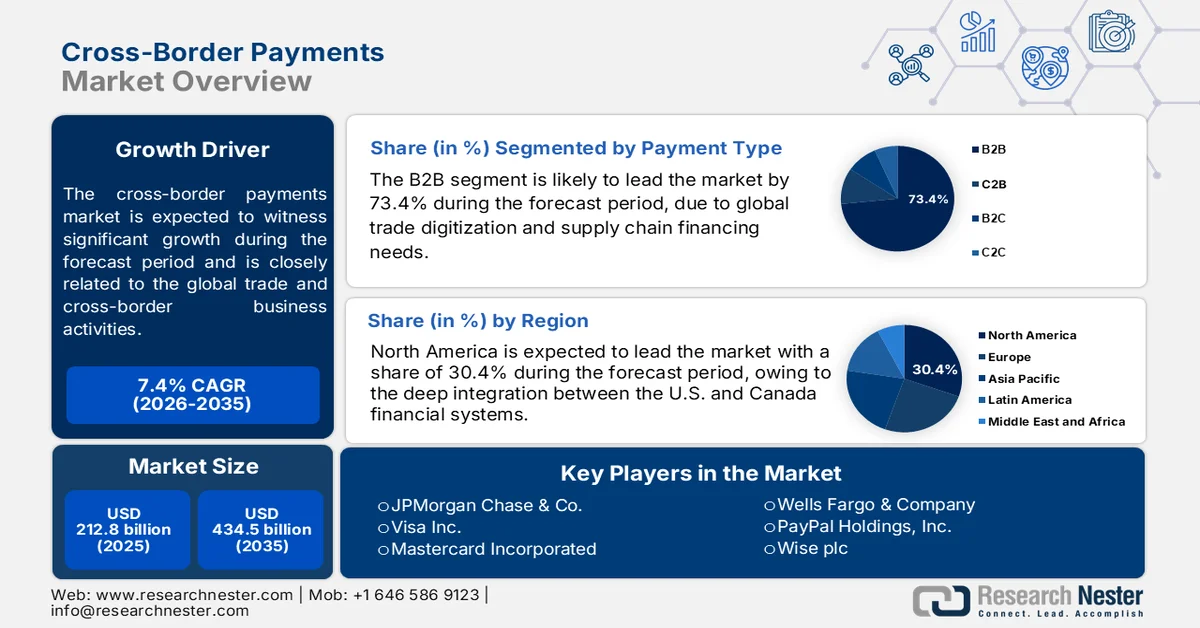
Cross-Border Payments Market size was valued at USD 212.8 billion in 2025 and is projected to cross USD 434.5 billion by 2035, growing at a CAGR of 7.4% during the forecast period, 2026-2035. In 2026, the industry size of cross-border payments is assessed at USD 228.5 billion.
Cross-border payments market are driven by the supporting international trade and global business transactions and complex regulatory requirements. According to the U.S. Bureau of Economic Analysis September 2025 data, U.S. exports of goods and services totaled USD 280.5 billion in July 2025, while imports reached USD 358.8 billion, representing a USD 20.0 billion increase from the previous month. The growing volume of international trade is driving greater demand for efficient cross-border payment solutions. As transactions involve multiple currencies and must comply with regulations such as anti-money laundering and know-your-customer requirements, businesses increasingly require secure, transparent, and streamlined payment systems to facilitate global financial flows.
Moreover, the supply chains and rising international trade volumes promote the demand for fast, secure, and cost-efficient B2B payment solutions. As per the WTO’s Global Trade Outlook and Statistics 2025 data, the world merchandise trade rose to 3.6% in 2024, while the trade in commercial services grew by 6.8%. These data highlight the potential earnings for cross-border payment technology producers. As businesses operate across the worldwide cross-border payments market, they opt for smooth settlement and reduced transaction risks to support efficient global trade. Recent developments, such as in March 2025, RTGS Global announced a strategic partnership with TransferMate to simplify cross-border transactions. With this integration, TransferMate will use RTGS Global’s instant settlement infrastructure, enabling seamless and real-time international payments. This collaboration aims to lower the dependence on conventional banking and reduce the risk related to cross-border money transfer.
Baseline Trade Volume, 2023-2026
|
Year |
Trade Volume (Annual % Change) |
|
2023 |
0.9 |
|
2024 |
2.7 |
|
2025 |
4.6 |
|
2026 |
1.9 |
Source: WTO March 2026
Key Cross-Border Payments Market Insights Summary:
Regional Highlights:
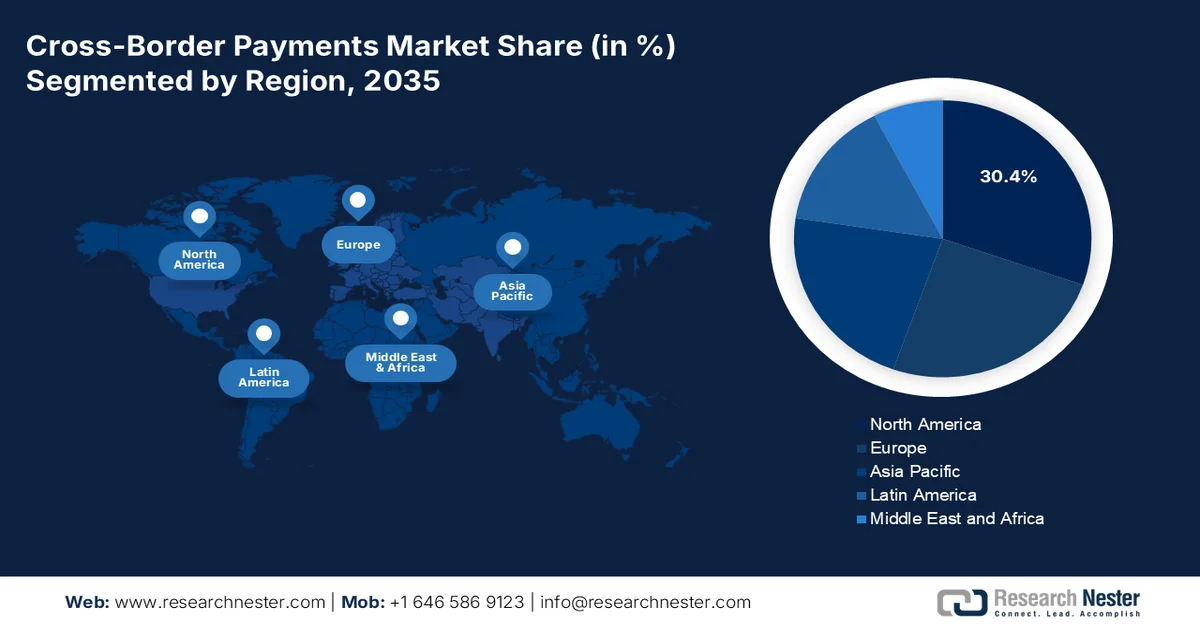
- North America is anticipated to secure 30.4% of the cross-border payments market revenue share by 2035, underpinned by accelerated adoption of real-time settlement infrastructure, fintech-led B2B transactions, and expanding digital trade corridors
- Asia Pacific is set to witness the fastest expansion across 2026-2035, fueled by booming e-commerce exports, interconnected real-time payment ecosystems, and high-volume remittance corridors
Segment Insights:
- In the cross-border payments market, the B2B payments sub-segment is projected to account for 73.4% share by 2035, propelled by global trade digitization and supply chain financing needs
- The large enterprises sub-segment is expected to command the largest revenue share by 2035, attributed to increasing demand for seamless high-volume multicurrency transactions across global operations and regions
Key Growth Trends:
- Fintech innovation and bank partnerships
- Cross border e-commerce
Major Challenges:
- Infrastructure gaps & digital divide
- Regulatory fragmentation across jurisdictions
Key Players: JPMorgan Chase & Co. (U.S.),Visa Inc. (U.S.),Mastercard Incorporated (U.S.),Wells Fargo & Company (U.S.),PayPal Holdings, Inc. (U.S.),Wise plc (UK),Revolut Ltd (UK),Adyen N.V. (Netherlands),Worldline SA (France),Deutsche Bank AG (Germany),Standard Chartered PLC (UK),Mitsubishi UFJ Financial Group (MUFG) (Japan),Sumitomo Mitsui Financial Group (SMFG) (Japan),Airwallex Pty Ltd (Australia),Nium Pte. Ltd. (Singapore),Toss Payments (South Korea),Amazon (U.S.),Bank of America (U.S.),NTT DATA (Japan),Citi (U.S.).
Global Cross-Border Payments Market Forecast and Regional Outlook:
Market Size & Growth Projections:
- 2025 Market Size: USD 212.8 billion
- 2026 Market Size: USD 228.5 billion
- Projected Market Size: USD 434.5 billion by 2035
- Growth Forecasts: 7.4% CAGR (2026-2035)
Key Regional Dynamics:
- Largest Region: North America (30.4% Share by 2035)
- Fastest Growing Region: Asia Pacific
- Dominating Countries: United States, China, United Kingdom, Japan, Germany
- Emerging Countries: India, Brazil, Indonesia, Mexico, South Korea
Last updated on : 10 June, 2026
Cross-Border Payments Market - Growth Drivers and Challenges
Growth Drivers
- Fintech innovation and bank partnerships: By utilizing blockchain and digital ledger technology, fintech companies are mainly collaborating with banks to improve cross-border payment speed, security, and cost effectiveness. This partnership involves improving transparency and changing settlement practices. For example, SBI Remit, a division of SBI Holdings in Japan, added Ripple's XRP-based payment system to its international money transfer services in September 2023. Real-time remittances from Japan to bank accounts in the Philippines, Vietnam, and Indonesia are made possible by this partnership. SBI Remit reduces the requirement for pre-funding destination accounts by using XRP as a bridge currency, thereby reducing transaction costs and settlement times. Ripple's On-Demand Liquidity (ODL) technology, which enables quick and inexpensive cross-border payments, is used in the integration.
- Cross border e-commerce: As online shopping becomes more popular worldwide, there is a greater demand for rapid and reasonably priced international payment options. Global B2B e-commerce sales have consistently increased year over year over the past ten years, according to the International Trade Administration's (ITA) Report on 2024 e-commerce size and sales prediction. Sectors include sophisticated manufacturing, energy, healthcare, and professional business services account for a sizable portion of this value. With China holding a 30% share, Asia Pacific is predicted to maintain its position as the world's cross-border payments market leader.
Leading Markets of Most Recent Cross-Border E-commerce Purchases Worldwide, 2024
|
Year |
Percentage |
|
China |
30 |
|
Germany |
14 |
|
UK |
10 |
|
U.S. |
10 |
|
France |
4 |
|
Others |
32 |
Source: ITA 2024
Challenges
- Infrastructure gaps & digital divide: In certain emerging nations, the sales of advanced payment systems are primarily hampered by infrastructure gaps. The adoption of cross-border payment solutions is significantly hampered by the lack of API standards, real-time payment networks, and inadequate rural connection. More than 2.6 billion people were offline in 2023, according to the International Trade Union (ITU), which had an effect on the uptake of cloud-native or app-based payment systems. Based on current patterns, developing markets have the potential to affect trade in both good and negative ways.
- Regulatory fragmentation across jurisdictions: The sales of cross-border payment solutions are being hampered by the inconsistent rules throughout the world. Although local financial authorities play a significant role in regulating cross-border transfers, the fragmentation of legislation serves as a significant barrier. Additionally, they hinder the progress of important firms by delaying market access and raising integration costs. The biggest obstacle to market access, according to payment companies, is regulatory mismatch. In order to comply with the necessary guidelines, businesses are urged to form strategic alliances with regional players.
Cross-Border Payments Market Size and Forecast:
| Report Attribute | Details |
|---|---|
|
Base Year |
2025 |
|
Forecast Year |
2026-2035 |
|
CAGR |
7.4% |
|
Base Year Market Size (2025) |
USD 212.8 billion |
|
Forecast Year Market Size (2035) |
USD 434.5 billion |
|
Regional Scope |
|
Cross-Border Payments Market Segmentation:
Payment Type Segment Analysis
Under the payment type segment, the B2B payments sub segment is leading and is poised to hold the share value of 73.4% by the end of 2035. The segment is driven by global trade digitization and supply chain financing needs. According to the ITA 2022 data in Europe, the largest regional B2B corridor, the market, led by Germany, the United Kingdom, and France, was valued at USD 1.3 trillion in 2022, reflecting the lowest global growth rate of 10.2% due to market maturity. Despite slower growth, this massive base volume ensures B2B Payments capture the highest revenue share among all payment types by 2035. Enterprises across manufacturing, logistics, and e-commerce prioritize faster, cheaper B2B settlement rails such as blockchain networks and API-based fintech platforms, replacing legacy correspondent banking for invoice and trade payments.
End user Segment Analysis
Under the end user segment, the large enterprises sub-segment is leading and is poised to hold the largest revenue share in the cross-border payments market. The segment is driven by the requirement for seamless high-volume transactions across currencies and regions among the multinational corporations. Their rising supply chains and international workforce drive the demand for cost-effective, efficient, and transparent payment solutions. Moreover, the rising pressure to improve liquidity management and foreign exchange costs is embracing digital platforms and real-time payment technologies. For example, HSBC has announced the launch of Global Wallet platforms for corporates in November 2024. This launch enables large enterprises to send and receive payments instantly with multiple currencies from a single account.
Currency Type Segment Analysis
G10 currencies, led by the U.S. dollar, is expected to capture the highest revenue share in cross-border payments by the end of 2035 due to unmatched liquidity and reserve status. According to the Bipartisan Policy Center September 2025 data, the U.S. dollar currently accounts for 88% of global foreign exchange transactions, 58% of global foreign exchange reserves, and 54% of global trade invoicing. This triple dominance ensures that most cross-border B2B contracts, commodity settlements (oil, metals, grains), and interbank transfers are denominated in dollars or other G10 currencies (euro, yen, pound). Even as CBDCs and emerging market currencies gain traction, the dollar's deep capital markets and legal certainty lock in its primacy. Consequently, payment rails prioritizing G10 settlement will process the largest transaction values through 2035.
Our in-depth analysis of the cross-border payments market includes the following segments:
|
Segment |
Subsegments |
|
Payment Type |
|
|
End user |
|
|
Payment Channel |
|
|
Settlement Speed |
|
|
Industry Vertical |
|
|
Currency Type |
|

Vishnu Nair
Head - Global Business DevelopmentCustomize this report to your requirements — connect with our consultant for personalized insights and options.
Cross-Border Payments Market - Regional Analysis
North America Market Insights
North America is dominating the cross-border payments market and is expected to hold the regional revenue share of 30.4% by the end of 2035. The market is mature and technologically advanced cross-border payments market, driven by deep integration between the U.S. and Canadian financial systems. The region is witnessing a rapid shift from traditional correspondent banking to real-time settlement rails and blockchain-based corridors. Regulatory harmonization around AML/KYC frameworks, coupled with the adoption of ISO 20022 messaging standards, is enhancing payment transparency and speed. Enterprises and SMEs increasingly favor fintech platforms over banks for B2B cross-border settlements due to lower fees and faster processing. Additionally, the growing volume of cross-border e-commerce and digital services trade between the U.S. and Canada continues to fuel demand for instant, low-value payment solutions.
The strong financial market activity and growing commercial transactions is driving the cross-border payments market in the U.S. Increasing demand for faster and more efficient international payments is being driven by global trade, digital commerce, and cross-border investment flows. According to the Federal Reserve December 2025 data, the Fedwire Securities Service processed 29.3 million securities transfers in 2024, highlighting the substantial scale of U.S. financial transactions that rely on secure payment and settlement infrastructure. Additionally, the U.S. Census Bureau May 2026 data estimated total retail sales at USD 1.929 trillion in the first quarter of 2026, up 1.5% from the fourth quarter of 2025, reflecting strong economic activity that supports international payment volumes and cross-border commercial transactions.
The increasing international travel, tourism spending, and digital payment adoption is driving the cross-border payments market in Canada. Rising movement of people across borders creates greater demand for foreign exchange services, card-based transactions, and real-time international payment solutions. According to the Government of Canada February 2026, 509,500 overseas residents arrived in Canada in December 2025, representing a 14.1% year-over-year increase, highlighting the growing volume of cross-border economic activity. Additionally, the agency reported that Canadian-resident return trips from overseas increased by 12.9% year over year in December 2025, reflecting stronger outbound travel demand. These trends are supporting higher volumes of international payments and encouraging investment in efficient, secure, and interoperable cross-border payment infrastructure.
APAC Market Insights
The Asia Pacific region is projected to emerge rapidly during the assessed period, 2026 to 2035, in the cross-border payments market. The region is driven by booming e-commerce exports from China, India, and Southeast Asia, as well as massive remittance corridors such as India-GCC and Philippines-US. The region is transforming the traditional banking rails through widespread adoption of real-time payment systems that are increasingly interconnected via bilateral linkages. Digital wallets dominate cross-border consumer payments, while B2B flows are rapidly adopting blockchain and API-based platforms. Cost reduction and speed remain the primary drivers for enterprises and individuals alike.
The rising remittance inflows, international trade, and increasing adoption of digital payment platforms is shaping the cross-border payments market in India. Government initiatives promoting digital financial infrastructure and greater global connectivity are enhancing the efficiency of international transactions. According to the News on Air July 2025 data, inward remittances to India reached approximately USD 129.4 billion in FY2024 to 2025, reinforcing India's position as the world's largest remittance recipient and highlighting substantial cross-border payment activity. Additionally, data from the PIB April 2025 show that India’s total merchandise exports reached USD 437.4 billion in FY2023 to 2024. Growing trade and remittance volumes are driving demand for faster, more secure, and cost-effective cross-border payment solutions across the country.
The international trade, tourism recovery, and increasing digitalization of financial services are shaping the cross-border payments market in Japan. Businesses and consumers are seeking faster and more transparent international payment solutions to support global commerce and travel-related transactions. According to the Travel Voice January 2025, 36.9 million international visitors arrived in Japan in 2024, surpassing pre-pandemic levels and generating substantial cross-border payment activity through travel spending and foreign exchange transactions. Additionally, the WTO April 2026 reported that Japan’s exports totaled approximately USD 709 billion in 2024, reflecting the significant volume of international trade requiring efficient payment and settlement services. These factors continue to strengthen demand for advanced cross-border payment infrastructure in Japan.
Europe Market Insights
Europe represents a mature but steadily growing cross-border payments market, characterized by high regulatory integration under the Single Euro Payments Area (SEPA) and strong adoption of instant payment infrastructure. The region is witnessing a gradual decline of correspondent banking in favor of pan-European real-time rails, with the EU’s Instant Payments Regulation mandating frictionless cross-border euro transfers. Fintech hubs in the UK, Germany, and France are driving innovation in B2B cross-border settlements, particularly for SME trade within Europe and with emerging cross-border payments markets. However, fragmentation persists between eurozone and non-eurozone countries (e.g., Poland, Sweden), requiring currency conversion solutions. Open banking and API-based platforms are displacing traditional card networks for cross-border e-commerce payments. Regulatory focus remains on AML harmonization and reducing latency across diverse local infrastructures.
International trade, tourism, and digital commerce are shaping the cross-border payments market in Germany. Increasing demand for efficient cross-border transactions is encouraging financial institutions and payment providers to invest in real-time and interoperable payment infrastructure. According to the GTAI February 2026 data, Germany’s exports of goods totaled USD 1.68 trillion in 2024, highlighting the substantial volume of international commercial transactions requiring cross-border payment services. Additionally, Germany Travel December 2025 data reported that Germany welcomed approximately 85.3 million overnight stays by international visitors in 2024, reflecting strong cross-border travel activity and associated payment flows. These trends are supporting higher transaction volumes and strengthening the adoption of advanced cross-border payment solutions throughout Germany.
The strong international trade, global financial services activity, and increasing digital payment adoption is shaping the cross-border payments market in the UK. Demand for faster and more transparent international transactions continues to rise among businesses, consumers, and financial institutions. The total value of UK goods exports is underscoring the substantial volume of international trade requiring cross-border payment services. Additionally, data from the UK Finance 2025 show that the CHAPS payment system processed USD 112.0 trillion in payments during 2024, reflecting the scale of high-value financial transactions flowing through the UK’s payment infrastructure. These factors are driving continued investment in secure and efficient cross-border payment solutions.
Key Cross-Border Payments Market Players:
- JPMorgan Chase & Co. (U.S.)
- Visa Inc. (U.S.)
- Mastercard Incorporated (U.S.)
- Wells Fargo & Company (U.S.)
- PayPal Holdings, Inc. (U.S.)
- Wise plc (UK)
- Revolut Ltd (UK)
- Adyen N.V. (Netherlands)
- Worldline SA (France)
- Deutsche Bank AG (Germany)
- Standard Chartered PLC (UK)
- Mitsubishi UFJ Financial Group (MUFG) (Japan)
- Sumitomo Mitsui Financial Group (SMFG) (Japan)
- Airwallex Pty Ltd (Australia)
- Nium Pte. Ltd. (Singapore)
- Toss Payments (South Korea)
- Amazon (U.S.)
- Bank of America (U.S.)
- NTT DATA (Japan)
- Citi (U.S.)
- Company Overview
- Business Strategy
- Key Product Offerings
- Financial Performance
- Key Performance Indicators
- Risk Analysis
- Recent Development
- Regional Presence
- SWOT Analysis
- JPMorgan Chase has significantly advanced the cross-border payments market through its proprietary blockchain network, Liink, and its digital currency, JPM Coin. Liink allows participating financial institutions to exchange complex payment-related data securely, reducing friction and compliance delays in cross-border transactions.
- Visa has transformed the cross-border payments market by expanding beyond card networks into B2B and real-time settlement solutions. Its Visa Direct platform enables push payments to over 8 billion endpoints globally, including cards, bank accounts, and digital wallets, facilitating instant cross-border fund transfers.
- Mastercard has strengthened the cross-border payments market through its Cross-Border Services platform, which supports over 220 countries. Unlike traditional card-based rails, this solution leverages local payment schemes and real-time trackers to provide transparency on fees and delivery times.
- Wells Fargo has modernized the cross-border payments market through its Wells Fargo Global Clearing and FX Velocity platforms, serving institutional and corporate clients. The bank was an early adopter of SWIFT GPI, which provides real-time tracking and fee transparency for cross-border wires.
- PayPal has revolutionized the cross-border payments market by enabling individuals and small businesses to send and receive payments in markets with localized currency conversion. Its Xoom subsidiary provides dedicated remittance and cross-border bill pay services, supporting bank account, cash pickup, and mobile wallet delivery. In 2025, the company has made a 10% growth in total payment volumes.
Here is a list of key players operating in the global cross-border payments market:
The global cross-border payments market is characterized by the presence of fintech innovators and traditional financial giants. Leading companies are focused on the production and commercialization of advanced cross-border payment solutions. They are entering into strategic partnerships with other companies to boost their market reach and revenues. For example, in April 2026, Amazon has announced the acquisition of Globalstar. Moreover, the industry giants are expanding their operations across developing markets to earn lucrative gains from untapped opportunities. Both the organic and inorganic marketing strategies are poised to double the revenues of key players by the end of the forecast period.
Corporate Landscape of the Cross-Border Payments Market:
Recent Developments
- In June 2026, Bank of America has announced the launch of the global cross-border real-time payments solution which enables the corporate, commercial and financial institution clients to send and receive funds instantly via Swift or CashPro®.
- In June 2026, AXS Pte Ltd (AXS) and NTT DATA Japan (NTT DATA) have entered into a MOU - Memorandum of Understanding to explore the development of secure and seamless cross‑border bill payment services.
- In September 2025, Citi and Dandelion has announced the collaboration to enable near-instant, full-value cross-border payments directly into the digital wallets worldwide, leveraging Citi’s WorldLink® Payment Services and Dandelion’s extensive digital wallet network.
- Report ID: 8121
- Published Date: Jun 10, 2026
- Report Format: PDF, PPT
- Explore a preview of key market trends and insights
- Review sample data tables and segment breakdowns
- Experience the quality of our visual data representations
- Evaluate our report structure and research methodology
- Get a glimpse of competitive landscape analysis
- Understand how regional forecasts are presented
- Assess the depth of company profiling and benchmarking
- Preview how actionable insights can support your strategy
Explore real data and analysis
Frequently Asked Questions (FAQ)
About this Report
Connect with our Expert


Report, 2026-2035



Copyright @ 2026 Research Nester. All Rights Reserved.
