Cooling Tower Market Outlook:
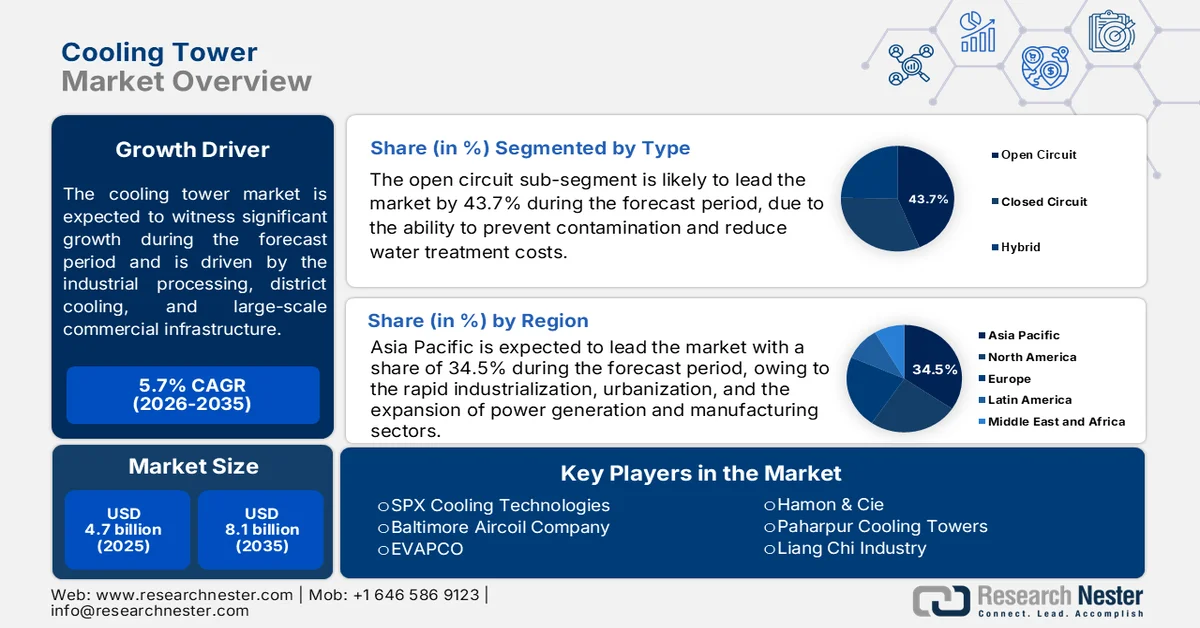
Cooling Tower Market size was valued at USD 4.7 billion in 2025 and is projected to account for USD 8.1 billion by 2035, rising at a CAGR of 5.7% during the forecast period 2026 to 2035. In 2026, the industry size of cooling tower is estimated at USD 4.9 billion.
The cooling tower market is supported by sustained investment in power generation, industrial processing, district cooling, and large-scale commercial infrastructure. According to the U.S. Energy Information Administration, March 2026 data, the industrial sector accounted for approximately 33% of total U.S. energy consumption, with energy-intensive industries such as chemicals, petroleum refining, food processing, pulp and paper, and primary metals continuing to expand thermal management requirements across production facilities. On the other hand, the U.S. Department of Energy 2024 data reports that HVAC systems represent roughly 35% of energy use in commercial buildings, increasing the need for efficient heat rejection systems in hospitals, data centers, airports, universities, and mixed-use developments. Federal efficiency programs are also influencing procurement decisions.
Key Cooling Tower Market Insights Summary:
Regional Highlights:
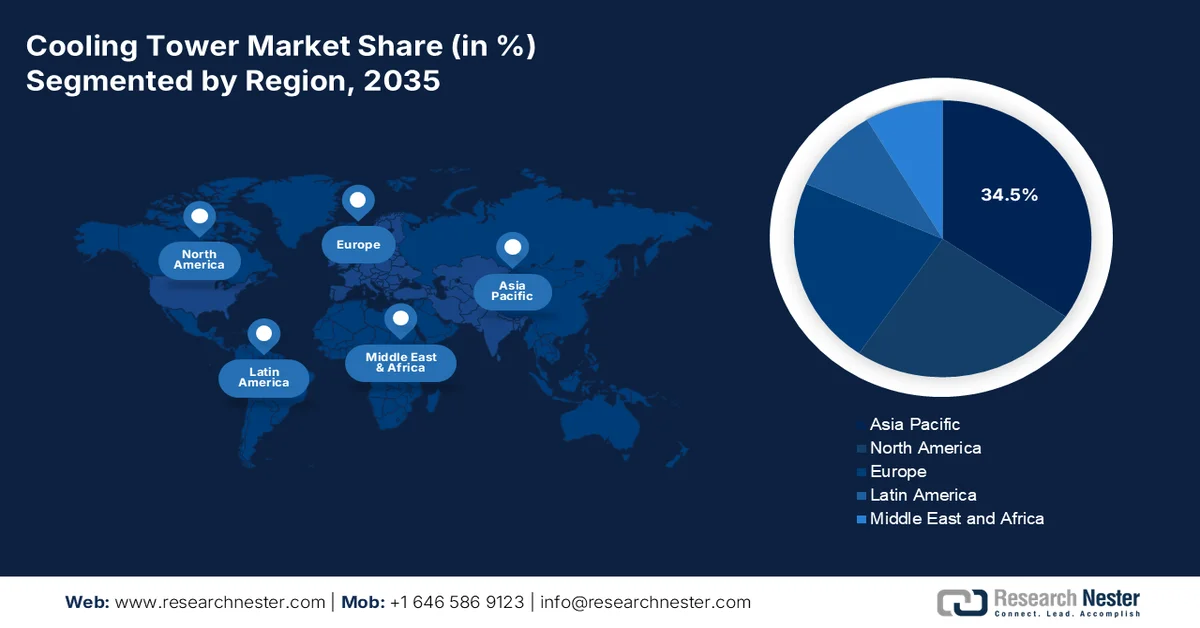
- The cooling tower market in Asia Pacific is anticipated to capture 34.5% of regional revenue by 2035, bolstered by rapid industrialization, urbanization, and the expansion of power generation and manufacturing sectors across China, India, and Southeast Asia
- North America is projected to witness the fastest growth throughout 2026-2035, stimulated by the replacement of aging industrial infrastructure and compliance with tightening water and energy regulations
Segment Insights:
- In the cooling tower market, the Open Circuit segment is forecast to account for 43.7% of the market share by 2035, supported by its ability to prevent contamination and reduce water treatment costs, particularly in data centers and pharmaceutical applications
- The FRP segment is expected to maintain its leading position through 2035, fueled by its exceptional corrosion resistance, lightweight structure, and low maintenance requirements
Key Growth Trends:
- Expansion of semiconductor manufacturing facilities
- Rising data center construction
Major Challenges:
- Biological contamination and health safety risks
- Technological expertise and innovation gaps
Key Players: SPX Cooling Technologies (U.S.), Baltimore Aircoil Company (U.S.), EVAPCO (U.S.), Hamon & Cie (Belgium), Paharpur Cooling Towers (India), Liang Chi Industry (Malaysia), Brentwood Industries (U.S.), Cooling Tower Depot (U.S.), Kuken Co., Ltd. (Japan), Shinwa Controls Co., Ltd. (Japan), Ebara Corporation (Japan), Kimco Controls (South Korea), Daeil Aqua Co., Ltd. (South Korea), ENEXIO Water Technologies (Germany), Thermal Care, Inc. (U.S.), Star Cooling Towers (India), Thyssenkrupp (Germany), ebm‑papst SEA (Germany), ABB (Europe), Delta (Taiwan).
Global Cooling Tower Market Forecast and Regional Outlook:
Market Size & Growth Projections:
- 2025 Market Size: USD 4.7 billion
- 2026 Market Size: USD 4.9 billion
- Projected Market Size: USD 8.1 billion by 2035
- Growth Forecasts: 5.7% CAGR (2026-2035)
Key Regional Dynamics:
- Largest Region: Asia Pacific (34.5% Share by 2035)
- Fastest Growing Region: North America
- Dominating Countries: China, United States, India, Japan, Germany
- Emerging Countries: Indonesia, Malaysia, Vietnam, South Korea, Saudi Arabia
Last updated on : 2 June, 2026
Cooling Tower Market - Growth Drivers and Challenges
Growth Drivers
- Expansion of semiconductor manufacturing facilities: Government-backed semiconductor investments are increasing the demand for industrial cooling infrastructure, particularly in the wafer fabrication plants that require continuous thermal regulation. As per the HAI Stanford August 2022 data, the U.S. CHIPS and Science Act allocated more than USD 52 billion to strengthen domestic semiconductor production and research capacity, promoting the new fabrication projects across various nations. Semiconductor manufacturing facilities consume substantial process cooling capacity due to heat-intensive lithography and etching operations, directly supporting cooling tower market deployment. Industrial engineering contractors are also prioritizing energy-efficient cooling assets to align with the national sustainability targets and operating cost controls.
- Rising data center construction: The rapid expansion of the hyperscale data centers is generating a strong demand for heat rejection systems across various regions. According to the International Energy Agency 2024 data, electricity consumption from data centers may exceed 945 TWh globally by 2030 due to cloud computing and AI processing growth. Cooling systems account for a significant share of data center operating costs, increasing investment in high-efficiency cooling towers and hybrid cooling technologies. In the U.S., federal incentives for AI infrastructure and advanced computing facilities are further accelerating cooling infrastructure procurement. Operators are adopting water-efficient cooling systems to comply with the local sustainability standards and reduce energy intensity. This trend is expected to strengthen the replacement demand for intelligent cooling tower monitoring systems and advanced water management technologies.
- Investments in thermal and nuclear power generation: Power generation infrastructure remains a major contributor to the global cooling tower demand because thermal and nuclear plants require large-scale cooling systems for condenser operations. According to the World Nuclear Association, August 2024 data, the global nuclear electricity generation increased to approximately 2,602 TWh in 2023, supporting the modernization and expansion of cooling infrastructure at nuclear facilities. India’s Ministry of Power also reported substantial additions in thermal power capacity under long-term energy security programs, increasing demand for wet and hybrid cooling systems. Many countries are modernizing aging plants to improve water-use efficiency and comply with environmental regulations governing thermal discharge and freshwater withdrawals.
Challenges
- Biological contamination and health safety risks: Biological contamination, particularly Legionella bacteria proliferation in cooling tower water systems, presents significant operational and liability challenges. New entrants must implement rigorous water treatment protocols, monitoring systems, and maintenance procedures to prevent outbreaks. Failure to manage these risks can result in severe health consequences, regulatory fines, and reputational damage.
- Technological expertise and innovation gaps: The cooling tower industry is rapidly evolving toward hybrid systems, digital controls, and IoT-enabled solutions. New entrants without deep engineering expertise in thermodynamics, fluid dynamics, and materials science struggle to compete with established players who have decades of R&D investment. Manufacturers must develop capabilities in variable frequency drives, smart monitoring systems, and advanced fill materials.
Cooling Tower Market Size and Forecast:
| Report Attribute | Details |
|---|---|
|
Base Year |
2025 |
|
Forecast Year |
2026-2035 |
|
CAGR |
5.7% |
|
Base Year Market Size (2025) |
USD 4.7 billion |
|
Forecast Year Market Size (2035) |
USD 8.1 billion |
|
Regional Scope |
|
Cooling Tower Market Segmentation:
Type Segment Analysis
Within the type segment, the open circuit is leading and is poised to hold the share value of 43.7% by the end of 2035. The segment is driven by their ability to prevent contamination and reduce water treatment costs, particularly in data centers and pharmaceutical applications. According to the FWPCOA January 2026 data, the closed-loop cooling systems can reduce fresh water consumption by up to 70% compared to traditional open circuit towers in HVAC applications. This efficiency advantage is driving higher adoption rates globally. Hybrid towers, which combine dry and wet cooling, are also emerging as a water-saving alternative in water-scarce regions. However, open-circuit towers remain dominant due to their lower initial capital costs and simpler maintenance requirements across heavy industrial sectors.
Material Segment Analysis
The material segment is primarily categorized into fiber-reinforced plastic, wood, steel, and concrete. Among these, FRP is the leading sub-segment due to its exceptional corrosion resistance, lightweight nature, and low maintenance requirements. Unlike traditional wood, which is prone to rotting and biological growth, or steel, which suffers from rust in humid environments, FRP offers superior durability in coastal and chemical plant settings. Its smooth surface also resists scaling and biofilm formation, enhancing thermal efficiency over time. Additionally, FRP towers are easier to transport and install, reducing overall project costs. As industries increasingly prioritize long-term operational reliability, FRP has become the preferred material choice for modern cooling tower installations globally.
Application Segment Analysis
Under the application segment, the HVAC remains the largest sub-segment in the cooling tower market and is driven by widespread commercial building and industrial cooling needs. Data centers are the fastest-growing sub-segment driven by rising server densities and heat loads. According to the Congress.gov May 2026 data, the cooling systems account for 38% to 40% of total electricity consumption in U.S. data centers. This statistic underscores the critical need for energy-efficient cooling tower designs. Consequently, manufacturers are integrating variable frequency drives and smart controls. HVAC and data centers together are expected to represent over half of all cooling tower application revenues.
Our in-depth analysis of the cooling tower market includes the following segments:
|
Segment |
Subsegments |
|
Type |
|
|
Design |
|
|
Material |
|
|
Flow Type |
|
|
Application |
|
|
End user Industry |
|

Vishnu Nair
Head - Global Business DevelopmentCustomize this report to your requirements — connect with our consultant for personalized insights and options.
Cooling Tower Market - Regional Analysis
APAC Market Insights
Asia Pacific is dominating the cooling tower market and is expected to hold the regional revenue share of 34.5% by the end of 2035. The market is driven by the rapid industrialization, urbanization, and the expansion of power generation and manufacturing sectors across China, India, and Southeast Asia. Rapid data center construction in Malaysia, Indonesia, and South Korea is creating new demand for water-efficient and hybrid cooling towers. Manufacturers in the region are adopting fiber-reinforced plastic materials to combat corrosion in humid coastal environments. Price sensitivity remains a key factor with the local manufacturers offering cost-competitive field-erected towers. Additionally, tightening environmental regulations on water discharge and groundwater extraction in India and China are pushing industrial end users toward closed-loop and adiabatic cooling solutions.
Large scale industrial expansion, power generation investments, and rising digital infrastructure development are shaping the cooling tower market in China. According to the RE Global April 2025 data, the country’s data center industry electricity demand is growing by 15%, reflecting the rapid expansion of AI and cloud computing infrastructure requiring advanced cooling systems. In addition, SASAC January 2026 data reported that total national power generation capacity surpassed 3.3 billion kilowatts in 2025, supported by continued additions in thermal, nuclear, and renewable energy facilities, where cooling systems remain operationally critical. Government-backed industrial modernization and energy efficiency policies are also accelerating upgrades of aging cooling infrastructure with water-saving and high-efficiency cooling tower technologies across manufacturing and utility sectors.
Data Center Electricity Consumption Growth, 2024
|
Metric |
Statistics |
|
Data Center Electricity Consumption (2024) |
~100 TWh |
|
Share of Global Data Center Electricity Consumption (2024) |
~25% |
|
Annual Growth in Data Center Electricity Demand (2015–2024) |
~15% per year |
|
Annual Growth in Overall National Electricity Demand (2015–2024) |
~7% per year |
Source: RE Global April 2025
The Japan cooling tower market is expected to grow from USD 196.2 million in 2025 to USD 283.3 million by the end of 2035 at a CAGR of 3.63%. In 2026, the market is projected to reach USD 205.5 million. The nation is driven by the rising industrial activity and increasing national energy demand. According to JIL May 2025 data, the country’s industrial production index is projected to reach 102.4, reflecting stable expansion across chemicals, machinery, and petroleum processing industries that require continuous thermal management systems. In addition, Japan’s 7th Energy Strategic Plan emphasizes strengthening national energy security and supporting higher electricity demand, creating additional opportunities for industrial cooling infrastructure. These developments are accelerating investments in efficient cooling technologies across the manufacturing plants and power-related facilities.
North America Market Insights
North America is projected to emerge rapidly during the forecast period, 2026 to 2035, in the cooling tower market. The market is primarily driven by the need to replace aging industrial infrastructure and comply with tightening water and energy regulations. In the U.S. and Canada, facility operators are shifting away from traditional open circuit designs toward closed-loop and hybrid systems to reduce freshwater withdrawal and lower carbon emissions. The growth of the hyperscale data centers and the expansion of the semiconductor manufacturing facilities have created sustained demand for precise, reliable thermal management solutions. Additionally, stricter health codes regarding Legionella control are pushing the commercial building owners to invest in modern towers with automated biocide dosing and remote monitoring capabilities.
The rising investments in water-efficient and digitally monitored cooling technologies across power generation and data center infrastructure are driving the cooling tower market in the U.S. According to the NET August 2022 data, the U.S. Department of Energy supported Infinite Cooling with a USD 1.1 million cooperative agreement to commercialize plume capture technology capable of recovering 150 to 250 million gallons of water annually from a single 250 MW coal plant. DOE estimates the technology could help U.S. thermal plants collectively recover up to 200 billion gallons of clean water per year, supporting industrial water conservation initiatives. In parallel, Ecolab in June 2025 launched its 3D TRASAR direct-to-chip liquid cooling platform for data centers, reflecting growing adoption of AI-enabled cooling management systems in high-density computing environments. These data show a positive impact on cooling tower market growth.
Increased investments in clean energy infrastructure, industrial modernization, and the commercial building efficiency programs are driving the cooling tower market in Canada. According to the U.S. Department of State, December 2023 data, the federal government committed more than USD 40 billion toward clean electricity, carbon reduction, and industrial decarbonization initiatives supporting demand for advanced thermal management systems in power and manufacturing facilities. Moreover, the investment in non-residential building construction is driving the growth in industrial plants, healthcare facilities, and data-related infrastructure requiring large-scale cooling systems. Rising emphasis on water efficiency and energy performance standards is also encouraging the replacement of aging cooling assets with modern closed-loop and hybrid cooling tower technologies across institutional and industrial sectors.
Europe Market Insights
The cooling tower market in Europe is shaped by stringent environmental regulations industrial decarbonization targets, and the phaseout of once-through cooling systems. The European Union's Industrial Emissions Directive and Ecodesign regulations push operators toward closed-loop and hybrid towers that minimize water consumption and energy use. Germany, France, and the UK lead in retrofitting aging power plants and chemical facilities with corrosion-resistant FRP and stainless steel towers. Data center expansion, particularly in the NORDIC region, drives demand for free-cooling-enabled hybrid towers. Additionally, stricter Legionella control measures under national health codes compel commercial building owners to upgrade monitoring systems.
Increasing investment in industrial maintenance solutions and sustainable water reuse technologies is shaping the cooling tower market in Germany. In November 2022, Goodway Technologies expanded its European presence by opening an office in Düsseldorf, strengthening supply and service capabilities for Germany’s food and beverage processing sector, which relies heavily on industrial cooling systems. Additionally, in January 2026, EEW Energy from Waste GmbH commissioned one of Germany’s first cooling tower blowdown water recycling plants at its Helmstedt thermal power facility. The reverse osmosis-based system supports industrial water reuse and sustainability objectives while reducing freshwater consumption. These developments highlight the rising demand for efficient, environmentally compliant cooling technologies across Germany’s industrial and energy sectors.
The rising investments in energy infrastructure, industrial decarbonization, and digital facilities are shaping the cooling tower market in the UK. According to the Government of the UK, December 2023 data, the government committed more than USD 27.1 billion toward the carbon capture, clean energy, and industrial transition projects, increasing demand for thermal management systems across utilities and processing facilities. In addition, the total construction output is supported by the growth in industrial buildings, healthcare infrastructure, and commercial developments requiring advanced cooling systems. Increasing focus on energy efficiency, water conservation, and operational resilience is promoting the adoption of modern cooling tower technologies across manufacturing district energy and data infrastructure projects.
Key Cooling Tower Market Players:
- SPX Cooling Technologies (U.S.)
- Baltimore Aircoil Company (U.S.)
- EVAPCO (U.S.)
- Hamon & Cie (Belgium)
- Paharpur Cooling Towers (India)
- Liang Chi Industry (Malaysia)
- Brentwood Industries (U.S.)
- Cooling Tower Depot (U.S.)
- Kuken Co., Ltd. (Japan)
- Shinwa Controls Co., Ltd. (Japan)
- Ebara Corporation (Japan)
- Kimco Controls (South Korea)
- Daeil Aqua Co., Ltd. (South Korea)
- ENEXIO Water Technologies (Germany)
- Thermal Care, Inc. (U.S.)
- Star Cooling Towers (India)
- Thyssenkrupp (Germany)
- ebm‑papst SEA (Germany)
- ABB (Europe)
- Delta (Taiwan)
- Company Overview
- Business Strategy
- Key Product Offerings
- Financial Performance
- Key Performance Indicators
- Risk Analysis
- Recent Development
- Regional Presence
- SWOT Analysis
- SPX Cooling Technologies is a dominant player in the cooling tower market under its brands Marley Recold and SGS. The company leverages advanced engineering to offer modular hybrid and forced draft cooling towers for power generation, HVAC, and industrial processing. Strategic initiatives include the digital monitoring integration and energy-efficient designs to reduce water consumption. In 2024, the company made a revenue of USD 2.27 billion.
- Baltimore Aircoil Company holds a significant share of the cooling tower market via its innovation in evaporative cooling closed circuit towers and hybrid adiabatic systems. BAC focuses on reducing the plume abatement and improving the thermal performance with corrosion-resistant materials. Strategic moves include developing IoT-enabled controls for remote operation and predictive maintenance.
- EVAPCO is a major innovator in the cooling tower market, offering axial and centrifugal fan towers, dry coolers, and evaporative condensers. The company’s strategic initiatives center on ultra-low noise fans, stainless steel construction, and hybrid cooling to reduce water usage during peak loads. By investing in global manufacturing and local engineering support, EVAPCO ensures a rapid response to regional regulations.
- Hamon & Cie specializes in the cooling tower market and advances in large-scale natural and mechanical draft cooling towers for thermal power plants, petrochemicals, and steel mills. The company’s strategic initiatives include advanced fill materials, plume dispersion models, and seismic-resistant designs.
- Paharpur Cooling Towers is a leading player in the Asia Pacific cooling tower market, known for its large induced draft counterflow towers with patented film fills and drift eliminators. Strategic initiatives include cost-competitive manufacturing, rapid on-site assembly, and customization for tropical climates. Paharpur has expanded into Africa and the Middle East by offering low-maintenance, corrosion-resistant designs.
Here is a list of key players operating in the global cooling tower market:
The global cooling tower market is highly competitive, characterized by a mix of multinational players and regional specialists. Key players focus on strategic initiatives such as product innovation in hybrid and closed-circuit towers, digitalization for predictive maintenance, and expansion into emerging economies. Mergers and acquisitions are common to consolidate technology and geographic reach. For example, in May 2024, Thyssenkrupp completes the sale of its industrial business in India. Additionally, manufacturers are prioritizing eco-efficient designs to comply with stringent environmental regulations on water and energy conservation while offering aftermarket services to secure recurring revenue. This landscape drives continuous improvement in thermal management solutions across diverse end-use industries.
Corporate Landscape of the Cooling Tower Market:
Recent Developments
- In July 2025, ebm‑papst SEA and Truwater has announced the launch of the i-VX-S Series cooling tower, which is an energy-efficient solution powered by the DV280 external rotor EC motor. Held at the ebm‑papst SEA’s Customer Experience Center, the event brought together sustainability-focused professionals from the built environment sector for an afternoon of knowledge exchange, networking, and innovation.
- In May 2025, ABB in Oman has announced the launch of an innovative cooling tower solution. The solution is built with advanced technology that enhances operational efficiency and reliability, reduces maintenance costs, and supports long-term sustainability goals.
- In January 2025, Delta announced the launch of the world's largest engineered plastic cooling tower. The product delivers unmatched cooling capacity, reliability and performance from its High-Density Polyethylene (HDPE) design.
- Report ID: 8594
- Published Date: Jun 02, 2026
- Report Format: PDF, PPT
- Explore a preview of key market trends and insights
- Review sample data tables and segment breakdowns
- Experience the quality of our visual data representations
- Evaluate our report structure and research methodology
- Get a glimpse of competitive landscape analysis
- Understand how regional forecasts are presented
- Assess the depth of company profiling and benchmarking
- Preview how actionable insights can support your strategy
Explore real data and analysis
Frequently Asked Questions (FAQ)
About this Report
Connect with our Expert


Report, 2026-2035



Copyright @ 2026 Research Nester. All Rights Reserved.
