Composable HCM Platform Market Outlook:
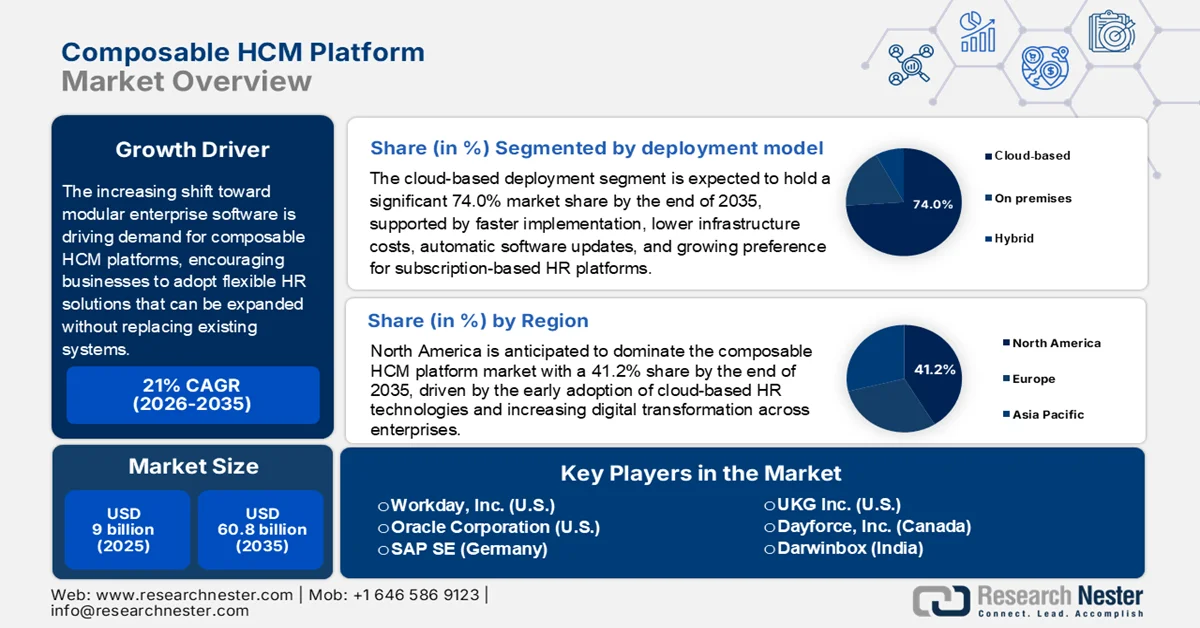
Composable HCM Platform Market size was valued at USD 9 billion in 2025 and is anticipated to reach USD 60.8 billion by the end of 2035, expanding at around 21% CAGR during the forecast period, i.e., 2026-2035. In 2026, the industry size of composable HCM platform is evaluated at USD 10.9 billion.
The composable HCM platform market is increasing steadily as organizations looking for more flexible ways to manage their work. Unlike traditional HR systems, composable platforms allow businesses to select, connect, and update individual HR functions, which include payroll, talent acquisition, workforce management, employee engagement, learning, and analytics, without replacing the entire system. This allows organizations to respond more quickly to changing business needs while making HR processes easier to manage and reduces the time and effort which is required to implement new capabilities.
Across several companies, businesses are also increasing investments in digital workplaces to improve employee productivity, which will create a better work experience. As organizations continue to modernize the way they manage their workforce, they are implementing flexible HR platforms that can support changing business priorities and employee expectations. According to the World Economic Forum, artificial intelligence, digital access, and information processing technologies are among the key factors transforming businesses globally.
Additionally, the growing need for connected HR ecosystems is creating new innovations for the market. Organizations are highly looking for platforms that can work seamlessly with payroll, finance, collaboration, and other business applications that do not need major system changes. This is encouraging more organizations to adopt composable HCM platforms during the forecast period.
Key Composable HCM Platform Market Insights Summary:
Regional Highlights:
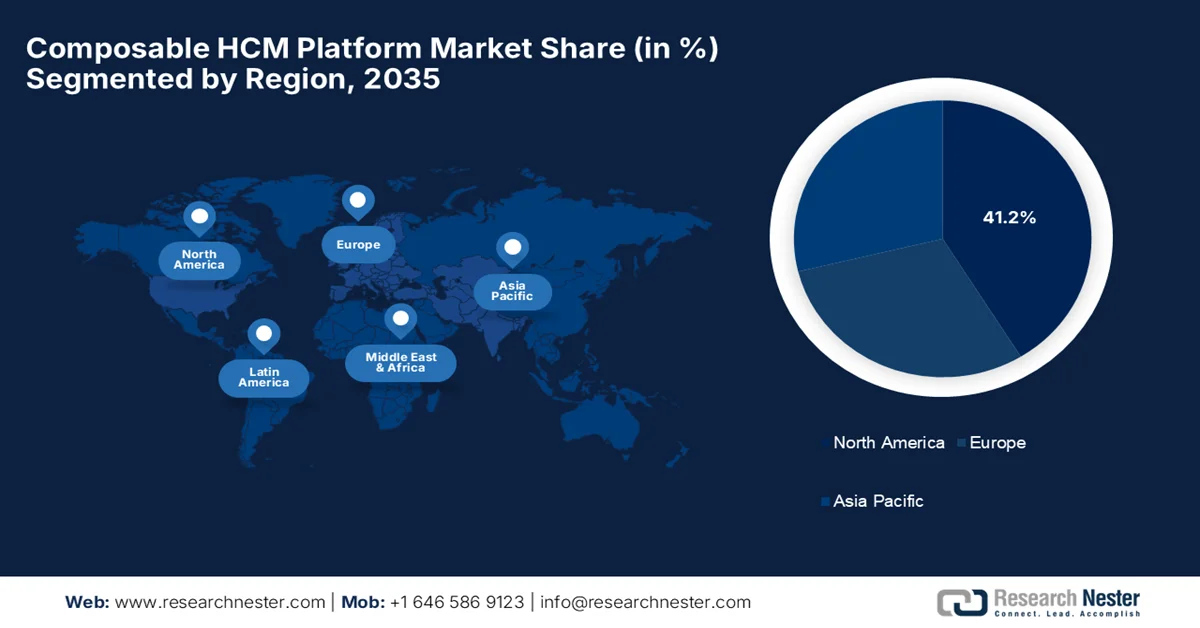
- North America is anticipated to command 41.2% of the composable hcm platform market by 2035, underpinned by robust investments in digital workplace transformation and widespread adoption of cloud-based HR technologies
- Europe is expected to witness steady growth throughout the 2026-2035 period, supported by increasing demand for adaptable HR platforms to address diverse labor regulations, languages, and workplace policies
Segment Insights:
- The cloud-based segment is projected to capture 74% of the composable hcm platform market by 2035, bolstered by increasing preference for subscription-based software over traditional on-premise systems
- The large enterprises segment is expected to secure the largest share of the market by 2035, fueled by growing digital capabilities and increasing adoption of advanced HR platforms among large organizations
Key Growth Trends:
- Rising adoption of AI across HR functions
- Growing investment in workforce upskilling
Major Challenges:
- Complex integration with existing systems
- Data security and privacy concerns
Key Players: Workday, Inc., Oracle Corporation, SAP SE, UKG Inc., Dayforce, Inc., Darwinbox.
Global Composable HCM Platform Market Forecast and Regional Outlook:
Market Size & Growth Projections:
- 2025 Market Size: USD 9 billion
- 2026 Market Size: USD 10.9 billion
- Projected Market Size: USD 60.8 billion by 2035
- Growth Forecasts: 21% CAGR (2026-2035)
Key Regional Dynamics:
- Largest Region: North America (41.2% share by 2035)
- Fastest Growing Region: Asia Pacific
- Dominating Countries: United States, Canada, Germany, United Kingdom, Japan
- Emerging Countries: India, China, Singapore, Australia, South Korea
Last updated on : 13 July, 2026
Composable HCM Platform Market - Growth Drivers and Challenges
Growth Drivers
- Rising adoption of AI across HR functions: There are organizations which are using AI to reduce HR activities, which improve workplace experience, and simplify daily work. A composable HCM platform allows new AI skills to be added without removing the system completely, which is one of the reasons for its demand among business leaders. The U.S. National Institute of Standards and Technology (NIST) has introduced the AI Risk Management Framework to guide the use of AI, supporting its large adoption across organizations.
- Growing investment in workforce upskilling: For AI in the market, organizations need to invest more in employee training and new skills. While for training, a traditional module needs an entire replacement. Using a composable HCM platform, it allows for change according to the requirements. As different leaders are paying attention to building upgraded skills, the demand for a composable HCM platform is also growing.
- Increasing regulatory compliance: As businesses are growing globally, they need to manage different guidelines that include labour laws, payroll rules, and workplace regulations. For making changes such as this, using a traditional HR system is time-consuming, whereas composable HCM platforms helps organizations to update specific functions whenever any update comes, making compliance easier. This is encouraging more businesses to adopt composable HCM platforms.
Challenges
- Complex integration with existing systems: Several organizations are already working with a mix of platforms which includes HR, payroll, finance, and enterprise software that has been in place for years. Applying a composable HCM platform into this environment can be challenging, as these all platform have to work together, while having different technologies and data formats. In some cases, businesses need additional time, technical expertise, and investment to ensure smooth connectivity across systems. These connecting challenges can slow implementation and make some organizations to think before adopting composable HCM platforms, specifically in IT sectors complex environments.
- Data security and privacy concerns: While composable HCM platform manage sensitive information or employee, that includes payroll records, personal details, and performance data, which make the platform security at a risk. Since these platforms are connected with multiple HR applications, organizations need to ensure that all employee data remains secure across all systems. These concerns about data privacy, cybersecurity risks, and compliance with data protections regulations can make businesses cautious about adopting composable HCM platforms, particularly those handling large volumes of employee data.
Composable HCM Platform Market Size and Forecast:
| Report Attribute | Details |
|---|---|
|
Base Year |
2025 |
|
Forecast Year |
2026-2035 |
|
CAGR |
21% |
|
Base Year Market Size (2025) |
USD 9 billion |
|
Forecast Year Market Size (2035) |
USD 60.8 billion |
|
Regional Scope |
|
Composable HCM Platform Market Segmentation:
Deployment Model Segment Analysis
Based on the deployment model, the cloud-based sub-segment is anticipated to account for the largest share of the composable HCM platform market, holding approximately 74% by the end of 2035. Cloud-based platforms enable businesses to launch HR applications more quickly and reduce the need for dedicated on-site IT infrastructure. To help companies access the latest features with minimal operational disruption, they allow software updates to be implemented automatically. According to the U.S. National Institute of Standards and Technology (NIST), cloud computing provides convenient, on-demand network access to shared computing resources that support efficient delivery of business applications. As more businesses prefer subscription-based software over traditional on-premise systems, the adoption of cloud-based composable HCM platforms is anticipated to continue increasing, strengthening the segment's leading position in the market.
End-user Enterprise Segment Analysis
Based on the enterprise size, the large enterprises sub-segment is anticipated to hold the largest share of the market by the end of 2035. Large organizations usually operate across multiple business locations and manage a diverse employee base, which makes the HR processes more demanding. Composable HCM platforms help these businesses to slowly introduce new HR capabilities while continuing to use their existing systems, which reduces disruption during expansion. As large enterprises continue to strengthen their digital capabilities, demand for composable HCM platforms is expected to remain strong. According to the Organization for Economic Co-operation and Development (OECD), larger firms generally have greater capacity to adopt digital technologies and invest in business innovation, supporting the adoption of advanced HR platforms.
Component Segment Analysis
For the component segment, the platform software sub-segment is expected to hold the largest share of the market by the end of 2035. Where platform software serves as the base of composable HCM by enabling businesses to build, manage, and enhance HR capabilities through a single modular environment. It allows companies to introduce new HR functions, connect third-party applications, and customize workflows without replacing the entire HR system. As organizations remain to prioritize implementation of HR technology that can help change operational requirements, demand for platform software is expected to remain strong, reinforcing its leading position in the market
Our in-depth analysis of the composable HCM platform includes the following segments:
|
Segment |
Sub-segment |
|
Deployment |
|
|
Component |
|
|
End-user Enterprise Size |
|
|
Functional Module |
|

Vishnu Nair
Head - Global Business DevelopmentCustomize this report to your requirements — connect with our consultant for personalized insights and options.
Composable HCM Platform Market - Regional Analysis
North America Market Insights
North America composable HCM platform market is anticipated to hold the largest share of 41.2% by the end of 2035. The region has adopted cloud-based HR technologies and is making robust investments in digital transformation that includes workplaces. It has some of the leading HCM software providers, while enterprises among industries are changing traditional HR systems with this platform to improve flexibility and efficiency. According to the World Economic Forum, AI, digital access, and information processing technologies are among the leading technologies that are transforming businesses and workforce strategies worldwide, supporting the adoption of modern HR platforms across the region.
The U.S. composable HCM platform market has the largest market in North America, due to its presence in major HR software providers and their early adoption of advanced workplace technologies. The country is also registering strong demand for AI-powered recruitment, workforce analytics, and employee experience solutions as organizations are paying attention on improving productivity and simplifying HR operations. In the forecast period, there are continued investments in enterprise software and digital workplace innovation, which are anticipated to support market growth.
In Canada, businesses are heavily investing in flexible HR platforms, showcasing a stable growth as organizations focus on managing meeting employment requirements across different provinces. In this country, growing implementation of digital technologies among small and medium-sized businesses, with the increasing demand for cloud- based HR solutions, is creating new opportunities for composable HCM platforms.
Europe Market Insights
Europe market is witnessing a steady growth as organizations continue to improve their HR operations and workforce management. In this region, companies are managing employees under different guidelines that are labor law, languages, and workplace policies, which creates a demand for HR platforms that can be easily implemented to fulfil local needs. According to the European Commission, the Digital Europe Programme supports the wider adoption of digital technologies across businesses and public administrations, creating a favorable environment for advanced HR platforms.
Germany is experiencing steady demand for composable HCM platforms as businesses face increasing pressure to attract and retain skilled employees across manufacturing, engineering, and industrial sectors. There are companies that are paying attention to managing talent, supporting internal mobility, and improving hiring processes to fulfil the ongoing labor shortage. This is helping businesses to implement flexible HR platforms that can be enhanced as the workforce changes.
The UK composable HCM platform market is seeing stable growth as businesses remain to enhance and rearrange their workforce due to the change in market conditions. Organizations are looking for HR solutions which can easily support new business units, changing team structures, and evolving workforce needs without replacing existing systems. This flexibility is helping greater adoption of composable HCM platforms across the country's technology, financial, and professional service sectors.
APAC Market Insights:
Asia Pacific market is anticipated to register significant growth, due to the expansion of businesses across the region and modernize their operations. In this region there are a large number of growing enterprises that are creating high demand for HR platforms that can help in business expansion without adding any complexity. As companies are growing across different industries, flexible CM solutions are becoming an important part of managing people and daily HR activities. According to the Asian Development Bank (ADB), digital technologies are playing an important role in improving productivity and supporting economic growth across Asia and the Pacific.
Japan composable HCM platform market is registering growing implementation as there are aging workforce and a persistent labor shortage. With some working-age employees available, many companies are placing greater emphasis on retaining experienced employees and making better use of existing talent. This is one of the reasons for companies to implement flexible HR platforms that can help employee development, internal mobility, and long-term workforce planning without replacing their existing HR systems.
As businesses remain to grow managing employees across different offices and business units becomes more complex, which creates demand for HR platforms that can support expansion without requiring major system changes. China's composable HCM platform market is experiencing rising demand. The increasing number of large enterprises and fast-growing private companies is further contributing to the adoption of flexible HCM solutions across the country.
Key Composable HCM Platform Market Players:
- Workday, Inc. (U.S.)
- Oracle Corporation (U.S.)
- SAP SE (Germany)
- UKG Inc. (U.S.)
- Dayforce, Inc. (Canada)
- Darwinbox (India)
- Company Overview
- Business Strategy
- Key Product Offerings
- Financial Performance
- Key Performance Indicators
- Risk Analysis
- Recent Development
- Regional Presence
- SWOT Analysis
- For composable HCM platforms, Workday, Inc. is remembered for its cloud-native HR platform, which was built around workforce planning and employee experience. The company remain to enhance AI-driven capabilities that help businesses simplify HR decision-making and improve employee engagement.
- Oracle Corporation offers enterprise HCM as part of its broader business software ecosystem. The company enables customers to manage HR, finance, and operational processes within a connected cloud environment, which reduces the need for multiple standalone applications.
- SAP SE provides digital HR solutions through its SuccessFactors portfolio for organizations that are handling large and diverse teams. The company is expanding employee-centric capabilities that support hiring, performance management, learning, and career development.
- UKG Inc. specializes in workforce management solutions that combine HR, payroll, and time management on a single platform. It is used by businesses to manage employee schedules, attendance, payroll, and daily work activities across different industries.
- Dayforce, Inc., the company pay attention to helping businesses manage HR activities through a single system while giving HR teams easy access to workforce information.
- Darwinbox develops cloud-based HCM solutions for businesses of different sizes. The company is increasing its presence by providing HR software that helps organizations manage recruitment, employee records, performance, and day-to-day HR activities more efficiently.
Here is a list of key players operating in the global market:
The market is highly competitive, with the leading providers paying attention on increasing modular HR capabilities that can implement to changing business requirements. Market participants are continuously enhancing their platforms by introducing AI-enabled features, improving user experience, and strengthening cloud-based offerings. To reach new customers partnerships, acquisitions, and continuous platform upgrades are helping providers broaden their solutions portfolio. Companies are investing in product innovation to simplify HR processes, workforce planning, payroll, talent management, and employee engagement. As organizations highly seek flexible and scalable HR technologies, competition is expected to remain strong, encouraging further innovation and continuous enhancement of composable HCM platforms.
Corporate Landscape of the Market:
Recent Developments
- In June 2026, Workday launched Agent Passport, a solution to test, verify, and continuously monitor AI agents across enterprise environments, strengthening AI governance for HR and finance.
- In April 2025, SAP SuccessFactors 1H 2025 Release introduced 250+ new features and AI-enabled innovations for recruiting, learning, payroll, and employee experience.
- In October 2024, Dayforce was recognized as a Leader in the 2024 Gartner® Magic Quadrant™ for Cloud HCM Suites for 1,000+ Employee Enterprises for the fifth consecutive year, highlighting the strength of its AI-enabled HCM platform and workforce management capabilities.
- Report ID: 8667
- Published Date: Jul 13, 2026
- Report Format: PDF, PPT
- Explore a preview of key market trends and insights
- Review sample data tables and segment breakdowns
- Experience the quality of our visual data representations
- Evaluate our report structure and research methodology
- Get a glimpse of competitive landscape analysis
- Understand how regional forecasts are presented
- Assess the depth of company profiling and benchmarking
- Preview how actionable insights can support your strategy
Explore real data and analysis
Frequently Asked Questions (FAQ)
About this Report
Connect with our Expert




Copyright @ 2026 Research Nester. All Rights Reserved.
