Commercial Aircraft MRO Market Outlook:
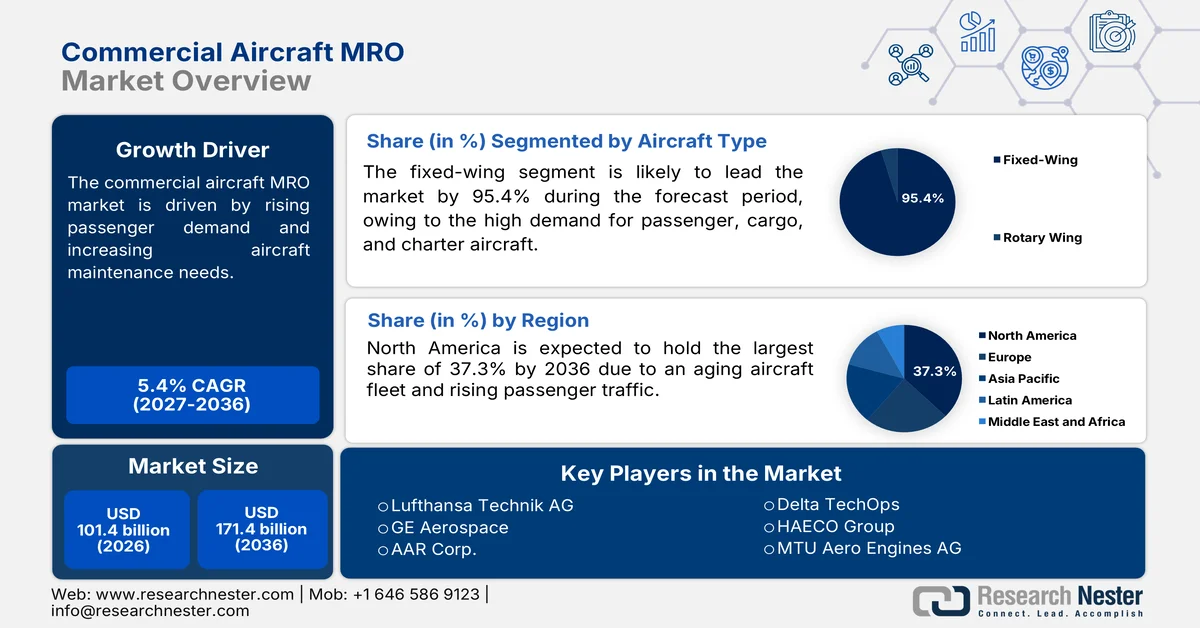
Commercial Aircraft MRO Market size was valued at USD 101.4 billion in 2026 and is expected to cross USD 171.4 billion by the end of 2036, expanding at more than 5.4% CAGR during the forecast period, i.e., 2027-2036. In 2027, the industry size of commercial aircraft MRO is estimated at USD 106.8 billion.
The worldwide commercial aircraft MRO market is navigating a structural transition through factors, including operational reality, the demand for unprecedented passenger demand, and aircraft maintenance. According to a data report published by the World Bank Organization in 2024, airlines, especially in North America, is continuously leading in profitability and significantly generating roughly USD 14.8 billion in net profit, further supported by increased load factors, strong demand, and robust yields. Likewise, carriers in Europe readily earned USD 8.6 billion in combating capacity issues and supply-based constraints, while Middle East airlines indicated USD 3.1 billion in profit by maintaining an upward trajectory. Besides, Australia, Japan, and China in the Asia Pacific combinedly earned USD 0.6 billion, thereby making it suitable for bolstering the market’s upliftment.
Furthermore, the rise in private equity consolidation of component repair shops, along with bifurcated competition between independent providers and OEMs, and the digital twin adoption for maintenance simulation are certain trends that are responsible for boosting the commercial aircraft MRO market globally. As stated in an article published by Decision Analytics Journal in March 2023, 75% of Internet of Things (IoT)-based organizations utilize digital twin technology. Additionally, more than 40% of large-scale firms globally are poised to utilize digital twin technology in their projects for increasing revenue by the end of 2027. Based on these applications, the digital twin industry size was estimated to be worth USD 8 billion, which is further projected to grow by nearly 25% by 2032, while the industry continued to grow by almost USD 32 billion in 2026, thus making it suitable for boosting the market.
Key Commercial Aircraft MRO Market Insights Summary:
Regional Highlights:
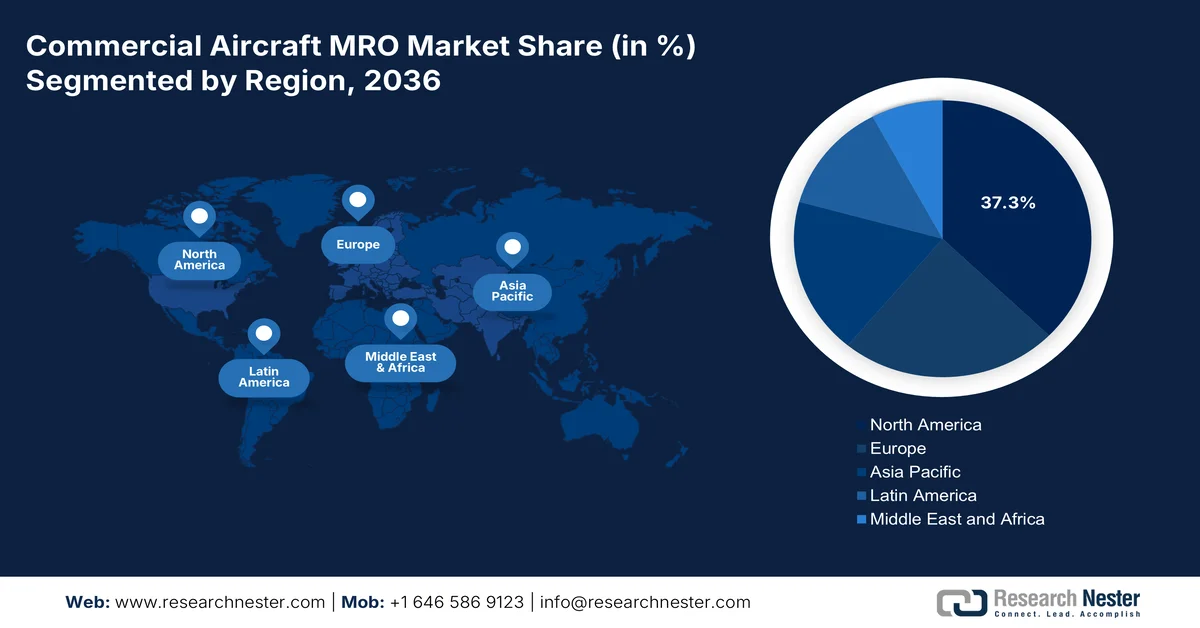
- North America is anticipated to command a 37.3% share of the commercial aircraft MRO market by 2036, with its strong position reinforced by an aging aircraft population, robust maintenance cycles, revenue departures, and commercial fleet expansion
- Asia Pacific is projected to register the fastest growth during 2027-2036, owing to rising maintenance requirements, increased engine servicing, expanding aircraft fleets, and the availability of licensed aircraft technicians
Segment Insights:
- The fixed-wing segment is projected to account for a 95.4% share of the commercial aircraft MRO market by 2036, reflecting its extensive role across passenger, cargo, and charter operations and varied aircraft maintenance requirements
- The commercial passenger airlines sub-segment is expected to capture a 66.5% share during 2027-2036, supported by rising passenger demand, expanding airline capacity, stronger air connectivity, and growing international travel activity
Key Growth Trends:
- Increase in aging fleet paradox
- Intensified aircraft utilization
Major Challenges:
- Severe shortage of certified technicians
- Supply chain certification bottlenecks and long lead times
Key Players: AAR Corp., Delta TechOps, HAECO Group, SIA Engineering Company Limited.
Global Commercial Aircraft MRO Market Forecast and Regional Outlook:
Market Size & Growth Projections:
- 2026 Market Size: USD 101.4 billion
- 2027 Market Size: USD 106.8 billion
- Projected Market Size: USD 171.4 billion by 2036
- Growth Forecasts: 5.4% CAGR (2027-2036)
Key Regional Dynamics:
- Largest Region: North America (37.3% Share by 2036)
- Fastest Growing Region: Asia Pacific
- Dominating Countries: United States, China, India, Japan, Germany
- Emerging Countries: India, China, Indonesia, Vietnam, Saudi Arabia
Last updated on : 25 September, 2026
Commercial Aircraft MRO Market - Growth Drivers and Challenges
Growth Drivers
- Increase in aging fleet paradox: The manufacturing capacity acts as the most suitable growth driver for the commercial aircraft MRO market. According to an article published by the IATA Organization in August 2025, the global commercial fleet consists of 35,550 aircraft, which further includes 30,300 active units as well as 5,250 held in storage in June 2025. These particular aircraft represent 152 master series that are produced by 26 aircraft manufacturers globally. Besides, the global fleet is composed of narrowbody aircraft, which represent almost 60% of the overall fleet. Additionally, this comprises 2 aircraft segments, including the 737 and the A-320, both of which account for more than 90% of the segment. Moreover, the composition of the worldwide commercial active fleet is different for different manufacturers, thus indicating a huge growth opportunity for the market.
Global Commercial Active Fleet Composition by Manufacturer, 2025
|
Manufacturer Name |
Number of Fleet |
Composition % |
|
Boeing |
12,234 |
40 |
|
Airbus |
11,804 |
39 |
|
Embraer |
1,977 |
7 |
|
ATR |
910 |
3 |
|
Bombardier |
824 |
3 |
|
Other |
2,527 |
8 |
Source: IATA Organization
- Intensified aircraft utilization: There is a continuous increase in aircraft that are flying more than usual historical norms, which is also driving the market’s growth. As per the August 2025 IATA Organization data report, the global fleet industry expects approximately 16,004 new aircraft to enter service by 2026. However, the cumulative deliveries are poised to be limited to 10,720 aircraft and thereby shortened by roughly 5,284 units, which creates a substantial supply barrier. This particular barrier has restricted aircraft availability, but readily supports yields across many regions. Therefore, with the continuous gap in aircraft deliveries and yield support, the market has the ability to increase growth.
Real Aircraft Deliveries, 2016-2026
|
Year |
Deliveries |
|
2016 |
1,710 |
|
2017 |
1,729 |
|
2018 |
1,813 |
|
2019 |
1,407 |
|
2020 |
806 |
|
2021 |
1,040 |
|
2022 |
1,238 |
|
2023 |
1,377 |
|
2024 |
1,266 |
|
2025 |
1,580 |
|
2026 |
2,006 |
Source: IATA Organization
Challenges
- Severe shortage of certified technicians: The commercial aircraft MRO market's most fundamental constraint is a structural shortage of licensed aircraft maintenance engineers. A large wave of experienced technicians is reaching retirement age, while younger workers show declining interest in entering the field, creating a dangerous gap in knowledge transfer. Besides, training a qualified technician takes years and cannot be accelerated through short-term programs. This talent gap directly limits how much work MRO providers can actually accept. Even when market demand is strong, it cannot be converted into revenue without enough certified hands to perform the work safely and compliantly.
- Supply chain certification bottlenecks and long lead times: The core problem in parts supply is not insufficient production volume but the scarcity of qualified and certifiable components, which are limiting the market. Besides, aviation-grade parts require strict source approval, certified mill verification, and complete traceability documentation, and re-certifying alternative sources often takes months or even years. Moreover, lead times for engine components, specialty forgings, and fasteners continue to stretch. A shortage of even a single certified fastener can halt an entire assembly line. This certification rigidity leaves the supply chain with almost no flexibility to respond quickly when demand surges or schedules shift unexpectedly.
Commercial Aircraft MRO Market Size and Forecast:
| Report Attribute | Details |
|---|---|
|
Base Year |
2026 |
|
Forecast Year |
2027-2036 |
|
CAGR |
5.4% |
|
Base Year Market Size (2026) |
USD 101.4 billion |
|
Forecast Year Market Size (2036) |
USD 171.4 billion |
|
Regional Scope |
|
Commercial Aircraft MRO Market Segmentation:
Aircraft Type Segment Analysis
The fixed-wing segment is anticipated to register the highest share of 95.4% in the commercial aircraft MRO market by the end of 2036. The segment’s upliftment is primarily driven by forming the backbone of passenger, cargo, and charter operations worldwide. This segment splits into narrowbody, widebody, and regional transport aircraft, each with distinct maintenance profiles. Besides, narrowbodies generate high-frequency line maintenance and engine shop visits due to intense short-haul utilization. Moreover, widebodies demand complex heavy checks, cabin reconfigurations, and sophisticated component overhauls given their size and systems. Based on these, regional transport aircraft, often older and cost-sensitive, rely on repair-over-replace strategies and independent providers.
End user Segment Analysis
The commercial passenger airlines sub-segment, which is part of the end user segment, is predicted to account for the second-highest share of 66.5% in the market during the forecast period. The sub-segment’s growth is effectively fueled by effectively driving worldwide economic growth, supporting suitable employment opportunities, and readily connecting distant communities. According to an article published by the IATA Organization in January 2026, there was a rise in passenger revenue, which accounted for 5.7% in comparison to November 2024. In addition, the overall passenger capacity, which is measured in available seat kilometers, also increased by 5.4% year-on-year (YoY), while the load factor constituted 83.7%. Besides, the international demand also rose by 7.7%, with the capacity increasing by 7.1% YoY, with 84.05% as the load factor, thus positively supporting the sub-segment’s growth.
Service-Provider Type Segment Analysis
By the end of the stipulated timeline, the independent third-party MROs sub-segment under the service-provider type segment is expected to grab the third-highest share of 49.2% in the market. The sub-segment’s development is highly propelled by competing primarily on cost, turnaround speed, and flexibility. It thrives in component repair and airframe heavy checks where OEM intellectual property restrictions are weaker, and price competition is intense. Besides, airlines and lessors turn to independents for redelivery checks, legacy fleet support, and workscopes that OEM-affiliated providers decline or overprice. However, independents face growing pressure from OEMs restricting repair data access and from consolidation driven by private equity. Their survival depends on specialized capabilities, digital efficiency, and securing parts traceability that satisfies regulators and leasing companies alike.
Our in-depth analysis of the market includes the following segments:
|
Segment |
Subsegments |
|
Aircraft Type |
|
|
End user |
|
|
Service-Provider |
|
|
MRO Type |
|

Vishnu Nair
Head - Global Business DevelopmentCustomize this report to your requirements — connect with our consultant for personalized insights and options.
Commercial Aircraft MRO Market - Regional Analysis
North America Market Insights
North America commercial aircraft MRO market is anticipated to garner the largest share of 37.3% by the end of 2036. The market’s upliftment in the region is primarily fueled by the aging aircraft population, strong maintenance cycles, revenue departures, and the strengthening of the commercial fleet. According to a data report published by the 2025 Infrastructure Report Card, there was an increase in domestic air passenger enplanements, especially in the U.S., from 629.5 million to 811.4 million. Additionally, air travel also improved in the country, particularly during the pandemic, to 819.5 million as of 2023 and is further continuously expanding. Besides, the passenger traffic is also expected to grow from 58% to 1.2 billion yearly passengers by the end of 2040. In this regard, based on the 2021 Infrastructure Investment and Jobs Act (IIJA), there has been the provision of USD 25 billion for more than 5 years for enhancing passenger experience, thus positively impacting the market in the region.
The commercial aircraft MRO market in the U.S. is growing significantly, owing to the rebound in cargo and passenger flight hours, an expansion in OEM long-lasting service agreements, engine shop visit concentration from the turbofan installed base, along with an increase in the aging narrowbody fleet. As stated in an article published by the Federal Aviation Administration, in 2026, the carrier system passenger growth in the country is poised to account for 2.4% in 2026. Besides, the real gross domestic product (GDP) growth effectively averages 1.7% every year, which further demonstrates an average of 1.8% in the first decade and 1.6% in the second decade by the end of 2046. Moreover, in terms of oil price, the payers’ pricing of oil in the nation amounted to USD 69 per barrel as of 2025, which is projected to reduce to USD 57 per barrel in 2026, thus positively fueling the market’s growth.
The expansion in regional airport MRO infrastructure, an extension in fleet life due to OEM delivery delays, generous funding for aerospace regional recovery initiative workforce, along with government-specific defense MRO capacity investment are certain factors that are responsible for boosting the commercial aircraft MRO market in Canada. As per an article published by the Government of Canada in February 2025, the Minister for PrairiesCan offered the newest federal funding of USD 1.3 million for increasing accessibility to ensure pilot training across 2 Saskatchewan cities, and also upscale aerospace manufacturing in the urban center. In addition, such investments also assist in addressing labor and economic demands, particularly in aviation, enable innovative specialized aerospace manufacturing, and develop prairie prosperity with suitable employment opportunities, thus making it suitable for boosting market growth.
Investment Opportunity for Aerospace Manufacturing in Canada, 2025
|
Organization |
Funding Amount Received |
Purpose |
|
The Regina Flying Club |
USD 250,000 |
Expansion of commercial flight training program for upgrading meeting areas, renovating classrooms, and training aircraft |
|
Saskatchewan Polytechnic (Sask Polytech) |
USD 450,000 |
To increase the efficiency of its commercial pilot program and attract students for enabling increased flight hours |
|
Miccar Aerial Ltd. |
USD 600,000 |
To upscale business operations in Yorkton and assist in the launch of a new replacement aircraft commuter seat in the U.S. and Canada |
Source: Government of Canada
APAC Market Insights
The Asia Pacific market is expected to emerge as the fastest-growing region during the forecast period. The market’s development is highly attributed to maintenance intervals, an increase in engine services, an expansion in fleet, and suitable licenses for aircraft technicians. Besides, in terms of organizational contributions, in February 2025, Boeing forecasted that South Asia and India’s commercial airplane fleet is poised to grow almost 4-fold in the upcoming 20 years, which is built on sustained fleet growth. This continuous growth is also predicted to be driven by huge demand and an upsurge in regional air traffic, which is further projected to grow by over 7% yearly by the end of 2043. This particular growth is effectively fueled by optimized policies and connectivity, along with sustained economic growth that readily supported air travel liberalization, thereby making it suitable for expanding the market’s development in the region.
The commercial aircraft MRO market in China is gaining increased traction, owing to sustained demand, government approaches for expanding MRO capabilities, and an expansion in aircraft infrastructure. As stated in an article published by the ITA in September 2025, the Civil Aviation Administration of China (CAAC) proclaimed record passenger traffic of 730 million, along with cargo volume of 8.9 million metric tons as of 2024. This eventually indicated a YoY increase of 17.9% as well as 22.1%, respectively, due to the country’s massive upsurge in cross-border e-commerce, which comprises sales of small packages and consumers, particularly in the U.S. and Europe. Additionally, there was a rise in passenger traffic by 10.6% and 19.3% for cargo, while there was continuous recovery of international passenger flight volumes as of 2024, thereby ensuring a huge growth opportunity for the market.
The aspects of government strategies and fleet extension for developing the national MRO ecosystem, along with generous budget provision for raw materials and components for aircraft manufacturing, and growth in the aviation sector are certain trends that are boosting the commercial aircraft MRO market in India. Based on the April 2026 ITA data report, the country is predicted to comprise over 500 million international and domestic air travelers by the end of 2030, and further constitutes the potential to emerge as a notable aviation sector by 2047 globally. Besides, the overall number of air passengers, both international and domestic, increased by nearly 16% as of 2024. Moreover, as per the Directorate General of Civil Aviation, more than 79 million passengers were carried by national airlines between January and June 2024, which registered a yearly growth of more than 4%, thus contributing to the market’s growth and development.
Europe Market Insights
Europe market is predicted to account for a considerable share by the end of the stipulated timeline. The market’s growth in the region is effectively driven by the presence of the busiest airspace and aerospace industrial base, as well as the existence of regulatory demands and a surge in air passengers. According to an article published by the European Commission in July 2026, nearly 1.1 billion air passengers were effectively carried in the region as of 2025, which indicated a 4.8% increase in comparison to 2024. In addition, there were recovery signs in commercial flights between 2204 and 2025, wherein the recovery continued in the first 9 months of 2024 from 13.5% to 4.7% as of June 2024. This is followed by recovery from 9.1% to within 5% in January 2025, thereby demonstrating an optimistic outlook for the market’s exposure in the region.
The commercial aircraft MRO market in Germany is gaining increased exposure, owing to organizational contributions, the location of aircraft centers, suitable government support, and an increase in the demand for substantial maintenance. As stated in a data report published by the ITA in June 2026, mandatory sustainable aviation fuel (SAF) quotas were applied in the country from 2025 onwards, effectively constituting a 2% level. Additionally, this is further poised to increase to 6% each year by the end of 2030, which is followed by 20% by 2035, 42% by 2045, and finally 70% by 2050. Therefore, this continuous increase in the need despite increased costs in comparison to fossil fuel-specific kerosene. Besides, the aerospace sector in the nation significantly employs an estimated 115,000 people, thus demonstrating a suitable growing opportunity for the market.
The strong government support for aerospace advancements, suitable tax incentives that foster generous investments in sustainable maintenance practices and digitalization, the air travel center, and an escalation in energy transition are a few trends that are responsible for enhancing the market in France. As per a data report published by the ITA in May 2026, renewable energy readily accounts for almost 22.2% of the nation’s gross final energy consumption in 2023, which indicates a surge from 20.5% as of 2022. Besides, in terms of the national Multiannual Energy Program (PPE), a standard plan was outlined to diminish the nuclear power share in electricity generation from more than 70% to 50% by the end of 2035, with renewables constituting a huge role, thereby significantly contributing to the market’s growth and expansion.
Key Commercial Aircraft MRO Market Players:
- Lufthansa Technik AG (Germany)
- GE Aerospace (U.S.)
- Air France Industries KLM Engineering & Maintenance (France/Netherlands)
- MTU Aero Engines AG (Germany)
- ST Engineering Aerospace Ltd. (Singapore)
- AAR Corp. (U.S.)
- Delta TechOps (U.S.)
- HAECO Group (Hong Kong)
- SIA Engineering Company Limited (Singapore)
- SR Technics Switzerland Ltd. (Switzerland)
- Evergreen Aviation Technologies Corp. (Taiwan)
- Company Overview
- Business Strategy
- Key Product Offerings
- Financial Performance
- Key Performance Indicators
- Risk Analysis
- Recent Development
- Regional Presence
- Lufthansa Technik AG is one of the world's leading independent MRO providers, offering comprehensive airframe, engine, and component services to commercial airlines globally. Its competitive strength lies in deep OEM partnerships, digital maintenance platforms, and a broad global network of maintenance facilities.
- GE Aerospace dominates the engine MRO segment through its OEM-authorized repair capabilities and proprietary diagnostic technologies for its own engine families. Its aftermarket services are deeply integrated with long-term service agreements that lock airlines into OEM-backed maintenance solutions.
- Air France Industries KLM E&M operates as a major airline-affiliated MRO provider with strong capabilities across engine overhaul, airframe maintenance, and component repair. It leverages its dual airline parentage to serve both internal fleet needs and third-party commercial customers worldwide.
- MTU Aero Engines AG is a specialized engine MRO provider with deep expertise in commercial turbofan overhaul and OEM-authorized workscopes. It holds a strong position in the engine segment, particularly for narrowbody and widebody powerplants.
- ST Engineering Aerospace Ltd. is a major independent MRO provider with significant presence across airframe heavy maintenance, component repair, and engine services. It is particularly strong in the Asia Pacific region, serving airlines with cost-competitive maintenance solutions.
Here is a list of key players operating in the global market:
The global commercial aircraft MRO market is moderately consolidated, with the top five providers, such as Lufthansa Technik, GE Aerospace, AFI KLM E&M, MTU Maintenance, and Rolls-Royce, collectively holding over the majority of global market share. Competition is segmented by service type, wherein engine overhaul is dominated by OEM-affiliated providers, including GE and Rolls-Royce, while airframe heavy maintenance remains more fragmented, with independent providers such as AAR Corp. and ST Engineering competing on cost and turnaround speed. Besides, in September 2025, ST Engineering’s Commercial Aerospace business and SF Airlines commenced the latest MRO facility in China, which was developed through their joint venture. Therefore, based on such collaborations, there is a huge growth opportunity for the commercial aircraft MRO industry globally.
Corporate Landscape of the Market:
Recent Developments
- In April 2025, Delta TechOps readily signed a contract with UPS for 10 years to provide suitable services to Whitney PW2037 engines on UPS’ entire 757 fleet, along with engine maintenance services.
- In December 2024, Air France-KLM Group and Saudia effectively signed a tactical memorandum of understanding, which eventually laid the foundation for an expanded cooperation, particularly in the passenger transport aircraft maintenance field.
- In March 2024, AAR CORP. successfully acquired Triumph Group’s Product Support business, which increasingly focuses on specialized MRO capabilities for critical aircraft components in defense and commercial sectors.
- Report ID: 8766
- Published Date: Sep 25, 2026
- Report Format: PDF, PPT
- Explore a preview of key market trends and insights
- Review sample data tables and segment breakdowns
- Experience the quality of our visual data representations
- Evaluate our report structure and research methodology
- Get a glimpse of competitive landscape analysis
- Understand how regional forecasts are presented
- Assess the depth of company profiling and benchmarking
- Preview how actionable insights can support your strategy
Explore real data and analysis
Frequently Asked Questions (FAQ)
About this Report
Connect with our Expert


Report, 2027-2036



Copyright @ 2026 Research Nester. All Rights Reserved.
