Coffee Packaging Market Outlook:
Coffee Packaging Market size was valued at USD 913.5 million in 2025 and is projected to reach USD 1.50 billion by the end of 2035, rising at a CAGR of 5.1% during the forecast period, i.e., 2026-2035. In 2026, the industry size of coffee packaging is evaluated at USD 960.1 million.
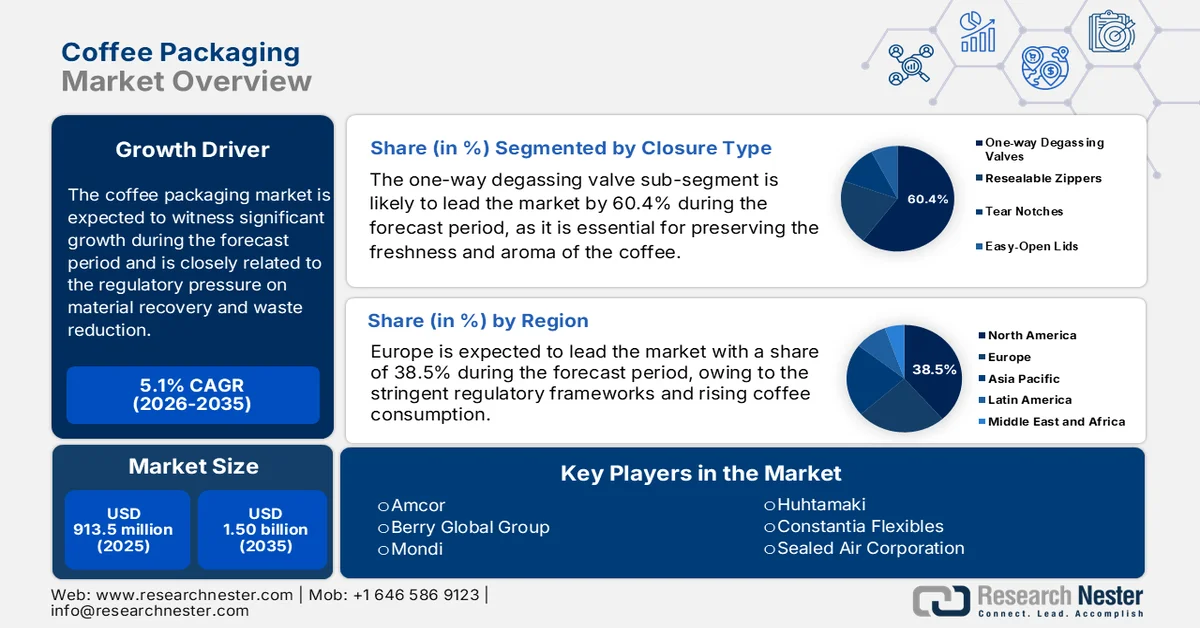
The global coffee packaging market is closely aligned with the regulatory pressure on material recovery, waste reduction, and food safety compliance across the major consuming economies. The main aim of the market is to retain the aroma, quality, and freshness of the coffee beans from production to consumption. Packaging and labelling of food play a vital role in gaining the consumer's attention and shaping their expectations. Moreover, as per the PEW December 2025 data, in Europe, consumers generate 40% of the plastic waste, and producers account for the remaining. Extended producer responsibility (EPR) and deposit return scheme (DRS) frameworks are influencing the packaging procurement decisions across the coffee value chain. Further, the projected 52% rise in global primary plastic production is slowing the expansion in waste management capacity, intensifying regulatory cost exposure, and accelerating the shift toward recyclable and lower-impact material formats in coffee packaging portfolios.
Besides, the sustainability targets, circular economy policies are materially shaping the supplier investment decisions. According to the NLM study in September 2022, nearly 70% of individuals are looking for sustainable packaging for shopping. Moreover, consumers pay 10% additionally for brands providing sustainable materials for packaging. Moreover, during the pandemic, the use of paper packaging increased by 3.1% in Europe. Further, the rising customer awareness surges a demand for sustainable packaging. Additionally, the recycling rates for paper containers and packaging are higher when compared with plastic. The compliance with migration limits, labeling mandates, and recyclability standards across North America and Europe continues to drive capital allocation toward material redesign, traceability systems, and waste recovery partnerships across the coffee value chain.
Key Coffee Packaging Market Insights Summary:
Regional Highlights:
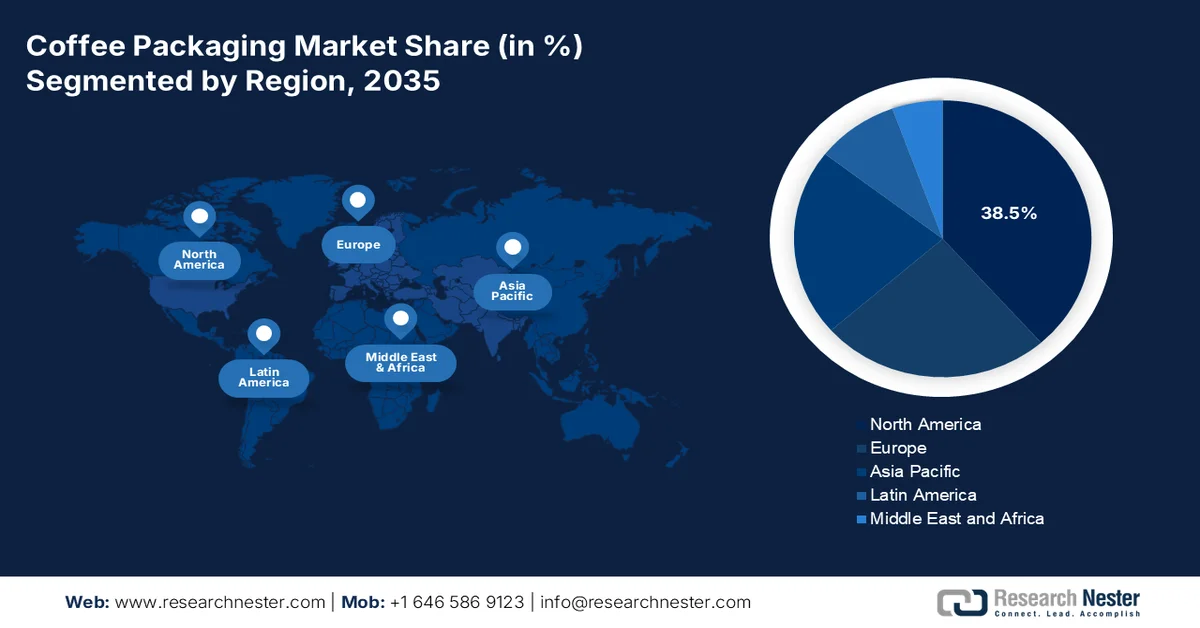
- Europe is projected to secure a 38.5% revenue share by 2035 in the coffee packaging market, impelled by stringent EU packaging regulations, high coffee consumption, and accelerating sustainability mandates
- Asia Pacific is anticipated to register a CAGR of 6.1% during 2026–2035, fueled by expanding population, westernized beverage habits, and strengthening localized manufacturing capabilities
Segment Insights:
- The one-way degassing valve segment in the coffee packaging market is projected to command a 60.4% share by 2035, propelled by the increasing emphasis on preserving coffee freshness, extending shelf life, and reducing food waste
- Bags and pouches within the packaging type segment are anticipated to dominate by 2035, driven by their consumer convenience, cost-efficient logistics, and sustainability advantages
Key Growth Trends:
- Rising coffee consumption
- Demand for sustainable packaging material
Major Challenges:
- Material innovation tradeoffs
- Recycling infrastructure gaps
Key Players: Amcor, Berry Global Group, Mondi, Huhtamaki, Constantia Flexibles, Sealed Air Corporation, Sonoco Products Company, ProAmpac, Winpak Ltd., Novolex, Goglio S.p.A., Pacific Bag, Inc., Bemis Company, Inc. (now part of Amcor), Paharpur 3P, Uflex Ltd., DS Smith, Clondalkin Group, FLAIR Flexible Packaging Corporation, Toyo Seikan Co., Ltd., Dai Nippon Printing Co., Ltd.
Global Coffee Packaging Market Forecast and Regional Outlook:
Market Size & Growth Projections:
- 2025 Market Size: USD 913.5 million
- 2026 Market Size: USD 960.1 million
- Projected Market Size: USD 1.50 billion by 2035
- Growth Forecasts: 5.1% CAGR (2026-2035)
Key Regional Dynamics:
- Largest Region: Europe (38.5% Share by 2035)
- Fastest Growing Region: Asia Pacific
- Dominating Countries: - United States, Germany, China, Japan, France
- Emerging Countries: - India, Brazil, South Korea, Vietnam, Indonesia
Last updated on : 23 February, 2026
Coffee Packaging Market - Growth Drivers and Challenges
Growth Drivers
- Rising coffee consumption: Coffee consumption is one of the major growth drivers in the coffee packaging market. According to the Coffee Board April 2024 report, the consumption reaching 91,000 tonnes green bean equivalent (GBE) in 2023 reflects a sustained growth in both at-home and out-of-home channels. Moreover, the increased household usage of instant coffee drives demand for flexible sachets, laminated pouches, and rigid jars, while expanding cafe consumption supports bulk packaging, valve-integrated bags, and foodservice supply formats. Additionally, the growth in cafe culture increases the requirements for portion-controlled, branded, and transport-stable packaging solutions. This upward consumption trajectory strengthens long-term volume visibility for packaging converters and material suppliers serving both consumer and institutional coffee segments.
- Demand for sustainable packaging material: Aluminum-based barrier advancements are strengthening demand in the coffee packaging market by enabling extended shelf life and improved product stability. According to the NLM November 2025 study, the traditional multilayer laminates using 7–9 µm aluminum foil provide near-complete barriers against oxygen, moisture, and light, supporting aroma retention in roasted and ground coffee. However, metallized films use significantly less aluminum, applying coatings only several tens of nanometers thick, improving material efficiency while maintaining strong barrier performance. These mono-material-compatible solutions support recyclability objectives while maintaining functional performance, making them increasingly attractive for premium and export-oriented coffee packaging applications.
- Food safety modernization: Government food safety regulations drive the packaging upgrades in the coffee packaging market. The U.S. FDA's Food Safety Modernization Act imposes preventive control requirements that extend to packaging suppliers as critical food contact material providers. Moreover, the FDA guidance requires that packaging materials not become a vehicle for contamination, necessitating validated sanitation procedures and material traceability. This drives coffee roasters to source from audited, compliant packaging manufacturers rather than uncertified suppliers. As a result, packaging converters are increasing investment in quality assurance systems, third-party certifications, and documented compliance protocols to secure long-term supply agreements with regulated coffee brands and exporters.
Challenges
- Material innovation tradeoffs: Even as alternative materials improve, plastic remains the performance benchmark. One thing that plastic has done is to improve how it performs in packaging. These are difficult materials to get out of. Manufacturers are developing sustainable alternatives and face difficulty in the coffee packaging market trade as they lack barrier properties, paper-based solutions, and recyclable mono materials that require production line reengineering.
- Recycling infrastructure gaps: Creating recyclable packaging does not guarantee it actually gets recycled. Even if manufacturers develop packages that meet the recyclability targets, the system has to adapt. Many market manufacturers fail without an industrial composting infrastructure, which is a hidden compliance risk. New entrants must consider not only materials but also waste management.
Coffee Packaging Market Size and Forecast:
| Report Attribute | Details |
|---|---|
|
Base Year |
2025 |
|
Forecast Period |
2026-2035 |
|
CAGR |
5.1% |
|
Base Year Market Size (2025) |
USD 913.5 million |
|
Forecast Year Market Size (2035) |
USD 1.50 billion |
|
Regional Scope |
|
Coffee Packaging Market Segmentation:
Closure Type Segment Analysis
The one-way degassing valve is leading and is poised to hold the share value of 60.4% by 2035 in the coffee packaging market. The closure type segment is essential for preserving the freshness and aroma of freshly roasted coffee. These valves allow carbon dioxide to escape from the bag post roasting without permitting oxygen to enter, which prevents staleness and package bursting. Their utility is directly linked to food waste reduction by maintaining optimal product quality for long periods. Moreover, they ensure less coffee is discarded by consumers. According to the U.S. EPA August 2025 data, one-third of the food produced by the human are wasted. This data indicates the importance of advanced degassing closures in extending the shelf life, stabilizing product quality, and supporting waste reduction objectives in the food supply chain.
Packaging Type Segment Analysis
Within the packaging type, the bags and pouches are dominating the coffee packaging market. Their dominance is driven by the unique combination of consumer convenience, brand marketing potential, and sustainability advantages. The stand-up pouches utilize less material than rigid containers, lowering the transportation costs and carbon footprints, while their flexible structure allows for high-quality rotogravure printing that enhances the shelf appeal. Moreover, they are also easily integrated with the leading closure features, such as the resealable zippers and one-way degassing valves. Their lightweight format also improves pallet density and storage efficiency, enabling cost-effective bulk distribution for roasters and retail supply chains. On the other hand, the compatibility with mono-material laminates supports recyclability improvements and aligns flexible coffee packaging formats with emerging extended producer responsibility frameworks.
Production Technology Segment Analysis
Barrier coating technology is propelling the production technology segment in the coffee packaging market by 2035. This technology involves applying a thin, specialized coating to flexible films or paper to block oxygen, moisture, and light that reduces the freshness of the coffee. According to the NLM study in September 2022, biodegradable polymers such as polyhydroxy alkanoates, starch, polylactic acid, chitosan, and polysaccharides are used as barrier coatings on packaging applications. The study has also depicted that the coating weight of 9 g/m2 has shown superior barrier properties. These optimized coating weights enable manufacturers to achieve high barrier performance and minimize the material usage, supporting both shelf life extension and lightweighting objectives in the sustainable coffee packaging applications.
Our in-depth analysis of the market includes the following segments:
|
Segment |
Subsegments |
|
Material Type |
|
|
Packaging Type |
|
|
Closure Type |
|
|
Application |
|
|
Distribution Channel |
|
|
Product Technology |
|
|
Sustainability Type |
|

Vishnu Nair
Head - Global Business DevelopmentCustomize this report to your requirements — connect with our consultant for personalized insights and options.
Coffee Packaging Market - Regional Analysis
Europe Market Insights
The Europe is dominating the market and is expected to hold the regional revenue share of 38.5% by 2035. The coffee packaging market is driven by the stringent regulatory frameworks, mainly in the EU packaging and packaging waste regulation, which mandates that all packaging be recyclable or reusable and establishes recycled content requirements. These regulatory pressures drive a rapid innovation in the mono-material flexible structures and compostable formats. The coffee packaging market in Europe is further driven by the high coffee consumption, with features such as one-way degassing valves becoming standard. Manufacturers face varying national implementations of EU directives requiring region-specific portfolios. Corporate sustainability commitments amplified by the EU's Corporate Sustainability Reporting Directive further accelerate packaging transitions across the region.
Germany represents the largest coffee packaging market in Europe, supported by its position as the continent’s leading green coffee importer. According to the CBI November 2025 data, Germany imported over 1 million tonnes of green coffee, significantly higher, reinforcing its central role in the roasting and redistribution. Moreover, nearly 194,000 tonnes were re-exported primarily to Poland, Spain, and the Netherlands, strengthening demand for bulk transport sacks and secondary packaging. On the other hand, nearly 90% of adults consume coffee, which is equivalent to roughly 200 million cups daily. further Germany also sustains a large retail and foodservice packaging base within its €20 billion coffee market. Additionally, innovation such as recyclable mono-material coffee packaging introduced by Sudpack in May 2025 reflects growing demand for compliant high-barrier and recyclable packaging, thereby driving the market in Germany.
Green Coffee Imports (2020-2024)
|
Year |
Units (in thousand tonnes) |
|
2020 |
1.011 |
|
2021 |
1.006 |
|
2022 |
1.010 |
|
2023 |
859 |
|
2024 |
1.004 |
Source: CBI November 2025
The coffee packaging market in UK is supported by strong domestic consumption, high import dependence, and tightening packaging waste regulations. The UK imports the vast majority of its coffee, as domestic production is negligible, making packaging critical for retail distribution and re-export. Moreover, the UK government’s Extended Producer Responsibility (EPR) scheme for packaging shifts full net packaging waste management costs to producers. Additionally, the Government of UK, in July 2025, data depicts that the packaging waste recycling rate for paper and cardboard has remained above 74.3%, increasing pressure for recyclable coffee pouches and mono-material formats. These regulatory and consumption data are driving the demand for compliant resealable and high-barrier coffee packaging solutions.
Packaging Waste Recycling Rates by Material
|
Material |
Recycling Rate (%) |
|
Metal |
68.4% |
|
Paper and cardboard |
74.3% |
|
Glass |
65.7% |
|
Plastic |
51.0% |
|
Wood |
42.4% |
|
Total (for recycling) |
64.1% |
Source: Government of UK, July 2025
APAC Market Insights
The Asia Pacific is the fastest growing coffee packaging market and is expected to grow at a CAGR of 6.1% during the forecast period 2026 to 2035. The market is driven by the rapidly expanding population, westernization of beverages, habits, and localized manufacturing capabilities. China and India are leading in the volume growth, while Japan and South Korea are driving in premium packaging innovation. The region presents a diversified market, such as the mature economies demanding advanced features such as degassing valves and premium printing, while emerging markets prioritize cost-effective barrier solutions. Regulatory divergence characterizes the region, with Japan's detailed recycling laws contrasting with the policy frameworks elsewhere. Sustainability adoption accelerates unevenly, with multinational brands introducing global recyclable formats while local players prioritize barrier performance.
The rapid organized retail growth and regulatory transformation are shaping the coffee packaging market in India. As per the Coffee Board April 2024 data, the consumption of coffee in the country is rising steadily. Moreover, the per capita income, higher discretionary spending in both the rural and urban areas, and increasing penetration of instant coffee are the key contributors to this growth. With more than 93% to 94% of coffee consumed at home, the demand for retail packaging remains dominant, mainly in rigid bottles and jar formats, which account for 53% of preferred at-home packaging. Additionally, expanding café culture and higher out-of-home consumption in urban centers are supporting demand for flexible pouches, bulk packs, and specialty coffee packaging. Younger individuals and evolving taste preferences toward premium and niche variants further reinforce opportunities for value-added and differentiated packaging solutions in India.
Preferred Packaging for At-Home Coffee Consumption
|
|
Bottle/jar |
Pouch |
Can |
Box with sachets |
Sachet |
Tetra pack |
|
Coffee |
53 |
47 |
36 |
35 |
34 |
26 |
|
Hot Coffee |
43 |
41 |
31 |
30 |
33 |
23 |
|
Cold Coffee |
54 |
38 |
44 |
31 |
19 |
26 |
Source: Coffee Board April 2024
High coffee consumption growth and domestic manufacturing capacity are driving the coffee packaging market in China. According to the USDA December 2024 data nearly 150% surge is seen in coffee consumption over the past decade, with total consumption reaching 6.3 million in 2024 to 2025. Moreover, the domestic production reached 2.0 million bags, resulting in sustained import dependence to meet the rising demand. Besides, the higher quality green coffee now accounts for over 60% of total imports, reflecting a structural shift toward premium and specialty segments. This transition is driving demand for high-barrier flexible pouches with degassing valves, premium rigid containers, and specialty retail packaging formats that preserve aroma and freshness, hence demanding quality-focused coffee packaging solutions across China’s retail and foodservice markets.
North America Market Insights
The North America market is expanding significantly and is driven by specialty coffee production and rigid food contact material regulations. The key drivers include state-level EPR laws requiring producer-funded recycling programs and federal Biopreferred procurement preferences. Canada contributes via its ambitious zero plastic waste agenda and mandatory recycled content requirements. Both the U.S. and Canada markets show a strong preference for flexible pouches with one-way degassing valves as specialty roasters prioritize freshness. Moreover, sustainability dominates innovation with manufacturers transitioning to mono-material recyclable structures and certified compostable formats. The coffee packaging market in North America is further supported by the EPA and ECCC investments, enabling a scalable adoption of circular packaging solutions.
The rising domestic coffee consumption, foodservice recovery, and packaging waste compliance requirements are fueling the growth of the coffee packaging market in the U.S. According to the WITS 2022 data, U.S. coffee imports reached USD 7,371,391.91 in 2022, reflecting sustained raw material throughput for the domestic roasting and retail distribution. On the other hand, the NCA 2023 data reported that consumer spend USD 300 million on coffee products, indicating stronger at-home demand. Moreover, the recent advancement is the partnership of Amcor and Löfbergs in June 2023, which is transforming the industry by providing more sustainable coffee packaging solutions. The main aim is to prioritize recyclability and environmental impact. Overall, these data show a steady growth in high-barrier, recyclable, and value-added coffee packaging formats across the U.S. coffee packaging market.
Economic Impact of the Coffee Industry in the U.S.
|
Category |
Statistic / Data Point |
|
Daily Coffee Consumption |
Two-thirds (~66%) of American adults drink coffee each day |
|
Weekly Coffee Consumption |
More than 70% of American adults drink coffee each week |
|
Total Economic Impact (2022) |
USD 343.2 billion (up 52.4% since 2015) |
|
Employment Impact |
More than 2.2 million U.S. jobs supported |
|
Annual Wages Generated |
Over USD 100 billion per year |
|
Consumer Spending |
More than USD 300 million spent daily (~USD 110 billion annually) |
|
Import Value Multiplier |
Every USD 1 in imported coffee generates an estimated USD 43 in U.S. economic value |
|
Domestic Production |
Less than 1% of coffee consumed is grown in the U.S. (Hawaii & Puerto Rico) |
Source: NCA 2023
The rising roasted coffee imports, expanding domestic manufacturing activity, and increasing industry footprint are propelling the coffee packaging market in Canada. As per the data reported by Statistics Canada in September 2023, nearly 5.0 million kilograms of roasted coffee imported into retail-ready packaging demand continues to grow across branded and private label segments. The coffee and tea manufacturing industry recorded USD 305.3 million in sales in October 2022, reflecting sustained processing and shipment volumes. On the other hand, the number of business locations was 591 by June 2023, indicating capacity expansion and new market entrants. This operational growth directly translates into higher procurement of flexible pouches, rigid containers, instant coffee jars, and bulk transport packaging, reinforcing steady demand across Canada’s coffee packaging value chain.
Key Coffee Packaging Market Players:
- Amcor (U.S.)
- Berry Global Group (U.S.)
- Mondi (UK)
- Huhtamaki (Finland)
- Constantia Flexibles (Austria)
- Sealed Air Corporation (U.S.)
- Sonoco Products Company (U.S.)
- ProAmpac (U.S.)
- Winpak Ltd. (Canada)
- Novolex (U.S.)
- Goglio S.p.A. (Italy)
- Pacific Bag, Inc. (U.S.)
- Bemis Company, Inc. (now part of Amcor) (U.S.)
- Paharpur 3P (India)
- Uflex Ltd. (India)
- DS Smith (UK)
- Clondalkin Group (Netherlands)
- FLAIR Flexible Packaging Corporation (U.S.)
- Toyo Seikan Co., Ltd. (Japan)
- Dai Nippon Printing Co., Ltd. (Japan)
- Company Overview
- Business Strategy
- Key Product Offerings
- Financial Performance
- Key Performance Indicators
- Risk Analysis
- Recent Development
- Regional Presence
- SWOT Analysis
- Amcor is a dominant player in the coffee packaging market, using its global scale to drive innovation in sustainable materials. The company has significantly advanced the sector by developing high-barrier recyclable mono material structures that replace the traditional multi-layer laminates. These solutions are specifically engineered to protect the delicate aromas and oils of the coffee. According to the 2025 annual report, the company has made an investment of USD 180 million in R&D.
- Berry Global Group has strengthened its position in the coffee packaging market via a combination of expertise in material science and customer-centric design. The company has significantly made advancements by adopting advanced barrier technologies into its flexible packaging offering and ensuring that ground and whole bean coffee remain fresh during extended distribution cycles.
- Mondi is a leading innovator in the coffee packaging market, renowned for its EcoSolution approach, which combines functionality with sustainability. The company has significantly advanced the market by focusing on the paper-based and mono-material plastic solutions that are designed for recyclability. Mondi’s functional barrier papers offer a renewable alternative for coffee packaging while providing essential protection against moisture and oxygen.
- Huhtamaki is a key player in the coffee packaging market, recognized for its commitment to sustainable and innovative rigid and flexible packaging solutions. The company has made significant advancements by developing a high quality barrier coated paperboard containers and flexible pouches specifically designed for coffee applications. These solutions cater to the premium segment, offering excellent print surfaces for the branding while ensuring product protection.
- Constantia Flexibles is a global leader in the coffee packaging market, known for its high-quality printed packaging and focus on product differentiation. The company has significantly advanced the sector by adopting EcoLam and EcoLamHighPlus technologies, high-barrier mono material polypropylene laminates that are fully recyclable. According to the 2024 sustainability report, 92% of the product portfolio was already designed for recycling.
Here is a list of key players operating in the global coffee packaging market:
The global coffee packaging market is highly competitive and fragmented, defined by the presence of large multinational corporations and specialized regional players. The key strategic initiatives among these leaders include a strong shift toward sustainable, eco-friendly solutions, such as compostable films, recyclable mono-materials, and reduced-plastic designs. The top players are investing heavily in advanced barrier technologies to extend shelf life and preserve coffee aroma, also focusing on the premium resealable and convenient features like one-way valves. To gain market share, companies are pursuing mergers and acquisitions, expanding production capacities in emerging markets, and offering highly customized printing and shaping to support brand differentiation for roasters worldwide. The recent advancement is that Nam Song in July 2025 has launched a brand-new range of Retail Coffees championing Coffee Exclusively from different origins in Asia, with our initial range including exceptional Coffees.
Corporate Landscape of the Coffee Packaging Market:
Recent Developments
- In January 2026, ePac Flexible Packaging has introduced the new Easy Open Barrier Films, a premium packaging innovation created to enhance the consumer experience for coffee brands. The latest films feature a smooth, peelable opening that eliminates the need for scissors or tear notches, offering a clean, effortless, and accessible way for consumers to open their coffee bags.
- In October 2024, Mondi and Paulig partner to revolutionise coffee packaging with a sustainable mono-material solution. The company is closely aligned with customers to help them achieve their sustainability goals and overcome challenges presented by packaging changes.
- In May 2024, Paulig is one of the first coffee companies in the world to bring the easy-open recyclable vacuum coffee packaging to retail stores in Finland and Estonia. This achievement is enabled by Paulig’s 25 MEUR investment in new packaging lines and palletizing cells at its CarbonNeutral certified Vuosaari Roastery in Helsinki.
- Report ID: 4531
- Published Date: Feb 23, 2026
- Report Format: PDF, PPT
- Explore a preview of key market trends and insights
- Review sample data tables and segment breakdowns
- Experience the quality of our visual data representations
- Evaluate our report structure and research methodology
- Get a glimpse of competitive landscape analysis
- Understand how regional forecasts are presented
- Assess the depth of company profiling and benchmarking
- Preview how actionable insights can support your strategy
Explore real data and analysis
Frequently Asked Questions (FAQ)
About this Report
Connect with our Expert


Report, 2026-2035



Copyright @ 2026 Research Nester. All Rights Reserved.
