Assistive Technologies for Visually Impaired Market Outlook:
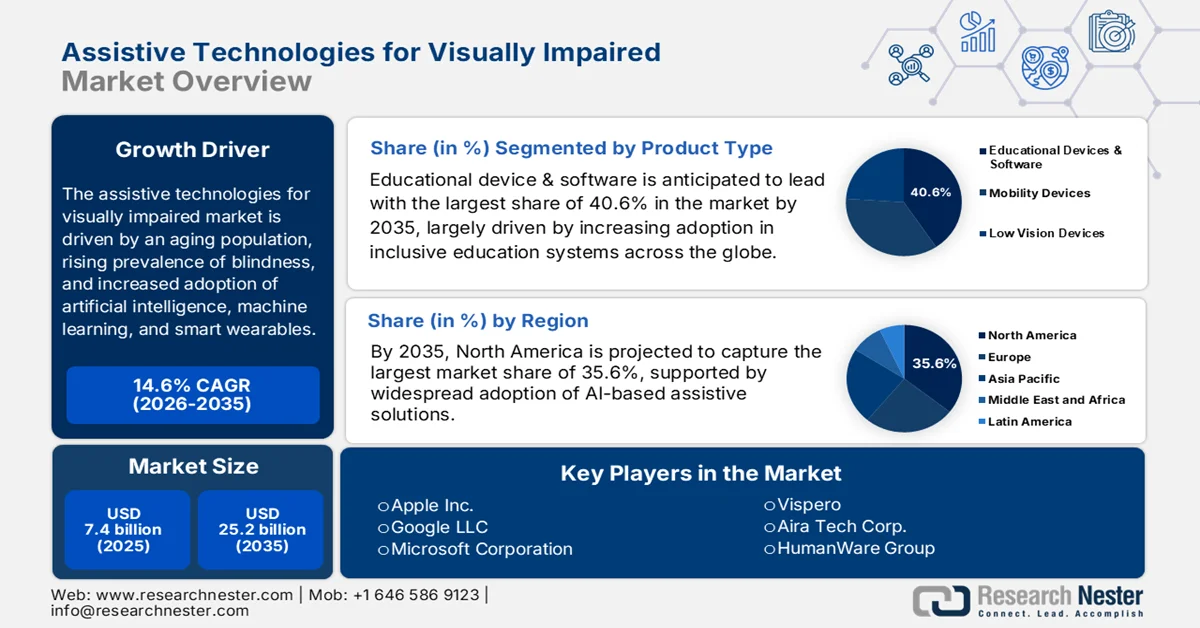
Assistive Technologies for Visually Impaired Market size was valued at USD 7.4 billion in 2025 and is projected to reach around USD 25.2 billion by the end of 2035, reflecting a CAGR of 14.6% during the forecast period, i.e., 2026-2035. In 2026, the industry size of assistive technologies for visually impaired is estimated at USD 8.4 billion.
The assistive technologies for visually impaired market is experiencing continued expansion owing to the escalating integration of AI, computer vision, and IoT-based navigation into daily tools. The market outlook is considered to be positive, effectively fueled by a rising global prevalence of vision impairment. As per the article published by the World Health Organization (WHO) in February 2026, globally, at least 2.2 billion people have near or distance vision impairment, of which around 1 billion cases are preventable or untreated. It also stated that vision impairment carries an estimated annual global productivity loss of about USD 411 billion. In low-income countries, 2 out of 3 people needing eyeglasses lack access, and globally, 1 in 2 people requiring cataract surgery do not receive it, which showcases a major market opportunity. Prevalence in low- and middle-income regions is about 4 times higher than when compared to high-income regions, thus denoting a positive assistive technologies for visually impaired market outlook.
Global Burden of Vision Impairment: Key Causes and Estimated Prevalence Across Major Eye Conditions as of 2026
|
Cause of vision impairment |
Estimated number of people affected (global) |
|
Cataract |
94 million |
|
Refractive errors |
88.4 million |
|
Glaucoma |
7.7 million |
|
Diabetic retinopathy |
3.9 million |
|
Presbyopia |
826 million |
Source: WHO
The assistive technologies for visually impaired market is shifting away toward more connected devices and hybrid solutions that combine traditional mobility aids with smart technology, creating a high-growth landscape for consumer-grade assistive tools. In July 2022, the International Agency for the Prevention of Blindness (IAPB) stated that India is home to around 34 million people living with blindness or moderate-to-severe visual impairment, creating a significant socio-economic burden. According to a Seva Foundation report, this particular condition results in an annual economic loss of almost USD 54.4 billion at purchasing power parity, which is equivalent to about 0.6% of India’s GDP. The cost impact is driven by reduced workforce participation, productivity losses among employed individuals, and income losses over the life course, particularly for visually impaired children. Therefore, this denotes that there is an urgent need for affordable assistive technologies and stronger investment in prevention and rehabilitation systems.
Key Assistive Technologies for Visually Impaired Market Insights Summary:
Regional Highlights:
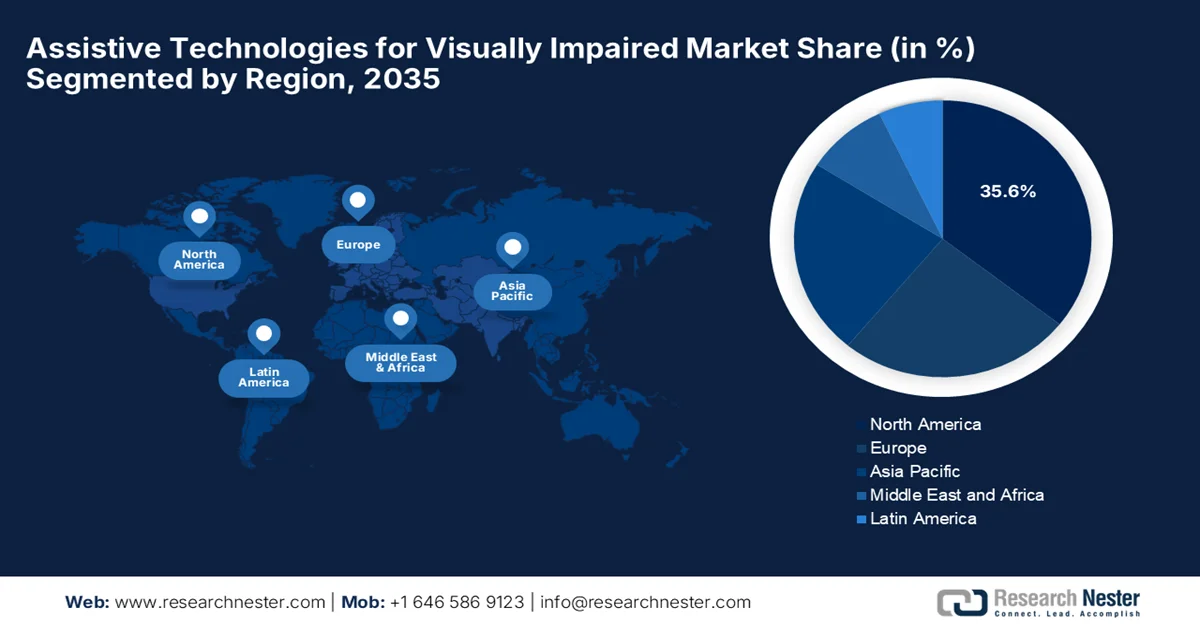
- North America is projected to command a 35.6% share of the assistive technologies for visually impaired market by 2035, attributed to strong healthcare infrastructure and widespread adoption of AI-enabled assistive solutions
- Asia Pacific is set to witness notable expansion in the forecast period, propelled by large visually impaired populations and rising digital adoption
Segment Insights:
- Educational devices & software segment in the assistive technologies for visually impaired market is expected to account for a 40.6% share by 2035, driven by increasing adoption in inclusive education systems across the globe
- Education application segment is anticipated to secure a significant revenue share by 2035, fueled by supportive government policies promoting inclusive education and digital accessibility
Key Growth Trends:
- Rapid technological advancements
- Government policies, accessibility regulations, and funding
Major Challenges:
- Limited awareness and accessibility gaps
- Usability, training, and learning curve barriers
Key Players: Apple Inc. (U.S.), Google LLC (U.S.), Microsoft Corporation (U.S.), Vispero (U.S.), Aira Tech Corp. (U.S.), HumanWare Group (Canada), OrCam Technologies Ltd. (Israel), Envision Digital B.V. (Netherlands), Dolphin Computer Access Ltd. (UK), Eschenbach Optik GmbH (Germany), Gentex (U.S.), eSight (Canada), Lighthouse Guild (U.S.), Meta (U.S.).
Global Assistive Technologies for Visually Impaired Market Forecast and Regional Outlook:
Market Size & Growth Projections:
- 2025 Market Size: USD 7.4 billion
- 2026 Market Size: USD 8.4 billion
- Projected Market Size: USD 25.2 billion by 2035
- Growth Forecasts: 14.6% CAGR (2026-2035)
Key Regional Dynamics:
- Largest Region: North America (35.6% Share by 2035)
- Fastest Growing Region: Asia Pacific
- Dominating Countries: United States, Germany, United Kingdom, Japan, China
- Emerging Countries: India, South Korea, Brazil, Australia, Canada
Last updated on : 24 April, 2026
Assistive Technologies for Visually Impaired Market - Growth Drivers and Challenges
Growth Drivers
- Rapid technological advancements: The assistive technologies in the visually impaired category are being readily transformed by AI-based assistive solutions. Smart glasses that convert visuals into speech, AI-based object and text recognition, wearable navigation aids, and voice assistants are gaining enhanced traction, thereby improving uptake in the assistive technologies for visually impaired market. In February 2024, NUS researchers introduced AiSee, which is an AI-based wearable device that is especially designed to help visually impaired people identify and interact with objects more naturally. It notes that AiSee uses a discreet bone conduction headphone, a micro-camera, and advanced AI to recognize items and answer user queries. This particular project aims to make assistive technology more affordable and accessible, thus empowering users with greater independence in daily life.
- Government policies, accessibility regulations, and funding: A strong regulatory support is accelerating adoption in the assistive technologies for visually impaired market. Laws mandating digital accessibility and disability inclusion programs in education and employment are encouraging organizations to adopt inclusive technologies at scale. The Europe’s Accessibility Act, which came into force in June 2025, has set a common standard to make key products and services such as phones, banking, public transport, and IT equipment accessible to persons with disabilities. The region is home to around 100 million people with disabilities, and the act reduces daily barriers by requiring features such as text-to-speech, accessible ATMs, and inclusive emergency communication, thus denoting a huge opportunity for the assistive technologies for visually impaired market to grow.
- Growth of digital education and inclusive learning: There has been an increased adoption of assistive tools such as braille displays, screen readers, and accessible learning software across most of the educational institutions. This is effectively fueled by the expansion of inclusive education programs and digital learning platforms, driving the assistive technologies for visually impaired market. In this context, the Press Information Bureau (PIB) in January 2026, India stated that braille is a gateway to education, dignity, and inclusion for more than 5 million visually impaired citizens. Besides, it is anchored in the Rights of Persons with Disabilities Act, whereas initiatives such as NEP, Sugamya Bharat Abhiyan, and Sugamya Pustakalaya have expanded braille access through education, infrastructure, as well as certain digital platforms. The adoption of Bharati Braille as a unified national script is currently digitally mapped to Unicode, and it ensures consistency across languages in India.
Challenges
- Limited awareness and accessibility gaps: The lack of awareness about modern assistive technologies among visually impaired populations, caregivers, and institutions is a paramount concern, causing hindrance to market expansion. Users in most of the regions are mostly dependent on traditional tools such as white canes or basic magnifiers simply because they are unaware of newer AI-based or digital solutions. In addition, the distribution networks for improved assistive devices are mostly concentrated in urban areas, leaving rural populations underserved. This creates a considerable accessibility gap between developed and developing regions. At the same time, educational institutions and healthcare providers may also lack training to recommend or support advanced tools, thus negatively impacting growth in the assistive technologies for visually impaired market.
- Usability, training, and learning curve barriers: Most of the assistive technologies, especially in terms of advanced digital or AI-based systems, come with a steep learning curve for users who may not be familiar with smartphones, apps, or voice interfaces. This, in turn, creates usability challenges, particularly for elderly users or individuals who have multiple disabilities. Therefore, training is required to effectively use screen readers, Braille displays, or smart wearable devices, but structured training programs are not widely available. Without proper onboarding, users may abandon devices or fail to use them to their full potential, causing obstacles to the assistive technologies for visually impaired market expansion. Companies need to make investments in terms of simplified design, intuitive interaction models, and continuous user education to make sure there is long-term adoption.
Assistive Technologies for Visually Impaired Market Size and Forecast:
| Report Attribute | Details |
|---|---|
|
Base Year |
2025 |
|
Forecast Year |
2026-2035 |
|
CAGR |
14.6% |
|
Base Year Market Size (2025) |
USD 7.4 billion |
|
Forecast Year Market Size (2035) |
USD 25.2 billion |
|
Regional Scope |
|
Assistive Technologies for Visually Impaired Market Segmentation:
Product Type Segment Analysis
Under the product type segment, educational devices & software is anticipated to lead with the largest share of 40.6% in the assistive technologies for visually impaired market by 2035. The dominance is largely driven by increasing adoption in inclusive education systems across the globe. Governments and institutions are imposing mandates on accessible digital learning environments, encouraging the use of tools such as screen readers, text-to-speech platforms, and accessible e-learning software. Aura Vision Glasses was launched in December 2024 by Narayana Nethralaya and SHG Technologies, which is India’s first-ever indigenously developed AR-powered low vision assistive device. The device is designed to help individuals with central, peripheral, or blurry vision loss, and it offers magnification, wide-angle awareness, image sharpening, and customizable contrast and zoom.
Application Segment Analysis
From an application perspective, education is poised to garner a significant revenue share in the assistive technologies for visually impaired market during the stipulated timeframe. The segment is largely supported by government policies promoting inclusive education and digital accessibility. In this context, Vision Empower brought its ARC on Wheels program to Asha Kirana School for the Blind in Sidlaghatta in November 2025, thereby bringing hands-on, tactile-based education directly to visually impaired students. This particular initiative enabled learners to explore different concepts in mathematics and science through braille materials, tactile kits, and guided physical experiments, in turn making abstract STEM topics accessible through touch and interaction. Such instances in the real world reflect the prominence of assistive and inclusive education technologies being incorporated into school learning environments.
End user Segment Analysis
The enterprises & social organizations segment is predicted to grow at a considerable rate in the end user category in the assistive technologies for visually impaired market over the forecasted years. The rising corporate responsibility initiatives and compliance requirements are fueling the sub segment’s leadership in this field. Organizations are making heavy investments in assistive technologies to ensure workplace accessibility, meet diversity and inclusion goals, and stay concerned to legal standards. In March 2026, Microsoft reported that it embeds a core requirement in enterprise software development, making sure that assistive technologies are integrated from the earliest stages, i.e., the shift left approach. The company is proactively incorporating accessibility features such as screen reader compatibility, voice input, and AI-powered tools, such as Microsoft 365 Copilot, to support visually impaired employees and enable inclusive workplaces, thus denoting a wider segment scope.
Our in-depth analysis of the assistive technologies for visually impaired market includes the following segments:
|
Segment |
Subsegments |
|
Product Type |
|
|
Application |
|
|
End user |
|
|
Trade |
|

Vishnu Nair
Head - Global Business DevelopmentCustomize this report to your requirements — connect with our consultant for personalized insights and options.
Assistive Technologies for Visually Impaired Market - Regional Analysis
North America Market Insights
By the end of the discussed timeframe, the North America assistive technologies for visually impaired market is forecasted to dominate with the largest share of 35.6%. The region’s leadership is effectively attributable to strong healthcare infrastructure, high adoption of AI-enabled assistive devices, and government accessibility mandates. Apart from this, the region will continue to benefit from the integration of assistive technologies into mainstream ecosystems such as smartphones, wearables, and enterprise software. As per the February 2026 data, the FCC’s National Deaf-Blind Equipment Distribution Program provides low-income individuals who are deaf-blind with specialized equipment to access telecommunications, the internet, and advanced communication services. Eligibility requires documented significant vision and hearing loss, along with income verification under 400% of the federal poverty guidelines. Other than equipment, this particular program offers installation, training, and technical support, making sure there is accessible communication for residents across all U.S. states and territories.
2026 Federal Poverty Guidelines: Household Income Thresholds by Family Size for the U.S., Alaska, and Hawaii (USD)
|
Number of Persons in Household |
48 States & DC (400%) |
Alaska (400%) |
Hawaii (400%) |
|
1 |
63,840 |
79,800 |
73,440 |
|
2 |
86,560 |
108,200 |
99,560 |
|
3 |
109,280 |
136,600 |
125,680 |
|
4 |
132,000 |
165,000 |
151,800 |
|
5 |
154,720 |
193,400 |
177,920 |
|
6 |
177,440 |
221,800 |
204,040 |
|
7 |
200,160 |
250,200 |
230,160 |
|
8 |
222,880 |
278,600 |
256,280 |
Source: FCC
The innovations in AI-based navigation, smart wearable vision devices, and enhanced digital accessibility tools are certain factors boosting the assistive technologies for visually impaired market in the U.S. The key players operating in the country lead in developing screen readers, braille displays, and object recognition technologies that improve user independence. The landscape emphasizes mobile app integration, haptic feedback mobility aids, and intelligent software to navigate both physical and virtual environments. In March 2023, Envision announced the launch of Envision Glasses in collaboration with Google Glass, which are advanced AI-powered assistive glasses especially designed to empower blind and visually impaired individuals with greater independence. They feature real-time text recognition in more than 60 languages, handwritten text reading, object and scene recognition, batch scanning, and video calling, thus suitable for standard assistive technologies for visually impaired market growth.
There is a huge opportunity for assistive technologies for visually impaired market in Canada owing to the stronger adoption rates of AI-based navigation, smart wearable vision devices, and next-generation refreshable braille displays. This sector is largely propelled by high accessibility standards and public infrastructure integration, with a strong focus on mobile app connectivity. In November 2025, the country’s National Institute for the Blind, Council of the Blind, and Alliance for Equality of Blind jointly responded to Canada’s Budget 2025, highlighting its focus on upskilling, workforce development, and disability inclusion as a major opportunity to unlock the potential of the country’s citizens with sight loss. In addition, they emphasized that inclusive employment policies, training programs, and accessibility investments can significantly reduce employment gaps, thereby strengthening the economic participation of visually impaired individuals.
APAC Market Insights
The Asia Pacific assistive technologies for visually impaired market is expected to grow considerably during the forecast period. The region’s growth is effectively attributable to large visually impaired populations, rising digital adoption, and expanding government support programs. Rapid urbanization and smartphone penetration are also accelerating the adoption of low-cost assistive solutions. In March 2026, the Blind Low Vision NZ submitted a response to New Zealand’s proposed reforms to the Total Mobility Scheme, stating that changes such as trip caps and subsidy reductions weaken independence for people who are blind, deafblind, or low vision. In addition, the submission emphasized that transport accessibility is highly essential for education, employment, healthcare, and social participation, given that visually impaired individuals already face major socio-economic disadvantages and limited mobility options. Therefore, such instances indicate that there is an urgent need for inclusive mobility policies and assistive technologies to ensure equal access for visually impaired individuals across the region.
China assistive technologies for visually impaired market is growing exponentially on account of heightened demand for accessibility tools, increased awareness, and rapid advancements in assistive solutions. The proliferation of these technologies is effectively supported by government initiatives, with a strong focus on integrating visually impaired individuals into both educational and professional environments. In this context, the China Disabled Persons’ Federation (CDPF) in July 2025 reported that the country is proactively promoting high-tech disability support solutions such as smart bionic hands and guide robots to enhance the well-being and independence of people with disabilities, including those with visual impairments. This particular initiative also involves collaboration between government departments, universities, research institutes, and technology companies to accelerate innovation in assistive technologies.
The local innovation and government backing to enhance mobility and digital accessibility are responsibly uplifting assistive technologies for visually impaired market in India. Apart from this, the sector emphasizes independent navigation and daily task management, with affordable products that are suitable for the country’s context, focusing on voice-enabled support, facial recognition, and reading assistance for education and employment. In March 2026, the Ministry of Information and Broadcasting issued new accessibility guidelines for OTT platforms to make sure that content is inclusive for persons with hearing and visual impairments. These rules impose mandates that all newly published content must include at least one feature for hearing-impaired viewers, such as captions or the country’s sign language, and one for visually impaired viewers, such as audio descriptions, thus indicating an optimistic market opportunity.
Europe Market Insights
Europe assistive technologies for visually impaired market is poised to acquire a prominent position in the global landscape during the stipulated timeframe. The region’s market is mostly driven by strong regulatory support for inclusive education and mobility. The region is led by countries such as Germany, France, and the UK, which fosters market growth through extensive research, collaborative development, and specialized digital, braille, and low-vision tools. In May 2025, the article published by the World Health Organization (WHO) reported that Europe WHO launched a new assistive technology data dashboard on the regional health information gateway to track and improve access to assistive services across the region, including tools that are used by people with visual impairments, such as glasses and other vision-support devices. This platform provides country-specific data on AT availability, funding, service coverage, and barriers to access, helping governments identify gaps and improve equity in disability support systems.
Government-supported accessibility frameworks coupled with rising collaboration between research institutions and technology developers are certain growth drivers boosting the overall assistive technologies for visually impaired market in Germany. These initiatives are enabling the deployment of advanced solutions such as tactile feedback systems, intelligent mobility aids, and inclusive digital platforms, thereby encouraging more players to establish their footprint in the country. Apart from this, healthcare providers, mobility service operators, and assistive technology companies are offering integrated ecosystems that combine hardware, software, and cloud-based services to support independent living. The country’s market also benefits from a structural shift toward digitally driven accessibility, with extensive use of AI-based navigation tools, smart wearable devices, and enhanced screen-reading technologies across public services, education, and workplace environments.
The UK assistive technologies for visually impaired market is witnessing noteworthy growth owing to the presence of government-led accessibility programs and burgeoning investment in digital health. There has been a strong emphasis on digitally connected accessibility ecosystems, wherein public institutions, transport operators, and private technology providers are including advanced solutions into everyday services, which also contributes to wider market expansion. Based on the government data published in June 2023, the UK Department for Transport funded several accessibility-focused innovation projects under its transport research and innovation grant scheme, which includes solutions that are aimed at improving mobility for visually impaired passengers. In addition, one project involved an augmented reality-based navigation application, which is especially designed to support independent movement through rail stations, thus suitable for bolstering the country’s overall assistive technologies for visually impaired market growth.
Key Assistive Technologies for Visually Impaired Market Players:
- Apple Inc. (U.S.)
- Google LLC (U.S.)
- Microsoft Corporation (U.S.)
- Vispero (U.S.)
- Aira Tech Corp. (U.S.)
- HumanWare Group (Canada)
- OrCam Technologies Ltd. (Israel)
- Envision Digital B.V. (Netherlands)
- Dolphin Computer Access Ltd. (UK)
- Eschenbach Optik GmbH (Germany)
- Gentex (U.S.)
- eSight (Canada)
- Lighthouse Guild (U.S.)
- Meta (U.S.)
- Envision (Netherlands)
- Solos (U.S.)
- LVI Low Vision International AB (Sweden)
- Dot Incorporation (South Korea)
- HIMS International Corporation (South Korea)
- Zoomax Technology Co. Ltd. (China)
- Tobii Dynavox (Sweden)
- Cambium Learning Group (U.S.)
- Bose Corporation (U.S.)
- Nippon Telesoft Co., Ltd. (Japan)
- Cochlear Limited (Australia)
- Thinkerbell Labs (India)
- Company Overview
- Business Strategy
- Key Product Offerings
- Financial Performance
- Key Performance Indicators
- Risk Analysis
- Recent Development
- Regional Presence
- SWOT Analysis
- Apple Inc. is a transformative player in the market that is embedding accessibility directly into its mainstream ecosystem, including iPhones, iPads, Macs, and wearables. The company’s strategy is highly focused on universal design, integrating features such as screen readers, magnification tools, and braille support into standard products.
- Microsoft Corporation is highly focused on AI-based accessibility software, especially through tools such as Seeing AI and accessibility features embedded in Windows and cloud platforms. The firm has its strength in AI, cloud computing, and enterprise software, with a main goal to deliver scalable assistive solutions across education and workplaces.
- Vispero is one of the most specialized players in this market, which is best known for products such as JAWS and ZoomText. The company is highly focused on dedicated assistive solutions, especially for education, government, and enterprise users.
- HumanWare Group is yet another prominent player in hardware-based assistive technologies, including braille displays, note-takers, and low-vision devices. The company’s strategy centers on specialized hardware combined with software integration by mainly targeting education and rehabilitation markets.
- OrCam Technologies Ltd. focuses on AI-based wearable vision devices, such as camera-based systems that convert visual information into audio feedback. In addition, the company’s strategy is built on computer vision and edge AI, thereby delivering portable, offline solutions that enhance independence.
Below is the list of some prominent players operating in the global assistive technologies for visually impaired market:
The assistive technologies for visually impaired market consists of global technological giants such as Apple Inc., Microsoft Corporation, and Google LLC, which are integrating accessibility into mainstream ecosystems. Meanwhile, specialized firms such as Vispero and HumanWare Group are highly focused on solutions such as screen readers and braille devices. Emerging players, i.e., Envision Digital B.V. and OrCam Technologies Ltd., are driving continued innovation through AI-powered wearables. Strategic initiatives in this field span AI integration, partnerships, affordability, and mobile-first solutions, wherein companies are embedding assistive features into everyday consumer technology with the main goal to expand accessibility as well as global reach. In January 2024, Gentex announced the acquisition of eSight, which is a pioneer in vision enhancement technology with a main goal to develop next-gen electronic eyewear for people with visual impairments.
Corporate Landscape of the Assistive Technologies for Visually Impaired Market:
Recent Developments
- In March 2026, Lighthouse Guild announced the launch of Lighthouse Guild AI, which is an initiative placing blind leadership at the center of adaptive technology design, with Meta as its first partner. The glasses co-developed with LGAI showcase how innovation built with the blind community can redefine independence and mobility.
- In August 2025, Envision, in partnership with Solos, announced the launch of the Ally Solos Glasses, which is a lightweight wearable AI device designed for people who are blind or have low vision. The glasses provide hands-free assistance such as reading text, describing surroundings, recognizing objects and faces, and offering real-time conversational AI support.
- Report ID: 8531
- Published Date: Apr 24, 2026
- Report Format: PDF, PPT
- Explore a preview of key market trends and insights
- Review sample data tables and segment breakdowns
- Experience the quality of our visual data representations
- Evaluate our report structure and research methodology
- Get a glimpse of competitive landscape analysis
- Understand how regional forecasts are presented
- Assess the depth of company profiling and benchmarking
- Preview how actionable insights can support your strategy
Explore real data and analysis
Frequently Asked Questions (FAQ)
About this Report
Connect with our Expert


Report, 2026-2035



Copyright @ 2026 Research Nester. All Rights Reserved.
