Application Virtualization Market Outlook:
Application Virtualization Market size was valued at USD 6.9 billion in 2025 and is projected to reach USD 20.7 billion by the end of 2035, rising at a CAGR of 11.6% during the forecast period, i.e., 2026-2035. In 2026, the industry size of application virtualization is assessed at USD 7.7 billion.
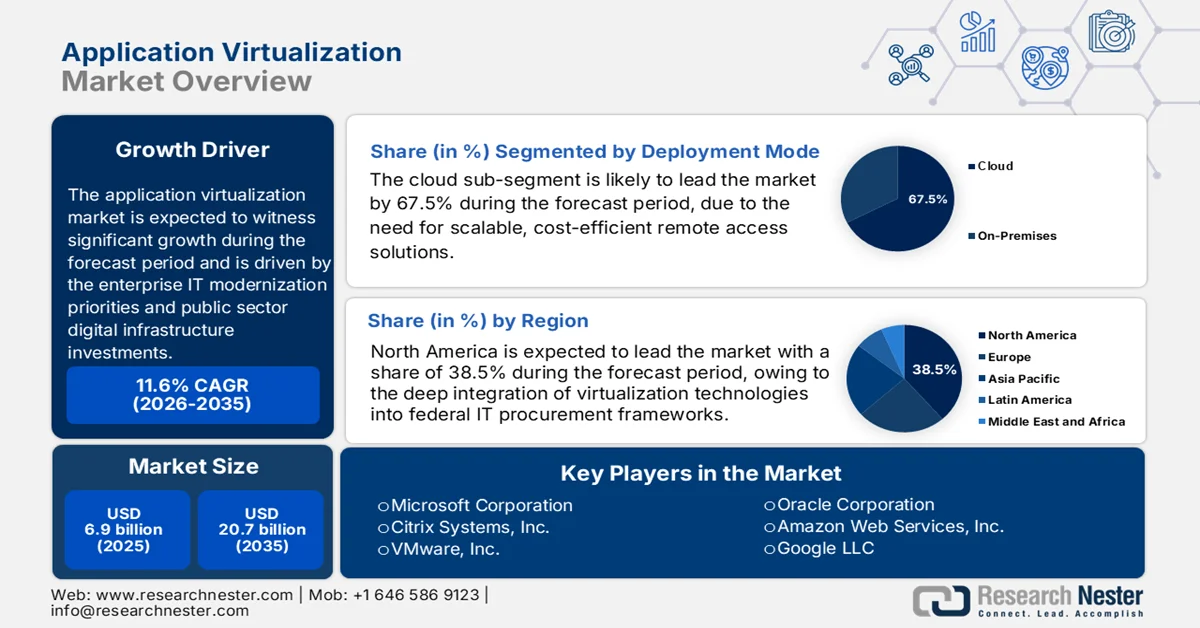
The application virtualization market adoption is shaped by the enterprise IT modernization priorities and public sector digital infrastructure investments. The federal agencies continue to expand the cloud-based delivery models under programs such as FedRAMP, which has authorized many cloud services that support virtualized application environments to improve scalability and centralized management. According to the CSIS July 2023 data the cloud smart strategies with federal cloud spending accounted for USD 12 billion annually reinforcing the demand for secure application delivery mechanisms that reduce the endpoint dependency reinforcing the demand for secure application delivery mechanisms that reduce the endpoint dependency. These factors are driving enterprise and government buyers toward virtualized application deployment models that enable policy-based access, rapid patching, and reduced local attack surfaces.
Besides, the digital transformation, funding, and cross-border IT standardization are stimulating the uptake. As per the Konica Minolta January 2026 data, Horizon Europe has allocated USD 104 billion to support digital research and innovation and strengthen digital capacity. Further, the Eurostat 2025 data depicts that nearly 45% of the EU enterprises used cloud computing services, with a growing share using advanced delivery environments for software access and collaboration. The public sector initiatives are promoting interoperable and sovereign cloud ecosystems supporting the application virtualization deployment across regulated industries. These institutional investments and policy frameworks are sustaining enterprise demand for centralized, secure, and compliant application access models across regions.
Key Application Virtualization Market Insights Summary:
Regional Highlights:
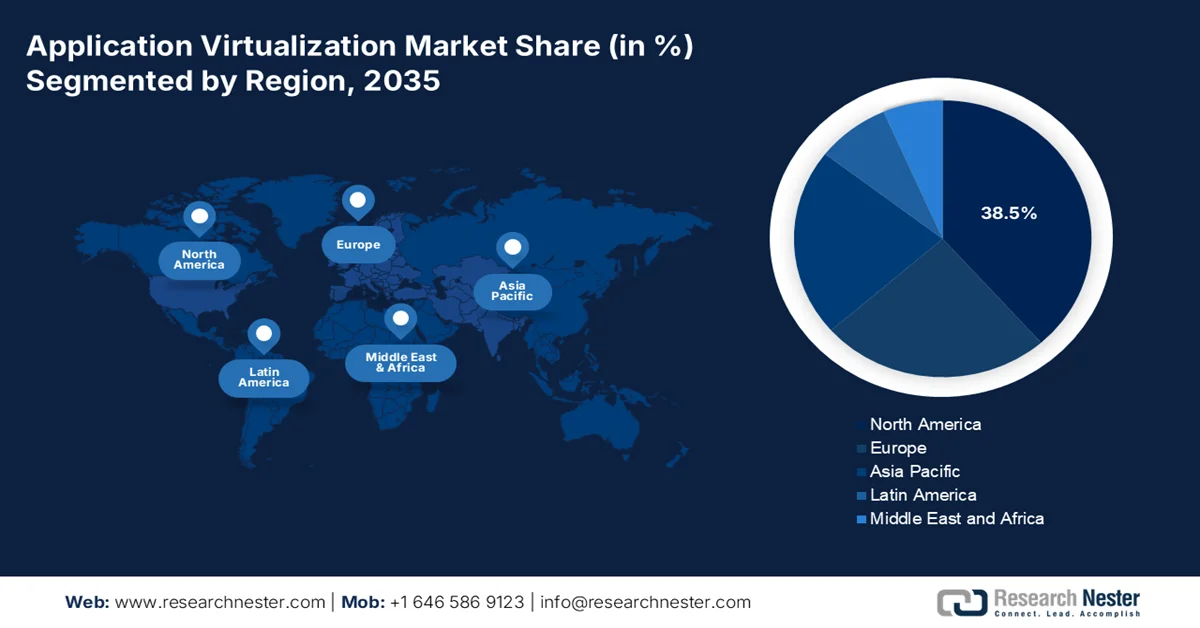
- North America application virtualization market is projected to secure a 38.5% revenue share by 2035, impelled by deep integration of virtualization technologies into federal IT frameworks and enterprise computing standards
- Asia Pacific is anticipated to expand at a CAGR of 13.6% during 2026-2035, catalyzed by rapid digital transformation across government, healthcare, and financial sectors
Segment Insights:
- Cloud sub-segment in the application virtualization market is expected to account for a 67.5% share by 2035, driven by the need for scalable, cost-efficient remote access solutions
- Large enterprise segment is projected to dominate over the forecast period 2026–2035, fueled by complex IT infrastructure and substantial security compliance requirements
Key Growth Trends:
- Rising cybersecurity spending
- Growth in remote and hybrid work culture
Major Challenges:
- Implementation and management complexity
- Data security and compliance concerns
Key Players: Microsoft Corporation, Citrix Systems, Inc., VMware, Inc., Oracle Corporation, Amazon Web Services, Inc., Google LLC, Nutanix, Inc., IBM Corporation, Ericom Software, Sangfor Technologies, Huawei Technologies Co., Ltd., SAP SE, TeamViewer AG, Parallels International GmbH, Cameyo, Numecent Holdings Ltd., Synopsys, Inc., NetApp, Rocket Software, Inc., Nutanix.
Global Application Virtualization Market Forecast and Regional Outlook:
Market Size & Growth Projections:
- 2025 Market Size: USD 6.9 billion
- 2026 Market Size: USD 7.7 billion
- Projected Market Size: USD 20.7 billion by 2035
- Growth Forecasts: 11.6% CAGR (2026-2035)
Key Regional Dynamics:
- Largest Region: North America (38.5% Share by 2035)
- Fastest Growing Region: Asia Pacific
- Dominating Countries: United States, China, Germany, United Kingdom, Japan
- Emerging Countries: India, Brazil, South Korea, Singapore, United Arab Emirates
Last updated on : 1 April, 2026
Application Virtualization Market - Growth Drivers and Challenges
Growth Drivers
- Rising cybersecurity spending: Cybersecurity threats are pushing governments to adopt centralized application control strategies to overcome cybersecurity-related issues. According to the CSA June 2023 report, the ransomware incidents have increased by 13% globally, indicating vulnerabilities tied to the endpoint-based systems. Application virtualization reduces the attack surfaces by limiting local installations and enforcing secure access policies. Additionally, the Federal Register July 2024 data reports that the nearly USD 10.9 billion losses were registered from cybercrime, reinforcing the investment in secure IT architecture. Further, the ENISA continues to promote the zero-trust frameworks that rely on virtualized application environments, thus driving the application virtualization market.
- Growth in remote and hybrid work culture: Post-pandemic has restructured the demand for remote application access. According to the OPM data published in 2024, nearly 40% of the federal employees remain eligible for telework, requiring secure centralized access to enterprise applications. Similarly, the OECD highlights a sustained hybrid work adoption across member countries' public sector. Application virtualization supports secure remote work by delivering controlled environments independent of endpoint devices. Government agencies increasingly mandate that remote access solutions maintain strict security compliance, and application virtualization delivers this by ensuring the sensitive data never resides on the endpoint devices. This advantage positions virtualization as the preferred delivery method for public sector remote work programs, with procurement forecast to remain elevated as agencies formalize hybrid work policies into permanent operating models.
Telework Eligibility, Participation, and Frequency (2024)
|
Category |
Number of Employees |
Number of Responding Agencies |
|
Total number of employees |
2,513,200 |
78 |
|
Employees deemed eligible to telework |
1,349,440 |
77 |
|
Employees teleworking |
1,017,230 |
77 |
Source: OPM 2024
- Investments in healthcare digitalization: Healthcare digitization is surging the demand for the secure application virtualization market. According to the Journal of AHIMA, November 2024 data, the U.S. allocated over USD 2 billion via HITECH and related programs to enhance the electronic health infrastructure. Similarly, the EU has allocated a budget to strengthen the digital health systems. Virtualized applications enable clinicians to securely access patient data and diagnostic tools across facilities. Further, the virtualized application environments are inherently supported by centralizing data access controls and maintaining consistent user experiences across disparate clinical settings. As healthcare systems consolidate through mergers and acquisitions, application virtualization provides the technical foundation for standardizing electronic health record delivery across formerly independent facilities without requiring costly end-user device refreshes.
Challenges
- Implementation and management complexity: Deploying application virtualization in diverse IT ecosystems requires extensive strategic planning and precise configuration, mainly when dealing with legacy infrastructure. Compatibility issues across the operating systems, software versions, and endpoint devices frequently derail implementation timelines. Maintaining these virtual environments demands specialized expertise that places significant pressure on IT departments, a challenge acute for small to mid-sized enterprises with limited technical resources.
- Data security and compliance concerns: Security remains a challenge for the players entering the application virtualization market, as organizations fear exposing sensitive corporate and customer data via virtualized environments. Enterprises require robust security controls, including micro segmentation, real-time threat monitoring, and secure endpoint management, before adopting virtualization solutions. Compliance with stringent regulations like HIPAA, GDPR, and industry-specific mandates adds another layer of complexity that new entrants must address from day one.
Application Virtualization Market Size and Forecast:
| Report Attribute | Details |
|---|---|
|
Base Year |
2025 |
|
Forecast Year |
2026-2035 |
|
CAGR |
11.6% |
|
Base Year Market Size (2025) |
USD 6.9 billion |
|
Forecast Year Market Size (2035) |
USD 20.7 billion |
|
Regional Scope |
|
Application Virtualization Market Segmentation:
Deployment Mode Segment Analysis
Within the deployment mode, the cloud sub-segment is dominating and is poised to hold the share value of 67.5% by the end of 2035 in the application virtualization market. The segment is driven by the need for scalable, cost-efficient remote access solutions. Organizations are rapidly migrating virtualized applications to public cloud infrastructure to support distributed workforces and reduce the capital expenditure related with on premises data centers. According to the World Bank Group 2022 data, government spending on public cloud services has surged to 17.1%. This rise underscores the stimulating federal adoption of public cloud environments, which directly influences enterprise confidence in deploying application virtualization via public cloud. This shift enables organizations to use elastic scalability, integrated security frameworks, and disaster recovery capabilities, making public cloud the dominant deployment architecture in the market.
Organization Size Segment Analysis
Under the organization size segment, the large enterprise represents the leading sub-segment in the application virtualization market. The segment is driven by their complex IT infrastructure and substantial security compliance requirements. These organizations employ application virtualization to streamline software delivery across thousands of endpoints, enforce centralized security policies, and support hybrid work models. Large enterprise respondents implement centralized identity and access management systems integrated with virtualized application environments to mitigate cybersecurity risks. This funding highlights the critical role of virtualization in large-scale enterprise security postures. Further, the enterprises continue to prioritize the virtualization investments to ensure business continuity and seamless integration with cloud ecosystems, solidifying their position as the largest organizational segment.
Component Segment Analysis
The software is leading in the component segment as it forms the foundational layer for delivering virtualized applications and desktops. These software solutions enable centralized management, application streaming, and remote desktop capabilities essential for modern IT operations. According to the NLM January 2025 study, nearly 95% of eligible hospitals and critical access hospitals adopted certified electronic health record technology, much of which is delivered via software-based virtualization platforms to ensure secure remote clinician access. This data illustrates the dependency of critical sectors such as healthcare on robust virtualization software. The demand for the software platforms is driven by the continuous innovation in management consoles, enhanced security features, and subscription-based licensing models that offer predictable operational expenditure.
Our in-depth analysis of the application virtualization market includes the following segments:
|
Segment |
Subsegments |
|
Component |
|
|
Deployment Mode |
|
|
Organization Size |
|
|
Type |
|
|
End user |
|
|
Vertical |
|

Vishnu Nair
Head - Global Business DevelopmentCustomize this report to your requirements — connect with our consultant for personalized insights and options.
Application Virtualization Market - Regional Analysis
North America Market Insights
North America is leading the dominant position in the application virtualization market and is poised to hold the regional revenue share of 38.5% by the end of 2035. The market is driven by the deep integration of virtualization technologies into federal IT procurement frameworks and enterprise computing standards. The region benefits from a highly concentrated ecosystem of leading technology providers, which have established extensive partner networks and service delivery capabilities across the continent. Regulatory environments mainly in the U.S. have codified application isolation and centralized delivery as baseline security requirements for government information systems, creating non-discretionary demand that sustains market stability. This structural maturity translates into the predictable revenue streams and sustained investment in the virtualization infrastructure upgrades.
The continued federal investments in digital infrastructure, workforce mobility, and IT standardization initiatives is driving the application virtualization market in U.S. According to the GAO, May 2022, USD 1.1 billion in funding is allocated to modernize the federal IT systems with a strong focus on cloud-based and centralized application environments that improve the scalability and reduce legacy system dependence. The National Center for Science and Engineering Statistics August 2022 reports that nearly 52.77% of healthcare and social assistance have adopted cloud computing services, reflecting broader ecosystem readiness for virtualized application delivery across both public and private sectors. The OPM January 2026 data depicts that more than 3% of the federal employees were eligible for telework, reinforcing sustained demand for secure, remotely accessible application environments, thus boosting the market growth.
Cloud Computing Services by Industry (2022)
|
Sector |
Percentage |
|
Food and Fiber Manufacturing |
47.32 |
|
Information |
65.68 |
|
Finance and Insurance |
52.04 |
|
Educational Services |
58.77 |
|
Healthcare |
52.77 |
Source: NCSES August 2022
The federal digital transformation funding, cloud adoption across public institutions, and a strong emphasis on secure service delivery are driving the application virtualization market in Canada. According to the Government of Canada, April 2024 data, USD 2 billion is spent toward digital government and IT modernization initiatives, including investments in cloud-based infrastructure and enterprise application delivery systems that support virtualization frameworks. Additionally, Shared Services Canada manages IT, driving centralized application access and standardized platforms across government operations. These trends, combined with hybrid work policies and stringent data protection requirements under federal regulations, are increasing demand for the application virtualization solutions that enable secure remote access, centralized control, and efficient resource utilization across distributed public and private sector environments.
APAC Market Insights
Asia Pacific is projected to emerge as the fastest-growing region in the application virtualization market and is projected to expand at a CAGR of 13.6% during the assessed period, 2026 to 2035. The region is defined by the rapid digital transformation across government services, healthcare infrastructure, and financial technology sectors. APAC exhibits a fragmented adoption pattern with advanced economies prioritizing virtualization for aging population health delivery, while China and India focus on scaling centralized government application access across vast geographic territories. Further cybersecurity concerns regarding data sovereignty have prompted several APAC governments to mandate domestic cloud infrastructure for the public sector virtualization deployments. Private sector adoption is concentrated in banking, manufacturing, and retail, where virtualization supports legacy system modernization and distributed workforce models.
The large-scale government digitalization programs expanding cloud adoption and increasing demand for secure, scalable IT infrastructure across public and private sectors are fueling the application virtualization market in India. According to the IISPPR September 2025 data, the Government of India has allocated over USD 14 billion across multiple digital initiatives supporting cloud infrastructure, e-governance platforms, and centralized service delivery systems. Additionally, the PIB December 2024 data reports that the UMANG platform has over 7.12 crore users engaged with government services, requiring consistent and secure application access across diverse devices and regions. Furthermore, the IBEF February 2024 data highlighted that there are over 800 million internet users in India, driving demand for scalable digital platforms. These factors are bolstering the market growth.
The strong state-led digital infrastructure investments, enterprise cloud adoption, and expanding e-government services are driving the adoption of the application virtualization market in China. According to the People’s Republic of China, January 2025 data, the country had over 1.1 billion internet users as of 2023, creating significant demand for scalable and centralized application delivery systems across public and commercial platforms. China’s cloud computing market has been growing, with cloud infrastructure supporting enterprise IT modernization and virtualized environments. Further, China has advanced e-government capabilities with a large share of administrative services now accessible online via unified digital platforms. These data show an optimistic growth in the nation.
Europe Market Insights
The application virtualization market in Europe is shaped by the stringent data protection regulations, cross-border healthcare digitization, and funding mechanisms under the Digital Decade policy framework. The European Commission has prioritized cloud infrastructure and virtualized application delivery as foundational elements for achieving digital control across member states. Further, the public sector adoption is influenced by the General Data Protection Regulation, which incentivizes virtualization as a control mechanism for centralizing data access and reducing the endpoint storage of sensitive citizen information. Healthcare represents the largest vertical segment, driven by the national electronic health record mandates and the cross-border interoperability requirements. Europe exhibits fragmented adoption patterns with strong national champions in Germany, France, and the UK, alongside increasing deployment of sovereign cloud solutions that incorporate application virtualization capabilities.
The public investment in digital infrastructure, enterprise IT modernization, and secure data frameworks is shaping the application virtualization market in Germany. According to the Federal Government, August 2025 data, the country allocated USD 7.1 billion under the Digital Pact for Schools, accelerating the deployment of digital learning systems that rely on centralized and virtualized application access across institutions. Moreover, the World Economic Forum January 2025 data indicates that approximately 76% of German enterprises are provided with cybersecurity training and awareness, reflecting a secure IT environment and supporting virtualization adoption to minimize endpoint risks. These developments demand application virtualization solutions that enable controlled access, system interoperability, and secure digital service delivery across public and private sectors.
The sustained public sector digital transformation, spending on cloud-first procurement policies, and rising enterprise adoption of secure remote access systems are shaping the application virtualization market in the UK. The NHS Confederation December 2025 data depicts that USD 12.8 billion is expected to be allocated for digital transformation by the end of 2028, which is a rise of 50% from 2025, supporting migration toward centralized and cloud-based application environments. Additionally Government of the UK's January 2025 data reported that its digital services handled over 95 million online transactions. Further, the DTP Group's November 2025 data noted that 94% of the large enterprises use cloud computing services, indicating a strong foundation for application virtualization adoption. These trends show an active upliftment in market expansion and growth.
Key Application Virtualization Market Players:
- Microsoft Corporation (U.S.)
- Citrix Systems, Inc. (U.S.)
- VMware, Inc. (U.S.)
- Oracle Corporation (U.S.)
- Amazon Web Services, Inc. (U.S.)
- Google LLC (U.S.)
- Nutanix, Inc. (U.S.)
- IBM Corporation (U.S.)
- Ericom Software (U.S.)
- Sangfor Technologies (China)
- Huawei Technologies Co., Ltd. (China)
- SAP SE (Germany)
- TeamViewer AG (Germany)
- Parallels International GmbH (Switzerland)
- Cameyo (U.S.)
- Numecent Holdings Ltd. (UK)
- Synopsys, Inc (U.S.)
- NetApp (U.S.)
- Rocket Software, Inc. (U.S.)
- Nutanix (U.S.)
- Company Overview
- Business Strategy
- Key Product Offerings
- Financial Performance
- Key Performance Indicators
- Risk Analysis
- Recent Development
- Regional Presence
- SWOT Analysis
- Microsoft Corporation maintains a dominant position in the application virtualization market by deeply embedding virtualization capabilities into its Windows operating systems and Microsoft 365 ecosystem. The company’s strategic initiative centers on transitioning customers from legacy tools towards a unified cloud native experience via Azure Virtual Desktop. In 2024, the company made a revenue of USD 245,122 million.
- Citrix Systems, Inc remains a cornerstone of the application virtualization market, focusing on delivering secure, high-performance delivery of virtual apps and desktops across complex hybrid and multi-cloud environments. Following its strategic acquisitions and integration with Cloud Software Group, the company has expanded its focus on the unified platform strategy.
- VMware, Inc. drives its strategy in the application virtualization market by consolidating its end-user computing portfolio under the VMware Workspace ONE and Horizon brands. The company’s primary initiative is to provide an integrated platform that combines unified endpoint management with virtual application delivery, enabling IT teams to manage physical and virtual environments.
- Oracle Corporation approaches the application virtualization market as a critical component of its broader cloud infrastructure and enterprise application strategy. The company’s strategic initiatives are centered on Oracle Cloud Infrastructure, which offer high performance GPU accelerated virtual application hosting. In the 2025 quarter four, the company made a revenue of USD 15.9 billion.
- Amazon Web Services, Inc has redefined the application virtualization market via its fully managed desktop as a service offering, Amazon WorkSpaces Core, and Amazon AppStream 2.0. The company’s strategic initiative is to integrate application virtualization seamlessly with its vast ecosystem of cloud services, including ML, IoT, and analytics.
Here is a list of key players operating in the global application virtualization market:
The application virtualization market is defined by a mature competitive landscape shifting from standalone on-premises solutions to integrated cloud native platforms and Desktop as a Service offerings. The key players are pursuing strategic initiatives centered on deep integration with the hyperscale cloud ecosystems, enhancing security via zero trust frameworks, and incorporating AI for automated workspace management. For example, in February 2024, Synopsys, Inc. announced it had acquired VaST Systems Technology Corporation to extend its virtual prototyping solutions into the automotive and consumer application space. A notable trend is the consolidation of the market, where the major IT infrastructure vendors acquire specialized virtualization players to offer comprehensive end-user computing suites, intensifying competition against established pureplay providers.
Corporate Landscape of the Application Virtualization Market:
Recent Developments
- In October 2025, NetApp, the intelligent data infrastructure company, Broadcom, Inc., and Kochasoft, a trusted provider of enterprise solutions, announced a collaboration with Equinix, the world’s digital infrastructure company, on a new service offering for SAP S/4HANA & SAP Legacy Workloads running on VMware Cloud Foundation (VCF).
- In May 2024, Rocket Software, Inc. closed the acquisition of the Application Modernization and Connectivity (AMC) business of OpenText, formerly part of Micro Focus. Rocket Software now offers customers modernization software solutions spanning the mainframe to the cloud.
- In January 2024, Nutanix acquired D2iQ’s Kubernetes Platform, a leading Kubernetes management platform. This acquisition will enable Nutanix to offer its customers a comprehensive solution for managing cloud native applications across multiple environments.
- Report ID: 8497
- Published Date: Apr 01, 2026
- Report Format: PDF, PPT
- Explore a preview of key market trends and insights
- Review sample data tables and segment breakdowns
- Experience the quality of our visual data representations
- Evaluate our report structure and research methodology
- Get a glimpse of competitive landscape analysis
- Understand how regional forecasts are presented
- Assess the depth of company profiling and benchmarking
- Preview how actionable insights can support your strategy
Explore real data and analysis
Frequently Asked Questions (FAQ)
About this Report
Connect with our Expert


Report, 2026-2035



Copyright @ 2026 Research Nester. All Rights Reserved.
