Aluminum Foil Packaging Market Outlook:
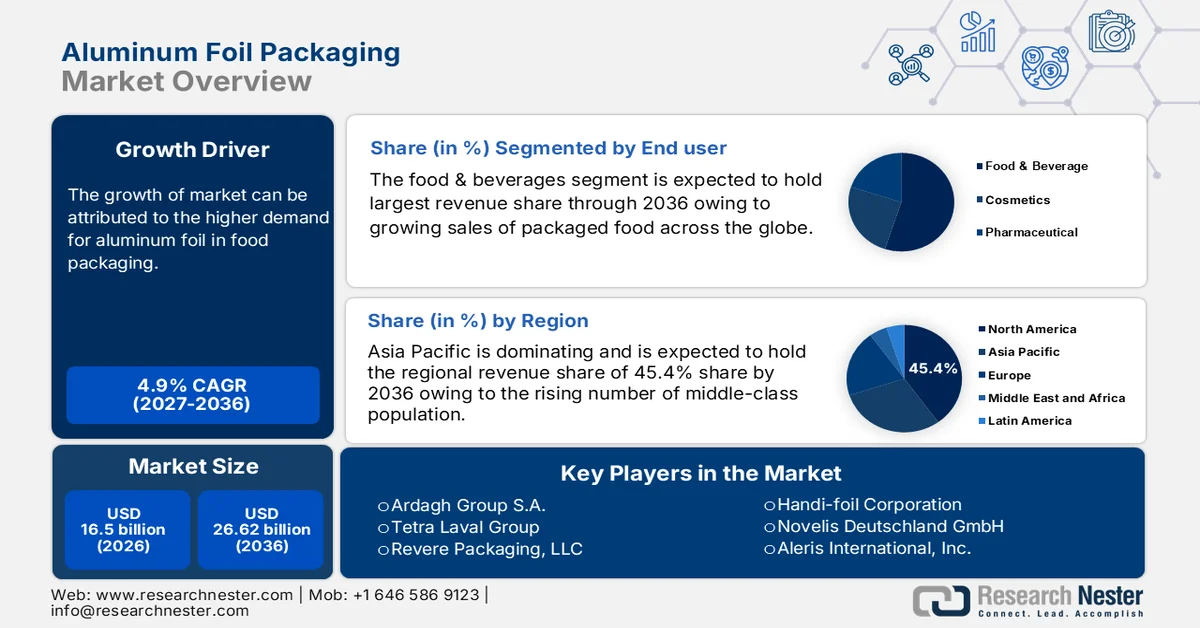
Aluminum Foil Packaging Market size was valued at USD 16.5 billion in 2026 and is projected to reach USD 26.62 billion by the end of 2036, registering around 4.9% CAGR during the forecast period, i.e., 2027-2036. In 2027, the industry size of aluminum foil packaging is estimated at USD 17.31 billion.
The demand for the aluminum foil packaging market is closely linked to food processing volumes, pharmaceutical output, and trade flows reported by the government and intergovernmental bodies. The high level of protection, mainly in the pharmaceutical food, and personal care applications are fueling the adoption of aluminum foil packaging due to the extensive shelf life and product safety. According to the Aluminum Association's June 2023 data, the primary aluminum production reached nearly 783.0 thousand metric tons in May 2023. Moreover, the secondary aluminum production exceeded 4.1 million metric tons as per the Congress.gov October 2022 report, underscoring the structural reliance on the recycled inputs across the packaging supply chains. Further, the steady imports and exports of the aluminum foil and related semi-fabricated products are reflecting the sustained cross-border demand and reinforcing the strategic importance of aluminum packaging in global food and pharmaceutical supply chains.
Besides, the U.S. Environmental Protection Agency in October 2025 reported that the containers and packaging represented 82.2 million tons of municipal solid waste generation, with aluminum containers contributing significantly to the metals fraction. Additionally, the aluminum foil packaging volumes correlate with beverage production, processed food trade, and sustainability mandates. The Food and Agriculture Organization's February 2026 data reports that global cereal production reached 3.023 billion tonnes in 2025, reflecting large-scale processing and downstream packaging requirements. Further, the growing importance of circular economy policies and extended producer responsibility frameworks across the major economies is surging the use of recyclable aluminum packaging formats to reduce landfill burden and improve material recovery rates.
Key Aluminum Foil Packaging Market Insights Summary:
Regional Highlights:
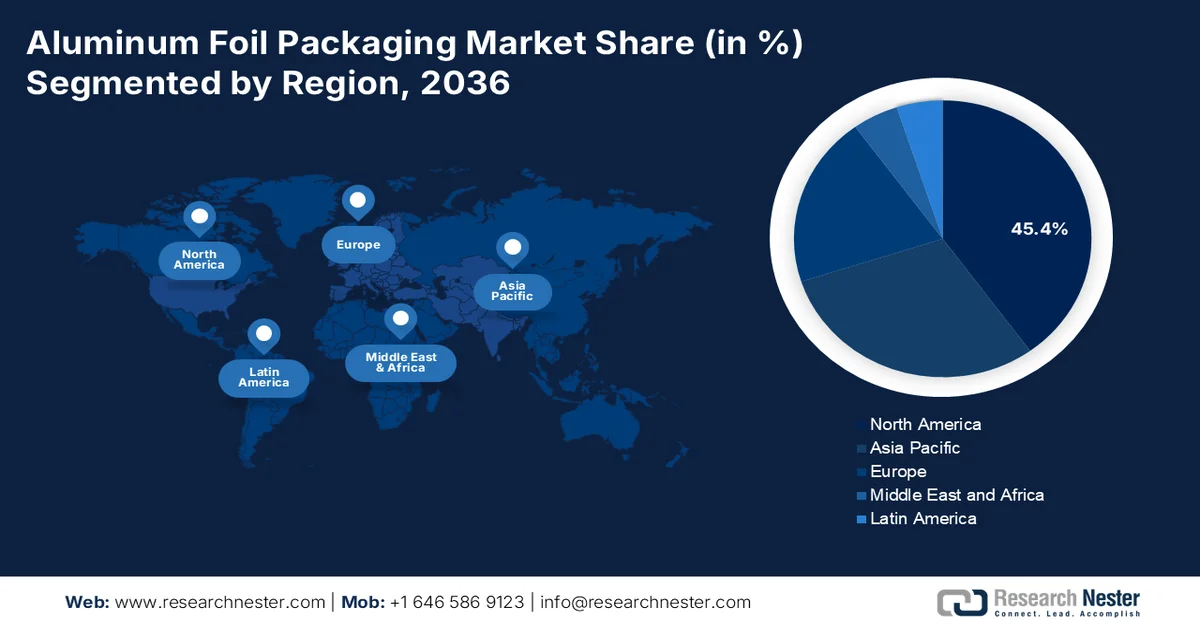
- The aluminum foil packaging market in Asia Pacific is projected to command a 45.4% revenue share by 2036, attributed to its vast population base, concentrated manufacturing ecosystem, and expanding middle-class consumption patterns.
- North America is forecast to expand at a CAGR of 3.2% during 2027-2036 in the market, stimulated by rising focus on recyclability, domestic sourcing, and pharmaceutical cold chain requirements.
Segment Insights:
- In the aluminum foil packaging market, the direct sales channel is anticipated to account for a dominant 70.4% share by 2036, propelled by large-scale industrial off-take.
- The printed foil sub-segment is poised to lead by 2036 in the market, fueled by rising demand for high-end flexible packaging and enhanced brand differentiation.
Key Growth Trends:
- Sustainability mandates and circular economy regulations
- Public infrastructure investment in healthcare facilities
Major Challenges:
- Intense competition from the alternative packaging materials
- Limited domestic supply and import dependence
Key Players: Constellium, Novelis Inc., Reynolds Group Holdings, Amcor plc, Hydro Aluminium, Assan Aluminyum, Eurofoil, Symetal, Hindalco Industries Ltd., Kobe Steel Ltd., UACJ Corporation, Mitsubishi Aluminum Co. Ltd., Shandong Nanshan Aluminium Co. Ltd., Loften Environmental Technology, Henan Mingtai Al Industrial Co. Ltd., RUSAL, Al-Taiseer Aluminium Industries Co., VAW Aluminium AG, Jasch Foils, ACM Carcano.
Global Aluminum Foil Packaging Market Forecast and Regional Outlook:
Market Size & Growth Projections:
- 2026 Market Size: USD 16.5 billion
- 2027 Market Size: USD 17.31 billion
- Projected Market Size: USD 26.62 billion by 2036
- Growth Forecasts: 4.9% CAGR (2027-2036)
Key Regional Dynamics:
- Largest Region: Asia Pacific (45.4% Share by 2036)
- Fastest Growing Region: North America
- Dominating Countries: - China, United States, Germany, Japan, India
- Emerging Countries: - Malaysia, Vietnam, Indonesia, Brazil, Mexico
Last updated on : 31 August, 2026
Aluminum Foil Packaging Market - Growth Drivers and Challenges
Growth Drivers
- Sustainability mandates and circular economy regulations: The recycling targets and the extended producer responsibility frameworks are actively influencing the material selection. According to the PKN Packaging News data in December 2025, the global packaging waste reached 434.5 million tonnes in 2025, and the metal packaging recorded a 88.6%, promoting a regular shift toward recyclable materials, hence driving the aluminum foil packaging market. The U.S. EPA's October 2025 report confirms that the containers and packaging accounted for 28.1% of the municipal solid waste. The governments are increasingly linking procurement eligibility to recyclability performance. Additionally, many public-sector tenders and food safety regulations now prioritize high-recyclability and low-carbon packaging materials, further strengthening the competitive position of aluminum foil in regulated end-use industries.
- Public infrastructure investment in healthcare facilities: Hospital construction and modernization programs are expanding the institutional aluminum foil packaging market demand. There is an active infrastructure grants under the federal healthcare modernization initiatives. Moreover, the metalized flexible packaging is driving the adoption of the aluminum foil packaging in the pharma and healthcare sectors. Moreover, according to the European Parliament, February 2025 data, the Recovery and Resilience Facility allocates substantial funding to health system upgrades exceeding EUR 700 billion in total facility support. Increased surgical volumes and inpatient services raise demand for sterile single-use and barrier packaging formats. Further, Japan’s Ministry of Health, Labor and Welfare continues capital allocations for medical infrastructure upgrades.
- Trade facilitation and export-oriented food policies: Government export promotion strategies increase the packaged food shipments, requiring compliant packaging materials. The World Trade Organization reports that the global merchandise trade has food exports forming a significant share. Moreover, the OECD 2026 data shows that Australia valued 12% of food exports in 2024. Exported processed foods must comply with destination labeling and safety standards, often requiring robust barrier packaging, thereby driving the adoption of the aluminum foil packaging market. The European Commission’s Common Agricultural Policy continues to provide multi-billion-euro support to agri-food producers. Further, aluminum foil packaging firms should invest in export-compliant certifications and multi-market regulatory expertise to align with government-backed export expansion strategies.
Challenges
- Intense competition from the alternative packaging materials: Aluminum foil faces are growing competition from plastic, paper-based laminates, and multi-layer packaging materials that offer cost advantages or perceived environmental benefits. These alternatives often have lower production costs and established supply chains. The presence of alternative packaging materials poses a competitive threat to aluminum foil containers, potentially limiting the aluminum foil packaging market share.
- Limited domestic supply and import dependence: Many regional aluminum foil packaging markets lack sufficient domestic aluminum rolling capacity, creating dependency on imports and vulnerability to supply disruptions. This is particularly acute in North America, where domestic production cannot meet packaging-grade aluminum demand. A significant portion of aluminum foil and semi-finished packaging products used in the U.S. is imported, particularly from Asian markets. This supply-demand imbalance creates strategic vulnerabilities for manufacturers relying on imported materials.
Aluminum Foil Packaging Market Size and Forecast:
| Report Attribute | Details |
|---|---|
|
Base Year |
2026 |
|
Forecast Period |
2027-2036 |
|
CAGR |
4.9% |
|
Base Year Market Size (2026) |
USD 16.5 billion |
|
Forecast Year Market Size (2036) |
USD 26.62 billion |
|
Regional Scope |
|
Aluminum Foil Packaging Market Segmentation:
Distribution Channel Segment Analysis
The direct sales channel is projected to capture the largest share value of 70.4% by 2036 in the aluminum foil packaging market. The segment is driven by the large-scale industrial off-take. This channel involves manufacturers supplying directly to pharmaceutical companies, food processors, and converters without intermediary distributors. The dominance of this model is attributed to the need for customized specifications regarding thickness, alloy composition, and width, which require direct technical collaboration between the supplier and the buyer. Further, the long-term supply contracts for high-volume users ensure price stability and supply chain security. According to the OEC 2024 data, the worldwide trade of aluminum plating reached USD 40.7 billion, with the vast majority of this value moving via direct manufacturers to industry sales channels, underscoring the B2B nature of the core market.
Printing Technology Segment Analysis
The printed foil is the largest sub-segment, reflecting the packaging industry’s dual role as both a protective vessel and a marketing tool in the aluminum foil packaging market. Printed aluminum foil is essential for brand differentiation in the competitive consumer goods sector, allowing for high-resolution graphics, product information, and anti-counterfeiting measures directly on the package. The shift towards the high-end flexible packaging for snacks, coffee, and cosmetics demands rotogravure and flexographic printing on foil, which enhances the shelf appeal. This trend is reinforced by the regulatory requirements for clear labeling and ingredient declaration. The data from the U.S. FDA indicates that the agency’s food contact substance notification program continues to see a steady influx of submissions for printed packaging materials, highlighting the industry’s focus on compliant and innovative printed food contact surfaces.
Product Thickness Segment Analysis
Light gauge foil defined as a foil thinner than 0.025mm, is leading the product thickness segment in the aluminum foil packaging market. The segment is driven by the critical role in flexible packaging and pharmaceutical blister packs. This ultra-thin foil acts as an absolute barrier to moisture, light, and gases while using minimal material, making it the most cost-effective and sustainable option for single-serve sachets, coffee capsules, and candy wrappers. The trend of light weighting drives the converters to use thinner gauges to reduce material costs and environmental footprint without compromising barrier properties. According to the USITC September 2023 data, Granges has announced a USD 26 million investment to restart production and expand its light-gauge aluminum foil facility in Newport. The trend of light-weighting drives converters to use thinner gauges to reduce material costs and environmental footprint without compromising barrier properties.
Our in-depth analysis of the aluminum foil packaging market includes the following segments:
|
Segment |
Subsegments |
|
Packaging Type |
|
|
Product Thickness |
|
|
Application |
|
|
End use Sector |
|
|
Printing Technology |
|
|
Distribution Channel |
|

Vishnu Nair
Head - Global Business DevelopmentCustomize this report to your requirements — connect with our consultant for personalized insights and options.
Aluminum Foil Packaging Market - Regional Analysis
APAC Market Insights
The aluminum foil packaging market in Asia Pacific is dominating and is expected to hold the regional revenue share of 45.4% by 2036. The market is driven by the population scale, manufacturing concentration, and expanding middle-class consumption patterns. China is the largest aluminum consumer and provides a raw material advantage for the domestic foil conversion industries. The regional drivers include pharmaceutical manufacturing concentration in India, which supplies a certain percentage of global generic medicines by volume, requiring significant foil packaging for export markets. The region, including Malaysia, benefits from electronics supply chain integration and food processing investments supported by economic development boards. Cross-border trade within Asia-Pacific facilitates specialized production, with China supplying semi-finished foil stock to converters throughout the region.
The aluminum foil packaging market in China is strongly export-oriented and supported by large-scale upstream aluminum production. According to WITS 2022 data, China exported approximately USD 4.04 billion worth of non-backed aluminum foil in 2022, totaling about 955.6 million kilograms, highlighting its dominant position in global foil supply. This trade volume aligns with China’s broader aluminum production scale. Further, the scale of exports indicates strong integration with international food packaging, pharmaceutical blister foil, and industrial flexible packaging markets. For global packaging converters and buyers, China remains a critical supply source, influencing international pricing, trade policy exposure, and procurement diversification strategies.
Export Data on Aluminum Foil in 2022
|
Country |
Trade Value (1000 USD) |
Quantity (Kg) |
|
Thailand |
368,870.54 |
80,636,100 |
|
India |
310,437.01 |
76,182,200 |
|
Indonesia |
251,324.98 |
56,057,700 |
|
Mexico |
248,493.38 |
62,458,900 |
|
United Arab Emirates |
243,818.56 |
61,944,600 |
Source: WITS 2022
The aluminum foil packaging market in India is supported by the expanding domestic aluminum production, strong growth in food processing, and rising pharmaceutical output under government-backed industrial programs. According to the NITI Aayog January 2026 report, the country produced approximately 4.1 million tonnes of primary aluminum, maintaining its position among the top global producers. On the other hand, the Ministry of Food Processing Industries (MoFPI) reports that India’s food processing sector accounts for over 23.4% of total manufacturing GVA and employs more than 2.89 lakhs people, with continued capital support based on the PIB December 2024 data. Further, the PIB December 2024 data notes that India’s pharmaceutical industry was valued at approximately USD 50 billion in 2023, with exports exceeding USD 26.5 billion, reinforcing demand for blister and strip packaging formats, driving the retail growth.
North America Market Insights
North America is the fastest-growing market and is accelerating at a CAGR of 3.2% during the forecast period 2026 to 2036. The market is defined by the mature demand across the food service, pharmaceutical, and household segments, with the increasing focus on recyclability and domestic sourcing. The U.S. Geological Survey January 2024 data depicts that the U.S. apparent consumption of aluminum for packaging and containers was nearly 1,630 thousand metric tons. The key drivers include pharmaceutical cold chain requirements, food waste reduction initiatives, and government procurement via USDA nutrition programs. The government is actively funding the recycling infrastructure and is improving the aluminum foil capture rates at material recovery facilities, addressing the challenges in foil recycling. The aluminum foil packaging market in North America is shifting toward light weighting and sustainable sourcing, with the manufacturers responding to brand owners' commitments to circular economy principles.
The domestic aluminum production capacity pricing trends and import dependence are propelling the aluminum foil packaging market in U.S. According to the U.S. Geological Survey, January 2024 data, in 2023, only five primary aluminum smelters were operational across five states with the domestic smelter capacity reaching 1.64 million tons in 2022. Moreover, the estimated primary aluminum production fell to 13% YoY to 750,000 metric tons while secondary production from old and new scrap remained stable at 1.5 million and 1.8 million metric tons, underscoring the growing reliance on recycled inputs. Packaging accounted for 22% of total U.S. aluminum consumption, making it the second largest end-use segment after transportation. At the same time, the U.S imported approximately USD 1.39 billion worth of aluminum foil (250 million kilograms), as per the WITS 2022 data, highlighting structural import reliance to meet downstream converter demand and driving the market growth.
U.S. Aluminum Production
|
|
2019 |
2020 |
2021 |
2022 |
2023 |
|
Primary |
1,090 |
1,010 |
889 |
861 |
750 |
|
Secondary (From Old Scrap) |
1,920 |
1,630 |
1,780 |
1,890 |
1,800 |
|
Secondary (From New Scrap) |
1,920 |
1,630 |
1,780 |
1,890 |
1,800 |
Source: USGS January 2024
Strong primary aluminum output and a low-carbon production base are fueling the aluminum foil packaging market in Canada. According to the Government of Canada, January 2026 data, Canada smelters produced 3.3 million tonnes of primary aluminum in 2024, reflecting a 1% increase from 2023 levels. Canada ranks as the world’s fourth-largest primary aluminum producer, with 10 smelters, nine in Quebec and one in British Columbia, and an alumina refinery in Jonquière, Quebec. Moreover, 16% of the aluminum is used for foil and packaging. Packaging remains a significant downstream application, particularly for beverage cans and aluminum foils, alongside construction and transportation uses. For foil packaging converters, this production scale, geographic concentration in Quebec, and renewable energy profile provide supply security and support procurement strategies aligned with low-emission and circular economy procurement requirements across North America's food and pharmaceutical supply chains.
Europe Market Insights
The aluminum foil packaging market in Europe is shaped by the stringent regulatory frameworks, circular economy mandates, and integrated pharmaceutical supply chains. The European Commission’s Packaging and Packaging Waste Regulation mandates that all packaging placed on the EU market must be recyclable, with aluminum foil meeting these requirements. Metal Packaging Europe reports that aluminum packaging achieves recycling rates 76% across the EU, supported by the extended producer responsibility schemes operating in member states. The key drivers include the pharmaceutical blister pack demand for temperature-stable drug delivery, food contact compliance with European Food Safety Authority standards, and substitution away from plastic packaging under the single-use plastics directive. Moreover, the cross-border trade within the single market facilitates specialized production, with Germany and France serving as manufacturing hubs for value-added coated and printed foil products destined for pan-European distribution.
The pharmaceutical manufacturing hub and industrial export economy are propelling the aluminum foil packaging market in Germany. According to the Packaging Europe February 2025 data, total aluminum production reached 2.7 million tonnes in 2024, while semi-finished aluminum output reached 2.3 million tonnes, including 1.8 million tonnes of rolled products, which are directly relevant to foil conversion. Recycled aluminum output showed relative resilience, with 648,000 tonnes produced in Q4 2024 (+3%), reinforcing the growing importance of scrap availability amid high energy costs. The industry employs over 60,000 workers and generates approximately €24 billion in annual turnover, underscoring its economic weight. On the other hand, Germany’s Packaging Act (VerpackG) mandates a 70% reusable packaging target for beverage bottles and, since January 2023, requires foodservice operators to offer reusable alternatives to single-use packaging, based on the Federal Ministry for the Environment, Climate Action, March 2023 report. These measures are accelerating the circular economy alignment and enabling positive market growth.
The rising sustainability-driven regulatory and procurement framework is propelling the aluminum foil packaging market in UK. The UK has generated 12.7 million tonnes of packaging waste as per the GS1 UK January 2025 data, with just under 65% recycled, indicating the scale of the material recovery pressures across the supply chain. Moreover, plastic packaging accounts for over one-third of plastic production and contributes an estimated 1.8 billion tonnes of carbon emissions annually, intensifying policy and corporate focus on lower-emission and highly recyclable alternatives. Besides the industry-wide discussions, including those at Environmental Packaging Live 2025, emphasize the need for verifiable data, carbon accounting transparency, and cross-supply chain coordination. For aluminum foil converters, this environment creates opportunities to position recycled content traceability systems and carbon disclosure capabilities, thereby providing a positive impact on market grow
Key Aluminum Foil Packaging Market Players:
- Constellium (U.S.)
- Novelis Inc. (U.S.)
- Reynolds Group Holdings (U.S.)
- Amcor plc (UK)
- Hydro Aluminium (Norway)
- Assan Aluminyum (Turkey)
- Eurofoil (Luxembourg)
- Symetal (Greece)
- Hindalco Industries Ltd. (India)
- Kobe Steel, Ltd. (Japan)
- UACJ Corporation (Japan)
- Mitsubishi Aluminum Co., Ltd. (Japan)
- Shandong Nanshan Aluminium Co., Ltd. (China)
- Loften Environmental Technology (China)
- Henan Mingtai Al Industrial Co., Ltd. (China)
- RUSAL (Russia)
- Al-Taiseer Aluminium Industries Co. (Saudi Arabia)
- VAW Aluminium AG (Germany)
- Jasch Foils (India)
- ACM Carcano (Italy)
- Company Overview
- Business Strategy
- Key Product Offerings
- Financial Performance
- Key Performance Indicators
- Risk Analysis
- Recent Development
- Regional Presence
- SWOT Analysis
- Constellium is a global leader in the development and manufacturing of advanced aluminum products, including highly specialized rolled products essential to the aluminum foil packaging market. The company uses its extensive metallurgical expertise to produce high-performance foil stock that converters use to create lightweight, sustainable packaging solutions for the pharmaceutical and food industries. According to the 2024 sustainability report, Constellium inaugurated a new €130 million recycling center at its Neuf-Brisach facility in France.
- Novelis Inc is the world’s largest recycler of aluminum and a premier supplier of rolled products. The company plays a pivotal role in the aluminum foil packaging market by providing sustainable, low-carbon foil stock. Moreover, the company's competitive advantage lies in its closed-loop recycling system, which allows it to repurpose manufacturing scrap and post-consumer packaging into new, high-quality foil. In 2024, the company made a net income of USD 166 million.
- Reynolds Group Holdings is a dominant player in the consumer goods and packaging industry and is known for the iconic Reynolds Wrap brand, which drives the presence in the aluminum foil packaging market. The company’s strategic initiatives focus on brand reinforcement, product innovation, and operational efficiency.
- Amcor plc stands as a global leader in responsible packaging solutions with a significant and specialized portfolio dedicated to the aluminum foil packaging market. The company utilizes aluminum foil as a critical component in the high-barrier laminates and closures for demanding applications, including pharmaceutical, coffee packaging, and pet food.
- Hydro Aluminum, a fully integrated aluminum company, is a key supplier of the high quality specialty foil stock to the global aluminum foil packaging market. Leveraging Norway’s renewable hydropower, Hydro produces some of the world’s lowest carbon aluminum, a significant differentiator as sustainability becomes a primary purchasing criterion for packaging manufacturers.
Here is a list of key players operating in the global aluminum foil packaging market:
The global aluminum foil packaging market is defined by intense competition and is driven by the demand from the food, pharmaceutical, and consumer goods sectors. The key players are strategically focusing on capacity expansions, mergers and acquisitions, and the development of sustainable, eco-friendly packaging solutions to meet stringent recycling regulations. For example, in February 2024, Constantia Flexibles announced the acquisition of Aluflexpack. Innovation in barrier technologies and lighweighting are also a critical initiative as companies vie for market share in developing regions.
Corporate Landscape of the Aluminum Foil Packaging Market:
Recent Developments
- In January 2026, Nestlé, Lindt, Amcor and other industry leaders have joined a new European alliance to improve the collection and recycling of small aluminum packaging formats and strengthen circularity across the value chain.
- In December 2025, XINXIA PACKAGE announced the launch of its new line of Printed Aluminum Foil Sealing Gaskets. This innovative product is designed to offer brands across the food, beverage, pharmaceutical, and chemical industries a superior combination of tamper-evident security, freshness preservation, and high-quality, customized branding directly on the seal.
- In July 2025, RUSAL has signed a strategic agreement with a beverage producer, an aluminium packaging manufacturer and a leading Russian retailer. This collaboration aims to develop circular economy initiatives specifically for aluminium packaging, aligning with national environmental priorities and the sustainability goals of all partners involved.
- Report ID: 4477
- Published Date: Aug 31, 2026
- Report Format: PDF, PPT
- Explore a preview of key market trends and insights
- Review sample data tables and segment breakdowns
- Experience the quality of our visual data representations
- Evaluate our report structure and research methodology
- Get a glimpse of competitive landscape analysis
- Understand how regional forecasts are presented
- Assess the depth of company profiling and benchmarking
- Preview how actionable insights can support your strategy
Explore real data and analysis
Frequently Asked Questions (FAQ)
About this Report
Connect with our Expert


Report, 2027-2036



Copyright @ 2026 Research Nester. All Rights Reserved.
