Agriculture Robots Market Outlook:
Agriculture Robots Market size was valued at USD 18.6 billion in 2025 and is projected to reach USD 123.4 billion by the end of 2035, rising at a CAGR of 23.4% during the forecast period, i.e., 2026-2035. In 2026, the industry size of agriculture robots is assessed at USD 22.9 billion.
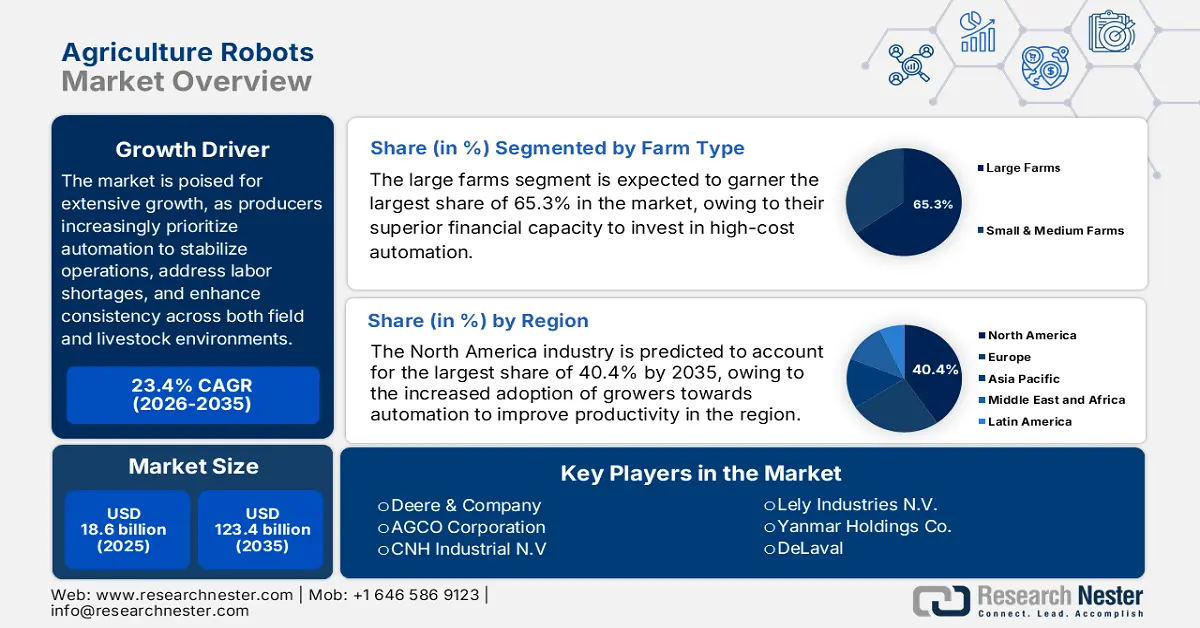
The agriculture robots market is poised for extensive growth in the upcoming years since producers increasingly prioritize automation to stabilize operations, address labor shortages, and enhance consistency across field and livestock environments. In this regard, the U.K. government in September 2023 announced that it is investing £12.5 million (USD 16.5 million) in robotics and automation projects to enhance sustainable farming, improve productivity, and support food security. It also mentioned that the amount was funded through the farming futures automation and robotics competition, initiatives that include robotic systems. Furthermore, these efforts are part of the wider £270 million (USD 356 million) farming innovation programme, which aims to drive agri-tech innovation and support long-term growth in the international agriculture robots industry.
On the supply chain aspect, robotics vendors are strengthening partnerships with OEMs, component suppliers, and farm-management platforms to expand production capabilities as well as to reduce deployment timelines. For instance, in April 2024, the U.S. NSF and USDA NIFA announced that they entered into a partnership with a prime focus on advancing agricultural robotics through foundational research, aiming to revolutionize farming practices and promote sustainability. The article also mentioned that this collaboration is looking for interdisciplinary proposals to develop robots that enhance productivity, reduce environmental impact, and support precision agriculture as well. In addition to this, the initiative aims to deliver innovative solutions that benefit farmers, consumers, and the environment, prompting a profitable business environment for the market.
Key Agriculture Robots Market Insights Summary:
Regional Highlights:
- By 2035, North America is anticipated to secure a 40.4% share in the agriculture robots market, supported by growers’ accelerating shift toward automation to address labor shortages and enhance large-scale farm productivity.
- Asia Pacific is set to emerge as the fastest-growing region through 2026-2035 as adoption rises across diverse farming systems, propelled by rapid technological integration and increasing demand for high-efficiency food production.
Segment Insights:
- By 2035, the large farms segment is projected to command a 65.3% share in the agriculture robots market, underpinned by their stronger capital capacity to invest in automation and achieve ROI through yield optimization.
- The unmanned aerial vehicles segment is forecast to attain a 40.6% revenue share by 2035, bolstered by their versatility and rapid ROI in precision agriculture operations.
Key Growth Trends:
- Labor shortages & cost reduction
- Precision agriculture & yield optimization
Major Challenges:
- High initial investment and cost of adoption
- Technological complexity and skill gap
Key Players: Deere & Company - U.S., AGCO Corporation - U.S., CNH Industrial N.V. - Netherlands, Lely Industries N.V. - Netherlands, Yanmar Holdings Co. - Japan, DeLaval - Sweden, BouMatic Robotics (BouMatic) - Canada / U.S., AG EAGLE Aerial Systems - U.S., Trimble Inc. - U.S., Blue River Technology - U.S., Harvest Automation - U.S., Harvest CROO Robotics - U.S., Naïo Technologies - France, Ecorobotix - Switzerland, AgroIntelli (ROBOTTI) - Denmark.
Global Agriculture Robots Market Forecast and Regional Outlook:
Market Size & Growth Projections:
- 2025 Market Size: USD 18.6 billion
- 2026 Market Size: USD 22.9 billion
- Projected Market Size: USD 123.4 billion by 2035
- Growth Forecasts: 23.4% CAGR (2026-2035)
Key Regional Dynamics:
- Largest Region: North America (40.4% Share by 2035)
- Fastest Growing Region: Asia Pacific
- Dominating Countries: United States, China, Japan, Germany, France
- Emerging Countries: India, Brazil, Australia, South Korea, Netherlands
Last updated on : 26 November, 2025
Agriculture Robots Market - Growth Drivers and Challenges
Growth Drivers
- Labor shortages & cost reduction: This is the primary growth driver for the agriculture robots market since the worldwide agriculture sector is facing extreme labor shortages influenced by urban migration, aging farmer populations, as well as rising labor costs. In March 2025 EU funded an AgRibot project, which was backed by a €4.97 million (USD 5.8 million) grant and aims to tackle Europe’s agricultural labor shortages as well as sustainability challenges by deploying six advanced robotic systems across multiple countries. It also underscored that these robots perform tasks such as weed identification, precision spraying, orchard harvesting, and robotic pruning, while AR/XR tools provide real-time support and immersive farmer training. Furthermore, these are powered by machine vision and explainable AI. AgRibot’s technologies significantly reduce chemical use up to 85% in potato crops and optimize resources through precision fertilization and monitoring, hence contributing to market growth.
- Precision agriculture & yield optimization: Precision agriculture focuses on applying inputs such as water, fertilizers, and pesticides exactly where and when needed to maximize yield and efficiency, prompting a profitable business environment for the market. In this regard EU Cap Network in March 2025 stated that the 2023 GALIRUMI Horizon project developed herbicide-free weed-control robots for dairy farms, utilizing the EU’s Galileo satellite system to accurately detect and target broad-leaved dock weeds. It also stated that by automating this extremely labor-intensive task, the robots help farmers reduce the manual workloads and lower expenses. Furthermore, this initiative showcases how robotics and AI are transforming the agricultural sector with innovations and efficient operations that boost productivity and allow farmers to focus on higher-value work.
- Sustainability & environmental regulations: The existence of global concerns about climate change, water scarcity, and excessive chemical utilization is encouraging the agriculture sector towards sustainable practices, allowing the agriculture robots market expansion. On the other hand, governing bodies are implementing regulations to reduce pesticide runoff, optimize water usage, and lower greenhouse gas emissions. In April 2025, the U.S. Environmental Protection Agency reported that it updated the 2025 mitigation menu, which outlines mandatory runoff, erosion, and spray-drift reduction practices that farmers must follow when applying certain pesticides. In this regard, EPA directs growers to use measures such as vegetative buffers, conservation tillage, reduced application rates, and water-management systems to limit chemical movement into ecosystems. The agency also introduced the pesticide app for label mitigations in 2025 to help applicators calculate required mitigation points and comply with new environmental protections.
Key Developments and Market Opportunities in Agricultural Robotics and Smart Farming (2023-2025)
|
Year |
Organization / Initiative |
Market Opportunity |
Description |
|
2025 |
Doosan Robotics & Daedong |
Agricultural field robots & on-device AI |
Joint development of Mobile Manipulator (MoMa) for smart farms, global expansion |
|
2024 |
ICAR / Ministry of Agriculture & Farmers Welfare (India) |
AI, robotics, drones, sensor tech for agriculture |
Adoption of smart farm technologies, including drones, AI-enabled harvesters, and IoT monitoring systems |
|
2023-2026 |
Govt of India - Namo Drone Didi / Kisan Drones |
Drone services & women-led SHGs in agriculture |
Financial support for drone adoption in farming, distributed to 15,000 SHGs |
Source: Official Press Releases
Challenges
- High initial investment and cost of adoption: The market faces severe challenges in terms of huge initial investments, where the cost of these robots, including autonomous tractors, robotic harvesters, and drone systems, can be restrictive for manufacturers from price sensitive regions. Along with the initial purchase, the costs such as maintenance, software updates, and training add to these costs. This high cost of adoption ultimately slows widespread deployment, particularly in developing countries where capital resources are limited. Therefore, most farmers consider robotics as a long-term investment that gives uncertain immediate returns, thereby creating hesitation in adoption. Until production costs decrease and financing options become more accessible, the affordability factor poses a major obstacle to the growth of the market.
- Technological complexity and skill gap: This is yet another factor that has slowed growth in the agriculture robots market. These robots are dependent on technologies such as AI, machine learning, IoT, and computer vision, which necessitate specialized knowledge for operation, maintenance, as well as troubleshooting. In this context, farmers in most regions do not have the technical skills to effectively use and manage robotic systems, which can reduce operational efficiency and limit adoption in this field. On the other hand, training programs and technical support infrastructure are constrained, especially in terms of, rural or developing areas. Additionally, integrating robots with existing farm operations and equipment can be complex, making it challenging for market expansion.
Agriculture Robots Market Size and Forecast:
| Report Attribute | Details |
|---|---|
|
Base Year |
2025 |
|
Forecast Year |
2026-2035 |
|
CAGR |
23.4% |
|
Base Year Market Size (2025) |
USD 18.6 billion |
|
Forecast Year Market Size (2035) |
USD 123.4 billion |
|
Regional Scope |
|
Agriculture Robots Market Segmentation:
Farm Type Segment Analysis
By the conclusion of forecast duration large farms segment is expected to garner the largest share of 65.3% in the market, owing to their superior financial capacity to invest in high-cost automation. The sub-type also faces acute labor shortages and has the scale to achieve a return on investment through significant labor savings and yield optimization. On the other hand, these larger farms are recognized to be the primary adopters of capital-intensive technologies since they can spread costs over more units of production, thereby enhancing profitability in this field. Moreover, government incentives and subsidies in regions such as North America and Europe are encouraging large-scale farms to adopt robotic solutions. In addition, advances in terms of AI and IoT integration also make these technologies more efficient and easier to manage across vast acreages. Furthermore, the emergence of sustainability and precision agriculture has become central to competitive farming, whereas these large farms are poised to lead the deployment of next-generation agricultural robots.
Product Type Segment Analysis
The unmanned aerial vehicles, in terms of product type segment, are expected to attain a significant revenue share of 40.6% in the agriculture robots market by the end of 2035. Their versatility, along with rapid ROI, is the key factor solidifying this leadership. These play a pivotal role in precision agriculture, enabling efficient crop scouting, health assessment, and data-driven spraying, positioning them at the forefront of revenue generation in this field. XAG announced that it showcased its P150 max agricultural drone along with an R series agricultural rover at the Agritechnica 2025, bringing out its advanced robotics and AI-driven precision farming solutions. The company also mentioned that this drone offers extremely high-payload autonomous spraying, seeding, and logistics capabilities with AI-powered field mapping, whereas the R series rover enables efficient ground operations in both orchards and greenhouses.
Application Segment Analysis
In terms of the application harvesting & picking segment is likely to acquire a share of 28.4% in the agriculture robots market throughout the discussed timeframe. The growth of this segment is highly subject to the critical nature of its labor challenge. Seasonal harvests are extremely vulnerable to labor shortages as well as rising wage costs, where these robots provide a reliable solution to prevent crop spoilage and ensure timely picking, which directly preserves revenue. In September 2025, Washington State University reported that its researchers had developed a robotic harvester that is capable of picking hidden strawberries using an AI vision system, soft silicone grippers, and a fan that moves leaves aside. It further underlined that tests showed the system improved picking efficiency from 58% to 74%, demonstrating potential to supplement human labor in open-field conditions. In addition, this robot uses 3D imaging and machine learning to locate fruit, calculate optimal gripper movements, and could be adapted for other occluded crops like grapes, addressing labor shortages strawberry industry.
Our in-depth analysis of the market includes the following segments:
|
Segment |
Subsegments |
|
Farm Type |
|
|
Product Type |
|
|
Application |
|
|
Offering |
|
|
Automation |
|

Vishnu Nair
Head - Global Business DevelopmentCustomize this report to your requirements — connect with our consultant for personalized insights and options.
Agriculture Robots Market - Regional Analysis
North America Market Insights
Within the conclusion of forecasted duration, North America is expected to capture the largest revenue share of 40.4% in the agriculture robots market. This dominance is effectively attributable to increased adoption of growers towards automation to improve productivity, address labor shortages, and manage large-scale farming operations. The adoption in this region is also supported by strong digital infrastructure, widespread use of GPS-guided farm machinery, as well as ongoing AI integrations and machine vision. In September 2024, Kubota North America Corporation announced that it had acquired U.S.-based AgTech startup Bloomfield Robotics, Inc., which provides specialty crop monitoring services using AI and image analysis to predict optimal harvest timing and yield. Bloomfield’s cameras, mounted on tractors, capture detailed plant-level images for continuous analysis, which enables farmers to optimize labor, resource allocation, and harvest efficiency, hence strengthening the firm’s capability in specialty crop digitization and automation to enhance operational efficiency and crop quality.
The U.S. is considered to be the frontrunner in the regional agriculture robots market, wherein these robots are becoming extremely essential since farms scale up and seek technology that ensures precision along with efficiency. Universities, national laboratories, and private manufacturers are readily making investments in robotic R&D with strong support from digital farming platforms. In May 2025, the University of Georgia announced that its precision horticulture lab won the 2025 farm robotics challenge innovation award for developing a fully automated spraying drone platform controlled through a cell phone. This event was sponsored by Farm-ng, Western Growers, Google.org, and others, which highlighted the exclusive agricultural robotics and the growing integration of drones and ground-based robots in precision farming, hence suitable for overall market growth.
Producers in Canada are increasingly emphasizing innovation to manage vast farmland, shorter growing seasons, and intensive crop management needs are contributing to the country’s market expansion. In June 2024, the country’s government announced that its Agriculture and Agri-Food Canada is supporting B.C. farmers through the on-farm technology adoption program, which allows them to adopt automation, robotics, and advanced growing, packing, and storage solutions to boost productivity and food security. On the other hand, farms such as Van Eekelen Enterprises and Sandhar Farms are using robotic weeders and fruit-picking platforms to reduce labor costs, whereas Camirlaney Farms upgraded potato storage with digital sensors for better crop preservation. Furthermore, this was funded through the Sustainable Canadian Agricultural Partnership, a program that provides up to USD 150,000 per farm, helping British Columbia’s agricultural sector innovate, thereby strengthening local food supply chains.
APAC Market Insights
Asia Pacific is identified as the fastest-growing region in the agriculture robots market, shaped by various factors such as diverse farming systems, rapid technological adoption, and a heightened demand to meet food production needs. Countries in the region are integrating these robots for crop monitoring, targeted spraying, rice-field automation, orchard management, and indoor farming. Simultaneously growing urbanization, evolving farm sizes, and increasing digitalization are also readily driving interest in robotics that improve accuracy and reduce manual dependency. Most of the regional startups, as well as global manufacturers, are partnering with research institutions to develop autonomous platforms that are suitable for humid climates, small plots, and intensive cultivation. Furthermore, robotics also plays a crucial role in greenhouse operations, hydroponics, and high-value fruit production, helping farmers achieve higher consistency and improved crop quality, hence indicating a positive market outlook.
China’s agriculture robots market is expanding very quickly as the country modernizes farming practices and accelerates the development of smart agriculture. The country also benefits from strong government support, extensive R&D programs, and rapid AI innovation encourage domestic manufacturing and large-scale application. As per an article published by the People’s Republic of China in March 2025, the country is embracing AI-powered agriculture to modernize farming and boost rural revitalization, wherein smart robots and AI systems, such as DeepSeek, help farmers monitor crops, identify pests with over 80% accuracy, and optimize planting decisions. It also mentioned that cities such as Maoming are deploying IoT sensors, 5G connectivity, and AI assistants to provide real-time data on soil, weather, and crop health, enabling precision farming and timely interventions.
India’s agriculture robots market is emerging at an extensive pace as farms seek technology that enhances productivity by meeting the needs of fragmented landholdings and labor-intensive practices. Also, the rise of agritech startups, accessible digital tools, and growing government support are encouraging the adoption of low-cost and adaptable robotic solutions. In June 2025, the Maharashtra Cabinet approved the MahaAgri-AI 2025-29 policy to transform the state’s agriculture sector using AI, generative AI, drones, robotics, computer vision, and predictive analytics, supporting initiatives such as AgriStack, Maha-Agritech, Mahavedh, CropSAPP, and digital farming schools. It also mentioned that the policy includes expanding weather-based agricultural advisory services through automated weather stations under the Mahavedh project, ensuring accurate, localized information at the gram panchayat level, hence making it suitable for overall market growth.
Europe Market Insights
Europe has a strong scope in the market, which benefits from strong innovation ecosystems, sustainability targets, as well as investment in digital agriculture. Policies in the region are encouraging reduced chemical use and improved environmental performance, which contribute to greater interest in autonomous technologies. The region also benefits from a strong network of universities, startups, and manufacturers who are collaborating on advanced robotic systems. In March 2025, Hexagon announced the launch of a dedicated robotics division, which aims to accelerate next-generation autonomy, leveraging its expertise in AI, spatial intelligence, and measurement technologies for industrial applications across sectors such as manufacturing, automotive, aviation, energy, warehousing, and logistics. It then underscored that the division aims to develop autonomous systems that enhance efficiency and complement workforce challenges, using digital twins, AI, and advanced sensors to enable robots to navigate complex environments.
Germany gained huge exposure in the regional agriculture robots market, efficiently backed by advanced engineering capabilities, strong research institutions, and widespread adoption of snart farming technologies. The country also benefits from a well-developed digital infrastructure that supports the integration of AI-driven machinery, real-time monitoring tools, and sensor-based management systems. In November 2023, Organifarms announced that it had partnered with the EBZ Group, with a prime focus on scaling its strawberry-harvesting robots, combining Organifarms’ AI-driven automation with EBZ’s expertise in production systems. Therefore, the collaboration will help the company to expand into new markets, industrialize production, and address labor shortages for farmers, whereas EBZ gains a technological edge in robotics innovation. It is noted that their robot, BERRY, automates harvesting, quality control, and packing, enabling year-round operation, hence allowing a steady cash influx in the market.
The U.K. is one of the central players in the regional market, which is advancing through the presence of strong innovation hubs, agri tech incubators, and heightened demand for automation. The country has a thriving research landscape with strong governing support, which accelerates the development of lightweight, AI-powered systems that are designed for row crops, horticulture, and specialty produce. According to an article published by IAGRE in July 2023, the BSI has published a new code of practice called BS 8646:2023 to support the safe and effective use of autonomous mobile machinery, which also includes crop robots, in agriculture and horticulture, helping farmers address labor shortages and improve sustainable food production. The guidance covers safety, risk management, training, farm planning, and emergency preparedness, promoting wider adoption of AMM, especially among smaller farms.

Key Agriculture Robots Market Players:
- Deere & Company - U.S.
- Company Overview
- Business Strategy
- Key Product Offerings
- Financial Performance
- Key Performance Indicators
- Risk Analysis
- Recent Development
- Regional Presence
- SWOT Analysis
- AGCO Corporation - U.S.
- CNH Industrial N.V. - Netherlands
- Lely Industries N.V. - Netherlands
- Yanmar Holdings Co. - Japan
- DeLaval - Sweden
- BouMatic Robotics (BouMatic) - Canada / U.S.
- AG EAGLE Aerial Systems - U.S.
- Trimble Inc. - U.S.
- Blue River Technology - U.S.
- Harvest Automation - U.S.
- Harvest CROO Robotics - U.S.
- Naïo Technologies - France
- Ecorobotix - Switzerland
- AgroIntelli (ROBOTTI) - Denmark
- Deere & Company is a global machinery behemoth that is leading the agricultural robotics area through deep integration of AI, autonomy, and connectivity. The company’s latest advancements include autonomy-ready tractors such as the 9RX, see & spray AI sprayers, and computer‑vision systems. It is readily making investments through acquisitions and in-house R&D to scale autonomous operations and retrofit existing equipment, solidifying the company’s dominance in this sector.
- AGCO Corporation is strengthening its robotics portfolio by leveraging its well-known brands such as Fendt and Massey Ferguson, delivering modular driverless tractors, smart harvesters, and precision farming tools. The company’s strategy focuses on flexibility, interoperability across mixed fleets, and ecosystem partnerships to make robotics accessible to various types of farming operations.
- CNH Industrial N.V. is based in Europe, which is pushing field automation with AI-enabled sprayers, autonomy, and smart implements through its Case IH and New Holland brands. Its most recent moves include acquiring advanced farm technologies and integrating autonomy with machine vision, which positions the company as the frontrunner in this sector.
- Lely Industries N.V. is identified as one of the major pioneers in dairy robotics, especially automated milking systems. Also, its long-standing expertise in terms of livestock automation, robotic milking, and herd monitoring gives it a strong competitive niche, particularly in mature dairy markets, allowing it to capture the interest of a wider audience group.
- Blue River Technology is acquired by John Deere, and is a key innovator in AI-driven agriculture robotics. It leverages a product called see & spray technology, which uses computer vision to distinguish weeds from crops and target herbicide application very precisely. Therefore, this reduces chemical use, operational costs, and environmental impact, hence allowing for efficient operation in this field.
Below is the list of some prominent players operating in the global market:
The agriculture robots market is effectively dominated by large machinery manufacturers such as John Deere, AGCO, and CNH Industrial, alongside tech firms such as Blue River Technology and Harvest CROO Robotics. These leading pioneers are leveraging strengths in precision agriculture, AI, and autonomous vehicles to address labor shortages as well as sustainability. In February 2025, Yamaha Motor announced that it had established Yamaha Agriculture, Inc. in the U.S., consolidating its acquisitions of New Zealand’s robotics plus and Australia’s The Yield to deliver precision agriculture solutions. By integrating Robotics Plus’ automation and UGV technologies with The Yield’s AI-driven analytics, the company is aiming to enhance productivity, reduce input costs, and support sustainable farming for specialty crops across North America, Australia, and New Zealand. Hence, this strategic move aligns with Yamaha Motor’s 2030 vision of advancing robotics and expanding agriculture as a key growth area, denoting a positive market outlook.
Corporate Landscape of the Market:
Recent Developments
- In September 2025, Hyundai Motor and Kia announced that they had signed an MoU with Korea’s rural development administration to introduce their wearable robot, the X-ble Shoulder, to farming environments, which focuses on improving farmers’ health, safety, and efficiency by supporting physically demanding tasks.
- In October 2024, FarmDroid announced that it had secured a €10.5 million (USD 12.2 million) investment, led by venture capital with support from EIFO and Navus Ventures, to accelerate its global expansion of autonomous, solar-powered agricultural robots.
- Report ID: 365
- Published Date: Nov 26, 2025
- Report Format: PDF, PPT
- Explore a preview of key market trends and insights
- Review sample data tables and segment breakdowns
- Experience the quality of our visual data representations
- Evaluate our report structure and research methodology
- Get a glimpse of competitive landscape analysis
- Understand how regional forecasts are presented
- Assess the depth of company profiling and benchmarking
- Preview how actionable insights can support your strategy
Explore real data and analysis
Frequently Asked Questions (FAQ)
About this Report
Connect with our Expert


Report, 2026-2035



Copyright @ 2026 Research Nester. All Rights Reserved.
