Advanced Insulation Material Market Outlook:
Advanced Insulation Material Market size was valued at USD 10.1 billion in 2025 and is expected to reach USD 21.2 billion by the end of 2035, growing at around 7.7% CAGR during the forecast period, i.e., 2026-2035. In 2026, the industry size of advanced insulation material is estimated at USD 10.8 billion.
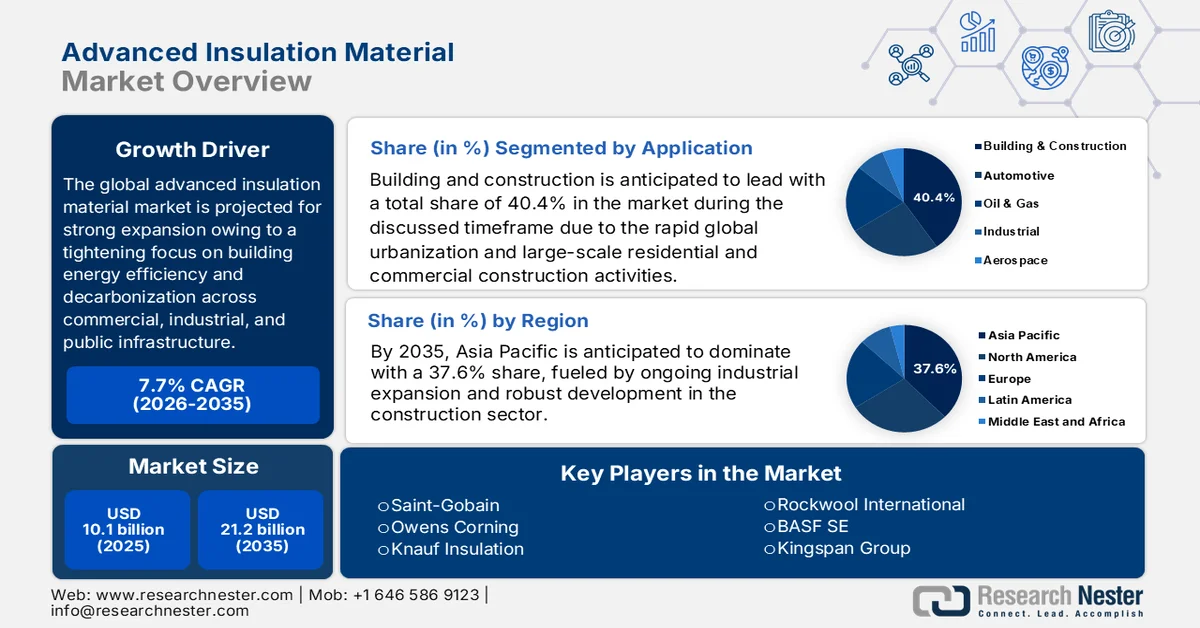
The tightening focus on building energy efficiency and decarbonization across commercial, industrial, and public infrastructure is the key factor propelling the growth of the advanced insulation material market globally. In addition, the rising adoption of high-performance insulation solutions across various sectors is also supporting market expansion. In this context, the article published by the International Energy Agency in 2025 reported that global energy demand reached over 450 EJ in 2024, wherein buildings accounted for about 30% and driving 20% of the growth over the past few years. In advanced economies, most residential energy use comes from space and water heating, whereas in emerging economies, demand is rising for space cooling due to hotter summers and growing incomes. It also mentioned some of the key measures, which include scaling up retrofits and heat pump deployment in advanced economies, along with efficient new buildings, thus positively benefiting the market’s expansion.
Furthermore, the technological advancements in insulation materials, which include lightweight, durable, and environmentally friendly products, are enhancing their applicability across diverse industries, benefiting the overall advanced insulation material market. In April 2025, Armacell introduced ArmaGel XGC, which is a next-generation cryogenic and dual-temperature aerogel insulation blanket, especially designed for industrial and energy applications. It is manufactured in China and India, and it delivers exceptional thermal performance down to -196°C and complies with ASTM C1728 Type I and IV standards. Hence, such instances denote the prominence of lightweight insulation solutions in expanding industrial applications and strengthening demand for advanced insulation materials across global end use sectors.
Key Advanced Insulation Material Market Insights Summary:
Regional Highlights:
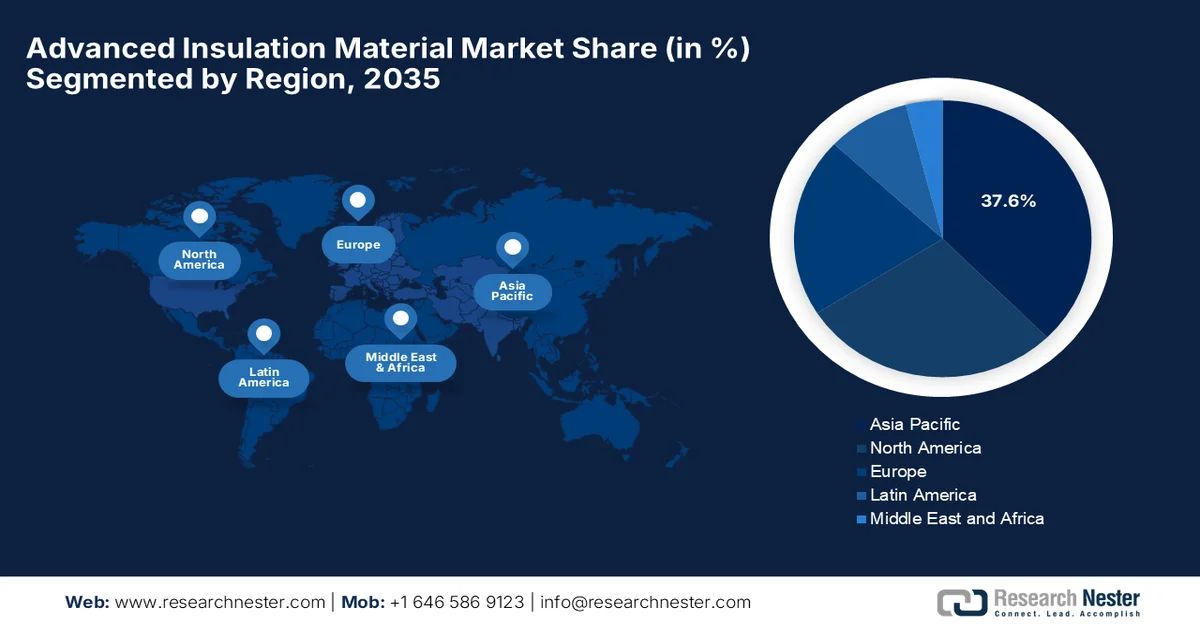
- Asia Pacific advanced insulation material market is projected to account for 37.6% share by 2035, bolstered by rapid industrialization, strong growth in the construction sector, expanding manufacturing activity, and increasing investments in energy-efficient infrastructure
- North America is poised for significant growth in the market throughout 2026-2035, stimulated by net-zero building codes and extensive green building retrofitting initiatives
Segment Insights:
- Building and construction is anticipated to capture 40.4% of the advanced insulation material market by 2035, underpinned by rapid global urbanization and large-scale residential and commercial construction activities
- Aerogel is expected to secure a considerable share of the market by 2035, reinforced by its superior thermal performance coupled with ultra-lightweight and space-saving characteristics
Key Growth Trends:
- Urbanization & severe space constraints
- Industrial expansion & extreme applications
Major Challenges:
- Structural limitations & vulnerabilities
- Manufacturing & environmental issues
Key Players: Saint-Gobain (France),Owens Corning (U.S.),Knauf Insulation (Germany),Rockwool International (Denmark),BASF SE (Germany),Kingspan Group (Ireland),Covestro AG (Germany),Morgan Advanced Materials (UK),3M Company (U.S.),Borealis AG (Austria) ,Armacell (Luxembourg) ,Johns Manville (U.S.).
Global Advanced Insulation Material Market Forecast and Regional Outlook:
Market Size & Growth Projections:
- 2025 Market Size: USD 10.1 billion
- 2026 Market Size: USD 10.8 billion
- Projected Market Size: USD 21.2 billion by 2035
- Growth Forecasts: 7.7% CAGR (2026-2035)
Key Regional Dynamics:
- Largest Region: Asia Pacific (37.6% Share by 2035)
- Fastest Growing Region: North America
- Dominating Countries: United States, China, Germany, Japan, South Korea
- Emerging Countries: India, Brazil, Saudi Arabia, Indonesia, Vietnam
Last updated on : 25 June, 2026
Advanced Insulation Material Market - Growth Drivers and Challenges
Growth Drivers
- Urbanization & severe space constraints: The urban real estate prices have been skyrocketing, due to which developers need to maximize usable indoor floor space. Thick insulation reduces valuable square footage, making ultra-thin vacuum insulation panels highly attractive in these settings. In May 2025, Panasonic showcased its ADVANC-R® vacuum insulation panel at the AIA Conference 2025 in Boston, thereby offering an ultra-high R-Value of 66 in a slim 24mm profile. The company also notes that this solution addresses modern roofing challenges by enabling energy-efficient retrofits and new builds with height restrictions, thus positively benefiting the advanced insulation material market.
- Industrial expansion & extreme applications: The rapid industrial growth requires specialized thermal management under extreme conditions. Besides, the aerospace sector relies on lightweight shields, whereas expanding LNG infrastructure demands cryogenic insulation. In addition, the booming electric vehicle industry utilizes advanced aerogel blankets to prevent battery thermal runaway, thus prompting continued cash inflow in the advanced insulation material market. In May 2023, Cabot Corporation announced the launch of ENTERA™ aerogel particles to serve as advanced thermal barriers for EV lithium-ion batteries. These ultra-light additives are up to 20 times lighter when compared to traditional insulation, providing strong formulation flexibility across blankets, pads, films, foams, and coatings, benefiting the overall market.
Challenges
- Structural limitations & vulnerabilities: Severe physical fragility and a complete lack of site adaptability have been creating immense logistical and structural hurdles for the advanced insulation material market globally. For instance, vacuum insulation panels are entirely dependent on an unbroken outer membrane to maintain their thermal properties. Therefore, if a panel is accidentally punctured by a nail, screw, or handling error during installation, its internal vacuum is lost, destroying its insulation efficiency. These materials possess delicate engineering due to which they cannot be cut, drilled, or resized on an active construction site to fit unexpected gaps, and every unit must be custom-manufactured to exact dimensions beforehand. Any type of minor alignment issues during assembly creates prominent thermal bridges along the seams, affecting the energy-saving performance of the entire structural system.
- Manufacturing & environmental issues: The fabric complexity, coupled with environmental concerns, has resulted in a major challenge for the advanced insulation material market. The production process of these materials needs highly precise technical controls, which limits the number of capable global suppliers and hence caps overall market volume. In addition, the synthesis of certain high-performance variants, such as specific chemical foams and ceramic fibers, releases harmful volatile organic compounds and hazardous greenhouse gases. Apart from this, the end-of-life phase also presents a massive sustainability challenge. Multi-layered advanced composites are incredibly difficult to separate and recycle during building demolition, due to which most materials ending up in landfills.
Advanced Insulation Material Market Size and Forecast:
| Report Attribute | Details |
|---|---|
|
Base Year |
2025 |
|
Forecast Year |
2026-2035 |
|
CAGR |
7.7% |
|
Base Year Market Size (2025) |
USD 10.1 billion |
|
Forecast Year Market Size (2035) |
USD 21.2 billion |
|
Regional Scope |
|
Advanced Insulation Material Market Segmentation:
Application Segment Analysis
Under the application segment, building and construction is anticipated to lead with a total share of 40.4% in the advanced insulation material market during the discussed timeframe. The segment’s leadership is mainly propelled by rapid global urbanization and large-scale residential and commercial construction activities. In addition, the rising focus on net-zero energy buildings and sustainable infrastructure development also strengthens adoption. Based on the government data published in March 2023, the UK government has allocated a total of USD 2.2 billion through the social housing decarbonization fund, home upgrade grant, and public sector decarbonization scheme to improve energy efficiency in homes and public buildings across England. More than 115,000 homes benefited from upgrades such as insulation, new windows, heat pumps, and solar panels, helping households save USD 275 to USD 500 annually on energy bills, thus denoting a wider segment scope.
Material Type Segment Analysis
On the basis of material type, aerogel is expected to grow with a considerable share in the advanced insulation material market by the end of 2035. The growth of the segment is largely attributable to its superior thermal performance coupled with ultra-lightweight and space-saving characteristics, making it highly suitable for applications where conventional insulation materials are insufficient. Apart from this, the rising demand from electric vehicle battery thermal management systems, LNG, and cryogenic infrastructure also accelerates adoption. For instance, in June 2023, Aspen Aerogels inaugurated its Advanced Thermal Barrier Center in Marlborough, MA, which is a 59,000-square-foot engineering and prototyping hub dedicated to advancing PyroThin® cell-to-cell barriers. These ultrathin aerogel-based solutions are especially designed to address thermal runaway in EV and energy storage batteries.
End user Segment Analysis
By the end of the forecast period, the commercial segment in the end user category is predicted to attain a notable share in the advanced insulation material market. The segment’s dominance is largely driven by the strong demand from office buildings, retail complexes, hospitality infrastructure, and institutional facilities. In these settings, advanced insulation is widely adopted to reduce operational energy costs, enhance tenant comfort, and meet increasingly strict environmental and building efficiency regulations. On the other hand, the rapid expansion of commercial real estate development, particularly in emerging economies, along with growing emphasis on green-certified and energy-efficient buildings, has also strengthened its leading position in the overall market structure. For instance, large-scale adoption of high-performance insulation in modern commercial skyscrapers and LEED-certified office developments across different nations reflects the segment’s sustained demand momentum.
Our in-depth analysis of the advanced insulation material market includes the following segments:
|
Segment |
Subsegments |
|
Application |
|
|
Material Type |
|
|
End user |
|

Vishnu Nair
Head - Global Business DevelopmentCustomize this report to your requirements — connect with our consultant for personalized insights and options.
Advanced Insulation Material Market - Regional Analysis
APAC Market Insights
The Asia Pacific advanced insulation material market is anticipated to dominate with a commendable share of 37.6% during the forecast period. The region’s leadership is mainly propelled by rapid industrialization, strong growth in the construction sector, expanding manufacturing activity, and increasing investments in energy-efficient infrastructure. In addition, rising demand for thermal management solutions across automotive, electronics, and oil & gas industries, especially in China, India, Japan, and South Korea, is also accelerating the adoption of advanced insulation materials. In April 2026, the article published by the World Economic Forum revealed that Japan is readily advancing its green materials sector with government-backed innovation to decarbonize buildings, which account for 40% of national emissions. The industry is projected to grow to USD 4.8 billion by 2034, owing to the emergence of solutions such as carbon-sequestering concrete, heat-reflective coatings, and photovoltaic glass, thus making it suitable for standard market growth.
The nation's carbon neutrality mandates, large-scale green building initiatives, along with extensive infrastructure development, are responsible for boosting China advanced insulation material market. Domestically, the roaring electric vehicle ecosystem, substantial data center installations, and certain targeted government-led retrofitting projects are amplifying product demand in the country. Based on the government data published in September 2025, China introduced a two-year plan 2025-2026 to strengthen its building materials industry, targeting the green materials sector to exceed a substantial USD 42.2 billion in revenue by the end of 2026. This plan also promotes industrial cooperation with Belt and Road countries, encourages global adoption of the country’s building materials standards, and expands advanced inorganic non-metallic materials.
In India, the advanced insulation material market is poised for solid growth, propelled by the expansion of infrastructure and commercial real estate and construction sectors, which are increasingly adopting high-performance thermal barriers. The country’s market also benefits from the government’s focus on domestic manufacturing, which has boosted demand for advanced materials. In this context, Press Information Bureau (PIB) in February 2026 revealed that IIT Roorkee transferred its Aerogel Thermal Wraps technology to Indobell Insulations Limited, which is a major step in the Make-in-India initiative. It also mentioned that the lightweight insulation is suitable for aerospace, automobiles, energy systems, and construction, and this collaboration strengthens industry-academia ties, thus supporting scalable deployment of advanced materials.
India Exports of Slag Wool, Rock Wool & Mineral Insulation Materials by Country - 2024 Shipment Value & Quantity
|
Partner Country |
Export Value (USD ‘000) |
Quantity (Kg) |
|
Indonesia |
2,550.72 |
2,251,370 |
|
Japan |
1,660.48 |
897,026 |
|
Singapore |
1,650.97 |
1,290,350 |
|
Qatar |
1,234.05 |
620,689 |
|
Saudi Arabia |
1,117.40 |
317,816 |
|
Vietnam |
803.80 |
778,495 |
|
UAE |
734.05 |
303,058 |
|
Other Asia, nes |
622.89 |
493,000 |
|
Thailand |
549.14 |
315,176 |
|
U.S. |
524.37 |
156,199 |
|
Tanzania |
437.26 |
425,947 |
Source: WITS
North America Market Insights
The North America advanced insulation material market is projected for extensive growth, largely driven by the region’s net-zero building codes and extensive green building retrofitting initiatives. The region also benefits from its massive expansion of deepwater oil exploration, LNG cryogenic export infrastructure, and high-tech data centers, which require sophisticated thermal management solutions like aerogels and vacuum insulation panels. As per an official press release in June 2025 reported that the U.S. National Science Foundation’s structural and architectural engineering and materials program supports fundamental research to enable sustainable buildings and resilient structures. It focuses on innovative materials and systems that reduce lifecycle emissions, improve durability, and enhance energy efficiency. It also mentions the priority areas, which include bio-inspired materials, recycled and low-carbon solutions, and smart systems that are responsive to environmental changes.
The rigorous federal energy efficiency mandates, updating state-level building codes, fuel growth in the U.S. advanced insulation material market. The country’s market also benefits from the massive buildout of high-capacity data centers and semiconductor fabrication plants. The market is supported by substantial federal funding for clean energy infrastructure, domestic material science research, and a well-integrated supply chain of leading chemical and tech innovators. In July 2025, Governor Wes Moore joined Liatris in Rockville to inaugurate the expanded thermal insulation solutions facility, supported by a USD 800,000 Build Our Future grant. This particular project adds 4,000 square feet of lab space, enabling pilot production of advanced insulation products, and it will deliver next-generation insulation such as non-combustible R-5/inch boards and R-10/inch super-insulation mats.
Canada advanced insulation material market is growing on account of certain stringent federal climate plans and extreme sub-zero winter temperatures that necessitate elite thermal performance. The country’s extensive oil and gas extraction operations, expanding liquefied natural gas export infrastructure, and robust mining sector heavily rely on these materials for reliable pipeline and cryogenic equipment insulation in harsh environments. In May 2026, Canada, British Columbia, and LNG Canada signed an enhanced investment co‑operation agreement to advance the proposed Phase 2 expansion, for a potential final investment decision. If approved, this Phase 2 will position Canada among the world’s top five LNG exporters, wherein the emissions are projected 35% lower than the best-performing global facilities and 60% below the average.
Europe Market Insights
The Europe advanced insulation material market is progressing at a rapid pace, catalyzed by the strict energy performance of building directives and the urgent push for full carbon neutrality. The regional developers and municipalities are opting for elite solutions such as vacuum insulation panels and silica aerogels to execute complex deep-renovation projects on historical urban architecture. In addition, the rapid expansion of green hydrogen infrastructure and strict industrial emissions trading schemes further intensifies product adoption. The revised Energy Performance of Buildings Directive, which has been in force since May 2024, aims to achieve a fully decarbonized EU building stock by 2050. It states that buildings are responsible for about 40% of energy use and 35% of emissions, and the directive focuses on renovation, decarbonization, digitalization, and financing, thus making it suitable for standard market growth.
The country's premier automotive manufacturing ecosystem, along with a highly developed machinery, chemical processing, and aerospace sectors, is driving the overall advanced insulation material market in Germany. The country’s market is supported by government subsidies for energy-efficient renovations, a domestic research network which is dedicated to material sciences, and an established supply chain of leading chemical innovators. In November 2025, BASF introduced Cavipor clay foam as a new mineral insulation material, which is now approved for walls, floor slabs, and roofs. This innovative system improves energy-efficient renovation by evenly filling cavities, offering non-flammable, water-repellent yet breathable insulation, thus contributing to the market’s expansion.
In the UK, the advanced insulation material market is projected for explosive growth owing to the strong political emphasis on upgrading old housing infrastructure. The country’s market is supported by rising corporate sustainability commitments and high consumer awareness regarding soaring energy bills, due to which the market continues to transition toward broader commercial and industrial implementation. Based on the government data published in May 2026, the UK’s Great British Insulation Scheme, which ran from March 2023 to March 2026, delivered around 139,200 insulation-related measures across 100,900 homes, mainly focusing on cavity wall and loft insulation to improve energy efficiency. The programme targeted low-income and energy-inefficient households, with a main goal to reduce heating costs and improve thermal performance in older housing stock, thus positively impacting the market’s expansion.
Key Advanced Insulation Material Market Players:
- Saint-Gobain (France)
- Owens Corning (U.S.)
- Knauf Insulation (Germany)
- Rockwool International (Denmark)
- BASF SE (Germany)
- Kingspan Group (Ireland)
- Covestro AG (Germany)
- Morgan Advanced Materials (UK)
- 3M Company (U.S.)
- Borealis AG (Austria)
- Armacell (Luxembourg)
- Johns Manville (U.S.)
- Company Overview
- Business Strategy
- Key Product Offerings
- Financial Performance
- Key Performance Indicators
- Risk Analysis
- Recent Development
- Regional Presence
- SWOT Analysis
- Saint-Gobain has registered itself as one of the world’s leading manufacturers of light and sustainable construction materials, in which insulation solutions form a key part of its portfolio. The company is highly focused on developing high-performance insulation products that improve building energy efficiency, thermal comfort, and acoustic performance.
- Owens Corning benefits from a strong position in insulation products for residential, commercial, and industrial applications. Besides, the firm emphasizes energy efficiency, resource conservation, and lower-carbon building solutions, allowing it to maintain a leading position in this field.
- Knauf Insulation is one of the world's largest insulation manufacturers and a key division of the Knauf Group. The company specializes in terms of glass mineral wool, rock mineral wool, wood wool, and sustainable insulation technologies such as its ECOSE® plant-based binder technology.
- ROCKWOOL International is a foundational player in this sector, which manufactures insulation products derived from volcanic rock. The firm has been operating in more than 35 countries and leverages stone wool's unique properties to address challenges such as noise reduction, fire safety, and carbon emissions reduction.
- BASF SE is a global chemical leader that participates in this industry through innovative insulation products and raw materials, which are used in building construction. The company is best known for insulation solutions such as Styrodur® extruded polystyrene, which is more recognized for its thermal efficiency, moisture resistance, and energy-saving properties.
Here is a list of key players operating in the global advanced insulation material market:
The advanced insulation material market is extremely competitive and moderately consolidated, with the presence of Saint-Gobain, Owens Corning, and Rockwool International. These players are dominating through strong production capabilities and diversified product portfolios. Firms are also focused on developing sustainable and lightweight insulation solutions to meet strict environmental regulations. Strategic initiatives opted by the market participants are mergers and acquisitions, expansion of production facilities, and heavy investment in terms of R&D for advanced aerogel, foam, and fiberglass technologies. In this context, Solvay in June 2023 signed a long-term supply agreement with Zotefoams to provide Solef® PVDF for producing ZOTEK® F aerospace foams. This collaboration enables up to 70% weight savings in aircraft interiors by targeting applications such as ducting, insulation, and environmental control systems.
Corporate Landscape of the Advanced Insulation Material Market:
Recent Developments
- In October 2025, Borealis announced a generous investment of USD 213 million to expand its XLPE production in Stenungsund, Sweden, thereby strengthening supply for medium-, high-, and extra-high voltage cable insulation. This move supports renewable integration and electrification by supporting cleaner materials for critical energy infrastructure.
- In June 2025, Armacell announced the inauguration of a new aerogel insulation plant in India, doubling its manufacturing capacity to meet global demand. The facility produces the ArmaGel XG range, which includes ArmaGel XGH for high temperatures and ArmaGel XGC for cryogenic and dual-temperature applications.
- Report ID: 8633
- Published Date: Jun 25, 2026
- Report Format: PDF, PPT
- Explore a preview of key market trends and insights
- Review sample data tables and segment breakdowns
- Experience the quality of our visual data representations
- Evaluate our report structure and research methodology
- Get a glimpse of competitive landscape analysis
- Understand how regional forecasts are presented
- Assess the depth of company profiling and benchmarking
- Preview how actionable insights can support your strategy
Explore real data and analysis
Frequently Asked Questions (FAQ)
About this Report
Connect with our Expert


Report, 2026-2035



Copyright @ 2026 Research Nester. All Rights Reserved.
